REVIEW 2 major objections 2 minor 179 references
Possibility Frames and Forcing for Modal Logic
T0 review · 2 major / 2 minor · reviewed 2026-08-10 · deepseek-v4-flash
Pith's one-line read Possibility frames built from partial states give a strictly more general normal modal semantics than Kripke frames, characterizing continuum many unimodal logics that are Kripke-frame incomplete.
desk verdict The paper's flagship Kripke-incompleteness example has a load-bearing flaw: under the admissible valuation p = ↓R, the canonical encoding σ_R is empty, so the frame does not validate (Split), and Theorems 2.50–2.51 are not established as written. read the letter →
The pith
A machine-rendered reading of the paper's core claim, the machinery that carries it, and where it could break.
The reading
What carries the argument
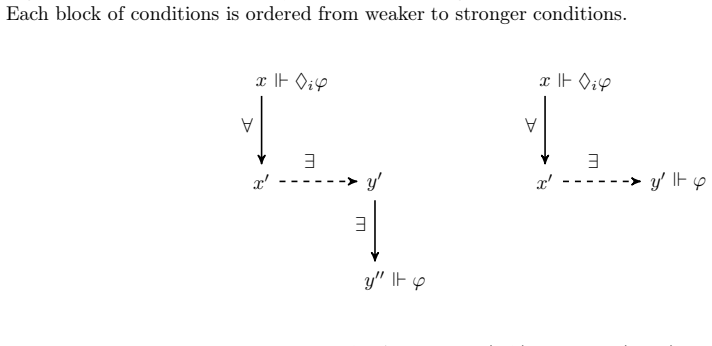
The central object is a possibility frame $\mathcal{F}=\langle S,\sqsubseteq,\{R_i\},P\rangle$, where $S$ is a poset of partial states, each $R_i$ is an accessibility relation, and $P$ is a set of admissible propositions contained in the regular open sets $\mathrm{RO}(S,\sqsubseteq)$. An admissible proposition is persistent—true at a state implies true at all refinements—and refinable—if false at a state, some refinement excludes it in every further refinement; topologically this means $X=\mathrm{int}(\mathrm{cl}(X))$ in the Alexandrov downset topology. Full possibility frames take $P=\mathrm{RO}(S,\sqsubseteq)$, and the condition $R\Leftrightarrow \mathrm{win}$, which says that accessibility is equivalent to a winning strategy in a refinement game, characterizes exactly when this choice is closed under the modal operation $\blacksquare_i$. The argument is carried by duality functors: the algebra of a frame is its regular open algebra with completely additive operators, and the frame of an algebra is its poset of proper filters (or the algebra minus its bottom element), so algebraic constructions translate into relation-on-poset constructions.
What would settle it
Concretely, apply the cited polymodal-to-unimodal reduction to the polymodal frames of the paper's continuum construction and compute whether the resulting unimodal logics remain pairwise distinct and Kripke-incomplete; if any reduced logic is Kripke-complete, or if the continuum many frames collapse to only finitely many reduced logics, then the unimodal theorem fails. A searchable test is whether a formula valid on the reduced unimodal frame would force a first-order condition such as seriality or reflexivity on every Kripke frame validating it, making the reduced logic Kripke-incomplete while still full-possibility-sound.
Extended reading notes
Core claim
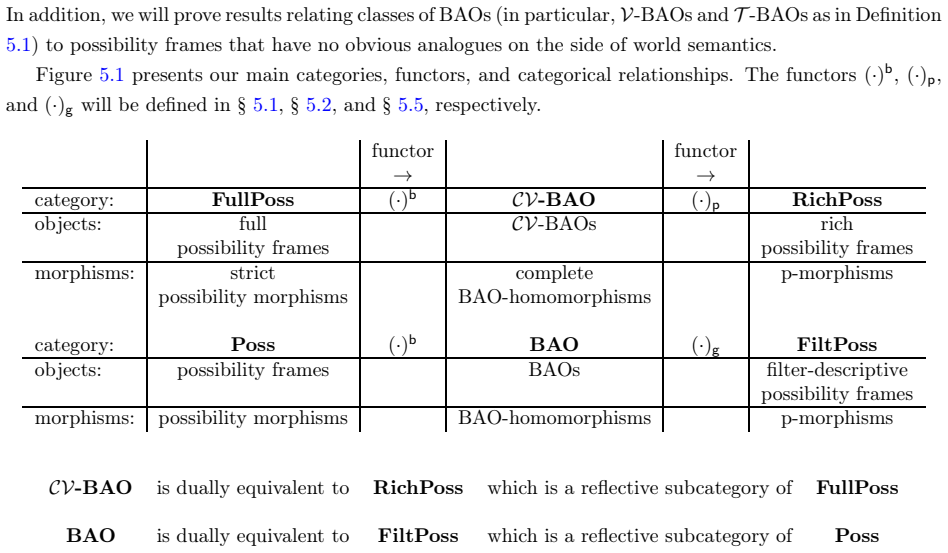
The core discovery is that full possibility frames are to complete, completely additive Boolean algebras with operators (CV-BAOs) what Kripke frames are to the atomic ones: dropping atomicity is exactly what makes the frame semantics broader. On this basis the paper proves that there are continuum many full possibility frames for the polymodal language whose logics are pairwise distinct and Kripke-frame inconsistent, and it states the unimodal analogue: continuum many full possibility frames whose logics are pairwise distinct and Kripke-frame incomplete. The technical heart is a frame-theoretic rendering of an algebraic construction of complete, completely additive BAOs with no atomic members, using a splitting formula that is valid because a partial state can split a proposition into two incompatible refinements, something a single world cannot do. The paper further proves that every normal modal logic is complete with respect to its filter-descriptive possibility frame built from proper filters rather than ultrafilters, a choice-free construction.
Load-bearing premise
The load-bearing premise is that the polymodal-to-unimodal reduction invoked for the unimodal theorem preserves both Kripke-frame incompleteness and characterizability by full possibility frames, a fact the supplied text cites but does not prove.
Editorial extensions
If this is right
- Any logic complete with respect to Kripke frames is automatically complete with respect to full possibility frames, since every Kripke frame is a full possibility frame with a discrete refinement order.
- There are continuum many pairwise distinct normal unimodal logics that are Kripke-frame incomplete yet characterized by full possibility frames, so Kripke incompleteness is not an obstacle to having a frame-based semantics.
- All normal modal logics are sound and complete with respect to filter-descriptive possibility frames, and this completeness is obtained without relying on the ultrafilter axiom.
- Every Sahlqvist logic has an atomless full possibility frame—a frame with no worlds—so the usual completeness guarantees for these logics can be witnessed entirely by partial possibilities.
- The correspondence theory over full possibility frames has analogues of the classical first-order correspondence results, so modal formulas in the usual Sahlqvist form define first-order frame classes in this setting as well.
Reading between the lines
- Inference: If the polymodal-to-unimodal reduction used in the unimodal theorem is as robust as the paper expects, the splitting phenomenon offers a blueprint for turning other Kripke-incomplete logics into full-possibility-complete ones; one could test this by searching for a pure unimodal formula analogous to the polymodal splitting formula.
- Inference: The hierarchy of completeness notions implicit in the paper suggests that the lattice of normal modal logics between the Kripke-complete ones and all normal modal logics may be stratified by which non-atomic algebraic constructions are admitted, giving a concrete order in which to look for separating logics.
- Inference: Because the filter-descriptive representation avoids the ultrafilter axiom, the canonical completeness proof could in principle be formalized in weak set theories, a consequence the paper does not itself draw.
- Inference: The original, more restrictive definition of possibility frames remains an open endpoint: if it is as general as the full frames studied here, the broader regular-open definition is harmless; if not, the choice of frame condition is itself a substantive semantic commitment.
Signed reviews
Editorial analysis
A structured set of objections, weighed in public.
Referee Report
Summary. The paper develops a general semantics for normal modal logics based on partial possibilities rather than total worlds, building on Humberstone's possibility semantics and on connections with weak forcing. It defines possibility frames, studies their model theory (morphisms, special frame classes, interplay conditions between accessibility and refinement), proves duality theorems relating full possibility frames to complete and completely additive BAOs and filter-descriptive frames to all BAOs, and outlines definability and correspondence theory. A central advertised application is the existence of continuum many full possibility frames whose logics are Kripke-frame incomplete, with a concrete polymodal construction in §2.5 and a deferred unimodal version in §7.1.
Significance. If the main results hold, the paper would establish that full possibility frames form a genuinely more general semantics than Kripke frames for normal modal logics, while retaining a well-behaved duality theory. The paper is careful and systematic: it gives explicit first-order conditions for the basic semantic closure properties, provides concrete frame constructions, develops categorical dualities for several classes of frames, and obtains a choice-free filter representation of BAOs. These are valuable contributions independent of the specific incompleteness example. However, the flagship example in §2.5 appears to be incorrect as it stands, and because Theorem 2.50 and the promised Theorem 2.51 rest on it, the advertised completeness claim is not currently established.
major comments (2)
- [§2.5, Lemma 2.46 and Proposition 2.49] The claim that the frame F validates (Split) is false. Consider the admissible valuation π(p) = RO(R) \ {∅}; this set is ↓R in the frame, hence regular open and admissible, and it satisfies ⟦p⟧ ∩ RO(R) = ↓R with O = R. But by (4), σ_R = ∅, and by (5), R⁻ = ∅, which is not an element of S. Under this valuation, for every finite interval (a,b), Lemma 2.47 gives {⟨a,b⟩} ⊩ □⊳p, and since (a,b) can be properly extended to an interval still contained in R, we also have {⟨a,b⟩} ⊩ ♦⊊□⊳p; hence ¬♦⊊□⊳p fails at every singleton. The conjunct ♦+⊤ fails at every regular open, so ⟦α⟧ = ∅, and Lemma 2.46 then gives ⟦♦⊲α⟧ = ∅ rather than ↓R. Thus the consequent of (Split) is false at every state, while the antecedent is true at every state (take y′ = R as the universal Ri-successor). Therefore F does not validate (Split), and Theorem 2.50, which builds on this example, is not established as written.
- [§2.5, Theorem 2.51] The unimodal continuum result is stated with its proof deferred to Section 7 and described as following from Theorem 2.50, the duality theory, and 'known results about polymodal-to-unimodal reduction'. No specific reduction is identified in the material before Section 5, and no preservation statement is given for the two properties that matter: Kripke-frame incompleteness and being characterized by full possibility frames. Even after the polymodal construction in §2.5 is repaired, the unimodal theorem would require explicit preservation lemmas for the cited reduction. As presented, the headline unimodal claim is therefore conditional on facts that are not stated.
minor comments (2)
- [Equation (5) and surrounding text] For a < b, the expression b + |a−b|/2 is strictly greater than b, so the set O⁻ defined in (5) is not a strict subset of O; the text's assertion that 'O⁻ ⊊ O' is false as printed. The intended operation is presumably b − |a−b|/2 (or the midpoint), and the formula should be corrected consistently in (5), Lemma 2.48, and the definition of R+.
- [§2.5, canonical encoding for unbounded O] The notation σ_O in (4) is empty for unbounded regular opens such as O = R, since R contains no maximal open subinterval. The construction should either restrict attention to bounded regular opens or explicitly handle this case; as it stands, the 'shrinking' step is undefined for the admissible proposition ↓R.
Circularity Check
No significant circularity: the paper's main constructions and proofs are explicit and self-contained, and its self-citations are not load-bearing.
full rationale
The central existence result for polymodal possibility frames (Theorem 2.50) is proved by an explicit frame construction in Section 2.5: the frame F is built from regular open subsets of R and nonempty sets of pairs, with explicitly defined accessibility relations R⊲, R⊳, R⊊, and R+, and the formulas α, ϕ, and ψ are then verified by Lemmas 2.46 through 2.48 and Proposition 2.49. The validation of (Split) is derived from the semantics, not assumed as an input. The continuum-many distinct logics in Theorem 2.50 are obtained by disjoint unions with an external continuum family of Kripke frames, and the separating formulas are constructed from that family; this does not presuppose the target Kripke-incompleteness. The first inequality chain involving ML(CAV), ML(CV), and related classes is attributed to Litak 2005a and Holliday and Litak 2019, but those citations are contextual strictness results rather than inputs to the Section 2.5 construction, and they are cited as published external results. The statement after Theorem 2.50 that Theorem 2.51 will use Theorem 2.50, the paper's own duality theory, and known results about polymodal-to-unimodal reduction is a deferred proof, and reliance on an external reduction result would be a completeness or correctness consideration, not circular reasoning. Any alleged failure of the Section 2.5 validation, such as an admissible valuation p = ↓R making σ_R empty, would be a mathematical error in the proof rather than a reduction of the conclusion to its own inputs, so it is outside the circularity score.
Assumptions & free parameters
assumptions (7)
- domain assumption Soundness and completeness of the basic normal modal logic K with respect to Kripke frames, and of intuitionistic modal logic HK with respect to intuitionistic modal frames (Bozic and Dosen 1984).
- standard math Godel-Gentzen double-negation translation for classical propositional logic into intuitionistic propositional logic.
- domain assumption Goldblatt 1974 duality between descriptive world frames and Boolean algebras with operators.
- domain assumption Thomason 1975a duality between Kripke frames and CAV-BAOs.
- domain assumption Strict inclusions ML(CAV) subset ML(CV) subset ML(T) subset ML(V) subset ML(ALG).
- domain assumption Known polymodal-to-unimodal reduction results preserve the relevant frame-completeness and incompleteness properties.
- standard math There exist continuum many Kripke frames for the unimodal language with pairwise distinct modal logics.
Cite this review
Pith. "Pith review of Possibility Frames and Forcing for Modal Logic." pith.science (2026). https://pith.science/paper/CKBWPVLM
@misc{pith2026250111768,
  author       = {Pith},
  title        = {Pith review of: Possibility Frames and Forcing for Modal Logic},
  year         = {2026},
  howpublished = {\url{https://pith.science/paper/CKBWPVLM}},
  note         = {Machine review of arXiv:2501.11768}
}
read the original abstract
This paper develops the model theory of normal modal logics based on partial "possibilities" instead of total "worlds," following Humberstone (1981) instead of Kripke (1963). Possibility semantics can be seen as extending to modal logic the semantics for classical logic used in weak forcing in set theory, or as semanticizing a negative translation of classical modal logic into intuitionistic modal logic. Thus, possibility frames are based on posets with accessibility relations, like intuitionistic modal frames, but with the constraint that the interpretation of every formula is a regular open set in the Alexandrov topology on the poset. The standard world frames for modal logic are the special case of possibility frames wherein the poset is discrete. We develop the beginnings of duality theory, definability/correspondence theory, and completeness theory for possibility frames.
Figures


Figures from the paper (21 more)






Reference graph
Works this paper leans on
-
[1]
Strecker
Ji r \' i Ad\' a mek, Horst Herrlich, and George E. Strecker. Abstract and Concrete Categories: The Joy of Cats. Dover Publications, Mineloa, NY, 2009. Online at http://katmat.math.uni-bremen.de/acc/acc.pdf
2009
-
[2]
Andr\' e ka and I
H. Andr\' e ka and I. N\' e meti. HSP K is equational class, without the axiom of choice . Algebra Universalis, 13 0 (1): 0 164--166, 1981
1981
-
[3]
Ultraproducts of continuous posets
Hajnal Andr\' e ka, Zal\' a n Gyenis, and Istv\' a n N\' e meti. Ultraproducts of continuous posets . Algebra Universalis, 26 0 (2): 0 231--235, 2016
2016
-
[4]
Distributive Lattices
Raymond Balbes and Philip Dwinger. Distributive Lattices. University of Missouri Press, Columbia, 1974
1974
-
[5]
A Note on Modal Formulae and Relational Properties
Johan Benthem van Benthem . A Note on Modal Formulae and Relational Properties . The Journal of Symbolic Logic, 40 0 (1): 0 55--58, 1975
1975
-
[6]
Modal Correspondence Theory
Johan Benthem van Benthem . Modal Correspondence Theory. PhD thesis, University of Amsterdam, 1976 a
1976
-
[7]
Modal Formulas Are Either Elementary or Not -Elementary
Johan Benthem van Benthem . Modal Formulas Are Either Elementary or Not -Elementary . The Journal of Symbolic Logic, 41 0 (2): 0 436--438, 1976 b
1976
-
[8]
Two simple incomplete modal logics
Johan Benthem van Benthem . Two simple incomplete modal logics . Theoria, 44 0 (1): 0 25--37, 1978
1978
Show all 179 references
-
[9]
Syntactic aspects of modal incompleteness theorems
Johan Benthem van Benthem . Syntactic aspects of modal incompleteness theorems . Theoria, 45 0 (2): 0 63--77, 1979 a
1979
-
[10]
Canonical Modal Logics and Ultrafilter Extensions
Johan Benthem van Benthem . Canonical Modal Logics and Ultrafilter Extensions . The Journal of Symbolic Logic, 44 0 (1): 0 1--8, 1979 b
1979
-
[11]
Possible Worlds Semantics for Classical Logic
Johan Benthem van Benthem . Possible Worlds Semantics for Classical Logic . Technical Report ZW-8018, Department of Mathematics, Rijksuniversiteit, Groningen, December 1981
1981
-
[12]
Modal Logic and Classical Logic
Johan Benthem van Benthem . Modal Logic and Classical Logic. Bibliopolis, Milan, 1983
1983
-
[13]
Partiality and Nonmonotonicity in Classical Logic
Johan Benthem van Benthem . Partiality and Nonmonotonicity in Classical Logic . Logique et Analyse, 29: 0 225--247, 1986
1986
-
[14]
A Manual of Intensional Logic
Johan Benthem van Benthem . A Manual of Intensional Logic. CSLI Publications, Stanford, 2nd revised and expanded edition, 1988
1988
-
[15]
Correspondence Theory
Johan Benthem van Benthem . Correspondence Theory . In D.M. Gabbay and F. Guenthner, editors, Handbook of Philosophical Logic, volume 3, pages 325--408. Springer, Dordrecht, 2 edition, 2001
2001
-
[16]
Modal Logic for Open Minds
Johan Benthem van Benthem . Modal Logic for Open Minds. CSLI Publications, Stanford, 2010
2010
-
[17]
Holliday
Johan Benthem van Benthem , Nick Bezhanishvili, and Wesley H. Holliday. A bimodal perspective on possibility semantics. Journal of Logic and Computation, 27 0 (5): 0 1353--1389, 2017
2017
-
[18]
E.W. Beth. Semantic construction of intuitionistic logic. Mededelingen der Koninklijke Nederlandse Akademie van Wetenschappen, 19 0 (11): 0 357--388, 1956
1956
-
[19]
Bezhanishvili and W
G. Bezhanishvili and W. H. Holliday. A semantic hierarchy for intuitionistic logic. Indagationes Mathematicae, 30 0 (3): 0 403--469, 2019. Special issue on ``L.E.J. Brouwer, fifty years later''
2019
-
[20]
Varieties of Monadic Heyting Algebras Part II: Duality Theory
Guram Bezhanishvili. Varieties of Monadic Heyting Algebras Part II: Duality Theory . Studia Logica, 62 0 (1): 0 21--48, 1999
1999
-
[21]
Holliday
Guram Bezhanishvili and Wesley H. Holliday. Locales, Nuclei, and Dragalin Frames . In Lev Beklemishev, St\' e phane Demri, and Andr\' a s M\' a t\' e , editors, Advances in Modal Logic, volume 11, pages 177--196. College Publications, London, 2016
2016
-
[22]
Lattices of intermediate and cylindric modal logics
Nick Bezhanishvili. Lattices of intermediate and cylindric modal logics. PhD thesis, University of Amsterdam, 2006. ILLC Dissertation Series DS-2006-02
2006
-
[23]
On the Structure of Abstract Algebras
Garrett Birkhoff. On the Structure of Abstract Algebras . Proceedings of the Cambridge Philosophical Society, 31 0 (4): 0 433--454, 1935
1935
-
[24]
Lattice Theory, volume 25 of Colloquium Publications
Garrett Birkhoff. Lattice Theory, volume 25 of Colloquium Publications. American Mathematical Society, Providence, Rhode Island, 1967
1967
-
[25]
Modal Logic: A Semantic Perspective
Patrick Blackburn and Johan van Benthem. Modal Logic: A Semantic Perspective . In Patrick Blackburn, Johan van Benthem, and Frank Wolter, editors, Handbook of Modal Logic, pages 1--84. Elsevier, Amsterdam, 2007
2007
-
[26]
Modal Logic
Patrick Blackburn, Maarten de Rijke, and Yde Venema. Modal Logic. Cambridge University Press, New York, 2001
2001
-
[27]
W. J. Blok. An Axiomatization of the Modal Theory of the Veiled Recession Frame . Studia Logica, 38 0 (1): 0 37--47, 1979
1979
-
[28]
W. J. Blok. The Lattice of Modal Logics: An Algebraic Investigation . The Journal of Symbolic Logic, 45 0 (2): 0 221--236, 1980
1980
-
[29]
Compositionality solves Carnap's problem
Denis Bonnay and Dag Westerst hl. Compositionality solves Carnap's problem . Manuscript, 2015
2015
-
[30]
An Incomplete Systems of Modal Logic
George Boolos and Giovanni Sambin. An Incomplete Systems of Modal Logic . Journal of Philosophical Logic, 14 0 (4): 0 351--358, 1985
1985
-
[31]
Models for normal intuitionistic modal logics
Milan Bo z i\' c and Kosta Do s en. Models for normal intuitionistic modal logics. Studia Logica, 43 0 (3): 0 217--245, 1984
1984
-
[32]
Some Properties Related to Compactness in Topological Spaces
Donald Carnahan. Some Properties Related to Compactness in Topological Spaces. PhD thesis, University of Arkansas, 1973
1973
-
[33]
A New Semantics for Positive Modal Logic
Sergio Celani and Ramon Jansana. A New Semantics for Positive Modal Logic . Notre Dame Journal of Formal Logic, 38 0 (1): 0 1--19, 1997
1997
-
[34]
A Closer Look at Some Subintuitionistic Logics
Sergio Celani and Ramon Jansana. A Closer Look at Some Subintuitionistic Logics . Notre Dame Journal of Formal Logic, 42 0 (4): 0 225--255, 2001
2001
-
[35]
Modal Logic
Alexander Chagrov and Michael Zakharyaschev. Modal Logic. Clarendon Press, Oxford, 1997
1997
-
[36]
C. C. Chang and H. Jerome Keisler. Model Theory . Studies in Logic and the Foundations of Mathematics. North-Holland Press, New York, 3rd edition, 1990
1990
-
[37]
Brian F. Chellas. Modal logic: an introduction. Cambridge University Press, New York, 1980
1980
-
[38]
Modalities in the Realm of Questions: Axiomatizing Inquisitive Epistemic Logic
Ivano Ciardelli. Modalities in the Realm of Questions: Axiomatizing Inquisitive Epistemic Logic . In Rajeev Gor\' e , Barteld Kooi, and Agi Kurucz, editors, Advances in Modal Logic, volume 10, pages 94--113. College Publications, London, 2014
2014
-
[39]
Inquisitive Logic
Ivano Ciardelli and Floris Roelofsen. Inquisitive Logic . Journal of Philosophical Logic, 40: 0 55--94, 2011
2011
-
[40]
Inquisitive dynamic epistemic logic
Ivano Ciardelli and Floris Roelofsen. Inquisitive dynamic epistemic logic . Synthese, 192 0 (6): 0 1643--1687, 2015
2015
-
[41]
Inquisitive Semantics: A New Notion of Meaning
Ivano Ciardelli, Jeroen Groenendijk, and Floris Roelofsen. Inquisitive Semantics: A New Notion of Meaning . Language and Linguistics Compass, 7 0 (9): 0 459--476, 2013
2013
-
[42]
On the semantics and logic of declaratives and interrogatives
Ivano Ciardelli, Jeroen Groenendijk, and Floris Roelofsen. On the semantics and logic of declaratives and interrogatives . Synthese, 192 0 (6): 0 1689--1728, 2015
2015
-
[43]
Ciardelli
Ivano A. Ciardelli. Inquisitive semantics and intermediate logics. Master's thesis, University of Amsterdam, 2009. ILLC Master of Logic Thesis Series MoL-2009-11
2009
-
[44]
Ciardelli
Ivano A. Ciardelli. Questions in Logic. PhD thesis, University of Amsterdam, 2016
2016
-
[45]
Paul J. Cohen. Set Theory and the Continuum Hypothesis. W. A. Benjamin, New York, 1966
1966
-
[46]
Constructive Canonicity of Inductive Inequalities
Willem Conradie and Alessandra Palmigiano. Constructive Canonicity of Inductive Inequalities . arXiv:1603.08341 [math.LO], 2016
2016 arXiv
-
[47]
Algebraic modal correspondence: Sahlqvist and beyond
Willem Conradie, Alessandra Palmigiano, and Sumit Sourabh. Algebraic modal correspondence: Sahlqvist and beyond . Journal of Logical and Algebraic Methods in Programming, 91: 0 60--84, 2017
2017
-
[48]
Cresswell
M.J. Cresswell. Possibility Semantics for Intuitionistic Logic . Australasian Journal of Logic, 2: 0 11--29, 2004
2004
-
[49]
Davey and H.A
B.A. Davey and H.A. Priestley. Introduction to Lattices and Order. Cambridge University Press, New York, 2nd edition, 2002
2002
-
[50]
Duality Between Modal Algebras and Neighborhood Frames
Kosta Do s en. Duality Between Modal Algebras and Neighborhood Frames . Studia Logica, 48 0 (2): 0 219--234, 1989
1989
-
[51]
A. G. Dragalin. Mathematical Intuitionism: Introduction to Proof Theory. Translations of Mathematical Monographs. American Mathematical Society, Providence, Rhode Island, 1988
1988
-
[52]
Michael Dunn, Mai Gehrke, and Alessandra Palmigiano
J. Michael Dunn, Mai Gehrke, and Alessandra Palmigiano. Canonical Extensions and Relational Completeness of Some Substructural Logics . The Journal of Symbolic Logic, 70 0 (3): 0 713--740, 2005
2005
-
[53]
The Paradox of Knowability
Dorothy Edgington. The Paradox of Knowability . Mind, 94 0 (376): 0 557--568, 1985
1985
-
[54]
Possible knowledge of unknown truth
Dorothy Edgington. Possible knowledge of unknown truth . Synthese, 173: 0 41--52, 2010
2010
-
[55]
Topological Kripke Models
Leo Esakia. Topological Kripke Models . Soviet Mathematics Doklady, 15 0 (1): 0 147--151, 1974
1974
-
[56]
Propositional Lax Logic
Matt Fairtlough and Michael Mendler. Propositional Lax Logic . Information and Computation, 137 0 (1): 0 1--33, 1997
1997
-
[57]
Feferman
S. Feferman. Some applications of the notions of forcing and generic sets. Fundamenta Mathematicae, 56 0 (3): 0 325--345, 1964
1964
-
[58]
Models for Entailment
Kit Fine. Models for Entailment . Journal of Philosophical Logic, 3 0 (4): 0 347--372, 1974 a
1974
-
[59]
An incomplete logic containing S4
Kit Fine. An incomplete logic containing S4 . Theoria, 60: 0 23--29, 1974 b
1974
-
[60]
Vagueness, Truth and Logic
Kit Fine. Vagueness, Truth and Logic . Synthese, 30 0 (3-4): 0 265--300, 1975 a
1975
-
[61]
Some Connections Between Elementary and Modal Logic
Kit Fine. Some Connections Between Elementary and Modal Logic . In Stig Kanger, editor, Proceedings of the Third Scandinavian Logic Symposium, pages 15--31. North Holland, Amsterdam, 1975 b
1975
-
[62]
An Observation Concerning Porte's Rule in Modal Logic
Rohan French and Lloyd Humberstone. An Observation Concerning Porte's Rule in Modal Logic . Bulletin of the Section of Logic, 44 0 (1/2): 0 25--31, 2015
2015
-
[63]
Pseudo-complements in semi-lattices
Orrin Frink. Pseudo-complements in semi-lattices. Duke Mathematical Journal, 29 0 (4): 0 505--514, 1962
1962
-
[64]
Modal logic
James Garson. Modal logic. In Edward N. Zalta, editor, The Stanford Encyclopedia of Philosophy. Summer 2014 edition, 2014
2014
-
[65]
James W. Garson. What Logics Mean: From Proof Theory to Model-Theoretic Semantics . Cambridge University Press, Cambridge, 2013
2013
-
[66]
Bounded Lattice Expansions
Mai Gehrke and John Harding. Bounded Lattice Expansions . Journal of Algebra, 238 0 (1): 0 345--371, 2001
2001
-
[67]
Priestley
Mai Gehrke and Hilary A. Priestley. Canonical Extensions and Completions of Posets and Lattices . Reports on Mathematical Logic, 43: 0 133--152, 2008
2008
-
[68]
MacNeille Completions and Canonical Extensions
Mai Gehrke, John Harding, and Yde Venema. MacNeille Completions and Canonical Extensions . Transactions of the American Mathematical Society, 358 0 (2): 0 573--590, 2005
2005
-
[69]
U ber das Verh\
Gerhard Gentzen. \" U ber das Verh\" a ltnis zwischen intuitionistischer und klassischer Arithmetik . Mathematische Annalen, 1933
1933
-
[70]
Die Widerspruchsfreiheit der reinen Zahlentheorie
Gerhard Gentzen. Die Widerspruchsfreiheit der reinen Zahlentheorie . Mathematische Annalen, 112: 0 493--565, 1936
1936
-
[71]
U ber das Verh\
Gerhard Gentzen. \" U ber das Verh\" a ltnis zwischen intuitionistischer und klassischer Arithmetik . Archiv f\" u r mathematische Logik und Grundlagenforschung , 16 0 (3): 0 119--132, 1974
1974
-
[72]
An algebraic theory of normal forms
Silvio Ghilardi. An algebraic theory of normal forms . Annals of Pure and Applied Logic, 71: 0 189--245, 1995
1995
-
[73]
Constructive canonicity in non-classical logics
Silvio Ghilardi and Giancarlo Meloni. Constructive canonicity in non-classical logics . Annals of Pure and Applied Logic, 86 0 (1): 0 1--32, 1997
1997
-
[74]
Givant and Y
S. Givant and Y. Venema. The preservation of Sahlqvist equations in completions of Boolean algebras with operators . Algebra Universalis, 41 0 (1): 0 47--84, 1999
1999
-
[75]
Duality Theories for Boolean Algebras with Operators
Steven Givant. Duality Theories for Boolean Algebras with Operators . Springer, New York, 2014
2014
-
[76]
Introduction to Boolean Algebras
Steven Givant and Paul Halmos. Introduction to Boolean Algebras . Springer, New York, 2000
2000
-
[77]
Sur quelques points de la logique de M
Val\` e re Glivenko. Sur quelques points de la logique de M. Brouwe . Bull. Acad. des Sci. de Belgique, 15: 0 183--188, 1929
1929
-
[78]
Zur intuitionistischen arithmetik und zahlentheorie
Kurt G\" o del. Zur intuitionistischen arithmetik und zahlentheorie. Ergebnisse eines Mathematischen Kolloquiums, 4: 0 34--38, 1933
1933
-
[79]
R. I. Goldblatt. First-Order Definability in Modal Logic . The Journal of Symbolic Logic, 40 0 (1): 0 35--40, 1975
1975
-
[80]
R. I. Goldblatt. Metamathematics of Modal Logic, Part I . Reports on Mathematical Logic, 6: 0 41--78, 1976 a
1976
-
[81]
R. I. Goldblatt. Metamathematics of Modal Logic, Part II . Reports on Mathematical Logic, 7: 0 21--52, 1976 b
1976
-
[82]
R. I. Goldblatt and S. K. Thomason. Axiomatic Classes in Propositional Modal Logic . In John N. Crossley, editor, Algebra and Logic, volume 450 of Lecture Notes in Mathematics, pages 163--173. Springer-Verlag, Heidelberg, 1975
1975
-
[83]
Metamathematics of Modal Logic
Robert Goldblatt. Metamathematics of Modal Logic. PhD thesis, Victoria University, Wellington, 1974. Reprinted in Goldblatt 1993
1974
-
[84]
Mathematics of Modality
Robert Goldblatt. Mathematics of Modality. CSLI Publications, Stanford, CA, 1993
1993
-
[85]
Mathematical Modal Logic: A View of Its Evolution
Robert Goldblatt. Mathematical Modal Logic: A View of Its Evolution . In Dov M. Gabbay and John Woods, editors, Handbook of the History of Logic, volume 7, pages 1--98. Elsevier, 2006 a
2006
-
[86]
Maps and Monads for Modal Frames
Robert Goldblatt. Maps and Monads for Modal Frames . Studia Logica, 83 0 (1): 0 309--331, 2006 b
2006
-
[87]
Goldblatt
Robert I. Goldblatt. Grothendieck Topology as Geometric Modality . Zeitschrift f\" u r mathematische Logik und Grundlagen der Mathematik , 27: 0 495--529, 1981
1981
-
[88]
Model Theory of Modal Logic
Valentin Goranko and Martin Otto. Model Theory of Modal Logic . In Patrick Blackburn, Johan van Benthem, and Frank Wolter, editors, Handbook of Modal Logic, pages 249--329. Elsevier, Amsterdam, 2007
2007
-
[89]
Halpern and Azriel L\' e vy
James D. Halpern and Azriel L\' e vy. The Boolean Prime Ideal Theorem Does Not Imply the Axiom of Choice . In Dana S. Scott, editor, Axiomatic Set Theory, volume 13 of Proceedings of Symposia in Pure Mathematics, pages 83--134. American Mathematical Society, Providence, RI, 1971
1971
-
[90]
MacNeille Completions of Modal Algebras
John Harding and Guram Bezhanishvili. MacNeille Completions of Modal Algebras . Houston Journal of Mathematics, 33 0 (2): 0 355--384, 2007
2007
-
[91]
A Representation Theorem for Possibility Models
Matthew Harrison-Trainor. A Representation Theorem for Possibility Models . UC Berkeley Working Paper in Logic and the Methodology of Science, 2017. URL https://escholarship.org/uc/item/881757qn
2017
-
[92]
First-Order Possibility Models and Finitary Completeness Proofs
Matthew Harrison-Trainor. First-Order Possibility Models and Finitary Completeness Proofs . The Review of Symbolic Logic, 12 0 (4): 0 637--662, 2019
2019
-
[93]
The Expressive Power of Modal Dependence Logic
Lauri Hella, Kerkko Luosto, Katsuhiko Sano, and Jonni Virtema. The Expressive Power of Modal Dependence Logic . In Rajeev Gor\' e , Barteld Kooi, and Agi Kurucz, editors, Advances in Modal Logic, volume 10, pages 294--312. College Publications, London, 2014
2014
-
[94]
Holliday
Wesley H. Holliday. Partiality and Adjointness in Modal Logic . In Rajeev Gor\' e , Barteld Kooi, and Agi Kurucz, editors, Advances in Modal Logic, volume 10, pages 313--332. College Publications, London, 2014
2014
-
[95]
Holliday
Wesley H. Holliday. Possibility Frames and Forcing for Modal Logic . UC Berkeley Working Paper in Logic and the Methodology of Science , 2015. URL https://escholarship.org/uc/item/5462j5b6
2015
-
[96]
Holliday
Wesley H. Holliday. Possibility Frames and Forcing for Modal Logic (June 2016) . UC Berkeley Working Paper in Logic and the Methodology of Science , 2016. URL https://escholarship.org/uc/item/9v11r0dq
2016
-
[97]
Holliday
Wesley H. Holliday. Possibility Frames and Forcing for Modal Logic (February 2018) . UC Berkeley Working Paper in Logic and the Methodology of Science , 2018. URL https://escholarship.org/uc/item/0tm6b30q
2018
-
[98]
Holliday
Wesley H. Holliday. Possibility semantics. In Melvin Fitting, editor, Selected Topics from Contemporary Logics, volume 2 of Landscapes in Logic, pages 363--476. College Publications, 2021. URL https://escholarship.org/uc/item/9ts1b228
2021
-
[99]
Holliday
Wesley H. Holliday. Compatibility and accessibility: lattice representations for semantics of non-classical and modal logics. In David Fern\' a ndez Duque, Alessandra Palmigiano, and Sophie Pinchinat, editors, Advances in Modal Logic, Vol. 14, pages 507--529. College Publicati...
2022 arXiv
-
[100]
Holliday
Wesley H. Holliday. A fundamental non-classical logic. Logics, 1: 0 36--79, 2023
2023
-
[101]
Holliday
Wesley H. Holliday. Modal logic, fundamentally. In Agata Ciabattoni, David Gabelaia, and Igor Sedlár, editors, Advances in Modal Logic, Vol. 15, pages 423--446. College Publications, London, 2024. arXiv:2403.14043 [math.LO]
2024 arXiv
-
[102]
Holliday and Tadeusz Litak
Wesley H. Holliday and Tadeusz Litak. Complete additivity and modal incompleteness. The Review of Symbolic Logic, 12 0 (3): 0 487--535, 2019
2019
-
[103]
Holliday and Matthew Mandelkern
Wesley H. Holliday and Matthew Mandelkern. The orthologic of epistemic modals. Journal of Philosophical Logic, 53: 0 831--907, 2024. doi:10.1007/s10992-024-09746-7. arXiv:2203.02872 [cs.LO]
2024 arXiv
-
[104]
Hughes and M.J
G.E. Hughes and M.J. Cresswell. A New Introduction to Modal Logic. Routledge, New York, 1996
1996
-
[105]
From Worlds to Possibilities
Lloyd Humberstone. From Worlds to Possibilities . Journal of Philosophical Logic, 10 0 (3): 0 313--339, 1981
1981
-
[106]
Heterogeneous Logic
Lloyd Humberstone. Heterogeneous Logic . Erkenntnis, 10 0 (3): 0 395--435, 1988
1988
-
[107]
The Connectives
Lloyd Humberstone. The Connectives . MIT Press, Cambridge, Mass., 2011
2011
-
[108]
Supervenience, dependence, disjunction
Lloyd Humberstone. Supervenience, dependence, disjunction. Logic and Logical Philosophy, 28: 0 3--135, 2019
2019
-
[109]
Multiple Forcing
Thomas Jech. Multiple Forcing. Cambridge University Press, Cambridge, 1986
1986
-
[110]
Thomas J. Jech. Set Theory. Springer, New York, 3rd edition, 2002
2002
-
[111]
Thomas J. Jech. The Axiom of Choice. Dover, Mineola, New York, 2008
2008
-
[112]
A Survey of Boolean Algebras with Operators
Bjarni J\' o nnson. A Survey of Boolean Algebras with Operators . In I. G. Rosenberg and G. Sabidussi, editors, Algebras and Orders, pages 239--286. Kluwer Academic Publishers, 1993
1993
-
[113]
Boolean Algebras with Operators
Bjarni J\' o nsson and Alfred Tarski. Boolean Algebras with Operators. Part I. American Journal of Mathematics, 73: 0 891--939, 1951
1951
-
[114]
Boolean Algebras with Operators
Bjarni J\' o nsson and Alfred Tarski. Boolean Algebras with Operators. Part II. American Journal of Mathematics, 74: 0 127--162, 1952
1952
-
[115]
Brouwerian semilattices
Peter K\" o hler. Brouwerian semilattices. Transactions of the American Mathematical Society, 268 0 (1): 0 103--126, 1981
1981
-
[116]
Semantical study of intuitionistic modal logics
Kensuke Kojima. Semantical study of intuitionistic modal logics. PhD thesis, Kyoto University, 2012
2012
-
[117]
Modal Independence Logic
Juha Kontinen, Julian-Steffen M\" u ller, Henning Schnoor, and Heribert Vollmer. Modal Independence Logic . In Rajeev Gor\' e , Barteld Kooi, and Agi Kurucz, editors, Advances in Modal Logic, pages 353--372. College Publications, London, 2014
2014
-
[118]
How Completeness and Correspondence Theory Got Married
Marcus Kracht. How Completeness and Correspondence Theory Got Married . In M. de Rijke, editor, Diamonds and Defaults, pages 175--214. Kluwer Academic Publishers, Dordrecht, 1993
1993
-
[119]
Tools and Techniques in Modal Logic
Marcus Kracht. Tools and Techniques in Modal Logic. Elsevier, 1999
1999
-
[120]
Simulation and Transfer Results in Modal Logic - A Survey
Marcus Kracht and Frank Wolter. Simulation and Transfer Results in Modal Logic - A Survey . Studia Logica, 59: 0 149--177, 1997
1997
-
[121]
Normal Monomodal Logics Can Simulate All Others
Marcus Kracht and Frank Wolter. Normal Monomodal Logics Can Simulate All Others . Journal of Symbolic Logic, 64 0 (1): 0 99--138, 1999
1999
-
[122]
Dynamic topological logic
Philip Kremer and Grigori Mints. Dynamic topological logic. Annals of Pure and Applied Logic, 131: 0 133--158, 2005
2005
-
[123]
Saul A. Kripke. Semantical Analysis of Modal Logic I. Normal Modal Propositional Calculi . Zeitschrift f\" u r Mathematische Logik und Grundlagen der Mathematik , 9: 0 67--96, 1963
1963
-
[124]
Saul A. Kripke. Semantical Analysis of Intuitionistic Logic I . In J.N. Crossley and M.A.E. Dummett, editors, Formal Systems and Recursive Functions, pages 92--130. North-Holland Publishing Company, Amsterdam, 1965
1965
-
[125]
Lemmon and Dana Scott
E.J. Lemmon and Dana Scott. The ``Lemmon Notes'': An Introduction to Modal Logic. Number 11 in American Philosophical Quarterly Monograph Series. Basil Blackwell, Oxford, 1977
1977
-
[126]
On Notions of Completeness Weaker than Kripke Completeness
Tadeusz Litak. On Notions of Completeness Weaker than Kripke Completeness . In Renate Schmidt, Ian Pratt-Hartmann, Mark Reynolds, and Heinrich Wansing, editors, Advances in Modal Logic, volume 5, pages 149--169. College Publications, London, 2005 a
2005
-
[127]
An Algebraic Approach to Incompleteness in Modal Logic
Tadeusz Litak. An Algebraic Approach to Incompleteness in Modal Logic. PhD thesis, Japan Advanced Institute of Science and Technology, 2005 b
2005
-
[128]
Stability of the Blok Theorem
Tadeusz Litak. Stability of the Blok Theorem . Algebra Universalis, 58 0 (4): 0 385--411, 2008
2008
-
[129]
H. M. MacNeille. Partially Ordered Sets . Transactions of the American Mathematical Society, 42: 0 416--460, 1937
1937
-
[130]
A Normal Modal Calculus Between T and S4 without the Finite Model Property
David Makinson. A Normal Modal Calculus Between T and S4 without the Finite Model Property . The Journal of Symbolic Logic, 34 0 (1): 0 35--38, 1969
1969
-
[131]
A generalisation of the concept of a relational model for modal logic
David Makinson. A generalisation of the concept of a relational model for modal logic . Theoria, 36: 0 330--335, 1970
1970
-
[132]
Some Embedding Theorems for Modal Logic
David Makinson. Some Embedding Theorems for Modal Logic . Notre Dame Journal of Formal Logic, 12 0 (2): 0 252--254, 1971
1971
-
[133]
B-frame duality
Guillaume Massas. B-frame duality . Annals of Pure and Applied Logic, 174 0 (5): 0 103245, 2023
2023
-
[134]
Yu. T. Medvedev. Interpretation of the Logical Formulas by Means of Finite Problems . Soviet Mathematics Doklady, 7 0 (1): 0 857--860, 1966
1966
-
[135]
Kripke Incomplete Logics Containing KTB
Yutaka Miyazaki. Kripke Incomplete Logics Containing KTB . Studia Logica, 85: 0 303--317, 2007
2007
-
[136]
Donald Monk
J. Donald Monk. Completions of Boolean Algberas with Operators . Mathematische Nachrichten, 46: 0 47--55, 1970
1970
-
[137]
Universal Grammar
Richard Montague. Universal Grammar . Theoria, 36 0 (3): 0 373--398, 1970
1970
-
[138]
Gregory H. Moore. The Origins of Forcing . In Frank R. Drake and John K. Truss, editors, Logic Colloquium '86, pages 143--173. North Holland, Amsterdam, 1988
1988
-
[139]
William C. Nemitz. Implicative Semi-Lattices . Transactions of the American Mathematical Society, 117: 0 128--142, 1965
1965
-
[140]
Adding dependent choice to the prime ideal theorem
David Pincus. Adding dependent choice to the prime ideal theorem. In R. O. Gandy and J. M. E. Hyland, editors, Logic Colloquium 76, volume 87 of Studies in Logic and the Foundations of Mathematics, pages 547--565. North-Holland, Amsterdam, 1977
1977
-
[141]
David Pincus and Robert M. Solovay. Definability of measures and ultrafilters. The Journal of Symbolic Logic, 42 0 (2): 0 179--190, 1977
1977
-
[142]
First Steps in Modal Logic
Sally Popkorn. First Steps in Modal Logic. Cambridge University Press, New York, 1994
1994
-
[143]
A new semantic framework for Modal Logic
V\' i t Pun c och\' a r . A new semantic framework for Modal Logic . Philosophical Alternatives, 23 0 (6): 0 47--59, 2014
2014
-
[144]
A Generalization of Inquisitive Semantics
V\' i t Pun c och\' a r . A Generalization of Inquisitive Semantics . Journal of Philosophical Logic, 45: 0 399--428, 2016
2016
-
[145]
Algebras of Information States
V\' i t Pun c och\' a r . Algebras of Information States . Journal of Logic and Computation, 27 0 (5): 0 1643--1675, 2017
2017
-
[146]
Subintuitionistic Logics
Greg Restall. Subintuitionistic Logics . Notre Dame Journal of Formal Logic, 35 0 (1): 0 116--129, 1994
1994
-
[147]
An Introduction to Substructural Logics
Greg Restall. An Introduction to Substructural Logics. Routledge, New York, 2000
2000
-
[148]
Intuitionistic Correspondence Theory
Piet Rodenburg. Intuitionistic Correspondence Theory. PhD thesis, University of Amsterdam, 1986
1986
-
[149]
Algebraic foundations for the semantic treatment of inquisitive content
Floris Roelofsen. Algebraic foundations for the semantic treatment of inquisitive content . Synthese, 190: 0 79--102, 2013
2013
-
[150]
On A Neglected Path to Intuitionism
Ian Rumfitt. On A Neglected Path to Intuitionism . Topoi, 31: 0 101--109, 2012
2012
-
[151]
The Boundary Stones of Thought: An Essay in the Philosophy of Logic
Ian Rumfitt. The Boundary Stones of Thought: An Essay in the Philosophy of Logic. Oxford University Press, Oxford, 2015
2015
-
[152]
Completeness and Correspondence in the First and Second Order Semantics for Modal Logic
Henrik Sahlqvist. Completeness and Correspondence in the First and Second Order Semantics for Modal Logic . In Stig Kanger, editor, Proceedings of the Third Scandinavian Logic Symposium, pages 110--143. North Holland, Amsterdam, 1975
1975
-
[153]
Topology and Duality in Modal Logic
Giovanni Sambin and Virginia Vaccaro. Topology and Duality in Modal Logic . Annals of Pure and Applied Logic, 37: 0 249--296, 1988
1988
-
[154]
Advice on modal logic
Dana Scott. Advice on modal logic. In Karel Lambert, editor, Philosophical Problems in Logic: Some Recent Developments, volume 29, pages 143--173. D. Reidel Publishing Company, Dordrecht, 1970
1970
-
[155]
An Essay in Classical Modal Logic, volume 3 of Filosofiska Studier
Krister Segerberg. An Essay in Classical Modal Logic, volume 3 of Filosofiska Studier. Uppsala Universitet, Uppsala, 1971
1971
-
[156]
On the intermediate logic of open subsets of metric spaces
Timofei Shatrov. On the intermediate logic of open subsets of metric spaces. In Carlos Areces and Robert Goldblatt, editors, Advances in Modal Logic, volume 7, pages 305--313. College Publications, London, 2008
2008
-
[157]
Skvortsov
D. Skvortsov. The Logic of Infinite Problems and the Kripke Models on Atomic Semilattices of Sets . Doklady Akademii Nauk SSSR, 245 0 (4): 0 798--801, 1979. Russian
1979
-
[158]
M. H. Stone. The Theory of Representation for Boolean Algebras . Transactions of the American Mathematical Society, 40 0 (1): 0 37--111, 1936
1936
-
[159]
M. H. Stone. Applications of the Theory of Boolean Rings to General Topology . Transactions of the American Mathematical Society, 41 0 (3): 0 375--481, 1937
1937
-
[160]
Gaisi Takeuti and Wilson M. Zaring. Axiomatic Set Theory . Springer-Verlag, New York, 1973
1973
-
[161]
U ber additive und multiplikative Mengenk\
Alfred Tarski. \" U ber additive und multiplikative Mengenk\" o rper und Mengenfunktionen . Sprawozdania z Posiedze\' n Towarzystwa Naukowego Warszawskiego, Wydzia III, Nauk Matematyczno-fizycznych , 30: 0 151--181, 1937 a
1937
-
[162]
Ideale in den Mengenk\" o rpen
Alfred Tarski. Ideale in den Mengenk\" o rpen . Annales de la Soci\' e t\' e Polonaise de Math\' e matique , 15: 0 186--189, 1937 b
1937
-
[163]
Der A ussagenkalku\" u l und die T opologie
Alfred Tarski. Der A ussagenkalku\" u l und die T opologie. Fundamenta Mathematicae, 31 0 (1): 0 103--134, 1938. English translation as Chapter 17 of Tarski1956
1938
-
[164]
Logic, Semantics, Metamathematics: Papers from 1923 to 1938
Alfred Tarski. Logic, Semantics, Metamathematics: Papers from 1923 to 1938. Clarendon Press, Oxford, 1956. Translated by J. H. Woodger
1923
-
[165]
The Importance of Being Discrete
Balder ten Cate and Tadeusz Litak. The Importance of Being Discrete . Technical Report PP-2007-39, Institute for Logic, Language and Computation, University of Amsterdam, 2007
2007
-
[166]
MacNeille completions of lattice expansions
Mark Theunissen and Yde Venema. MacNeille completions of lattice expansions . Algebra Universalis, 57 0 (2): 0 143--193, 2007
2007
-
[167]
S. K. Thomason. Semantic Analysis of Tense Logics . The Journal of Symbolic Logic, 37 0 (1): 0 150--158, 1972
1972
-
[168]
S. K. Thomason. An incompleteness theorem in modal logic . Theoria, 40 0 (1): 0 30--34, 1974 a
1974
-
[169]
S. K. Thomason. Reduction of Tense Logic to Modal Logic I . The Journal of Symbolic Logic, 39 0 (3): 0 549--551, 1974 b
1974
-
[170]
S. K. Thomason. Categories of Frames for Modal Logic . The Journal of Symbolic Logic, 40 0 (3): 0 439--442, 1975 a
1975
-
[171]
S. K. Thomason. Reduction of Tense Logic to Modal Logic II . Theoria, 41 0 (3): 0 154--169, 1975 b
1975
-
[172]
S. K. Thomason. Reduction of Second-Order Logic to Modal Logic . Zeitschrift f\" u r mathematische Logik und Grundlagen der Mathematik , 21 0 (1): 0 107--114, 1975 c
1975
-
[173]
a \" a n\
Jouko V\" a \" a n\" a nen. Modal Dependence Logic . In Krzysztof R. Apt and Robert van Rooij, editors, New Perspectives on Games and Interaction, volume 4 of Texts in Logic and Games, pages 237--254. Amsterdam University Press, Amsterdam, 2008
2008
-
[174]
Atom Structures
Yde Venema. Atom Structures . In Marcus Kracht, Maarten de Rijke, Heinrich Wansing, and Michael Zakharyaschev, editors, Advances in Modal Logic, volume 1, pages 291--305. CSLI Publications, Stanford, CA, 1998
1998
-
[175]
Atomless Varieties
Yde Venema. Atomless Varieties . The Journal of Symbolic Logic, 68 0 (2): 0 607--614, 2003
2003
-
[176]
Algebras and Coalgebras
Yde Venema. Algebras and Coalgebras . In Patrick Blackburn, Johan van Benthem, and Frank Wolter, editors, Handbook of Modal Logic, pages 331--426. Elsevier, Amsterdam, 2007
2007
-
[177]
The relation between intuitionistic and classical modal logics
Frank Wolter and Michael Zakharyaschev. The relation between intuitionistic and classical modal logics . Algebra and Logic, 36 0 (2): 0 73--92, 1997
1997
-
[178]
Intuitionistic Modal Logics as Fragments of Classical Bimodal Logics
Frank Wolter and Michael Zakharyaschev. Intuitionistic Modal Logics as Fragments of Classical Bimodal Logics . In Ewa Orłowska, editor, Logic at Work: Essays Dedicated to the Memory of Helena Rasiowa, pages 168--183. Physica Verlag, Heidelberg, 1999
1999
-
[179]
Results in modal correspondence theory for possibility semantics
Kentar\^ o Yamamoto. Results in modal correspondence theory for possibility semantics . Journal of Logic and Computation, 27 0 (8): 0 2411--2430, 2017. URL https://escholarship.org/uc/item/7t12914n
2017
Reviewed August 10, 2026 · model on record in the stance chip above.
Discussion (0). Continue with ORCID to comment.