REVIEW 3 major objections 7 minor 45 references
Drop impact on a heated pre-wetted wall: deposition-on-crater splash regime
T0 review · 3 major / 7 minor · reviewed 2026-08-12 · deepseek-v4-flash
Pith's one-line read Impact drop deposits on the crater while only the wall film splashes.
desk verdict A genuinely new IR observation with a plausible but under-supported compositional claim; deserves refereeing after the overclaims are trimmed. read the letter →
The pith
A machine-rendered reading of the paper's core claim, the machinery that carries it, and where it could break.
The reading
What carries the argument
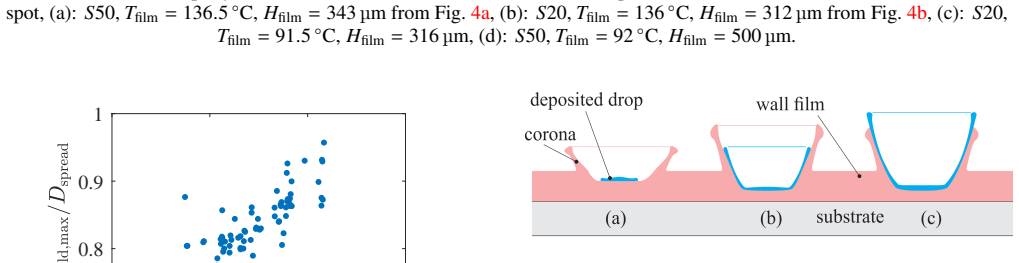
The argument rests on a boundary-layer description of the spreading drop on a thin wall film, combined with a thermal-boundary-layer model for the substrate cooling. The lamella flow is described by a similarity solution with radial velocity $u_r = r/(t+\tau)$ and thickness decaying as $t^{-2}$; the residual thickness of the combined layers is $h_{\mathrm{res}} = A(\delta) D \mathrm{Re}^{-2/5}$, with $A$ built from the film influence parameter $\chi = \delta^{1/5}\omega/[(1+3.86\omega)\kappa^{1/10}]$. From mass balance, the drop's maximum spreading diameter becomes $D_{\mathrm{spread}} \approx 1.1 D \mathrm{Re}^{1/5}$, which is identified with the maximum cold-spot diameter. The matching of $d_{\mathrm{cold,max}}$ to $D_{\mathrm{spread}}$ is the key comparison that assigns the cold spot to the deposited drop rather than to the corona region; because this diameter is much smaller than the corona base, the drop liquid is confined to the crater floor. The thermal delay before substrate cooling appears is modeled by equating the thermal boundary layer thickness $\sqrt{\alpha_{\mathrm{film}} t}/c$ to the evolving film thickness, yielding a validated formula for the delay time.
What would settle it
Repeat a deposition-on-crater impact with a small amount of dye or fluorescent tracer added to the cold drop and inspect the corona and secondary droplets; any tracer signal in either would show that drop material leaves the crater, contradicting the regime.
Extended reading notes
Core claim
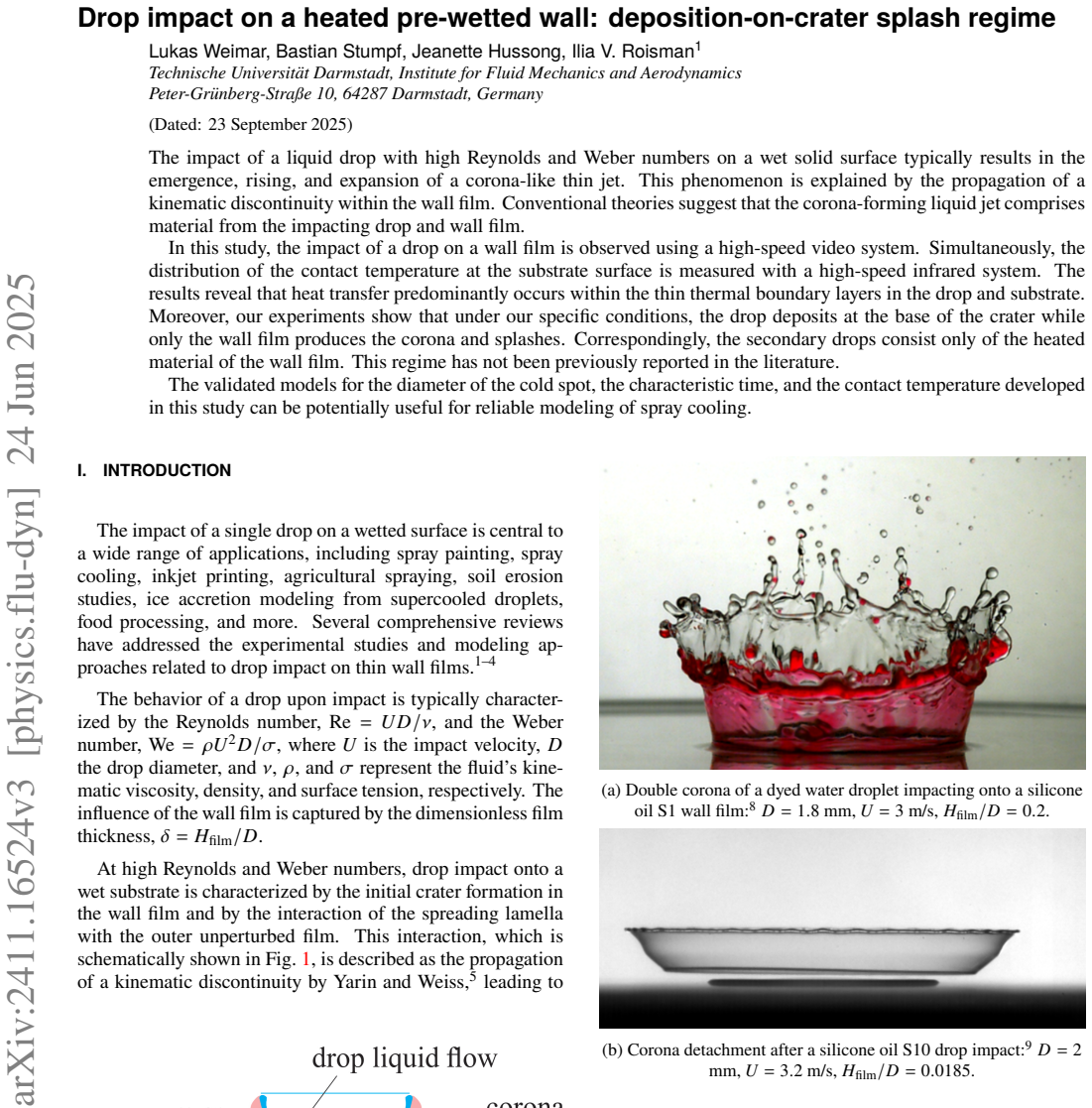
The central discovery is that under the studied conditions (silicone oil drops and films, Reynolds numbers 130--350, Weber numbers 880--1030, film thickness below 30% of the drop diameter, heated film), the impacting drop never becomes part of the corona. The drop spreads along the floor of the crater it forms in the film, depositing there, while the kinematic-discontinuity corona is created only from the wall film. This is shown by infrared images in which the cold spot left by the drop has a diameter close to the predicted spreading diameter $D_{\mathrm{spread}} \approx 1.1 D \mathrm{Re}^{1/5}$, much smaller than the corona base, and by the delayed appearance of cooling that matches a thermal boundary layer crossing the residual film. The paper validates models for the cold-spot diameter, the delay time before the cooling signal reaches the substrate, and the contact temperature, and argues that this deposition-on-crater regime is the most favorable for spray cooling, since the cold drop avoids splashing and the secondary drops carry only already-hot film liquid.
Load-bearing premise
The regime classification assumes that the maximum diameter of the infrared cold spot equals the footprint of the drop liquid on the crater floor; if thermal smearing or lateral conduction shrinks or blurs the cold spot, the drop could spread wider than the cold spot indicates and even feed the corona without being detected.
Editorial extensions
If this is right
- In the deposition-on-crater regime, the full mass of the cold drop lands on the wall, so spray cooling efficiency is higher than in a drop-dominant corona where cold drops are lost to splash.
- The cold spot's maximum diameter is predictable from $D_{\mathrm{spread}} \approx 1.1 D \mathrm{Re}^{1/5}$, giving an estimate of the cooled surface area per individual drop.
- The delay between impact and substrate cooling is set by the time a thermal boundary layer takes to cross the residual film, so the model can be used to estimate contact temperature and heat flux in spray-cooling simulations.
- Because the corona and secondary drops in this regime contain only wall-film liquid, their material and temperature differ from the drop's, so models that mix drop and film contributions in the corona need revision.
Reading between the lines
- The regime boundary is left open in the paper; a natural criterion is that deposition-on-crater holds whenever the predicted spreading diameter $D_{\mathrm{spread}}$ stays below the corona base diameter, which could be expressed as a condition on $\mathrm{Re}$, $\mathrm{We}$, and the dimensionless film thickness $\delta$ using existing corona-growth laws.
- The cold-spot measurement could be validated as a non-invasive footprint diagnostic by repeating the experiments with a fluorescing species in the drop; if it holds, it would let researchers map drop deposition in sprays without adding tracers.
- If the same regime occurs in water-based sprays at practical temperatures, spray-cooling models would need to count the deposited cold drop mass as wall heat extraction and treat corona splash as pure film loss, changing the predicted heat flux.
- The persistence of the cold spot long after the corona collapses suggests a slow, post-corona cooling phase on the crater floor that the present models do not explicitly describe.
Editorial analysis
A structured set of objections, weighed in public.
Referee Report
Summary. The paper reports an experimental study of a silicone-oil drop impacting a heated, pre-wetted sapphire wall, using simultaneous high-speed shadowgraphy (side view) and high-speed infrared thermography (bottom view through the IR-transparent substrate). The authors observe that the infrared cold spot at the substrate is much smaller than the corona base, persists after corona collapse, and reaches a maximum diameter close to a model prediction for the drop spreading diameter. From this, they propose a new impact regime, 'deposition-on-crater', in which the impacting cold drop deposits at the crater floor while only the heated wall film feeds the corona and the secondary splash droplets. They further develop boundary-layer models for the contact temperature, the time delay of the cold-spot appearance, and the spreading diameter, and discuss implications for spray cooling.
Significance. If the central compositional claim is correct, the paper identifies a previously unreported impact regime that is directly relevant to spray-cooling efficiency, since it implies that the cold drop mass is fully deposited while only the heated film is lost to splash. The experimental setup is a strength: the simultaneous side-view and calibrated bottom-view IR measurements provide a direct, quantitative view of substrate cooling during impact, and the cold-spot persistence is an interesting observation. However, the paper's main claim rests on an indirect proxy (IR cold-spot diameter) rather than on direct measurement of liquid origin, and the quantitative 'validation' of the models involves fitted constants. The work is therefore a promising contribution that currently overstates the certainty of its central conclusion.
major comments (3)
- [Section IV, Figs. 10 and 11] The central claim that the drop deposits at the crater base and does not enter the corona or secondary drops rests entirely on identifying the maximum IR cold-spot diameter d_cold,max with the drop's deposited footprint. This proxy is asserted in Section IV ('This result confirms our assumption that the cold spot ... is associated with the deposited liquid drop') but is never checked against a direct tracer such as dye or fluorescence. Since the drop and film are the same silicone oil at different temperatures, side-view shadowgraphy cannot distinguish fluid origin. A cold drop that is entrained into the corona and ejected upward would not necessarily cool the substrate outside the crater, so the observed small cold spot is compatible with drop liquid participating in the corona. Consequently, the abstract's claims that 'only the wall film produces the corona and splashes' and that 'secondary drops consist only of the heated material of the wall film' go beyond what the measurements establish. This is load-bearing because the claimed novelty and the spray-cooling efficiency conclusion depend on it.
- [Section III C, Eq. (23), and Eq. (26)] The 'validated' prediction for the time delay t_delay contains an ad hoc fitting parameter c=0.36 (with standard error 0.0086), and the spreading diameter D_spread in Eq. (26) uses the empirical constant A0=0.55 fitted in the authors' own reference [9]. As a result, the agreement between d_cold,max and D_spread in Fig. 11 is partly by construction: both sides of the comparison incorporate fitted numbers. The authors should either determine these constants independently from first principles or explicitly frame the comparisons as consistency checks with fitted parameters rather than as parameter-free predictions. This also affects the abstract's phrase 'validated models'.
- [Section IV, Fig. 13] The supplementary evidence from the residual-film radius r_res being smaller than the maximum corona radius r_max is qualitative and comes from a single case (S10, H_film=52 µm) that appears to involve corona detachment rather than the deposition-on-crater regime studied in Figs. 4 and 10. It is not clear how this observation supports the claim that the drop does not enter the corona in the main experiments. A quantitative comparison between r_res and the expected drop-spreading diameter for that detachment case, or a dye-tracer experiment, would strengthen the argument.
minor comments (7)
- [Section II A] The calibration procedure uses a thermocouple placed 'close to the surface', but the exact position, the thermal contact with the graphite coating, and the uncertainty propagation into the temperature maps are not described. Please clarify how the ±1°C thermocouple accuracy and the NETD of 0.05°C translate into the reported temperature fields.
- [Fig. 4 caption] The caption states that side-view and bottom-view images are 'scaled identically', but the two cameras have different fields of view (23×23 mm versus 23×18 mm). Please specify the scaling procedure and confirm that the comparison of diameters is unaffected by optical distortion.
- [Section IV] The outer cold-spot diameter d_cold,2 is defined by a dimensionless temperature threshold of 0.08, but the choice of threshold and its sensitivity to the results are not discussed. Please state how the threshold was selected and whether the conclusions in Figs. 10 and 11 are robust to reasonable variations of this threshold.
- [Fig. 11] The range of the dimensionless parameter chi is narrow (0.1 to 0.25), and the claimed monotonic increase of d_cold,max/D_spread with chi could be within experimental scatter. Please include error bars and, if possible, a least-squares fit with confidence intervals to assess the trend.
- [Introduction and Section IV] The distinction between the proposed deposition-on-crater regime and the previously reported double-corona regime (Fig. 2a) should be clarified. If the double corona is a wall-film-dominant corona, how does it differ from the new regime in terms of the liquid-origin composition of the corona? The current text leaves this ambiguity.
- [Introduction, ref. [5]] The statement that 'conventional theories suggest that the corona-forming liquid jet comprises material from the impacting drop and wall film' is attributed to the Yarin-Weiss kinematic discontinuity model, which does not explicitly address the composition of the jet. A more specific reference to the origin-composition assumption would help the reader evaluate the novelty claim.
- [Section III C, Eq. (16)] There is a typographical issue in Eq. (16): the integral notation is unclear (the dummy variable is not distinguished), and the derivative with respect to r is missing a factor. Please revise the equation to the standard form u_z = -(1/r) ∂/∂r ∫_0^z r u_r(r,z') dz'.
Circularity Check
Central regime claim is partly self-confirming: the cold-spot proxy is assumed to mark deposited drop liquid, and that assumption is then used to infer that the corona and secondary drops contain no drop liquid; the validated time-delay model also contains an in-sample fitted constant c=0.36.
-
fitted input called prediction
[Section III C, Eq. (23) and Fig. 8]
"The time evolution of the thickness of the thermal boundary layer can be estimated with hΘ=√(αfilm t/c), where αfilm is the thermal diffusivity of the liquid film, t is the time and c is a fitting parameter in the order of unity. ... For the fitting parameter c=0.36 (standard fitting error σ≈0.0086), good agreement between the experiments and the model, indicated by the straight dashed line, is observed."
The 'theoretical prediction' of t_delay in Eq. (23) is obtained only after inserting c=0.36, which is fitted to the same time-delay measurements shown in Fig. 8. The agreement is therefore an in-sample measure of the fit quality, not an independent out-of-sample prediction. Because the abstract lists the characteristic time among the validated models, this part of the validation reduces to a fitted parameter renamed as a prediction.
-
self citation load bearing
[Sections III B and IV, Eq. (26) and Fig. 11]
"The dimensionless constant A0=0.55 was obtained 9 by fitting experimental data for isothermal drop impact onto a liquid film of a different liquid. ... Since the residual thickness of the drop lamella is determined by Eq. (20), the drop spreading diameter can be estimated from the drop mass balance and the empirical coefficient A0=0.55, in the form Dspread=... This result confirms our assumption that the cold spot in our experiments is associated with the deposited liquid drop."
The spreading diameter D_spread used to 'confirm' the cold-spot interpretation is not a parameter-free first-principles quantity; it inherits A0=0.55, an empirical coefficient fitted in the authors' own Ref. 9. The match d_cold,max/D_spread≈1 is therefore calibrated by a self-cited fitted constant rather than an independent geometric prediction. This is not fully circular because A0 was fit to different experimental data, but the load-bearing inference 'the drop liquid therefore does not enter the corona' depends on this self-citation.
1 more flagged steps
-
self definitional
[Section IV, paragraph following Fig. 11]
"This result confirms our assumption that the cold spot in our experiments is associated with the deposited liquid drop. Its maximum diameter is much smaller than that of the crater, and the drop liquid therefore does not enter the corona. In the case of a splash, the secondary drops consist exclusively of the wall film liquid."
The central compositional claim—secondary drops consist exclusively of wall-film liquid—is presented as the outcome of the assumption that the cold spot marks the deposited drop. No dye, tracer, or compositional measurement distinguishes drop liquid from film liquid (both are the same silicone oil at different temperatures). The conclusion that the corona contains no drop liquid is the assumed cold-spot-to-drop correspondence restated, so the defining claim of the new regime is confirmed by the same proxy used to define it.
full rationale
The paper contains an independent raw observation that is not circular: the IR cold spot is much smaller than the corona base, persists after corona collapse, and Fig. 13 shows a residual film smaller than the corona. Those facts are real and support the existence of an unexpected cooling pattern. However, the interpretive leap from 'small cold spot' to 'drop liquid never enters the corona and secondary drops are pure wall film' is not directly measured; it is inferred from the assumption that the cold spot corresponds to the deposited drop. The validation of the characteristic-time model uses an in-sample fitted constant c=0.36, and the spreading-diameter check inherits a fitted A0=0.55 from the authors' own earlier work. Thus parts of the claimed validation reduce to the fitted constants being tested, giving partial circularity rather than complete equivalence. The raw phenomenology and the dimensional scalings are independent, so the score is 6 rather than 8 or higher.
Assumptions & free parameters
free parameters (2)
- A0 =
0.55
- c =
0.36
assumptions (7)
- standard math Navier-Stokes equations and the thin-lamella mass and momentum balances are valid for the impact flow.
- standard math The similarity solution for the spreading lamella, Eq. (5), has a solution matching the inviscid outer solution Eq. (2), and the constants gamma=0.6 and eta=0.39 from reference 30 are accepted.
- domain assumption For t >> t_nu,film, the shear stress at the drop/film interface equals the dry-wall value Eq. (7).
- domain assumption For silicone oils, Pr >> 1, so the thermal boundary layer is much thinner than the viscous boundary layer and heat transfer is confined to thin boundary layers.
- domain assumption Thermal boundary layer thickness follows h_Theta = sqrt(alpha_film t / c) with c of order unity.
- domain assumption The empirical coefficient A0=0.55, fitted to isothermal impact data in the authors' own reference 9, remains valid for heated films of the same liquid.
- domain assumption No phase change or significant evaporation occurs in the heated silicone-oil film at temperatures up to 140 C.
Cite this review
Pith. "Pith review of Drop impact on a heated pre-wetted wall: deposition-on-crater splash regime." pith.science (2026). https://pith.science/paper/CKKUQ2CU
@misc{pith2026241116524,
  author       = {Pith},
  title        = {Pith review of: Drop impact on a heated pre-wetted wall: deposition-on-crater splash regime},
  year         = {2026},
  howpublished = {\url{https://pith.science/paper/CKKUQ2CU}},
  note         = {Machine review of arXiv:2411.16524}
}
read the original abstract
The impact of a liquid drop with high Reynolds and Weber numbers on a wet solid surface typically results in the emergence, rising, and expansion of a corona-like thin jet. This phenomenon is explained by the propagation of a kinematic discontinuity within the wall film. Conventional theories suggest that the corona-forming liquid jet comprises material from the impacting drop and wall film. In this study, the impact of a drop on a wall film is observed using a high-speed video system. Simultaneously, the distribution of the contact temperature at the substrate surface is measured with a high-speed infrared system. The results reveal that heat transfer predominantly occurs within the thin thermal boundary layers in the drop and substrate. Moreover, our experiments show that under our specific conditions, the drop deposits at the base of the crater while only the wall film produces the corona and splashes. Correspondingly, the secondary drops consist only of the heated material of the wall film. This regime has not been previously reported in the literature. The validated models for the diameter of the cold spot, the characteristic time, and the contact temperature developed in this study can be potentially useful for reliable modeling of spray cooling.
Figures


Figures from the paper (9 more)




Reference graph
Works this paper leans on
-
[9]
author author A. L. \ Yarin , author I. V. \ Roisman , \ and\ author C. Tropea ,\ 10.1017/9781316556580 title Collision Phenomena in Liquids and Solids \ ( publisher Cambridge University Press ,\ year 2017 ) NoStop
-
[1]
merlin.mbs aapmrev4-1.bst 2010-07-25 4.21a (PWD, AO, DPC) hacked
FUNCTION id.bst "merlin.mbs aapmrev4-1.bst 2010-07-25 4.21a (PWD, AO, DPC) hacked" ENTRY address archive archivePrefix author bookaddress booktitle chapter collaboration doi edition editor eid eprint howpublished institution isbn issn journal key language month note number organization pages primaryClass publisher school SLACcitation series title translat...
2010
-
[2]
merlin.mbs aipauth4-1.bst 2010-07-25 4.21a (PWD, AO, DPC) hacked
FUNCTION id.bst "merlin.mbs aipauth4-1.bst 2010-07-25 4.21a (PWD, AO, DPC) hacked" ENTRY address archive archivePrefix author bookaddress booktitle chapter collaboration doi edition editor eid eprint howpublished institution isbn issn journal key language month note number organization pages primaryClass publisher school SLACcitation series title translat...
2010
-
[3]
merlin.mbs aipnum4-1.bst 2010-07-25 4.21a (PWD, AO, DPC) hacked
FUNCTION id.bst "merlin.mbs aipnum4-1.bst 2010-07-25 4.21a (PWD, AO, DPC) hacked" ENTRY address archive archivePrefix author bookaddress booktitle chapter collaboration doi edition editor eid eprint howpublished institution isbn issn journal key language month note number organization pages primaryClass publisher school SLACcitation series title translati...
2010
-
[4]
merlin.mbs apsrev4-1.bst 2010-07-25 4.21a (PWD, AO, DPC) hacked
FUNCTION id.bst "merlin.mbs apsrev4-1.bst 2010-07-25 4.21a (PWD, AO, DPC) hacked" ENTRY address archive archivePrefix author bookaddress booktitle chapter collaboration doi edition editor eid eprint howpublished institution isbn issn journal key language month note number organization pages primaryClass publisher school SLACcitation series title translati...
2010
-
[5]
merlin.mbs apsrmp4-1.bst 2010-07-25 4.21a (PWD, AO, DPC) hacked
FUNCTION id.bst "merlin.mbs apsrmp4-1.bst 2010-07-25 4.21a (PWD, AO, DPC) hacked" ENTRY address archive archivePrefix author bookaddress booktitle chapter collaboration doi edition editor eid eprint howpublished institution isbn issn journal key language month note number organization pages primaryClass publisher school SLACcitation series title translati...
2010
-
[6]
author author A. L. \ Yarin ,\ title title Drop impact dynamics: Splashing, spreading, receding, bouncing , \ 10.1146/annurev.fluid.38.050304.092144 journal journal Annual Review of Fluid Mechanics \ volume 38 ,\ pages 159--192 ( year 2006 ) NoStop
- [7]
Show all 45 references
-
[8]
Liang \ and\ author I
author author G. Liang \ and\ author I. Mudawar ,\ title title Review of mass and momentum interactions during drop impact on a liquid film , \ 10.1016/j.ijheatmasstransfer.2016.05.062 journal journal International Journal of Heat and Mass Transfer \ volume 101 ,\ pages 577--5...
2016 doi
-
[10]
author author A. L. \ Yarin \ and\ author D. A. \ Weiss ,\ title title Impact of drops on solid surfaces: self-similar capillary waves, and splashing as a new type of kinematic discontinuity , \ 10.1017/S0022112095002266 journal journal Journal of Fluid Mechanics \ volume 283 ...
-
[11]
Gao \ and\ author R
author author X. Gao \ and\ author R. Li ,\ title title Impact of a single drop on a flowing liquid film , \ 10.1103/PhysRevE.92.053005 journal journal Physical review. E, Statistical, nonlinear, and soft matter physics \ volume 92 ,\ pages 053005 ( year 2015 ) NoStop
-
[12]
Lamanna , author A
author author G. Lamanna , author A. Geppert , author R. Bernard , \ and\ author B. Weigand ,\ title title Drop impact onto wetted walls: an unsteady analytical solution for modelling crown spreading , \ 10.1017/jfm.2022.69 journal journal Journal of Fluid Mechanics \ volume 9...
2022 doi
-
[13]
author author H. M. \ Kittel ,\ title Drop Impact onto a Wall Wetted by a Thin Film of Another Liquid ,\ @noop type Phd thesis ,\ school Technische Universit \"a t Darmstadt , address Darmstadt, Germany ( year 2019 ) NoStop
2019
-
[14]
Stumpf , author J
author author B. Stumpf , author J. Hussong , \ and\ author I. V. \ Roisman ,\ title title Drop impact onto a substrate wetted by another liquid: Flow in the wall film , \ 10.3390/colloids6040058 journal journal Colloids and Interfaces \ volume 6 ,\ pages 58 ( year 2022 ) NoStop
-
[15]
author author G. E. \ Cossali , author A. Coghe , \ and\ author M. Marengo ,\ title title The impact of a single drop on a wetted solid surface , \ 10.1007/s003480050073 journal journal Experiments in Fluids \ volume 22 ,\ pages 463--472 ( year 1997 ) NoStop
-
[16]
Mundo , author M
author author C. Mundo , author M. Sommerfeld , \ and\ author C. Tropea ,\ title title Droplet-wall collisions: Experimental studies of the deformation and breakup process , \ 10.1016/0301-9322(94)00069-V journal journal International Journal of Multiphase Flow \ volume 21 ,\ ...
-
[17]
Geppert , author A
author author A. Geppert , author A. Terzis , author G. Lamanna , author M. Marengo , \ and\ author B. Weigand ,\ title title A benchmark study for the crown-type splashing dynamics of one- and two-component droplet wall--film interactions , \ 10.1007/s00348-017-2447-2 journal...
-
[18]
author author H. M. \ Kittel , author I. V. \ Roisman , \ and\ author C. Tropea ,\ title title Splash of a drop impacting onto a solid substrate wetted by a thin film of another liquid , \ 10.1103/PhysRevFluids.3.073601 journal journal Physical Review Fluids \ volume 3 ( year ...
-
[19]
Stumpf , author I
author author B. Stumpf , author I. V. \ Roisman , author A. L. \ Yarin , \ and\ author C. Tropea ,\ title title Drop impact onto a substrate wetted by another liquid: corona detachment from the wall film , \ @noop journal journal Journal of Fluid Mechanics \ volume 956 ,\ pag...
2023
-
[20]
Tran , author H
author author T. Tran , author H. J. J. \ Staat , author A. Prosperetti , author C. Sun , \ and\ author D. Lohse ,\ title title Drop impact on superheated surfaces , \ 10.1103/PhysRevLett.108.036101 journal journal Physical review letters \ volume 108 ,\ pages 036101 ( year 20...
-
[21]
Herbert , author T
author author S. Herbert , author T. Gambaryan-Roisman , \ and\ author P. Stephan ,\ title title Influence of the governing dimensionless parameters on heat transfer during single drop impingement onto a hot wall , \ 10.1016/j.colsurfa.2013.05.014 journal journal Colloids and ...
-
[22]
Liang \ and\ author I
author author G. Liang \ and\ author I. Mudawar ,\ title title Review of drop impact on heated walls , \ 10.1016/j.ijheatmasstransfer.2016.10.031 journal journal International Journal of Heat and Mass Transfer \ volume 106 ,\ pages 103--126 ( year 2017 ) NoStop
2016 doi
-
[23]
Staszel \ and\ author A
author author C. Staszel \ and\ author A. L. \ Yarin ,\ title title Exponential vaporization fronts and critical heat flux in pool boiling , \ 10.1016/j.icheatmasstransfer.2018.08.019 journal journal International Journal of Heat and Mass Transfer \ volume 98 ,\ pages 171--176...
2018 doi
-
[24]
Liu , author Y
author author L. Liu , author Y. Zhang , author G. Cai , \ and\ author P. A. \ Tsai ,\ title title High-speed dynamics and temperature variation during drop impact on a heated surface , \ 10.1016/j.ijheatmasstransfer.2022.122710 journal journal International Journal of Heat an...
2022
-
[25]
Breitenbach , author I
author author J. Breitenbach , author I. V. \ Roisman , \ and\ author C. Tropea ,\ title title From drop impact physics to spray cooling models: a critical review , \ 10.1007/s00348-018-2514-3 journal journal Experiments in Fluids \ volume 59 ( year 2018 ),\ 10.1007/s00348-018...
-
[26]
author author J. B. \ Schmidt , author J. Hofmann , author F. M. \ Tenzer , author J. Breitenbach , author C. Tropea , \ and\ author I. V. \ Roisman ,\ title title Thermosuperrepellency of a hot substrate caused by vapour percolation , \ 10.1038/s42005-021-00680-7 journal jour...
-
[27]
author author Wacker ,\ title title Wacker silicon \"o le ak , \ https://www.hellermanntyton.at/binaries/content/assets/downloads/at/datenblatter/01-wacker-silikone/siliconefluidsakde.pdf journal journal Datasheet \ ( year 2001 ) NoStop
2001
-
[28]
author author A. A. \ Darhuber , author J. M. \ Davis , author S. M. \ Troian , \ and\ author W. W. \ Reisner ,\ title title Thermocapillary actuation of liquid flow on chemically patterned surfaces , \ 10.1063/1.1562628 journal journal Physics of Fluids \ volume 15 ,\ pages 1...
-
[29]
author author Q. S. \ Bhatia , author J.-K. \ Chen , author J. T. \ Koberstein , author J. E. \ Sohn , \ and\ author J. A. \ Emerson ,\ title title The measurement of polymer surface tension by drop image processing: Application to pdms and comparison with theory , \ 10.1016/S...
-
[30]
Ricci , author R
author author E. Ricci , author R. Sangiorgi , \ and\ author A. Passerone ,\ title title Density and surface tension of dioctylphthalate, silicone oil and their solutions , \ 10.1016/0257-8972(86)90060-5 journal journal Surface and Coatings Technology \ volume 28 ,\ pages 215-...
-
[31]
Roberts , author A
author author C. Roberts , author A. Graham , author M. Nemer , author L. Phinney , author R. Garcia , author M. Soehnel , \ and\ author E. Stirrup ,\ 10.2172/1343365 title Physical properties of low-molecular weight polydimethylsiloxane fluids , \ ( year 2017 ) NoStop
-
[32]
author author I. V. \ Roisman , author E. Berberovi \'c , \ and\ author C. Tropea ,\ title title Inertia dominated drop collisions. I . O n the universal flow in the lamella , \ 10.1063/1.3129282 journal journal Physics of Fluids \ volume 21 ( year 2009 ),\ 10.1063/1.3129282 NoStop
-
[33]
Bakshi , author I
author author S. Bakshi , author I. V. \ Roisman , \ and\ author C. Tropea ,\ title title Investigations on the impact of a drop onto a small spherical target , \ 10.1063/1.2716065 journal journal Physics of fluids \ volume 19 ,\ pages 032102 ( year 2007 ) NoStop
-
[34]
Abbot , author M
author author M. Abbot , author M. Lannert , author A. Kiran , author S. Bakshi , author J. Hussong , \ and\ author I. V. \ Roisman ,\ title title Spreading of a viscous drop after impact onto a spherical target , \ @noop journal journal Journal of Fluid Mechanics \ volume 996...
2024
-
[35]
author author I. V. \ Roisman ,\ title title Inertia dominated drop collisions. II . A n analytical solution of the N avier-- S tokes equations for a spreading viscous film , \ 10.1063/1.3129283 journal journal Physics of Fluids \ volume 21 ( year 2009 ),\ 10.1063/1.3129283 NoStop
-
[36]
author author I. V. \ Roisman ,\ title title Fast forced liquid film spreading on a substrate: flow, heat transfer and phase transition , \ 10.1017/S0022112010001126 journal journal Journal of Fluid Mechanics \ volume 656 ,\ pages 189--204 ( year 2010 ) NoStop
-
[37]
\ Senoner , author G
author author J.-M. \ Senoner , author G. Castanet , author O. Caballina , \ and\ author P. Villedieu ,\ title title Modeling of water drop impactions in the L eidenfrost regime , \ 10.1615/AtomizSpr.2015013386 journal journal Atom. Sprays \ volume 26 ,\ pages 853--888 ( year ...
-
[38]
Renardy , author S
author author Y. Renardy , author S. Popinet , author L. Duchemin , author M. Renardy , author S. Zaleski , author C. Josserand , author M. A. \ Drumright-Clarke , author D. Richard , author C. Clanet , \ and\ author D. Qur ,\ title title Pyramidal and toroidal water drops aft...
-
[39]
author author J. C. \ Bird , author R. Dhiman , author H.-M. \ Kwon , \ and\ author K. K. \ Varanasi ,\ title title Reducing the contact time of a bouncing drop , \ 10.1038/nature12740 journal journal Nature \ volume 503 ,\ pages 385--388 ( year 2013 ) NoStop
-
[40]
Liu , author L
author author Y. Liu , author L. Moevius , author X. Xu , author T. Qian , author J. M. \ Yeomans , \ and\ author Z. Wang ,\ title title Pancake bouncing on superhydrophobic surfaces , \ 10.1038/nphys2980 journal journal Nature Phys. \ volume 10 ,\ pages 515--519 ( year 2014 ) NoStop
-
[41]
Richard , author C
author author D. Richard , author C. Clanet , \ and\ author D. Qu \'e r \'e ,\ title title Contact time of a bouncing drop , \ 10.1038/417811a journal journal Nature \ volume 417 ,\ pages 811--811 ( year 2002 ) NoStop
2002 doi
-
[42]
Willis \ and\ author M
author author K. Willis \ and\ author M. Orme ,\ title title Binary droplet collisions in a vacuum environment: an experimental investigation of the role of viscosity , \ 10.1007/s00348-002-0526-4 journal journal Exp. Fluids \ volume 34 ,\ pages 28--41 ( year 2003 ) NoStop
-
[43]
Clanet , author C
author author C. Clanet , author C. B \'e guin , author D. Richard , \ and\ author D. Qu \'e r \'e ,\ title title Maximal deformation of an impacting drop , \ 10.1017/S0022112004000904 journal journal Journal of Fluid Mechanics \ volume 517 ,\ pages 199--208 ( year 2004 ) NoStop
-
[44]
author author N. P. \ van Hinsberg , author M. Budakli , author S. G \"o hler , author E. Berberovic , author I. V. \ Roisman , author T. Gambaryan-Roisman , \ and\ author Tropea, C. Stephan, P. ,\ title title Dynamics of the cavity and the surfacee film for impingements of si...
-
[45]
Hauk , author M
author author T. Hauk , author M. von der Grün , author I. V. \ Roisman , \ and\ author C. Tropea ,\ title title Investigation of the coefficient of restitution of spheres impacting on a water film , \ in\ @noop booktitle Proc. 26th European Conference on Liquid Atomization an...
2014
Reviewed August 12, 2026 · model on record in the stance chip above.
Discussion (0). Continue with ORCID to comment.