Projection Is All You Need: Interpreting Polarization Measurements in the Orion Clouds with Sub-Alfv\'enic MHD Simulations
Pith reviewed 2026-06-30 05:03 UTC · model grok-4.3
The pith
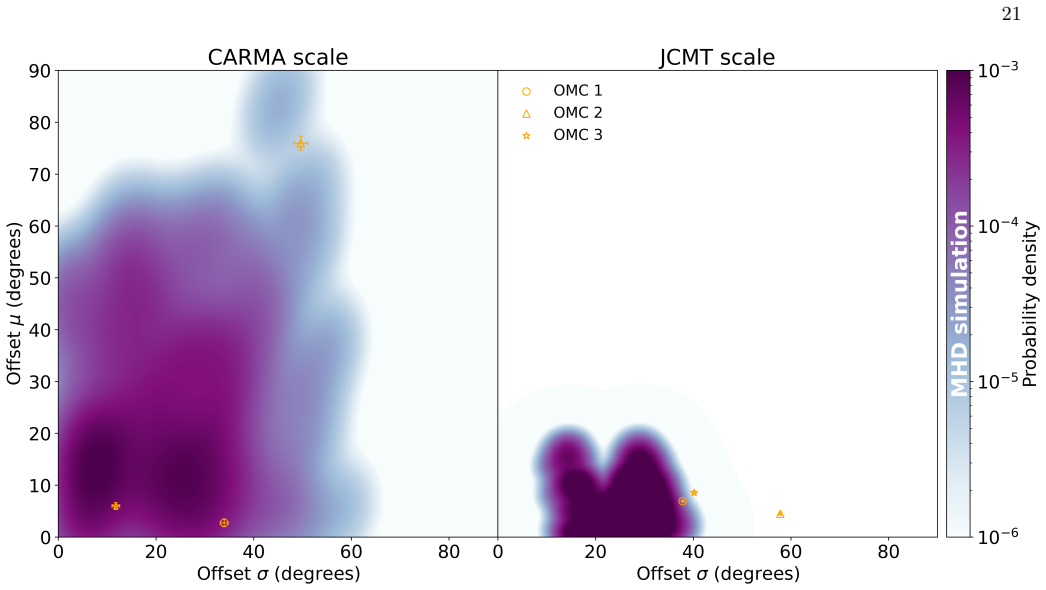
Observed polarization statistics from the Orion ISF match those from projected sub-Alfvénic MHD simulations over many angles.
A machine-rendered reading of the paper's core claim, the machinery that carries it, and where it could break.
Core claim
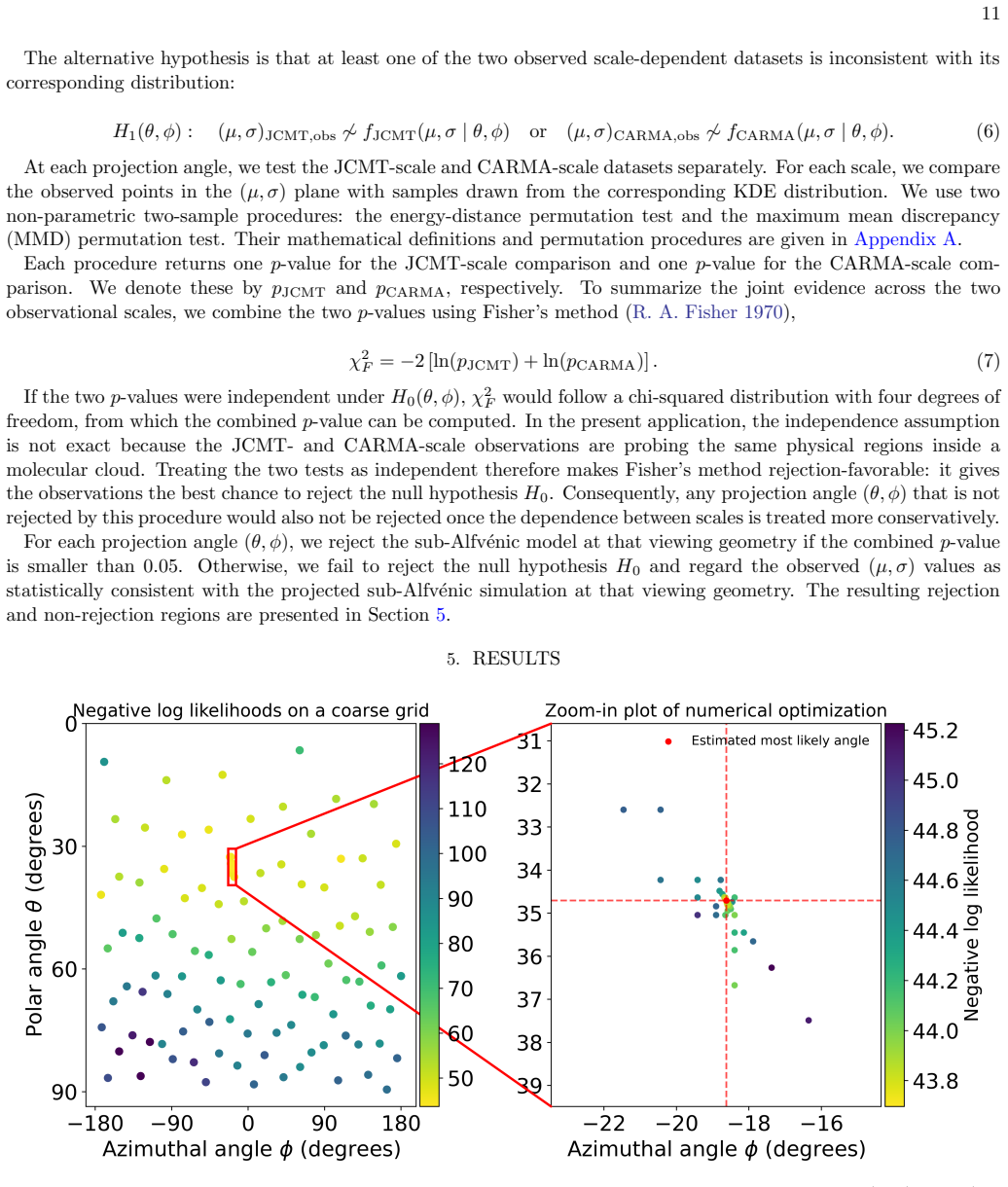
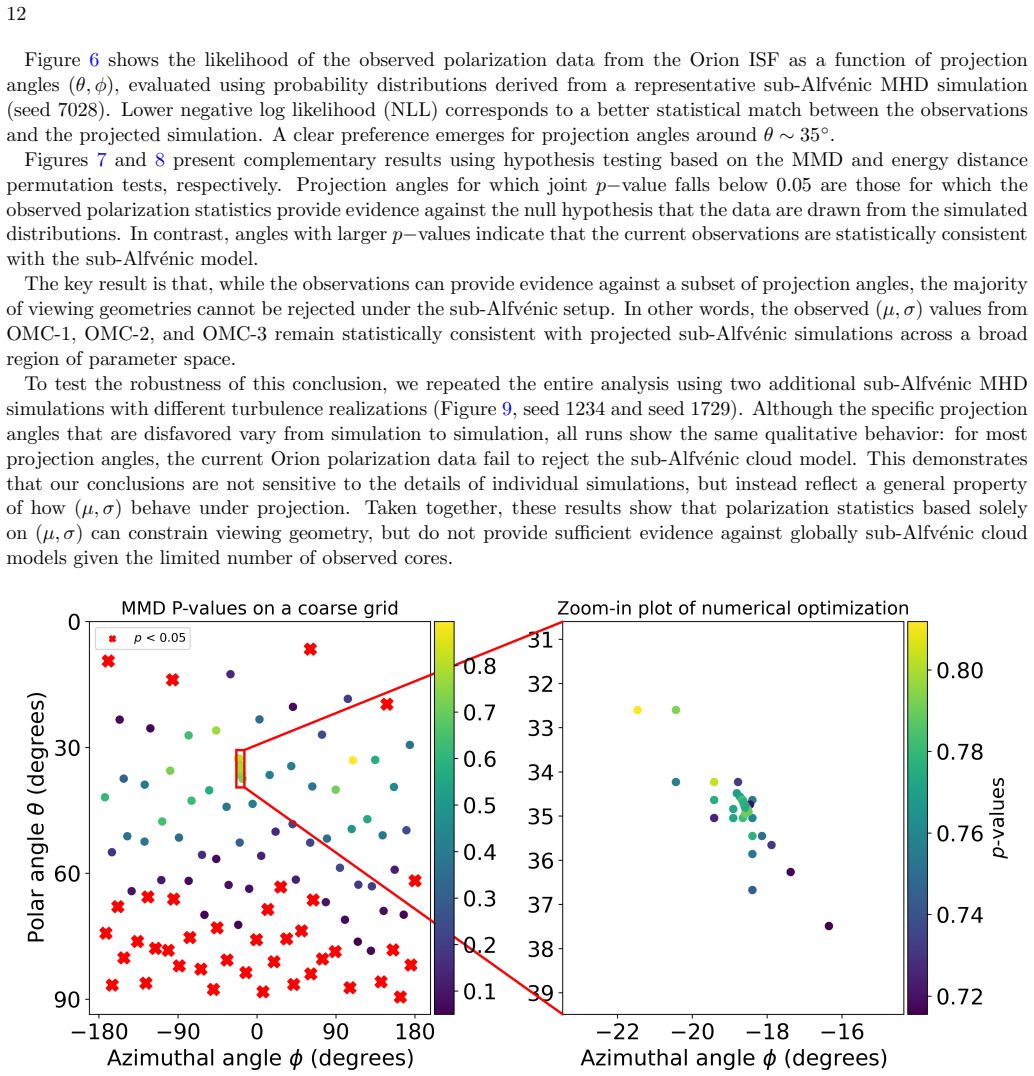
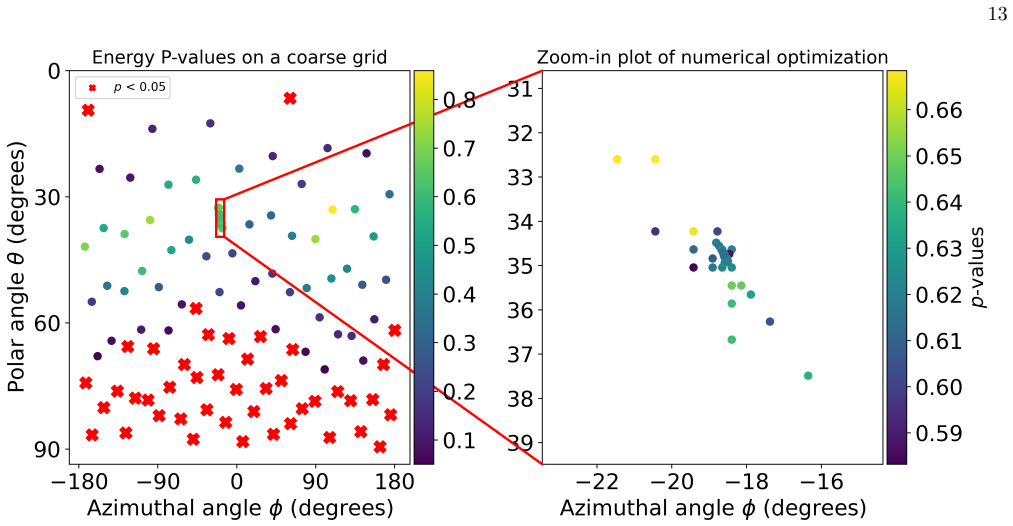
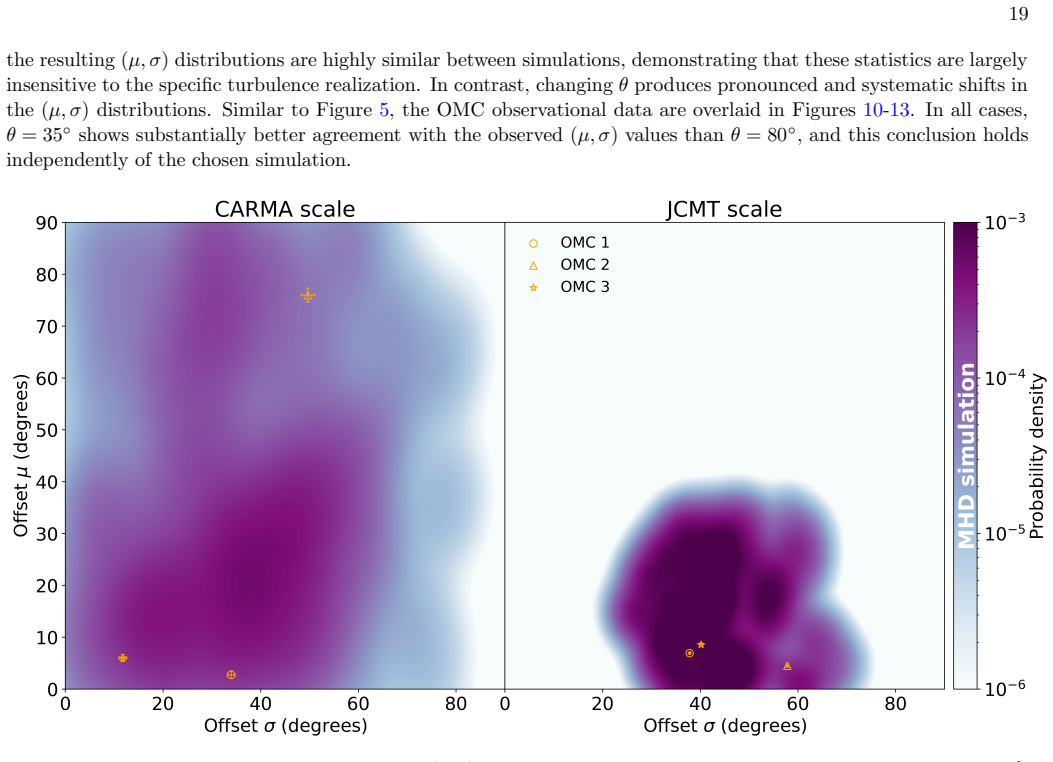
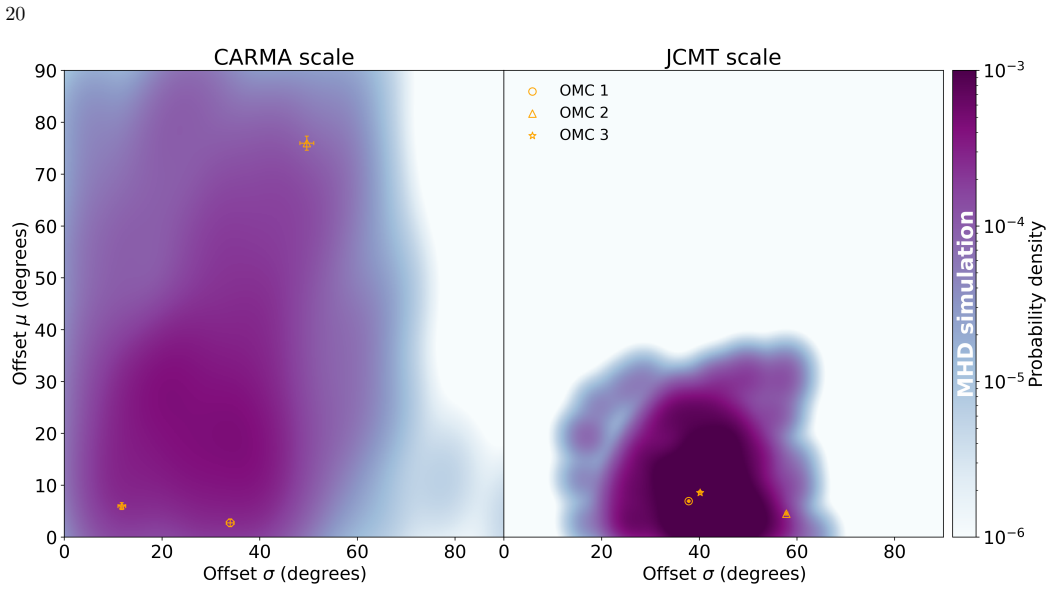
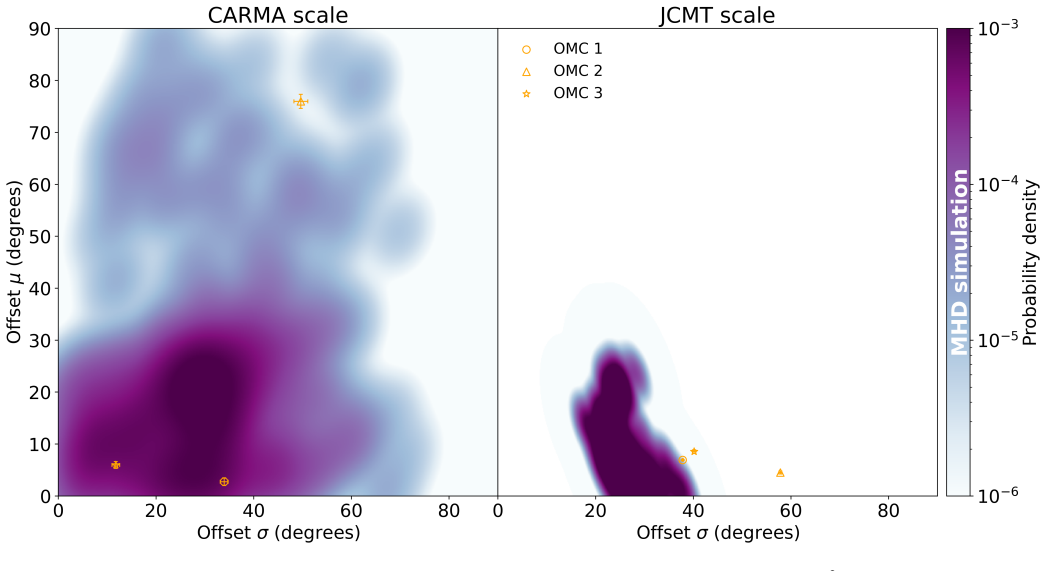
Using globally sub-Alfvénic MHD simulations that naturally produce slightly super-Alfvénic dense cores, the authors show through hypothesis testing that the observed (μ, σ) values in the Orion ISF are statistically consistent with these models over a broad range of viewing angles. Modest deviations of core-scale magnetic fields from the parent cloud field, when combined with projection, can generate a wide range of plane-of-sky polarization dispersions. This broad degeneracy implies that μ and σ alone cannot provide precise information about the three-dimensional magnetic-field distribution, and hence the Alfvén Mach number, of an individual cloud. Polarization statistics based solely on (μ,
What carries the argument
Hypothesis testing on the polarization mean μ and dispersion σ extracted from projections of globally sub-Alfvénic MHD simulations at varying viewing angles.
If this is right
- Diversity in polarization morphology among dense cores arises from modest core-scale field deviations combined with projection.
- Observations can exclude specific viewing angles but cannot exclude sub-Alfvénic conditions on the basis of (μ, σ) alone.
- Additional polarization metrics beyond mean direction and dispersion are required to constrain the three-dimensional Alfvén Mach number.
- Explicit inclusion of projection effects is necessary when using polarization data to diagnose magnetic field importance in molecular clouds.
Where Pith is reading between the lines
- The same projection-induced degeneracy may affect polarization interpretations in other star-forming regions.
- Combining polarization data with line-of-sight velocity information or multi-scale field measurements could reduce the viewing-angle ambiguity.
- Simulations with varied initial conditions or higher resolution could test whether the consistency holds only for the chosen sub-Alfvénic setups.
Load-bearing premise
The specific globally sub-Alfvénic MHD simulations used, which produce slightly super-Alfvénic dense cores, are representative of the physical conditions in the Orion ISF.
What would settle it
A set of observed (μ, σ) values in the Orion ISF that lies outside the distribution produced by any viewing angle of the sub-Alfvénic simulations, or a direct measurement of the line-of-sight field strength that contradicts the sub-Alfvénic regime.
Figures
read the original abstract
Dust polarization observations are widely used to diagnose the relative importance of magnetic fields and turbulence in star forming molecular clouds, often through summary statistics such as the mean polarization direction $\mu$ and dispersion $\sigma$. Recent multi-scale polarization observations of the Orion Integral-Shaped Filament (ISF) reveal substantial diversity in polarization morphology among its dense cores, raising questions about the underlying Alfv\'enic nature of the cloud. In this work, we develop a statistical framework to compare polarization-based summary statistics from observations with those derived from projected three dimensional MHD simulations, explicitly accounting for projection effects. Using globally sub-Alfv\'enic simulations that naturally produce slightly super-Alfv\'enic dense cores, we show that modest deviations of core-scale magnetic fields from the parent cloud field, when combined with projection, can generate a wide range of plane-of-sky polarization dispersions. Applying hypothesis testing, we find that the observed $(\mu, \sigma)$ values in the Orion ISF are statistically consistent with sub-Alfv\'enic cloud models over a broad range of viewing angles. This broad degeneracy implies that $\mu$ and $\sigma$ alone cannot provide precise information about the three-dimensional magnetic-field distribution, and hence the Alfv\'en Mach number, of an individual cloud. While the observations can provide evidence against certain projection geometries, we demonstrate that polarization statistics based solely on $(\mu, \sigma)$ are insufficient to provide evidence against sub-Alfv\'enic cloud models. Our results highlight the necessity of explicitly incorporating projection effects when interpreting polarization observations of molecular clouds.
Editorial analysis
A structured set of objections, weighed in public.
Referee Report
Summary. The paper develops a statistical framework comparing observed polarization summary statistics (mean direction μ and dispersion σ) in the Orion Integral-Shaped Filament with those obtained by projecting globally sub-Alfvénic MHD simulations that naturally yield slightly super-Alfvénic dense cores. It applies hypothesis testing across a range of viewing angles and concludes that the Orion ISF (μ, σ) values are statistically consistent with these sub-Alfvénic models, implying that μ and σ alone cannot rule out sub-Alfvénic conditions because of projection-induced degeneracy in the plane-of-sky field orientation.
Significance. If the central consistency result holds, the work provides a clear demonstration that projection effects must be explicitly modeled before using simple polarization statistics to diagnose the Alfvén Mach number of a cloud. The hypothesis-testing approach on projected simulation outputs is a methodological strength that moves beyond qualitative visual comparison. The finding that modest core-scale field deviations combined with viewing angle can reproduce the observed diversity in core polarizations is a useful caution for the field.
major comments (2)
- [§3] §3 (hypothesis-testing framework): the claim that the observed (μ, σ) values are statistically consistent with sub-Alfvénic models rests on the specific globally sub-Alfvénic runs being representative of Orion ISF conditions. The paper should include explicit sensitivity tests (varying turbulence driving mechanism, sonic Mach number distribution, or initial B-field geometry) to show that the projected (μ, σ) range and the resulting degeneracy are robust; without this, the generalization that (μ, σ) alone cannot provide evidence against sub-Alfvénic models is not yet load-bearing.
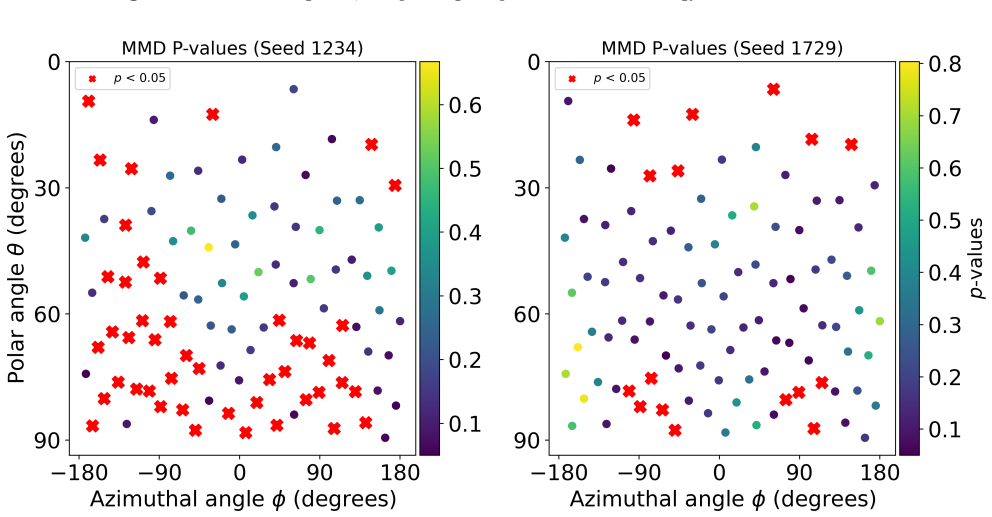
- [§3] §3 (viewing-angle sampling): the breadth of the degeneracy is quantified by sampling viewing angles, but the manuscript does not report the precise prior or grid used for the angle distribution nor the number of independent lines of sight per angle. This directly affects the p-value thresholds in the hypothesis test and therefore the strength of the consistency statement.
minor comments (1)
- The notation for the polarization dispersion σ should be clarified in the methods section to distinguish between the dispersion of polarization angles versus the dispersion of polarization vectors; the current usage is consistent within the paper but could be ambiguous to readers.
Simulated Author's Rebuttal
We thank the referee for the constructive comments and positive assessment of the work's significance. We address each major comment below. We agree that the viewing-angle sampling details must be reported explicitly and will revise the manuscript to include them. For the hypothesis-testing robustness, we provide justification for our simulation choices and will incorporate limited additional discussion and tests.
read point-by-point responses
-
Referee: [§3] §3 (hypothesis-testing framework): the claim that the observed (μ, σ) values are statistically consistent with sub-Alfvénic models rests on the specific globally sub-Alfvénic runs being representative of Orion ISF conditions. The paper should include explicit sensitivity tests (varying turbulence driving mechanism, sonic Mach number distribution, or initial B-field geometry) to show that the projected (μ, σ) range and the resulting degeneracy are robust; without this, the generalization that (μ, σ) alone cannot provide evidence against sub-Alfvénic models is not yet load-bearing.
Authors: The simulations used are globally sub-Alfvénic MHD runs that self-consistently produce slightly super-Alfvénic dense cores while matching key observed properties of the Orion ISF (column density and velocity dispersion ranges). The central result demonstrates that projection effects combined with modest core-scale field deviations can reproduce the observed (μ, σ) diversity even under globally sub-Alfvénic conditions, establishing the existence of a degeneracy. We acknowledge that broader sensitivity tests across driving mechanisms and sonic Mach numbers would increase robustness. In revision we will add a dedicated paragraph justifying the representativeness of the chosen runs (citing prior validation against Orion-like conditions) and will include one additional projection test with altered initial B-field geometry. This is a partial revision. revision: partial
-
Referee: [§3] §3 (viewing-angle sampling): the breadth of the degeneracy is quantified by sampling viewing angles, but the manuscript does not report the precise prior or grid used for the angle distribution nor the number of independent lines of sight per angle. This directly affects the p-value thresholds in the hypothesis test and therefore the strength of the consistency statement.
Authors: We agree that these procedural details are required for full reproducibility and proper interpretation of the hypothesis tests. In the revised manuscript we will explicitly state the prior distribution over viewing angles, the angular grid employed, and the number of independent lines of sight generated per angle, together with the method used to compute the projected polarization statistics and p-values. revision: yes
Circularity Check
No circularity: external simulations and independent statistical test
full rationale
The paper selects globally sub-Alfvénic MHD simulations (external to the Orion observations), projects them over viewing angles to produce (μ, σ) distributions, and applies hypothesis testing to check consistency with the observed Orion ISF values. No equations reduce by construction to fitted parameters from the target data, no self-definitional loops exist, and no load-bearing self-citations or imported uniqueness theorems are invoked in the provided text. The central claim of statistical consistency and degeneracy is a direct output of the simulation-to-observation comparison, not a renaming or ansatz smuggling. This is self-contained against external benchmarks.
Axiom & Free-Parameter Ledger
free parameters (2)
- global Alfvén Mach number
- viewing angle range
axioms (2)
- standard math MHD equations accurately describe the dynamics of molecular clouds
- domain assumption Dust polarization traces the plane-of-sky component of the magnetic field
Reference graph
Works this paper leans on
-
[1]
The Astrophysical Journal Supplement Series , archivePrefix = "arXiv", eprint =
yt: A Multi-code Analysis Toolkit for Astrophysical Simulation Data. The Astrophysical Journal Supplement Series , archivePrefix = "arXiv", eprint =. doi:10.1088/0067-0049/192/1/9 , adsurl =
-
[2]
The Astrophysical Journal Letters , abstract =
Cao, Zhuo and Li, Hua-bai , title =. The Astrophysical Journal Letters , abstract =. 2023 , month =. doi:10.3847/2041-8213/acc5e8 , url =
-
[3]
and Ward-Thompson, Derek and Pattle, Kate and Johnstone, Doug and Koch, Patrick M
Wu, Jintai and Qiu, Keping and Poidevin, Frédérick and Bastien, Pierre and Liu, Junhao and Ching, Tao-Chung and Bourke, Tyler L. and Ward-Thompson, Derek and Pattle, Kate and Johnstone, Doug and Koch, Patrick M. and Arzoumanian, Doris and Lee, Chang Won and Fanciullo, Lapo and Onaka, Takashi and Hwang, Jihye and Gouellec, Valentin J. M. Le and Soam, Archa...
-
[4]
Malicious User Experience Design Research for Cybersecurity
Theory of Star Formation. , keywords =. doi:10.1146/annurev.astro.45.051806.110602 , archivePrefix =. 0707.3514 , primaryClass =
work page internal anchor Pith review Pith/arXiv arXiv doi:10.1146/annurev.astro.45.051806.110602
-
[5]
TADPOL: A 1.3 mm Survey of Dust Polarization in Star-forming Cores and Regions
TADPOL: A 1.3 mm Survey of Dust Polarization in Star-forming Cores and Regions. , keywords =. doi:10.1088/0067-0049/213/1/13 , archivePrefix =. 1310.6653 , primaryClass =
work page internal anchor Pith review Pith/arXiv arXiv doi:10.1088/0067-0049/213/1/13
-
[6]
Magnetic Fields in Molecular Clouds Observation and Interpretation. Galaxies , keywords =. doi:10.3390/galaxies9020041 , archivePrefix =. 2106.08172 , primaryClass =
-
[7]
Observational Constraints on the Ages of Molecular Clouds and the Star Formation Timescale: Ambipolar-Diffusion-controlled or Turbulence-induced Star Formation?. , keywords =. doi:10.1086/500125 , archivePrefix =. astro-ph/0512043 , primaryClass =
work page internal anchor Pith review Pith/arXiv arXiv doi:10.1086/500125
-
[8]
Control of star formation by supersonic turbulence
Control of star formation by supersonic turbulence. Reviews of Modern Physics , keywords =. doi:10.1103/RevModPhys.76.125 , archivePrefix =. astro-ph/0301093 , primaryClass =
work page internal anchor Pith review Pith/arXiv arXiv doi:10.1103/revmodphys.76.125
-
[9]
Anchoring Magnetic Field in Turbulent Molecular Clouds
Anchoring Magnetic Field in Turbulent Molecular Clouds. , keywords =. doi:10.1088/0004-637X/704/2/891 , archivePrefix =. 0908.1549 , primaryClass =
work page internal anchor Pith review Pith/arXiv arXiv doi:10.1088/0004-637x/704/2/891
-
[10]
Anchoring Magnetic Fields in Turbulent Molecular Clouds. II. From 0.1 to 0.01 pc. , keywords =. doi:10.3847/1538-4357/aaf57c , archivePrefix =. 1901.03964 , primaryClass =
-
[11]
Simulating Radiating and Magnetized Flows in Multi-Dimensions with ZEUS-MP
Simulating Radiating and Magnetized Flows in Multiple Dimensions with ZEUS-MP. , keywords =. doi:10.1086/504594 , archivePrefix =. astro-ph/0511545 , primaryClass =
work page internal anchor Pith review Pith/arXiv arXiv doi:10.1086/504594
-
[12]
Velocity Anisotropy in Self-gravitating Molecular Clouds. I. Simulation. , keywords =. doi:10.3847/1538-4357/836/1/95 , archivePrefix =. 1701.01806 , primaryClass =
work page internal anchor Pith review Pith/arXiv arXiv doi:10.3847/1538-4357/836/1/95
-
[13]
Ade, P. A. R. and Aghanim, N. and Alina, D. and Alves, M. I. R. and Armitage-Caplan, C. and Arnaud, M. and Arzoumanian, D. and Ashdown, M. and Atrio-Barandela, F. and Aumont, J. and Baccigalupi, C. and Banday, A. J. and Barreiro, R. B. and Battaner, E. and Benabed, K. and Benoit-Lévy, A. and Bernard, J.-P. and Bersanelli, M. and Bielewicz, P. and Bock, J....
-
[14]
Polarization Holes as an Indicator of Magnetic Field‑Angular Momentum Alignment. I. Initial Tests. , keywords =. doi:10.3847/1538-4357/ad3734 , archivePrefix =. 2403.15280 , primaryClass =
-
[15]
and Haberland, Matt and Reddy, Tyler and Cournapeau, David and Burovski, Evgeni and Peterson, Pearu and Weckesser, Warren and Bright, Jonathan and
Virtanen, Pauli and Gommers, Ralf and Oliphant, Travis E. and Haberland, Matt and Reddy, Tyler and Cournapeau, David and Burovski, Evgeni and Peterson, Pearu and Weckesser, Warren and Bright, Jonathan and. Nature Methods , year =
-
[16]
Measurement of Areas on a Sphere Using Fibonacci and Latitude–Longitude Lattices , volume=
Gonzalez, Alvaro , year=. Measurement of Areas on a Sphere Using Fibonacci and Latitude–Longitude Lattices , volume=. Mathematical Geosciences , publisher=. doi:10.1007/s11004-009-9257-x , number=
-
[17]
W., Lang, D., et al.\ 2013, , 125, 306
Foreman-Mackey, Daniel and Hogg, David W. and Lang, Dustin and Goodman, Jonathan , year=. <tt>emcee</tt>: The MCMC Hammer , volume=. Publications of the Astronomical Society of the Pacific , publisher=. doi:10.1086/670067 , number=
-
[18]
Bayesian Revisit of the Relationship between the Total Field Strength and the Volume Density of Interstellar Clouds. , keywords =. doi:10.3847/1538-4357/ab672b , adsurl =
-
[19]
2003 , eprint=
A new test for the multivariate two-sample problem based on the concept of minimum energy , author=. 2003 , eprint=
2003
-
[20]
Borgwardt and Malte J
Arthur Gretton and Karsten M. Borgwardt and Malte J. Rasch and Bernhard Sch. A Kernel Two-Sample Test , journal =. 2012 , volume =
2012
-
[21]
and Burkhart, Blakesley and Lazarian, A
Tofflemire, Benjamin M. and Burkhart, Blakesley and Lazarian, A. , year=. INTERSTELLAR SONIC AND ALFVÉNIC MACH NUMBERS AND THE TSALLIS DISTRIBUTION , volume=. The Astrophysical Journal , publisher=. doi:10.1088/0004-637x/736/1/60 , number=
-
[22]
Planck intermediate results. XXXV. Probing the role of the magnetic field in the formation of structure in molecular clouds. , keywords =. doi:10.1051/0004-6361/201525896 , archivePrefix =. 1502.04123 , primaryClass =
work page internal anchor Pith review Pith/arXiv arXiv doi:10.1051/0004-6361/201525896
-
[23]
Self-similar Fragmentation Regulated by Magnetic Fields in a Massive Star Forming Filament
Self-similar fragmentation regulated by magnetic fields in a region forming massive stars. , keywords =. doi:10.1038/nature14291 , archivePrefix =. 1510.07094 , primaryClass =
work page internal anchor Pith review Pith/arXiv arXiv doi:10.1038/nature14291
-
[24]
The Journal of Open Source Software , keywords =
PyVista: 3D plotting and mesh analysis through a streamlined interface for the Visualization Toolkit (VTK). The Journal of Open Source Software , keywords =. doi:10.21105/joss.01450 , adsurl =
-
[25]
The Astrophysical Journal , abstract =
Yuan, Shibo and Li, Hua-bai , title =. The Astrophysical Journal , abstract =. 2025 , month =. doi:10.3847/1538-4357/ade5b6 , url =
-
[26]
Star formation in molecular clouds: observation and theory. , keywords =. doi:10.1146/annurev.aa.25.090187.000323 , adsurl =
-
[27]
Equation versus AI: Predicting Density and Measuring Width of Molecular Clouds by Multiscale Decomposition. , keywords =. doi:10.3847/1538-4357/ae3377 , archivePrefix =. 2508.01130 , primaryClass =
-
[28]
Probing the Turbulence Dissipation Range and Magnetic Field Strengths in Molecular Clouds. II. Directly Probing the Ion-neutral Decoupling Scale. , keywords =. doi:10.3847/1538-4357/aacb82 , archivePrefix =. 1901.06289 , primaryClass =
work page internal anchor Pith review Pith/arXiv arXiv doi:10.3847/1538-4357/aacb82 1901
-
[29]
The Jeans Condition: A New Constraint on Spatial Resolution in Simulations of Isothermal Self-gravitational Hydrodynamics. , keywords =. doi:10.1086/310975 , adsurl =
-
[30]
Probing the Turbulence Dissipation Range and Magnetic Field Strengths in Molecular Clouds
Probing the Turbulence Dissipation Range and Magnetic Field Strengths in Molecular Clouds. , keywords =. doi:10.1086/529581 , archivePrefix =. 0801.2757 , primaryClass =
work page internal anchor Pith review Pith/arXiv arXiv doi:10.1086/529581
-
[31]
Ambipolar diffusion and the mass-to-flux ratio in a turbulent collapsing cloud. , keywords =. doi:10.1051/0004-6361/202554422 , archivePrefix =. 2505.20391 , primaryClass =
-
[32]
Projection-angle effects when ``observing'' a turbulent magnetized collapsing molecular cloud: II. Magnetic field. , keywords =. doi:10.1051/0004-6361/202453265 , archivePrefix =. 2503.01971 , primaryClass =
-
[33]
Basu, Shantanu , title =. 2000 , month =. doi:10.1086/312885 , url =
-
[34]
The JCMT BISTRO Survey: Magnetic Fields Associated with a Network of Filaments in NGC 1333. , keywords =. doi:10.3847/1538-4357/aba1e2 , archivePrefix =. 2007.00176 , primaryClass =
-
[35]
, year = 2015, month = aug, volume =
Interstellar Dust Grain Alignment. , year = 2015, month = aug, volume =. doi:10.1146/annurev-astro-082214-122414 , adsurl =
-
[36]
Hydromagnetic waves in weakly-ionized media - I. Basic theory, and application to interstellar molecular clouds. , keywords =. doi:10.1111/j.1365-2966.2011.18817.x , adsurl =
-
[37]
Radiative transfer with POLARIS. I. Analysis of magnetic fields through synthetic dust continuum polarization measurements. , keywords =. doi:10.1051/0004-6361/201424930 , archivePrefix =. 1604.05305 , primaryClass =
work page internal anchor Pith review Pith/arXiv arXiv doi:10.1051/0004-6361/201424930
-
[38]
, year = 1983, month = sep, volume =
The determination of cloud masses and dust characteristics from submillimetre thermal emission. , year = 1983, month = sep, volume =
1983
-
[39]
RAS Techniques and Instruments , keywords =
Scorpio: a two-fluid code for ambipolar diffusion simulations informed by recent observational constraints. RAS Techniques and Instruments , keywords =. doi:10.1093/rasti/rzaf054 , adsurl =
-
[40]
Protostars and Planets VII , year = 2023, editor =
Magnetic Fields in Star Formation: from Clouds to Cores. Protostars and Planets VII , year = 2023, editor =. doi:10.48550/arXiv.2203.11179 , archivePrefix =. 2203.11179 , primaryClass =
-
[41]
From Polarimetry Instrument to Polarimetry Observation , author =
-
[42]
Breakthroughs in Statistics: Methodology and distribution , pages=
Statistical Methods for Research Workers , author=. Breakthroughs in Statistics: Methodology and distribution , pages=. 1970 , publisher=
1970
-
[43]
2 - DESCRIPTIVE MEASURES , booktitle =. 1972 , series =. doi:https://doi.org/10.1016/B978-0-12-471150-1.50008-X , url =
-
[44]
and Kirby, Larry and Dotson, Jessie L
Hildebrand, Roger H. and Kirby, Larry and Dotson, Jessie L. and Houde, Martin and Vaillancourt, John E. , title =. 2009 , month =. doi:10.1088/0004-637X/696/1/567 , url =
-
[45]
Physical Review , year = 1951, month = mar, volume =
The Strength of Interstellar Magnetic Fields. Physical Review , year = 1951, month = mar, volume =. doi:10.1103/PhysRev.81.890.2 , adsurl =
-
[46]
, year = 1953, month = jul, volume =
Magnetic Fields in Spiral Arms. , year = 1953, month = jul, volume =. doi:10.1086/145731 , adsurl =
-
[47]
Pubblicazioni del R istituto superiore di scienze economiche e commericiali di firenze , volume=
Teoria statistica delle classi e calcolo delle probabilita , author=. Pubblicazioni del R istituto superiore di scienze economiche e commericiali di firenze , volume=
discussion (0)
Sign in with ORCID, Apple, or X to comment. Anyone can read and Pith papers without signing in.