What concerns do Chinese parents have about their children's digital adoption and how to better support them?
Pith reviewed 2026-05-25 15:14 UTC · model grok-4.3
The pith
Chinese parents of children aged 6-10 need specific guidance on digital content choices and greater school involvement to address online privacy risks.
A machine-rendered reading of the paper's core claim, the machinery that carries it, and where it could break.
Core claim
The survey shows that Chinese parents are aware of online risks to their young children and employ various management practices, yet the data implies a continued need to supply specific guidance for choosing digital content and to investigate how schools can better support parents and children through recommendations on online activities.
What carries the argument
Online survey instrument measuring Chinese parents' reported awareness, concerns, and practices regarding children's digital device use and privacy management.
If this is right
- Parents require ongoing specific guidance to support their choices of digital content for young children.
- Schools' roles in children's online activities warrant deeper examination.
- Support mechanisms should be developed for schools and teachers making recommendations to parents and children.
Where Pith is reading between the lines
- The reported concerns could guide the design of culturally tailored parental-control features in apps popular with Chinese families.
- Parallel surveys in other countries might clarify which parental worries are universal versus specific to the Chinese context.
- Teacher training programs could incorporate findings on how schools currently influence family digital decisions.
Load-bearing premise
The 593 parents who responded to the online survey accurately represent Chinese families with children aged 6-10 and their self-reported concerns reflect real behaviors without major selection or reporting bias.
What would settle it
A larger probability-sampled study of the same parent population that finds current parental practices already sufficient or that schools play no meaningful role in content recommendations would undermine the call for additional guidance.
Figures




read the original abstract
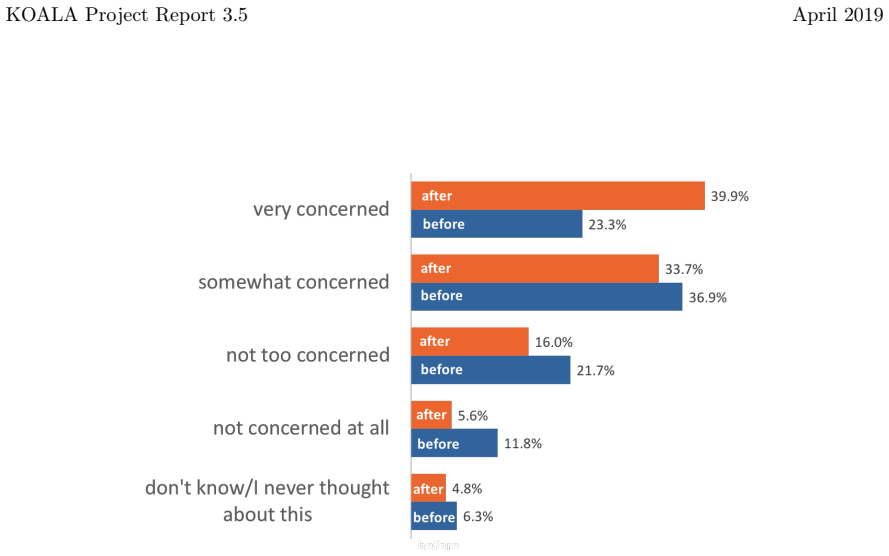
Digital devices are widely used by children, and children nowadays are spending more time online than with other media sources, such as watching television or playing offline video games. In the UK, 44% of children aged five to ten have been provided with their own tablets, with this percentage increasing annually, while in the US, ownership of tablets by children in this age group grew fivefold between 2011 and 2013. Our previous research found that UK children and parents need better support in dealing with online privacy risks. Interestingly, very few research was done on Chinese children and parents. In this report, we present findings from our online survey of 593 Chinese parents with children aged 6-10 in February and March 2019. Our study particularly focused on understanding Chinese parents' awareness and management of their children's online privacy risks. The goal of the survey was to examine the current adoption pattern of digital devices by Chinese families with young children, the concerns Chinese parents have about their children's online activities and the current practices they use for safeguarding their children online. Our findings imply that we need to continue presenting specific guidance to parents in order to support their choice of digital content for their young children. Further, we need to look more deeply into the roles schools are taking in children's online activities, how can we support schools and teachers when they are making recommendations to parents and children.
Editorial analysis
A structured set of objections, weighed in public.
Referee Report
Summary. The paper reports findings from an online survey of 593 Chinese parents with children aged 6-10 conducted in February-March 2019. It examines patterns of digital device adoption by families, parents' awareness and concerns regarding children's online privacy risks and activities, and current safeguarding practices. The authors conclude that the results imply a need to provide specific guidance to parents on digital content choices and to investigate more deeply the roles schools play in children's online activities in order to support teachers and parents.
Significance. If the survey is shown to be representative and free of major biases, the work would supply descriptive data on parental concerns and practices in an under-researched cultural setting (Chinese families with young children), which is currently sparse in the HCI literature on children's digital privacy and mediation. Such data could usefully inform the design of targeted guidance tools or interventions.
major comments (1)
- [Abstract] Abstract and throughout: the manuscript supplies no information on survey design, sampling frame, recruitment method (e.g., WeChat or other platforms), response rate, completion rate, question wording, or any post-stratification or weighting against national demographic statistics. This is load-bearing for the central claim, because the stated implications about the need for parental guidance and further examination of schools' roles rest on the assumption that the 593 self-selected respondents accurately reflect typical Chinese parents' concerns and behaviors without substantial selection or reporting bias.
minor comments (1)
- [Abstract] Abstract: 'very few research was done' is grammatically incorrect; revise to 'very little research has been done'.
Simulated Author's Rebuttal
We thank the referee for highlighting the importance of methodological transparency. This is a valid concern for assessing the generalizability of our findings on Chinese parents' concerns. We address it directly below and will revise the manuscript to incorporate the requested details.
read point-by-point responses
-
Referee: [Abstract] Abstract and throughout: the manuscript supplies no information on survey design, sampling frame, recruitment method (e.g., WeChat or other platforms), response rate, completion rate, question wording, or any post-stratification or weighting against national demographic statistics. This is load-bearing for the central claim, because the stated implications about the need for parental guidance and further examination of schools' roles rest on the assumption that the 593 self-selected respondents accurately reflect typical Chinese parents' concerns and behaviors without substantial selection or reporting bias.
Authors: We agree that the absence of these details limits evaluation of sample representativeness and potential biases, which underpins the implications. In the revised manuscript we will add a dedicated Methods section detailing: online survey design and platform (WeChat-based recruitment through parenting communities and forums in February-March 2019), sampling approach, achieved response and completion rates, question wording (translated from the original Chinese instrument), and any post-stratification or weighting. We will also expand the Limitations section to explicitly discuss self-selection bias and the lack of national demographic weighting. These additions will allow readers to better judge the strength of the descriptive claims. revision: yes
Circularity Check
No circularity: purely descriptive survey with no derivations, models, or self-referential predictions
full rationale
The paper reports results from an online survey of 593 Chinese parents and draws descriptive implications about guidance needs; it contains no equations, fitted parameters, predictions derived from inputs, uniqueness theorems, or ansatzes. The central claims rest on the survey responses themselves rather than reducing to any prior self-citation or definitional loop. No load-bearing step equates output to input by construction, satisfying the default expectation that most papers are non-circular.
Axiom & Free-Parameter Ledger
Reference graph
Works this paper leans on
-
[1]
Zero to Eight: Children’s Media Use in America 2013
2013. Zero to Eight: Children’s Media Use in America 2013 . Technical Re- port. Common Sense Media. https://www.commonsensemedia.org/research/ zero-to-eight-childrens-media-use-in-america-2013
work page 2013
-
[2]
The statistic report of the online activities of Chinese teenagers, 2018
2018. The statistic report of the online activities of Chinese teenagers, 2018
work page 2018
-
[3]
2018 Android Application Security White Paper
2019. 2018 Android Application Security White Paper. Keen Security Lab (2019). https: //keenlab.tencent.com/zh/whitepapers
work page 2019
-
[4]
The statistic report of the development of China internet network, No
2019. The statistic report of the development of China internet network, No. 43rd
work page 2019
-
[5]
Cecilia Kang. 2019. F .T.C. Hits Musical.ly With Record Fine for Child Privacy Violation. The New Y ork Times (Feb 2019). https://www.nytimes.com/2019/02/27/technology/ ftc-tiktok-child-privacy-fine.html
work page 2019
-
[6]
Parenting for a Digital Future, Data tables for reports 1-4
Sonia Livingstone. Parenting for a Digital Future, Data tables for reports 1-4. Technical Report
-
[7]
Sonia Livingstone, Alicia Blum-Ross, Jennifer Pavlick, and Kjartan Olafsson. 2018b. In the digital home, how do parents support their children and who supports them? Technical Report. LSE
-
[8]
Sonia Livingstone, Alicia Blum-Ross, and Dongmiao Zhang. 2018a. What do parents think, and do, about their childrenâ ˘A ´Zs online privacy? Technical Report. LSE
-
[9]
Sonia Livingstone, Julia Davidson, Joanne Bryce, Saqba Batool, Ciaran Haughton, and An- ulekha Nandi. 2017. Children’s online activities, risks and safety: a literature review by the UKCCIS evidence group. Technical Report. UKCCIS evidence group. — KOALA Project Report 3.5 Page 14 KOALA Project Report 3.5 April 2019
work page 2017
-
[10]
Sonia Livingstone, Leslie Haddon, Anke Görzig, and Kjartan Ólafsson. 2014. EU Kids Online II: a large-scale quantitative approach to the study of European children’s use of the internet and online risks and safety. SAGE Publications, Ltd
work page 2014
-
[11]
Chinese Academy of Social Sciences. 2018. Bluebook of Teenagers. Technical Report
work page 2018
-
[12]
ofcom.org. 2016. Children and parents: media use and attitude report. (2016). https://www.ofcom.org.uk/research-and-data/media-literacy-research/childrens/ children-parents-nov16
work page 2016
-
[13]
ofcom.org. 2017. Children and parents: media use and attitude report. (2017). https://www.ofcom.org.uk/__data/assets/pdf_file/0020/108182/ children-parents-media-use-attitudes-2017.pdf
work page 2017
-
[14]
Bieke Zaman and Marije Nouwen. 2016. Parental controls: advice for parents, researchersand industry. (2016)
work page 2016
-
[15]
Jun Zhao. 2018. Are Children Well-Supported by Their Parents Concerning Online Privacy Risks, and Who Supports the Parents? CoRR abs/1809.10944 (2018). http://arxiv.org/ abs/1809.10944
work page internal anchor Pith review Pith/arXiv arXiv 2018
-
[16]
Jun Zhao, Ulrik Lyngs, and Nigel Shadbolt. 2018. What privacy concerns do parents have about children’s mobile apps, and how can they stay SHARP? CoRR abs/1809.10841 (2018). http://arxiv.org/abs/1809.10841
work page internal anchor Pith review Pith/arXiv arXiv 2018
-
[17]
Jun Zhao, Ge Wang, Carys Dally, Petr Slovak, Julian Childs, Max Van Klee, and Nigel Shadbolt
-
[18]
‘I make up a silly name’: Understanding Children’s Perception of Privacy Risks Online. CHI Conference on Human Factors in Computing Systems Proceedings (CHI 2019), May 4–9, 2019, Glasgow, Scotland Uk (2019). DOI:http://dx.doi.org/10.1145/3290605.3300336 — KOALA Project Report 3.5 Page 15 KOALA Project Report 3.5 April 2019 Figure 9: More digitally experie...
discussion (0)
Sign in with ORCID, Apple, or X to comment. Anyone can read and Pith papers without signing in.