REVIEW 3 major objections 6 minor 51 references
A Kernel Based High Order "Explicit" Unconditionally Stable Constrained Transport Method for Ideal Magnetohydrodynamics
T0 review · 3 major / 6 minor · reviewed 2026-08-14 · deepseek-v4-flash
Pith's one-line read The paper claims that advancing the magnetic vector potential with a kernel-based method of lines transpose makes constrained transport in ideal MHD A-stable, so the diffusion limiter required in the previous 3D scheme can be removed…
desk verdict A genuinely useful extension of the authors' kernel-based MOLT to vector-potential CT, with a clean blast-wave comparison—but the 'unconditionally stable in 3D' claim outruns the 1D scalar proof and the evidence is all at CFL 0.5. read the letter →
The pith
A machine-rendered reading of the paper's core claim, the machinery that carries it, and where it could break.
The reading
What carries the argument
The load-bearing object is the kernel-based approximation of the one-sided derivatives $A_x^-$ and $A_x^+$, built from the operators $L_L = I + \frac{1}{\alpha}\partial_x$ and $L_R = I - \frac{1}{\alpha}\partial_x$. With $\alpha = \beta/(c\,\Delta t)$, the inverse operators become successive convolution integrals, and the derivative is expressed as the series $\frac{1}{\alpha}\partial_x = \sum_{p\ge1} D_L^p$; truncating the series gives $k$th-order accuracy in $\Delta t$, and for $0 < \beta \le \beta_{k,\max}$ the 1D scalar advection scheme is A-stable. WENO-based quadrature of the convolution integrals supplies the nonlinear weights and filters that control oscillations at shocks. This machinery defines the numerical Hamiltonian in the Lax-Friedrichs flux, and is what allows the potential update to remain stable with large time steps.
What would settle it
Take the 3D potential update alone with a non-grid-aligned constant velocity such as $u=(1,1,1)$, periodic boundary conditions, a smooth random initial $A$, and a time step several times the explicit CFL limit with $\beta$ chosen as in the paper; monitor the Fourier energy of $A$ over many steps. If the energy grows without bound while the 1D scalar test remains bounded, the transfer of A-stability to the 3D system fails.
Extended reading notes
Core claim
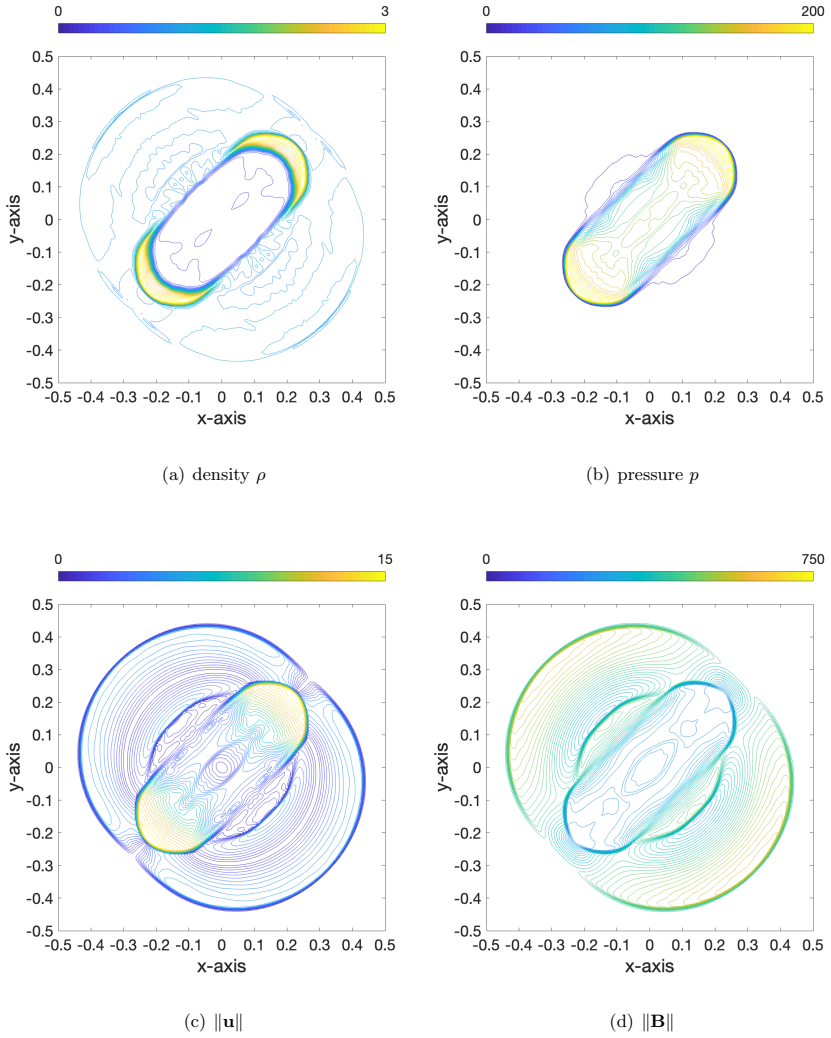
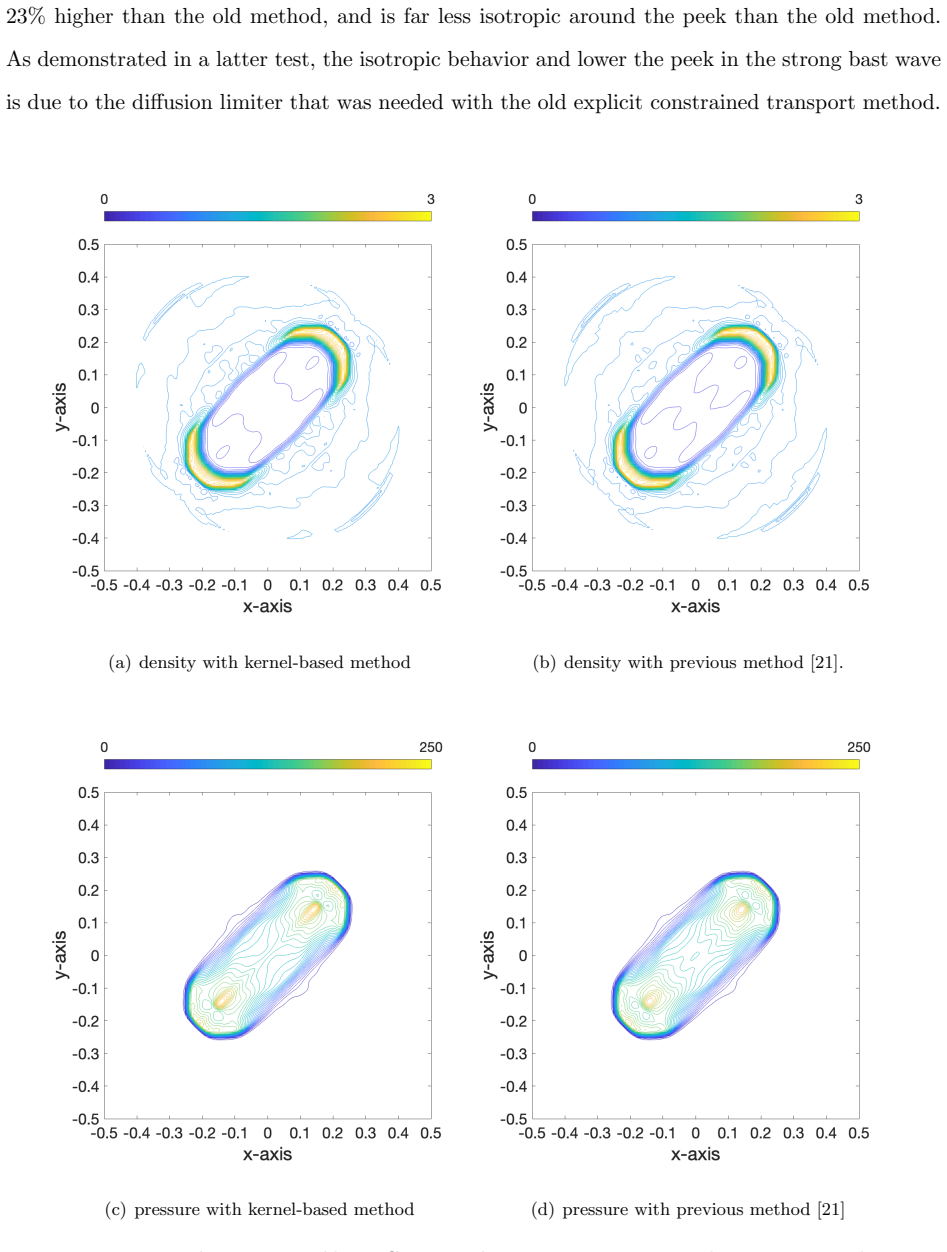
The central claim is that replacing local derivative approximations in the magnetic-vector-potential update with global convolution-kernel operators turns explicit Runge-Kutta time stepping into an unconditionally stable scheme for the potential equation. In 2D the potential is a scalar advection equation; in 3D it is the weakly hyperbolic system $\partial_t A + N_1 A_x + N_2 A_y + N_3 A_z = 0$ obtained with the Weyl gauge. The authors apply the 1D kernel derivative operators direction-by-direction with Lax-Friedrichs flux splitting, halve the 1D stability bound on $\beta$ in 2D to maintain unconditional stability, and claim the same idea transfers to the coupled 3D system. The magnetic field is then recovered as $B = \nabla \times A$ with 4th-order central differences, which cancels in the discrete divergence by commutativity of the difference operators. The paper's key numerical comparison is the 3D blast wave, where removing the diffusion limiter raises the peak $\|u\|$ from 261 to 320.
Load-bearing premise
The scheme's stability guarantee was proved only for a one-dimensional scalar advection equation, and the paper assumes the same property carries over to the three-dimensional coupled magnetic-potential system with variable coefficients, WENO filters, and flux splitting; no separate proof is given for the system.
Editorial extensions
If this is right
- The 3D constrained-transport update no longer needs the artificial resistivity term that stabilized the earlier scheme, so strong-shock solutions are less diffused; in the 3D blast wave the peak $\|u\|$ increases from 261 to 320.
- Because the corrected field is $B = \nabla \times A$ with central differences, the discrete divergence $\nabla \cdot B$ vanishes by commutativity of difference operators, independent of the accuracy of $A$.
- The kernel-based potential update is mesh-aligned and does not require solving a Poisson equation, so it fits an adaptive mesh refinement framework.
- The A-stable potential update means the time step is governed by the base MHD solver rather than by the divergence-correction step.
Reading between the lines
- The paper proves A-stability for the 1D scalar advection equation; the 3D weakly hyperbolic system is treated by analogy, so a numerical amplification-factor study of the full 3D system would either confirm the transfer or reveal a hidden step-size restriction.
- If the transfer holds, the same kernel-based update could be applied to other curl-form evolution equations where divergence constraints matter, such as vorticity-streamfunction formulations or reduced MHD models.
- The blast-wave comparison suggests that diffusion limiters used purely for numerical stability can alter shock physics; a limiter-on/limiter-off comparison in other MHD codes would be a cheap diagnostic.
Signed reviews
Editorial analysis
A structured set of objections, weighed in public.
Referee Report
Summary. The paper proposes a constrained-transport scheme for ideal MHD in which the magnetic vector potential is advanced by a kernel-based method-of-lines-transpose derivative solver, and the magnetic field is corrected as a discrete curl of the potential. The authors claim that this potential update is A-stable without artificial resistivity, unlike their earlier CT scheme [21], and that the discrete curl identity preserves the divergence-free condition on the mesh. The numerical section includes 2D and 3D tests: a smooth vortex accuracy study, Orszag-Tang vortex, cloud shock, blast wave, and field loop problems, together with a comparison in Section 6.8 that attributes differences in the 3D blast wave to the removed diffusion limiter.
Significance. If the stability claim holds, the contribution is significant: an AMR-friendly, mesh-aligned, unstaggered CT method that avoids diffusion limiters would remove a known limitation of the authors' earlier scheme and improve robustness for strong-shock MHD. The paper deserves credit for grounding the scalar derivative approximations in prior proven results (Theorems 4.1 and 4.2), for the discrete divergence-free identity in Section 5.2, and for the Section 6.8 control experiment that directly tests the diffusion-limiter hypothesis. The smooth vortex study (Table 6.2) shows high-order convergence of the coupled scheme. However, the headline 3D no-diffusion-limiter claim currently rests on an unproven transfer of 1D scalar A-stability to a weakly hyperbolic 3D system, and all reported tests are run at CFL 0.5, so the unconditional-stability assertion is not yet established.
major comments (3)
- [Section 4.6, Eq. (4.42)] The central claim that the 3D potential update is A-stable and therefore needs no diffusion limiter is not proven. Theorem 4.1 establishes A-stability only for the 1D scalar linear advection equation with periodic boundary conditions, while the 3D update is applied to the weakly hyperbolic system (2.12), whose flux Jacobian (2.13) has incomplete eigenvectors in four directions (Section 2.2), with velocity-dependent coefficients, a componentwise Lax-Friedrichs splitting (4.42a)-(4.42c), WENO-filtered derivative approximations, and, in several test problems, outflow boundary conditions. Section 4.6's statement that 'we can simply apply the ideas from the 2D case' is not a stability argument, and no eigenvalue, energy, or normal-mode analysis of the coupled update is given. A linearized von Neumann analysis for frozen coefficients, at minimum, is needed to support the no-diffusion-limiter claim.
- [Section 4.5 and Eq. (6.1)] The 2D statement that beta_max 'need[s] to be chosen as half of that for the 1D case to ensure the unconditional stability' is asserted without derivation, and no analogous 3D beta_max is given in Section 4.6. The beta values actually used in the Section 6 tests are not reported, so the claimed stability guarantee is not reproducible. Furthermore, every numerical experiment uses CFL=0.5 (Eq. (6.1)), which is within the reach of ordinary explicit schemes and cannot distinguish an unconditionally stable update from a conditionally stable one. Please provide large-time-step tests (e.g., CFL 2, 5, 10) for a 2D and a 3D field-loop problem, or a computed stability-region diagram, and report the beta values used.
- [Section 7 and Sections 6.7-6.8] The conclusion states that 'the new method is unconditionally stable,' but the coupled base MHD solver remains explicit and is advanced with CFL=0.5 (Eq. (6.1)). If the unconditional-stability claim applies only to the potential update and not to the full MHD scheme, the conclusion should be scoped accordingly; as written, the claim overstates what the discrete equations and tests establish. The Section 6.7-6.8 comparison (maximum ||u|| of 261, 320, and 265 with the limiter) is informative for the diffusion-limiter hypothesis, but it does not by itself establish the stability of the 3D update.
minor comments (6)
- [Section 6.3] The initial A3 formula for x greater than or equal to 0.05 is printed as -0.56418958(x-0.005); the two branches should match at x=0.05, so the subtraction point is likely a typo for 0.05.
- [Section 6.1] The initial data vector lists (rho,u1,u3,u3,p,...), which omits u2 and repeats u3; it should presumably read (rho,u1,u2,u3,p,...).
- [Section 6.2] The initial density is written as gamma2; this should be gamma^2 (or otherwise defined), and the initial data line would be clearer if commas were used consistently.
- [Table 6.2] The reported L1 convergence rates at 160x160 and 320x320 (4.078 and 3.924) are above the claimed third-order design; a sentence explaining the observed rates would be helpful.
- [Section 6.6, Fig. 6.6] The caption says '128x128 grid points' for the 3D field loop, but the computation is on a 128x128x128 mesh; the figure caption should state the full mesh size.
- [Section 5.2] No quantitative measure of the discrete divergence error (e.g., ||D dot B||_infinity over time) is reported; the pointwise identity (5.4) is reassuring, but a time-history plot would demonstrate that the correction step performs as intended in practice.
Circularity Check
No circular derivation found: the A-stability claim is inherited from the authors' prior work and then extrapolated to 3D, which is a missing-proof/correctness concern rather than a circular reduction.
full rationale
The derivation chain does not reduce to its own inputs. The kernel-based derivative operators and the A-stability theorem are taken from the authors' own prior papers [17, 18]; those are genuine prior results, proved there for a 1D scalar linear advection equation under stated assumptions, not assumptions manufactured in this paper to force the advertised conclusion. The 2D magnetic-potential equation (4.34) is a scalar advection equation that directly fits that framework, and the 3D update (4.42a-c) is a componentwise Lax-Friedrichs splitting of the weakly hyperbolic system (2.12). No parameter is fitted to produce the 'no diffusion limiter' outcome; Section 6.8 directly tests that claim by re-adding the old diffusion limiter and showing the solution reverts to the previous method's behavior, which is a genuine empirical check. The divergence-free property in Section 5 is enforced by construction because the corrected field is defined as a discrete curl of A with commuting differences, so this is an honest design property of constrained transport rather than a fitted prediction or a renamed result. The main weakness is that Section 4.6 asserts 'we can simply apply the ideas from the 2D case' and Section 4.5 halves beta_max 'to ensure unconditional stability' without a stability proof for the coupled 3D weakly hyperbolic system; Theorem 4.1 does not cover that setting. This is an extrapolation and an omitted proof, and it should be flagged as a correctness/rigor risk, not as a circular argument. Because the central stability premise is borrowed from self-citations but is not circularly deduced, the appropriate circularity score is low.
Assumptions & free parameters
free parameters (1)
- beta (stability parameter in alpha = beta/(c*dt)) =
not reported (must be <= beta_k,max from Table 4.1)
assumptions (5)
- standard math Kernel-based derivative approximations (4.11)/(4.16) are kth-order accurate and A-stable for linear scalar advection with alpha = beta/(c*dt) (Theorems 4.1 and 4.2 from refs [17,18]).
- domain assumption Stability of the 3D weakly hyperbolic vector potential system (2.12) follows from the scalar 1D kernel analysis without additional proof.
- domain assumption The Weyl gauge, psi = 0, yields the correct and stable potential evolution equation (2.11).
- domain assumption WENO quadrature and nonlinear filter sigma control oscillations while preserving order for discontinuous derivatives of A.
- domain assumption Positivity-preserving limiter from [21] prevents negative density or pressure in blast wave tests without affecting the CT update.
Cite this review
Pith. "Pith review of A Kernel Based High Order "Explicit" Unconditionally Stable Constrained Transport Method for Ideal Magnetohydrodynamics." pith.science (2026). https://pith.science/paper/CLN2MLTA
@misc{pith2026190801023,
  author       = {Pith},
  title        = {Pith review of: A Kernel Based High Order "Explicit" Unconditionally Stable Constrained Transport Method for Ideal Magnetohydrodynamics},
  year         = {2026},
  howpublished = {\url{https://pith.science/paper/CLN2MLTA}},
  note         = {Machine review of arXiv:1908.01023}
}
abstract
The ideal Magnetohydrodynamics (MHD) equations are challenging because one needs to maintain the divergence free condition, $\nabla \cdot \Bv = 0$. Many numerical methods have been developed to enforce this condition. In this work, we further our work on mesh aligned constrained transport by developing a new kernel based approach for the vector potential in 2D and 3D. The approach for solving the vector potential is based on the method of lines transpose and is A-stable, eliminating the need for diffusion limiters needed in our previous work in 3D. The work presented here is an improvement over the previous method in the context of problems with strong shocks due to the fact that we could eliminate the diffusion limiter that was needed in our previous version of constrained transport. The method is robust and has been tested on the 2D and 3D cloud shock, blast wave and field loop problems.
Figures


Figures from the paper (7 more)





Reference graph
Works this paper leans on
-
[21]
A. J. Christlieb, J. A. Rossmanith, and Q. Tang. Finite difference weighted essentially non- oscillatory schemes with constrained transport for ideal magnetohydrodynamics. Journal of Computational Physics, 268:302–325, 2014
work page 2014
-
[1]
D. S. Balsara. Divergence-free adaptive mesh refinement for magnetohydrodynamics. Journal of Computational Physics , 174(2):614–648, 2001
work page 2001
-
[2]
D. S. Balsara. Second-order-accurate schemes for magnetohydrodynamics with divergence-free reconstruction. The Astrophysical Journal Supplement Series , 151(1):149, 2004
work page 2004
-
[3]
D. S. Balsara. Divergence-free reconstruction of magnetic fields and weno schemes for magne- tohydrodynamics. Journal of Computational Physics , 228(14):5040–5056, 2009
work page 2009
-
[4]
D. S. Balsara and J. Kim. A comparison between divergence-cleaning and staggered-mesh formulations for numerical magnetohydrodynamics. The Astrophysical Journal , 602(2):1079, 2004
work page 2004
-
[5]
D. S. Balsara, C. Meyer, M. Dumbser, H. Du, and Z. Xu. Efficient implementation of ader schemes for euler and magnetohydrodynamical flows on structured meshes–speed comparisons with runge–kutta methods. Journal of Computational Physics , 235:934–969, 2013
work page 2013
-
[6]
D. S. Balsara, T. Rumpf, M. Dumbser, and C.-D. Munz. Efficient, high accuracy ader-weno schemes for hydrodynamics and divergence-free magnetohydrodynamics. Journal of Compu- tational Physics, 228(7):2480–2516, 2009
work page 2009
-
[7]
D. S. Balsara and D. S. Spicer. A staggered mesh algorithm using high order godunov fluxes to ensure solenoidal magnetic fields in magnetohydrodynamic simulations. Journal of Compu- tational Physics, 149(2):270–292, 1999
work page 1999
Show all 51 references
-
[8]
Borges, M
R. Borges, M. Carmona, B. Costa, and W. S. Don. An improved weighted essentially non-oscillatory scheme for hyperbolic conservation laws. Journal of Computational Physics , 227(6):3191–3211, 2008
2008
-
[9]
J. U. Brackbill and D. C. Barnes. The effect of nonzero? · b on the numerical solution of the magnetohydrodynamic equations. Journal of Computational Physics , 35(3):426–430, 1980
1980
-
[10]
Causley, H
M. Causley, H. Cho, and A. Christlieb. Method of lines transpose: Energy gradient flows using direct operator inversion for phase-field models. SIAM Journal on Scientific Computing , 39(5):B968–B992, 2017. 34
2017
-
[11]
Causley, A
M. Causley, A. Christlieb, B. Ong, and L. Van Groningen. Method of lines transpose: An implicit solution to the wave equation. Mathematics of Computation, 83(290):2763–2786, 2014
2014
-
[12]
M. F. Causley, H. Cho, A. J. Christlieb, and D. C. Seal. Method of lines transpose: High order L-stableO(N) schemes for parabolic equations using successive convolution. SIAM Journal on Numerical Analysis, 54(3):1635–1652, 2016
2016
-
[13]
M. F. Causley and A. J. Christlieb. Higher order a-stable schemes for the wave equation using a successive convolution approach. SIAM Journal on Numerical Analysis, 52(1):220–235, 2014
2014
-
[14]
M. F. Causley, A. J. Christlieb, Y. Guclu, and E. Wolf. Method of lines transpose: A fast implicit wave propagator. arXiv preprint arXiv:1306.6902 , 2013
2013 arXiv
-
[15]
Cheng, F
Y. Cheng, F. Li, J. Qiu, and L. Xu. Positivity-preserving dg and central dg methods for ideal mhd equations. Journal of Computational Physics , 238:255–280, 2013
2013
-
[16]
Christlieb, W
A. Christlieb, W. Guo, and Y. Jiang. A WENO-based Method of Lines Transpose approach for Vlasov simulations. Journal of Computational Physics , 327:337–367, 2016
2016
-
[17]
explicit
A. Christlieb, W. Guo, and Y. Jiang. Kernel based high order “explicit” unconditionally- stable scheme for nonlinear degenerate advection-diffusion equations. arXiv preprint arXiv:1707.09294, 2017
2017 arXiv
-
[18]
explicit
A. Christlieb, W. Guo, and Y. Jiang. A kernel based high order “explicit” unconditionally sta- ble scheme for time dependent hamilton–jacobi equations. Journal of Computational Physics , 379:214–236, 2019
2019
-
[19]
A. J. Christlieb, X. Feng, D. C. Seal, and Q. Tang. A high-order positivity-preserving single- stage single-step method for the ideal magnetohydrodynamic equations. Journal of Computa- tional Physics, 316:218–242, 2016
2016
-
[20]
A. J. Christlieb, Y. Liu, Q. Tang, and Z. Xu. Positivity-preserving finite difference weighted eno schemes with constrained transport for ideal magnetohydrodynamic equations. SIAM Journal on Scientific Computing , 37(4):A1825–A1845, 2015. 35
2015
-
[22]
Dai and P
W. Dai and P. R. Woodward. A simple finite difference scheme for multidimensional magne- tohydrodynamical equations. Journal of Computational Physics , 142(2):331–369, 1998
1998
-
[23]
De Sterck
H. De Sterck. Multi-dimensional upwind constrained transport on unstructured grids for ’shallow water’ magnetohydrodynamics. In AIAA Computational Fluid Dynamics Conference, 15 th, Anaheim, CA , 2001
2001
-
[24]
Dedner, F
A. Dedner, F. Kemm, D. Kr¨ oner, C.-D. Munz, T. Schnitzer, and M. Wesenberg. Hyperbolic divergence cleaning for the mhd equations. Journal of Computational Physics , 175(2):645–673, 2002
2002
-
[25]
C. R. DeVore. Flux-corrected transport techniques for multidimensional compressible magne- tohydrodynamics. Journal of Computational Physics , 92(1):142–160, 1991
1991
-
[26]
E. Dorfi. Numerical methods for astrophysical plasmas. Computer Physics Communications , 43(1):1–15, 1986
1986
-
[27]
C. R. Evans and J. F. Hawley. Simulation of magnetohydrodynamic flows-a constrained trans- port method. The Astrophysical Journal, 332:659–677, 1988
1988
-
[28]
Fey and M
M. Fey and M. Torrilhon. A constrained transport upwind scheme for divergence-free advec- tion. In Hyperbolic problems: theory, numerics, applications , pages 529–538. Springer, 2003
2003
-
[29]
P. Fu, F. Li, and Y. Xu. Globally divergence-free discontinuous galerkin methods for ideal magnetohydrodynamic equations. Journal of Scientific Computing , 77(3):1621–1659, 2018
2018
-
[30]
Gottlieb, C.-W
S. Gottlieb, C.-W. Shu, and E. Tadmor. Strong stability-preserving high-order time discretiza- tion methods. SIAM review, 43(1):89–112, 2001
2001
-
[31]
Helzel, J
C. Helzel, J. A. Rossmanith, and B. Taetz. An unstaggered constrained transport method for the 3d ideal magnetohydrodynamic equations. Journal of Computational Physics , 230(10):3803–3829, 2011. 36
2011
-
[32]
Helzel, J
C. Helzel, J. A. Rossmanith, and B. Taetz. A high-order unstaggered constrained-transport method for the three-dimensional ideal magnetohydrodynamic equations based on the method of lines. SIAM Journal on Scientific Computing , 35(2):A623–A651, 2013
2013
-
[33]
Jiang and D
G.-S. Jiang and D. Peng. Weighted ENO schemes for Hamilton–Jacobi equations. SIAM Journal on Scientific computing , 21(6):2126–2143, 2000
2000
-
[34]
Jiang and C.-W
G.-S. Jiang and C.-W. Shu. Efficient implementation of weighted eno schemes. Journal of computational physics, 126(1):202–228, 1996
1996
-
[35]
S. Kawai. Divergence-free-preserving high-order schemes for magnetohydrodynamics: An ar- tificial magnetic resistivity method. Journal of Computational Physics , 251:292–318, 2013
2013
-
[36]
R. J. LeVeque. Wave propagation algorithms for multidimensional hyperbolic systems. Journal of Computational Physics , 131(2):327–353, 1997
1997
-
[37]
F. Li, L. Xu, and S. Yakovlev. Central discontinuous galerkin methods for ideal mhd equa- tions with the exactly divergence-free magnetic field. Journal of Computational Physics , 230(12):4828–4847, 2011
2011
-
[38]
Londrillo and L
P. Londrillo and L. Del Zanna. High-order upwind schemes for multidimensional magnetohy- drodynamics. The Astrophysical Journal, 530(1):508, 2000
2000
-
[39]
Londrillo and L
P. Londrillo and L. Del Zanna. On the divergence-free condition in godunov-type schemes for ideal magnetohydrodynamics: the upwind constrained transport method. Journal of Compu- tational Physics, 195(1):17–48, 2004
2004
-
[40]
G. K. Parks. Physics of space plasmas-an introduction. Redwood City, CA, Addison-Wesley Publishing Co., 1991, 547 p. , 1991
1991
-
[41]
K. G. Powell. An approximate riemann solver for magnetohydrodynamics (that works more than one dimension). Technical report, INSTITUTE FOR COMPUTER APPLICATIONS IN SCIENCE AND ENGINEERING HAMPTON VA, 1994
1994
-
[42]
K. G. Powell, P. L. Roe, T. J. Linde, T. I. Gombosi, and D. L. De Zeeuw. A solution- adaptive upwind scheme for ideal magnetohydrodynamics. Journal of Computational Physics , 154(2):284–309, 1999. 37
1999
-
[43]
J. A. Rossmanith. An unstaggered, high-resolution constrained transport method for magne- tohydrodynamic flows. SIAM Journal on Scientific Computing , 28(5):1766–1797, 2006
2006
-
[44]
D. Ryu, F. Miniati, T. Jones, and A. Frank. A divergence-free upwind code for multidimen- sional magnetohydrodynamic flows. The Astrophysical Journal, 509(1):244, 1998
1998
-
[45]
D. C. Seal, Q. Tang, Z. Xu, and A. J. Christlieb. An explicit high-order single-stage single- step positivity-preserving finite difference weno method for the compressible euler equations. Journal of Scientific Computing , 68(1):171–190, 2016
2016
-
[46]
C.-W. Shu. High order weighted essentially nonoscillatory schemes for convection dominated problems. SIAM review, 51(1):82–126, 2009
2009
-
[47]
Torrilhon
M. Torrilhon. Locally divergence-preserving upwind finite volume schemes for magnetohydro- dynamic equations. SIAM Journal on Scientific Computing , 26(4):1166–1191, 2005
2005
-
[48]
G. T´ oth. The∇· B = 0 constraint in shock-capturing magnetohydrodynamics codes. Journal of Computational Physics , 161(2):605–652, 2000
2000
-
[49]
J. R. Wilson. Some magnetic effects in stellar collapse and accretion fn1. Annals of the New York Academy of Sciences, 262(1):123–132, 1975
1975
-
[50]
K. Yee. Numerical solution of initial boundary value problems involving maxwell’s equations in isotropic media. IEEE Transactions on antennas and propagation , 14(3):302–307, 1966
1966
-
[51]
A. L. Zachary, A. Malagoli, and P. Colella. A higher-order godunov method for multidimen- sional ideal magnetohydrodynamics. SIAM Journal on Scientific Computing , 15(2):263–284, 1994. 38
1994
Reviewed August 14, 2026 · model on record in the stance chip above.
Discussion (0). Continue with ORCID to comment.