REVIEW 4 major objections 3 minor 52 references
Network Inference from Consensus Dynamics with Unknown Parameters
T0 review · 4 major / 3 minor · reviewed 2026-08-14 · deepseek-v4-flash
Pith's one-line read Consensus snapshots can reveal a network's structure even when the dynamics parameters are unknown.
desk verdict Solid extension of spectral-template network inference to consensus dynamics with unknown parameters, but the ordering guarantee in Problem 3 rests on an unstated filter-separation condition. read the letter →
The pith
A machine-rendered reading of the paper's core claim, the machinery that carries it, and where it could break.
The reading
What carries the argument
The carrying object is the covariance identity $C_y = \sigma^2 h(L)^2 = \sigma^2 V h(\Lambda)^2 V^\top$, which converts the unknown Laplacian into a quantity directly readable from snapshot second moments. For the known-filter setting it yields $\sigma^2$ as the largest eigenvalue of $C_y$ and each $\lambda_i$ as the unique root of $\sigma^2 \prod_t (1-\alpha_t \lambda)^2 = \lambda_i(C_y)$. For the unknown-filter setting, Theorems 3 and 4 supply the eigenvector alignment and inverse-eigenvalue ordering that OrderedSpecTemp converts into the convex constraints of problem (23): $L \in \mathcal{L}_c$, near-diagonalization by the sample-covariance eigenvectors, and an approximately increasing sequence $\gamma$ with $\gamma_N=1$ and $\gamma_i \le \gamma_{i+\eta}$.
What would settle it
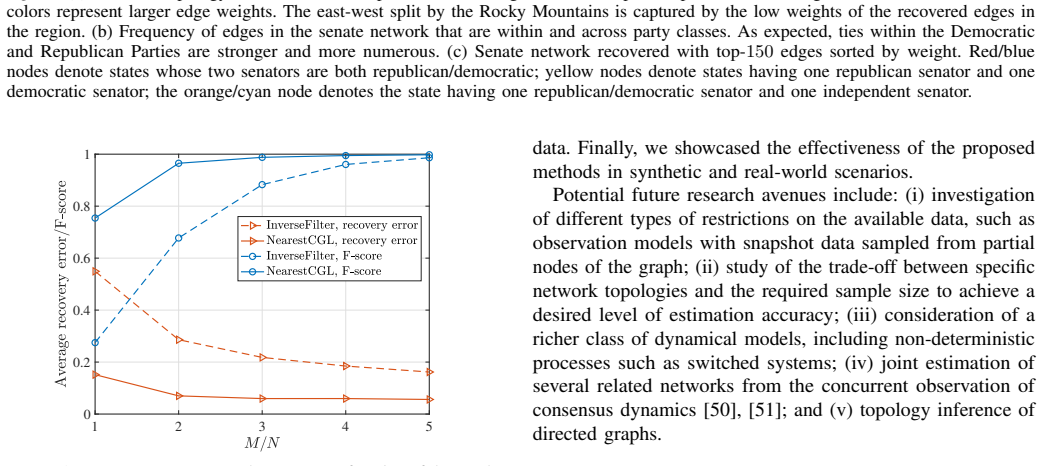
Generate data exactly as in the paper but draw the initial conditions from a non-white Gaussian distribution with covariance $C_\xi \neq I$, then run NearestCGL or OrderedSpecTemp and see whether recovery error still vanishes as $M$ grows; the paper's Fig. 1(c) indicates it will plateau, which would confirm that the white-input covariance is the load-bearing assumption.
Extended reading notes
Core claim
The central claim is that the combinatorial graph Laplacian $L$ is identifiable from independent realizations of consensus outputs $y = h(L)\xi$ even when the filter $h$ and the input power $\sigma^2$ are unknown. Because the input is white Gaussian, the output covariance is $C_y = \sigma^2 h(L)^2 = \sigma^2 V h(\Lambda)^2 V^\top$, so $C_y$ and $L$ share eigenvectors, and with known filter parameters each eigenvalue of $L$ can be recovered by inverting the monotone function $h(\lambda)=\prod_t (1-\alpha_t\lambda)$. When the filter is unknown, Theorem 3 shows that for large sample size $M$ the sample covariance $S_M$ is diagonalized by the same eigenbasis $V$, even if $S_M$ itself does not converge, and Theorem 4 shows the diagonal entries of $V^\top S_M V$ appear in the inverse order of the eigenvalues of $L$. The paper's central discovery is that this order information, combined with the valid-Laplacian and sparsity constraints of a convex program, suffices to recover $L$ under three levels of parameter uncertainty.
Load-bearing premise
The whole spectral argument assumes the unknown initial conditions are white Gaussian noise with covariance $\sigma^2 I$; if the inputs are colored, the snapshot covariance no longer shares eigenvectors with the Laplacian, and the paper's own experiments (Fig. 1c) show recovery error stops converging.
Editorial extensions
If this is right
- The InverseFilter estimate is consistent: for $M \ge N$ samples the spectral error decays as $1/\sqrt{M}$ (Lemma 1 and Theorems 1–2).
- NearestCGL's projection step guarantees the output is a valid combinatorial graph Laplacian and, with the $\ell_1$ penalty, a sparse one, so downstream spectral graph analysis operates on a proper Laplacian.
- In the heterogeneous-dynamics setting, the sample covariance need not converge to a fixed matrix, yet its eigenbasis still aligns with $L$ and the eigenvalue order still holds, making OrderedSpecTemp applicable when the dynamics are least controlled.
- The hybrid Algorithm 4 estimates the unknown observation time $T$ by a line search and then refines $L$ with NearestCGL; the experiments place it close to an oracle that knows $T$ (Fig. 2b).
Reading between the lines
- A direct extension is to replace consensus filters with any nonnegative, decreasing filter response, such as heat diffusion $e^{-\tau L}$; the order constraint should carry over unchanged, and a tailored treatment is a natural next step.
- The colored-input failure suggests jointly estimating the input covariance $C_\xi$ rather than the scalar power $\sigma^2$ could widen the model to non-white inputs, at the cost of an identifiability analysis.
- Because the value of eigenvector ordering grows with graph density in the paper's experiments, one could derive a quantitative criterion for when ordering constraints, rather than sparsity, are the primary source of identification.
- A practical deployment rule follows from the paper's own stress test: before applying these methods to real data, certify that input snapshots are approximately white, or expect a non-vanishing bias.
Signed reviews
Editorial analysis
A structured set of objections, weighed in public.
Referee Report
Summary. The paper studies the problem of inferring the weighted, undirected graph Laplacian of a network from snapshot observations of discrete-time consensus dynamics, under three increasingly uncertain parameter regimes: unknown input power only (Problem 1), additionally unknown but constant diffusion rate and observation time (Problem 2), and unknown, possibly different filter parameters per observation (Problem 3). The authors propose two-step procedures that first extract spectral information from the sample covariance of the snapshots and then solve a convex optimization problem to recover a sparse valid Laplacian. The main algorithms are InverseFilter and NearestCGL for Problem 1, OrderedSpecTemp for Problem 3, and a hybrid algorithm for Problem 2. The paper claims theoretical performance guarantees for the spectral estimation steps (Theorems 1-4) and supports the methods with synthetic experiments and two real-world case studies (temperature and senate roll-call data).
Significance. If the theoretical claims were fully valid, the paper would make a useful contribution to network inference from dynamical data: it formalizes a realistic hierarchy of parameter uncertainty, proposes scalable convex algorithms, provides explicit concentration bounds for eigenvector and eigenvalue estimates, and demonstrates practical performance on real-world data. The empirical evaluation is broad, including comparisons with the StructGLasso baseline, robustness checks beyond white Gaussian inputs, and a large-scale experiment on a political-blogs network. However, the central theoretical guarantee for the most general problem (Problem 3) rests on a theorem whose proof introduces an unstated additional assumption, and other guarantees apply only to idealized versions of the algorithms or to the spectral extraction steps rather than to the final Laplacian estimate. These issues do not destroy the empirical value of the paper, but they require substantial revision of the theoretical claims.
major comments (4)
- [Section V, Theorem 4 (proof, page 8)] The theorem is stated without any condition of the form h_k(λ_i) > h_k(λ_j) + τ with τ independent of M, yet the proof requires exactly this condition to obtain e_i > e_j + σ²τ² in equation (20). Under the standing assumptions of Section II-B, this condition can fail for valid consensus filters: take T_k = 1 and α_k = 1/(k λ_N); then h_k(λ_i) − h_k(λ_j) = (λ_j − λ_i)/(k λ_N), which tends to 0, so no uniform τ > 0 exists. In such cases the means e_i in (20) can approach each other at rate (log M)/M while the fluctuations of B_ii are of order 1/√M, so the ordering (19) has non-negligible failure probability for arbitrarily large M. Thus Theorem 4 is not valid as stated, and the ordering constraint (23d) in OrderedSpecTemp lacks the promised theoretical support. The theorem should be restated with an explicit uniform spectral-separation assumption, or proved under a weaker condition, and the resulting limitation should be acknowledged.
- [Section IV, Theorem 2 and Algorithm 1] Theorem 2 states the eigenvalue error bound under the assumption that σ is known, but Algorithm 1 estimates σ² as λ_max(S_M) in line 3. As written, the consistency claim for InverseFilter therefore does not follow for the algorithm that is actually proposed. Please either add a bound on |λ_max(S_M) − σ²| (for instance via Weyl's inequality) and propagate it through the root-finding step (10), or state explicitly that Theorem 2 applies only to an oracle version of Algorithm 1 with σ given.
- [Section V, Theorem 3 (proof)] The proof applies the sub-exponential tail bound of Lemma 3 only in the regime 0 ≤ l ≤ ν_*²/b_*, and then takes the limit 'for small enough l > 0.' For a fixed l > 0, this condition need not hold as M grows, so the displayed probability bound does not establish the stated convergence B_ij → 0 for each off-diagonal entry. The theorem itself is plausible and can be repaired by a direct second-moment argument (since Var(B_ij) ≤ σ⁴/M), but the proof as written is incomplete; the second tail case in Lemma 3 or a Chebyshev-style bound should be used.
- [Abstract and Sections IV-V] The abstract claims 'theoretical performance guarantees associated with these algorithms,' but Theorems 1-4 concern only the estimated eigenvectors, eigenvalues, and their ordering; they do not bound the distance between the final output L* of NearestCGL or OrderedSpecTemp and the true Laplacian. If the guarantee is meant to cover the final Laplacian estimate, this should be stated and proved; otherwise the claims should be explicitly scoped to the spectral extraction steps, which is what the theorems actually support.
minor comments (3)
- [Section V, Theorem 3 (proof)] The displayed exponent '−Ml²/(4σ²)' near the end of the proof is dimensionally inconsistent with the preceding bound '−Ml²/(2ν_*²)' and the estimate ν_*² ≤ 2σ⁴; it should read σ⁴ if the preceding bound is used.
- [Section III-A, Assumption 2] The white Gaussian input assumption is load-bearing for all three problems, as the paper's own Figure 1(c) demonstrates: with Wishart-colored input, the recovery error does not converge to zero. This limitation is acknowledged in the experiments but could be stated more prominently in the assumptions section, since it is a verifiability concern in practice.
- [Section VI-A, paragraph on robustness] The statement that 'the observed results are preserved' for white uniform inputs and other graph models is not supported by a figure or table; this claim should either be moved to a supplement or supported with quantitative results.
Circularity Check
The derivation is not circular: the covariance spectra are inverted against data, and the self-citations to [1] are standard lemmas that do not carry the central claim.
full rationale
The paper's derivation chain is self-contained against the observed data. For Problem 1, the covariance relation Cy = sigma^2 h(L)^2 in (5)-(6) is used to obtain the Laplacian spectrum by solving (10) from the sample covariance; the estimated input power is the largest sample eigenvalue, and no fitted parameter is later renamed as a prediction. NearestCGL then fits a valid sparse Laplacian to that spectral estimate through (15), with no target-derived quantity used as an input. For Problem 3, OrderedSpecTemp uses the eigenbasis of SM as spectral templates and imposes the order constraint (23d). The proof of Theorem 4 does introduce an extra uniform spectral-separation condition 'hk(lambda_i)>hk(lambda_j)+tau' that is not stated in the problem, but this is a missing assumption or correctness gap in the guarantee, not a circular reduction: the condition is stronger than the model, and it is not the same statement as the conclusion. The self-citations to [1] appear in Appendix A for standard sub-exponential product and square lemmas (Lemmas 4-5) and as a baseline method in Section VI-C; these are elementary, externally verifiable facts and are not load-bearing evidence for the central inference claim. Accordingly, no step in the paper reduces by construction to its own input.
Assumptions & free parameters
free parameters (3)
- beta =
Varies per experiment, e.g., {0, 0.055:0.0025:0.085} for NearestCGL (Frobenius) at M/N<=3
- epsilon =
Smallest value in {0.002:0.002:0.03} or {0.005r} that keeps (23) feasible
- eta =
1 (or >1 for small M)
assumptions (5)
- domain assumption Distinct eigenvalues of L: 0 = lambda1 < lambda2 < ... < lambdaN
- domain assumption Stable dynamics: 0 < alpha_t < 1/lambda_max for all t
- domain assumption White Gaussian input: xi ~ N(0, sigma^2 I)
- ad hoc to paper Uniform spectral gap tau: h_k(lambda_i) > h_k(lambda_j) + tau for i<j and all k
- domain assumption Sparsity prior: the true Laplacian is the sparsest valid CGL within epsilon of the spectral template
Cite this review
Pith. "Pith review of Network Inference from Consensus Dynamics with Unknown Parameters." pith.science (2026). https://pith.science/paper/CLWE72JY
@misc{pith2026190801393,
  author       = {Pith},
  title        = {Pith review of: Network Inference from Consensus Dynamics with Unknown Parameters},
  year         = {2026},
  howpublished = {\url{https://pith.science/paper/CLWE72JY}},
  note         = {Machine review of arXiv:1908.01393}
}
read the original abstract
We explore the problem of inferring the graph Laplacian of a weighted, undirected network from snapshots of a single or multiple discrete-time consensus dynamics, subject to parameter uncertainty, taking place on the network. Specifically, we consider three problems in which we assume different levels of knowledge about the diffusion rates, observation times, and the input signal power of the dynamics. To solve these underdetermined problems, we propose a set of algorithms that leverage the spectral properties of the observed data and tools from convex optimization. Furthermore, we provide theoretical performance guarantees associated with these algorithms. We complement our theoretical work with numerical experiments, that demonstrate how our proposed methods outperform current state-of-the-art algorithms and showcase their effectiveness in recovering both synthetic and real-world networks.
Figures


Figures from the paper (3 more)

Reference graph
Works this paper leans on
-
[1]
Network inference from consensus dynamics,
S. Segarra, M. T. Schaub, and A. Jadbabaie, “Network inference from consensus dynamics,” in IEEE 56th Annual Conference on Decision and Control (CDC), 2017, pp. 3212–3217
work page 2017
-
[2]
Statistical mechanics of complex networks,
R. Albert and A.-L. Barab´asi, “Statistical mechanics of complex networks,” Reviews of modern physics , vol. 74, no. 1, p. 47, 2002
work page 2002
-
[3]
M. O. Jackson, Social and economic networks . Princeton university press, 2010
work page 2010
-
[4]
S. H. Strogatz, “Exploring complex networks,” Nature, vol. 410, no. 6825, p. 268, 2001
work page 2001
-
[5]
Connecting the dots: Identifying network structure via graph signal processing,
G. Mateos, S. Segarra, A. G. Marques, and A. Ribeiro, “Connecting the dots: Identifying network structure via graph signal processing,” IEEE Signal Process. Mag. , vol. 36, no. 3, pp. 16–43, 2019
2019
-
[6]
Learning graphs from data: A signal representation perspective,
X. Dong, D. Thanou, M. Rabbat, and P. Frossard, “Learning graphs from data: A signal representation perspective,” IEEE Signal Process. Mag. , vol. 36, no. 3, pp. 44–63, 2019
2019
-
[7]
D. Koller and N. Friedman, Probabilistic graphical models: Principles and techniques. MIT Press, 2009
work page 2009
-
[8]
Sparse inverse covariance estimation with the graphical lasso,
J. Friedman, T. Hastie, and R. Tibshirani, “Sparse inverse covariance estimation with the graphical lasso,” Biostatistics, vol. 9, no. 3, pp. 432–441, Jul. 2008
work page 2008
Show all 52 references
-
[9]
High- dimensional covariance estimation by minimizing 𝓁1-penalized log- determinant divergence,
P. Ravikumar, M. J. Wainwright, G. Baskutti, and B. Yu, “High- dimensional covariance estimation by minimizing 𝓁1-penalized log- determinant divergence,” Electronic Journal of Statistics , vol. 5, pp. 935–980, 2011
2011
-
[10]
High-dimensional covariance estimation based on gaussian graphical models,
S. Zhou, P. Rutimann, M. Xu, and P. Buhlmann, “High-dimensional covariance estimation based on gaussian graphical models,” Journal of Machine Learning Research , vol. 12, pp. 2975–3026, 2011
2011
-
[11]
Inferring networks of diffusion and influence,
M. Gomez-Rodriguez, J. Leskovec, and A. Krause, “Inferring networks of diffusion and influence,” ACM Transactions on Knowledge Discovery from Data, vol. 5, no. 4, 2012
2012
-
[12]
Un- covering the structure and temporal dynamics of information propagation,
M. Gomez-Rodriguez, J. Leskovec, D. Balduzzi, and B. Sch ¨olkopf, “Un- covering the structure and temporal dynamics of information propagation,” Network Science, vol. 2, no. 1, pp. 26–55, 2014
2014
-
[13]
Revealing networks from dynamics: an introduction,
M. Timme and J. Casadiego, “Revealing networks from dynamics: an introduction,” Journal of Physics A: Mathematical and Theoretical , vol. 47, no. 34, p. 343001, 2014
2014
-
[14]
Topology identification of directed dynamical networks via power spectral analysis,
S. Shahrampour and V . M. Preciado, “Topology identification of directed dynamical networks via power spectral analysis,” IEEE Transactions on Automatic Control, vol. 60, no. 8, pp. 2260–2265, 2015
2015
-
[15]
Discrete signal processing on graphs,
A. Sandryhaila and J. M. F. Moura, “Discrete signal processing on graphs,” IEEE Trans. Signal Process. , vol. 61, no. 7, pp. 1644–1656, Apr. 2013
2013
-
[16]
The emerging field of signal processing on graphs: Extending high- dimensional data analysis to networks and other irregular domains,
D. I. Shuman, S. K. Narang, P. Frossard, A. Ortega, and P. Vandergheynst, “The emerging field of signal processing on graphs: Extending high- dimensional data analysis to networks and other irregular domains,” IEEE Signal Process. Mag. , vol. 30, no. 3, pp. 83–98, 2013
2013
-
[17]
Graph signal processing: Overview, challenges, and applications,
A. Ortega, P. Frossard, J. Kovacevic, J. M. F. Moura, and P. Vandergheynst, “Graph signal processing: Overview, challenges, and applications,” Proc. IEEE, vol. 106, no. 5, pp. 808–828, May 2018
2018
-
[18]
Learning laplacian matrix in smooth graph signal representations,
X. Dong, D. Thanou, P. Frossard, and P. Vandergheynst, “Learning laplacian matrix in smooth graph signal representations,” IEEE Trans. Signal Process., vol. 64, no. 23, pp. 6160–6173, 2016
2016
-
[19]
How to learn a graph from smooth signals,
V . Kalofolias, “How to learn a graph from smooth signals,” inProceedings of the International Conference on Artificial Intelligence and Statistics , 2016, pp. 920–929
2016
-
[20]
Signal processing on graphs: Causal modeling of unstructured data,
J. Mei and J. M. F. Moura, “Signal processing on graphs: Causal modeling of unstructured data,” IEEE Trans. Signal Process. , vol. 65, no. 8, p. 20772092, 2017
2017
-
[21]
Network topology inference from spectral templates,
S. Segarra, A. G. Marques, G. Mateos, and A. Ribeiro, “Network topology inference from spectral templates,” IEEE Trans. Signal Inf. Process. Netw., vol. 3, no. 3, pp. 467–483, 2017
2017
-
[22]
Characterization and inference of graph diffusion processes from observations of stationary signals,
B. Pasdeloup, V . Gripon, G. Mercier, D. Pastor, and M. G. Rabbat, “Characterization and inference of graph diffusion processes from observations of stationary signals,” IEEE Trans. Signal Inf. Process. Netw., vol. 4, no. 3, pp. 481–496, 2018
2018
-
[23]
Graph learning from filtered signals: Graph system and diffusion kernel identification,
H. E. Egilmez, E. Pavez, and A. Ortega, “Graph learning from filtered signals: Graph system and diffusion kernel identification,” IEEE Trans. Signal Inf. Process. Netw. , 2018
2018
-
[24]
Learning heat diffusion graphs,
D. Thanou, X. Dong, D. Kressner, and P. Frossard, “Learning heat diffusion graphs,” IEEE Trans. Signal Inf. Process. Netw. , vol. 3, no. 3, pp. 484–499, 2017
2017
-
[25]
Network topology inference from non-stationary graph signals,
R. Shafipour, S. Segarra, A. G. Marques, and G. Mateos, “Network topology inference from non-stationary graph signals,” in IEEE Int. Conf. on Acoustics, Speech and Signal Process. , March 2017, pp. 5870–5874
2017
-
[26]
Identifying the topology of undirected networks from diffused non-stationary graph signals,
R. Shafipour, S. Segarra, A. G. Marques, and G. Mateos, “Identifying the topology of undirected networks from diffused non-stationary graph signals,” arXiv preprint arXiv:1801.03862 , 2018
2018 arXiv
-
[27]
Coordination of groups of mobile autonomous agents using nearest neighbor rules,
A. Jadbabaie, J. Lin, and A. S. Morse, “Coordination of groups of mobile autonomous agents using nearest neighbor rules,” IEEE Trans. Auto. Control, vol. 48, no. 6, pp. 988–1001, Jun. 2003
2003
-
[28]
Consensus and cooperation in networked multi-agent systems,
R. Olfati-Saber, J. A. Fax, and R. M. Murray, “Consensus and cooperation in networked multi-agent systems,” Proc. IEEE, vol. 95, no. 1, pp. 215– 233, Jan. 2007
2007
-
[29]
Consensus seeking in multiagent systems under dynamically changing interaction topologies,
W. Ren and R. W. Beard, “Consensus seeking in multiagent systems under dynamically changing interaction topologies,” IEEE Trans. Auto. Control, vol. 50, no. 5, pp. 655–661, May 2005
2005
-
[30]
Single-cell rna-seq: advances and future challenges,
A.-E. Saliba, A. J. Westermann, S. A. Gorski, and J. V ogel, “Single-cell rna-seq: advances and future challenges,” Nucleic acids research, vol. 42, no. 14, pp. 8845–8860, 2014
2014
-
[31]
Ecological networks: the missing links in biomonitoring science,
C. Gray, D. J. Baird, S. Baumgartner, U. Jacob, G. B. Jenkins, E. J. O’Gorman, X. Lu, A. Ma, M. J. Pocock, N. Schuwirth et al., “Ecological networks: the missing links in biomonitoring science,” Journal of Applied Ecology, vol. 51, no. 5, pp. 1444–1449, 2014
2014
-
[32]
Optimal graph-filter design and applications to distributed linear network operators,
S. Segarra, A. G. Marques, and A. Ribeiro, “Optimal graph-filter design and applications to distributed linear network operators,” IEEE Trans. Signal Process., vol. 65, no. 15, pp. 4117–4131, Aug. 2017
2017
-
[33]
Stationary graph processes and spectral estimation,
A. G. Marques, S. Segarra, G. Leus, and A. Ribeiro, “Stationary graph processes and spectral estimation,” IEEE Trans. Signal Process. , vol. 65, no. 22, pp. 5911–5926, 2017
2017
-
[34]
Stationary signal processing on graphs,
N. Perraudin and P. Vandergheynst, “Stationary signal processing on graphs,” IEEE Trans. Signal Process. , vol. 65, no. 13, pp. 3462–3477, Jul. 2017
2017
-
[35]
Stationary graph signals using an isometric graph translation,
B. Girault, “Stationary graph signals using an isometric graph translation,” in European Signal Process. Conf. (EUSIPCO) , Nice, France, Aug. 31- Sep. 4, 2015, pp. 1516–1520
2015
-
[36]
How close is the sample covariance matrix to the actual covariance matrix?
R. Vershynin, “How close is the sample covariance matrix to the actual covariance matrix?” Journal of Theoretical Probability , vol. 25, no. 3, pp. 655–686, 2012
2012
-
[37]
A useful variant of the Davis-Kahan theorem for statisticians,
Y . Yu, T. Wang, and R. J. Samworth, “A useful variant of the Davis-Kahan theorem for statisticians,” Biometrika, vol. 102, no. 2, pp. 315–323, 2014
2014
-
[38]
J. V . Lambers and A. C. Sumner, Explorations in Numerical Analysis . World Scientific Publishing Company, 2018
2018
-
[39]
Matrix nearness problems with Bregman divergences,
I. S. Dhillon and J. A. Tropp, “Matrix nearness problems with Bregman divergences,” SIAM J. Matrix Anal. Appl. , vol. 29, no. 4, pp. 1120–1146, 2007
2007
-
[40]
An interior- point method for large-scale l1-regularized least squares,
S.-J. Kim, K. Koh, M. Lustig, S. Boyd, and D. Gorinevsky, “An interior- point method for large-scale l1-regularized least squares,” IEEE J. Sel. Topics Signal Process., vol. 4, no. 1, p. 606617, 2007
2007
-
[41]
Enhancing sparsity by reweighted 𝓁1 minimization,
E. J. Candes, M. B. Wakin, and S. P. Boyd, “Enhancing sparsity by reweighted 𝓁1 minimization,” Journal of Fourier analysis and applications, vol. 14, no. 5-6, pp. 877–905, 2008
2008
-
[42]
Kernels and regularization on graphs,
A. Smola and R. Kondor, “Kernels and regularization on graphs,” in 16th Annual Conference on Computational Learning Theory , 2003
2003
-
[43]
Graph learning from data under laplacian and structural constraints,
H. E. Egilmez, E. Pavez, and A. Ortega, “Graph learning from data under laplacian and structural constraints,” IEEE J. Sel. Topics Signal Process., vol. 11, no. 6, pp. 825–841, Jul. 2017
2017
-
[44]
Bollob ´as, Random graphs
B. Bollob ´as, Random graphs. Cambridge University Press, 2001
2001
-
[45]
CVX: Matlab software for disciplined convex programming, version 2.1,
M. Grant and S. Boyd, “CVX: Matlab software for disciplined convex programming, version 2.1,” http://cvxr.com/cvx, Mar. 2014
2014
-
[46]
The NCEP/NCAR 40-year reanalysis project,
E. Kalnay, M. Kanamitsu, R. Kistler, W. Collins, D. Deaven, L. Gandin, M. Iredell, S. Saha, G. White, J. Woollen, Y . Zhu, A. Leetmaa, R. Reynolds, M. Chelliah, W. Ebisuzaki, W. Higgins, J. Janowiak, K. C. Mo, C. Ropelewski, J. Wang, R. Jenne, and D. Joseph, “The NCEP/NCAR 40-...
1996
-
[47]
V oteview: Congressional roll-call votes database,
J. B. Lewis, K. Poole, H. Rosenthal, A. Boche, A. Rudkin, and L. Sonnet, “V oteview: Congressional roll-call votes database,” https://voteview.com/, 2019
2019
-
[48]
Exploring network structure, dynamics, and function using NetworkX,
A. A. Hagberg, D. A. Schult, and P. J. Swart, “Exploring network structure, dynamics, and function using NetworkX,” in Proceedings of the 7th Python in Science Conference (SciPy2008) , Aug. 2008, pp. 11–15
2008
-
[49]
The political blogosphere and the 2004 US election,
L. A. Adamic and N. Glance, “The political blogosphere and the 2004 US election,” in Proceedings of the WWW-2005 Workshop on the Weblogging Ecosystem, 2005
2004
-
[50]
Joint inference of networks from stationary graph signals,
S. Segarra, Y . Wang, C. Uhler, and A. G. Marques, “Joint inference of networks from stationary graph signals,” in Asilomar Conf. Signals, Syst. Comp., Oct 2017, pp. 975–979
2017
-
[51]
Estimation of network processes via blind graph multi-filter identification,
Y . Zhu, F. J. Iglesias, A. G. Marques, and S. Segarra, “Estimation of network processes via blind graph multi-filter identification,” in IEEE Int. Conf. on Acoustics, Speech and Signal Process. , May 2019, pp. 5451–5455
2019
-
[52]
M. J. Wainwright, High-dimensional statistics: A non-asymptotic view- point. Cambridge University Press, 2019
2019
Reviewed August 14, 2026 · model on record in the stance chip above.
Discussion (0). Continue with ORCID to comment.