The General Stability of Ranking
Pith reviewed 2026-07-03 00:37 UTC · model grok-4.3
The pith
General stability measures how much a ranking persists under weight changes by summing volumes of nearby rankings according to a user distance function.
A machine-rendered reading of the paper's core claim, the machinery that carries it, and where it could break.
Core claim
General stability is the integral, over the space of possible weight vectors, of a chosen distance between the ranking induced by each weight vector and a fixed target ranking. This replaces the indicator function used in exact stability with a distance function supplied by the user, so that the stability value reflects the magnitude of ranking changes rather than requiring an exact match.
What carries the argument
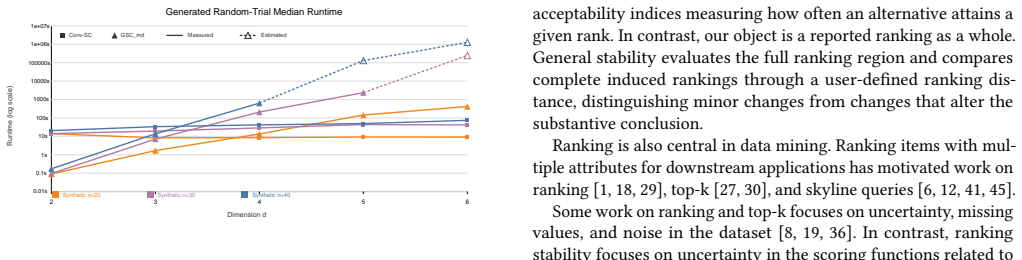
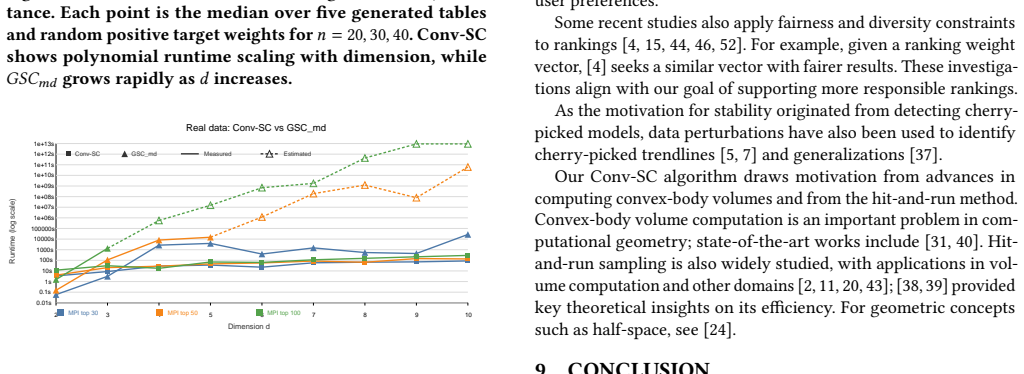
General stability, computed by aggregating the volumes of ranking regions in weight space according to their distance from the target ranking under a user-defined distance function; for quasiconvex distances this reduces via Conv-SC to convex-volume approximation.
If this is right
- Exact stability is recovered exactly when the distance function returns zero only for the identical ranking and infinity otherwise.
- For any quasiconvex distance function the general-stability score can be obtained by calling a convex-volume approximation routine on a derived convex body.
- In two dimensions a sweep algorithm computes the score exactly without sampling error.
- Unbiased sampling works in any dimension but its variance grows with dimension.
Where Pith is reading between the lines
- Domain experts could design distance functions that penalize changes only among the top-k positions.
- The same distance-based aggregation might apply to stability questions in other linear preference models beyond scoring functions.
- High-dimensional scaling limits suggest that further geometric structure beyond quasiconvexity could be exploited for faster methods.
Load-bearing premise
Quasiconvex distance functions form a subclass for which the stability integral reduces to the volume of a convex body that can be approximated by existing randomized polynomial-time methods.
What would settle it
A concrete 2D dataset where the general-stability value produced by the sweep algorithm differs from the value produced by the unbiased sampler by more than the reported error bound.
Figures
read the original abstract
Rankings derived from weighted scoring functions are widely used in settings such as university rankings and employment candidate evaluations. Since ranking weights are often chosen by organizations or analysts, ranking stability asks whether a reported ranking persists under reasonable weight changes. Prior work on stable rankings formalizes this idea through volume-based stability, which measures the fraction of the weight space that induces the target ranking exactly. This exact-match requirement can be too blunt: once a perturbed weight vector produces a different ranking, exact stability gives it no credit, whether the change replaces the top-ranked item or only swaps two nearly tied lower-ranked items. We propose general stability, a distance-based generalization that aggregates ranking regions according to a user-defined distance from the target ranking. This lets users specify which ranking changes matter in the application, while recovering exact stability as a special case. Our algorithmic focus is stability computation: given a reported or user-specified ranking and a distance function, estimate its general-stability score. We give a two-dimensional sweep algorithm and an unbiased multidimensional sampler that extend exact-stability methods, and analyze why sampling can scale poorly as the dimension grows. Motivated by this scaling challenge, we identify quasiconvex distance functions as a tractable subclass and introduce Conv-SC, which reduces stability computation for this subclass to convex-volume approximation, where randomized polynomial-time methods are available. Experiments on eight real datasets and generated instances show that distance-sensitive stability gives informative real-data results, that our estimators are accurate and practical, and that Conv-SC improves scaling with dimension for quasiconvex distance functions.
Editorial analysis
A structured set of objections, weighed in public.
Referee Report
Summary. The paper defines general stability as a distance-based generalization of volume-based exact stability for rankings induced by weighted scoring functions. It allows users to specify a distance function over rankings so that stability aggregates weight-space volume over all rankings within a user-specified distance of the target (recovering exact stability when distance is the indicator of equality). The algorithmic contributions are a 2-D sweep algorithm, an unbiased multidimensional sampler, an analysis of sampling scaling, and Conv-SC, which reduces general-stability computation for quasiconvex distance functions to convex-volume approximation. Experiments on eight real datasets and synthetic instances are reported to demonstrate informativeness and practical performance.
Significance. If the claimed reduction for quasiconvex distances holds, the work supplies a flexible, application-tunable stability measure together with practical algorithms that extend prior exact-stability methods; the ability to treat different ranking perturbations differently is a clear advance over all-or-nothing exact stability for domains such as university or hiring rankings.
major comments (1)
- [Abstract (Conv-SC paragraph)] Abstract (Conv-SC paragraph) and the algorithmic section on quasiconvex distances: the claim that quasiconvex distance functions form a tractable subclass for which stability computation reduces to convex-volume approximation is not supported by the supplied description. The relevant set is the union of polyhedral cells {w | d(ranking(w), target) ≤ t}. Quasiconvexity of d on the discrete ranking space does not imply that this union is a convex body, because adjacency of cells is determined by the geometry of the hyperplane arrangement induced by the scoring functions rather than by the distance function. Randomized polynomial-time convex-volume methods require a convex body (or membership oracle for one); if the union fails to be convex, the reduction does not hold and Conv-SC cannot be invoked directly.
Simulated Author's Rebuttal
We thank the referee for the careful and constructive review. The comment on the Conv-SC reduction identifies a genuine gap in the current presentation, which we address below.
read point-by-point responses
-
Referee: Abstract (Conv-SC paragraph) and the algorithmic section on quasiconvex distances: the claim that quasiconvex distance functions form a tractable subclass for which stability computation reduces to convex-volume approximation is not supported by the supplied description. The relevant set is the union of polyhedral cells {w | d(ranking(w), target) ≤ t}. Quasiconvexity of d on the discrete ranking space does not imply that this union is a convex body, because adjacency of cells is determined by the geometry of the hyperplane arrangement induced by the scoring functions rather than by the distance function. Randomized polynomial-time convex-volume methods require a convex body (or membership oracle for one); if the union fails to be convex, the reduction does not hold and Conv-SC cannot be invoked directly.
Authors: We agree that the supplied description does not establish convexity of the union. Quasiconvexity of d on the discrete ranking space does not automatically imply that the preimage under the arrangement map is a convex body in weight space. The manuscript therefore overstates the reduction. We will revise the abstract and the algorithmic section on quasiconvex distances to remove the unqualified claim, either by qualifying the conditions under which the set is convex (if such conditions exist and can be proved) or by retracting the reduction to convex-volume approximation and presenting Conv-SC only as a heuristic or as an exact method for special cases where convexity holds. The revision will include either a formal argument or a counter-example to make the scope of the algorithm precise. revision: yes
Circularity Check
No circularity: new definition and reduction to external convex-volume methods
full rationale
The paper defines general stability as a distance-based extension of exact stability (a new concept, not derived from prior fitted quantities) and identifies quasiconvex distances as a subclass whose stability score reduces to convex-volume approximation via Conv-SC. No equation or claim reduces a prediction to a fitted input by construction, no self-citation is load-bearing for the central claim, and no ansatz or uniqueness theorem is smuggled from the authors' prior work. The derivation chain is self-contained against external randomized convex-volume algorithms; the skeptic concern addresses whether the quasiconvexity reduction is mathematically valid, which is a correctness issue rather than circularity.
Axiom & Free-Parameter Ledger
axioms (1)
- standard math Randomized polynomial-time methods exist for approximating volumes of convex bodies
Reference graph
Works this paper leans on
-
[1]
Rakesh Agrawal, Ralf Rantzau, and Evimaria Terzi. 2006. Context-sensitive ranking. InProceedings of the 2006 ACM SIGMOD international conference on Management of data. 383–394
2006
-
[2]
Hans C Andersen and Persi Diaconis. 2007. Hit and run as a unifying device. Journal de la societe francaise de statistique & revue de statistique appliquee148, 4 (2007), 5–28
2007
-
[3]
Abolfazl Asudeh, HV Jagadish, Gerome Miklau, and Julia Stoyanovich. 2018. On obtaining stable rankings.Proceedings of the VLDB Endowment12, 3 (2018), 237–250
2018
-
[4]
Abolfazl Asudeh, HV Jagadish, Julia Stoyanovich, and Gautam Das. 2019. De- signing fair ranking schemes. InProceedings of the 2019 international conference on management of data. 1259–1276
2019
-
[5]
Abolfazl Asudeh, Hosagrahar Visvesvaraya Jagadish, You Wu, and Cong Yu. 2020. On detecting cherry-picked trendlines.Proceedings of the VLDB Endowment13, 6 (2020), 939–952
2020
-
[6]
Abolfazl Asudeh, Azade Nazi, Nan Zhang, and Gautam Das. 2017. Efficient computation of regret-ratio minimizing set: A compact maxima representative. InProceedings of the 2017 ACM International Conference on Management of Data. 821–834
2017
-
[7]
Abolfazl Asudeh, You Will Wu, Cong Yu, and HV Jagadish. 2021. Perturbation- based Detection and Resolution of Cherry-picking.A Quarterly bulletin of the Computer Society of the IEEE Technical Committee on Data Engineering45, 3 (2021)
2021
-
[8]
Abolfazl Asudeh, Gensheng Zhang, Naeemul Hassan, Chengkai Li, and Gergely V Zaruba. 2015. Crowdsourcing pareto-optimal object finding by pairwise compar- isons. InProceedings of the 24th ACM International on Conference on Information and Knowledge Management. 753–762
2015
-
[9]
[n.d.].2023–24 NBA Player Stats
Basketball Reference. [n.d.].2023–24 NBA Player Stats. https://www.basketball- reference.com/leagues/NBA_2024_per_game.html
2023
-
[10]
Valerie Belton and Theodor J. Stewart. 2002.Multiple Criteria Decision Analysis: An Integrated Approach. Springer
2002
-
[11]
Dimitris Bertsimas and Santosh Vempala. 2004. Solving convex programs by random walks.Journal of the ACM (JACM)51, 4 (2004), 540–556
2004
-
[12]
Stephan Borzsony, Donald Kossmann, and Konrad Stocker. 2001. The skyline operator. InProceedings 17th international conference on data engineering. IEEE, 421–430
2001
-
[13]
2004.Convex Optimization
Stephen Boyd and Lieven Vandenberghe. 2004.Convex Optimization. Cambridge University Press
2004
-
[14]
Campbell and Yuval Moskovitch
Felix S. Campbell and Yuval Moskovitch. 2026. Local Stability of Rankings. Proceedings of the ACM on Management of Data(2026). https://doi.org/10.1145/ 3802081
2026
-
[15]
L Elisa Celis, Damian Straszak, and Nisheeth K Vishnoi. 2018. Ranking with fairness constraints. In45th International Colloquium on Automata, Languages, and Programming (ICALP 2018) (Leibniz International Proceedings in Informatics (LIPIcs)), Vol. 107. Schloss Dagstuhl–Leibniz-Zentrum für Informatik, 28:1–28:15. https://doi.org/10.4230/LIPIcs.ICALP.2018.28
-
[16]
[n.d.].World University Rankings 2015
Center for World University Rankings. [n.d.].World University Rankings 2015. https://cwur.org/2015.php
2015
-
[17]
Apostolos Chalkis, Vissarion Fisikopoulos, Marios Papachristou, and Elias Tsigaridas. 2025. volesti: A C++ library for sampling and volume computa- tion on convex bodies.Journal of Open Source Software10, 108 (2025), 7886. https://doi.org/10.21105/joss.07886
-
[18]
Surajit Chaudhuri and Gautam Das. 2009. Keyword querying and ranking in databases.Proceedings of the VLDB Endowment2, 2 (2009), 1658–1659
2009
-
[19]
Surajit Chaudhuri, Gautam Das, Vagelis Hristidis, and Gerhard Weikum. 2004. Probabilistic ranking of database query results. InProceedings of the Thirtieth international conference on Very large data bases-Volume 30. 888–899
2004
-
[20]
Ming-Hui Chen and Bruce W Schmeiser. 1996. General hit-and-run Monte Carlo sampling for evaluating multidimensional integrals.Operations Research Letters 19, 4 (1996), 161–169
1996
-
[21]
Thomas M. Cover. 1967. The number of linearly inducible orderings of points in d-space.SIAM J. Appl. Math.15, 2 (1967), 434–439
1967
-
[22]
2016.CSMetrics
CSMetrics. 2016.CSMetrics. CSMetrics. https://csmetrics.org
2016
-
[23]
[n.d.].CSRankings: Computer Science Rankings
CSRankings. [n.d.].CSRankings: Computer Science Rankings. https://csrankings. org/
-
[24]
2000.Computational geometry: algorithms and applications
Mark De Berg. 2000.Computational geometry: algorithms and applications. Springer Science & Business Media
2000
-
[25]
Martin Dyer, Alan Frieze, and Ravi Kannan. 1991. A random polynomial-time algorithm for approximating the volume of convex bodies.Journal of the ACM (JACM)38, 1 (1991), 1–17
1991
-
[26]
Dyer and Alan M
Martin E. Dyer and Alan M. Frieze. 1988. On the complexity of computing the volume of a polyhedron.SIAM J. Comput.17, 5 (1988), 967–974
1988
-
[27]
Ronald Fagin, Amnon Lotem, and Moni Naor. 2001. Optimal aggregation algo- rithms for middleware. InProceedings of the twentieth ACM SIGMOD-SIGACT- SIGART symposium on Principles of database systems. 102–113
2001
-
[28]
2005.Multiple Criteria Decision Analysis: State of the Art Surveys
José Figueira, Salvatore Greco, and Matthias Ehrgott (Eds.). 2005.Multiple Criteria Decision Analysis: State of the Art Surveys. Springer
2005
-
[29]
Floris Geerts, Heikki Mannila, and Evimaria Terzi. 2004. Relational link-based ranking
2004
-
[30]
Ihab F Ilyas, George Beskales, and Mohamed A Soliman. 2008. A survey of top-k query processing techniques in relational database systems.ACM Computing Surveys (CSUR)40, 4 (2008), 1–58
2008
-
[31]
Ravi Kannan, László Lovász, and Miklós Simonovits. 1997. Random walks and an o*(n5) volume algorithm for convex bodies.Random Structures & Algorithms 11, 1 (1997), 1–50
1997
-
[32]
Keeney and Howard Raiffa
Ralph L. Keeney and Howard Raiffa. 1976.Decisions with Multiple Objectives: Preferences and Value Tradeoffs. Wiley
1976
-
[33]
Ravi Kumar and Sergei Vassilvitskii. 2010. Generalized distances between rank- ings. InProceedings of the 19th international conference on World wide web. 571– 580
2010
-
[34]
Risto Lahdelma, Joonas Hokkanen, and Pekka Salminen. 1998. SMAA: Stochastic Multiobjective Acceptability Analysis.European Journal of Operational Research 106, 1 (1998), 137–143
1998
-
[35]
Risto Lahdelma and Pekka Salminen. 2001. SMAA-2: Stochastic Multicriteria Acceptability Analysis for Group Decision Making.Operations Research49, 3 (2001), 444–454
2001
-
[36]
Jian Li and Amol Deshpande. 2010. Ranking continuous probabilistic datasets. Proceedings of the VLDB Endowment3, 1-2 (2010), 638–649
2010
-
[37]
Yin Lin, Brit Youngmann, Yuval Moskovitch, HV Jagadish, and Tova Milo. 2021. On detecting cherry-picked generalizations.Proceedings of the VLDB Endowment 15, 1 (2021), 59–71
2021
-
[38]
László Lovász. 1999. Hit-and-run mixes fast.Mathematical programming86 (1999), 443–461
1999
-
[39]
László Lovász and Santosh Vempala. 2004. Hit-and-run from a corner. InPro- ceedings of the thirty-sixth annual ACM symposium on Theory of computing. 310–314
2004
-
[40]
László Lovász and Santosh Vempala. 2006. Simulated annealing in convex bodies and an O*(n4) volume algorithm.J. Comput. System Sci.72, 2 (2006), 392–417
2006
-
[41]
Danupon Nanongkai, Atish Das Sarma, Ashwin Lall, Richard J Lipton, and Jun Xu. 2010. Regret-minimizing representative databases.Proceedings of the VLDB Endowment3, 1-2 (2010), 1114–1124
2010
-
[42]
[n.d.].QS World University Rankings
Quacquarelli Symonds. [n.d.].QS World University Rankings. https://www. topuniversities.com/world-university-rankings
-
[43]
Robert L Smith. 1996. The hit-and-run sampler: a globally reaching Markov chain sampler for generating arbitrary multivariate distributions. InProceedings of the 28th conference on Winter simulation. 260–264
1996
-
[44]
Julia Stoyanovich, Bill Howe, and Hosagrahar Visvesvaraya Jagadish. 2020. Re- sponsible data management.Proceedings of the VLDB Endowment13, 12 (2020)
2020
-
[45]
Julia Stoyanovich, William Mee, and Kenneth A Ross. 2010. Semantic ranking and result visualization for life sciences publications. In2010 IEEE 26th International Conference on Data Engineering (ICDE 2010). IEEE, 860–871
2010
-
[46]
Julia Stoyanovich, Ke Yang, and HV Jagadish. 2018. Online set selection with fairness and diversity constraints. InProceedings of the EDBT Conference
2018
-
[47]
Tommi Tervonen and José Rui Figueira. 2008. A Survey on Stochastic Multicrite- ria Acceptability Analysis Methods.Journal of Multi-Criteria Decision Analysis 15, 1–2 (2008), 1–14
2008
-
[48]
[n.d.].World University Rankings 2016
Times Higher Education. [n.d.].World University Rankings 2016. https://www. timeshighereducation.com/world-university-rankings/2016/world-ranking
2016
-
[49]
[n.d.].2023 Global Multidi- mensional Poverty Index (MPI)
United Nations Development Programme. [n.d.].2023 Global Multidi- mensional Poverty Index (MPI). https://hdr.undp.org/content/2023-global- multidimensional-poverty-index-mpi#/indicies/MPI
2023
-
[50]
[n.d.].2024 Environmental Performance Index
Yale Center for Environmental Law and Policy. [n.d.].2024 Environmental Performance Index. https://epi.yale.edu/
2024
-
[51]
Zelda B. Zabinsky and Robert L. Smith. 2013.Hit-and-Run Methods. Springer US, Boston, MA, 721–729. https://doi.org/10.1007/978-1-4419-1153-7_1145
-
[52]
Meike Zehlike, Francesco Bonchi, Carlos Castillo, Sara Hajian, Mohamed Mega- hed, and Ricardo Baeza-Yates. 2017. Fa* ir: A fair top-k ranking algorithm. InProceedings of the 2017 ACM on Conference on Information and Knowledge Management. 1569–1578. 13
2017
discussion (0)
Sign in with ORCID, Apple, or X to comment. Anyone can read and Pith papers without signing in.