REVIEW 3 major objections 5 minor 43 references
Scheduling Techniques of AI Models on Modern Heterogeneous Edge GPU -- A Critical Review
T0 review · 3 major / 5 minor · reviewed 2026-08-07 · deepseek-v4-flash
Pith's one-line read This review maps ten DNN schedulers for NVIDIA Jetson devices and argues the field has converged on a single DLA-to-GPU transition point, leaving the PVA and VIC accelerators unused.
desk verdict A useful survey of recent Jetson schedulers with a real gap analysis, but the comparative table contradicts its own energy claim and needs recomputation. read the letter →
The pith
A machine-rendered reading of the paper's core claim, the machinery that carries it, and where it could break.
The reading
What carries the argument
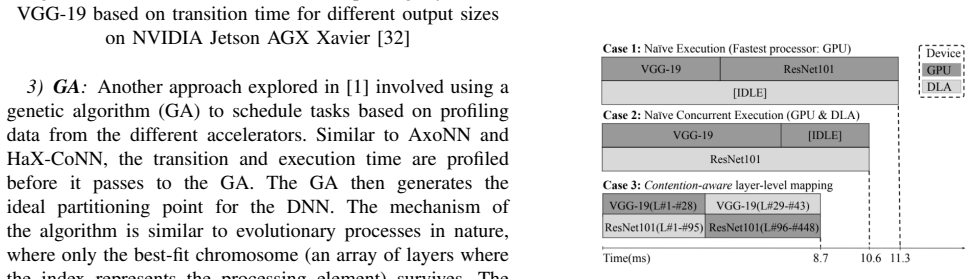
The object that carries the argument is the layer-to-device mapping problem on a heterogeneous system-on-chip: each layer $N_n$ of a DNN is assigned to a processing element $s(N_n)$ (CPU, GPU, or DLA), and the cost of a schedule is the sum of per-layer latency or energy plus a transition cost $\tau$ whenever consecutive layers run on different devices. The review uses this formalism to classify schedulers by how they choose the transition point: heuristic search (Jedi, CP-CNN), linear programming (LP), satisfiability-modulo-theories solvers (AxoNN, HaX-CoNN), or evolutionary algorithms (GA, Map-and-Conquer, MaGNAS). It then uses the comparative tables to explain why most schedulers converge on one DLA-to-GPU transition: frequent switching adds data-transfer overhead and solver time.
What would settle it
Run one of the surveyed schedulers, for example Jedi or HaX-CoNN, on a Jetson AGX Orin with the same DNNs used in the original papers, and check whether the optimal transition layer and measured speedups match the Xavier results; a mismatch would refute the claim that the devices are similar enough for results to transfer. In addition, a single published scheduler that assigns DNN layers to the PVA or VIC, or a TensorRT release that allows such assignments, would directly contradict the paper's stated gap.
Extended reading notes
Core claim
The paper's central claim is that, for NVIDIA Jetson AGX devices that include a DLA, the dominant and most effective scheduling strategy is to split each DNN once, running the early feature-extraction layers on the DLA and the later detection or classification layers on the GPU, with a single transition between the two. It further argues that among the reviewed schedulers, HaX-CoNN is the most versatile for multi-DNN workloads because its satisfiability-based search handles concurrent and changing DNN sets, while Map-and-Conquer is the most adaptable in model architecture because it parallelizes individual inference stages horizontally and supports transformer models. The review also claims that the PVA and VIC accelerators remain entirely unused by schedulers, and that NVIDIA frameworks such as TensorRT and DeepStream prevent DNN layers from being assigned to them, leaving a concrete opportunity for future work.
Load-bearing premise
The comparisons and rankings assume that throughput, latency, and energy numbers taken from different papers, measured on different setups and hardware, are comparable enough to rank, and that results measured on the Xavier carry over to the Orin because the two devices are 'similar architecturally.'
Editorial extensions
If this is right
- If the review's map is right, a practitioner choosing a scheduler for Jetson AGX can select by workload type: HaX-CoNN for concurrent multi-DNN streams, CP-CNN or Jedi for real-time frames of one detector, and AxoNN or Map-and-Conquer for energy-constrained inference.
- The single-transition DLA-to-GPU pattern implies that future schedulers can be simplified: most gains come from one carefully placed cut point rather than from frequent layer switching.
- Because no scheduler uses PVA or VIC, adding those accelerators to the partition space could yield further speedups or energy savings without changing the core scheduling methods.
- The claim that Orin behaves like Xavier implies that existing schedulers can be ported to Orin without re-profiling, which would save substantial engineering effort if true.
- TensorRT's restriction of DNN layers to DLA or GPU means that until NVIDIA's toolchain changes, PVA and VIC use will be limited to pre- and post-processing, bounding what any scheduler can do.
Reading between the lines
- Beyond the paper: the approximate energy values for Jedi and GA in Table I suggest the quantitative rankings are weaker than the qualitative ordering, so a controlled re-benchmark on identical hardware would be needed to confirm the throughput and energy comparisons.
- Beyond the paper: if the Xavier-to-Orin architectural-similarity premise fails, the field's reliance on Xavier measurements may have to be revisited; one concrete test is to run Jedi or HaX-CoNN on Orin and compare the chosen transition point.
- Beyond the paper: the review's gap analysis suggests a research program of extending existing schedulers to a three- or four-accelerator partition space (DLA plus GPU plus PVA plus VIC) once NVIDIA's layer-assignment constraints are relaxed or worked around.
- Beyond the paper: as the field moves toward LLM inference on edge devices, the single-transition DLA-GPU pattern may need re-examination for transformer layers, which Map-and-Conquer already handles but most other schedulers do not.
Editorial analysis
A structured set of objections, weighed in public.
Referee Report
Summary. This paper is a literature review of DNN scheduling techniques for NVIDIA Jetson edge devices, covering ten schedulers (Jedi, CP-CNN, Herald, H2H, LP, AxoNN, GA, HaX-CoNN, Map-and-Conquer, MaGNAS). It organizes the field according to heuristic versus optimization-based methods, static versus dynamic behavior, and inter- versus intra-accelerator parallelism, and it compares reported performance on the Jetson AGX Xavier. The review identifies the absence of schedulers that use the PVA and VIC accelerators and notes that TensorRT restricts DNN layer assignment to DLA or GPU. Its main conclusions are that the field tends toward a single DLA-to-GPU transition point, that HaX-CoNN is particularly versatile for multi-DNN workloads, that Map-and-Conquer is flexible in model architecture, and that CP-CNN and Jedi are suitable for real-time single-DNN workloads.
Significance. If the reported comparisons are reliable, the paper offers a useful structured map of a small but fast-moving literature and identifies a concrete gap: no scheduler exploits the PVA or VIC accelerators, and NVIDIA's frameworks currently block such use for DNN layers. The taxonomy is sensible, the gap analysis is actionable, and the paper usefully distinguishes static from dynamic schedulers and horizontal from vertical partitioning. The review contains no original measurements, so its value depends entirely on faithful and internally consistent reporting of the surveyed papers. That consistency currently fails at a load-bearing point: the energy comparison in Table I contradicts the text's quantitative claim, and the table mixes non-commensurable rows. The review also extends Xavier-era results to the Orin without support, despite its own description of architectural differences. These problems are repairable, but they undermine the central comparative claims as written.
major comments (3)
- [Section IV and Table I] The text states that 'CP-CNN reduces the energy consumed per image by 62% to 84%,' but Table I lists GPU-only energy at 329-460 mJ per image and CP-CNN at 306 mJ, which corresponds to a reduction of only about 7% to 33%. Either the 62-84% figure is against a different baseline than the table's GPU-only column, or the table is incorrect. Because this comparison is the basis for the later claim that CP-CNN is ideal for real-time single-DNN workloads, the discrepancy must be resolved by recomputing the table with a single clearly defined baseline or by explicitly reporting the original baselines from [8].
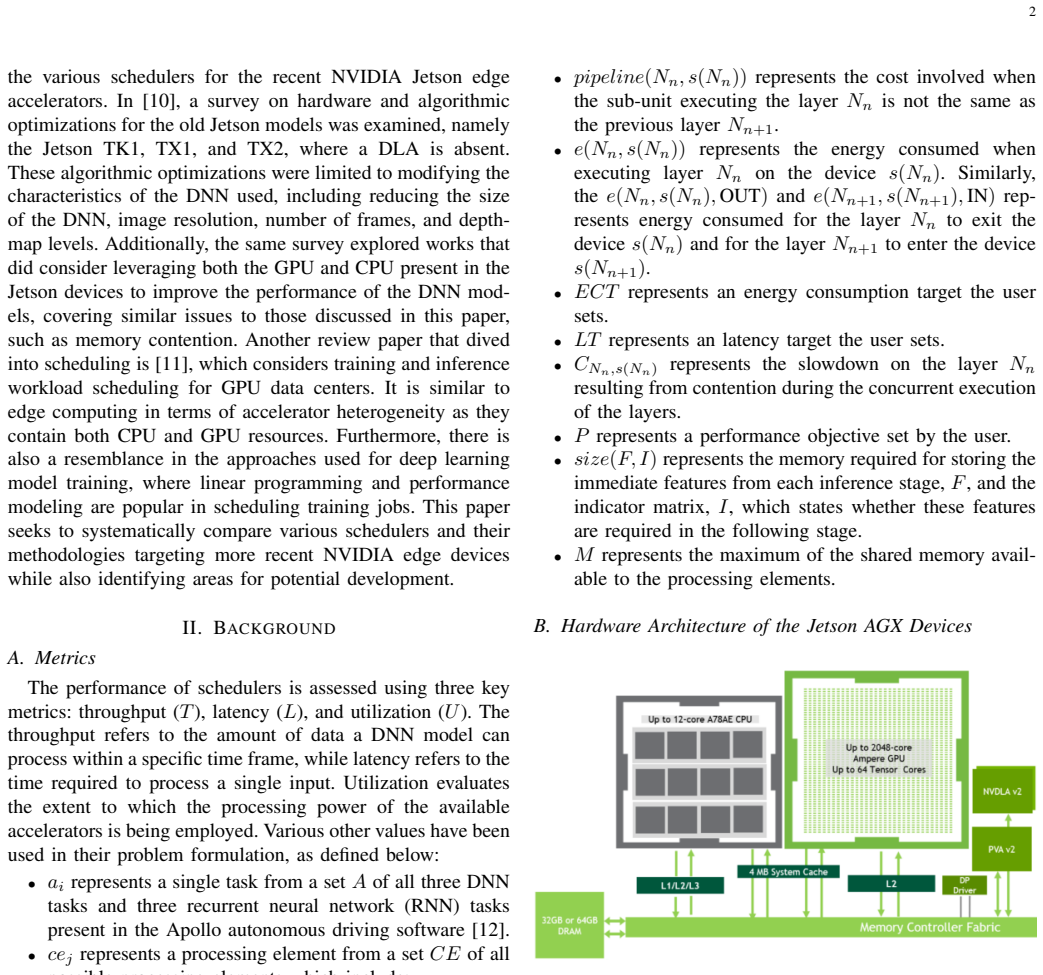
- [Section III] The claim that 'since both Xavier and Orin device are similar architecturally, the schedulers are expected to function similarly' is load-bearing for the paper's stated scope of 'more recent NVIDIA edge devices,' but it is unsupported. Section II documents substantial differences between the two platforms: Volta versus Ampere GPUs, different DLA versions, different CPU cores, an added L2 cache in the Orin PVA, different VIC frequency limits, and different memory systems. No Orin measurements or quantitative invariance argument are provided. This extrapolation should be either backed with data or explicitly reframed as an untested hypothesis.
- [Table I] The footnote that the energy values for Jedi and GA were 'calculated approximately by dividing the energy by the number of images used for inference' makes the rows non-commensurable with the GPU-only and CP-CNN rows, which are presented as per-image measurements. Adding a GPU-only range taken from two different papers further mixes baselines. As constructed, Table I cannot support the cross-scheduler ranking in Section IV or the conclusion that Jedi and CP-CNN are leading choices for real-time single-DNN workloads. The authors should replace the table with a consistent set of measured figures or explicitly state that the rows are not directly comparable and remove the resulting rankings.
minor comments (5)
- [Abstract] The phrase 'optimal execution of optimal execution of deep neural network' contains a duplicated phrase and should be corrected to 'optimal execution of deep neural networks'.
- [Throughout] The accelerator is sometimes written as 'PV A' with a space (e.g., in the abstract and Section II.B); the standard abbreviation 'PVA' should be used consistently.
- [Section IV] The sentence 'the increasing throughput across the different models does not cause an increase in power consumption, which is usually not the case' is unclear: it should specify whether the usual expectation is that power grows with throughput, and it should distinguish between total power and energy per inference.
- [Sections II.D.5 and IV] The taxonomy defines horizontal scheduling as width-wise partitioning of a model, but Section IV attributes Jedi's improvement to 'horizontal parallelization occurring within the accelerators,' which seems to refer to intra-accelerator multistreaming. These uses of 'horizontal' should be reconciled to avoid confusing the reader.
- [Table I] The blank cells for CP-CNN's latency and throughput and for Jedi's latency are unexplained; adding 'not reported' or a dash with a note would make the table easier to interpret.
Circularity Check
No internal circularity: the review synthesizes externally measured scheduler results and performs no derivation that reduces to its own inputs.
full rationale
This is a critical review of ten external schedulers for NVIDIA Jetson devices. The review authors are not authors of any surveyed scheduler, and the comparative tables and figures are drawn from the cited primary papers (e.g., [7], [8], [33]). The paper performs no fitting, no prediction from its own model, and no derivation whose conclusion is equivalent to its premises. The central claims—that Jedi and CP-CNN are leading for single-DNN real-time workloads, that HaX-CoNN is versatile for multi-DNN, and that Map-and-Conquer supports transformer-like architectures—are summaries of externally reported measurements and methodologies, not results manufactured by the review itself. The self-citations among the surveyed papers (e.g., HaX-CoNN and AxoNN share authors [7], [32]) are not load-bearing for this review's own argument, since the review merely reports their stated numbers and does not invoke any uniqueness theorem or ansatz from those papers to justify its own categories. The reviewer's noted issues are correctness and comparability concerns, not circularity: the Table I footnote that energy values for Jedi and GA were 'calculated approximately by dividing the energy by the number of images used for inference' weakens cross-scheduler comparability, and the statement that 'Since both Xavier and Orin device are similar architecturally, the schedulers are expected to function similarly' is an untested extrapolation, but neither reduces the review's conclusions to its inputs by construction. The apparent contradiction between the claimed '62% to 84%' energy reduction for CP-CNN and the Table I values (329–460 mJ GPU-only vs 306 mJ CP-CNN) is an internal consistency or sourcing defect in the reviewed data, not a circularity in the review's reasoning. The paper is self-contained as a literature survey; its value depends on the reliability of its sources and the fairness of its comparisons, which are external-evidence limitations rather than circular derivation. Therefore the circularity score is 0.
Assumptions & free parameters
assumptions (3)
- domain assumption Benchmark numbers reported in the surveyed papers are accurate and sufficiently comparable across papers to support the rankings in Tables I and II.
- domain assumption Xavier and Orin are architecturally similar enough that schedulers developed and tuned on Xavier will function similarly on Orin.
- domain assumption The surveyed set of ten schedulers is comprehensive, including the negative claim that no scheduler uses the PVA or VIC accelerators.
Cite this review
Pith. "Pith review of Scheduling Techniques of AI Models on Modern Heterogeneous Edge GPU -- A Critical Review." pith.science (2026). https://pith.science/paper/CMM6YIKM
@misc{pith2026250601377,
  author       = {Pith},
  title        = {Pith review of: Scheduling Techniques of AI Models on Modern Heterogeneous Edge GPU -- A Critical Review},
  year         = {2026},
  howpublished = {\url{https://pith.science/paper/CMM6YIKM}},
  note         = {Machine review of arXiv:2506.01377}
}
read the original abstract
In recent years, the development of specialized edge computing devices has significantly increased, driven by the growing demand for AI models. These devices, such as the NVIDIA Jetson series, must efficiently handle increased data processing and storage requirements. However, despite these advancements, there remains a lack of frameworks that automate the optimal execution of optimal execution of deep neural network (DNN). Therefore, efforts have been made to create schedulers that can manage complex data processing needs while ensuring the efficient utilization of all available accelerators within these devices, including the CPU, GPU, deep learning accelerator (DLA), programmable vision accelerator (PVA), and video image compositor (VIC). Such schedulers would maximize the performance of edge computing systems, crucial in resource-constrained environments. This paper aims to comprehensively review the various DNN schedulers implemented on NVIDIA Jetson devices. It examines their methodologies, performance, and effectiveness in addressing the demands of modern AI workloads. By analyzing these schedulers, this review highlights the current state of the research in the field. It identifies future research and development areas, further enhancing edge computing devices' capabilities.
Figures


Figures from the paper (10 more)




Reference graph
Works this paper leans on
-
[8]
D. Chun, J. Choi, H.-J. Lee, and H. Kim, “CP-CNN: Computational Parallelization of CNN-Based Object Detectors in Heterogeneous Em- bedded Systems for Autonomous Driving,” IEEE Access , vol. 11, pp. 52 812–52 823, 2023
work page 2023
-
[1]
Scheduling of Deep Learning Applications Onto Heterogeneous Processors in an Embedded Device,
D. Kang, J. Oh, J. Choi, Y . Yi, and S. Ha, “Scheduling of Deep Learning Applications Onto Heterogeneous Processors in an Embedded Device,” IEEE Access , vol. 8, pp. 43 980–43 991, 2020
work page 2020
-
[2]
Deadline-Based Scheduling for GPU with Preemption Support,
N. Capodieci, R. Cavicchioli, M. Bertogna, and A. Paramakuru, “Deadline-Based Scheduling for GPU with Preemption Support,” in 2018 IEEE Real-Time Systems Symposium (RTSS) , Dec 2018, pp. 119– 130
work page 2018
-
[3]
Deep Learning- Based Pedestrian Detection Using RGB Images and Sparse LiDAR Point Clouds,
H. Xu, S. Huang, Y . Yang, X. Chen, and S. Hu, “Deep Learning- Based Pedestrian Detection Using RGB Images and Sparse LiDAR Point Clouds,” IEEE Transactions on Industrial Informatics , vol. 20, no. 5, pp. 7149–7161, May 2024
work page 2024
-
[4]
S. Protasov, P. Karpyshev, I. Kalinov, P. Kopanev, N. Mikhailovskiy, A. Sedunin, and D. Tsetserukou, “CNN-based Omnidirectional Object Detection for HermesBot Autonomous Delivery Robot with Preliminary Frame Classification,” in 2021 20th International Conference on Ad- vanced Robotics (ICAR) , 2021, pp. 517–522
work page 2021
-
[5]
Saildrone Charts Autonomous Oceanic Monitoring — resources.nvidia.com,
S. Martin, “Saildrone Charts Autonomous Oceanic Monitoring — resources.nvidia.com,” 2023, (Accessed Apr. 17, 2025). [Online]. Available: https://resources.nvidia.com/en-us-jetson-success/saildrone- autonomous?lx=XRDs y&ncid=no-ncid
work page 2023
-
[6]
Small Object Few-Shot Segmentation for Vision-Based Industrial Inspection,
Z. Zhang, C. Niu, Z. Zhao, X. Zhang, and X. Chen, “Small Object Few-Shot Segmentation for Vision-Based Industrial Inspection,” IEEE Transactions on Industrial Informatics , pp. 1–12, 2025
work page 2025
-
[7]
I. Dagli and M. E. Belviranli, “Shared Memory-contention-aware Concurrent DNN Execution for Diversely Heterogeneous System-on- Chips,” in Proceedings of the 29th ACM SIGPLAN Annual Symposium on Principles and Practice of Parallel Programming , ser. PPoPP ’24. New York, NY , USA: Association for Computing Machinery, 2024, p. 243–256. [Online]. Available: h...
Show all 43 references
-
[9]
Generative inference of large language models in edge computing: An energy efficient approach,
X. Yuan, H. Li, K. Ota, and M. Dong, “Generative inference of large language models in edge computing: An energy efficient approach,” in 2024 International Wireless Communications and Mobile Computing (IWCMC), May 2024, pp. 244–249
2024
-
[10]
A Survey on optimized implementation of deep learning models on the NVIDIA Jetson platform,
S. Mittal, “A Survey on optimized implementation of deep learning models on the NVIDIA Jetson platform,” Journal of Systems Architecture, vol. 97, pp. 428–442, 2019. [Online]. Available: https://www.sciencedirect.com/science/article/pii/S1383762118306404
2019
-
[11]
Deep Learning Workload Scheduling in GPU Datacenters: A Survey,
Z. Ye, W. Gao, Q. Hu, P. Sun, X. Wang, Y . Luo, T. Zhang, and Y . Wen, “Deep Learning Workload Scheduling in GPU Datacenters: A Survey,” ACM Comput. Surv. , vol. 56, no. 6, Jan. 2024. [Online]. Available: https://doi.org/10.1145/3638757
2024 doi
-
[12]
Baidu Apollo Team, Apollo: Open Source Autonomous Driving,
“Baidu Apollo Team, Apollo: Open Source Autonomous Driving,” 2017, (Accessed Apr. 17, 2025). [Online]. Available: https://github. com/ApolloAuto/apollo
2017
-
[13]
NVIDIA Jetson AGX Orin Series,
L. S. Karumbunathan, “NVIDIA Jetson AGX Orin Series,” 2022, (Accessed Apr. 17, 2025). [Online]. Available: https://www.nvidia.com/content/dam/en-zz/Solutions/gtcf21/ jetson-orin/nvidia-jetson-agx-orin-technical-brief.pdf
2022
-
[14]
NVIDIA Jetson AGX Xavier System-on-Module Data Sheet,
“NVIDIA Jetson AGX Xavier System-on-Module Data Sheet,” 2018, (Accessed Apr. 17, 2025). [Online]. Available: https://developer.nvidia. com/embedded/downloads#?tx=$product,jetson agx xavier
2018
-
[15]
NVIDIA Orin Series System-on-Chip Technical Reference Manual,
“NVIDIA Orin Series System-on-Chip Technical Reference Manual,” 2023, (Accessed Apr. 17, 2025). [Online]. Available: https://developer. nvidia.com/embedded/downloads#?tx=$product,jetson agx orin
2023
-
[16]
NVIDIA Jetson AGX Orin Series Data Sheet,
“NVIDIA Jetson AGX Orin Series Data Sheet,” 2023, (Accessed Apr. 17, 2025). [Online]. Available: https://developer.nvidia.com/embedded/ downloads#?tx=$product,jetson agx orin
2023
-
[17]
Hardware Architectural Specification — NVDLA Documentation,
“Hardware Architectural Specification — NVDLA Documentation,” 2014, (Accessed Apr. 17, 2025). [Online]. Available: https://nvdla.org/ hw/v1/hwarch.html
2014
-
[18]
NVIDIA Jetson AGX Xavier Delivers 32 Teraops for New Era of AI in Robotics,
D. Franklin, “NVIDIA Jetson AGX Xavier Delivers 32 Teraops for New Era of AI in Robotics,” 2018, (Accessed Apr. 17, 2025). [Online]. Available: https://developer.nvidia.com/blog/nvidia- jetson-agx-xavier-32-teraops-ai-robotics/ 12
2018
-
[19]
NVIDIA Xavier Series System-on-Chip,
“NVIDIA Xavier Series System-on-Chip,” 2020, (Accessed Apr. 17, 2025). [Online]. Available: https://developer.nvidia.com/embedded/ downloads#?tx=$product,jetson agx xavier
2020
-
[20]
Jetson Orin Nano Series, Jetson Orin NX Series and Jetson AGX Orin Series,
“Jetson Orin Nano Series, Jetson Orin NX Series and Jetson AGX Orin Series,” 2024, (Accessed Apr. 17, 2025). [Online]. Available: https://docs.nvidia.com/jetson/ archives/r35.5.0/DeveloperGuide/SD/PlatformPowerAndPerformance/ JetsonOrinNanoSeriesJetsonOrinNxSeriesAndJetsonAgxO...
2024
-
[21]
Jetson Xavier NX Series and Jetson AGX Xavier Series,
“Jetson Xavier NX Series and Jetson AGX Xavier Series,” 2024, (Accessed Apr. 17, 2025). [Online]. Available: https://docs.nvidia.com/jetson/archives/ r35.5.0/DeveloperGuide/SD/PlatformPowerAndPerformance/ JetsonXavierNxSeriesAndJetsonAgxXavierSeries.html#supported- modes-and-p...
2024
-
[22]
MEPHESTO: Modeling Energy-Performance in Heterogeneous SoCs and Their Trade-Offs,
M. A. H. Monil, M. E. Belviranli, S. Lee, J. S. Vetter, and A. D. Malony, “MEPHESTO: Modeling Energy-Performance in Heterogeneous SoCs and Their Trade-Offs,” in Proceedings of the ACM International Conference on Parallel Architectures and Compilation Techniques, ser. PACT ’20....
2020
-
[23]
17, 2025)
“CUDA,” 2025, (Accessed Apr. 17, 2025). [Online]. Available: https://docs.nvidia.com/cuda/cuda-toolkit-release-notes/index.html
2025
-
[24]
17, 2025)
“cuBLAS,” 2025, (Accessed Apr. 17, 2025). [Online]. Available: https://docs.nvidia.com/cuda/cublas/
2025
-
[25]
Working with DLA,
“Working with DLA,” 2025, (Accessed Apr. 17, 2025). [Online]. Available: https://docs.nvidia.com/deeplearning/tensorrt/latest/inference- library/work-with-dla.html
2025
-
[26]
DeepStream Documentation,
“DeepStream Documentation,” 2025, (Accessed Apr. 17, 2025). [Online]. Available: https://docs.nvidia.com/metropolis/deepstream/dev- guide/text/DS Overview.html
2025
-
[27]
Convert Image Format,
“Convert Image Format,” 2024, (Accessed Apr. 17, 2025). [Online]. Available: https://docs.nvidia.com/vpi/algo imageconv.html
2024
-
[28]
PCCS: Processor- Centric Contention-aware Slowdown Model for Heterogeneous System- on-Chips,
Y . Xu, M. E. Belviranli, X. Shen, and J. Vetter, “PCCS: Processor- Centric Contention-aware Slowdown Model for Heterogeneous System- on-Chips,” in MICRO-54: 54th Annual IEEE/ACM International Symposium on Microarchitecture , ser. MICRO ’21. New York, NY , USA: Association for...
2021
-
[29]
Google Neural Network Models for Edge Devices: Analyzing and Mitigating Machine Learning Inference Bottlenecks,
A. Boroumand, S. Ghose, B. Akin, R. Narayanaswami, G. F. Oliveira, X. Ma, E. Shiu, and O. Mutlu, “Google Neural Network Models for Edge Devices: Analyzing and Mitigating Machine Learning Inference Bottlenecks,” in Proceedings of the 30th International Conference on Parallel Ar...
2024
-
[30]
Rescale,
“Rescale,” 2024, (Accessed Apr. 17, 2025). [Online]. Available: https://docs.nvidia.com/vpi/algo rescale.html
2024
-
[31]
Working with DLA - DLA Supported Layers and Restrictions,
“Working with DLA - DLA Supported Layers and Restrictions,” 2022, (Accessed Apr. 17, 2025). [On- line]. Available: https://docs.nvidia.com/deeplearning/tensorrt/archives/ tensorrt-853/developer-guide/index.html#dla layers
2022
-
[33]
TensorRT-Based Framework and Optimization Methodology for Deep Learning Inference on Jetson Boards,
E. Jeong, J. Kim, and S. Ha, “TensorRT-Based Framework and Optimization Methodology for Deep Learning Inference on Jetson Boards,” ACM Trans. Embed. Comput. Syst. , vol. 21, no. 5, Oct. 2022. [Online]. Available: https://doi.org/10.1145/3508391
2022 doi
-
[34]
Heterogeneous Dataflow Accelerators for Multi-DNN Workloads ,
H. Kwon, L. Lai, M. Pellauer, T. Krishna, Y .-H. Chen, and V . Chandra, “ Heterogeneous Dataflow Accelerators for Multi-DNN Workloads ,” in 2021 IEEE International Symposium on High-Performance Computer Architecture (HPCA) . Los Alamitos, CA, USA: IEEE Computer Society, March ...
2021
-
[35]
H2H: heterogeneous model to heterogeneous system mapping with computation and communication awareness,
X. Zhang, C. Hao, P. Zhou, A. Jones, and J. Hu, “H2H: heterogeneous model to heterogeneous system mapping with computation and communication awareness,” in Proceedings of the 59th ACM/IEEE Design Automation Conference , ser. DAC ’22. New York, NY , USA: Association for Computi...
2022
-
[36]
Generating and Exploiting Deep Learning Variants to Increase Heterogeneous Resource Utilization in the NVIDIA Xavier,
R. Pujol, H. Tabani, L. Kosmidis, E. Mezzetti, J. Abella, and F. J. Cazorla, “Generating and Exploiting Deep Learning Variants to Increase Heterogeneous Resource Utilization in the NVIDIA Xavier,” in 31st Euromicro Conference on Real-Time Systems (ECRTS 2019) , ser. Leibniz In...
2019
-
[37]
OpenMP: an industry standard API for shared-memory programming,
L. Dagum and R. Menon, “OpenMP: an industry standard API for shared-memory programming,” IEEE Computational Science and En- gineering, vol. 5, no. 1, pp. 46–55, Jan 1998
1998
-
[38]
Z3: An Efficient SMT Solver,
L. de Moura and N. Bjørner, “Z3: An Efficient SMT Solver,” in Tools and Algorithms for the Construction and Analysis of Systems , C. R. Ramakrishnan and J. Rehof, Eds. Berlin, Heidelberg: Springer Berlin Heidelberg, 2008, pp. 337–340
2008
-
[39]
Map-and-Conquer: Energy-Efficient Mapping of Dynamic Neural Nets onto Heterogeneous MPSoCs,
H. Bouzidi, M. Odema, H. Ouarnoughi, S. Niar, and M. A. Al Faruque, “Map-and-Conquer: Energy-Efficient Mapping of Dynamic Neural Nets onto Heterogeneous MPSoCs,” in 2023 60th ACM/IEEE Design Automa- tion Conference (DAC) , July 2023, pp. 1–6
2023
-
[40]
Toward Collaborative Inferencing of Deep Neural Networks on Internet-of-Things Devices,
R. Hadidi, J. Cao, M. S. Ryoo, and H. Kim, “Toward Collaborative Inferencing of Deep Neural Networks on Internet-of-Things Devices,” IEEE Internet of Things Journal , vol. 7, no. 6, pp. 4950–4960, June 2020
2020
-
[41]
XGBoost: A Scalable Tree Boosting System,
T. Chen and C. Guestrin, “XGBoost: A Scalable Tree Boosting System,” in Proceedings of the 22nd ACM SIGKDD International Conference on Knowledge Discovery and Data Mining , ser. KDD ’16. New York, NY , USA: Association for Computing Machinery, 2016, p. 785–794. [Online]. Avail...
2016
-
[42]
MaGNAS: A Mapping-Aware Graph Neural Architecture Search Framework for Heterogeneous MPSoC Deployment,
M. Odema, H. Bouzidi, H. Ouarnoughi, S. Niar, and M. A. Al Faruque, “MaGNAS: A Mapping-Aware Graph Neural Architecture Search Framework for Heterogeneous MPSoC Deployment,” ACM Trans. Embed. Comput. Syst. , vol. 22, no. 5s, Sep. 2023. [Online]. Available: https://doi.org/10.11...
2023 doi
-
[43]
Gst-nvtracker,
“Gst-nvtracker,” 2025, (Accessed Apr. 17, 2025). [Online]. Avail- able: https://docs.nvidia.com/metropolis/deepstream/dev-guide/text/DS plugin gst-nvtracker.html
2025
-
[44]
SCHED²: Scheduling Deep Learning Training via Deep Reinforcement Learning,
Y . Luan, X. Chen, H. Zhao, Z. Yang, and Y . Dai, “SCHED²: Scheduling Deep Learning Training via Deep Reinforcement Learning,” in 2019 IEEE Global Communications Conference (GLOBECOM) , Dec 2019, pp. 1–7
2019
Reviewed August 7, 2026 · model on record in the stance chip above.
Discussion (0). Sign in to comment.