REVIEW 3 major objections 6 minor 3 references
Generalizing Co-operative Evaporation in Two-Dimensional Droplet Arrays
T0 review · 3 major / 6 minor · reviewed 2026-08-14 · deepseek-v4-flash
Pith's one-line read A droplet's evaporation lifetime in a two-dimensional array depends only on the area of its Voronoi cell, not on the positions of its neighbors.
desk verdict A genuinely useful Voronoi-based lifetime scaling for arbitrary 2D droplet arrays, but the universal prediction is only as strong as the provenance of the two constants A and β. read the letter →
The pith
A machine-rendered reading of the paper's core claim, the machinery that carries it, and where it could break.
The reading
What carries the argument
The central object is the Voronoi tessellation of the droplet array, which partitions the plane into cells $A_v$; each cell is the spatial footprint of vapor confinement belonging to one droplet. The load-bearing quantity is the confinement ratio $A_{df}/A_v$, which enters linearly in the lifetime scaling and absorbs all geometric information about the array. The mechanism is a two-resistance diffusion model: Fickian escape from the droplet surface to the uniform confinement concentration $c'_\infty$ is coupled to one-dimensional vertical diffusion through the cell area to the ambient, and the product of the two resistances produces the coefficient $2A\beta f(\theta_{ci})$ (with an additional $\mathrm{cosec}^2\theta_{ci}$ factor for hydrophobic substrates). The accumulation length $\bar{L}_a$, the distance over which the vapor relaxes to the ambient, is scaled as $\beta R_{ci}$ with $\beta \sim 4$, fixing the theory with no free fitting parameters. Transient vapor-front merging is neglected because its timescale, $10^{-2}$–$10^{-1}$ s, is far shorter than the droplet lifetime, $\sim 10^3$ s.
What would settle it
Print two droplet arrays whose center droplets have identical $A_{df}/A_v$ but very different cell shapes—one compact hexagonal cell and one long, thin cell—and measure the center-droplet lifetimes; if they differ beyond experimental scatter, the Voronoi-area-only description fails. A complementary check is a 3D diffusion simulation of both geometries that includes lateral vapor flux between cells.
Extended reading notes
Core claim
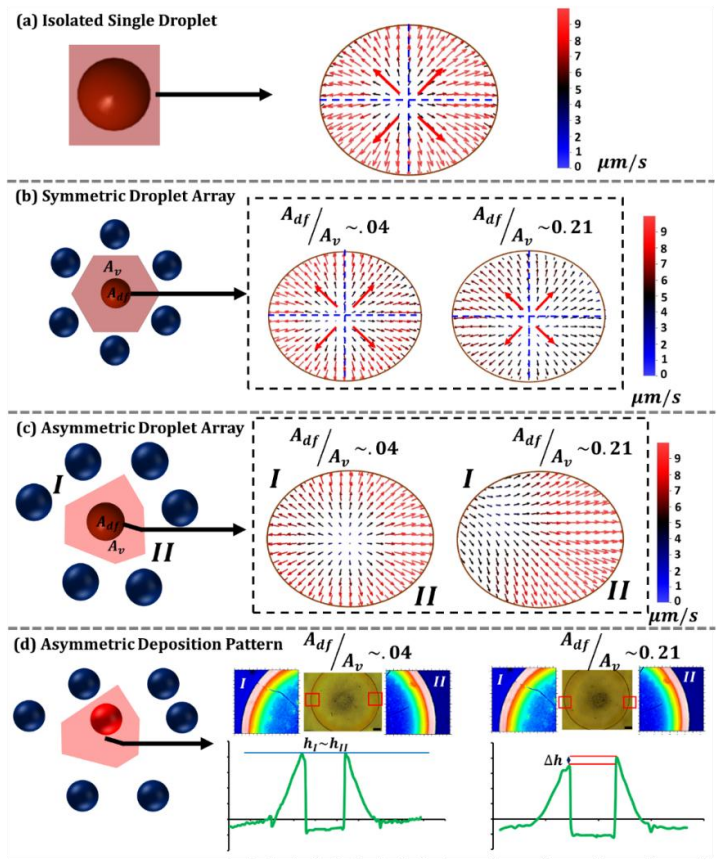
The paper's central claim is that cooperative evaporation in a 2D droplet array is universal in a specific sense: the lifetime of a droplet relative to an isolated one is insensitive to the relative positions of surrounding droplets and to the asymmetry of the array, and is uniquely determined by the Voronoi tessellation area $A_v$. The supporting model treats evaporation in two steps: vapor first diffuses from the droplet surface to a quasi-uniform 'confinement' region with concentration $c'_\infty$, then escapes vertically through the cell cross-section $A_v$ to the ambient. Equating these fluxes yields the predictive formulas of Eqs. (7)-(8), $t_c/t_{uc} = 1 + [2A\beta f(\theta_{ci})]\,A_{df}/A_v$ for hydrophilic substrates and the corresponding cosecant-weighted form for hydrophobic ones, with $\beta \approx 4$ and $f(\theta)$ the standard single-droplet function. The paper reports that measurements across substrates, particle loadings, and symmetric versus asymmetric layouts collapse onto this trend, and that the earlier flat-superdrop model overshoots to a factor of two in sparse arrays while the new model agrees with experiments. A companion result is that high confinement combined with geometric asymmetry breaks the radial symmetry of local evaporation flux, generating a unidirectional internal flow and preferential deposition of particles at the less-confined side of the droplet.
Load-bearing premise
The model assumes that after a short transient, the vapor in each Voronoi cell is well mixed and escapes only straight upward through the cell's area, so neighboring cells do not trade vapor sideways.
Editorial extensions
If this is right
- For any 2D droplet array, a top-view image plus the initial contact angle is enough to predict each droplet's evaporation lifetime: compute the Voronoi cell area and read $t_c/t_{uc}$ from the linear law.
- The universal scaling extends to disordered and asymmetric arrays and to nanoparticle-laden droplets (0.5–5 wt% tested), so pattern-level evaporation control does not require resolving pairwise interactions.
- Sparse arrays are handled correctly, where the earlier superdrop approximation breaks down and overshoots the lifetime ratio to 2.
- Asymmetry can be used as a design input: at high confinement, an asymmetric array creates a unidirectional internal flow and moves particles preferentially to the less-confined side, without changing the global drying time.
- Substrate wettability enters only through known functions of $\theta_{ci}$, so the same formula is expected to hold for any droplet-substrate combination within the model's validity.
Reading between the lines
- The same Voronoi reduction suggests a mean-field structure, so the scaling might extend to polydisperse or three-dimensionally arranged droplets through weighted (power) Voronoi diagrams; the paper does not test this.
- Because global lifetime and internal flow direction are decoupled, one could deliberately distort an array to pattern deposits while holding all droplet lifetimes fixed, which is a design strategy the paper hints at but does not fully develop.
- A boundary of the model is likely at very low confinement (large, elongated cells), where lateral vapor exchange between cells should become comparable to vertical escape; locating where the linear law breaks is a natural next test.
- A full 3D diffusion simulation with the same droplet positions could independently verify whether the lifetime collapse on $A_{df}/A_v$ is exact or only approximate; if substantial deviations appear, a correction term based on cell shape would be needed.
Signed reviews
Editorial analysis
A structured set of objections, weighed in public.
Referee Report
Summary. The manuscript proposes a generalized theoretical description of the evaporation lifetime of droplets arranged in arbitrary two-dimensional arrays. The central idea is to quantify vapor-mediated confinement by the Voronoi tessellation area A_v of each droplet. Evaporation is modeled as two serial diffusion steps: first from the droplet surface to a vapor-rich confinement region, and then vertically through the cell area A_v to the ambient. The resulting scaling, Eqs. (7)-(8), predicts t_c/t_uc as a linear function of A_df/A_v with a slope that depends only on the initial contact angle through known functions and the constants A and beta. The authors validate the prediction with experiments on glass, PDMS, GDL, and several other substrates, for symmetric and asymmetric arrays, and for nanoparticle-laden droplets. They further report that asymmetric confinement creates directional internal flows that can be exploited for patterned particle deposition.
Significance. If the proposed scaling holds, it provides a remarkably simple and potentially universal predictive tool for droplet lifetimes in arbitrary 2D arrays, covering different substrates, array asymmetries, and particle loadings with a single geometric parameter, the Voronoi cell area. The companion observation that local evaporation flux asymmetries can be tuned independently of global lifetime is also of practical interest for particle-patterning applications. The paper combines a clear physical picture, a compact analytical result, and a broad experimental data set, including several substrate chemistries. The strength of the claim, however, rests on the status of the two constants A and beta, since they enter the prefactor of the central scaling and currently are not derived from first principles or independently calibrated in the main text.
major comments (3)
- [Theory, Eqs. (7)-(8)] The prefactor C(theta) in Eqs. (7)-(8) contains two constants, A and beta, whose values are not established a priori. A is introduced as '~O(1)' immediately before Eq. (1), and beta~4 is stated to follow from Supplementary Figure S5. If A and beta are inferred from the same t_c/t_uc data plotted in Fig. 3, the reported collapse is a two-parameter fit rather than an independent test of the Voronoi-area universality. The authors should either derive A and beta from independent measurements (e.g., unconfined single-droplet decay curves and direct vapor-concentration profiling), or provide a sensitivity analysis showing that a single a priori (A,beta) pair simultaneously collapses all substrates, array geometries, and particle loadings.
- [Eq. (2) and Fig. 3] The vertical-diffusion model in Eq. (2) neglects lateral vapor exchange between neighboring Voronoi cells and in-plane concentration gradients within a cell. The central claim that the lifetime depends only on A_df/A_v, and not on the asymmetry parameter L_max/L_min, would break if lateral exchange contributes appreciably. The manuscript should quantify this contribution, for example by comparing the model with full three-dimensional diffusion simulations for the most asymmetric and most sparse cases tested, or by an explicit estimate of the ratio of lateral to vertical transport (e.g., a geometric factor involving A_v^{1/2}/L_a) below which lateral exchange is negligible.
- [Eqs. (5)-(6)] The step from the ratio of average volumetric decay rates to the ratio of lifetimes implicitly assumes that the initial droplet volume is the same for confined and unconfined droplets and that both evaporate to zero volume. More importantly, the model uses only the initial contact radius and angle, R_ci and theta_ci, in the rate expressions (1) and (7)-(8). For droplets evaporating in constant-angle, constant-radius, or stick-slip modes, R and theta vary with time, and f(theta) is a function of the instantaneous angle. The authors should state which evaporation mode their experiments follow and justify that A and beta, together with the initial-angle substitution, account for this time dependence.
minor comments (6)
- [Figure 1 caption] The caption reads 'Area of the Voronoi cell, A_v quantifies the of vapor accumulation'; it should read 'quantifies the extent of vapor accumulation'.
- [Throughout] The notation for the accumulation length is inconsistent: the text introduces \bar{L_a}, while Eq. (3) and subsequent equations use L_a without the overbar. Please define the symbol once and use it consistently.
- [Fig. 3 discussion] The statement that 'raw data shows variation of two times' is ambiguous: it could mean two repeated experiments, a factor-of-two spread, or two orders of magnitude. Please clarify and report the number of repeats and the corresponding error bars in Fig. 3.
- [References] The reference list is inconsistent: 'Toledano, P., Mettout, B., Aroyo, M., & Mato, J. P.' appears in the text as both 'Toledano' and 'Tolédano'; please standardize the spelling.
- [Eq. (8)] The intermediate denominator A_v cosec^2(theta_ci) is algebraically correct but easy to misread; inserting A_df explicitly in the final line would help the reader follow the simplification.
- [Experimental methods] The text says a '5 X 5 two-dimensional droplet array' with the center droplet 'surrounded by six adjacent droplets'; this implies a hexagonal packing rather than a square grid. Please clarify the actual arrangement used.
Circularity Check
The Voronoi-area scaling has independent geometric content, but the predictive slope in Eqs. (7)-(8) depends on constants A and β that are not derived a priori, so part of the claimed prediction is imported from the same study's measurements.
-
fitted input called prediction
[Section 'In an effort to develop a simple theory...', preceding Eq. (7) and Eqs. (7)-(8)]
"Therefore, L_a can be scaled as βR_ci, and β~4 (Supplementary Figure S5). ... Here, R_i and θ_i are the initial droplet contact radius and contact angle respectively, and A is a constant (~O(1)). ... Equations (7) and (8) present a predictive formulation for the evaporation lifetime scaling of sessile droplets confined in a two-dimensional array."
The predicted lifetime ratio in Eqs. (7)-(8) is t_c/t_uc = 1 + C(θ) A_df/A_v with C(θ) proportional to the product A·β. The paper does not derive A or β from first principles: A is only asserted to be ~O(1), and β~4 is cited from Supplementary Figure S5, a measurement made within the same study. The same experimental campaign also supplies the t_c/t_uc data against which Eqs. (7)-(8) are validated in Fig. 3. Therefore, unless A and β were fixed a priori from independent data (which the paper does not demonstrate), the apparent agreement between the theoretical lines and the data is partly a two-parameter fit, and the central quantitative claim reduces to the calibrated constants rather than being a parameter-free prediction.
full rationale
The geometric core of the model—using the Voronoi cell area A_v as the single confinement parameter—is an ansatz rather than a circular result: it enters through the vertical-diffusion assumption in Eq. (2), and the observation that droplet lifetime is independent of array asymmetry is a nontrivial experimental finding. The derivation from Fick's law up to Eq. (6) is algebraically self-contained. However, the final predictive formulas (7)-(8) contain two constants, A and β, that are not fixed by the theory. In particular, β is stated as ~4 from a supplementary measurement of the same research effort, so the slope of the predicted master curve is not fully independent of the data used to validate it. This is a partial circularity: the functional form and the θ-dependence can still be tested, but the quantitative slope is not predicted from first principles. The paper also cites prior work by the same group (Bansal et al., Hatte et al.) for the accumulation-length concept, but that is normal scientific lineage rather than a load-bearing self-citation chain. Overall, the central claim has independent geometric content, but the predictive slope is partly calibrated, giving a score of 4 rather than 0.
Assumptions & free parameters
free parameters (2)
- A =
~O(1) (not specified)
- beta (accumulation length factor) =
~4
assumptions (4)
- standard math Fick's law for an isolated sessile droplet with volume decay rate 2 pi D M R f(theta)(c_s - c_inf)/rho, using the Picknett and Bexon f(theta) correlation.
- domain assumption Quasi-steady two-step vapor diffusion: the vapor concentration in the Voronoi cell is uniform (c'_inf), and escape to the ambient is one-dimensional vertical diffusion through the cell area A_v.
- domain assumption The Voronoi cell area A_v, determined only by the geometric positions of droplet centers, quantitatively represents the effective vapor confinement region for each droplet.
- ad hoc to paper The constant A, relating average to initial evaporation rate, is the same for confined and unconfined droplets and is O(1).
Cite this review
Pith. "Pith review of Generalizing Co-operative Evaporation in Two-Dimensional Droplet Arrays." pith.science (2026). https://pith.science/paper/CMZT5KTO
@misc{pith2026190803705,
  author       = {Pith},
  title        = {Pith review of: Generalizing Co-operative Evaporation in Two-Dimensional Droplet Arrays},
  year         = {2026},
  howpublished = {\url{https://pith.science/paper/CMZT5KTO}},
  note         = {Machine review of arXiv:1908.03705}
}
read the original abstract
Sessile droplets exposed to an incipient condition lead to an inevitable loss of mass, which is critical in many practical applications. By considering an arbitrarily configured two-dimensional array of droplets, here we provide a simple generalized theoretical limit to their lifetime in an evaporating state. Notwithstanding the geometrical and physical complexity of the effective confinement generated due to their cooperative interactions, we show that the consequent evaporation characteristics may be remarkably insensitive to the topographical details of the overall droplet organization, for a wide range of droplet-substrate combinations. With subsequent deployment of particle-laden droplets, however, our results lead to the discovery of a unique pathway towards tailoring the internal flows within the collective system by harnessing an exclusive topologically-driven symmetry breaking phenomenon, yielding a new strategy of patterning particulate matters around the droplet array.
Figures

Reference graph
Works this paper leans on
-
[1]
Aurenhammer, F. (1991). Voronoi diagrams —A survey of a fundamental geometric data str ucture. ACM Computing Surveys (CSUR), 23(3), 345–405. Bansal, L., Chakraborty, S., & Basu, S. (2017 a). Confinement -induced alterations in the evaporation dynamics of sessile droplets. Soft Matter, 13(5), 969–977. Bansal, L., Hatte, S., Basu, S., & Chakrabo rty, S. (20...
work page 1991
-
[744]
Tolédano, P., Mettout, B., Aroyo, M., & Mato, J. P. (2005). Theory of the cooperative evaporation of volatile droplets. Physical Review Letters, 95(20), 205701. Xu, W., & Choi, C. -H. (2012). From sticky to slippery droplets: Dynamics of contact line depinning on superhydrophobic surfaces. Physical Review Letters, 109(2), 024504
work page 2005
-
[1888]
Ghasemi, H., & Ward, C. A. (2010). Energy transport by thermocapillary convection during sessile -water- droplet evaporation. Physical Review Letters, 105(13), 136102. Hatte, S., Pandey, K., Pandey, K., Chakraborty, S., & Basu, S. (2019). Universal evaporation dynamics of ordered arrays of sessile droplets. Journal of Fluid Mechanics, 866, 61–81. Hu, D., ...
work page 2010
Reviewed August 14, 2026 · model on record in the stance chip above.
Discussion (0). Continue with ORCID to comment.