Comment on "Analysis of recent interpretations of the Abraham-Minkowski problem"
Pith reviewed 2026-05-24 20:32 UTC · model grok-4.3
The pith
The flux of rest energy from atoms displaced forward by light must be counted in the total energy flux of the mass polariton.
A machine-rendered reading of the paper's core claim, the machinery that carries it, and where it could break.
Core claim
The atoms and their masses are displaced forward by the field and their displaced rest energies give rise to an energy flux. The difference of arguments between ours and Brevik's culminates on the question whether the flux of rest energy caused by the displacement of the medium moving with light should be included in the total energy flux. We also show that the four-divergence of the stress-energy-momentum tensor of the mass polariton theory of light is zero.
What carries the argument
Mass polariton theory of light, which couples the electromagnetic field to a mass-density wave whose forward displacement carries rest energy.
If this is right
- Brevik's rough estimates of kinetic energy and atomic displacement remain numerically correct but cannot be compared directly to rest-energy contributions.
- The total energy flux of light in a dielectric must incorporate the rest energy transported by the displaced atoms.
- Local conservation holds for the mass polariton because its stress-energy-momentum tensor has vanishing four-divergence.
Where Pith is reading between the lines
- If rest-energy flux is required, momentum-transfer calculations in other dielectric experiments may need re-examination for consistency with the same tensor.
- The irreversibility argument could be tested by repeating the Kundu experiment with faster imaging techniques that resolve elastic transients.
Load-bearing premise
The AFM line scans of the GO film after the laser is switched off occur on a timescale too long for any elastic deformation to persist, so the observed changes must be irreversible.
What would settle it
A time-resolved measurement showing that the GO film deformation relaxes elastically on a timescale shorter than the AFM scan duration would validate the applicability of the optoelastic model.
Figures
read the original abstract
In a recent paper [I. Brevik, Phys. Rev. A 98, 043847 (2018)], Brevik analyzed the experiment by Kundu et al. [A. Kundu et al., Sci. Rep. 7, 42538 (2017)] reporting deformation of a graphene oxide (GO) film after it has been irradiated by a laser beam. The two-dimensional atomic force microscope (AFM) line scanning of the deformation of the GO film after switching off the laser beam takes by far too much time for any elastic changes to remain in the AFM scans. Thus, the changes in the GO film are irreversible and the optoelastic model used by Brevik is not applicable. The rough estimates of the kinetic energy and displacement of atoms by the optical force of a light pulse calculated by Brevik are correct, but in making a comparison with the corresponding high-precision results for the kinetic energy and displacement of atoms in our work [M. Partanen et al., Phys. Rev. A 95, 063850 (2017)], the kinetic energy of atoms is confused with their rest energy. The atoms and their masses are displaced forward by the field and their displaced rest energies give rise to an energy flux. The difference of arguments between ours and Brevik's culminates on the question whether the flux of rest energy caused by the displacement of the medium moving with light should be included in the total energy flux. We also show that the four-divergence of the stress-energy-momentum tensor of the mass polariton theory of light is zero.
Editorial analysis
A structured set of objections, weighed in public.
Referee Report
Summary. This manuscript is a comment critiquing I. Brevik's analysis of the Kundu et al. experiment on laser-induced deformation of a graphene oxide (GO) film. The authors argue that the AFM line scanning after laser switch-off takes too long for elastic changes to remain, making the deformation irreversible and Brevik's optoelastic model inapplicable. They note that Brevik's estimates of kinetic energy and atomic displacement are correct but that he confuses kinetic energy with rest energy when comparing to their prior work. The comment discusses whether the flux of rest energy due to medium displacement should be included in the total energy flux and claims to show that the four-divergence of the stress-energy-momentum tensor in the mass polariton theory is zero.
Significance. Should the timing argument be substantiated with quantitative data, this comment would provide a valid basis for questioning the applicability of the optoelastic model to the Kundu experiment and would highlight an important distinction in energy types relevant to the Abraham-Minkowski controversy. The demonstration of zero four-divergence for the mass polariton tensor is a positive technical contribution if it stands independently. The paper correctly credits Brevik's estimates while challenging the interpretation.
major comments (1)
- [Abstract] Abstract: The assertion that 'the two-dimensional atomic force microscope (AFM) line scanning of the deformation of the GO film after switching off the laser beam takes by far too much time for any elastic changes to remain in the AFM scans' is load-bearing for the conclusion that changes are irreversible and that Brevik's optoelastic model is inapplicable, yet the manuscript supplies no numerical values for either the scan duration (from Kundu et al.) or the elastic/viscoelastic recovery timescale of the GO film. Without this comparison the premise cannot be verified.
minor comments (1)
- The derivation of the zero four-divergence result would be clearer if the manuscript included an explicit equation reference or short outline of the steps, even if the result follows from the authors' prior framework.
Simulated Author's Rebuttal
We thank the referee for the constructive feedback on our comment. The single major comment concerns the need for quantitative support of the timing argument in the abstract. We address it below and will revise the manuscript accordingly.
read point-by-point responses
-
Referee: [Abstract] Abstract: The assertion that 'the two-dimensional atomic force microscope (AFM) line scanning of the deformation of the GO film after switching off the laser beam takes by far too much time for any elastic changes to remain in the AFM scans' is load-bearing for the conclusion that changes are irreversible and that Brevik's optoelastic model is inapplicable, yet the manuscript supplies no numerical values for either the scan duration (from Kundu et al.) or the elastic/viscoelastic recovery timescale of the GO film. Without this comparison the premise cannot be verified.
Authors: We agree that the timing argument is central and that explicit numerical comparison would strengthen verifiability. The revised manuscript will add the AFM line-scan durations reported by Kundu et al. together with a brief comparison to the elastic recovery timescales of GO films drawn from the literature on their viscoelastic response. This addition will be placed in the abstract and main text to substantiate the claim that the observed deformations are irreversible on the relevant timescale. revision: yes
Circularity Check
Zero four-divergence result for mass polariton theory tied to authors' prior self-work
specific steps
-
self citation load bearing
[Abstract]
"We also show that the four-divergence of the stress-energy-momentum tensor of the mass polariton theory of light is zero."
The mass polariton theory is defined in the authors' prior paper (Partanen et al., Phys. Rev. A 95, 063850 (2017)). The zero-divergence is asserted here as following from that framework, with the comment supplying no separate derivation or external verification that stands apart from the self-citation.
full rationale
The comment's core rejection of Brevik's optoelastic model is an experimental timing argument about AFM scans (unquantified but not circular). The additional claim to 'show' zero four-divergence is presented as a property of the mass polariton theory introduced in the authors' 2017 paper. This matches self-citation load-bearing for that specific result, as no independent derivation or external benchmark is supplied in the comment. No self-definitional equations, fitted predictions, or other patterns appear. The energy-flux disagreement is a conceptual stance, not a reduction by construction.
Axiom & Free-Parameter Ledger
axioms (1)
- domain assumption Validity of the mass polariton theory of light as formulated in the authors' prior work
invented entities (1)
-
mass polariton
no independent evidence
Reference graph
Works this paper leans on
-
[1]
Comment on "Analysis of recent interpretations of the Abraham-Minkowski problem"
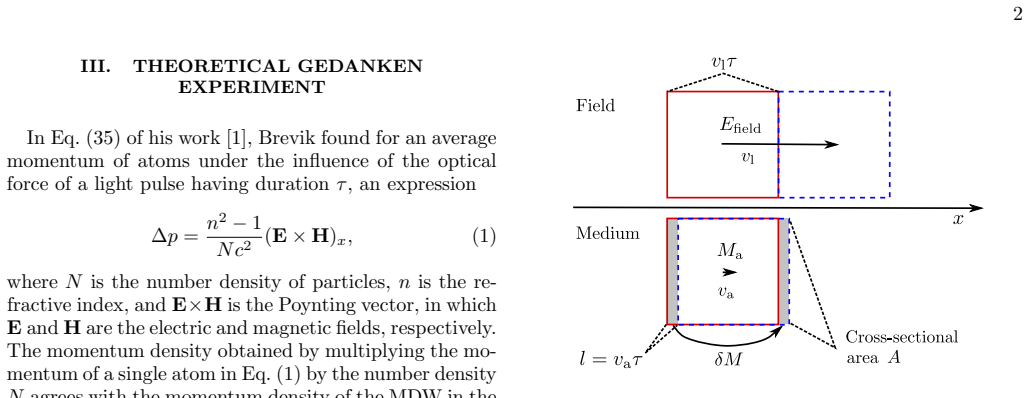
we have shown using two independent approaches that the kinetic energy of atoms in the MDW is a vanishingly small part of the field energy. arXiv:1907.07300v1 [physics.optics] 17 Jul 2019 2 III. THEORETICAL GEDANKEN EXPERIMENT In Eq. (35) of his work [1], Brevik found for an average momentum of atoms under the influence of the optical force of a light pulse...
work page internal anchor Pith review Pith/arXiv arXiv 1907
-
[2]
by stating that, due to the term δMc 2, the “values of EMP and pMP do not allow one to use the Lorentz transformation, as they are not the energy and momen- tum components of an energy-momentum tensor whose four-divergence is zero.” However, Brevik provided no ar- guments to support his claim that the four-divergence of the SEM tensor of the MP would be n...
-
[3]
Analysis of recent interpretations of the Abraham-Minkowski problem,
I. Brevik, “Analysis of recent interpretations of the Abraham-Minkowski problem,” Phys. Rev. A 98, 043847 (2018)
work page 2018
-
[4]
Graphene ox- ide demonstrates experimental confirmation of Abraham pressure on solid surface,
A. Kundu, R. Rani, and K. S. Hazra, “Graphene ox- ide demonstrates experimental confirmation of Abraham pressure on solid surface,” Sci. Rep. 7, 42538 (2017)
work page 2017
-
[5]
Photon mass drag and the momentum of light in a medium,
M. Partanen, T. H¨ ayrynen, J. Oksanen, and J. Tulkki, “Photon mass drag and the momentum of light in a medium,” Phys. Rev. A 95, 063850 (2017)
work page 2017
-
[6]
Mass-polariton theory of light in dispersive media,
M. Partanen and J. Tulkki, “Mass-polariton theory of light in dispersive media,” Phys. Rev. A 96, 063834 (2017)
work page 2017
-
[7]
Mass-polariton theory of sharing the total angular momentum of light between the field and matter,
M. Partanen and J. Tulkki, “Mass-polariton theory of sharing the total angular momentum of light between the field and matter,” Phys. Rev. A 98, 033813 (2018)
work page 2018
-
[8]
Light-driven mass density wave dynamics in optical fibers,
M. Partanen and J. Tulkki, “Light-driven mass density wave dynamics in optical fibers,” Opt. Express 26, 22046 (2018)
work page 2018
-
[9]
Isolated detection of elastic waves driven by the momentum of light,
T. Poˇ zar, J. Laloˇ s, A. Babnik, R. Petkovˇ sek, M. Bethune- Waddell, K. J. Chau, G. V. B. Lukasievicz, and N. G. C. Astrath, “Isolated detection of elastic waves driven by the momentum of light,” Nat. Commun. 9, 3340 (2018)
work page 2018
-
[10]
J. D. Jackson, Classical Electrodynamics , Wiley, New York (1999)
work page 1999
-
[11]
Zur Lichtfortpflanzung nach der Rela- tivit¨ atstheorie,
W. Gordon, “Zur Lichtfortpflanzung nach der Rela- tivit¨ atstheorie,”Ann. Phys. 377, 421 (1923)
work page 1923
-
[12]
General relativity in electrical engineering,
U. Leonhardt and T. G. Philbin, “General relativity in electrical engineering,” New J. Phys. 8, 247 (2006)
work page 2006
-
[13]
U. Leonhardt and T. Philbin, Geometry and Light: The Science of Invisibility , Dover, New York (2010)
work page 2010
-
[14]
Lorentz covariance of the mass-polariton theory of light,
M. Partanen and J. Tulkki, “Lorentz covariance of the mass-polariton theory of light,” Phys. Rev. A 99, 033852 (2019)
work page 2019
-
[15]
R. J. Jimenez Rioboo, E. Climent-Pascual, X. Diez- Betriu, F. Jimenez-Villacorta, C. Prieto, and A. de An- dres, “Elastic constants of graphene oxide few-layer films: correlations with interlayer stacking and bonding,” J. Mater. Chem. C 3, 4868 (2015)
work page 2015
-
[16]
Lagrangian dynamics of the coupled field-medium state of light,
M. Partanen and J. Tulkki, “Lagrangian dynamics of the coupled field-medium state of light,” New J. Phys., doi:10.1088/1367-2630/ab3069 (2019)
discussion (0)
Sign in with ORCID, Apple, or X to comment. Anyone can read and Pith papers without signing in.