Studying the absorption signatures of H I Lyman-α\ in the warm-hot circumgalactic medium with TNG50
Pith reviewed 2026-06-28 08:47 UTC · model grok-4.3
The pith
Warm-hot circumgalactic gas produces detectable Lyman-alpha absorption that accounts for half of CGM HI absorbers around Milky Way-like galaxies.
A machine-rendered reading of the paper's core claim, the machinery that carries it, and where it could break.
Core claim
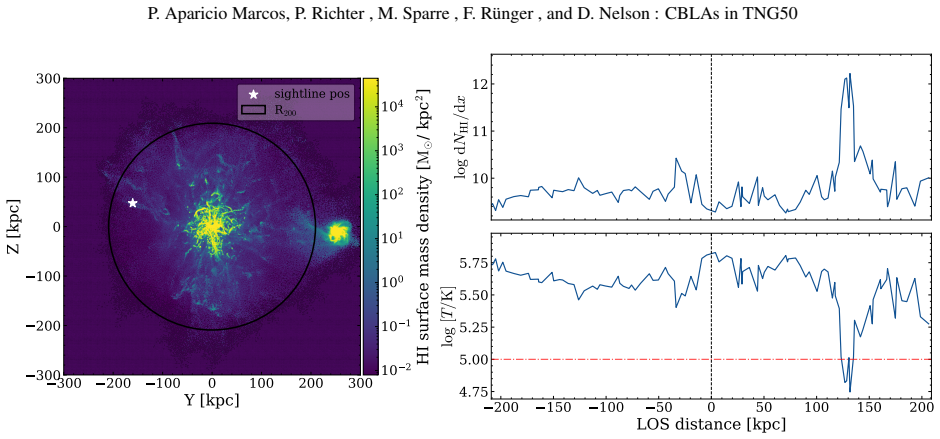
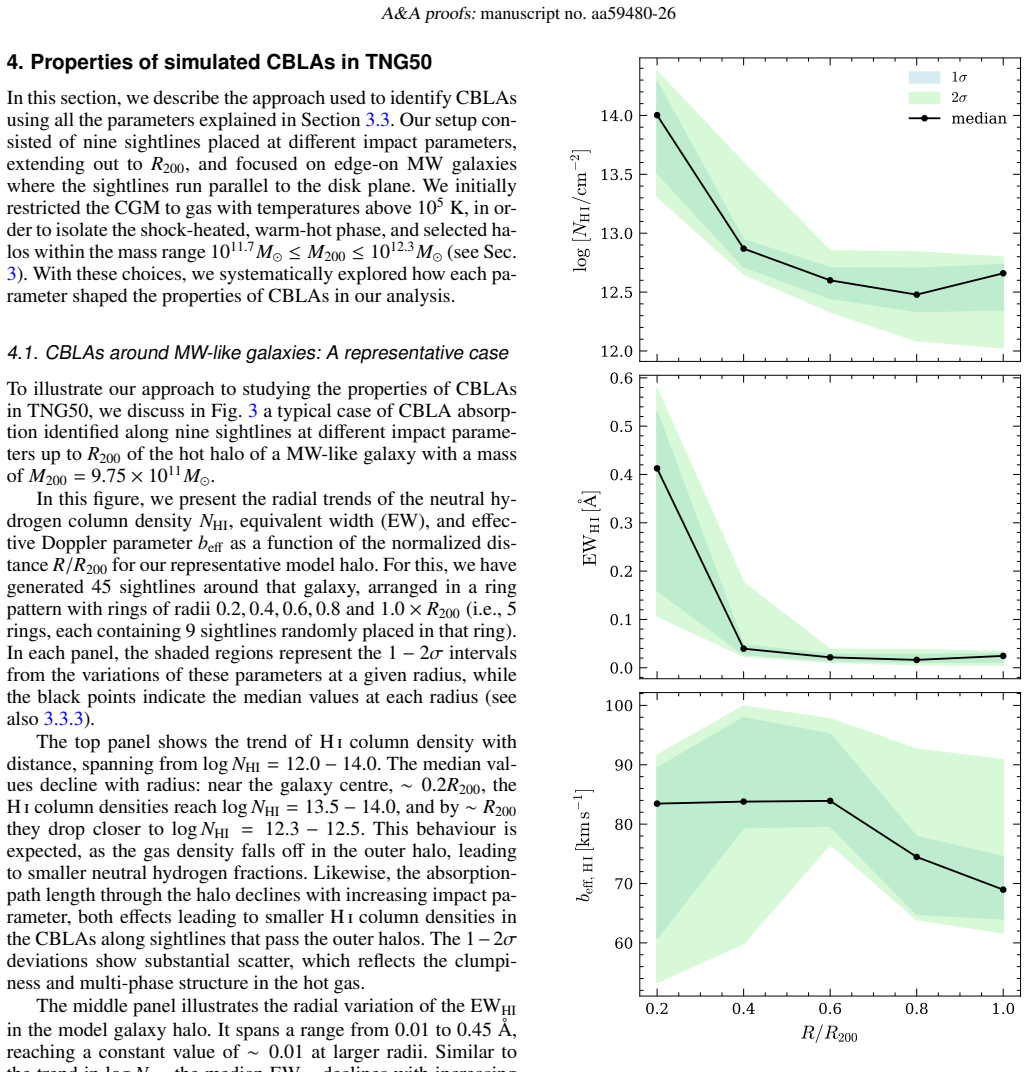
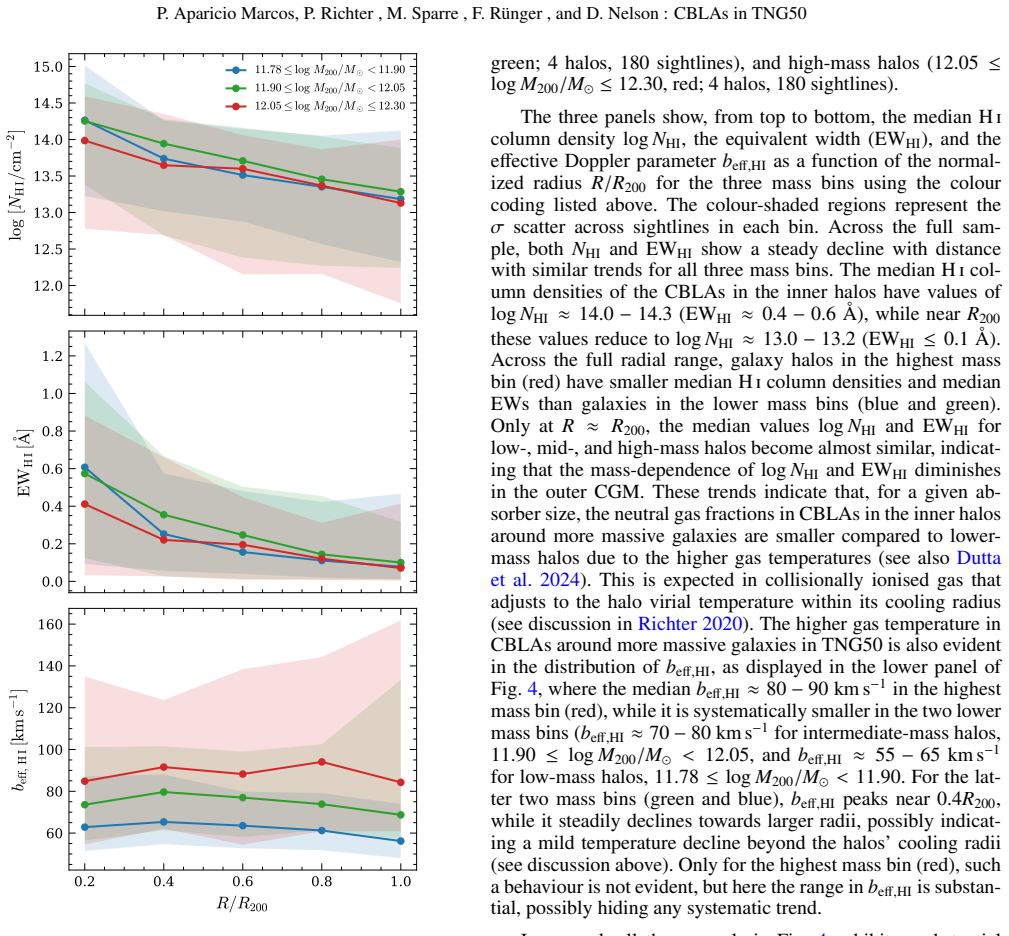
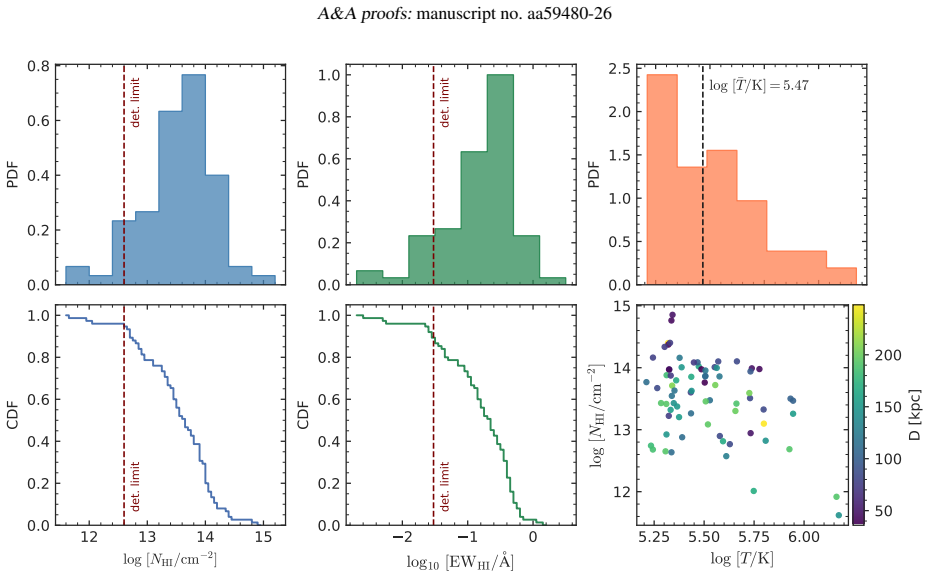
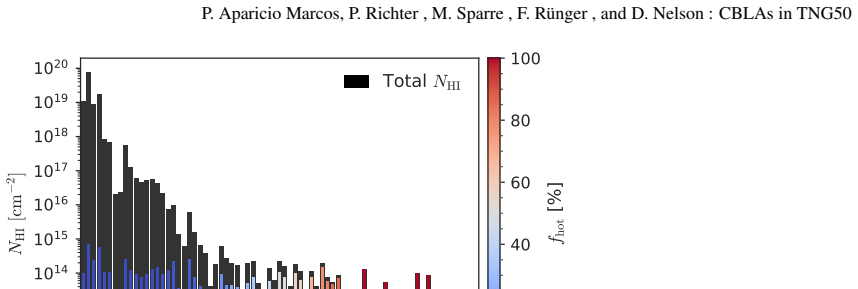
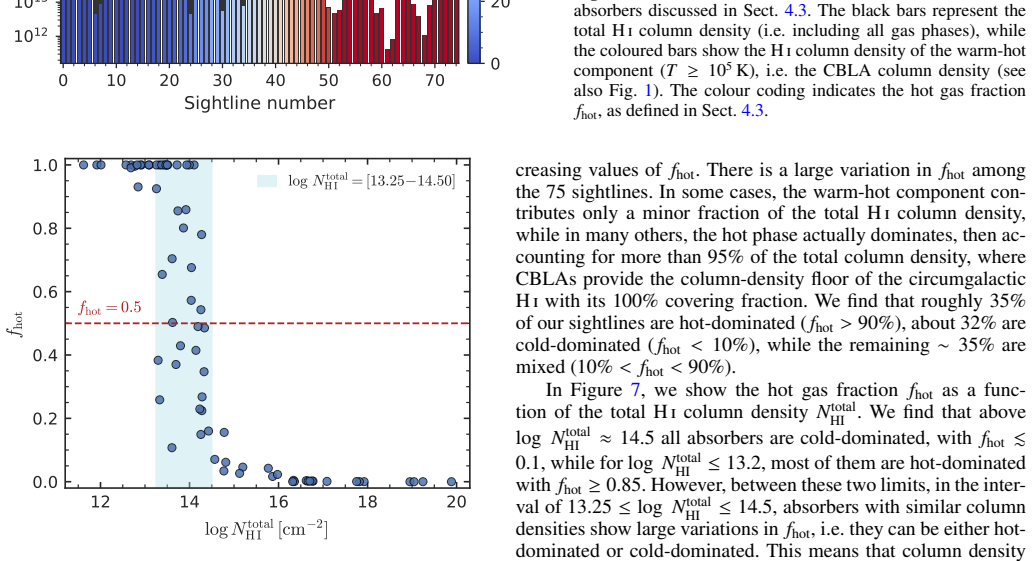
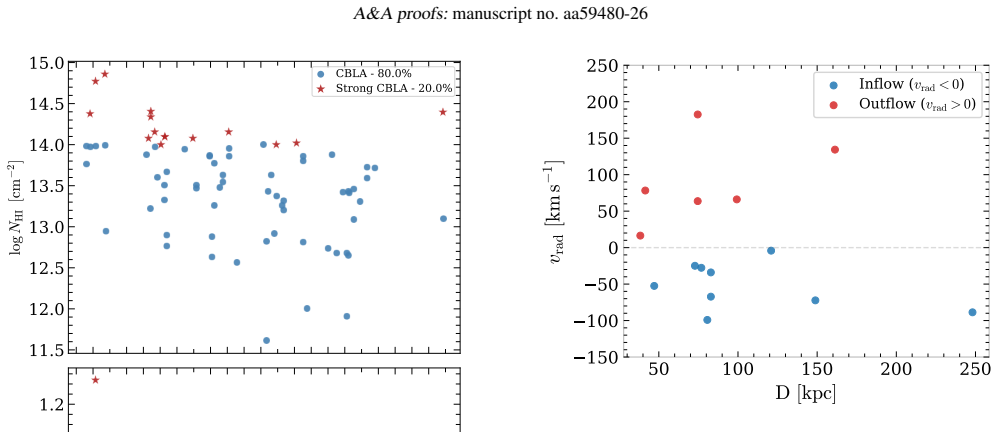
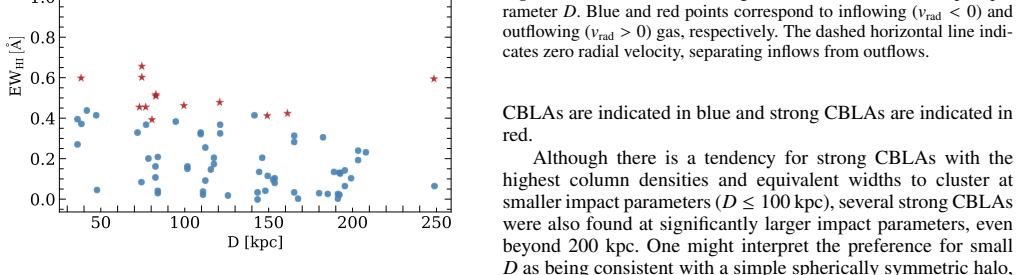
Analysis of 75 sightlines through the CGM of 15 TNG50 galaxies shows that CBLAs have a significant absorption cross-section with fc ≈ 0.8 for log N_HI ≥ 13. Approximately 50 percent of the CGM absorbers are dominated by CBLA absorption. These features trace warm-hot gas in the temperature range T = 10^{5.2-6.4} K, which accounts for ~7 percent of the overall baryon budget and ~25 percent of the total CGM mass. A subset of strong CBLAs reaches log N_HI up to 14.9 and traces massive warm-hot structures at large radial distances.
What carries the argument
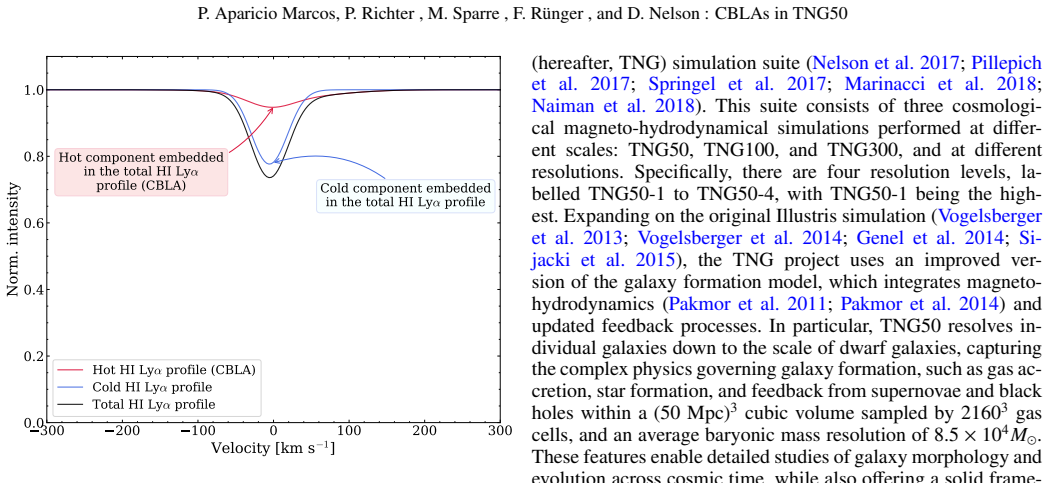
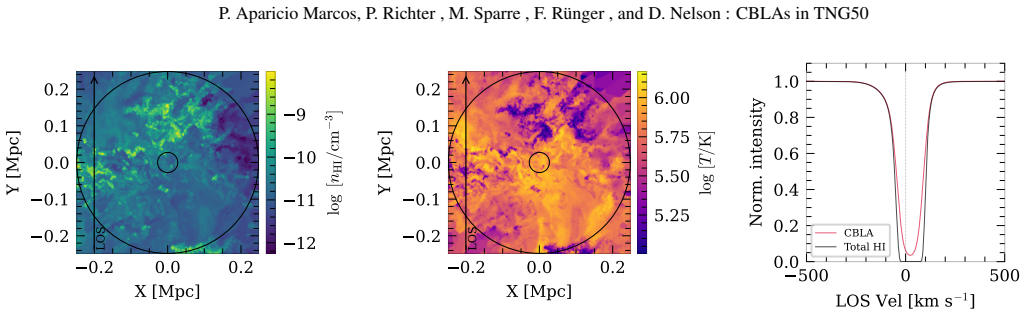
Coronal broad Lyα absorbers (CBLAs), defined as HI Lyman-alpha absorption features produced by warm-hot CGM gas at temperatures above 10^5 K and isolated via synthetic spectra to quantify their contribution to observed optical depth.
If this is right
- CBLAs contribute substantially to the total HI optical depth through the CGM.
- The warm-hot phase traced by CBLAs comprises one-quarter of the simulated CGM mass.
- Strong CBLAs identify massive warm-hot structures at large galactocentric distances.
- Multi-phase CGM interpretations at low redshift must include the warm-hot absorber population.
Where Pith is reading between the lines
- If the simulated absorber statistics hold, stacking analyses of real quasar spectra could separate the warm-hot contribution from cooler phases using line width and column density distributions.
- Cross-matching CBLA sightlines with X-ray emission maps of the same halos could test whether the same gas reservoir is detected in both absorption and emission.
- Extending the analysis to higher redshifts in the simulation would predict how the CBLA fraction evolves and whether it affects interpretations of the missing baryons problem at earlier epochs.
Load-bearing premise
The TNG50 simulation produces a realistic spatial distribution, temperature structure, and neutral hydrogen content in the warm-hot CGM of MW-like galaxies such that the synthetic spectra accurately isolate absorption from gas above 10^5 K.
What would settle it
High-resolution quasar spectra toward background sources near Milky Way-like galaxies should show roughly 50 percent of HI absorbers with Doppler parameters indicating gas temperatures above 10^5 K and a covering fraction near 0.8 for log N_HI ≥ 13; a substantially lower observed fraction would falsify the claim.
Figures
read the original abstract
In this study, we investigate the spectral signatures of neutral hydrogen Lyman-$\alpha$ absorption arising from the warm-hot gas component of the circumgalactic medium (CGM) around $z=0$ Milky Way (MW)-like galaxies using the high-resolution TNG50 cosmological simulation. We used synthetic absorption spectra to identify and characterise coronal broad Ly$\alpha$ absorbers (CBLAs), which represent H I absorption features produced by the warm-hot CGM at temperatures above $10^5$ K. Our study implies that CBLAs have a significant absorption cross-section, $f_c$, around MW-like galaxies. Based on an analysis of 75 sightlines intersecting the CGM of 15 galaxies in the mass range $10^{11.7} M_{\odot} \leq M_{200} \leq 10^{12.3} M_{\odot}$, we find $f_c \approx 0.8$ for $\log N_{\rm HI} \geq 13$, where CBLAs span a total column-density range $\log N_{\rm HI}=11.6-15.4$. Therefore, CBLAs provide a significant contribution to the overall H I optical depth in the CGM with $\sim 50\%$ of the CGM absorbers being dominated by CBLA absorption. Furthermore, we find that CBLAs trace warm-hot gas in a temperature range $T=10^{5.2-6.4}$ K, which accounts for $\sim 7\%$ of the overall baryon budget in the TNG50 galaxies and $\sim 25\%$ of the total CGM mass. Finally, we identify a population of strong CBLAs that exhibit substantial H I column densities up to $\log N_{\rm HI}=14.9$. This population represents a new absorber class tracing massive warm-hot circumgalactic structures at large radial distances. In conclusion, our study demonstrates that CBLAs represent an important absorber class that needs to be considered when interpreting the H I absorption signatures from the multi-phase CGM of MW-like galaxies at low redshift.
Editorial analysis
A structured set of objections, weighed in public.
Referee Report
Summary. The paper analyzes synthetic H I Lyman-α absorption spectra generated from the TNG50 cosmological simulation for 15 Milky Way-like galaxies (M_200 in 10^{11.7}-10^{12.3} M_⊙) at z=0. Along 75 sightlines through the CGM, it identifies coronal broad Lyα absorbers (CBLAs) arising from warm-hot gas with T > 10^5 K. Key results include a covering fraction f_c ≈ 0.8 for log N_HI ≥ 13 (with CBLAs spanning log N_HI = 11.6-15.4), ~50% of CGM absorbers being CBLA-dominated, and this gas phase (T = 10^{5.2-6.4} K) accounting for ~7% of the baryon budget and ~25% of total CGM mass. A population of strong CBLAs at large radii is also noted.
Significance. If the quantitative results are robust, the work demonstrates that warm-hot CGM gas produces a substantial fraction of observable H I absorption around MW-like galaxies, requiring its inclusion in interpretations of multi-phase CGM observations. The use of high-resolution TNG50 output with synthetic spectra provides concrete, simulation-derived predictions for absorber covering fractions, column-density distributions, and mass budgets that are directly testable against quasar absorption-line data.
major comments (2)
- [Methods] Methods section (sightline selection and galaxy sample): The criteria used to select the 15 galaxies in the stated mass range and to place the 75 sightlines are not described. This is load-bearing for the reported f_c ≈ 0.8 and mass-fraction claims, as the results depend on how representative the sample is of the overall CGM population.
- [Analysis of absorbers] Analysis of absorbers (identification algorithm): The procedure for identifying absorbers in the synthetic spectra, attributing absorption to specific gas phases, and determining whether an absorber is 'dominated by CBLA absorption' (including any tests for contamination from T < 10^5 K or T > 10^{6.4} K gas) is not specified. This directly affects the ~50% contribution claim and the attributed temperature range.
minor comments (2)
- [Abstract] Abstract: The temperature range is written as T=10^{5.2-6.4} K; ensure consistent use of scientific notation (e.g., 10^{5.2-6.4}) and explicit definition of CBLA on first use throughout the manuscript.
- Notation: Column densities are given as log N_HI without specifying the base or units in all instances; add a brief clarification in the methods or figure captions for clarity.
Simulated Author's Rebuttal
We thank the referee for their constructive comments, which highlight the need for greater methodological transparency. We will revise the manuscript to provide the requested details on sample selection and absorber analysis, thereby strengthening the presentation of our results on CBLAs in the TNG50 CGM.
read point-by-point responses
-
Referee: [Methods] Methods section (sightline selection and galaxy sample): The criteria used to select the 15 galaxies in the stated mass range and to place the 75 sightlines are not described. This is load-bearing for the reported f_c ≈ 0.8 and mass-fraction claims, as the results depend on how representative the sample is of the overall CGM population.
Authors: We agree that the manuscript does not provide sufficient detail on these selection procedures. In the revised version we will add an explicit subsection describing (i) the precise criteria applied to identify the 15 TNG50 galaxies within the quoted M_200 range (including any isolation, morphology or star-formation cuts), and (ii) the algorithm used to generate the 75 sightlines (random orientations, impact-parameter distribution, and radial extent). This addition will allow readers to evaluate the representativeness of the sample for the reported covering fractions and mass budgets. revision: yes
-
Referee: [Analysis of absorbers] Analysis of absorbers (identification algorithm): The procedure for identifying absorbers in the synthetic spectra, attributing absorption to specific gas phases, and determining whether an absorber is 'dominated by CBLA absorption' (including any tests for contamination from T < 10^5 K or T > 10^{6.4} K gas) is not specified. This directly affects the ~50% contribution claim and the attributed temperature range.
Authors: We acknowledge that the absorber identification and phase-attribution methodology is not described at the level of detail required. We will expand the Methods section to document (i) the algorithm used to detect and fit absorbers in the synthetic spectra, (ii) the procedure for associating absorption with individual gas cells and temperature bins, (iii) the quantitative criterion for classifying an absorber as CBLA-dominated (e.g., fractional optical-depth contribution), and (iv) any tests performed to quantify possible contamination from gas outside the T = 10^{5.2–6.4} K range. These additions will directly support the ~50 % contribution and temperature-range statements. revision: yes
Circularity Check
No significant circularity
full rationale
The paper reports direct measurements extracted from TNG50 simulation outputs after generating synthetic Ly-alpha spectra: covering fraction f_c, absorber dominance fractions, temperature ranges, and baryon/CGM mass contributions. These quantities are computed from the simulation's gas cells and sightline analysis rather than from any internal equations, fitted parameters, or self-citations that reduce the reported values to the inputs by construction. No self-definitional steps, fitted-input predictions, uniqueness theorems, or ansatzes are invoked in the provided text. The analysis is a standard post-processing study of simulation data and remains self-contained against external benchmarks.
Axiom & Free-Parameter Ledger
free parameters (1)
- Temperature threshold defining warm-hot gas =
10^5 K
axioms (2)
- domain assumption TNG50 hydrodynamical simulation produces realistic neutral hydrogen fractions and kinematics in the warm-hot CGM
- domain assumption Synthetic spectra generated from the simulation accurately reproduce observable Lyman-alpha absorption without significant numerical artifacts
invented entities (1)
-
Coronal broad Lyα absorbers (CBLAs)
no independent evidence
Reference graph
Works this paper leans on
-
[1]
G., Navarro, J
Abadi, M. G., Navarro, J. F., Steinmetz, M., & Eke, V . R. 2003, ApJ, 591, 499
2003
-
[2]
2021, MNRAS, 504, 65
Anand, A., Nelson, D., & Kauffmann, G. 2021, MNRAS, 504, 65
2021
-
[3]
Anderson, M. E. & Bregman, J. N. 2010, ApJ, 714, 320
2010
-
[4]
E., Bregman, J
Anderson, M. E., Bregman, J. N., & Dai, X. 2013, ApJ, 762, 106
2013
-
[5]
E., Churazov, E., & Bregman, J
Anderson, M. E., Churazov, E., & Bregman, J. N. 2016, MNRAS, 455, 227
2016
-
[6]
2021, MNRAS, 505, 6195
Augustin, R., Péroux, C., Hamanowicz, A., et al. 2021, MNRAS, 505, 6195
2021
-
[7]
2019, MNRAS, 489, 2417
Augustin, R., Quiret, S., Milliard, B., et al. 2019, MNRAS, 489, 2417
2019
-
[8]
Aumer, M., White, S. D. M., Naab, T., & Scannapieco, C. 2013, MNRAS, 434, 3142
2013
-
[9]
Bagla, J. 2002, J. Astrophys. Astron., 23, 185
2002
-
[10]
S., Wechsler, R
Behroozi, P. S., Wechsler, R. H., & Conroy, C. 2013, ApJ, 770, 57 Ben Bekhti, N., Winkel, B., Richter, P., et al. 2012, A&A, 542, A110
2013
-
[11]
1986, A&A, 155, L8
Bergeron, J. 1986, A&A, 155, L8
1986
-
[12]
1977, ApJ, 215, 483
Binney, J. 1977, ApJ, 215, 483
1977
-
[13]
R., Faber, S
Blumenthal, G. R., Faber, S. M., Primack, J. R., & Rees, M. J. 1984, Nature, 311, 517
1984
-
[14]
& Ostriker, J
Bode, P. & Ostriker, J. P. 2003, ApJS, 145, 1–13
2003
-
[15]
2015, ApJ, 813, 46
Borthakur, S., Heckman, T., Tumlinson, J., et al. 2015, ApJ, 813, 46
2015
-
[16]
V ., Chelouche, D., Jenkins, E
Bowen, D. V ., Chelouche, D., Jenkins, E. B., et al. 2016, ApJ, 826, 50
2016
-
[17]
L., Fielding, D
Carr, C., Bryan, G. L., Fielding, D. B., Pandya, V ., & Somerville, R. S. 2023, ApJ, 949, 21
2023
-
[18]
2023, arXiv e-prints, arXiv:2307.10498 Article number, page 14 of 17 P
Caudill, L. 2023, arXiv e-prints, arXiv:2307.10498 Article number, page 14 of 17 P. Aparicio Marcos, P. Richter , M. Sparre , F. Rünger , and D. Nelson : CBLAs in TNG50
arXiv 2023
-
[19]
H., & Kravtsov, A
Conroy, C., Wechsler, R. H., & Kravtsov, A. V . 2006, ApJ, 647, 201
2006
-
[20]
M., Bhardwaj, M., Gaensler, B
Cook, A. M., Bhardwaj, M., Gaensler, B. M., et al. 2023, ApJ, 946, 58
2023
-
[21]
S., Tumlinson, J., et al
Corlies, L., Peeples, M. S., Tumlinson, J., et al. 2020, ApJ, 896, 125
2020
-
[22]
& Schiminovich, D
Corlies, L. & Schiminovich, D. 2016, ApJ, 827, 148
2016
-
[23]
2022, MNRAS, 512, 3717
Damle, M., Sparre, M., Richter, P., et al. 2022, MNRAS, 512, 3717
2022
-
[24]
2025, ApJ, 986, 69
Damle, M., Tonnesen, S., Sparre, M., & Richter, P. 2025, ApJ, 986, 69
2025
-
[25]
W., Keeney, B
Danforth, C. W., Keeney, B. A., Tilton, E. M., et al. 2016, ApJ, 817, 111
2016
-
[26]
S., & White, S
Davis, M., Efstathiou, G., Frenk, C. S., & White, S. D. M. 1985, ApJ, 292, 371
1985
-
[27]
2024, A&A, 685, A8
Madau, Piero. 2024, A&A, 685, A8
2024
-
[28]
F., Genel, S., et al
DeFelippis, D., Bouché, N. F., Genel, S., et al. 2021, ApJ, 923, 56
2021
-
[29]
N., Komatsu, E., et al
Dunkley, J., Spergel, D. N., Komatsu, E., et al. 2009, ApJ, 701, 1804
2009
-
[30]
& Smith, B
Dunn, B. & Smith, B. J. 2018, in American Astronomical Society Meeting Ab- stracts, V ol. 231, American Astronomical Society Meeting Abstracts #231, 440.02
2018
-
[31]
2024, MNRAS, 528, 3745
Dutta, S., Muzahid, S., Schaye, J., et al. 2024, MNRAS, 528, 3745
2024
-
[32]
2021, ApJ, 918, 7
Emami, R., Hernquist, L., Alcock, C., et al. 2021, ApJ, 918, 7
2021
-
[33]
Faerman, Y ., Sternberg, A., & McKee, C. F. 2020, ApJ, 893, 82 Faucher-Giguère, C.-A., Lidz, A., Zaldarriaga, M., & Hernquist, L. 2009, ApJ, 703, 1416
2020
-
[34]
B., Oppenheimer, B
Ford, A. B., Oppenheimer, B. D., Davé, R., et al. 2013, MNRAS, 432, 89
2013
-
[35]
2012, MNRAS, 420, 1731
Frank, S., Rasera, Y ., Vibert, D., et al. 2012, MNRAS, 420, 1731
2012
-
[36]
2014, MNRAS, 445, 175
Genel, S., V ogelsberger, M., Springel, V ., et al. 2014, MNRAS, 445, 175
2014
-
[37]
H., Sparre, M., Ellison, S
Hani, M. H., Sparre, M., Ellison, S. L., Torrey, P., & V ogelsberger, M. 2017, MNRAS, 475, 1160
2017
-
[38]
H., Martin, C
Ho, S. H., Martin, C. L., & Schaye, J. 2020, ApJ, 904, 76
2020
-
[39]
F., Wetzel, A., Wheeler, C., et al
Hopkins, P. F., Wetzel, A., Wheeler, C., et al. 2023, MNRAS, 519, 3154
2023
-
[40]
C., Stern, J., & Sternberg, A
Jana, R., Sarkar, K. C., Stern, J., & Sternberg, A. 2024, MNRAS, 531, 2757
2024
-
[41]
D., Chen, H.-W., Mulchaey, J
Johnson, S. D., Chen, H.-W., Mulchaey, J. S., Schaye, J., & Straka, L. A. 2017, ApJ, 850, L10
2017
-
[42]
H., & Hernquist, L
Katz, N., Weinberg, D. H., & Hernquist, L. 1996, ApJS, 105, 19
1996
-
[43]
A., Stocke, J
Keeney, B. A., Stocke, J. T., Danforth, C. W., et al. 2017, ApJS, 230, 6
2017
-
[44]
Kennicutt, Robert C., J., Tamblyn, P., & Congdon, C. E. 1994, ApJ, 435, 22
1994
-
[45]
& Churazov, E
Khabibullin, I. & Churazov, E. 2018, MNRAS, 482, 4972–4984
2018
-
[46]
2025, arXiv e-prints, arXiv:2510.00868
Laktionov, R., Sasaki, M., & Wilms, J. 2025, arXiv e-prints, arXiv:2510.00868
arXiv 2025
-
[47]
M., Bowen, D
Lanzetta, K. M., Bowen, D. V ., Tytler, D., & Webb, J. K. 1995, ApJ, 442, 538
1995
-
[48]
D., Richter, P., et al
Lehner, N., Savage, B. D., Richter, P., et al. 2007, ApJ, 658, 680
2007
-
[49]
J., Kravtsov, A
Liang, C. J., Kravtsov, A. V ., & Agertz, O. 2018, MNRAS, 479, 1822
2018
-
[50]
F., Lira, P., et al
Lopez, S., Barrientos, L. F., Lira, P., et al. 2008, ApJ, 679, 1144
2008
-
[51]
2014, MNRAS, 437, 1750
Marinacci, F., Pakmor, R., & Springel, V . 2014, MNRAS, 437, 1750
2014
-
[52]
2018, MNRAS, 480, 5113
Marinacci, F., V ogelsberger, M., Pakmor, R., et al. 2018, MNRAS, 480, 5113
2018
-
[53]
2023, MNRAS, 525, L11–L16
Mathur, S., Das, S., Gupta, A., & Krongold, Y . 2023, MNRAS, 525, L11–L16
2023
-
[54]
McGaugh, S. S. 2008, in IAU Symposium, V ol. 244, Dark Galaxies and Lost Baryons, ed. J. I. Davies & M. J. Disney, 136–145
2008
-
[55]
S., Schombert, J
McGaugh, S. S., Schombert, J. M., de Blok, W. J. G., & Zagursky, M. J. 2009, ApJ, 708, L14
2009
-
[56]
& Werk, J
McQuinn, M. & Werk, J. K. 2018, ApJ, 852, 33
2018
-
[57]
Miller, M. J. & Bregman, J. N. 2013, ApJ, 770, 118
2013
-
[58]
Miller, M. J. & Bregman, J. N. 2015, ApJ, 800, 14 Méndez-Hernández, H., Cassata, P., Ibar, E., et al. 2022, A&A, 666, A56
2015
-
[59]
P., Pillepich, A., Springel, V ., et al
Naiman, J. P., Pillepich, A., Springel, V ., et al. 2018, MNRAS, 477, 1206–1224
2018
-
[60]
D., & Wakker, B
Narayanan, A., Savage, B. D., & Wakker, B. P. 2010, ApJ, 712, 1443
2010
-
[61]
2025, arXiv e-prints, arXiv:2510.19904
Nelson, D., Peroux, C., Richter, P., et al. 2025, arXiv e-prints, arXiv:2510.19904
Pith/arXiv arXiv 2025
-
[62]
2019, MNRAS, 490, 3234
Nelson, D., Pillepich, A., Springel, V ., et al. 2019, MNRAS, 490, 3234
2019
-
[63]
2017, MNRAS, 475, 624
Nelson, D., Pillepich, A., Springel, V ., et al. 2017, MNRAS, 475, 624
2017
-
[64]
Nelson, D., Springel, V ., Pillepich, A., et al. 2021, J. Open Source Software, 7, 30
2021
-
[65]
2023, ApJ, 955, L21
Nicastro, F., Krongold, Y ., Fang, T., et al. 2023, ApJ, 955, L21
2023
-
[66]
D., Crain, R
Oppenheimer, B. D., Crain, R. A., Schaye, J., et al. 2016, MNRAS, 460, 2157
2016
-
[67]
2011, MNRAS, 418, 1392
Pakmor, R., Bauer, A., & Springel, V . 2011, MNRAS, 418, 1392
2011
-
[68]
2014, ApJ, 783, L20
Pakmor, R., Marinacci, F., & Springel, V . 2014, ApJ, 783, L20
2014
-
[69]
S., Werk, J
Peeples, M. S., Werk, J. K., Tumlinson, J., et al. 2014, ApJ, 786, 54
2014
-
[70]
V ., Stocke, J
Penton, S. V ., Stocke, J. T., & Shull, J. M. 2004, ApJS, 152, 29 Péroux, C., Zwaan, M. A., Klitsch, A., et al. 2019, MNRAS, 485, 1595
2004
-
[71]
2017, MNRAS, 475, 648–675
Pillepich, A., Nelson, D., Hernquist, L., et al. 2017, MNRAS, 475, 648–675
2017
-
[72]
2019, MNRAS, 490, 3196
Pillepich, A., Nelson, D., Springel, V ., et al. 2019, MNRAS, 490, 3196
2019
-
[73]
2024, MNRAS, 535, 1721
Pillepich, A., Sotillo-Ramos, D., Ramesh, R., et al. 2024, MNRAS, 535, 1721
2024
-
[74]
2018, MNRAS, 473, 4077 Planck Collaboration, Ade, P
Pillepich, A., Springel, V ., Nelson, D., et al. 2018, MNRAS, 473, 4077 Planck Collaboration, Ade, P. A. R., Aghanim, N., et al. 2016, A&A, 594, A13
2018
-
[75]
S., & Peeples, M
Popping, G., Behroozi, P. S., & Peeples, M. S. 2015, MNRAS, 449, 477
2015
-
[76]
2007, A&A, 470, 67
Prause, N., Reimers, D., Fechner, C., & Janknecht, E. 2007, A&A, 470, 67
2007
-
[77]
X., Weiner, B., Chen, H.-W., Mulchaey, J., & Cooksey, K
Prochaska, J. X., Weiner, B., Chen, H.-W., Mulchaey, J., & Cooksey, K. 2011, ApJ, 740, 91
2011
-
[78]
X., Werk, J
Prochaska, J. X., Werk, J. K., Worseck, G., et al. 2017, ApJ, 837, 169 Péroux, C. & Howk, J. C. 2020, ARA&A, 58, 363–406 Péroux, C., Nelson, D., van de V oort, F., et al. 2020, MNRAS, 499, 2462–2473
2017
-
[79]
2023, MNRAS, 522, 1535–1555
Ramesh, R., Nelson, D., & Pillepich, A. 2023, MNRAS, 522, 1535–1555
2023
-
[80]
2020, ApJ, 892, 33
Richter, P. 2020, ApJ, 892, 33
2020
discussion (0)
Sign in with ORCID, Apple, or X to comment. Anyone can read and Pith papers without signing in.