REVIEW 2 major objections 6 minor 71 references
Selection of Exponential-Family Random Graph Models via Held-Out Predictive Evaluation (HOPE)
T0 review · 2 major / 6 minor · reviewed 2026-08-14 · deepseek-v4-flash
Pith's one-line read This paper proposes a cross-validation-style procedure, HOPE, that selects among competing exponential-family random graph models by how well each predicts edge states held out from the observed network, and shows it can outperform…
desk verdict A sensible extension of HOPE to ERGM model selection, but the empirical case is under-powered: the decisive model comparisons are too close to distinguish from noise without Monte Carlo error bars. read the letter →
The pith
A machine-rendered reading of the paper's core claim, the machinery that carries it, and where it could break.
The reading
What carries the argument
The central object is the held-out edge-state partition of the adjacency matrix: the index set of edge variables is split into folds, and for each fold the states in that fold are marked missing while their presence is retained. Estimation uses the face-value likelihood that marginalizes over missing states, and evaluation uses conditional ERGM simulation from $\hat{\theta}$ with observed edges fixed, plus metrics such as overall accuracy, total squared loss, a centrality reliability coefficient $\rho_C$, and centralization RMSE. That machinery converts the paper's notion of predictive performance into quantities that can be compared across model specifications.
What would settle it
Find or construct a pair of ERGMs on a single network where the model with better HOPE-held-out metrics is nonetheless worse at predicting the edges of a new or future network from the same population; if such a case is common, HOPE's suitability for model selection in practice would be in doubt. A concrete version: fit competing models to year-one ties, score them by HOPE, then see whether the HOPE-preferred model also has lower error on year-two ties.
Extended reading notes
Core claim
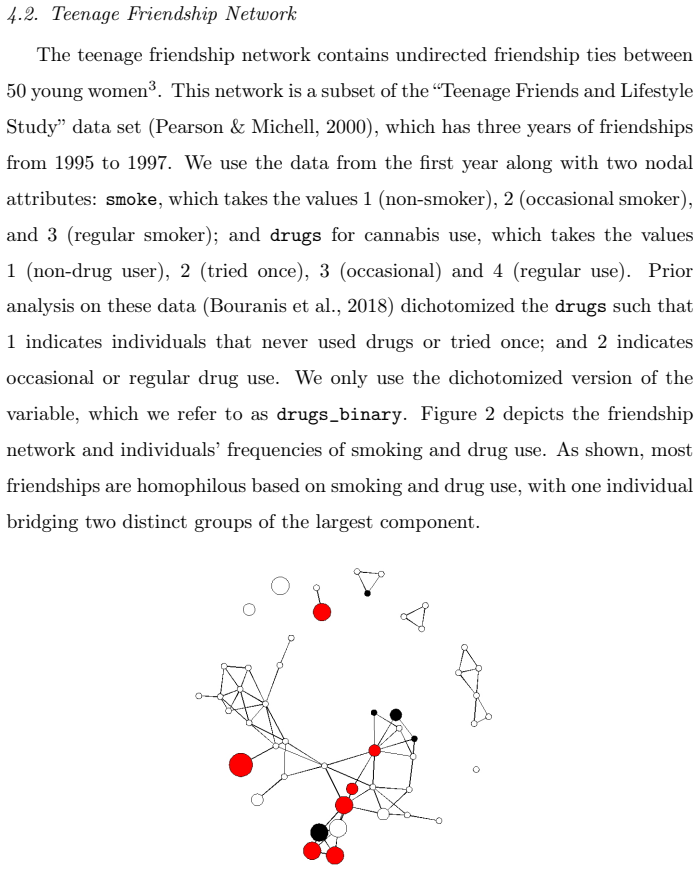
The central claim is that the ability of an ERGM to predict held-out edge states, conditional on the rest of the observed network, is a usable and illuminating model-selection criterion. The paper's innovation is to treat held-out edges as missing rather than removed: the presence of every edge variable is kept, only its state is hidden, so the dependence structure that makes standard cross-validation impossible for ERGMs is preserved. Estimation proceeds by the missing-data likelihood of Handcock and Gile, prediction by simulation from the conditional distribution of held-out states given observed states, and performance is summarized by dyad-, node-, and graph-level metrics. Applied to a lawyers' collaboration network and a teenage friendship network, HOPE ranks the models, prefers the more parsimonious model that includes both covariates and dependence terms, and shows that additional significant homophily terms do not improve predictive performance.
Load-bearing premise
The load-bearing premise is that predictive accuracy on edge states held out from a single observed network is a trustworthy guide to which model is genuinely better; since the held-out states are not independent test data, this equates model quality with imputation ability within that one network.
Editorial extensions
If this is right
- HOPE provides a model-selection criterion that does not depend on the nominal sample size or asymptotic assumptions underlying AIC and BIC, so it is applicable even when those criteria are not.
- Because scoring is done out-of-sample on held-out edge states, HOPE automatically penalizes overfitting: a complex model that merely fits the observed network better will not necessarily win.
- The dyad-, node-, and graph-level metrics give diagnostic information about where a model fails, such as poor prediction of betweenness centralization, pointing to missing covariates or dependence terms.
- Different held-out strategies are not interchangeable: leave-one-out gives stable dyad-level scores, node-holdout stresses local structure, and leave-M-out balances the two; the paper suggests leave-M-out as a general default.
- HOPE can be applied to any network model for which parameter estimation with missing edge data is feasible, including valued-edge ERGMs, not just binary networks.
Reading between the lines
- An implication the paper leaves implicit is that HOPE measures imputation within one network, not generalization to new networks; a model chosen by HOPE may not be the best at forecasting a future network, and testing against genuinely held-out networks would be a natural next step.
- The paper's results suggest a testable extension: use HOPE-type predictive scores as a term-selection criterion rather than significance tests, since several significant homophily terms added no predictive value in the case studies.
- A further consequence is that the choice of held-out strategy encodes a substantive assumption about the prediction task; researchers who care about vertex-level structure should match the holdout pattern to that task, and the paper's guidelines could be turned into a diagnostic test.
- The exact leave-one-out marginal probabilities could be computed via change scores, as the paper notes; a cheaper algorithmic variant might use that exact computation to reduce simulation burden at scale.
Signed reviews
Editorial analysis
A structured set of objections, weighed in public.
Referee Report
Summary. The paper proposes a held-out predictive evaluation (HOPE) strategy for exponential-family random graph model (ERGM) selection. Building on the missing-data likelihood of Handcock and Gile (2010) and the HOPE scheme of Wang et al. (2016), the authors hold out edge states (rather than edge variables), fit the ERGM to the remaining data, simulate from the conditional distribution of the held-out states, and evaluate predictions using dyad-, node-, and graph-level metrics. Two hold-out schemes are described (random edge removal and node removal), and the method is demonstrated on two empirical networks, Lazega's lawyers and a teenage friendship network, with model rankings compared to nominal AIC and BIC.
Significance. If the proposed method reliably ranks ERGMs by their predictive performance, it would be a practically valuable complement to AIC/BIC and Bayes factors, which have questionable theoretical foundations for single-network ERGMs. The methodological core in Section 2 is standard and correctly stated, and the procedure builds on existing, widely used software (the ergm package), which is a clear practical strength. However, the empirical support is currently too weak to establish the central claim: the decisive model comparisons in the two case studies are extremely close in value, no uncertainty quantification is reported, and there is no simulation study with a known data-generating process showing that HOPE rankings track generalization to independent networks rather than mere imputation accuracy.
major comments (2)
- [Tables 3 and 5; Section 4.1] The empirical comparisons that carry the central claim are not accompanied by any measure of uncertainty. In Table 3, the leave-M-out Overall ACC for Model 4 is 0.789 and for Model 5 is 0.789, with TSL values 67.412 and 67.842; in Table 5, the leave-1-out Overall ACC is 0.938 versus 0.937 for Models 4 and 5. These differences are far smaller than the Monte Carlo error that should be expected from B=500 conditional simulations from a single random partition, and no repeated-partition or simulation standard errors are reported. The conclusion in Section 4.1 that "HOPE suggests that model 4 is the preferred model" therefore does not follow from the reported numbers, and the same issue affects the recommendation of Model 4 in Section 4.2. At minimum, the authors should report Monte Carlo standard errors or confidence intervals for the metrics, and ideally repeat the hold-out partitioning to quantify partition variability.
- [Section 1; Section 4] The paper's central claim is that HOPE provides a practical basis for ERGM model selection because predictive assessments "automatically correct for overfitting" (Section 1). This claim is not validated by the two case studies, because in both cases the data-generating model is unknown and the held-out edge states are imputed conditional on the observed edge states of the same single network. There is no simulation study in which networks are generated from known models and HOPE's selected model is compared with the model that best predicts independent networks from the same process. Without such a study, the assertion that HOPE's ranking tracks generalization rather than mere imputation accuracy remains unsupported. I recommend adding a simulation section (e.g., generating networks from each candidate specification and from alternative processes, then comparing HOPE's selection with the best predictor on independent network replicates, with selection frequencies across repeated partitions).
minor comments (6)
- [Table 1] The table caption contains a typo: "Descriptive statsitics" should read "Descriptive statistics".
- [Section 1] The phrase "computational challanges" on page 4 should read "computational challenges".
- [Section 3.2.1] The prior is referred to as "Jeffrey's prior" but should be "Jeffreys prior".
- [Section 3.6] The running-time formula is labeled as both (3.3) and (3.4); the second equation number appears to be an error and should be removed or corrected.
- [Tables 2 and 3 / Tables 4 and 5] The AIC/BIC values for the same model differ between the main estimation tables and the HOPE tables (e.g., Model 2 in the Lazega analysis has AIC 524.3 in Table 2 but 523.0 in Table 3). The text should state explicitly what the AIC/BIC values in the HOPE tables represent, such as averages over held-out fits, or correct the discrepancy.
- [Section 4.1] The statement "we set M = 35 (the same number of edge variables as under node-held-out)" appears to confuse batch size with number of folds; under node-held-out, each batch contains all n-1 = 35 edge variables incident to a vertex, whereas with M = 35 random batches on an undirected 36-vertex graph, each batch contains 630/35 = 18 edge variables. Please clarify the intended comparison.
Circularity Check
No circular derivation: HOPE scores held-out edge states from models fit only to retained edge states, and the shared-author HOPE citation is external, published, and software-supported.
full rationale
The paper's derivation chain is not circular. HOPE's target is the held-out edge state, and the ERGM parameters used to impute those states are estimated from the complement of the held-out data via the missing-data likelihood (2.3); the held-out states are not used in that fit. The predictive quantities (Edge ACC, Null ACC, Overall ACC, TSL, node- and graph-level metrics) are then computed from conditional simulations (2.4) evaluated against the held-out states. This is a genuine out-of-sample exercise at the level of edge-state prediction, not a re-derivation of an input. The main shared-author citation, Wang et al. (2016), supplies the hold-out-as-missing-data mechanism, but that mechanism is independently published, implemented in standard ERGM software, and not used to justify the present paper's model-selection claim by fiat. The empirical support has limitations—the decisive comparisons in Tables 3 and 5 are very close, and no repeated-partition Monte Carlo error or simulation with a known true model is reported—but these are statistical validity concerns, not circularity. No fitted parameter is renamed as a prediction, no uniqueness theorem is imported from the authors' prior work, and no ansatz is smuggled in via a self-citation. Accordingly, the paper earns a no-significant-circularity finding.
Assumptions & free parameters
free parameters (3)
- GWESP decay phi (lawyers) =
0.75
- GWESP decay phi (friendship) =
log(2)
- GWDEG decay phi (friendship) =
0.8
assumptions (5)
- domain assumption The face-value likelihood in equation (2.3) correctly marginalizes over missing edge states and yields a valid MLE under ignorable missingness.
- standard math Conditional simulations from equation (2.4) via the ergm package converge to the target conditional distribution.
- domain assumption Predictive accuracy on held-out edge states is a valid proxy for overall model quality for the analyst's objective.
- domain assumption B equals 500 simulated graphs per fold are sufficient for stable metric estimates.
- domain assumption The two empirical networks are adequate benchmarks for demonstrating model selection performance.
Cite this review
Pith. "Pith review of Selection of Exponential-Family Random Graph Models via Held-Out Predictive Evaluation (HOPE)." pith.science (2026). https://pith.science/paper/COBXU7BO
@misc{pith2026190805873,
  author       = {Pith},
  title        = {Pith review of: Selection of Exponential-Family Random Graph Models via Held-Out Predictive Evaluation (HOPE)},
  year         = {2026},
  howpublished = {\url{https://pith.science/paper/COBXU7BO}},
  note         = {Machine review of arXiv:1908.05873}
}
read the original abstract
Statistical models for networks with complex dependencies pose particular challenges for model selection and evaluation. In particular, many well-established statistical tools for selecting between models assume conditional independence of observations and/or conventional asymptotics, and their theoretical foundations are not always applicable in a network modeling context. While simulation-based approaches to model adequacy assessment are now widely used, there remains a need for procedures that quantify a model's performance in a manner suitable for selecting among competing models. Here, we propose to address this issue by developing a predictive evaluation strategy for exponential family random graph models that is analogous to cross-validation. Our approach builds on the held-out predictive evaluation (HOPE) scheme introduced by Wang et al. (2016) to assess imputation performance. We systematically hold out parts of the observed network to: evaluate how well the model is able to predict the held-out data; identify where the model performs poorly based on which data are held-out, indicating e.g. potential weaknesses; and calculate general summaries of predictive performance that can be used for model selection. As such, HOPE can assist researchers in improving models by indicating where a model performs poorly, and by quantitatively comparing predictive performance across competing models. The proposed method is applied to model selection problem of two well-known data sets, and the results are compared to those obtained via nominal AIC and BIC scores.
Figures

Reference graph
Works this paper leans on
-
[1]
, " * write output.state after.block = add.period write newline
ENTRY address author booktitle chapter edition editor howpublished institution journal key month note number organization pages publisher school series title type url volume year label extra.label sort.label short.list INTEGERS output.state before.all mid.sentence after.sentence after.block FUNCTION init.state.consts #0 'before.all := #1 'mid.sentence := ...
-
[2]
" write newline "" before.all 'output.state := FUNCTION n.dashify 't := "" t empty not t #1 #1 substring "-" = t #1 #2 substring "--" = not "--" * t #2 global.max substring 't := t #1 #1 substring "-" = "-" * t #2 global.max substring 't := while if t #1 #1 substring * t #2 global.max substring 't := if while FUNCTION word.in bbl.in capitalize " " * FUNCT...
-
[3]
write newline
" write newline "" before.all 'output.state := FUNCTION n.dashify 't := "" t empty not t #1 #1 substring "-" = t #1 #2 substring "--" = not "--" * t #2 global.max substring 't := t #1 #1 substring "-" = "-" * t #2 global.max substring 't := while if t #1 #1 substring * t #2 global.max substring 't := if while FUNCTION word.in bbl.in ":" * " " * FUNCTION f...
-
[4]
author Akaike, H. ( year 1973 ). title Information theory and an extension of the maximum likelihood principle . In booktitle Selected Papers of Hirotugu Akaike \/ (pp. pages 199--213 ). address New York, NY : publisher Springer New York
work page 1973
-
[5]
author Arlot, S. , & author Celisse, A. ( year 2010 ). title A survey of cross-validation procedures for model selection . journal Statistics Surveys \/ , volume 4 \/ , pages 40--79
work page 2010
-
[6]
author Bernardo, J. M. , & author Smith, A. F. M. ( year 1994 ). title Bayesian Theory \/ . address New York : publisher John Wiley & Sons
work page 1994
-
[7]
author Bouranis, L. , author Friel, N. , & author Maire, F. ( year 2018 ). title Bayesian model selection for exponential random graph models via adjusted pseudolikelihoods . journal Journal of Computational and Graphical Statistics \/ , volume 27 \/ , pages 516--528
work page 2018
-
[8]
author Caimo, A. , & author Friel, N. ( year 2011 ). title Bayesian inference for exponential random graph models . journal Social Networks \/ , volume 33 \/ , pages 41--55
work page 2011
Show all 71 references
-
[9]
, & author Friel, N
author Caimo, A. , & author Friel, N. ( year 2013 ). title Bayesian model selection for exponential random graph models . journal Social Networks \/ , volume 35 \/ , pages 11--24
2013
-
[10]
, & author Lei, J
author Chen, K. , & author Lei, J. ( year 2018 ). title Network cross-validation for determining the number of communities in network data . journal Journal of the American Statistical Association \/ , volume 113 \/ , pages 241--251
2018
-
[11]
author Cranmer, S. J. , & author Desmarais, B. A. ( year 2011 ). title Inferential network analysis with exponential random graph models . journal Political Analysis \/ , volume 19 \/ , pages 66--86
2011
-
[12]
, & author Junker, B
author Dabbs, B. , & author Junker, B. ( year 2016 ). title Comparison of cross-validation methods for stochastic block models. arXiv:1605.03000v1 http://arxiv.org/abs/1605.03000v1
2016 arXiv
-
[13]
author Desmarais, B. A. , & author Cranmer, S. J. ( year 2012 ). title Statistical inference for valued-edge networks: The generalized exponential random graph model . journal PloS One \/ , volume 7 \/ , pages 1--12
2012
-
[14]
author Fowler, J. H. ( year 2006 ). title Connecting the congress: A study of cosponsorship networks . journal Political Analysis \/ , volume 14 \/ , pages 456--487
2006
-
[15]
, & author Strauss, D
author Frank, O. , & author Strauss, D. ( year 1986 ). title Markov graphs . journal Journal of the American Statistical Association \/ , volume 81 \/ , pages 832--842
1986
-
[16]
author Freeman, L. C. ( year 1978 ). title Centrality in social networks: conceptual clarification . journal Social Networks \/ , volume 1 \/ , pages 215--239
1978
-
[17]
( year 1975 )
author Geisser, S. ( year 1975 ). title The predictive sample reuse method with applications . journal Journal of the American Statistical Association \/ , volume 70 \/ , pages 320--328
1975
-
[18]
author Goodman, S. N. ( year 2019 ). title Why is getting rid of p-values so hard? musings on science and statistics . journal The American Statistician \/ , volume 73 \/ , pages 26--30
2019
-
[19]
author Goodreau, S. M. ( year 2007 ). title Advances in exponential random graph (p*) models applied to a large social network . journal Social Networks \/ , volume 29 \/ , pages 231--248
2007
-
[20]
author Green, P. J. ( year 1995 ). title Reversible jump M arkov chain M onte C arlo computation and B ayesian model determination . journal Biometrika \/ , volume 82 \/ , pages 711--732
1995
-
[21]
( year 1950 )
author Gulliksen, H. ( year 1950 ). title Theory of Mental Tests \/ . publisher Hoboken, NJ: Wiley
1950
-
[22]
author Handcock, M. S. ( year 2003 ). title Assessing Degeneracy in Statistical Models of Social Networks \/ . type Technical Report Center for Statistics and Social Sciences, University of Washington. note https://www.csss.washington.edu/Papers/wp39.pdf
2003
-
[23]
author Handcock, M. S. , & author Gile, K. J. ( year 2010 ). title Modeling social networks from sampled data . journal The Annals of Applied Statistics \/ , volume 4 \/ , pages 5--25
2010
-
[24]
author Handcock, M. S. , author Hunter, D. R. , author Butts, C. T. , author Goodreau, S. M. , & author Morris, M. ( year 2008 ). title statnet: Software tools for the representation, visualization, analysis and simulation of network data . journal Journal of Statistical Softw...
2008
-
[25]
( year 1989 )
author Haughton, D. ( year 1989 ). title Size of the error in the choice of a model to fit data from an exponential family . journal Sankhy \=a : The Indian Journal of Statistics, Series A \/ , (pp. pages 45--58 )
1989
-
[26]
author Haughton, D. M. ( year 1988 ). title On the choice of a model to fit data from an exponential family . journal The Annals of Statistics \/ , volume 16 \/ , pages 342--355
1988
-
[27]
( year 2008 )
author Hoff, P. ( year 2008 ). title Modeling homophily and stochastic equivalence in symmetric relational data . In booktitle Advances in Neural Information Processing Systems \/ (pp. pages 657--664 )
2008
-
[28]
author Hoff, P. D. , & author Ward, M. D. ( year 2004 ). title Modeling dependencies in international relations networks . journal Political Analysis \/ , volume 12 \/ , pages 160--175
2004
-
[29]
author Holland, P. W. , & author Leinhardt, S. ( year 1981 ). title An exponential family of probability distributions for directed graphs . journal Journal of the American Statistical Association \/ , volume 76 \/ , pages 33--50
1981
-
[30]
author Hunter, D. R. , author Goodreau, S. M. , & author Handcock, M. S. ( year 2008 a ). title Goodness of fit of social network models . journal Journal of the American Statistical Association \/ , volume 103 \/ , pages 248--258
2008
-
[31]
author Hunter, D. R. , & author Handcock, M. S. ( year 2006 ). title Inference in curved exponential family models for networks . journal Journal of Computational and Graphical Statistics \/ , volume 15 \/ , pages 565--583
2006
-
[32]
author Hunter, D. R. , author Handcock, M. S. , author Butts, C. T. , author Goodreau, S. M. , & author Morris, M. ( year 2008 b ). title ergm: A package to fit, simulate and diagnose exponential-family models for networks . journal Journal of Statistical Software \/ , volume ...
2008
-
[33]
author Kolaczyk, E. D. , & author Krivitsky, P. N. ( year 2015 ). title On the question of effective sample size in network modeling: An asymptotic inquiry . journal Statistical Science \/ , volume 30 \/ , pages 184--198
2015
-
[34]
, author Wang, P
author Koskinen, J. , author Wang, P. , author Robins, G. , & author Pattison, P. ( year 2018 ). title Outliers and influential observations in exponential random graph models . journal Psychometrika \/ , volume 83 \/ , pages 809--830
2018
-
[35]
author Krivitsky, P. N. ( year 2012 ). title Exponential-family random graph models for valued networks . journal Electronic Journal of Statistics \/ , volume 6 \/ , pages 1100--1128
2012
-
[36]
author Krivitsky, P. N. , & author Butts, C. T. ( year 2017 ). title Exponential-family random graph models for rank-order relational data . journal Sociological Methodology \/ , volume 47 \/ , pages 68--112
2017
-
[37]
author Kuffner, T. A. , & author Walker, S. G. ( year 2019 ). title Why are p-values controversial? journal The American Statistician \/ , volume 73 \/ , pages 1--3
2019
-
[38]
( year 2001 )
author Lazega, E. ( year 2001 ). title The Collegial Phenomenon: The Social Mechanisms of Cooperation Among Peers in a Corporate Law Partnership \/ . publisher Oxford University Press
2001
-
[39]
, & author Pattison, P
author Lazega, E. , & author Pattison, P. E. ( year 1999 ). title Multiplexity, generalized exchange and cooperation in organizations: a case study . journal Social Networks \/ , volume 21 \/ , pages 67--90
1999
-
[40]
, author Levina, E
author Li, T. , author Levina, E. , & author Zhu, J. ( year 2016 ). title Network cross-validation by edge sampling . arXiv:1612.04717v6 http://arxiv.org/abs/1612.04717v6
2016 arXiv
-
[41]
, author Koskinen, J
author Lusher, D. , author Koskinen, J. , & author Robins, G. ( year 2013 ). title Exponential Random Graph Models for Social Networks: Theory, Methods, and Applications \/ . publisher Cambridge University Press
2013
-
[42]
, author Kuperman, R
author Maoz, Z. , author Kuperman, R. D. , author Terris, L. , & author Talmud, I. ( year 2006 ). title Structural equivalence and international conflict: A social networks analysis . journal Journal of Conflict Resolution \/ , volume 50 \/ , pages 664--689
2006
-
[43]
author McShane, B. B. , author Gal, D. , author Gelman, A. , author Robert, C. , & author Tackett, J. L. ( year 2019 ). title Abandon statistical significance . journal The American Statistician \/ , volume 73 \/ , pages 235--245
2019
-
[44]
, author Handcock, M
author Morris, M. , author Handcock, M. S. , & author Hunter, D. R. ( year 2008 ). title Specification of exponential-family random graph models: terms and computational aspects . journal Journal of Statistical Software \/ , volume 24 \/ , pages 1--24
2008
-
[45]
, author Ghahramani, Z
author Murray, I. , author Ghahramani, Z. , & author MacKay, D. J. C. ( year 2006 ). title MCMC for doubly-intractable distributions . In booktitle Proceedings of the 22nd Conference on Uncertainty in Artificial Intelligence \/ UAI--06 (pp. pages 359--366 ). publisher AUAI Pre...
2006
-
[46]
( year 1984 )
author Nishii, R. ( year 1984 ). title Asymptotic properties of criteria for selection of variables in multiple regression . journal The Annals of Statistics \/ , (pp. pages 758--765 )
1984
-
[47]
, & author Michell, L
author Pearson, M. , & author Michell, L. ( year 2000 ). title Smoke rings: social network analysis of friendship groups, smoking and drug-taking . journal Drugs: Education, Prevention and Policy \/ , volume 7 \/ , pages 21--37
2000
-
[48]
title R: A Language and Environment for Statistical Computing \/
author R Core Team ( year 2018 ). title R: A Language and Environment for Statistical Computing \/ . address Vienna, Austria: R Foundation for Statistical Computing
2018
-
[49]
author Raftery, A. E. ( year 1995 ). title Bayesian model selection in social research . journal Sociological Methodology \/ , volume 25 \/ , pages 111--163
1995
-
[50]
, author Snijders, T
author Robins, G. , author Snijders, T. , author Wang, P. , author Handcock, M. , & author Pattison, P. ( year 2007 ). title Recent developments in exponential random graph (p*) models for social networks . journal Social Networks \/ , volume 29 \/ , pages 192--215
2007
-
[51]
( year 1978 )
author Schwarz, G. ( year 1978 ). title Estimating the dimension of a model . journal Annals of Statistics \/ , volume 6 \/ , pages 461--464
1978
-
[52]
( year 2011 )
author Schweinberger, M. ( year 2011 ). title Instability, sensitivity, and degeneracy of discrete exponential families . journal Journal of the American Statistical Association \/ , volume 106 \/ , pages 1361--1370
2011
-
[53]
, author Krivitsky, P
author Schweinberger, M. , author Krivitsky, P. , author Butts, C. , & author Stewart, J. ( year 2017 ). title Exponential-family models of random graphs: inference in finite-, super-, and infinite population scenarios. arXiv:1707.04800v3 http://arxiv.org/abs/1707.04800v3
2017 arXiv
-
[54]
author Shalizi, C. R. , & author Rinaldo, A. ( year 2013 ). title Consistency under sampling of exponential random graph models . journal Annals of Statistics \/ , volume 41 \/ , pages 508
2013
-
[55]
, & author Lubin, B
author Shore, J. , & author Lubin, B. ( year 2015 ). title Spectral goodness of fit for network models . journal Social Networks \/ , volume 43 \/ , pages 16--27
2015
-
[56]
author Snijders, T. A. , author Pattison, P. E. , author Robins, G. L. , & author Handcock, M. S. ( year 2006 ). title New specifications for exponential random graph models . journal Sociological Methodology \/ , volume 36 \/ , pages 99--153
2006
-
[57]
author Spiegelhalter, D. J. , author Best, N. G. , author Carlin, B. P. , & author Van Der Linde, A. ( year 2002 ). title Bayesian measures of model complexity and fit . journal Journal of the Royal Statistical Society: Series B (Statistical Methodology) \/ , volume 64 \/ , pa...
2002
-
[58]
, author Schweinberger, M
author Stewart, J. , author Schweinberger, M. , author Bojanowski, M. , & author Morris, M. ( year 2019 ). title Multilevel network data facilitate statistical inference for curved ERGMs with geometrically weighted terms . journal Social Networks \/ , volume to appear \/
2019
-
[59]
, author Butts, C
author Wang, C. , author Butts, C. T. , author Hipp, J. R. , author Jose, R. , & author Lakon, C. M. ( year 2016 ). title Multiple imputation for missing edge data: a predictive evaluation method with application to A dd H ealth . journal Social Networks \/ , volume 45 \/ , pa...
2016
-
[60]
, author Pattison, P
author Wang, P. , author Pattison, P. , & author Robins, G. ( year 2013 a ). title Exponential random graph model specifications for bipartite networks - a dependence hierarchy . journal Social Networks \/ , volume 35 \/ , pages 211--222
2013
-
[61]
, author Robins, G
author Wang, P. , author Robins, G. , author Pattison, P. , & author Koskinen, J. ( year 2014 ). title MPNet, Program for the simulation and estimation of ( p^ * ) exponential random graph models for Multilevel networks: USER MANUAL \/ . address Melbourne School of Psychologic...
2014
-
[62]
, author Robins, G
author Wang, P. , author Robins, G. , author Pattison, P. , & author Lazega, E. ( year 2013 b ). title Exponential random graph models for multilevel networks . journal Social Networks \/ , volume 35 \/ , pages 96--115
2013
-
[63]
, & author Faust, K
author Wasserman, S. , & author Faust, K. ( year 1994 ). title Social Network Analysis: Methods and applications \/ volume volume 8 . publisher Cambridge University Press
1994
-
[64]
, & author Pattison, P
author Wasserman, S. , & author Pattison, P. ( year 1996 ). title Logit models and logistic regressions for social networks: I . an introduction to M arkov graphs and p* . journal Psychometrika \/ , volume 61 \/ , pages 401--425
1996
-
[65]
write newline
" write newline "" before.all 'output.state := FUNCTION n.dashify 't := "" t empty not t #1 #1 substring "-" = t #1 #2 substring "--" = not "--" * t #2 global.max substring 't := t #1 #1 substring "-" = "-" * t #2 global.max substring 't := while if t #1 #1 substring * t #2 gl...
-
[66]
write newline
" write newline "" before.all 'output.state := FUNCTION n.dashify 't := "" t empty not t #1 #1 substring "-" = t #1 #2 substring "--" = not "--" * t #2 global.max substring 't := t #1 #1 substring "-" = "-" * t #2 global.max substring 't := while if t #1 #1 substring * t #2 gl...
-
[67]
write newline
" write newline "" before.all 'output.state := FUNCTION n.dashify 't := "" t empty not t #1 #1 substring "-" = t #1 #2 substring "--" = not "--" * t #2 global.max substring 't := t #1 #1 substring "-" = "-" * t #2 global.max substring 't := while if t #1 #1 substring * t #2 gl...
-
[68]
write newline
" write newline "" before.all 'output.state := FUNCTION n.dashify 't := "" t empty not t #1 #1 substring "-" = t #1 #2 substring "--" = not "--" * t #2 global.max substring 't := t #1 #1 substring "-" = "-" * t #2 global.max substring 't := while if t #1 #1 substring * t #2 gl...
-
[69]
write newline
" write newline "" before.all 'output.state := FUNCTION n.dashify 't := "" t empty not t #1 #1 substring "-" = t #1 #2 substring "--" = not "--" * t #2 global.max substring 't := t #1 #1 substring "-" = "-" * t #2 global.max substring 't := while if t #1 #1 substring * t #2 gl...
-
[70]
write newline
" write newline "" before.all 'output.state := FUNCTION n.dashify 't := "" t empty not t #1 #1 substring "-" = t #1 #2 substring "--" = not "--" * t #2 global.max substring 't := t #1 #1 substring "-" = "-" * t #2 global.max substring 't := while if t #1 #1 substring * t #2 gl...
-
[71]
write newline
" write newline "" before.all 'output.state := FUNCTION n.dashify 't := "" t empty not t #1 #1 substring "-" = t #1 #2 substring "--" = not "--" * t #2 global.max substring 't := t #1 #1 substring "-" = "-" * t #2 global.max substring 't := while if t #1 #1 substring * t #2 gl...
Reviewed August 14, 2026 · model on record in the stance chip above.
Discussion (0). Continue with ORCID to comment.