REVIEW 2 major objections 3 minor 46 references
Beyond Fast Contractions: Attenuation and Recovery of Matrix-Engine Speedups in High-Order Finite Elements
T0 review · 2 major / 3 minor · reviewed 2026-08-11 · deepseek-v4-flash
Pith's one-line read Matrix-engine speedups in finite-element codes are governed by the whole operator path, not the contraction kernel.
desk verdict Central attenuation numbers are solid; the 1.6x recovery headline is a best-to-best comparison that should not be sold as a controlled effect. read the letter →
The pith
A machine-rendered reading of the paper's core claim, the machinery that carries it, and where it could break.
The reading
What carries the argument
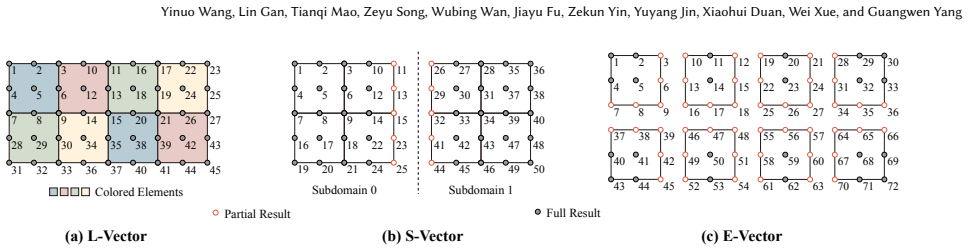
The carrying mechanism is a factorized diagnostic methodology that decomposes the stiffness operator into independently controllable layers—contraction backend, pointwise physics and geometry, field layout, coefficient layout, and reconciliation—and compares matched null, SIMD, and matrix-engine backends using measured time, throughput, and effective-bandwidth deltas rather than hardware counters. The null backend is the key control: it removes contraction instructions while preserving the surrounding operator path, so its 1.11–1.32x margin over the recovered matrix-engine operator is both a diagnosis of non-contraction cost and a counterfactual ceiling on making contractions free. The recovery uses three concrete layout mechanisms: S-vector and E-vector field storage that trade in-kernel indirection and conflicts for duplication and explicit reconciliation, and array-of-structures-of-vectors coefficient storage that aligns streams with SIMD consumption.
What would settle it
An independent reimplementation of the SIMD contraction and operator path that raises single-core utilization well above 65% of SIMD FMA peak would test the claim: if the full-operator matrix-engine/SIMD speedup then approaches the ~2.2x contraction proxy at p=15, the attenuation cascade would be an artifact of baseline quality rather than operator structure.
Extended reading notes
Core claim
The central claim is that useful matrix-engine speedup is a property of the whole operator, not of the contraction kernel. On LX2, the matrix engine's 4x FP32 peak over SIMD becomes about 2.2x for matched standalone tensor contractions, because small spectral-element contractions only partially occupy the matrix tile, and about 1.1x inside the conventional L-vector stiffness operator, because pointwise computation, indirect gather/scatter, shared-degree-of-freedom reconciliation, and irregular coefficient traffic dominate elapsed time. Explicit SIMD for pointwise physics raises the full-operator ratio to about 1.3x; moving fields to S/E-vector layouts and coefficients to vector-blocked streaming raises it to about 1.6x at p=15. A contraction-free null backend runs only 1.11–1.32x faster than the recovered matrix-engine operator, giving an empirical ceiling on further contraction-only optimization.
Load-bearing premise
The central ratios are measured against the authors' hand-written SIMD baseline, which reaches about 65% of SIMD peak; if a substantially better SIMD implementation exists, the reported attenuation, recovery, and ceiling numbers would all change.
Editorial extensions
If this is right
- On LX2, swapping in matrix-engine contractions alone is not enough; the conventional irregular operator gains only about 1.1x, so pointwise SIMD and layout changes are required to approach 1.6x.
- Further tuning of the contraction kernels has at most 1.11–1.32x left to give at high order, since even a contraction-free operator is only that much faster than the recovered matrix-engine configuration.
- The shared-degree-of-freedom cost is relocated, not eliminated: L-, S-, and E-vector layouts trade indirection and conflicts for duplication and reconciliation, and reconciliation time must be counted in any claimed speedup.
- In an iso-accuracy wave-propagation test, the recovered throughput favors higher polynomial order: p=7 is clearly beneficial, while p=15 helps only when the accuracy-selected timestep stays above the CFL limit.
- The methodology ports to another matrix-engine CPU with the same experimental controls, so the diagnostic can identify where acceleration is masked before large optimization efforts are invested.
Reading between the lines
- If the same attenuation cascade appears on GPU tensor cores, isolated microkernel speedups over conventional GPU cores likely overstate end-to-end gains for high-order finite elements; the LX2 evidence suggests the operator path, not the kernel, is the bottleneck.
- The null-backend ceiling implies that future work should target pointwise and data-movement stages, whose combined cost is several times larger than the contraction-only savings, rather than further matrix-engine microkernel tuning.
- A testable extension would run the same factorized diagnostic with an FP64 or different matrix-engine configuration; the ratios would shift, but the claim that layout and reconciliation dominate at low-to-mid order could be checked directly.
Signed reviews
Editorial analysis
A structured set of objections, weighed in public.
Referee Report
Summary. The paper studies why the Arm SME matrix unit's large FP32 peak advantage (4x over SVE on the LX2 processor) is not realized end to end in SPECFEM3D's stiffness operator. Using matched SVE, SME, and null contraction backends embedded in a factorized full-operator benchmark, the authors measure attenuation from peak to isolated tensor contractions (about 2.2x at p=15), then to the conventional irregular L-vector operator (about 1.1x), and finally report partial recovery through explicit-SIMD pointwise work (about 1.3x) and through field-layout and coefficient-streaming changes (about 1.6x at high order). A contraction-free null backend is used to bound further contraction-only gains at 1.11-1.32x. The paper also includes a smooth-wave-problem case study suggesting that recovered high-order operator throughput can make higher polynomial order more favorable in an iso-accuracy sense.
Significance. If the central findings hold, the paper makes a valuable contribution to the growing literature on matrix engines in scientific computing: it demonstrates, on a production-relevant CPU and a widely used application operator, that the realizable speedup from a matrix unit is determined by the whole operator path—pointwise physics, field movement, coefficient delivery, and shared-DoF reconciliation—rather than by the contraction kernel alone. The methodological contribution is strong: the authors provide matched build contracts for SVE and SME, canonical-output validation for every optimized path, binary hashes, a clearly described filtering and remeasurement procedure for outlier samples, and an artifact repository. They also explicitly flag limitations of their own measurements (the best-to-best nature of the envelope and the non-strictness of the null-backend ceiling). These transparency practices raise confidence in the reported numbers. If the concerns below are addressed, the paper would be a useful reference for both hardware-software co-design and high-order FEM framework design.
major comments (2)
- [Section 6.3, Figure 11, and abstract] The paper's most prominent quantitative recovery claim—that coordinated pointwise, field-layout, and coefficient-layout changes 'together raise speedup to 1.6x'—is not supported by a controlled cumulative experiment. Section 6.3 explicitly states that Figure 11 is 'a best-to-best rather than fixed-layout comparison,' because each backend independently selects its fastest configuration at every order. The controlled comparisons in Figures 7 and 9A-D isolate individual changes with other factors fixed, but no experiment applies the three recovery stages cumulatively while holding all other factors fixed for both backends. As written, the 1.6x ratio could reflect differential configuration selection (e.g., SME choosing E-vector with mixed-AoSoV while SVE chooses S-vector with SoA) as much as the named operator-path changes. This is load-bearing because the abstract and conclusion present the 1.6x as the result of the specific recovery sequence. I recommend either adding a controlled cumulative comparison (e.g., start from the matched L-vector baseline and apply explicit SIMD, then S/E-vector, then AoSoV with all else fixed) or explicitly reframing the claim as 'the best validated SME configuration reaches 1.6x over the best validated SVE configuration,' without attributing the gain to the sequence.
- [Section 4, SVE baseline quality] The load-bearing premise of all SME/SVE ratios is that the hand-written SVE contraction backend is a genuinely high-performance SIMD implementation. The paper reports that the SVE backend reaches about 65 GFLOP/s, roughly 65% of the single-core SVE FMA peak, and states that the matched SVE path ensures later comparisons measure hardware datapaths rather than a strong SME implementation against a weak SIMD baseline. However, no independent evidence is provided that 65% of peak is near the attainable limit for these small, direction-dependent tensor contractions. A stronger SVE kernel—for example, with better register tiling, software pipelining, or a different direction-specific strategy—would directly reduce the reported 2.2x contraction speedup and the 1.6x recovery ratio. This is a correctness-risk concern rather than a demonstrated flaw. I would like to see a sensitivity analysis: vary one or two SVE kernel parameters (e.g., unroll factors or pipeline depth) and report the resulting SME/SVE ratios, or cite an independent high-quality SVE implementation for the same kernels.
minor comments (3)
- [Section 6.3, null-backend ceiling] The abstract says the contraction-free control 'bounds further contraction-only gains at 1.11–1.32x,' but Section 6.3 correctly notes that this 'is not a strict hardware bound because removing contraction can perturb caching and overlap.' Please use more precise wording in the abstract, such as 'suggests an empirical ceiling' or 'indicates an upper range,' to avoid overstating the strength of the null-backend result.
- [Section 7, iso-accuracy projection] The iso-accuracy cost projection relies on a least-squares fit of station-wise error to c1*x + c2*x^2 and on the assumption that the scalar-wave calibration transfers to elastic propagation. The paper states this assumption explicitly, but the sensitivity of the projected speedups to the error-fit choice is not reported. A brief sentence on how the frontier changes if the error model is changed (e.g., using a single power law) would strengthen the case-study conclusions.
- [Throughout] There are several typographical and formatting issues from the LaTeX source, including missing spaces around numbers and symbols (e.g., 'SME’s4×' in the abstract, '1.1×' and 'SVE' in Section 1) and inconsistent use of en-dashes in ranges. These are cosmetic but should be cleaned up in the final version.
Circularity Check
No circularity: all headline SME/SVE ratios are direct matched measurements; the only fitted parameters are diagnostic or calibration tools, not sources of the speedup claims.
full rationale
The paper's central quantitative claims are direct measurements between matched backends on the same hardware: the 4x peak-to-2.2x contraction-to-1.1x operator attenuation and the recovery to 1.3x/1.6x are timing results from Figures 6, 7, 9, and 11. The only free parameters are alpha_b in the partial-overlap model (Eq. 6) and c1/c2 in the iso-accuracy error fits (Section 7), and neither generates the headline speedups: alpha_b is explicitly labeled 'diagnostic rather than cycle accurate,' and the c1/c2 fits are a calibration for the discretization projection, not a first-principles prediction. The CPI-style bound (Eqs. 4-5) uses stated issue-cost constants (CPI_OPA=2, CPI_LSU=1) rather than values extracted from the measured SME curves, so the bound is not fitted to the data. The null-backend ceiling (1.11-1.32x) is a measured counterfactual, not a derived equivalence. The author self-citations ([14] for vector-blocked AoSoA layout and [37] for stencil-related work) are contextual and non-load-bearing; the recovery numbers are measured with the paper's own implementations. The paper also transparently discloses that the final envelope (Figure 11) is a 'best-to-best rather than fixed-layout comparison,' which is a validity caveat rather than a circular reduction and does not affect the matched L-vector comparisons of Figure 7. No derivation step reduces to its inputs by construction.
Assumptions & free parameters
free parameters (2)
- alpha_b non-overlap parameter =
not reported explicitly
- c1, c2 error-distance fit coefficients =
not reported
assumptions (5)
- domain assumption LX2 hardware characteristics: SME provides 4x FP32 peak over SVE, ZA tile is 64 rows of 64 bytes, and the measured FP32 configuration uses VL=16.
- domain assumption Single-core issue costs CPI_OPA=2 and CPI_LSU=1 for the SME outer-product and load/store units.
- ad hoc to paper Partial-overlap model structure: T_b approx max(T_mem, T_contr) + alpha_b min(T_mem, T_contr) in Eq. 6.
- domain assumption Order-to-order spatial-resolution trend from the homogeneous scalar wave calibration transfers to smooth elastic propagation.
- standard math Tensor-product sum factorization expresses SEM directional derivatives as batches of small tensor contractions.
Cite this review
Pith. "Pith review of Beyond Fast Contractions: Attenuation and Recovery of Matrix-Engine Speedups in High-Order Finite Elements." pith.science (2026). https://pith.science/paper/CPBP5UK4
@misc{pith2026260809175,
  author       = {Pith},
  title        = {Pith review of: Beyond Fast Contractions: Attenuation and Recovery of Matrix-Engine Speedups in High-Order Finite Elements},
  year         = {2026},
  howpublished = {\url{https://pith.science/paper/CPBP5UK4}},
  note         = {Machine review of arXiv:2608.09175}
}
abstract
Modern processors increasingly provide matrix engines whose peak arithmetic throughput greatly exceeds conventional SIMD, but scientific applications rarely realize this advantage end to end. We examine this gap in SPECFEM3D's dominant stiffness operator on the Arm LX2 CPUs that power the flagship Lineshine supercomputer. Against a matched, high-performance SVE baseline on the same cores, SME's $4\times$ single-precision peak advantage falls to $2.2\times$ for isolated tensor contractions and $1.1\times$ for the complete operator. Our factorized diagnostic attributes the loss to pointwise computation, indirect field movement and synchronization, and irregular coefficient delivery. Explicit SIMD mitigates pointwise work, raising the full-operator speedup to $1.3\times$. Field-layout changes mitigate indirect movement and synchronization, while vector-blocked coefficient streaming reduces irregular-access costs; together they raise speedup to $1.6\times$ at high order. A contraction-free control bounds further contraction-only gains at $1.11$--$1.32\times$. Realizing matrix-engine performance therefore requires co-designing the entire operator path, not merely replacing its contraction kernel.
Figures


Figures from the paper (8 more)




Reference graph
Works this paper leans on
-
[1]
Ahmad Abdelfattah, Valeria Barra, Natalie Beams, Ryan Bleile, Jed Brown, Jean- Sylvain Camier, Robert Carson, Noel Chalmers, Veselin Dobrev, Yohann Dudouit, Paul Fischer, Ali Karakus, Stefan Kerkemeier, Tzanio Kolev, Yu-Hsiang Lan, Elia Merzari, Misun Min, Malachi Phillips, Thilina Rathnayake, Robert Rieben, Thomas Stitt, Ananias Tomboulides, Stanimire To...
arXiv 2021
-
[2]
Mark Ainsworth. 2004. Discrete Dispersion Relation forℎ𝑝-Version Finite Ele- ment Approximation at High Wave Number.SIAM J. Numer. Anal.42, 2 (2004), 553–575. doi:10.1137/S0036142903423460
-
[3]
Mark Ainsworth and Hafiz Abdul Wajid. 2009. Dispersive and Dissipative Behavior of the Spectral Element Method.SIAM J. Numer. Anal.47, 5 (2009), 3910–3937. doi:10.1137/080724976
-
[4]
Robert Anderson, Julian Andrej, Andrew Barker, Jamie Bramwell, Jean-Sylvain Camier, Jakub Cerveny, Veselin Dobrev, Yohann Dudouit, Aaron Fisher, Tzanio Kolev, Will Pazner, Mark Stowell, Vassileios Tomov, Ido Akkerman, Johann Dahm, David Medina, and Stefano Zampini. 2021. MFEM: A Modular Finite Element Methods Library.Computers & Mathematics with Applicati...
-
[5]
Julian Andrej, Nabil Atallah, Jan-Phillip Bäcker, Jean-Sylvain Camier, Dylan Copeland, Veselin Dobrev, Yohann Dudouit, Tobias Duswald, Brendan Keith, Dohyun Kim, Tzanio Kolev, Boyan Lazarov, Ketan Mittal, Will Pazner, Socratis Petrides, Syun’ichi Shiraiwa, Mark Stowell, and Vladimir Tomov. 2024. High- Performance Finite Elements with MFEM.The Internationa...
-
[6]
2022.Arm Architecture Reference Manual Supplement: The Scalable Matrix Extension
Arm Ltd. 2022.Arm Architecture Reference Manual Supplement: The Scalable Matrix Extension. Arm Ltd. https://developer.arm.com/documentation/ddi0616/ latest
work page 2022
-
[7]
Daniel Arndt, Wolfgang Bangerth, Denis Davydov, Timo Heister, Luca Heltai, Martin Kronbichler, Matthias Maier, Jean-Paul Pelteret, Bruno Turcksin, and David Wells. 2021. The deal.II Finite Element Library: Design, Features, and Insights.Computers & Mathematics with Applications81 (2021), 407–422. doi:10. 1016/j.camwa.2020.02.022
work page 2021
-
[8]
Jed Brown, Ahmad Abdelfattah, Valeria Barra, Natalie Beams, Jean-Sylvain Camier, Veselin Dobrev, Yohann Dudouit, Leila Ghaffari, Tzanio Kolev, David Medina, Will Pazner, Thilina Ratnayaka, Jeremy Thompson, and Stan Tomov
Show all 46 references
-
[9]
Canuto, M
Claudio G. Canuto, M. Yousuff Hussaini, Alfio M. Quarteroni, and Thomas A. Zang. 2007.Spectral Methods: Evolution to Complex Geometries and Applications to Fluid Dynamics. Springer-Verlag, Berlin, Heidelberg
2007
-
[10]
Yuetao Chen, Kun Li, Yuhao Wang, Donglin Bai, Lei Wang, Lingxiao Ma, Liang Yuan, Yunquan Zhang, Ting Cao, and Mao Yang. 2024. ConvStencil: Transform Stencil Computation to Matrix Multiplication on Tensor Cores. InProceedings of the 29th ACM SIGPLAN Annual Symposium on Principl...
2024
-
[11]
Cu Cui. 2024. Acceleration of Tensor-Product Operations with Tensor Cores. ACM Transactions on Parallel Computing11, 4, Article 34 (2024). doi:10.1145/ 3695466
2024
-
[12]
Deville, Paul F
Michel O. Deville, Paul F. Fischer, and Ernest H. Mund. 2002.High-Order Meth- ods for Incompressible Fluid Flow. Cambridge University Press. doi:10.1017/ CBO9780511546792
2002
-
[13]
Jens Domke, Emil Vatai, Aleksandr Drozd, Peng Chen, Yosuke Oyama, Lingqi Zhang, Shweta Salaria, Daichi Mukunoki, Artur Podobas, Mohamed Wahib, and Satoshi Matsuoka. 2021. Matrix Engines for High Performance Computing: A Paragon of Performance or Grasping at Straws?. InProceedi...
2021
-
[14]
Xiaohui Duan, Kai Xu, Yuandong Chan, Christian Hundt, Bertil Schmidt, Pavan Balaji, and Weiguo Liu. 2017. S-Aligner: Ultrascalable Read Mapping on Sunway Taihu Light. In2017 IEEE International Conference on Cluster Computing. IEEE, 36–46. doi:10.1109/CLUSTER.2017.16
2017 doi
-
[15]
Ruibo Fan, Wei Wang, and Xiaowen Chu. 2024. DTC-SpMM: Bridging the Gap in Accelerating General Sparse Matrix Multiplication with Tensor Cores. In Proceedings of the 29th ACM International Conference on Architectural Support for Programming Languages and Operating Systems, Volu...
2024
-
[16]
Paul Fischer, Stefan Kerkemeier, Misun Min, Yu-Hsiang Lan, Malachi Phillips, Thilina Rathnayake, Elia Merzari, Ananias Tomboulides, Ali Karakus, Noel Chalmers, and Tim Warburton. 2022. NekRS, a GPU-Accelerated Spectral Ele- ment Navier–Stokes Solver.Parallel Comput.114 (2022),...
2022
-
[17]
Qiqi Gu, Chenpeng Wu, Heng Shi, Jianguo Yao, and Haibing Guan. 2026. Do We Need Tensor Cores for Stencil Computations? arXiv:2603.00477 [cs.DC]
2026
-
[18]
Alexander Heinecke, Greg Henry, Maxwell Hutchinson, and Hans Pabst. 2016. LIBXSMM: Accelerating Small Matrix Multiplications by Runtime Code Genera- tion. InProceedings of the International Conference for High Performance Comput- ing, Networking, Storage and Analysis. IEEE Pre...
2016
-
[19]
Stefan Henneking, Sreeram Venkat, Veselin Dobrev, John Camier, Tzanio Kolev, Milinda Fernando, Alice-Agnes Gabriel, and Omar Ghattas. 2025. Real-Time Bayesian Inference at Extreme Scale: A Digital Twin for Tsunami Early Warning Applied to the Cascadia Subduction Zone. InProcee...
2025
-
[20]
Han Huang, Jiabin Xie, Guangnan Feng, Xianwei Zhang, Dan Huang, Zhiguang Chen, and Yutong Lu. 2025. HStencil: Matrix–Vector Stencil Computation with Interleaved Outer Product and MLA. InProceedings of the International Conference for High Performance Computing, Networking, Sto...
2025
-
[21]
Jones and Paul E
Mark T. Jones and Paul E. Plassmann. 1993. A Parallel Graph Coloring Heuristic. SIAM Journal on Scientific Computing14, 3 (1993), 654–669. doi:10.1137/0914041
1993 doi
-
[22]
Hesthaven
Andreas Klöckner, Tim Warburton, and Jan S. Hesthaven. 2011. Viscous Shock Capturing in a Time-Explicit Discontinuous Galerkin Method.Mathematical Modelling of Natural Phenomena6, 3 (2011), 57–83. doi:10.1051/mmnp/20116303 11 Yinuo Wang, Lin Gan, Tianqi Mao, Zeyu Song, Wubing ...
2011
-
[23]
Tzanio Kolev, Paul Fischer, Misun Min, Jack Dongarra, Jed Brown, Veselin Dobrev, Tim Warburton, Stanimire Tomov, Mark S. Shephard, Ahmad Abdelfattah, Valeria Barra, Natalie Beams, Jean-Sylvain Camier, Noel Chalmers, Yohann Dudouit, Ali Karakus, Ian Karlin, Stefan Kerkemeier, Y...
2021
-
[24]
Dimitri Komatitsch, Gordon Erlebacher, Dominik Göddeke, and David Michéa
-
[25]
Dimitri Komatitsch and Jeroen Tromp. 1999. Introduction to the Spectral Element Method for Three-Dimensional Seismic Wave Propagation.Geophysical Journal International139, 3 (1999), 806–822. doi:10.1046/j.1365-246x.1999.00967.x
1999
-
[26]
Xiaoyan Liu, Yi Liu, Hailong Yang, Jianjin Liao, Mingzhen Li, Zhongzhi Luan, and Depei Qian. 2022. Toward Accelerated Stencil Computation by Adapting Tensor Core Unit on GPU. InProceedings of the 36th ACM International Conference on Supercomputing. Association for Computing Ma...
2022
-
[27]
Yuechen Lu, Hongwei Zeng, Marc Casas, and Weifeng Liu. 2026. Characterizing Matrix Multiplication Units across General Parallel Patterns in Scientific Com- puting. InProceedings of the 31st ACM SIGPLAN Annual Symposium on Principles and Practice of Parallel Programming. Associ...
2026
-
[28]
McCalpin
John D. McCalpin. 1995. Memory Bandwidth and Machine Balance in Cur- rent High Performance Computers.IEEE Technical Committee on Computer Architecture Newsletter(1995), 19–25
1995
-
[29]
Anthony T. Patera. 1984. A Spectral Element Method for Fluid Dynamics: Laminar Flow in a Channel Expansion.J. Comput. Phys.54, 3 (1984), 468–488. doi:10. 1016/0021-9991(84)90128-1
1984
-
[30]
Daniel Peter, Dimitri Komatitsch, Yang Luo, Roland Martin, Nicolas Le Goff, Emanuele Casarotti, Pieyre Le Loher, Federica Magnoni, Qinya Liu, Céline Blitz, Tarje Nissen-Meyer, Piero Basini, and Jeroen Tromp. 2011. Forward and Adjoint Simulations of Seismic Wave Propagation on ...
2011 arXiv
-
[31]
Jinliang Shi, Shigang Li, Youxuan Xu, Rongtian Fu, Xueying Wang, and Tong Wu
-
[32]
Kasia Swirydowicz, Noel Chalmers, Ali Karakus, and Tim Warburton. 2019. Ac- celeration of Tensor-Product Operations for High-Order Finite Element Methods. The International Journal of High Performance Computing Applications33, 4 (2019), 735–757. doi:10.1177/1094342018816368
2019 doi
-
[33]
TOP500. 2026. TOP500 List, June 2026. https://www.top500.org/lists/top500/ 2026/06/. Accessed July 2026
2026
-
[34]
Sara Touhami, Filippo Gatti, Fernando Lopez-Caballero, David Alejandro Cas- tro Cruz, and Didier Clouteau. 2022. SEM3D: A 3D High-Fidelity Numerical Earthquake Simulator for Broadband (0–10 Hz) Seismic Response Prediction at a Regional Scale.Geosciences12, 3 (2022), 112. doi:1...
2022 doi
-
[35]
Jiqun Tu, Ian Karlin, John Camier, Veselin Dobrev, Tzanio Kolev, Stefan Hennek- ing, and Omar Ghattas. 2026. Accelerating High-Order Finite Element Simula- tions at Extreme Scale with FP64 Tensor Cores. arXiv:2603.09038 [cs.DC]
2026 arXiv
-
[36]
Peter E. J. Vos, Spencer J. Sherwin, and Robert M. Kirby. 2010. From ℎ to𝑝 Efficiently: Implementing Finite and Spectral/ℎ𝑝 Element Methods to Achieve Optimal Performance for Low- and High-Order Discretisations.J. Comput. Phys. 229, 13 (2010), 5161–5181. doi:10.1016/j.jcp.2010.03.031
2010 doi
-
[37]
Yinuo Wang, Tianqi Mao, Lin Gan, Wubing Wan, Zeyu Song, Jiayu Fu, Lanke He, Wenqiang Wang, Zekun Yin, Wei Xue, and Guangwen Yang. 2026. SMES- tencil: Optimizing High-Order Stencils on Arm Multicore Using SME Unit. IEEE Transactions on Parallel and Distributed Systems37, 3 (202...
2026
-
[38]
Z. J. Wang, Krzysztof Fidkowski, Rémi Abgrall, Francesco Bassi, Doru Caraeni, Andrew Cary, Herman Deconinck, Ralf Hartmann, Koen Hillewaert, H. T. Huynh, Norbert Kroll, Georg May, Per-Olof Persson, Bram van Leer, and Miguel Visbal
-
[39]
Samuel Williams, Andrew Waterman, and David Patterson. 2009. Roofline: An Insightful Visual Performance Model for Multicore Architectures.Commun. ACM52, 4 (2009), 65–76. doi:10.1145/1498765.1498785
2009
-
[40]
Orestis Zachariadis, Nitin Satpute, Juan Gómez-Luna, and Joaquín Olivares
-
[41]
Yiwei Zhang, Kun Li, Liang Yuan, Jiawen Cheng, Yunquan Zhang, Ting Cao, and Mao Yang. 2024. LoRAStencil: Low-Rank Adaptation of Stencil Computation on Tensor Cores. InProceedings of the International Conference for High Performance Computing, Networking, Storage, and Analysis....
2024 arXiv
-
[2010]
High-Order Finite-Element Seismic Wave Propagation Modeling with MPI on a Large GPU Cluster.J. Comput. Phys.229 (2010), 7692–7714. doi:10.1016/j. jcp.2010.06.024
2010 doi
-
[2013]
doi:10.1002/fld.3767
High-Order CFD Methods: Current Status and Perspective.International Journal for Numerical Methods in Fluids72, 8 (2013), 811–845. doi:10.1002/fld.3767
2013 doi
-
[2020]
Computers & Electrical Engineering88 (2020), 106848
Accelerating Sparse Matrix–Matrix Multiplication with GPU Tensor Cores. Computers & Electrical Engineering88 (2020), 106848. doi:10.1016/j.compeleceng. 2020.106848
2020
-
[2021]
Journal of Open Source Software6, 63 (2021), 2945
libCEED: Fast Algebra for High-Order Element-Based Discretizations. Journal of Open Source Software6, 63 (2021), 2945. doi:10.21105/joss.02945
2021 doi
-
[2025]
InProceedings of the 30th ACM SIGPLAN Annual Symposium on Principles and Practice of Parallel Programming
FlashSparse: Minimizing Computation Redundancy for Fast Sparse Matrix Multiplications on Tensor Cores. InProceedings of the 30th ACM SIGPLAN Annual Symposium on Principles and Practice of Parallel Programming. Association for Computing Machinery, 312–325. doi:10.1145/3710848.3710858
Reviewed August 11, 2026 · model on record in the stance chip above.
Discussion (0). Continue with ORCID to comment.