REVIEW 2 major objections 6 minor 2 cited by
Fade to grey: systematic variation of the galaxy attenuation curves with galaxy properties in EAGLE
T0 review · 2 major / 6 minor · reviewed 2026-08-14 · deepseek-v4-flash
Pith's one-line read A galaxy's dust attenuation curve is set by its average dust surface density, a relation that is tight and nearly redshift-independent, and adding a birth-cloud screen reproduces the observed attenuation trend.
desk verdict The Σ_dust–attenuation calibration is solid and useful; the birth-cloud 'reproduction' of Salim et al. is plausible but not yet demonstrated. read the letter →
The pith
A machine-rendered reading of the paper's core claim, the machinery that carries it, and where it could break.
The reading
What carries the argument
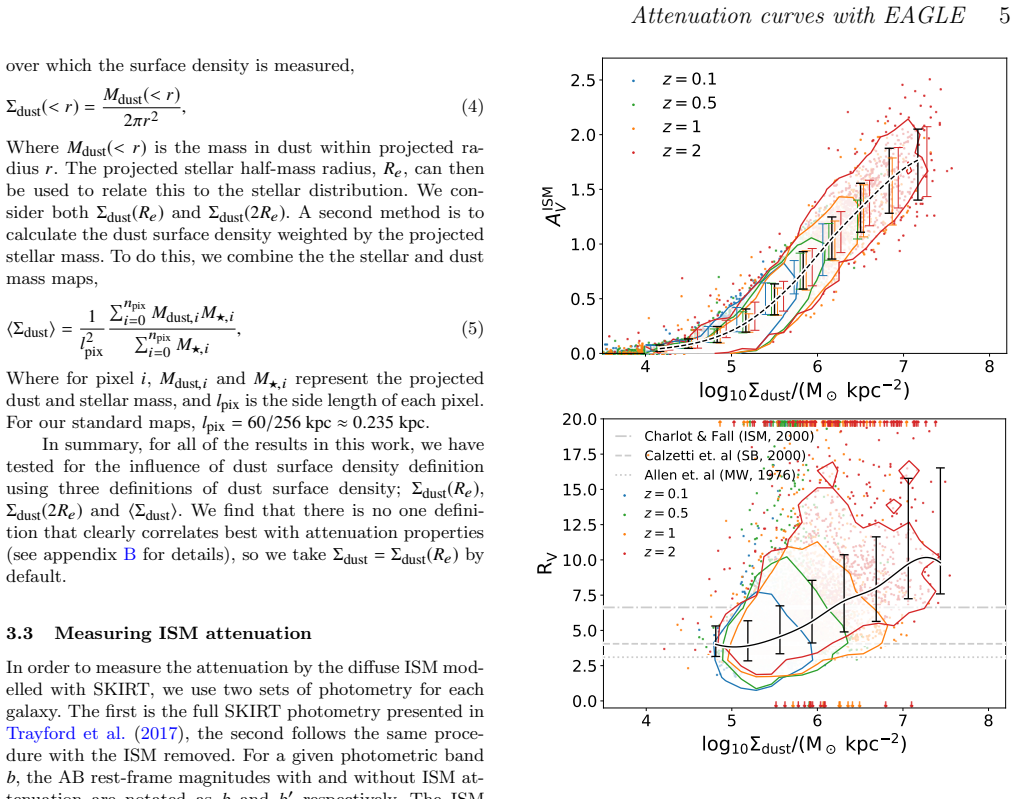
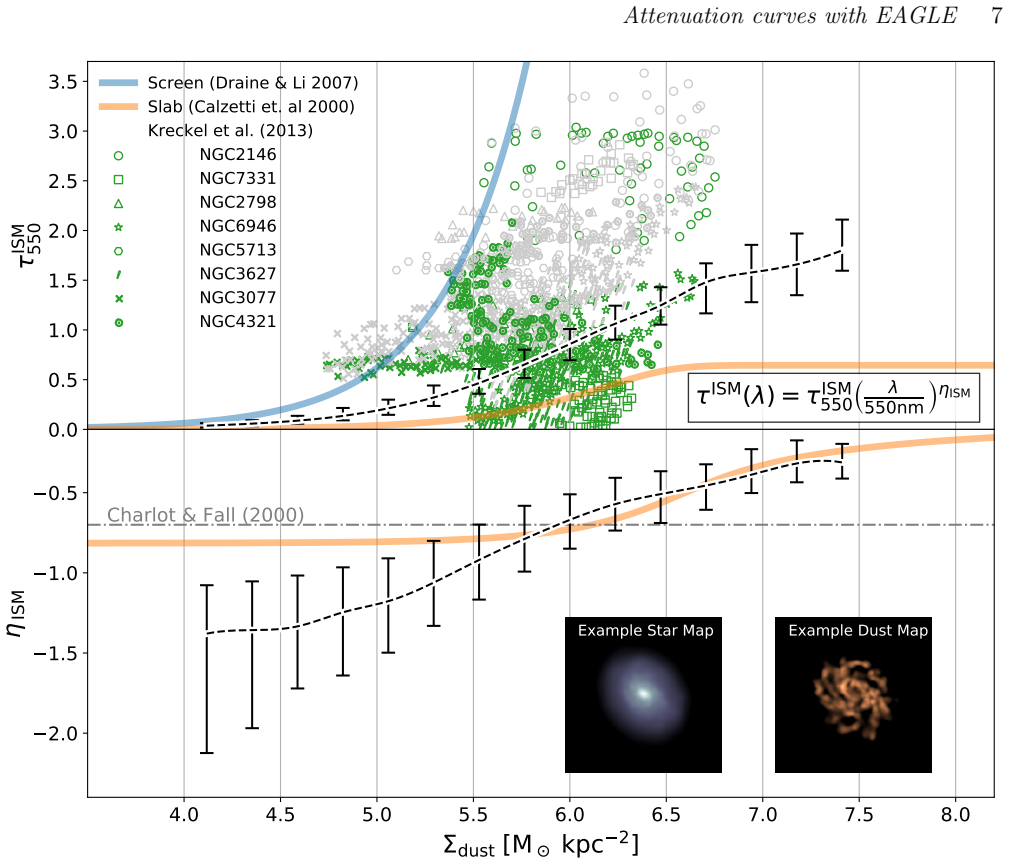
The load-bearing object is a two-component screen model in the style of Charlot & Fall (2000): a diffuse ISM power-law screen, $\tau_{\rm ISM}(\lambda) = \tau_{\rm ISM}^{550}(\lambda/5500\,{\rm \AA})^{-\eta_{\rm ISM}}$, plus a birth-cloud screen that applies only to stars younger than 10 Myr. The paper distils the full SKIRT radiative-transfer output by fitting this power law to each galaxy's ugriz-band attenuation, then studies the fitted parameters against the average dust surface density $\Sigma_{\rm dust}$, measured either within the projected stellar half-mass radius or as a stellar-mass-weighted average. $\Sigma_{\rm dust}$ is the single predictor that carries the argument: it encodes the geometric effects of star-dust mixing that make attenuation differ from a uniform screen, and it explains both the normalisation and the slope of the attenuation curve. The birth-cloud term is added in post-processing below the simulation resolution, with $\tau_{\rm BC} = f_\tau \tau_{\rm ISM}$ and a steeper slope $\eta_{\rm BC} = -1.3$, and the observed slope-attenuation relation is recovered for any reasonable $f_\tau \gtrsim 2$.
What would settle it
Measure dust surface densities from resolved far-infrared dust maps and attenuation slopes from independent SED fits for galaxies at $z \approx 2$ and $z \approx 0.1$, and check whether the same $\Sigma_{\rm dust}$ produces the same attenuation curve; a systematic offset between redshifts, or a change in slope at fixed $\Sigma_{\rm dust}$ beyond the predicted orientation scatter, would falsify the relation.
Extended reading notes
Core claim
The central claim is that the effective attenuation curve of a galaxy, computed by full radiative transfer through the star-dust geometry of EAGLE galaxies, collapses onto a two-parameter family: $\tau_{\rm ISM}(\lambda) = \tau_{\rm ISM}^{550}(\lambda/5500\,{\rm \AA})^{-\eta_{\rm ISM}}$. Fitting this power law to the ugriz attenuation of each galaxy, the authors find that the V-band optical depth $\tau_{\rm ISM}^{550}$ and the slope $\eta_{\rm ISM}$ both track the average dust surface density $\Sigma_{\rm dust}$: more dust per square kiloparsec means stronger and flatter, greyer attenuation, approaching the Milky Way extinction curve at the highest surface densities. The relation is tight enough that $\Sigma_{\rm dust}$ alone predicts the ISM attenuation, with residual scatter set by galaxy orientation and morphology, and it is nearly independent of redshift over $z = 2$ to $0.1$. When an unresolved birth-cloud screen with boosted attenuation for stars younger than 10 Myr is added, the model reproduces the observed relation between attenuation slope and V-band attenuation found by Salim et al. (2018), and this result is insensitive to the birth-cloud attenuation prescription as long as the infant-star attenuation is boosted.
Load-bearing premise
The model assumes dust always makes up 30 per cent of the metal mass in gas and that dust grains scatter and absorb light like Milky Way dust at every redshift, so a real variation in the dust-to-metal ratio or in grain properties would shift the predicted attenuation relations.
Editorial extensions
If this is right
- SED fitting codes can replace arbitrary screen or slab attenuation geometries with a relation keyed to a measurable physical quantity, $\Sigma_{\rm dust}$.
- Semi-analytic models and other hydrodynamic simulations can assign wavelength-dependent attenuation from gas mass, metallicity and galaxy size, instead of from fixed idealised geometries.
- The near redshift-independence implies that the simulated evolution of galaxy attenuation is not driven by evolving dust physics but by galaxies populating different parts of a static $\Sigma_{\rm dust}$--attenuation relation.
- The predicted scatter means orientation and morphology leave a distinctive imprint: at fixed attenuation, edge-on galaxies should show flatter, greyer attenuation curves.
- The birth-cloud result implies that the observed slope--attenuation relation requires only boosted attenuation of infant stars, not fine-tuned birth-cloud dust properties.
Reading between the lines
- If real dust-to-metal ratios vary with metallicity or redshift, the same $\Sigma_{\rm dust}$--attenuation relation would shift, and mapping that variation could turn the model into a probe of dust production and destruction.
- A direct observational test would be to compare resolved $\Sigma_{\rm dust}$ measurements with attenuation slopes from SED fitting across galaxy orientations, checking the paper's prediction that edge-on galaxies are greyer at fixed attenuation.
- The same $\Sigma_{\rm dust}$ parameter could help explain the scatter in the infrared-excess--UV-slope relation, since that scatter is partly driven by the geometric effects the paper quantifies.
- The greying-with-dustiness trend suggests that SED fits to very dusty high-redshift galaxies may systematically require shallower attenuation curves than the Calzetti law allows.
Signed reviews
Editorial analysis
A structured set of objections, weighed in public.
Referee Report
Summary. This paper distills SKIRT radiative transfer calculations for roughly 100,000 EAGLE galaxies at redshifts z = 0.1, 0.5, 1 and 2 into a two-component screen model of galaxy attenuation. The ISM component is parametrized by the dust surface density, Σ_dust, and the paper reports tight, nearly redshift-independent relations between Σ_dust and both the V-band attenuation strength and the power-law slope of the attenuation curve. A birth-cloud term is then added in post-processing to attenuate stars younger than 10 Myr, and the resulting δ–A_V relation is compared with the observed relation of Salim et al. (2018). The paper claims that this is the first cosmological simulation to reproduce that relation, and that the result is insensitive to the assumed birth-cloud attenuation properties as long as infant stars receive a boosted attenuation. The paper is careful to state several caveats, including the fixed dust-to-metal ratio, the fixed input extinction curve, and the fact that a full forward-modeling comparison to observed SED fits is left to future work.
Significance. If the central claims hold, the Σ_dust-parametrized ISM attenuation model is a valuable practical tool for semi-analytic models and for interpreting galaxy observations, and the redshift-independence of the relations would be an interesting emergent property of the EAGLE model. The study's strengths include the large statistical sample, the explicit treatment of scatter and orientation effects, and the convergence tests in Appendix A, which are a genuine strength. The birth-cloud comparison with Salim et al. (2018) is promising and the paper is honest about its limitations; however, as written, the headline claim that the observed δ–A_V relation is reproduced is not yet fully supported because the model relation and the observed relation are derived through different inference procedures. The robust core of the paper is the EAGLE ISM attenuation–Σ_dust relation itself, which stands independently of the birth-cloud modeling.
major comments (2)
- [§5.2, Fig. 5] The comparison to Salim et al. (2018) is between a model relation obtained by fitting Eq. (1) directly to noise-free SKIRT attenuation values, using representative SDSS errors only as fit weights (Appendix C), and an observational relation obtained from full SED fitting with its own degeneracies, priors, and sample selection. The paper itself states in §5 that applying the same inference procedure to EAGLE spectra is left for future work, so the abstract's claim that the observed δ–A_V relation is reproduced 'for the first time in a cosmological simulation' is stronger than the evidence presented. Without forward-modeling the EAGLE spectra through the same SED-fitting pipeline used for the observations, the agreement could reflect differences in how δ and A_V are defined rather than physical agreement. Please either carry out such a test or explicitly temper the claim to say that the model is consistent with the observed relation under a simple birth-cloud boost.
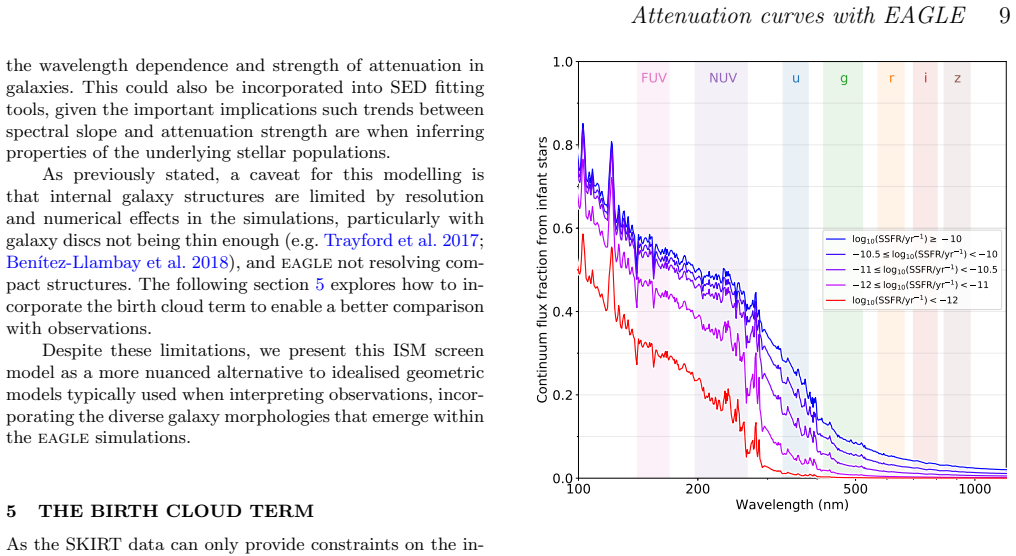
- [§5.2, §6] The stated robustness of the birth-cloud result is demonstrated only for variations in the birth-cloud spectral slope η_BC and the optical-depth ratio f_τ. The birth-cloud dispersal time t_disp is fixed at 10 Myr, as acknowledged in §6, and the paper notes in §5.2 that variation in t_disp is not explored. Because t_disp determines which stellar populations receive the birth-cloud boost, and because Fig. 4 shows that the infant-star flux fraction varies rapidly with wavelength and sSFR, a different dispersal time could change the shape of the δ–A_V relation, especially at low A_V where infant stars contribute a larger fraction of the light. The conclusion that the result 'merely requires' a boosted attenuation should therefore be restricted to the explored parameter space, or the t_disp dependence should be tested.
minor comments (6)
- [§1] The text 'Sloane galaxies' should read 'Sloan galaxies'.
- [§5.2] The sentence 'assuming ηBC = ηshell ISM' appears to contain a typo; it should presumably be 'ηBC = ηshellBC' or 'ηBC = −1.3'.
- [§6] The phrase 'birth cloud dspersal time' contains a typo and should read 'birth cloud dispersal time'.
- [Appendix A] The phrase 'Rec25 differs rom RefHi25' should read 'Rec25 differs from RefHi25'.
- [Appendix C] The inset label 'Modified C01 fit' should read 'Modified C00 fit' for consistency with Calzetti et al. (2000).
- [Fig. A1] The right-hand panel shows a λ^0.2 offset in η_ISM for Recal25 relative to Ref100; this is described as 'moderately well converged' in the text, but given that η_ISM is one of the two model parameters, it would be helpful to state this offset explicitly as a systematic uncertainty in the model's slope calibration.
Circularity Check
No significant circularity: the EAGLE attenuation relations are empirical fits to SKIRT output, and the birth-cloud comparison is a forward model with literature parameters and explicit insensitivity tests.
full rationale
I walked the derivation chain from SKIRT radiative transfer on EAGLE to the fitted ISM-screen parameters and the birth-cloud comparison. The Sigma_dust-AV and Sigma_dust-eta_ISM relations are empirical calibrations of simulation output, not derivations from Sigma_dust; the paper itself labels them as fits ('cubic spline fit to the medians') and does not claim they are logically entailed by the dust maps. The birth-cloud step (Eq. 6) subtracts the MAPPINGS-III HII contribution and adds a pure GALAXEV SED attenuated by exp(-f_tau tau_ISM (lambda/5500)^eta_BC); tau_ISM comes from the already-computed ISM attenuation, so the new fluxes are a forward-modeled combination, not a fit to the Salim et al. (2018) delta-AV relation. The BC parameters (f_tau=2, eta_BC=-1.3, t_disp=10 Myr) are taken from Charlot & Fall (2000) and Wild et al. (2007), and the paper demonstrates insensitivity by trying eta_BC=-0.7, f_tau=1, 5, and [2,10], all giving similar relations. The acknowledged limitation that the same SED-inference pipeline has not been applied to EAGLE spectra is a validation caveat, not circularity: it concerns comparability, not the model's derivation reducing to its inputs. Self-citations to Camps et al. (2016) and Trayford et al. (2017) provide the simulation and data products and are not invoked as an unverified uniqueness theorem or to forbid alternatives. No self-definition, fitted-input-renamed-prediction, or ansatz-smuggled-via-citation step was found.
Assumptions & free parameters
free parameters (5)
- fdust (dust-to-metal ratio) =
0.3
- fPDR (photodissociation region covering fraction) =
0.1
- fτ (birth cloud to ISM optical depth ratio) =
2 (fiducial; trials 1,5,2-10)
- tdisp (birth cloud dispersal time) =
10 Myr
- Input extinction curve (Zubko et al. 2004) =
fixed
assumptions (4)
- domain assumption Dust is a fixed fraction of gas metallicity (mdust = fdust Z mgas).
- domain assumption Attenuation curves can be represented as a power law for the ISM plus a birth-cloud screen (the CF00 two-component model).
- domain assumption EAGLE galaxy structures, including the pressure floor and 'puffed-up' ISM, are representative enough for attenuation modelling.
- domain assumption Cosmological parameters and baryonic physics of EAGLE are assumed.
Cite this review
Pith. "Pith review of Fade to grey: systematic variation of the galaxy attenuation curves with galaxy properties in EAGLE." pith.science (2026). https://pith.science/paper/CPGXLNYV
@misc{pith2026190808956,
  author       = {Pith},
  title        = {Pith review of: Fade to grey: systematic variation of the galaxy attenuation curves with galaxy properties in EAGLE},
  year         = {2026},
  howpublished = {\url{https://pith.science/paper/CPGXLNYV}},
  note         = {Machine review of arXiv:1908.08956}
}
abstract
We present a simple model for galaxy attenuation by distilling SKIRT radiative transfer calculations for ~100,000 EAGLE galaxies at redshifts z=2-0. Our model adapts the two component screen model of Charlot & Fall (2000), parametrising the optical depth and slope of the ISM screen using the average dust surface density, $\Sigma_{\rm dust}$. We recover relatively tight relations between these parameters for the EAGLE sample, but also provide the scatter in these parameter owing to the morphological variation and orientation of galaxies. We also find that these relations are nearly independent of redshift in the EAGLE model. By pairing our model with an empirical prescription for birth clouds below the resolution scale of the simulation, we reproduce the observed relation between attenuation slope and optical depth for the first time in a cosmological simulation. We demonstrate that this result is remarkably independent of the attenuation properties assumed for birth cloud screen, merely requiring a boosted attenuation for infant stars. We present this model with a view to interpreting observations, as well as processing semi-analytic models and other hydrodynamic simulations.
Figures

Figures from the paper (2 more)

Forward citations
Cited by 2 Pith papers
-
First Light and Assembly of GalaxieS (FLAGS) I: The JWST/NIRCam Number Counts and IGL as Constraints on Galaxy Formation Models
FLAGS-I delivers the deepest JWST/NIRCam number counts to date, new 2.77 and 4.10 micron IGL constraints, and a model comparison that ranks SC-SAM first.
-
From the far-ultraviolet to the far-infrared -- galaxy emission at $0\le z \le 10$ in the Shark semi-analytic model
The Shark semi-analytic galaxy formation model, combined with EAGLE-informed attenuation curves and energy-conserving FIR re-emission, reproduces galaxy luminosity functions, number counts, UV slopes, SMG redshift dis...
Reference graph
Works this paper leans on
-
[1]
write newline
" write newline "" before.all 'output.state := FUNCTION fin.entry write newline FUNCTION new.block output.state before.all = 'skip after.block 'output.state := if FUNCTION new.sentence output.state after.block = 'skip output.state before.all = 'skip after.sentence 'output.state := if if FUNCTION not #0 #1 if FUNCTION and 'skip pop #0 if FUNCTION or pop #1...
-
[2]
Aniano G., et al., 2012, @doi [ ] 10.1088/0004-637X/756/2/138 , https://ui.adsabs.harvard.edu/abs/2012ApJ...756..138A 756, 138
-
[3]
Baes M., Dejonghe H., 2001, @doi [ ] 10.1046/j.1365-8711.2001.04626.x , https://ui.adsabs.harvard.edu/abs/2001MNRAS.326..733B 326, 733
arXiv 2001
-
[5]
Baes M., Verstappen J., De Looze I., Fritz J., Saftly W., Vidal P \'e rez E., Stalevski M., Valcke S., 2011, @doi [ ] 10.1088/0067-0049/196/2/22 , https://ui.adsabs.harvard.edu/abs/2011ApJS..196...22B 196, 22
-
[6]
Ben \' tez-Llambay A., Navarro J. F., Frenk C. S., Ludlow A. D., 2018, @doi [ ] 10.1093/mnras/stx2420 , https://ui.adsabs.harvard.edu/abs/2018MNRAS.473.1019B 473, 1019
-
[7]
Bianchi S., 2008, @doi [ ] 10.1051/0004-6361:200810027 , https://ui.adsabs.harvard.edu/abs/2008A&A...490..461B 490, 461
-
[8]
Boselli A., et al., 2010, @doi [ ] 10.1086/651535 , https://ui.adsabs.harvard.edu/abs/2010PASP..122..261B 122, 261
doi:10.1086/651535 2010
-
[9]
Bruzual G., Charlot S., 2003, @doi [ ] 10.1046/j.1365-8711.2003.06897.x , https://ui.adsabs.harvard.edu/abs/2003MNRAS.344.1000B 344, 1000
arXiv 2003
Show all 80 references
-
[10]
Calzetti D., 2013, Star Formation Rate Indicators . p. 419
2013
-
[11]
L., Storchi-Bergmann T., 1994, @doi [ ] 10.1086/174346 , https://ui.adsabs.harvard.edu/abs/1994ApJ...429..582C 429, 582
Calzetti D., Kinney A. L., Storchi-Bergmann T., 1994, @doi [ ] 10.1086/174346 , https://ui.adsabs.harvard.edu/abs/1994ApJ...429..582C 429, 582
1994 doi
-
[12]
C., Kinney A
Calzetti D., Armus L., Bohlin R. C., Kinney A. L., Koornneef J., Storchi-Bergmann T., 2000, @doi [ ] 10.1086/308692 , https://ui.adsabs.harvard.edu/abs/2000ApJ...533..682C 533, 682
2000 doi
-
[13]
Camps P., Baes M., 2015, @doi [Astronomy and Computing] 10.1016/j.ascom.2014.10.004 , https://ui.adsabs.harvard.edu/abs/2015A26C.....9...20C 9, 20
2015 doi
-
[14]
W., Baes M., Theuns T., Schaller M., Schaye J., 2016, @doi [ ] 10.1093/mnras/stw1735 , https://ui.adsabs.harvard.edu/\#abs/2016MNRAS.462.1057C 462, 1057
Camps P., Trayford J. W., Baes M., Theuns T., Schaller M., Schaye J., 2016, @doi [ ] 10.1093/mnras/stw1735 , https://ui.adsabs.harvard.edu/\#abs/2016MNRAS.462.1057C 462, 1057
2016 doi
-
[15]
Camps P., et al., 2018, @doi [ ] 10.3847/1538-4365/aaa24c , https://ui.adsabs.harvard.edu/abs/2018ApJS..234...20C 234, 20
2018 doi
-
[16]
A., Clayton G
Cardelli J. A., Clayton G. C., Mathis J. S., 1989, @doi [ ] 10.1086/167900 , https://ui.adsabs.harvard.edu/abs/1989ApJ...345..245C 345, 245
1989 doi
-
[17]
Chabrier G., 2003, @doi [ ] 10.1086/376392 , https://ui.adsabs.harvard.edu/abs/2003PASP..115..763C 115, 763
2003 doi
-
[18]
M., 2000, @doi [ ] 10.1086/309250 , http://adsabs.harvard.edu/abs/2000ApJ...539..718C 539, 718
Charlot S., Fall S. M., 2000, @doi [ ] 10.1086/309250 , http://adsabs.harvard.edu/abs/2000ApJ...539..718C 539, 718
2000 doi
-
[19]
Chevallard J., Charlot S., Wandelt B., Wild V., 2013, @doi [ ] 10.1093/mnras/stt523 , https://ui.adsabs.harvard.edu/abs/2013MNRAS.432.2061C 432, 2061
2013 doi
-
[20]
Conroy C., 2013, @doi [ ] 10.1146/annurev-astro-082812-141017 , https://ui.adsabs.harvard.edu/abs/2013ARA&A..51..393C 51, 393
2013 doi
-
[21]
A., et al., 2015, @doi [ ] 10.1093/mnras/stv725 , http://adsabs.harvard.edu/abs/2015MNRAS.450.1937C 450, 1937
Crain R. A., et al., 2015, @doi [ ] 10.1093/mnras/stv725 , http://adsabs.harvard.edu/abs/2015MNRAS.450.1937C 450, 1937
2015 doi
-
[22]
Dalla Vecchia C., Schaye J., 2012, @doi [ ] 10.1111/j.1365-2966.2012.21704.x , http://adsabs.harvard.edu/abs/2012MNRAS.426..140D 426, 140
2012
-
[23]
F., 2016, @doi [ ] 10.1093/mnras/stw1862 , https://ui.adsabs.harvard.edu/abs/2016MNRAS.462.3265D 462, 3265
Dav \'e R., Thompson R., Hopkins P. F., 2016, @doi [ ] 10.1093/mnras/stw1862 , https://ui.adsabs.harvard.edu/abs/2016MNRAS.462.3265D 462, 3265
2016 doi
-
[24]
De Looze I., et al., 2014, @doi [ ] 10.1051/0004-6361/201424747 , https://ui.adsabs.harvard.edu/abs/2014A&A...571A..69D 571, A69
2014 doi
-
[25]
Decleir M., et al., 2019, @doi [ ] 10.1093/mnras/stz805 , https://ui.adsabs.harvard.edu/abs/2019MNRAS.486..743D 486, 743
2019 doi
-
[26]
F., Faucher-Gigu \`e re C.-A., Kere s D., 2017, @doi [ ] 10.1093/mnras/stx1120 , https://ui.adsabs.harvard.edu/abs/2017MNRAS.470.1050F 470, 1050
Feldmann R., Quataert E., Hopkins P. F., Faucher-Gigu \`e re C.-A., Kere s D., 2017, @doi [ ] 10.1093/mnras/stx1120 , https://ui.adsabs.harvard.edu/abs/2017MNRAS.470.1050F 470, 1050
2017 doi
-
[27]
A., Sutherland R
Fischera J., Dopita M. A., Sutherland R. S., 2003, @doi [ ] 10.1086/381190 , http://adsabs.harvard.edu/abs/2003ApJ...599L..21F 599, L21
2003 doi
-
[28]
L., 1999, @doi [ ] 10.1086/316293 , https://ui.adsabs.harvard.edu/abs/1999PASP..111...63F 111, 63
Fitzpatrick E. L., 1999, @doi [ ] 10.1086/316293 , https://ui.adsabs.harvard.edu/abs/1999PASP..111...63F 111, 63
1999 doi
-
[30]
Furlong M., et al., 2015, @doi [ ] 10.1093/mnras/stv852 , https://ui.adsabs.harvard.edu/abs/2015MNRAS.450.4486F 450, 4486
2015 doi
-
[31]
Furlong M., et al., 2017, @doi [ ] 10.1093/mnras/stw2740 , https://ui.adsabs.harvard.edu/abs/2017MNRAS.465..722F 465, 722
2017 doi
-
[32]
G., Baugh C
Gonzalez-Perez V., Lacey C. G., Baugh C. M., Frenk C. S., Wilkins S. M., 2013, @doi [ ] 10.1093/mnras/sts446 , https://ui.adsabs.harvard.edu/abs/2013MNRAS.429.1609G 429, 1609
2013 doi
-
[33]
D., Calzetti D., Witt A
Gordon K. D., Calzetti D., Witt A. N., 1997, @doi [ ] 10.1086/304654 , https://ui.adsabs.harvard.edu/abs/1997ApJ...487..625G 487, 625
1997 doi
-
[34]
A., Sutherland R
Groves B., Dopita M. A., Sutherland R. S., Kewley L. J., Fischera J., Leitherer C., Brandl B., van Breugel W., 2008, @doi [ ] 10.1086/528711 , https://ui.adsabs.harvard.edu/abs/2008ApJS..176..438G 176, 438
2008 doi
-
[35]
Guo Q., et al., 2016, @doi [ ] 10.1093/mnras/stw1525 , https://ui.adsabs.harvard.edu/abs/2016MNRAS.461.3457G 461, 3457
2016 doi
-
[36]
M., Tran J
Haardt F., Madau P., 2001, in Neumann D. M., Tran J. T. V., eds, Clusters of Galaxies and the High Redshift Universe Observed in X-rays. p. 64 ( @eprint astro-ph/0106018 )
2001 arXiv
-
[37]
W., Keel W
Holwerda B. W., Keel W. C., 2017, in Gil de Paz A., Knapen J. H., Lee J. C., eds, IAU Symposium Vol. 321, Formation and Evolution of Galaxy Outskirts. pp 248--250 ( @eprint arXiv 1605.02420 ), @doi 10.1017/S1743921316009133
2017 arXiv
-
[38]
F., 2013, @doi [ ] 10.1093/mnras/sts210 , https://ui.adsabs.harvard.edu/abs/2013MNRAS.428.2840H 428, 2840
Hopkins P. F., 2013, @doi [ ] 10.1093/mnras/sts210 , https://ui.adsabs.harvard.edu/abs/2013MNRAS.428.2840H 428, 2840
2013 doi
-
[39]
M., Connolly A
Hopkins A. M., Connolly A. J., Haarsma D. B., Cram L. E., 2001, @doi [ ] 10.1086/321113 , https://ui.adsabs.harvard.edu/abs/2001AJ....122..288H 122, 288
2001 doi
-
[40]
K., Kamaya H., 2004, @doi [ ] 10.1111/j.1365-2966.2004.07686.x , http://adsabs.harvard.edu/abs/2004MNRAS.350..729I 350, 729
Inoue A. K., Kamaya H., 2004, @doi [ ] 10.1111/j.1365-2966.2004.07686.x , http://adsabs.harvard.edu/abs/2004MNRAS.350..729I 350, 729
2004
-
[41]
M., Ho P
Jackson J. M., Ho P. T. P., 1988, @doi [ApJ] 10.1086/185079 , https://ui.adsabs.harvard.edu/abs/1988ApJ...324L...5J 324, L5
1988 doi
-
[42]
J., 2009, arXiv e-prints, https://ui.adsabs.harvard.edu/abs/2009arXiv0906.2156J p
Jonsson P., Groves B., Cox T. J., 2009, arXiv e-prints, https://ui.adsabs.harvard.edu/abs/2009arXiv0906.2156J p. arXiv:0906.2156
2009 arXiv
-
[43]
C., van Soest E
Keel W. C., van Soest E. T. M., 1992, , https://ui.adsabs.harvard.edu/abs/1992A&AS...94..553K 94, 553
1992
-
[44]
Kreckel K., et al., 2013, @doi [ ] 10.1088/0004-637X/771/1/62 , https://ui.adsabs.harvard.edu/\#abs/2013ApJ...771...62K 771, 62
2013 doi
-
[45]
Kriek M., Conroy C., 2013, @doi [ ] 10.1088/2041-8205/775/1/L16 , https://ui.adsabs.harvard.edu/abs/2013ApJ...775L..16K 775, L16
2013 doi
-
[46]
Lagos C. d. P., et al., 2015, @doi [ ] 10.1093/mnras/stv1488 , https://ui.adsabs.harvard.edu/abs/2015MNRAS.452.3815L 452, 3815
2015 doi
-
[47]
Lagos C. d. P., Tobar R. J., Robotham A. S. G., Obreschkow D., Mitchell P. D., Power C., Elahi P. J., 2018, @doi [ ] 10.1093/mnras/sty2440 , https://ui.adsabs.harvard.edu/abs/2018MNRAS.481.3573L 481, 3573
2018 doi
-
[48]
Lagos C. d. P., et al., 2019, arXiv e-prints, https://ui.adsabs.harvard.edu/abs/2019arXiv190803423L p. arXiv:1908.03423
2019 arXiv
-
[49]
Leja J., et al., 2019, @doi [ ] 10.3847/1538-4357/ab1d5a , https://ui.adsabs.harvard.edu/abs/2019ApJ...877..140L 877, 140
2019 doi
-
[50]
C., Zafar T., 2014, @doi [ ] 10.1093/mnras/stu370 , https://ui.adsabs.harvard.edu/\#abs/2014MNRAS.440.1562M 440, 1562
Mattsson L., De Cia A., Andersen A. C., Zafar T., 2014, @doi [ ] 10.1093/mnras/stu370 , https://ui.adsabs.harvard.edu/\#abs/2014MNRAS.440.1562M 440, 1562
2014 doi
-
[51]
R., Heckman T
Meurer G. R., Heckman T. M., Calzetti D., 1999, @doi [ ] 10.1086/307523 , https://ui.adsabs.harvard.edu/abs/1999ApJ...521...64M 521, 64
1999 doi
-
[52]
D., Popping G., 2018, @doi [ApJ] 10.3847/1538-4357/aaed25 , https://ui.adsabs.harvard.edu/\#abs/2018ApJ...869...70N 869, 70
Narayanan D., Conroy C., Dav \'e R., Johnson B. D., Popping G., 2018, @doi [ApJ] 10.3847/1538-4357/aaed25 , https://ui.adsabs.harvard.edu/\#abs/2018ApJ...869...70N 869, 70
2018 doi
-
[53]
C., 2009, @doi [ ] 10.1051/0004-6361/200912497 , https://ui.adsabs.harvard.edu/abs/2009A
Noll S., Burgarella D., Giovannoli E., Buat V., Marcillac D., Mu \ n oz-Mateos J. C., 2009, @doi [ ] 10.1051/0004-6361/200912497 , https://ui.adsabs.harvard.edu/abs/2009A
2009 doi
-
[54]
Padmanabhan N., et al., 2008, @doi [ ] 10.1086/524677 , https://ui.adsabs.harvard.edu/abs/2008ApJ...674.1217P 674, 1217
2008 doi
-
[55]
Planck Collaboration Ade P. A. R., Aghanim N., Banday A. J., et al. 2014, @doi [ ] 10.1051/0004-6361/201321521 , https://ui.adsabs.harvard.edu/abs/2014A26A...571A..20P 571, A20
2014 doi
-
[56]
A., Erb D
Reddy N. A., Erb D. K., Pettini M., Steidel C. C., Shapley A. E., 2010, @doi [ ] 10.1088/0004-637X/712/2/1070 , https://ui.adsabs.harvard.edu/abs/2010ApJ...712.1070R 712, 1070
2010 doi
-
[57]
Rodriguez-Gomez V., et al., 2019, @doi [ ] 10.1093/mnras/sty3345 , https://ui.adsabs.harvard.edu/abs/2019MNRAS.483.4140R 483, 4140
2019 doi
-
[58]
M., et al., 2015, @doi [ ] 10.1093/mnras/stv2056 , http://adsabs.harvard.edu/abs/2015MNRAS.454.1038R 454, 1038
Rosas-Guevara Y. M., et al., 2015, @doi [ ] 10.1093/mnras/stv2056 , http://adsabs.harvard.edu/abs/2015MNRAS.454.1038R 454, 1038
2015 doi
-
[59]
Saftly W., Baes M., De Geyter G., Camps P., Renaud F., Guedes J., De Looze I., 2015, @doi [ ] 10.1051/0004-6361/201425445 , https://ui.adsabs.harvard.edu/abs/2015A\
2015 doi
-
[60]
C., 2018, @doi [ ] 10.3847/1538-4357/aabf3c , https://ui.adsabs.harvard.edu/\#abs/2018ApJ...859...11S 859, 11
Salim S., Boquien M., Lee J. C., 2018, @doi [ ] 10.3847/1538-4357/aabf3c , https://ui.adsabs.harvard.edu/\#abs/2018ApJ...859...11S 859, 11
2018 doi
-
[61]
Salmon B., et al., 2016, @doi [ ] 10.3847/0004-637X/827/1/20 , https://ui.adsabs.harvard.edu/\#abs/2016ApJ...827...20S 827, 20
2016 doi
-
[62]
P., Hurwitz M., Dixon W
Sasseen T. P., Hurwitz M., Dixon W. V., Airieau S., 2002, @doi [ ] 10.1086/337955 , https://ui.adsabs.harvard.edu/abs/2002ApJ...566..267S 566, 267
2002 doi
-
[63]
Schaye J., 2004, @doi [ ] 10.1086/421232 , https://ui.adsabs.harvard.edu/abs/2004ApJ...609..667S 609, 667
2004 doi
-
[64]
Schaye J., et al., 2015, @doi [ ] 10.1093/mnras/stu2058 , http://adsabs.harvard.edu/abs/2015MNRAS.446..521S 446, 521
2015 doi
-
[65]
Springel V., 2005, @doi [ ] 10.1111/j.1365-2966.2005.09655.x , http://adsabs.harvard.edu/abs/2005MNRAS.364.1105S 364, 1105
2005
-
[66]
D., 2013, @doi [ ] 10.1146/annurev-astro-082812-141042 , https://ui.adsabs.harvard.edu/abs/2013ARA&A..51...63S 51, 63
Steinacker J., Baes M., Gordon K. D., 2013, @doi [ ] 10.1146/annurev-astro-082812-141042 , https://ui.adsabs.harvard.edu/abs/2013ARA&A..51...63S 51, 63
2013 doi
-
[67]
Sullivan M., Mobasher B., Chan B., Cram L., Ellis R., Treyer M., Hopkins A., 2001, @doi [ ] 10.1086/322451 , https://ui.adsabs.harvard.edu/abs/2001ApJ...558...72S 558, 72
2001 doi
-
[69]
W., Schaye J., 2018, arXiv e-prints, http://adsabs.harvard.edu/abs/2018arXiv181206984T
Trayford J. W., Schaye J., 2018, arXiv e-prints, http://adsabs.harvard.edu/abs/2018arXiv181206984T
2018
-
[70]
W., et al., 2015, @doi [ ] 10.1093/mnras/stv1461 , http://adsabs.harvard.edu/abs/2015MNRAS.452.2879T 452, 2879
Trayford J. W., et al., 2015, @doi [ ] 10.1093/mnras/stv1461 , http://adsabs.harvard.edu/abs/2015MNRAS.452.2879T 452, 2879
2015 doi
-
[71]
W., et al., 2017, @doi [ ] 10.1093/mnras/stx1051 , http://adsabs.harvard.edu/abs/2017MNRAS.470..771T 470, 771
Trayford J. W., et al., 2017, @doi [ ] 10.1093/mnras/stx1051 , http://adsabs.harvard.edu/abs/2017MNRAS.470..771T 470, 771
2017 doi
-
[72]
G., Bressan A., Barro G., nguez-S \'a nchez H
Tress M., Ferreras I., P \'e rez-Gonz \'a lez P. G., Bressan A., Barro G., nguez-S \'a nchez H. D., Eliche-Moral C., 2019, @doi [ ] 10.1093/mnras/stz1851 , https://ui.adsabs.harvard.edu/abs/2019MNRAS.tmp.1799T p. 1799
2019 doi
-
[73]
Viaene S., et al., 2017, @doi [ ] 10.1051/0004-6361/201629251 , https://ui.adsabs.harvard.edu/abs/2017A&A...599A..64V 599, A64
2017 doi
-
[74]
A., 2011, Bulletin of the Astronomical Society of India, https://ui.adsabs.harvard.edu/abs/2011BASI...39..101W 39, 101
Whitney B. A., 2011, Bulletin of the Astronomical Society of India, https://ui.adsabs.harvard.edu/abs/2011BASI...39..101W 39, 101
2011
-
[76]
Wiersma R. P. C., Schaye J., Theuns T., Dalla Vecchia C., Tornatore L., 2009b, @doi [ ] 10.1111/j.1365-2966.2009.15331.x , http://adsabs.harvard.edu/abs/2009MNRAS.399..574W 399, 574
2009
-
[77]
Wild V., Kauffmann G., Heckman T., Charlot S., Lemson G., Brinchmann J., Reichard T., Pasquali A., 2007, @doi [ ] 10.1111/j.1365-2966.2007.12256.x , https://ui.adsabs.harvard.edu/abs/2007MNRAS.381..543W 381, 543
2007
-
[78]
Wild V., Charlot S., Brinchmann J., Heckman T., Vince O., Pacifici C., Chevallard J., 2011, @doi [ ] 10.1111/j.1365-2966.2011.19367.x , https://ui.adsabs.harvard.edu/abs/2011MNRAS.417.1760W 417, 1760
2011
-
[79]
N., Gordon K
Witt A. N., Gordon K. D., 2000, @doi [ ] 10.1086/308197 , https://ui.adsabs.harvard.edu/abs/2000ApJ...528..799W 528, 799
2000 doi
-
[80]
N., Thronson Jr
Witt A. N., Thronson Jr. H. A., Capuano Jr. J. M., 1992, @doi [ ] 10.1086/171530 , https://ui.adsabs.harvard.edu/abs/1992ApJ...393..611W 393, 611
1992 doi
-
[81]
Wuyts S., et al., 2009, @doi [ ] 10.1088/0004-637X/700/1/799 , https://ui.adsabs.harvard.edu/abs/2009ApJ...700..799W 700, 799
2009 doi
-
[82]
R., Charlot S., eds, IAU Symposium Vol
Zibetti S., Charlot S., Rix H.-W., 2010, in Bruzual G. R., Charlot S., eds, IAU Symposium Vol. 262, Stellar Populations - Planning for the Next Decade. pp 89--92 ( @eprint arXiv 0910.4975 ), @doi 10.1017/S1743921310002589
2010 arXiv
-
[83]
G., 2004, @doi [ ] 10.1086/382351 , http://adsabs.harvard.edu/abs/2004ApJS..152..211Z 152, 211
Zubko V., Dwek E., Arendt R. G., 2004, @doi [ ] 10.1086/382351 , http://adsabs.harvard.edu/abs/2004ApJS..152..211Z 152, 211
2004 doi
-
[84]
da Cunha E., Charlot S., Elbaz D., 2008, @doi [ ] 10.1111/j.1365-2966.2008.13535.x , https://ui.adsabs.harvard.edu/abs/2008MNRAS.388.1595D 388, 1595
2008
Reviewed August 14, 2026 · model on record in the stance chip above.
Discussion (0). Continue with ORCID to comment.