The Frog Model on mathbb Z with Random Discrete Weibull Lifetimes and Biased Nearest-Neighbour Random Walks
Pith reviewed 2026-06-27 11:48 UTC · model grok-4.3
The pith
The frog model with random Weibull lifetimes dies out almost surely when the tail parameter β exceeds 1/γ.
A machine-rendered reading of the paper's core claim, the machinery that carries it, and where it could break.
Core claim
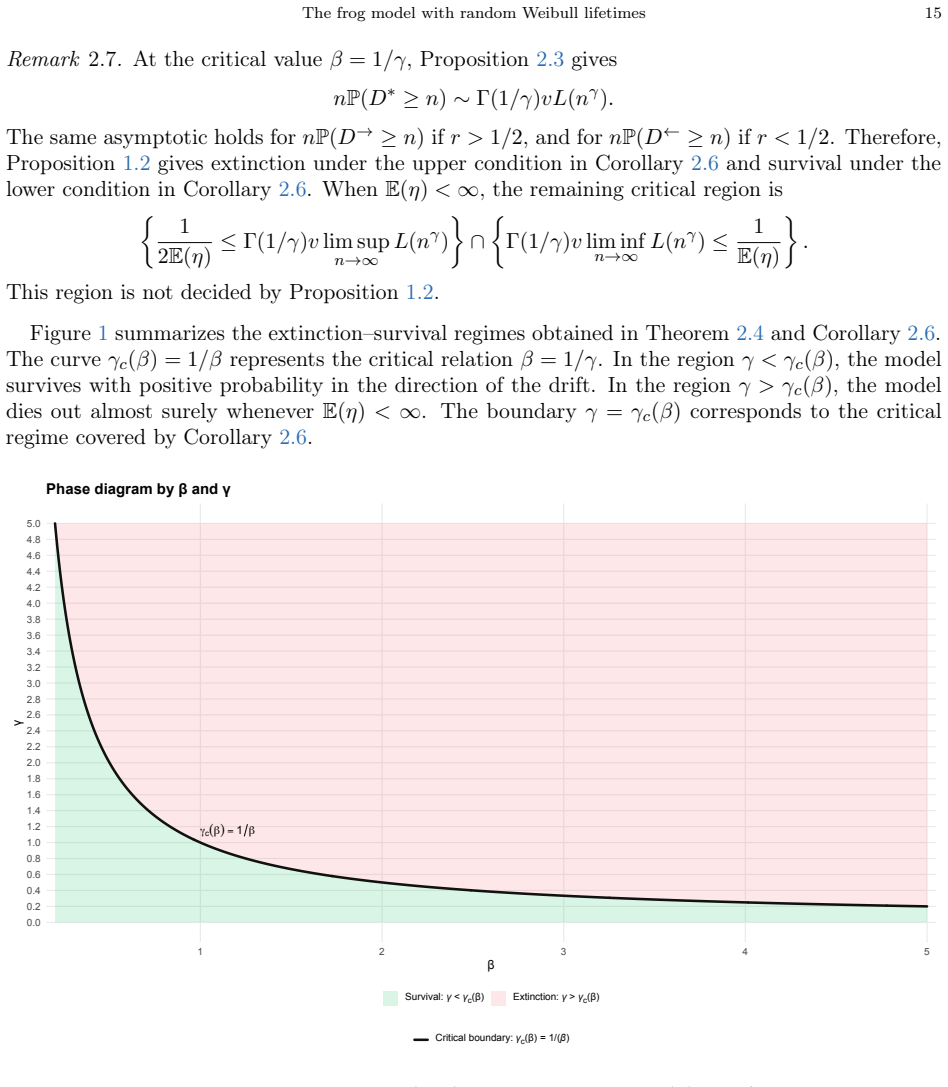
If β > 1/γ and the initial number of particles per site has finite mean, the model dies out almost surely. If β < 1/γ and the initial configuration is not almost surely empty, the model survives with positive probability in the direction of the drift. The threshold β_c = 1/γ is obtained because the tail of G(k) is k to the minus γβ times slowly varying, and the biased walk has linear hitting time scale so that the expectation E[G(τ_n)] inherits the power -γβ.
What carries the argument
The single-particle maximal displacement probability expressed as the expectation E[G(τ_n)], where G(k) is the conditional survival probability and τ_n is the hitting time to distance n.
If this is right
- If β > 1/γ, almost sure extinction holds whenever the mean number of initial particles per site is finite.
- If β < 1/γ, survival with positive probability occurs in the drift direction provided the initial configuration is not almost surely empty.
- The critical value remains 1/γ regardless of the specific slowly varying function in the density of π.
- The result applies specifically to the discrete Weibull lifetime family with the given right-edge behavior.
Where Pith is reading between the lines
- The same tail analysis could be applied to other random lifetime distributions with comparable boundary behavior.
- Relaxing the linear hitting time assumption to sublinear or superlinear scaling would shift the critical β accordingly.
- Simulations with β near 1/γ for moderate system sizes could provide evidence for the phase transition.
- Extensions to two or more dimensions would require replacing the linear scale with the diffusive scale of the walk.
Load-bearing premise
The biased nearest-neighbour random walk has a linear hitting-time scale, meaning the time to reach distance n grows proportionally to n.
What would settle it
A numerical check showing whether the expected hitting time E[τ_n] divided by n converges to a finite positive constant as n increases, or a simulation of the full model exhibiting extinction or survival on either side of β = 1/γ.
Figures
read the original abstract
We study the frog model on $\mathbb Z$ with particle-wise random discrete Weibull lifetimes and biased nearest-neighbour random walks. Each particle has an independent survival parameter $\pi\in(0,1)$. Conditionally on $\pi=p$, its lifetime $\Xi$ satisfies $$ \mathbb P(\Xi\ge k\mid \pi=p)=p^{k^\gamma}, \, k\in\mathbb{N}_0, $$ where $\gamma>0$. The distribution of $\pi$ is assumed to have right-edge density $$ f_\pi(u)\sim (1-u)^{\beta-1} L\left(\frac1{1-u}\right), \, u\uparrow1, $$ where $\beta>0$ and $L:(0,\infty)\to(0,\infty)$ is a slowly varying function at infinity. The main step is to estimate the tail of the maximal displacement of a single particle before death. If $\tau_n$ denotes the time needed by the underlying walk to reach distance $n$, then $$ \mathbb P(D^*\ge n)=\mathbb E[G(\tau_n)], \, G(k):=\mathbb P(\Xi\ge k). $$ Since $$ G(k)\sim \Gamma(\beta)k^{-\gamma\beta}L(k^\gamma), $$ and the biased nearest-neighbour random walk has linear hitting-time scale, the off-critical threshold is $\beta_c=1/\gamma$. If $\beta>\beta_c$ and the initial number of particles per site has finite mean, the model dies out almost surely. If $\beta<\beta_c$ and the initial configuration is not almost surely empty, the model survives with positive probability in the direction of the drift.
Editorial analysis
A structured set of objections, weighed in public.
Referee Report
Summary. The manuscript studies the frog model on ℤ with independent random discrete Weibull lifetimes (P(Ξ ≥ k | π = p) = p^{k^γ}) where the mixing distribution on π has right-edge density f_π(u) ∼ (1-u)^{β-1} L(1/(1-u)), together with biased nearest-neighbour random walks. The central claim is that the critical value separating almost-sure extinction from positive survival probability is exactly β_c = 1/γ: extinction holds a.s. when β > β_c provided the initial particle count per site has finite mean, while survival with positive probability in the drift direction holds when β < β_c provided the initial configuration is not a.s. empty. The argument proceeds by relating the tail of the maximal single-particle displacement D* to E[G(τ_n)] where G(k) = P(Ξ ≥ k) and τ_n is the hitting time of distance n.
Significance. If the threshold result holds, the paper supplies a clean, explicit critical exponent for survival in an inhomogeneous frog model whose lifetime tails are regularly varying after mixing. The derivation correctly invokes the external regularly-varying asymptotic G(k) ∼ Γ(β) k^{-γβ} L(k^γ) together with the linear speed of the biased walk; the monotonicity sandwich that preserves the exact power -γβ is a strength of the approach. The work therefore gives a parameter-free threshold once the hitting-time limit is granted.
major comments (2)
- [Abstract, main step] Abstract (main-step paragraph) and the derivation of the off-critical threshold: the claim that the linear hitting-time scale τ_n/n → μ > 1 a.s. together with G(k) ∼ Γ(β) k^{-γβ} L(k^γ) immediately yields β_c = 1/γ requires an explicit justification that E[G(τ_n)] is regularly varying with the same index -γβ. The manuscript must supply the sandwich bounds or invoke a theorem on regularly varying functions evaluated at a random index to confirm that the slowly-varying factor L does not alter the critical exponent and that no additional error terms affect the threshold.
- [Survival and extinction statements] The statements on extinction and survival (finite-mean initial configuration for a.s. extinction; non-a.s.-empty initial configuration for positive survival probability) are load-bearing for the main theorem yet are stated without reference to the precise propositions that convert the single-particle tail P(D* ≥ n) into the global extinction/survival dichotomy; these implications must be spelled out or cited.
minor comments (1)
- The notation D* for maximal displacement and the precise definition of the bias parameter in the nearest-neighbour walk should be introduced before the main-step paragraph.
Simulated Author's Rebuttal
We thank the referee for the careful reading and for identifying points where the exposition can be strengthened. We address the two major comments below and will revise the manuscript to incorporate the requested clarifications and justifications.
read point-by-point responses
-
Referee: [Abstract, main step] Abstract (main-step paragraph) and the derivation of the off-critical threshold: the claim that the linear hitting-time scale τ_n/n → μ > 1 a.s. together with G(k) ∼ Γ(β) k^{-γβ} L(k^γ) immediately yields β_c = 1/γ requires an explicit justification that E[G(τ_n)] is regularly varying with the same index -γβ. The manuscript must supply the sandwich bounds or invoke a theorem on regularly varying functions evaluated at a random index to confirm that the slowly-varying factor L does not alter the critical exponent and that no additional error terms affect the threshold.
Authors: We agree that the passage from the regularly-varying tail of G to the tail of E[G(τ_n)] needs an explicit argument. In the revision we will insert a short lemma (placed immediately after the statement of the linear hitting-time limit) that invokes the almost-sure convergence τ_n/n → μ together with the standard composition theorem for regularly varying functions evaluated at a random index (e.g., the version in Resnick, Extreme Values, Regular Variation, and Point Processes, Thm. 2.3.6 or the sandwich bounds of Bingham–Goldie–Teugels, Regular Variation, Prop. 1.5.8). The lemma will show that E[G(τ_n)] remains regularly varying with the same index −γβ, with a new slowly-varying function that does not change the critical value β_c = 1/γ. revision: yes
-
Referee: [Survival and extinction statements] The statements on extinction and survival (finite-mean initial configuration for a.s. extinction; non-a.s.-empty initial configuration for positive survival probability) are load-bearing for the main theorem yet are stated without reference to the precise propositions that convert the single-particle tail P(D* ≥ n) into the global extinction/survival dichotomy; these implications must be spelled out or cited.
Authors: We accept that the link between the single-particle tail P(D* ≥ n) and the global extinction/survival dichotomy should be made explicit rather than left implicit. In the revised version we will add a short paragraph (or a brief appendix) that recalls the relevant standard results for the frog model on ℤ (e.g., the implications of power-law tails on the maximal displacement for extinction when the mean initial configuration is finite, and for survival when the initial configuration is non-degenerate) and cites the appropriate propositions from the literature (e.g., the criteria in Kesten–Sidoravicius or subsequent works on inhomogeneous frog models). This will make the load-bearing statements fully traceable. revision: yes
Circularity Check
No significant circularity identified
full rationale
The paper derives β_c = 1/γ directly from the regularly-varying tail G(k) ~ Γ(β) k^{-γβ} L(k^γ) (given by the Weibull lifetime assumption) combined with the independent fact that biased nearest-neighbour walks satisfy τ_n/n → μ > 1 a.s. Neither input is defined in terms of the frog-model survival probability, nor is any quantity fitted to survival data and then relabeled as a prediction. No self-citations, ansatzes, or uniqueness theorems appear in the threshold argument. The derivation is therefore self-contained against external benchmarks.
Axiom & Free-Parameter Ledger
axioms (2)
- domain assumption Biased nearest-neighbour random walk on Z has linear hitting-time scale: E[τ_n] ∼ c n for some c > 0.
- standard math The tail G(k) ∼ Γ(β) k^{-γβ} L(k^γ) holds with the given slowly-varying function L.
Reference graph
Works this paper leans on
-
[1]
O. S. M. Alves, F. P. Machado and S. Popov. Phase transition for the frog model. Electronic Journal of Probability, 7, Paper No. 16, 21 pp., 2002. doi:10.1214/EJP.v7-115
-
[2]
D. Bertacchi, F. P. Machado and F. Zucca. Local and global survival for nonhomogeneous random walk systems on \( Z\). Advances in Applied Probability, 46(1), 256--278, 2014. doi:10.1239/aap/1396360113
-
[3]
N. H. Bingham, C. M. Goldie and J. L. Teugels. Regular Variation. Cambridge University Press, 1987. doi:10.1017/CBO9780511721434
-
[4]
G. O. Carvalho and F. P. Machado. Frog model on \( Z\) with random survival parameter. Stochastic Processes and their Applications, 194, Article 104856, 2026. doi:10.1016/j.spa.2025.104856
-
[5]
G. O. Carvalho, F. P. Machado and J. H. Ram\'irez-Gonz\'alez. The frog model on \( Z\) with general random survival parameter. Preprint, arXiv:2512.10171, 2025
arXiv 2025
-
[6]
J. H. Ram\'irez-Gonz\'alez, G. O. Carvalho and F. P. Machado. The frog model on \( Z\) with discrete Weibull lifetimes and random parameter \(p\). Preprint, arXiv:2601.15526, 2026
arXiv 2026
-
[7]
L. R. G. Fontes, F. P. Machado and A. Sarkar. The critical probability for the frog model is not a monotonic function of the graph. Journal of Applied Probability, 41(1), 292--298, 2004. doi:10.1239/jap/1077134688
-
[8]
Gantert and P
N. Gantert and P. Schmidt. Recurrence for the frog model with drift on \( Z\). Markov Processes and Related Fields, 15(1), 51--58, 2009
2009
-
[9]
E. Lebensztayn, F. P. Machado and S. Popov. An improved upper bound for the critical probability of the frog model on homogeneous trees. Journal of Statistical Physics, 119(1--2), 331--345, 2005. doi:10.1007/s10955-004-2051-8
-
[10]
T. Nakagawa and S. Osaki. The discrete Weibull distribution. IEEE Transactions on Reliability, R-24(5), 300--301, 1975. doi:10.1109/TR.1975.5214915
discussion (0)
Sign in with ORCID, Apple, or X to comment. Anyone can read and Pith papers without signing in.