REVIEW 3 major objections 6 minor 29 references
DiffPower: GPU-Accelerated Differentiable Switching Power Analysis and Optimization
T0 review · 3 major / 6 minor · reviewed 2026-08-05 · deepseek-v4-flash
Pith's one-line read DiffPower claims switching-power analysis can be made differentiable and GPU-fast—1,002x over CPU propagation—by compiling netlists to bytecode, calibrating with bit-packed simulation, and using the resulting power gradients to guide cell s
desk verdict DiffPower is a real engineering advance with a genuinely solid power-virus result, but the headline sizing gains are measured on its own approximate power model—worth a referee, not yet worth trusting for signoff claims. read the letter →
The pith
A machine-rendered reading of the paper's core claim, the machinery that carries it, and where it could break.
The reading
What carries the argument
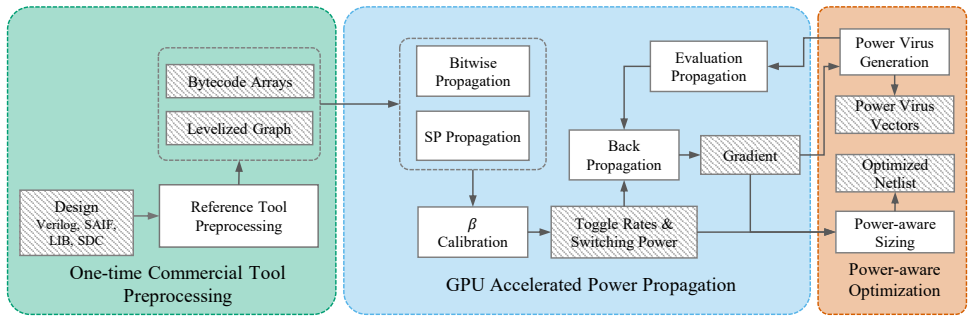
The load-bearing object is the per-pin power gradient, defined as the derivative of total switching power with respect to a pin's switching activity, obtained by running reverse-mode automatic differentiation backwards through a levelized pin-level DAG. The DAG is evaluated as a stack-machine bytecode program: each cell function compiles to ops (IN, NOT, AND, OR, XOR, CONST) that the same interpreter executes forward for static-probability propagation and backward for exact derivatives; common gates get hand-optimized kernels. To close the fidelity gap, a bit-packed 64-bit parallel simulation pass computes an accurate toggle rate per pin, and the ratio TR_acc/TR_model, clipped to [0.1,10], s
What would settle it
Run the same sizing and power-virus flows on a new design while replacing DiffPower's gradients with finite-difference gradients of the commercial signoff power (or a high-fidelity vector simulation), and compare optimization outcomes. If beta-scaled gradients do not rank pins the same way as signoff gradients on a design with heavy reconvergence—the failure mode already visible at r=0.84 on the 652K design—the 2.98x sizing and 2.13x power-virus gains would not reproduce, and the straight-through estimator would be the cause to isolate by ablating beta.
Extended reading notes
Core claim
The paper's central claim is that a differentiable surrogate for switching power—built by treating every gate as a Boolean probability function and every wire as a probability copy—can be made accurate enough and fast enough to guide real optimization. The mechanism is a levelized pin-level DAG resident in GPU memory, with Boolean cell functions compiled to stack-machine bytecode; the same bytecode runs forward static-probability propagation and reverse-mode automatic differentiation, so arbitrary cell libraries get gradients with no gate-specific derivative code. A second, bit-packed 64-bit simulation pass measures per-pin toggle rates and computes scaling factors beta_i that multiply the a
Load-bearing premise
The load-bearing premise is that the beta-scaled analytical gradients—beta estimated from a 100-cycle bit-packed simulation and held constant during backprop—point in directions that improve true switching power on real designs; the paper validates gradients against finite differences of its own surrogate, not against signoff power gradients, so a design where this estimator misleads the optimizer would break both downstream claims.
Editorial extensions
If this is right
- Switching-power analysis can move inside iterative optimization loops: re-running full forward/backward passes on a 652K-cell design takes tens of milliseconds, so gradients can be refreshed every few resize decisions instead of computed once.
- New cell libraries need no new derivative code: any Boolean function compiles to bytecode, and both propagation and backprop follow automatically, easing retargeting across technology nodes.
- Cell sizing can be driven by global sensitivity rather than local power, so downsizing choices that cut downstream load are found even where local heuristics plateau, as on the 117K-cell design.
- Power-virus search becomes a fixed-cost gradient ascent with T=100 steps, replacing population-based search; on the evaluated designs it dominates evolutionary search in both score and runtime.
- Gradient rank agreement with numerical differentiation (top-500 Jaccard 1.0 on the medium design) means the model's ordering of high-impact pins is trustworthy enough to prioritize optimization effort.
Reading between the lines
- The beta-calibration scheme is presented as a fixed, parameter-free scaling; an implicit extension is to fit beta or a small correction function from a few simulation vectors, potentially recovering toggle-rate fidelity on the large 652K design where r=0.84.
- Because gradients capture downstream fanout effects, the same machinery could be applied to other power-relevant discrete choices, such as logic restructuring, pin swapping, or multi-voltage assignment, not just cell sizing.
- Power-virus search could be hybridized: use gradient ascent to initialize a small set of candidates, then apply one-bit flip refinement; the paper notes the smallest designs show the narrowest gap, and a discrete local polish would likely close it.
- The combinational-boundary scoping is the main accuracy limit; extending the levelized graph to treat sequential feedback as differentiable state, or modeling clock and infrastructure nets explicitly, is the natural next regime the architecture already points toward.
Editorial analysis
A structured set of objections, weighed in public.
Referee Report
Summary. DiffPower presents a GPU-resident, levelized pin-graph engine that computes static-probability (SP) propagation and toggle-rate (TR) estimates through a hybrid of algebraic SP analysis and bit-packed simulation. A bytecode representation of arbitrary Boolean cells enables reverse-mode automatic differentiation with no gate-specific derivative code. The paper reports up to 1,002× speedup over single-threaded CPU propagation, a median TR correlation of r=0.96 against a commercial reference, near-perfect rank agreement between analytical and finite-difference gradients of its own surrogate, and two downstream applications: gradient-weighted cell sizing (claimed 2.98× improvement over local-power heuristics) and gradient-ascent power virus generation (up to 2.13× higher transition-weighted power than evolutionary search).
Significance. If the claims hold, DiffPower is a significant contribution to EDA: it extends differentiable gate-level analysis to switching power at industrial scale, provides a PDK-agnostic bytecode abstraction, and demonstrates a fast power-virus generator that is evaluated on the true discrete transition-weighted metric (Eq. 3) rather than on a proxy. The accuracy comparison against an external commercial tool is a genuine strength, as is the use of the same P_virus metric for the evolutionary baseline. The main gap is that the headline cell-sizing result is presented as power reduction but appears to be computed by DiffPower's own approximate model; without a signoff-power evaluation, the 2.98×/4.4× ratios are not evidence about real design power. The framework's speed and architectural ideas are likely to be of interest regardless, but the practical optimization claims need strengthening.
major comments (3)
- [§IV-A, Fig. 3] The claimed 2.98×/4.4× sizing improvements are not substantiated by signoff-level power measurements. In §IV-A the acceptance criterion is 'reduces switching power', but the only commercial query explicitly described is slack from the commercial timer; no statement says the power reduction plotted in Fig. 3 is computed by a commercial power engine. If the y-axis is DiffPower's own Eq. (1)–(2) (optionally β-scaled via Eq. (5)–(6)), then the experiment optimizes and evaluates the same approximate objective, so a gradient-guided method is expected to beat local heuristics on that model. Please add a final signoff-power evaluation of the sized netlists, or at least report separately the DiffPower-model reduction and the signoff reduction. The current text does not support the external validity of the core sizing claim.
- [§V-C] The finite-difference validation establishes that the backward pass correctly differentiates the algebraic SP forward model, not that the resulting gradients correlate with signoff switching-power sensitivity. The large-scale rank comparison (Jaccard=1.0, Pearson≈1.0) is between analytical gradients and CPU finite differences of the same surrogate. Since the downstream sizing and virus generation rely on these gradients, an important missing link is a comparison of top gradient-ranked pins/cells against a commercial power analysis engine (or at least against the hybrid TR correlation of Table III). As written, the 'near-perfect' gradient claim supports implementation correctness only; the optimization-quality claims must be carried by the downstream experiments, which are themselves incomplete for sizing (see previous comment).
- [§III-D, Eq. (6), §V-C] Eq. (6) scales backward gradients by β_i treated as a constant, whereas β_i in Eq. (5) is computed from the simulated toggle rate and therefore depends on the input probabilities. The resulting backward pass is a straight-through estimator, not the exact gradient of the hybrid forward model. The validation in §V-C is described as testing 'derivatives of the forward SP model'—apparently the algebraic model without β-scaling. If hybrid (β-scaled) gradients are used in the sizing metric or in Algorithm 4, please state this explicitly and validate the hybrid backward pass under fixed β, or clearly delimit which experiments use unscaled algebraic gradients. Without this clarification, it is unclear whether the finite-difference validation covers the deployed gradient.
minor comments (6)
- [Table II] The table's last column is labeled 'GPU vs. CPU', but the text also claims 'three to four orders of magnitude faster than the commercial reference tool'. Add an explicit GPU vs. Ref. column or report those ratios in the text.
- [§III-D] The phrase 'simulation-informed analytical gradients' is useful, but the paper also repeatedly says 'exact gradients'. Please distinguish the exact gradients of the algebraic SP model from the approximate β-scaled gradients of the hybrid model to avoid overclaiming.
- [Algorithm 4, line 18-19] The discretization v0_i = I(P_i ≥ 0.5), v1_i = 1 − v0_i forces every startpoint to toggle. This is a reasonable heuristic for maximizing transitions, but it is a design choice not derived from the optimization; please acknowledge this limitation, especially for designs where reconvergence may make complementary primary-input toggling suboptimal.
- [§V-B / Table III] The text in §VI says the large design has TR r=0.84, while Table III reports 0.835. Rounding is fine, but please keep the table and text consistent or explicitly state the rounding.
- [Abstract] The abstract states 'near-perfect rank agreement' without specifying that the agreement is with finite-difference gradients of the same differentiable model, not with signoff power gradients. A short qualifier would prevent misinterpretation.
- [General] The paper does not mention a code/data release. Given the strong runtime and portability claims, a reproducibility artifact (even for the open-source IWLS benchmarks) would substantially increase confidence and is encouraged.
Circularity Check
No significant circularity: core accuracy claims are validated against external commercial reference and power-virus evaluation uses a distinct discrete ground-truth metric.
full rationale
DiffPower's central claims do not reduce to their inputs by construction. The toggle-rate accuracy claim (median r=0.96) is evaluated against an external commercial reference (Synopsys Fusion Compiler/Design Compiler) using per-pin correlation, not against DiffPower's own outputs (Table III, Section V-B). The beta-scaling factors (Eq. 5) are computed from bit-packed simulation, not from the commercial reference, and the hybrid TR is then compared to the commercial tool, so this is an external check. The gradient validation in Section V-C verifies that reverse-mode AD matches finite differences of DiffPower's own forward model; this is an implementation-correctness test, not a prediction claim, and the paper states it as such ('produces exact derivatives of the forward SP model'). The power-virus results are evaluated on the true discrete P_virus (Eq. 3) via bitwise simulation, independent of the differentiable proxy (Eq. 9) used for search, so the 2.13x improvement is not a self-referential fit. The cell-sizing experiment may rely on an approximate power model for acceptance/evaluation, but the paper does not define the sizing gain as an identity; it is a method comparison on an optimization objective, and any external-validity limitation is a correctness concern rather than circularity. No load-bearing self-citations or imported uniqueness theorems are present; the straight-through-estimator analogy to prior work is illustrative, not a circular justification. Therefore no circular step can be exhibited under the required standard.
Assumptions & free parameters
free parameters (6)
- beta_min (clipping lower bound) =
0.1
- beta_max (clipping upper bound) =
10
- Monte Carlo iterations N_sim =
100
- gradient ascent learning rate eta =
not specified
- gradient ascent steps T =
100
- finite-difference epsilon =
1e-4
assumptions (5)
- domain assumption Temporal independence: TR = 2P(1-P)
- domain assumption Combinational-boundary scoping: sequential elements are fixed PPIs/PPOs with constant SP
- ad hoc to paper Straight-through estimator: backward pass treats beta_i as a constant and uses the analytical SP gradient as the direction of update
- domain assumption Bit-packed simulation with 64-bit Markov chains captures the spatial correlations needed for calibration
- domain assumption Commercial reference tool's propagated switching activity is ground truth for correlation
Cite this review
Pith. "Pith review of DiffPower: GPU-Accelerated Differentiable Switching Power Analysis and Optimization." pith.science (2026). https://pith.science/paper/CR4Y45QM
@misc{pith2026260803778,
  author       = {Pith},
  title        = {Pith review of: DiffPower: GPU-Accelerated Differentiable Switching Power Analysis and Optimization},
  year         = {2026},
  howpublished = {\url{https://pith.science/paper/CR4Y45QM}},
  note         = {Machine review of arXiv:2608.03778}
}
abstract
Accurate and scalable switching power analysis remains a critical bottleneck in modern physical design, often forcing a trade-off between computational speed and modeling fidelity. We present DiffPower, a GPU-accelerated framework for differentiable power analysis and optimization. DiffPower translates design netlists into a PDK-agnostic bytecode representation, enabling analytical gradient computation via reverse-mode automatic differentiation, achieving up to a $1{,}002\times$ speedup over single-threaded CPU propagation on the largest evaluated design, with the GPU advantage growing with design scale. A hybrid propagation methodology fusing analytical modeling with parallel simulation achieves a median toggle-rate correlation of $r{=}0.96$ across ten industrial and benchmark designs. The resulting \emph{power gradients}, computed up to $904\times$ faster than CPU finite-difference methods with near-perfect rank agreement, enable two downstream applications: (1) gradient-weighted cell sizing, which achieves up to $2.98\times$ improvement over local-power heuristics on industrial designs, with even stronger advantages at the 117K-cell scale where competing methods plateau; and (2) power virus generation via gradient ascent, which yields up to $2.13\times$ higher transition-weighted power, replacing a search process that traditionally requires hours.
Figures


Reference graph
Works this paper leans on
-
[1]
Dark silicon and the end of multicore scaling,
H. Esmaeilzadeh, E. Blem, R. St. Amant, K. Sankaralingam, and D. Burger, “Dark silicon and the end of multicore scaling,” inPro- ceedings of the 38th annual international symposium on Computer architecture, 2011, pp. 365–376
2011
-
[2]
R. E. Bryant, “Binary decision diagrams,” inHandbook of model checking. Springer, 2018, pp. 191–217
work page 2018
-
[3]
INSTA: An ultra-fast, differentiable, statistical static timing analysis engine for industrial physical design applications,
Y .-C. Lu, Z. Guo, K. Kunal, R. Liang, and H. Ren, “INSTA: An ultra-fast, differentiable, statistical static timing analysis engine for industrial physical design applications,” in2025 62nd ACM/IEEE Design Automation Conference (DAC). IEEE, 2025, pp. 1–7
2025
-
[4]
DiffCCD: Differ- entiable concurrent clock and data optimization,
Y . Ji, Y . Lu, Z. Zhang, Z. Guo, Y . Lin, and B. Yu, “DiffCCD: Differ- entiable concurrent clock and data optimization,” in2025 IEEE/ACM International Conference on Computer-Aided Design (ICCAD). IEEE, 2025, pp. 1–9
work page 2025
-
[5]
Differentiable physical optimiza- tion,
Y . Du, Z. Guo, R. Wang, and Y . Lin, “Differentiable physical optimiza- tion,” in2025 IEEE/ACM International Conference on Computer-Aided Design (ICCAD). IEEE, 2025, pp. 1–9
work page 2025
-
[6]
Deep differentiable logic gate networks,
F. Petersen, C. Borgelt, H. Kuehne, and O. Deussen, “Deep differentiable logic gate networks,” inAdvances in Neural Information Processing Systems, S. Koyejo, S. Mohamed, A. Agarwal, D. Belgrave, K. Cho, and A. Oh, Eds., vol. 35. Curran Associates, Inc., 2022, pp. 2006– 2018
work page 2022
-
[7]
GATSPI: GPU ac- celerated gate-level simulation for power improvement,
Y . Zhang, H. Ren, A. Sridharan, and B. Khailany, “GATSPI: GPU ac- celerated gate-level simulation for power improvement,” inProceedings of the 59th ACM/EDAC/IEEE Design Automation Conference (DAC). ACM, 2022, pp. 1–6
work page 2022
-
[8]
GRANNITE: Graph neural network inference for transferable power estimation,
Y . Zhang, H. Ren, and B. Khailany, “GRANNITE: Graph neural network inference for transferable power estimation,” in2020 57th ACM/IEEE Design Automation Conference (DAC). IEEE, 2020, pp. 1–6
work page 2020
Show all 29 references
-
[9]
Reverse-mode automatic differentiation and optimization of GPU kernels via Enzyme,
W. S. Moses, V . Churavy, L. Paehler, J. H ¨uckelheim, S. K. Narayanan, M. Schanen, and J. Doerfler, “Reverse-mode automatic differentiation and optimization of GPU kernels via Enzyme,” inProceedings of the International Conference for High Performance Computing, Networking, S...
2021
-
[10]
Icarus Verilog,
S. Williams, “Icarus Verilog,” https://steveicarus.github.io/iverilog/, 1998, open-source Verilog simulator; VVP (Verilog Virtual Processor) compiles HDL to a structural-functor bytecode executed by a virtual machine
1998
-
[11]
Strongly NP-hard discrete gate-sizing problems,
W. Ning, “Strongly NP-hard discrete gate-sizing problems,”IEEE Trans- actions on Computer-Aided Design of Integrated Circuits and Systems, vol. 13, no. 8, pp. 1045–1051, 1994
1994
-
[12]
Timing and area op- timization for standard-cell VLSI circuit design,
W. Chuang, S. S. Sapatnekar, and I. N. Hajj, “Timing and area op- timization for standard-cell VLSI circuit design,”IEEE Transactions on Computer-Aided Design of Integrated Circuits and Systems, vol. 14, no. 3, pp. 308–320, 1995
1995
-
[13]
LEGO-SiZE: LLM-enhanced GPU-optimized signoff-accurate differen- tiable VLSI gate sizing in advanced nodes,
Y .-C. Lu, K. Kunal, G. Pradipta, R. Liang, R. Gandikota, and H. Ren, “LEGO-SiZE: LLM-enhanced GPU-optimized signoff-accurate differen- tiable VLSI gate sizing in advanced nodes,” inProceedings of the 2025 International Symposium on Physical Design, 2025, pp. 152–162
2025
-
[14]
AGD: Analytic gradient descent for discrete optimization in EDA and its use to gate sizing,
P. Pham, T.-M. Park, S.-H. Cho, T. Mahmood, J.-S. Yang, and J. Chung, “AGD: Analytic gradient descent for discrete optimization in EDA and its use to gate sizing,”ACM Transactions on Design Automation of Electronic Systems, vol. 30, no. 5, pp. 1–22, 2025
2025
-
[15]
Learning- driven physically aware large-scale circuit gate sizing,
Y . Ye, P. Xu, L. Ren, T. Chen, H. Yan, B. Yu, and L. Shi, “Learning- driven physically aware large-scale circuit gate sizing,”IEEE Transac- tions on Computer-Aided Design of Integrated Circuits and Systems, vol. 44, no. 5, p. 1901, 2025
1901
-
[16]
DREAM- Place: Deep learning toolkit-enabled GPU acceleration for modern VLSI placement,
Y . Lin, S. Dhar, W. Li, H. Ren, B. Khailany, and D. Z. Pan, “DREAM- Place: Deep learning toolkit-enabled GPU acceleration for modern VLSI placement,” inProceedings of the 56th Annual Design Automation Conference 2019, 2019, pp. 1–6
2019
-
[17]
DGR: Differentiable global router,
W. Li, R. Liang, A. Agnesina, H. Yang, C.-T. Ho, A. Rajaram, and H. Ren, “DGR: Differentiable global router,” inProceedings of the 61st ACM/IEEE Design Automation Conference, 2024, pp. 1–6
2024
-
[18]
SAGA: A surrogate-assisted genetic algorithm for fast CPU power virus genera- tion,
P. Chatzimiltis, G. Antoniou, H. V olos, and Y . Sazeides, “SAGA: A surrogate-assisted genetic algorithm for fast CPU power virus genera- tion,” in2025 IEEE International Symposium on Performance Analysis of Systems and Software (ISPASS). IEEE, 2025, pp. 309–319
2025
-
[19]
Exact and approximate estimation for maximum instantaneous current of CMOS circuits,
Y .-M. Jiang and K.-T. Cheng, “Exact and approximate estimation for maximum instantaneous current of CMOS circuits,” inProceedings Design, Automation and Test in Europe. IEEE, 1998, pp. 698–702
1998
-
[20]
Maximizing the switching activity of different modules within a processor core via evolutionary techniques,
N. I. Deligiannis, R. Cantoro, and M. S. Reorda, “Maximizing the switching activity of different modules within a processor core via evolutionary techniques,” in2021 24th Euromicro Conference on Digital System Design (DSD). IEEE, 2021, pp. 535–540
2021
-
[21]
System-level max power (SYMPO): A systematic approach for escalating system-level power consumption using synthetic benchmarks,
K. Ganesan, J. Jo, W. L. Bircher, D. Kaseridis, Z. Yu, and L. K. John, “System-level max power (SYMPO): A systematic approach for escalating system-level power consumption using synthetic benchmarks,” inProceedings of the 19th international conference on Parallel archi- tectur...
2010
-
[22]
Automating the generation of programs maximizing the sustained switching activity in microprocessor units via evolutionary techniques,
N. I. Deligiannis, R. Cantoro, and M. S. Reorda, “Automating the generation of programs maximizing the sustained switching activity in microprocessor units via evolutionary techniques,”Microprocessors and Microsystems, vol. 98, p. 104775, 2023
2023
-
[23]
Efficient peak power estima- tion using probabilistic cost-benefit analysis,
H. Hajimiri, K. Rahmani, and P. Mishra, “Efficient peak power estima- tion using probabilistic cost-benefit analysis,” in2015 28th International Conference on VLSI Design. IEEE, 2015, pp. 369–374
2015
-
[24]
DEFT: Differentiable automatic test pattern generation,
W. Li, Y . Zou, Y . Liang, J. Moura, and S. Blanton, “DEFT: Differentiable automatic test pattern generation,” 2026. [Online]. Available: https://arxiv.org/abs/2512.23746
2026 arXiv
-
[25]
A survey of power estimation techniques in VLSI circuits,
F. Najm, “A survey of power estimation techniques in VLSI circuits,” IEEE Transactions on V ery Large Scale Integration (VLSI) Systems, vol. 2, no. 4, pp. 446–455, 1994
1994
-
[26]
Quantized neural networks: Training neural networks with low preci- sion weights and activations,
I. Hubara, M. Courbariaux, D. Soudry, R. El-Yaniv, and Y . Bengio, “Quantized neural networks: Training neural networks with low preci- sion weights and activations,”Journal of Machine Learning Research, vol. 18, no. 187, pp. 1–30, 2018
2018
-
[27]
Understanding straight-through estimator in training activation quantized neural nets,
P. Yin, J. Lyu, S. Zhang, S. Osher, Y . Qi, and J. Xin, “Understanding straight-through estimator in training activation quantized neural nets,” arXiv preprint arXiv:1903.05662, 2019
1903 arXiv
-
[28]
AdaSTE: An adaptive straight-through estimator to train binary neural networks,
H. Le, R. K. Høier, C.-T. Lin, and C. Zach, “AdaSTE: An adaptive straight-through estimator to train binary neural networks,” inProceed- ings of the IEEE/CVF Conference on Computer Vision and Pattern Recognition, 2022, pp. 460–469
2022
-
[29]
IWLS 2005 benchmarks,
International Workshop on Logic Synthesis, “IWLS 2005 benchmarks,” http://iwls.org/iwls2005/benchmarks.html, 2005, 84 industrial and aca- demic Verilog netlists, re-mapped to target library
2005
Reviewed August 5, 2026 · model on record in the stance chip above.
Discussion (0). Continue with ORCID to comment.