REVIEW 3 major objections 4 minor 31 references
Secure Beamforming for Continuous Aperture Array (CAPA) Systems
T0 review · 3 major / 4 minor · reviewed 2026-08-10 · deepseek-v4-flash
Pith's one-line read Secure CAPA beamforming collapses to a single matrix inversion, and the paper derives the closed-form current pattern behind it.
desk verdict The FP-BCD optimality claim is undone by a false equivalence in Lemma 2, but the problem formulation and the ZF scheme have real merit. read the letter →
The pith
A machine-rendered reading of the paper's core claim, the machinery that carries it, and where it could break.
The reading
What carries the argument
The load-bearing object is the continuous inversion identity for kernels of the form $\Psi(s,s')=\delta(s-s')+\sum_{i=1}^{I}\psi_i^*(s)\psi_i(s')$. The paper proves that its inverse is $\delta(s-s')$ minus a finite-rank correction built from the matrix $(I+\Psi)^{-1}$, where $[\Psi]_{i,i'}=\int \psi_i(s)\psi_{i'}^*(s)\,ds$. This identity turns the infinite-dimensional task of inverting an operator into an $I \times I$ matrix inversion. It is applied to the kernel $W_{\lambda,k}$ that appears in the first-order optimality condition for the current pattern, with the functions $\psi_i$ taken as the normalized legitimate and eavesdropping channel responses; combined with fractional-programming auxiliary variables, it yields the closed-form current update in (51).
What would settle it
A direct numerical check settles whether the reformulation is equivalent: take $K=1$, pick any current $J_1(s)$ with $\gamma_1 < \Gamma_1$, and choose parameters so that $G_\Gamma > 2\Gamma_1$. Problem (15) then has optimum $b_1=0$ because the secrecy rate is negative, while problem (20) is positive at $b_1=\alpha_1$ since $\log_2((1+G_\Gamma-\Gamma_1)/(1+\Gamma_1))>0$; the two problems therefore have different optima on this instance.
Extended reading notes
Core claim
On the paper's own terms, the contribution is a continuous-domain counterpart to linear precoding. The transmit current density $J_k(s)$ for each legitimate user is not searched over all functions: the optimal pattern is shown to be a weighted sum of the conjugate channel spatial responses $H_i^*(s)$ of the legitimate users and $\bar{H}_q^*(s)$ of the eavesdroppers. The weights come from the inverse of a kernel $W_{\lambda,k}(s,s')$ built from the Dirac delta plus the Gram matrix of those responses. The paper's Theorem 2 supplies a continuous-function inversion identity that converts this operator inversion into an $(K+Q) \times (K+Q)$ matrix inversion, giving a closed-form current update at every step of a block coordinate descent algorithm based on fractional programming. The same span result drives the zero-forcing construction, whose coefficients are columns of the inverse channel-correlation matrix. The claimed consequence is that optimal secure beamforming for CAPA is achievable without Fourier truncation, with complexity $O(LKN^3)$ after the channel correlation matrix is precomputed.
Load-bearing premise
The load-bearing premise is that a term involving $G_\Gamma$ can be discarded as a constant during the reformulation, even though it is multiplied by the decision variable $b_k$, so the claimed equivalence of the transformed problems depends on that multiplication being harmless.
Editorial extensions
If this is right
- Because the optimal current pattern lies in the span of the $K+Q$ channel responses, each BCD iteration only needs the precomputed channel correlation matrix $\mathbf{H}$; no numerical integration over the aperture is required inside the iterations.
- The complexity of the optimization-based method is $O(LKN^3)$ after computing $\mathbf{H}$ with $M$-point quadrature, compared with $O(LKN_F^3)$ for Fourier discretization, where the number of Fourier bases $N_F$ grows rapidly with aperture size and carrier frequency.
- The zero-forcing CAPA scheme achieves zero inter-user interference and zero eavesdropper leakage, uses water-filling for power allocation, and approaches the FP-based optimum at high SNR while costing only $O(N^3)$ beyond computing $\mathbf{H}$.
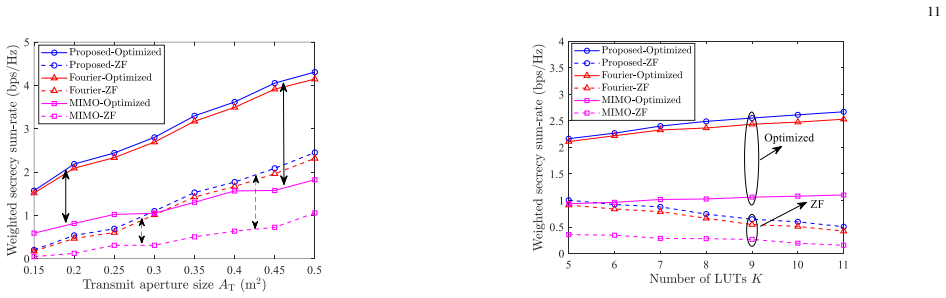
- Reported simulations put CAPA's WSSR gain over discrete MIMO at 77% for the optimization-based method and 117% for the zero-forcing method at transmit power $10^2$ mA$^2$, with the gap widening as the aperture size grows.
- The optimization-based method flexibly trades residual leakage against power, whereas the ZF method nulls all leakage; this is why the paper reports that the ZF method degrades as the number of users grows, while the optimization method improves.
Reading between the lines
- If the span result is correct, a testable extension is that secure CAPA beamforming needs only the Gram matrix of channel responses, not full continuous channel functions, which would make CSI acquisition for CAPA substantially lighter than a literal continuous-channel model suggests.
- The same inversion identity would apply to other continuous-aperture functional programming problems, such as joint sensing and communication or energy-splitting designs, whenever the kernel has the structure 'Dirac delta plus finite-rank channel correlations'.
- A natural prediction to test experimentally is that the gap between the ZF heuristic and the FP-based optimum shrinks with SNR, so a hybrid scheme could switch from ZF at high SNR to the optimization method only when the number of users or eavesdroppers makes interference management difficult.
- The dependence of the ZF method on inverting the full $K+Q$ channel matrix implies each additional eavesdropper consumes one spatial degree of freedom; the optimization method, by contrast, spends power to suppress leakage softly, which explains its reported advantage when many users compete.
Editorial analysis
A structured set of objections, weighed in public.
Referee Report
Summary. The paper considers a downlink secure transmission system in which a continuous aperture array (CAPA) serves multiple legitimate users in the presence of multiple eavesdroppers. The authors formulate the weighted secrecy sum-rate (WSSR) maximization as a functional programming problem over the source current density, subject to a transmit power constraint. They propose an FP-based block coordinate descent (BCD) algorithm that they claim obtains the globally optimal current pattern in closed form via a continuous-function inversion theory, and they also propose a zero-forcing (ZF) heuristic with water-filling power allocation. Numerical results compare the proposed schemes with discrete MIMO baselines and a Fourier-based discretization benchmark.
Significance. Should the main optimality claim hold, the paper would establish that a nonconvex functional WSSR problem is exactly solvable with low computational complexity, and it would quantify substantial secrecy gains of CAPA over discrete MIMO. The continuous-function inversion theorem and the observation that the optimal current is a linear combination of channel spatial responses are elegant and potentially useful. However, the central equivalence on which the FP-BCD algorithm rests is flawed, so the main contribution is not established. The ZF heuristic is a reasonable baseline, but its conceptual novelty is limited.
major comments (3)
- [Section III-A, Lemma 2 (Eqs. (15a), (19)-(22))] The equivalence claimed in Lemma 2 is false. Starting from Eq. (15a), one has sum_k b_k [log2(1+gamma_k) - log2(1+Gamma_k)] = sum_k b_k [log2(1+gamma_k) + log2((1+G_Gamma)/(1+Gamma_k))] - log2(1+G_Gamma) sum_k b_k. The term -log2(1+G_Gamma) sum_k b_k depends on the optimization variables b_k, so discarding it does not preserve equivalence. In addition, Eq. (22b) is algebraically incorrect: (1+G_Gamma)/(1+Gamma_k) equals 1 + (G_Gamma - Gamma_k)/(1+Gamma_k), not (1+G_Gamma - Gamma_k)/(1+Gamma_k); the two quantities differ unless Gamma_k = 0. Thus problem (20) is not equivalent to problem (15), and the subsequent FP transformations and the optimality claim for Algorithm 1 are unsupported.
- [Section III-B and III-C, Eq. (30) and Eq. (61)] The b_k update rule in Eq. (30) is the optimal solution for problem (15) for fixed J_k(s), but in the transformed problem (20a) the coefficient of b_k is different, namely log2(1+gamma_k) + log2((1+G_Gamma - Gamma_k)/(1+Gamma_k)) as written, or log2((1+G_Gamma)/(1+Gamma_k)) after the algebraic correction. The threshold condition gamma_k >= Gamma_k therefore does not maximize the transformed objective. Moreover, the convergence proof in Eq. (61) omits the b_k block and states that b_k is a non-negative constant, which contradicts its role as an optimization variable in Algorithm 1. Consequently, the monotonicity chain does not establish convergence of Algorithm 1 to a stationary point of the WSSR problem (13).
- [Appendix A, proof of Theorem 1] The proof of Theorem 1 invokes "Lemma 3 in [21]" to conclude that V_k(s) = 0 from the condition that the integral of U_k^*(s) V_k(s) over S_T vanishes for all smooth U_k vanishing on the boundary. Since [21] is an unpublished preprint and the lemma is not stated in the manuscript, the derivation of the optimal current structure in Eq. (41) is not self-contained. The authors should state and prove the needed variational lemma or provide a complete derivation.
minor comments (4)
- [Lemma 3 and Eqs. (23a)-(26)] The logarithm base switches between log2, used in the problem statement, and log, apparently the natural logarithm, in the FP transformations; this should be made consistent.
- [Section III-C] The sentence "We omit b_k since it is a non-negative constant" is inaccurate because b_k is an optimization variable updated in Algorithm 1 and must be treated as a block in the BCD analysis.
- [Theorem 3] Theorem 3 requires the N x N channel correlation matrix H to be invertible, but the paper does not discuss rank deficiency when K + Q exceeds the available spatial degrees of freedom; a regularity condition should be stated.
- [Eq. (21b)] The definition of G_Gamma as P times the sum over q of the integral of |bar_H_q(s)|^2 ds lacks parentheses; the intended grouping should be clarified.
Circularity Check
No significant circularity (score 1): the FP-BCD derivation is self-contained and parameter-free, its only same-group citation ([21]) supplies a textbook CoV lemma, and the benchmark [20] is external. The claimed optimality is nonetheless undercut by an algebraic error in Lemma 2 (Eqs. 22a–b; dropped Σb_k term) — a correctness defect, not a circular reduction.
full rationale
The derivation chain is self-contained rather than circular. The Green's-function model (Eqs. 1–2) is standard EM theory from the external reference [6]; the FP transformations of Lemmas 3–4 build on the external framework of [28], [29]; and the numerical benchmark is the external Fourier-based method of Zhang & Dai ([20]). No parameter is fitted to data and no simulation output is fed back into the derivation, so the 'predictions' — the closed-form current pattern (51) and the reported WSSR gains — do not reduce to their inputs by construction. The only same-group citation inside the derivation is [21] (Wang, Ouyang, Liu), invoked in Appendix A as 'Lemma 3 in [21]' for the fundamental lemma of calculus of variations; that is a textbook-standard, externally checkable result, so under the rules it is real evidence and does not raise the circularity score. Reference [27] is contextual prior work. The honest circularity finding is therefore near zero (score 1 for the cosmetic same-group citation). Separately, and per the reviewing rule to weigh flagged flaws explicitly, the central claim of 'obtaining the optimal solution' is not supported — but for a non-circularity reason. Lemma 2 breaks the claimed equivalence (15)↔(20): Eq. (22b) asserts log2((1+GΓ)/(1+Γ_k)) = log2((1+GΓ−Γ_k)/(1+Γ_k)), which fails unless Γ_k = 0, and the term log2(1+GΓ) dropped in passing from (15) to (20) actually multiplies Σ_k b_k, which is not constant because {b_k} are optimization variables in (15c) and are reset each iteration by (30). The b-subproblem (29) is itself solved against the original objective (15a), not the 'equivalent' (20a). The β-update (34), the J-update (51), and the asserted optimality of Algorithm 1 inherit the defect, as does the convergence argument in Section III-C, which treats b_k as 'a non-negative constant' although it is an iterated variable. These are validity defects in the claimed reduction (the conclusion is not assumed as input; the asserted equivalence is simply false), so they belong in correctness risk rather than in the circularity score. The ZF scheme of Section IV is an independent, standard construction and is not affected by the Lemma 2 defect.
Assumptions & free parameters
assumptions (5)
- domain assumption The EM channel is modeled by the free-space Green's function (2) with scalar, vertically polarized source current and point receivers (Section II-A).
- domain assumption The eavesdroppers' CSI is known perfectly at the BS via TDD reciprocity because Eves behave as registered users (Section II).
- domain assumption The variational lemma 'if Re(integral U* V)=0 for all smooth U vanishing on the boundary, then V=0' is taken from Lemma 3 of [21] (Appendix A, Eqs. 81-83).
- standard math Standard fractional programming identities from [28] and [29] are used in Lemma 3 and Lemma 4.
- standard math The kernel inverse in Theorem 2 exists because lambda I + Phi is invertible for lambda > 0 with Phi positive semidefinite.
Cite this review
Pith. "Pith review of Secure Beamforming for Continuous Aperture Array (CAPA) Systems." pith.science (2026). https://pith.science/paper/CRGH6IKW
@misc{pith2026250104924,
  author       = {Pith},
  title        = {Pith review of: Secure Beamforming for Continuous Aperture Array (CAPA) Systems},
  year         = {2026},
  howpublished = {\url{https://pith.science/paper/CRGH6IKW}},
  note         = {Machine review of arXiv:2501.04924}
}
read the original abstract
Continuous aperture array (CAPA) is considered a promising technology for 6G networks, offering the potential to fully exploit spatial DoFs and achieve the theoretical limits of channel capacity. This paper investigates the performance gain of a CAPA-based downlink secure transmission system, where multiple legitimate user terminals (LUTs) coexist with multiple eavesdroppers (Eves). The system's secrecy performance is evaluated using a weighted secrecy sum-rate (WSSR) under a power constraint. We then propose two solutions for the secure current pattern design. The first solution is a block coordinate descent (BCD) optimization method based on fractional programming, which introduces a continuous-function inversion theory corresponding to matrix inversion in the discrete domain. This approach derives a closed-form expression for the optimal source current pattern. Based on this, it can be found that the optimal current pattern is essentially a linear combination of the channel spatial responses, thus eliminating the need for complex integration operations during the algorithm's optimization process. The second solution is a heuristic algorithm based on Zero-Forcing (ZF), which constructs a zero-leakage current pattern using the channel correlation matrix. It further employs a water-filling approach to design an optimal power allocation scheme that maximizes the WSSR. In high SNR regions, this solution gradually approaches the first solution, ensuring zero leakage while offering lower computational complexity. Simulation results demonstrate that: 1) CAPA-based systems achieve better WSSR compared to discrete multiple-input multiple-output systems. 2) The proposed methods, whether optimization-based or heuristic, provide significant performance improvements over existing state-of-the-art Fourier-based discretization methods, while considerably reducing computational complexity.
Figures


Figures from the paper (3 more)


Reference graph
Works this paper leans on
-
[27]
Physical Layer Secu- rity for Continuous-Aperture Array (CAPA) Systems,
B. Zhao, C. Ouyang, X. Zhang, and Y . Liu, “Physical Layer Secu- rity for Continuous-Aperture Array (CAPA) Systems,” arXiv preprint arXiv:2412.13748, 2024
-
[20]
Pattern-division multiplexing for multi-user continuous-aperture MIMO,
Z. Zhang and L. Dai, “Pattern-division multiplexing for multi-user continuous-aperture MIMO,” IEEE J. Sel. Areas Commun. , vol. 41, no. 8, pp. 2350-2366, Aug. 2023
work page 2023
-
[21]
Beamforming Optimization for Continuous Aperture Array (CAPA)-based Communications
Z. Wang, C. Ouyang, and Y . Liu, “Beamforming optimization for con- tinuous aperture array (CAPA)-based communications,” arXiv preprint arXiv:2410.13677, 2024
work page Pith review arXiv 2024
-
[1]
J. G. Andrews, S. Buzzi, W. Choi, S. V . Hanly, A. Lozano, A. C. Soong, and J. C. Zhang, “What will 5G be?” IEEE J. Sel. Areas Commun. , vol. 32, no. 6, pp. 1065-1082, Jun. 2014
work page 2014
-
[2]
Noncooperative cellular wireless with unlimited num- bers of base station antennas,
T. L. Marzetta, “Noncooperative cellular wireless with unlimited num- bers of base station antennas,” IEEE Trans. Wireless Commun. , vol. 9, no. 11, pp. 3590-3600, Nov. 2010
work page 2010
-
[3]
Enabling 6G performance in the upper mid-band through gigantic MIMO,
E. Bj ¨ornson, F. Kara, N. Kolomvakis, A. Kosasih, P. Ramezani, and M. B. Salman, “Enabling 6G performance in the upper mid-band through gigantic MIMO,” arXiv preprint arXiv:2407.05630 , 2024
arXiv 2024
-
[4]
Spatially-stationary model for holographic MIMO small-scale fading,
A. Pizzo, T. L. Marzetta, and L. Sanguinetti, “Spatially-stationary model for holographic MIMO small-scale fading,” IEEE J. Sel. Areas Commun., vol. 38, no. 9, pp. 1964-1979, Sep. 2020
work page 1964
-
[5]
Channel modeling and channel estimation for holographic massive MIMO with planar arrays,
¨O. T. Demir, E. Bj ¨ornson, and L. Sanguinetti, “Channel modeling and channel estimation for holographic massive MIMO with planar arrays,” IEEE Wireless Commun. Lett. , vol. 11, no. 5, pp. 997-1001, May 2022
work page 2022
Show all 31 references
-
[6]
Communicating with large intelligent surfaces: Fundamen- tal limits and models,
D. Dardari, “Communicating with large intelligent surfaces: Fundamen- tal limits and models,” IEEE J. Sel. Areas Commun. , vol. 38, no. 11, pp. 2526-2537, Nov. 2020
2020
-
[7]
Beyond massive MIMO: The potential of data transmission with large intelligent surfaces,
S. Hu, F. Rusek, and O. Edfors, “Beyond massive MIMO: The potential of data transmission with large intelligent surfaces,” IEEE Trans. Signal Process., vol. 66, no. 10, pp. 2746-2758, May 2018
2018
-
[8]
A primer on near- field communications for next-generation multiple access,
C. Ouyang, Z. Wang, Y . Chen, X. Mu, and P. Zhu, “A primer on near- field communications for next-generation multiple access,” Proc. IEEE, Early Access, 2024
2024
-
[9]
Near-field communications: A comprehensive survey,
Y . Liu, C. Ouyang, Z. Wang, J. Xu, X. Mu, and A. L. Swindlehurst, “Near-field communications: A comprehensive survey,” IEEE Commun. Surveys Tuts., Early Access, 2024
2024
-
[10]
Performance Analysis for Near-Field MIMO: Discrete and Continuous Aperture Antennas,
Z. Xie, Y . Liu, J. Xu, X. Wu and A. Nallanathan, “Performance Analysis for Near-Field MIMO: Discrete and Continuous Aperture Antennas,” IEEE Wireless Commun. Lett. , vol. 12, no. 12, pp. 2258-2262, Dec. 2023
2023
-
[11]
Massive MIMO is a reality—what is next?: Five promising research directions for antenna arrays,
E. Bj ¨ornson, L. Sanguinetti, H. Wymeersch, J. Hoydis, and T. L. Marzetta, “Massive MIMO is a reality—what is next?: Five promising research directions for antenna arrays,” Digit. Signal Process. , vol. 94, pp. 3-20, Nov. 2019
2019
-
[12]
Communicating with waves between volumes: evaluating orthogonal spatial channels and limits on coupling strengths,
D. A. Miller, “Communicating with waves between volumes: evaluating orthogonal spatial channels and limits on coupling strengths,” Appl. Opt., vol. 39, no. 11, pp. 1681-1699, 2000
2000
-
[13]
Degrees of freedom in 3D linear large-scale antenna array communications—a spatial bandwidth approach,
L. Ding, E. G. Strom, and J. Zhang, “Degrees of freedom in 3D linear large-scale antenna array communications—a spatial bandwidth approach,” IEEE J. Sel. Areas Commun. , vol. 40, no. 10, pp. 2805-2822, Oct. 2022
2022
-
[14]
New aspects of electromagnetic information theory for wireless and antenna systems,
F. K. Gruber and E. A. Marengo, “New aspects of electromagnetic information theory for wireless and antenna systems,” IEEE Trans. Antennas Propag., vol. 56, no. 11, pp. 3470-3484, Nov. 2008
2008
-
[15]
Horse (electromagnetics) is more important than horse- man (information) for wireless transmission,
M. D. Migliore, “Horse (electromagnetics) is more important than horse- man (information) for wireless transmission,” IEEE Trans. Antennas Propag., vol. 67, no. 4, pp. 2046-2055, Apr. 2019
2019
-
[16]
Mutual information for electromagnetic information theory based on random fields,
Z. Wan, J. Zhu, Z. Zhang, L. Dai, and C.-B. Chae, “Mutual information for electromagnetic information theory based on random fields,” IEEE Trans. Commun., vol. 71, no. 4, pp. 1982-1996, Apr. 2023
1982
-
[17]
Diversity and multiplexing for continuous aperture array (CAPA)-based communications,
C. Ouyang, Z. Wang, X. Zhang, and Y . Liu, “Diversity and multiplexing for continuous aperture array (CAPA)-based communications,” arXiv preprint arXiv:2408.13948, 2024
2024 arXiv
-
[18]
Continuous aperture ar- ray (CAPA)-based wireless communications: Capacity characterization,
B. Zhao, C. Ouyang, X. Zhang, and Y . Liu, “Continuous aperture ar- ray (CAPA)-based wireless communications: Capacity characterization,” arXiv preprint arXiv:2406.15056 , 2024
2024
-
[19]
Wavenumber-division multiplexing in line-of-sight holographic MIMO communications,
L. Sanguinetti, A. A. D’Amico, and M. Debbah, “Wavenumber-division multiplexing in line-of-sight holographic MIMO communications,” IEEE Trans. Wireless Commun. , vol. 22, no. 4, pp. 2186-2201, Apr. 2023
2023
-
[22]
On the spectral efficiency of multi-user holographic MIMO uplink transmission,
M. Qian, L. You, X.-G. Xia, and X. Gao, “On the spectral efficiency of multi-user holographic MIMO uplink transmission,” IEEE Trans. Wireless Commun., Early Access, 2024
2024
-
[23]
Holographic intelligence surface assisted integrated sensing and communication,
Z. Liu, Y . Zhang, H. Zhang, F. Xu, and Y . C. Eldar, “Holographic intelligence surface assisted integrated sensing and communication,” arXiv preprint arXiv:2406.04762 , 2024
2024
-
[24]
A survey on multiple-antenna techniques for physical layer security,
X. Chen, D. W. K. Ng, W. H. Gerstacker, and H.-H. Chen, “A survey on multiple-antenna techniques for physical layer security,” IEEE Commun. Surv. Tutor ., vol. 19, no. 2, pp. 1027-1053, 2016
2016
-
[25]
Secure transmission using MIMO precoding,
C.-H. Lin, S.-H. Tsai, and Y .-P. Lin, “Secure transmission using MIMO precoding,” IEEE Trans. Inf. F orensics Security , vol. 9, no. 5, pp. 801- 813, May 2014
2014
-
[26]
Secure Active and Passive Beamforming in IRS-Aided MIMO Systems,
S. Asaad, Y . Wu, A. Bereyhi, R. R. M ¨uller, R. F. Schaefer and H. V . Poor, “Secure Active and Passive Beamforming in IRS-Aided MIMO Systems,” IEEE Trans. Inf. F orensics Security , vol. 17, pp. 1300-1315, 2022
2022
-
[28]
Fractional Programming for Communication Systems—Part II: Uplink Scheduling via Matching,
K. Shen and W. Yu, “Fractional Programming for Communication Systems—Part II: Uplink Scheduling via Matching,” IEEE Trans. Signal Process., vol. 66, no. 10, pp. 2631-2644, May 2018
2018
-
[29]
Fractional Programming for Communication Systems—Part I: Power Control and Beamforming,
K. Shen and W. Yu, “Fractional Programming for Communication Systems—Part I: Power Control and Beamforming,” IEEE Trans. Signal Process., vol. 66, no. 10, pp. 2616-2630, May 2018
2018
-
[30]
Optimal multiuser trans- mit beamforming: A difficult problem with a simple solution structure [lecture notes],
E. Bjornson, M. Bengtsson, and B. Ottersten, “Optimal multiuser trans- mit beamforming: A difficult problem with a simple solution structure [lecture notes],” IEEE Signal Process. Mag. , vol. 31, no. 4, pp. 142-148, Jul. 2014
2014
-
[31]
Practical algorithms for a family of waterfilling solutions,
D. Palomar and J. Fonollosa, “Practical algorithms for a family of waterfilling solutions,” IEEE Trans. Signal Process. , vol. 53, no. 2, pp. 686-695, Feb. 2005
2005
Reviewed August 10, 2026 · model on record in the stance chip above.
Discussion (0). Continue with ORCID to comment.