REVIEW 2 major objections 5 minor 63 references
Proximal Mediation Analysis with Unmeasured Treatment-Induced Confounding
T0 review · 2 major / 5 minor · reviewed 2026-07-12 · grok-4.5
Pith's one-line read Observed proxies can identify interventional mediation effects even when treatment-induced confounders are never measured.
desk verdict Solid, first-of-its-kind proximal identification for interventional mediation under unmeasured treatment-induced confounding; theory and sims check out, usual proximal caveats apply. read the letter →
The pith
A machine-rendered reading of the paper's core claim, the machinery that carries it, and where it could break.
The reading
What carries the argument
Outcome and mediation confounding bridge functions: solutions h_a and q_a to the Fredholm integral equations that recover the latent conditional expectations of the outcome and of the reciprocal mediator density given the unmeasured intermediate confounder; these bridges convert the four proximal identification formulas into observable functionals and enter the efficient influence function.
What would settle it
In a simulation or experiment where the true unmeasured intermediate confounder is known and the completeness condition is deliberately violated (e.g., by making the proxies independent of the confounder), check whether any of the four identification formulas recovers the true interventional effect; systematic bias would falsify the claim.
Extended reading notes
Core claim
Under standard consistency, positivity and latent ignorability assumptions, plus two proxy variables satisfying conditional independence and completeness, the interventional parameter ψ_{a,a'}=E{Y(a,G(a'))} is nonparametrically identified by any of four functionals of the observed data. The corresponding efficient influence function yields a multiply robust, locally efficient estimator that remains consistent whenever at least one of four nested nuisance models is correct.
Load-bearing premise
The proxies must carry enough information about the unmeasured intermediate confounder that any non-zero function of that confounder produces a non-zero conditional expectation given the proxies (completeness); if this fails the bridge equations need not have solutions that recover the latent quantities.
Editorial analysis
A structured set of objections, weighed in public.
Referee Report
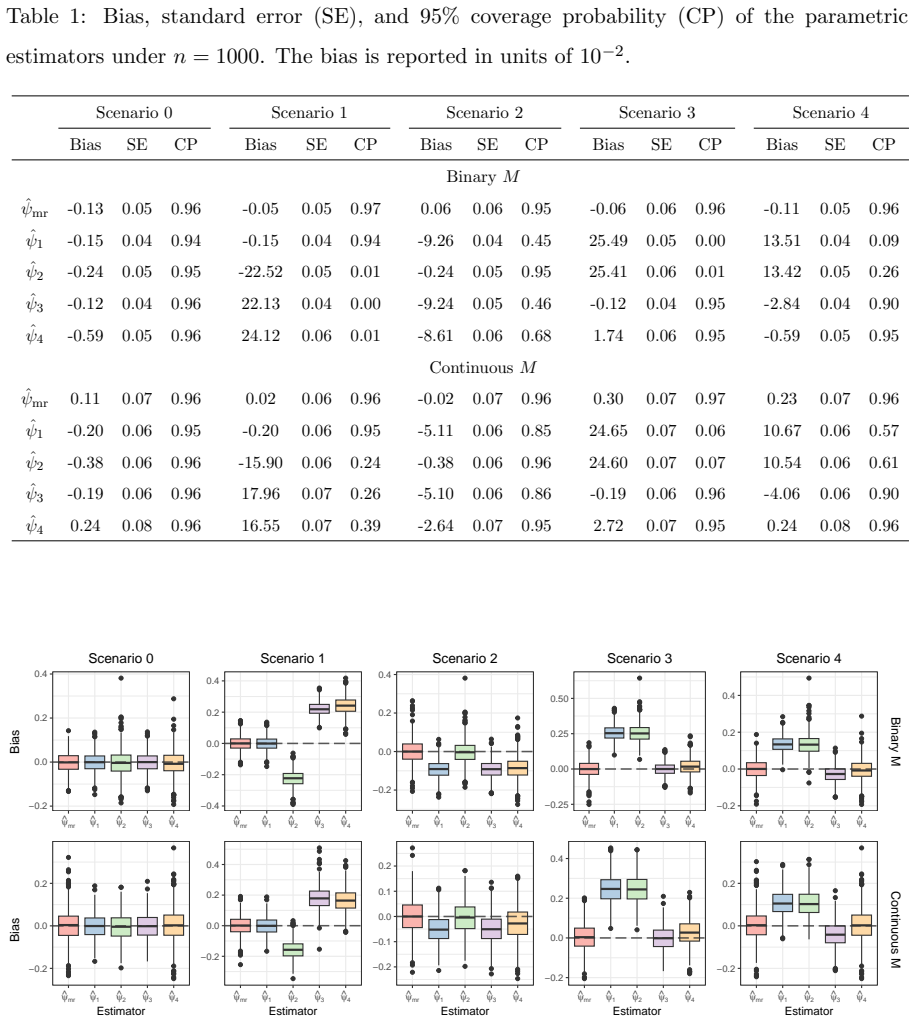
Summary. The paper develops proximal identification and estimation for interventional direct and indirect effects when treatment-induced confounders of the mediator–outcome relationship are unmeasured. Under consistency, positivity, latent conditional ignorability, proxy independence (Assumption 4), and completeness (Assumption 5), Theorems 1–2 and Corollary 1 show that ψ_{a,a′}=E{Y(a,G(a′))} is identified by any of four observed-data functionals that involve an outcome bridge h_a solving the Fredholm equation (3) or a mediation bridge q_a solving (4). Theorem 3 derives the efficient influence function under the semiparametric model that only assumes existence of h_a; Theorem 4 establishes multiple robustness of the corresponding parametric estimator under the union of four model classes; and Theorem 5 gives root-n asymptotic normality and local efficiency for a cross-fit debiased machine-learning estimator that estimates the bridges by minimax learning. Simulations confirm multiple robustness (Table 1, Figure 2) and DML rate behavior (Table 2); an HRS application illustrates racial disparities in life satisfaction mediated by discrimination.
Significance. The work fills a genuine gap: existing proximal mediation methods address unmeasured pre-treatment confounding, while existing interventional-effect methods require treatment-induced confounders to be fully observed. Extending proximal causal inference to treatment-induced U, obtaining four distinct identification formulas, and delivering a multiply robust, locally efficient, and DML-compatible estimator is a substantial methodological contribution. The moment reformulation of the mediation bridge (Proposition 1) that avoids estimating f(M|W,A,L,X) is technically useful, and the simulation design cleanly isolates the multiple-robustness claim. Completeness is the standard, untestable price of proximal methods and is stated transparently; it does not undermine the internal coherence of the results.
major comments (2)
- The main text defers all proofs of Theorems 1–5 and Proposition 1 to a supplement that is not included in the submitted manuscript. For a paper whose central claims are nonparametric identification via Fredholm inversion and an EIF-based multiply robust estimator, the absence of the technical arguments prevents independent verification of the key steps (especially the passage from the integral equations (3)–(4) to the latent conditional expectations, the derivation of the EIF under surjectivity of S_a, and the second-order remainder analysis for Theorem 5). The supplement should be supplied and the main-text statements cross-checked against it before acceptance.
- Section 5 / Table 3: the parametric multiply-robust estimates IIE_mr and IDE_mr exhibit extremely large and unstable bootstrap standard errors (e.g., SE 1.252 and 2.092 under C1), rendering the corresponding confidence intervals non-informative, while the DML estimates remain stable. The paper correctly notes this as evidence of a complex data-generating process, but the application is presented as an illustration of the proposed methodology. Either a clearer discussion of when the parametric MR estimator is expected to be unreliable in finite samples, or a more carefully chosen real-data example in which at least one of the four model classes is plausibly well-specified, would strengthen the empirical claim.
minor comments (5)
- Page 5, line after (1): typographical error “conrresponds” should be “corresponds”.
- Figure 1 caption and surrounding text: L and X are omitted “for simplicity,” but the figure is the only graphical summary of the proxy conditions; a brief note that the same conditional independences hold after conditioning on L,X would help readers.
- Section 3.2: the choice of user-specified functions d(Z,L,M,X) and g(W,L,M,X) for the parametric estimating equations is left largely to Remark 1; a short practical recommendation or default (e.g., the score of a linear/logistic working model) would improve reproducibility.
- Table 1 caption: bias is reported “in units of 10^{-2}”; stating this once in the table note is fine, but the same convention should be applied consistently to Table 2 for readability.
- References: a few recent proximal-mediation and interventional-effect papers (e.g., on time-varying settings) are cited; ensuring the most closely related concurrent arXiv preprints are acknowledged would be useful for the final version.
Circularity Check
No significant circularity: identification of interventional effects from proxy bridge equations is a standard proximal derivation, not tautological.
full rationale
The paper derives nonparametric identification of ψ_{a,a′}=E{Y(a,G(a′))} from stated Assumptions 1–5 (consistency, positivity, latent ignorability, proxy conditional independences, and completeness) plus existence of solutions to the Fredholm equations (3) and (4). Theorems 1–2 and Corollary 1 recover four observed-data functionals ψ₁–ψ₄ by inverting those equations under completeness; the target is not defined in terms of the bridge functions, nor are the bridges fitted to the target and then re-labeled as predictions. The EIF (Theorem 3), multiple robustness (Theorem 4), and DML rates (Theorem 5) are standard semiparametric constructions under the model M_sp that assumes existence of h_a. Self-citations (Miao et al., Tchetgen Tchetgen et al., Dukes et al., Ghassami et al., etc.) supply background proximal machinery and are not load-bearing uniqueness theorems that force the present estimands. Completeness is an untestable relevance condition, not a circular definition. No step reduces Eq. X to Eq. Y by construction or renames a fitted input as a first-principles result. Score 0 is therefore warranted.
Assumptions & free parameters
free parameters (2)
- Regularization parameters λ^h_Q, λ^h_H, λ^q_H, λ^q_Q in minimax bridge estimation
- Parametric bridge coefficients β_a, θ_a and nuisance regression coefficients
assumptions (8)
- domain assumption Consistency of potential outcomes/mediators (Assumption 1)
- domain assumption Positivity of treatment, intermediate confounders, and mediator (Assumption 2)
- domain assumption Latent conditional ignorability: Y(a,m)⊥A|X, M(a)⊥A|X, Y(a,m)⊥M|A,U,L,X (Assumption 3)
- domain assumption Proxy conditions Z⊥Y|A,U,L,M,X and W⊥(M,Z)|A,U,L,X (Assumption 4)
- ad hoc to paper Completeness of U given (Z,...) and given (W,...) (Assumption 5)
- ad hoc to paper Existence of outcome bridge h_a solving E(Y|Z,A=a,L,M,X)=E{h_a(W,L,M,X)|Z,A=a,L,M,X} (eq. 3)
- ad hoc to paper Existence of mediation bridge q_a solving 1/f(M|W,A=a,L,X)=E{q_a(Z,L,M,X)|W,A=a,L,M,X} (eq. 4)
- ad hoc to paper Surjectivity of conditional expectation operator S_a (Assumption 8)
invented entities (2)
-
Outcome confounding bridge function h_a(W,L,M,X)
-
Mediation confounding bridge function q_a(Z,L,M,X)
Cite this review
Pith. "Pith review of Proximal Mediation Analysis with Unmeasured Treatment-Induced Confounding." pith.science (2026). https://pith.science/paper/CSWBPASX
@misc{pith2026260702901,
  author       = {Pith},
  title        = {Pith review of: Proximal Mediation Analysis with Unmeasured Treatment-Induced Confounding},
  year         = {2026},
  howpublished = {\url{https://pith.science/paper/CSWBPASX}},
  note         = {Machine review of arXiv:2607.02901}
}
read the original abstract
Mediation analysis provides a central framework for elucidating causal mechanisms, yet its application is often impeded by treatment-induced confounding, under which the widely used natural mediation effects are generally unidentifiable. Interventional effects have been proposed as an alternative when these confounders are observable; however, identifying and estimating interventional effects remains challenging when confounders are unmeasured. In this paper, we address this issue by using observed variables as proxies for unmeasured treatment-induced confounders. We establish four proximal identification results and develop a multiply robust, semiparametric locally efficient estimator that accommodates flexible machine learning methods for nuisance parameter estimation. The proposed approach is illustrated through simulation studies and a real-data application evaluating racial disparities in life satisfaction mediated by discrimination.
Figures

Reference graph
Works this paper leans on
-
[1]
Handbook of Econometrics , volume=
Linear inverse problems in structural econometrics estimation based on spectral decomposition and regularization , author=. Handbook of Econometrics , volume=. 2007 , publisher=
2007
-
[2]
Statistical Science , volume =
Identification, Inference and Sensitivity Analysis for Causal Mediation Effects , author =. Statistical Science , volume =. doi:10.1214/10-STS321 , url =
-
[3]
Maximum Likelihood Estimation of Misspecified Models , author =. Econometrica , volume =. doi:10.2307/1912526 , url =. 1912526 , eprinttype =
-
[4]
Journal of the Royal Statistical Society Series B: Statistical Methodology , volume=
Non-parametric inference about mean functionals of non-ignorable non-response data without identifying the joint distribution , author=. Journal of the Royal Statistical Society Series B: Statistical Methodology , volume=. 2023 , publisher=
2023
-
[5]
Statistical Science , volume=
An Introduction to Proximal Causal Inference , author=. Statistical Science , volume=. 2024 , doi=
2024
-
[6]
Journal of the Royal Statistical Society Series B: Statistical Methodology , volume=
Multiply robust causal inference with double-negative control adjustment for categorical unmeasured confounding , author=. Journal of the Royal Statistical Society Series B: Statistical Methodology , volume=. 2020 , publisher=
2020
-
[7]
Epidemiology , volume=
Estimation of direct causal effects , author=. Epidemiology , volume=. 2006 , publisher=
2006
-
[8]
The International Journal of Biostatistics , volume=
Direct Effect Models , author=. The International Journal of Biostatistics , volume=. 2008 , publisher=
2008
Show all 63 references
-
[9]
Essay on principles
On the application of probability theory to agricultural experiments. Essay on principles. Section 9. , author=. Annals of Agricultural Sciences , volume=
-
[10]
, author=
Estimating causal effects of treatments in randomized and nonrandomized studies. , author=. Journal of Educational Psychology , volume=. 1974 , publisher=
1974
-
[11]
Epidemiology , volume=
Identifiability and exchangeability for direct and indirect effects , author=. Epidemiology , volume=. 1992 , publisher=
1992
-
[12]
Proceedings of the Seventeenth Conference on Uncertainty and Artificial Intelligence , pages=
Direct and indirect effects , author=. Proceedings of the Seventeenth Conference on Uncertainty and Artificial Intelligence , pages=
-
[13]
, author=
A general approach to causal mediation analysis. , author=. Psychological Methods , volume=. 2010 , publisher=
2010
-
[14]
Annals of Statistics , volume=
Semiparametric theory for causal mediation analysis: efficiency bounds, multiple robustness, and sensitivity analysis , author=. Annals of Statistics , volume=
-
[15]
Epidemiology , volume=
Cognitive aging in black and white Americans: cognition, cognitive decline, and incidence of Alzheimer disease dementia , author=. Epidemiology , volume=. 2018 , publisher=
2018
-
[16]
Journal of Aging and Health , volume=
Social determinants of racial disparities in cognitive functioning in later life in Canada , author=. Journal of Aging and Health , volume=. 2020 , publisher=
2020
-
[17]
, author=
Socioeconomic and psychosocial mechanisms underlying racial/ethnic disparities in cognition among older adults. , author=. Neuropsychology , volume=. 2021 , publisher=
2021
-
[18]
Journal of the Royal Statistical Society Series B: Statistical Methodology , volume=
Robust inference on population indirect causal effects: the generalized front door criterion , author=. Journal of the Royal Statistical Society Series B: Statistical Methodology , volume=. 2020 , publisher=
2020
-
[19]
Biometrika , volume=
Proximal mediation analysis , author=. Biometrika , volume=. 2023 , publisher=
2023
-
[20]
Biometrics , volume=
Using instrumental variables to address unmeasured confounding in causal mediation analysis , author=. Biometrics , volume=. 2024 , publisher=
2024
-
[21]
Biometrika , volume=
Causal inference with hidden mediators , author=. Biometrika , volume=. 2025 , publisher=
2025
-
[22]
arXiv preprint arXiv:2504.11848 , year=
Proximal Inference on Population Intervention Indirect Effect , author=. arXiv preprint arXiv:2504.11848 , year=
-
[23]
Epidemiology , volume=
Effect decomposition in the presence of an exposure-induced mediator-outcome confounder , author=. Epidemiology , volume=. 2014 , publisher=
2014
-
[24]
Journal of the American Statistical Association , volume=
Identification, semiparametric efficiency, and quadruply robust estimation in mediation analysis with treatment-induced confounding , author=. Journal of the American Statistical Association , volume=. 2023 , publisher=
2023
-
[25]
Epidemiology , volume=
Identification of natural direct effects when a confounder of the mediator is directly affected by exposure , author=. Epidemiology , volume=. 2014 , publisher=
2014
-
[26]
Biometrics , volume=
Efficient and flexible estimation of natural direct and indirect effects under intermediate confounding and monotonicity constraints , author=. Biometrics , volume=. 2023 , publisher=
2023
-
[27]
Causality and Psychopathology: Finding the Determinants of Disorders and their Cures , volume=
Alternative graphical causal models and the identification of direct effects , author=. Causality and Psychopathology: Finding the Determinants of Disorders and their Cures , volume=. 2010 , publisher=
2010
-
[28]
Epidemiology , volume=
Bounds for pure direct effect , author=. Epidemiology , volume=. 2014 , publisher=
2014
-
[29]
arXiv preprint arXiv:1509.01652 , year=
On partial identification of the pure direct effect , author=. arXiv preprint arXiv:1509.01652 , year=
-
[30]
Proceedings of the 19th International Joint Conference on Artificial Intelligence , pages=
Identifiability of path-specific effects , author=. Proceedings of the 19th International Joint Conference on Artificial Intelligence , pages=
-
[31]
Biometrika , volume=
On semiparametric estimation of a path-specific effect in the presence of mediator-outcome confounding , author=. Biometrika , volume=. 2020 , publisher=
2020
-
[32]
Journal of the Royal Statistical Society Series B: Statistical Methodology , volume=
Mediation analysis with time varying exposures and mediators , author=. Journal of the Royal Statistical Society Series B: Statistical Methodology , volume=. 2017 , publisher=
2017
-
[33]
Biometrika , volume=
Nonparametric efficient causal mediation with intermediate confounders , author=. Biometrika , volume=. 2021 , publisher=
2021
-
[34]
Epidemiology , volume=
Interventional effects for mediation analysis with multiple mediators , author=. Epidemiology , volume=. 2017 , publisher=
2017
-
[35]
arXiv preprint arXiv:2311.16793 , year=
Mediation pathway selection with unmeasured mediator-outcome confounding , author=. arXiv preprint arXiv:2311.16793 , year=
-
[36]
Biometrika , volume=
Identifying causal effects with proxy variables of an unmeasured confounder , author=. Biometrika , volume=. 2018 , publisher=
2018
-
[37]
arXiv preprint arXiv:2009.10982 , year=
An introduction to proximal causal learning , author=. arXiv preprint arXiv:2009.10982 , year=
2009 arXiv
-
[38]
Journal of the American Statistical Association , volume=
Semiparametric proximal causal inference , author=. Journal of the American Statistical Association , volume=. 2024 , publisher=
2024
-
[39]
Econometrica , volume=
Instrumental variable estimation of nonparametric models , author=. Econometrica , volume=. 2003 , publisher=
2003
-
[40]
1989 , publisher=
Linear Integral Equations , author=. 1989 , publisher=
1989
-
[41]
1993 , publisher=
Efficient and Adaptive Estimation for Semiparametric Models , author=. 1993 , publisher=
1993
-
[42]
Journal of the Royal Statistical Society Series B: Statistical Methodology , volume=
Proximal causal inference for complex longitudinal studies , author=. Journal of the Royal Statistical Society Series B: Statistical Methodology , volume=. 2023 , publisher=
2023
-
[43]
Fonctions de r
Sklar, A , booktitle=. Fonctions de r
-
[44]
1997 , publisher=
Multivariate Models and Multivariate Dependence Concepts (1st ed.) , author=. 1997 , publisher=
1997
-
[45]
2006 , publisher=
An Introduction to Copulas , author=. 2006 , publisher=
2006
-
[46]
2010 , publisher=
Copula Theory and its Applications , author=. 2010 , publisher=
2010
-
[47]
The Econometrics Journal , volume=
Double/debiased machine learning for treatment and structural parameters , author=. The Econometrics Journal , volume=. 2018 , publisher=
2018
-
[48]
Handbook of Statistical Methods for Precision Medicine , pages=
Semiparametric doubly robust targeted double machine learning: a review , author=. Handbook of Statistical Methods for Precision Medicine , pages=. 2024 , publisher=
2024
-
[49]
arXiv preprint arXiv:2103.14029 , year=
Causal inference under unmeasured confounding with negative controls: A minimax learning approach , author=. arXiv preprint arXiv:2103.14029 , year=
-
[50]
International Conference on Artificial Intelligence and Statistics , pages=
Minimax kernel machine learning for a class of doubly robust functionals with application to proximal causal inference , author=. International Conference on Artificial Intelligence and Statistics , pages=
-
[51]
Alzheimer's & Dementia , volume=
Racial disparities in cognitive function & mild cognitive impairment: Effects of income, education, and discrimination in the Midlife in the United States (MIDUS) study , author=. Alzheimer's & Dementia , volume=. 2024 , publisher=
2024
-
[52]
Advances in Neural Information Processing Systems , volume=
Minimax estimation of conditional moment models , author=. Advances in Neural Information Processing Systems , volume=
-
[53]
Journal of the American Statistical Association , volume=
Quantifying an adherence path-specific effect of antiretroviral therapy in the Nigeria PEPFAR program , author=. Journal of the American Statistical Association , volume=. 2017 , publisher=
2017
-
[54]
Statistical Causal Inferences and their Applications in Public Health Research , pages=
Semiparametric theory and empirical processes in causal inference , author=. Statistical Causal Inferences and their Applications in Public Health Research , pages=. 2016 , publisher=
2016
-
[55]
The Annals of Statistics , pages=
On asymptotically efficient estimation in semiparametric models , author=. The Annals of Statistics , pages=. 1986 , publisher=
1986
-
[56]
1996 , publisher=
Pattern Recognition and Neural Networks , author=. 1996 , publisher=
1996
-
[57]
Journal of Personality Assessment , volume=
The satisfaction with life scale , author=. Journal of Personality Assessment , volume=. 1985 , publisher=
1985
-
[58]
, author=
Ethnic inequality between Arabs and Jews in Israel in global life satisfaction: A social determinants examination among young adults. , author=. American Journal of Orthopsychiatry , year=
-
[59]
Quality of Life Research , volume=
The relative contributions of race/ethnicity, socioeconomic status, health, and social relationships to life satisfaction in the United States , author=. Quality of Life Research , volume=. 2009 , publisher=
2009
-
[60]
Journal of Health Psychology , volume=
Racial differences in physical and mental health: Socio-economic status, stress and discrimination , author=. Journal of Health Psychology , volume=. 1997 , publisher=
1997
-
[61]
Journal of the Royal Statistical Society Series B: Statistical Methodology , volume=
Non-parametric methods for doubly robust estimation of continuous treatment effects , author=. Journal of the Royal Statistical Society Series B: Statistical Methodology , volume=. 2017 , publisher=
2017
-
[62]
The international journal of biostatistics , volume=
Locally efficient estimation of marginal treatment effects when outcomes are correlated: is the prize worth the chase? , author=. The international journal of biostatistics , volume=. 2014 , publisher=
2014
-
[63]
Targeted learning: causal inference for observational and experimental data , pages=
Cross-validated targeted minimum-loss-based estimation , author=. Targeted learning: causal inference for observational and experimental data , pages=. 2011 , publisher=
2011
Reviewed July 12, 2026 · model on record in the stance chip above.
Discussion (0). Sign in to comment.