REVIEW 2 major objections 2 minor 35 references
Nested active pointing control for interspacecraft laser interferometry
T0 review · 2 major / 2 minor · reviewed 2026-06-26 · grok-4.3
Pith's one-line read A nested control architecture improves interspacecraft laser pointing stability by feeding fast steering mirror angles back to the attitude control system.
desk verdict The nested FSM-AOCS loop shows solid lab gains on pointing and tilt-to-length, but the hexapod setup's match to orbital conditions is the part that still needs checking. read the letter →
The pith
A machine-rendered reading of the paper's core claim, the machinery that carries it, and where it could break.
The reading
What carries the argument
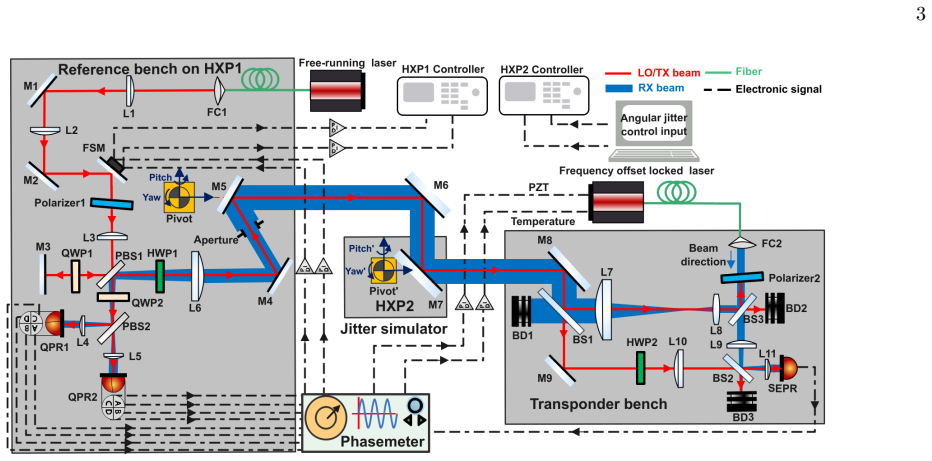
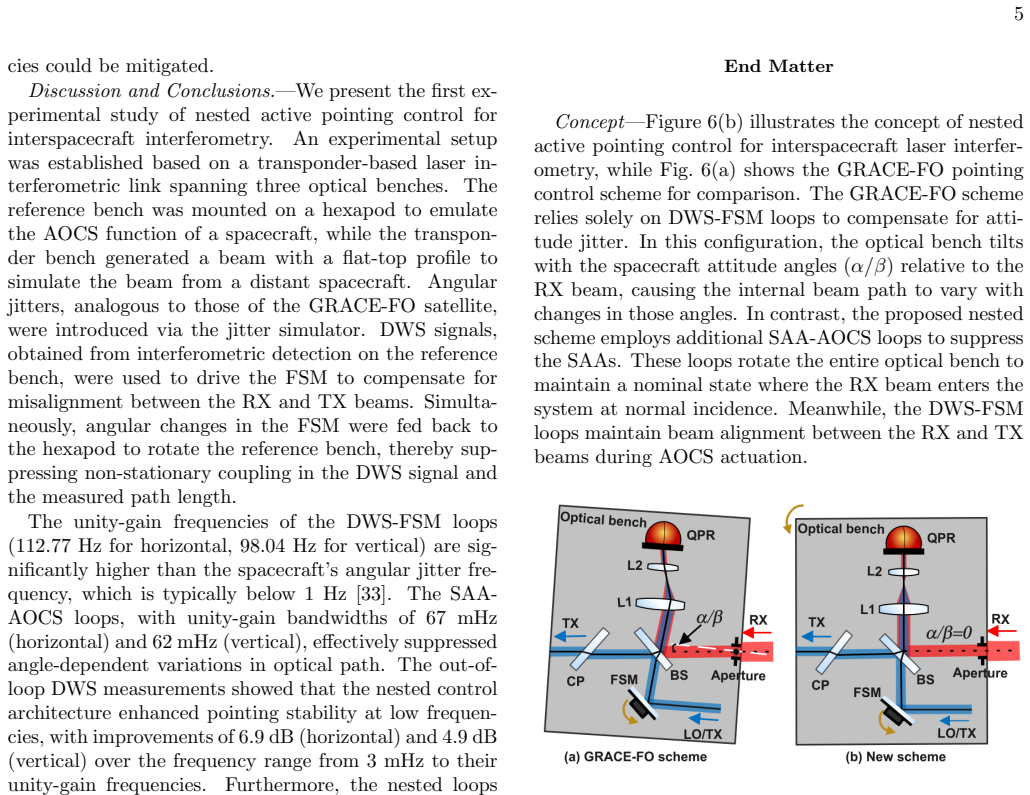
Nested control architecture that drives a fast steering mirror from differential wavefront sensing signals and feeds the mirror's angular corrections back to the attitude and orbit control system.
What would settle it
An orbital demonstration of the nested control showing less than 6.9 dB improvement in horizontal pointing stability from 3 mHz to the AOCS unity-gain frequency would falsify the performance gain for flight conditions.
Extended reading notes
Core claim
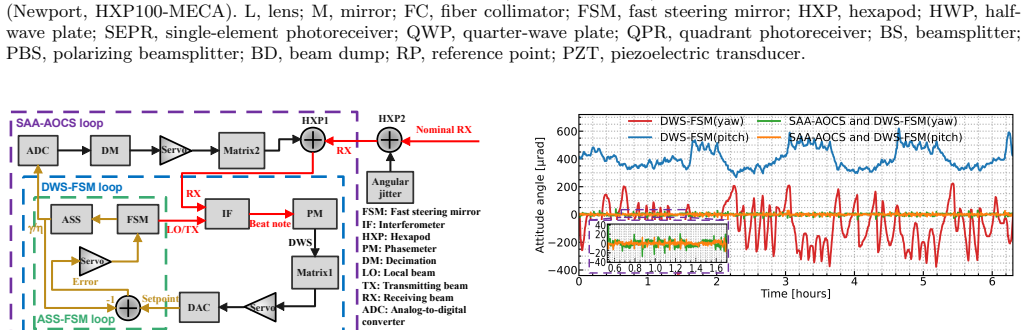
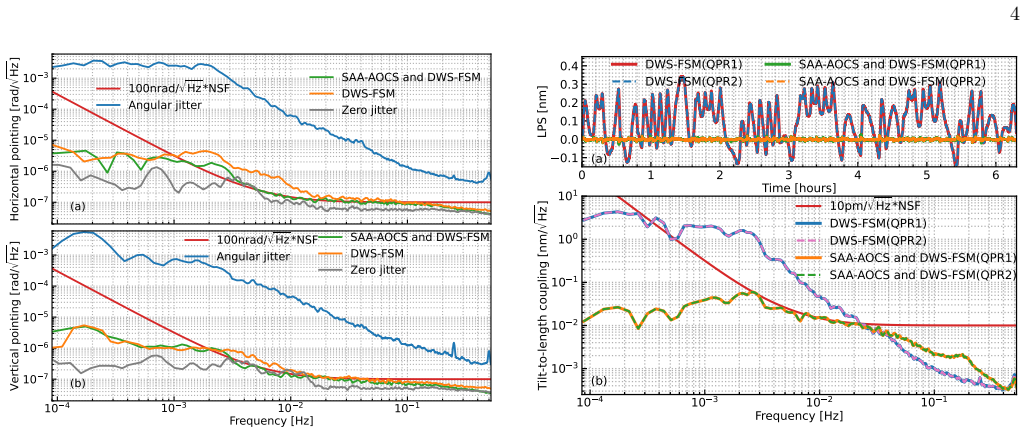
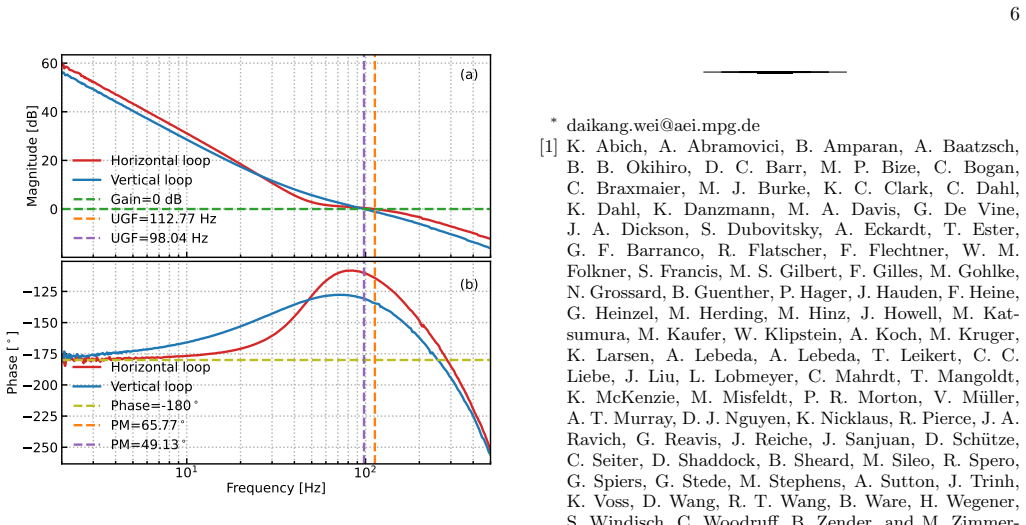
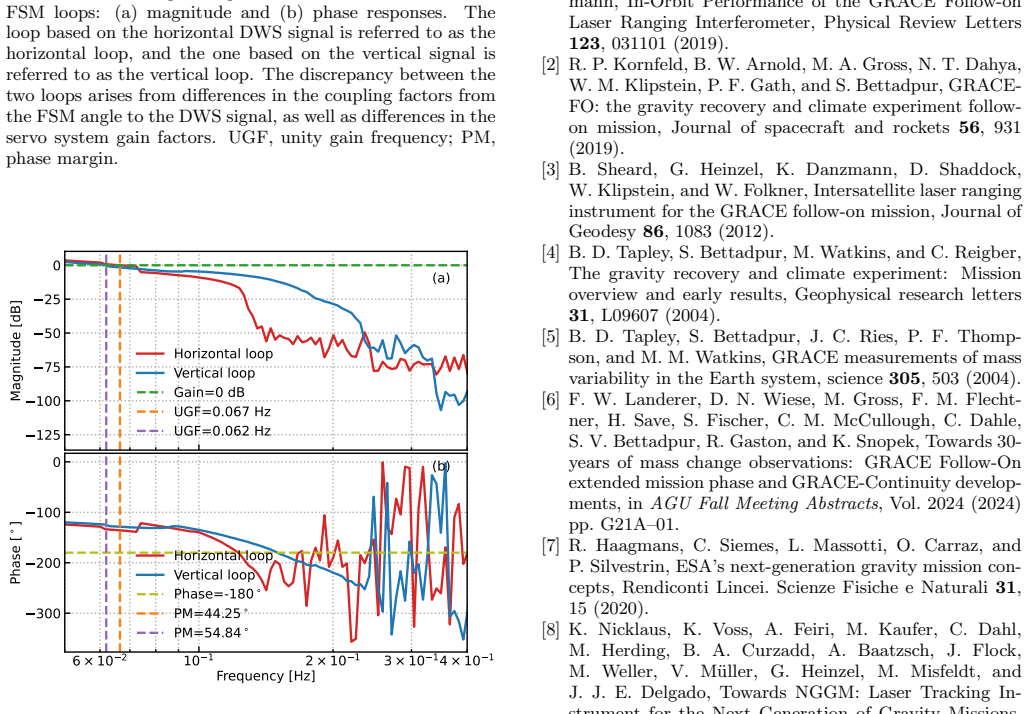
The central claim is that a nested control loop, in which differential wavefront sensing actuates a fast steering mirror to track the incoming beam while the mirror's angular motion is fed back to the attitude and orbit control system, suppresses both residual pointing errors and their coupling into optical path length. In the hexapod-based laboratory validation, this configuration delivers 6.9 dB and 4.9 dB better pointing stability in the horizontal and vertical axes across the band from 3 mHz to the AOCS unity-gain frequency compared with fast steering mirror actuation alone. Tilt-to-length coupling drops by an order of magnitude below 6 mHz and by two orders of magnitude below 0.45 mHz.
Load-bearing premise
The hexapod-based laboratory setup accurately reproduces the relevant dynamics, disturbance spectrum, and optical path conditions of actual interspacecraft laser links in orbit, without unmodeled effects from vacuum, thermal gradients, or other spacecraft subsystems.
Editorial extensions
If this is right
- Pointing stability improves by 6.9 dB horizontally and 4.9 dB vertically from 3 mHz to the AOCS unity-gain frequency.
- Tilt-to-length coupling is suppressed by an order of magnitude below 6 mHz.
- Tilt-to-length coupling is suppressed by two orders of magnitude below 0.45 mHz.
- The nested architecture demonstrates feasibility for maintaining laser links in future interspacecraft interferometry missions.
Reading between the lines
- The separation of fast optical correction from slower attitude adjustment allows each loop to be tuned independently without direct conflict.
- Laboratory gains in the millihertz band imply that similar nesting may reduce the actuator authority needed from the attitude system at the lowest frequencies.
Signed reviews
Editorial analysis
A structured set of objections, weighed in public.
Referee Report
Summary. The paper proposes a nested active pointing control architecture for interspacecraft laser interferometry. Differential wavefront sensing drives a fast steering mirror (FSM) to track the incoming beam while FSM angular changes are fed back to the attitude and orbit control system (AOCS) to suppress angle-dependent optical path variations (tilt-to-length coupling). Experimental validation in a hexapod-based laboratory setup reports that the nested configuration improves pointing stability by 6.9 dB (horizontal) and 4.9 dB (vertical) relative to standalone FSM actuation over 3 mHz to the AOCS unity-gain frequency, and suppresses tilt-to-length coupling by one order of magnitude below 6 mHz and two orders below 0.45 mHz, thereby demonstrating feasibility for future missions.
Significance. If the reported performance gains hold under orbital conditions, the nested architecture would represent a practical advance for precision laser links in space interferometry missions, directly addressing pointing-induced noise and link stability requirements. The work provides concrete experimental metrics rather than purely simulated results.
major comments (2)
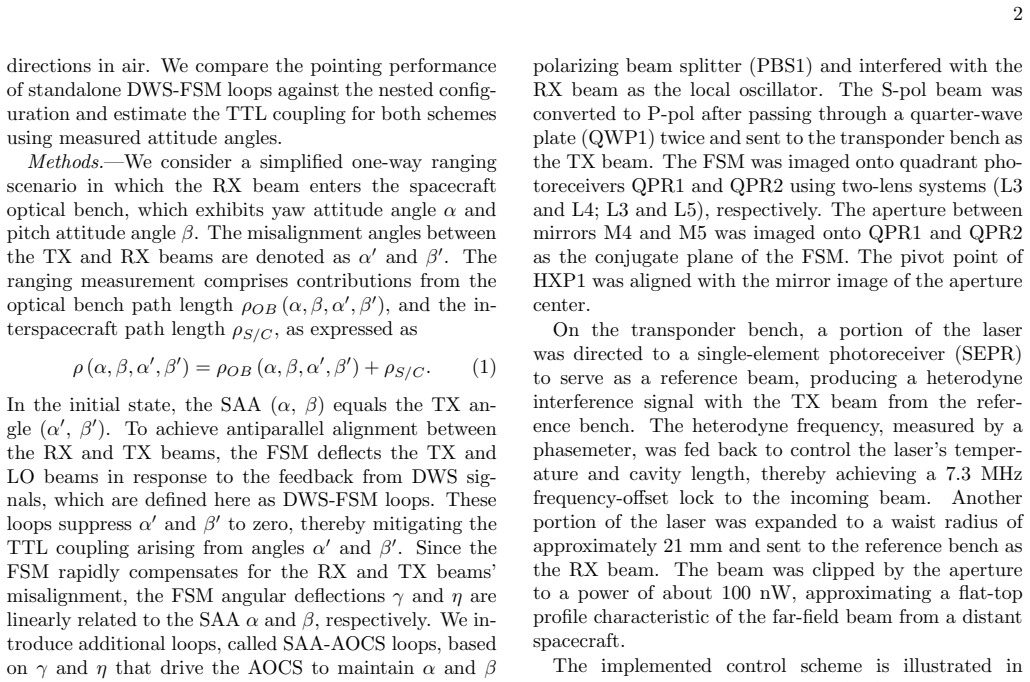
- [Experimental validation / hexapod setup description] The central feasibility claim for orbital interspacecraft links rests on the hexapod laboratory setup reproducing the relevant angular dynamics, disturbance spectrum, and optical path conditions. The manuscript does not include a quantitative comparison (e.g., power spectral densities or transfer functions) between the lab environment and expected on-orbit conditions, including vacuum, thermal gradients, or interactions with other spacecraft subsystems; without this, the reported 6.9 dB / 4.9 dB gains and tilt-to-length suppression cannot be confidently extrapolated.
- [Results and methods] The abstract states specific quantitative improvements (6.9 dB, 4.9 dB, order-of-magnitude suppressions) but the methods and results sections provide insufficient detail on data processing, error bars, statistical significance, or how the frequency bands and unity-gain frequency were determined; this directly affects verification of the load-bearing performance claims.
minor comments (2)
- [Abstract and introduction] Notation for frequency bands and dB improvements should be defined consistently on first use in the main text.
- [Figures] Figure captions for the hexapod setup and performance spectra should explicitly state the number of averaged measurements and any filtering applied.
Simulated Author's Rebuttal
We thank the referee for the constructive comments. We address each major comment below.
read point-by-point responses
-
Referee: [Experimental validation / hexapod setup description] The central feasibility claim for orbital interspacecraft links rests on the hexapod laboratory setup reproducing the relevant angular dynamics, disturbance spectrum, and optical path conditions. The manuscript does not include a quantitative comparison (e.g., power spectral densities or transfer functions) between the lab environment and expected on-orbit conditions, including vacuum, thermal gradients, or interactions with other spacecraft subsystems; without this, the reported 6.9 dB / 4.9 dB gains and tilt-to-length suppression cannot be confidently extrapolated.
Authors: The hexapod setup was constructed to replicate the angular dynamics, disturbance spectrum, and tilt-to-length coupling relevant to validating the nested control architecture. We agree that the manuscript lacks an explicit quantitative comparison (e.g., PSDs or transfer functions) to full on-orbit conditions such as vacuum and thermal gradients. We will add a dedicated paragraph in the experimental methods section that maps the lab parameters (angular range, disturbance injection, optical path) to typical mission requirements while stating the limitations for direct extrapolation. revision: yes
-
Referee: [Results and methods] The abstract states specific quantitative improvements (6.9 dB, 4.9 dB, order-of-magnitude suppressions) but the methods and results sections provide insufficient detail on data processing, error bars, statistical significance, or how the frequency bands and unity-gain frequency were determined; this directly affects verification of the load-bearing performance claims.
Authors: The current manuscript describes the overall measurement approach and identifies the AOCS unity-gain frequency from loop-gain measurements, with the 3 mHz lower bound set by the lowest reliable measurement frequency. We acknowledge that explicit details on PSD computation (e.g., Welch parameters), error bars, and statistical significance from repeated runs are not provided. We will revise the methods and results sections to include these elements, allowing independent verification of the reported dB improvements and suppression factors. revision: yes
Circularity Check
No circularity; experimental measurements are independent of any derivation chain
full rationale
The paper describes a nested FSM-AOCS control scheme and reports its performance via direct laboratory measurements on a hexapod setup (pointing stability gains of 6.9 dB / 4.9 dB and tilt-to-length suppression factors). These are empirical results, not outputs of equations, fitted parameters renamed as predictions, or self-citation chains. No load-bearing mathematical derivations appear in the provided text that could reduce to their own inputs by construction. The work is self-contained as an experimental validation and receives the default non-finding.
Assumptions & free parameters
Cite this review
Pith. "Pith review of Nested active pointing control for interspacecraft laser interferometry." pith.science (2026). https://pith.science/paper/CTPS76OG
@misc{pith2026260621274,
  author       = {Pith},
  title        = {Pith review of: Nested active pointing control for interspacecraft laser interferometry},
  year         = {2026},
  howpublished = {\url{https://pith.science/paper/CTPS76OG}},
  note         = {Machine review of arXiv:2606.21274}
}
read the original abstract
Precise pointing control is a critical requirement for interspacecraft laser interferometry, as angular misalignment introduces measurement noise and even leads to laser link loss. We present a nested control architecture that uses differential wavefront sensing signals to drive a fast steering mirror (FSM) to track the incoming beam, while feeding the FSM's angular changes back to the attitude and orbit control system (AOCS) to suppress angle-dependent optical path variations. This scheme is experimentally validated in our hexapod-based setup. Relative to standalone FSM actuation, the nested configuration enhanced pointing stability by 6.9 dB and 4.9 dB in the horizontal and vertical directions across the frequency band from 3 mHz to the AOCS actuation's unity-gain frequency. Additionally, tilt-to-length coupling was suppressed by an order of magnitude below 6 mHz and by two orders of magnitude below 0.45 mHz. These results demonstrate the feasibility of nested active pointing control for future interspacecraft laser interferometry missions.
Figures
Figures from the paper (4 more)
Reference graph
Works this paper leans on
-
[1]
Abich, A
K. Abich, A. Abramovici, B. Amparan, A. Baatzsch, B. B. Okihiro, D. C. Barr, M. P. Bize, C. Bogan, C. Braxmaier, M. J. Burke, K. C. Clark, C. Dahl, K. Dahl, K. Danzmann, M. A. Davis, G. De Vine, J. A. Dickson, S. Dubovitsky, A. Eckardt, T. Ester, G. F. Barranco, R. Flatscher, F. Flechtner, W. M. Folkner, S. Francis, M. S. Gilbert, F. Gilles, M. Gohlke, N....
2019
-
[2]
R. P. Kornfeld, B. W. Arnold, M. A. Gross, N. T. Dahya, W. M. Klipstein, P. F. Gath, and S. Bettadpur, GRACE- FO: the gravity recovery and climate experiment follow- on mission, Journal of spacecraft and rockets56, 931 (2019)
2019
-
[3]
Sheard, G
B. Sheard, G. Heinzel, K. Danzmann, D. Shaddock, W. Klipstein, and W. Folkner, Intersatellite laser ranging instrument for the GRACE follow-on mission, Journal of Geodesy86, 1083 (2012)
2012
-
[4]
B. D. Tapley, S. Bettadpur, M. Watkins, and C. Reigber, The gravity recovery and climate experiment: Mission overview and early results, Geophysical research letters 31, L09607 (2004)
2004
-
[5]
B. D. Tapley, S. Bettadpur, J. C. Ries, P. F. Thomp- son, and M. M. Watkins, GRACE measurements of mass variability in the Earth system, science305, 503 (2004)
2004
-
[6]
F. W. Landerer, D. N. Wiese, M. Gross, F. M. Flecht- ner, H. Save, S. Fischer, C. M. McCullough, C. Dahle, S. V. Bettadpur, R. Gaston, and K. Snopek, Towards 30- years of mass change observations: GRACE Follow-On extended mission phase and GRACE-Continuity develop- ments, inAGU Fall Meeting Abstracts, Vol. 2024 (2024) pp. G21A–01
2024
-
[7]
Haagmans, C
R. Haagmans, C. Siemes, L. Massotti, O. Carraz, and P. Silvestrin, ESA’s next-generation gravity mission con- cepts, Rendiconti Lincei. Scienze Fisiche e Naturali31, 15 (2020)
2020
-
[8]
Nicklaus, K
K. Nicklaus, K. Voss, A. Feiri, M. Kaufer, C. Dahl, M. Herding, B. A. Curzadd, A. Baatzsch, J. Flock, M. Weller, V. M¨ uller, G. Heinzel, M. Misfeldt, and J. J. E. Delgado, Towards NGGM: Laser Tracking In- strument for the Next Generation of Gravity Missions, Remote Sensing14, 4089 (2022)
2022
Show all 35 references
-
[9]
Amaro-Seoane, H
P. Amaro-Seoane, H. Audley, S. Babak, J. Baker, E. Ba- rausse, P. Bender, E. Berti, P. Binetruy, M. Born, D. Bor- toluzzi, J. Camp, C. Caprini, V. Cardoso, M. Colpi, J. Conklin, N. Cornish, C. Cutler, K. Danzmann, R. Dolesi, L. Ferraioli, V. Ferroni, E. Fitzsimons, J. Gair, 7 ...
2017 arXiv
-
[10]
Luo, L.-S
J. Luo, L.-S. Chen, H.-Z. Duan, Y.-G. Gong, S. Hu, J. Ji, Q. Liu, J. Mei, V. Milyukov, M. Sazhin, C.-G. Shao, V. T. Toth, H.-B. Tu, Y. Wang, Y. Wang, H.-C. Yeh, M.-S. Zhan, Y. Zhang, V. Zharov, and Z.-B. Zhou, TianQin: a space-borne gravitational wave detector, Classical and Q...
2016
-
[11]
Z. Luo, Z. Guo, G. Jin, Y. Wu, and W. Hu, A brief anal- ysis to Taiji: Science and technology, Results in Physics 16, 102918 (2020)
2020
-
[12]
Kawamura, M
S. Kawamura, M. Ando, N. Seto, S. Sato, T. Nakamura, K. Tsubono, N. Kanda, T. Tanaka, J. Yokoyama, I. Fu- naki,et al., The Japanese space gravitational wave an- tenna: DECIGO, Classical and Quantum Gravity28, 094011 (2011)
2011
-
[13]
M¨ uller,Design considerations for future geodesy mis- sions and for space laser interferometry, Ph.D
V. M¨ uller,Design considerations for future geodesy mis- sions and for space laser interferometry, Ph.D. thesis, Hannover: Gottfried Wilhelm Leibniz Universit¨ at Han- nover (2017)
2017
-
[14]
Wanner and G
G. Wanner and G. Heinzel, Analytical description of in- terference between two misaligned and mismatched com- plete gaussian beams, Applied optics53, 3043 (2014)
2014
-
[15]
Wegener, V
H. Wegener, V. M¨ uller, G. Heinzel, and M. Misfeldt, Tilt- to-length coupling in the GRACE Follow-On laser rang- ing interferometer, Journal of Spacecraft and Rockets57, 1362 (2020)
2020
-
[16]
Hartig, S
M.-S. Hartig, S. Schuster, and G. Wanner, Geometric tilt-to-length coupling in precision interferometry: mech- anisms and analytical descriptions, Journal of Optics24, 065601 (2022)
2022
-
[17]
Hartig, S
M.-S. Hartig, S. Schuster, G. Heinzel, and G. Wanner, Non-geometric tilt-to-length coupling in precision inter- ferometry: mechanisms and analytical descriptions, Jour- nal of Optics25, 055601 (2023)
2023
-
[18]
Sch¨ utze, G
D. Sch¨ utze, G. Stede, V. M¨ uller, O. Gerberding, T. Bandikova, B. S. Sheard, G. Heinzel, and K. Danz- mann, Laser beam steering for GRACE Follow-On inter- satellite interferometry, Optics express22, 24117 (2014)
2014
-
[19]
N. F. Hasselmann, Validation of novel pointing concepts for LISA, PhD Thesis (2025)
2025
-
[20]
P. Gath, H. R. Schulte, D. Weise, and U. Johann, Drag- free and attitude control system design for the LISA sci- ence mode, inAIAA Guidance, Navigation and Control Conference and Exhibit(2007) p. 6731
2007
-
[21]
U. Langer, Design and development of the point-ahead angle mechanism for the lase interferometer space an- tenna LISA, inProceedings of the 13th European Space Mechanisms & Tribology Symposium, Vol. 1 (2009)
2009
-
[22]
Houba, S
N. Houba, S. Delchambre, T. Ziegler, G. Hechenblaikner, and W. Fichter, Lisa point-ahead angle control for optimal tilt-to-length noise estimation, arXiv preprint arXiv:2208.11033 (2022)
2022
-
[23]
Vidano, M
S. Vidano, M. Pagone, J. Grzymisch, V. Preda, and C. Novara, Drag-free and attitude control system for the LISA space mission: AnH ∞ constrained decoupling ap- proach, IEEE Transactions on Control Systems Technol- ogy32, 2149 (2024)
2024
-
[24]
Heinzel, M
G. Heinzel, M. D. ´Alvarez, A. Pizzella, N. Brause, and J. J. E. Delgado, Tracking length and differential- wavefront-sensing signals from quadrant photodiodes in heterodyne interferometers with digital phase-locked- loop readout, Physical Review Applied14, 054013 (2020)
2020
-
[25]
Wanner, G
G. Wanner, G. Heinzel, E. Kochkina, C. Mahrdt, B. S. Sheard, S. Schuster, and K. Danzmann, Methods for sim- ulating the readout of lengths and angles in laser inter- ferometers with gaussian beams, Optics communications 285, 4831 (2012)
2012
-
[26]
Shaddock, B
D. Shaddock, B. Ware, P. Halverson, R. Spero, and B. Klipstein, Overview of the LISA Phasemeter, inAIP conference proceedings, Vol. 873 (American Institute of Physics, 2006) pp. 654–660
2006
-
[27]
Gerberding, B
O. Gerberding, B. Sheard, I. Bykov, J. Kullmann, J. J. E. Delgado, K. Danzmann, and G. Heinzel, Phasemeter core for intersatellite laser heterodyne interferometry: mod- elling, simulations and experiments, Classical and Quan- tum Gravity30, 235029 (2013)
2013
-
[28]
Y. Yang, K. Yamamoto, M. Dovale ´Alvarez, D. Wei, J. J. Esteban Delgado, V. M¨ uller, J. Jia, and G. Heinzel, On- axis optical bench for laser ranging instruments in future gravity missions, Sensors22, 2070 (2022)
-
[29]
D. Wei, C. Bode, K. Yamamoto, Y. Lee, G. F. Bar- ranco, V. M¨ uller, M. D. ´Alvarez, J. J. E. Delgado, and G. Heinzel, Experimental demonstration of an on-axis laser ranging interferometer for future gravity missions, Phys. Rev. Appl.25, 044039 (2026)
2026
-
[30]
Goswami, S
S. Goswami, S. P. Francis, T. Bandikova, and R. E. Spero, Analysis of GRACE follow-on laser ranging in- terferometer derived inter-satellite pointing angles, IEEE Sensors Journal21, 19209 (2021)
2021
-
[31]
Newport Corporation,HXP Controller User’s Man- ual: Hexapod Motion Controller, Newport Corporation, Irvine, CA, USA (2015)
2015
-
[32]
Kochkina,Stigmatic and astigmatic Gaussian beams in fundamental mode: impact of beam model choice on interferometric pathlength signal estimates, Ph.D
E. Kochkina,Stigmatic and astigmatic Gaussian beams in fundamental mode: impact of beam model choice on interferometric pathlength signal estimates, Ph.D. thesis, Hannover: Gottfried Wilhelm Leibniz Universit¨ at Han- nover (2013)
2013
-
[33]
Daniel,Intersatellite laser interferometry Test envi- ronments for GRACE Follow-On, Ph.D
S. Daniel,Intersatellite laser interferometry Test envi- ronments for GRACE Follow-On, Ph.D. thesis, Leibniz University Hannover, Hannover (2015)
2015
-
[34]
Daras, L
I. Daras, L. Massotti, P. Willemsen, G. March, M. Fran- cois, and B. Carnicero Dominguez, Next generation grav- ity mission (NGGM) status overview and scientific out- look, European Geosciences Union General Assembly 2024 (EGU24) , 11271 (2024)
2024
-
[35]
Cesare, S
S. Cesare, S. Dionisio, M. Saponara, D. Bravo- Bergu˜ no, L. Massotti, J. Teixeira da Encarna¸ c˜ ao, and B. Christophe, Drag and attitude control for the next generation gravity mission, Remote Sensing14, 2916 (2022)
2022
Reviewed June 26, 2026 · model on record in the stance chip above.
Discussion (0). Continue with ORCID to comment.