REVIEW 2 major objections 6 minor 65 references
Thirty-five years of timing of M53A with Arecibo and FAST
T0 review · 2 major / 6 minor · reviewed 2026-08-09 · deepseek-v4-flash
Pith's one-line read A 35-year timing baseline shows pulsar M53A is only about 0.7–0.85 billion years old, with a young helium white dwarf companion.
desk verdict First phase-connected timing solution for M53A plus a clean He WD identification; the spin-down age is solid in direction but carries a real, disclosed systematic from the early single-frequency Arecibo data. read the letter →
The pith
A machine-rendered reading of the paper's core claim, the machinery that carries it, and where it could break.
The reading
What carries the argument
The central machinery is a 35-year phase-coherent timing solution that combines times of arrival from Arecibo (430 MHz in 1989–1993 and L-band in 2003–2008) and FAST (1.0–1.5 GHz in 2019–2024), fit with the tempo pulsar-timing software. The key identity is the observed spin-down decomposition, $(\dot P/P)_{\rm obs} = (\dot P/P)_{\rm int} + \mu^2 d/c + a_{\ell,\mathrm{GC}}/c + a_{\mathrm{Gal}}/c$, which removes the Shklovskii effect, the line-of-sight acceleration from the cluster potential, and the Galactic acceleration, leaving the intrinsic spin-down. The companion's identity and age come from fitting the three-band HST photometry to helium and carbon-oxygen white-dwarf cooling tracks, with a likelihood over mass and cooling age. A secondary element is the measurement of the orbital-period derivative, which independently constrains the cluster acceleration and rules out a nearby star as the cause of the large observed jerk.
What would settle it
A multi-frequency analysis of the 1989-1993 Arecibo data, or new FAST observations at two or more widely separated bands across the same epochs, would reveal whether the timing residuals have a chromatic, frequency-dependent component. If such a component is found, the measured first spin-frequency derivative (and hence the $0.70$–$0.85$ Gyr characteristic age) would be biased, whereas if the residuals are achromatic, the current spin-down interpretation is supported.
Extended reading notes
Core claim
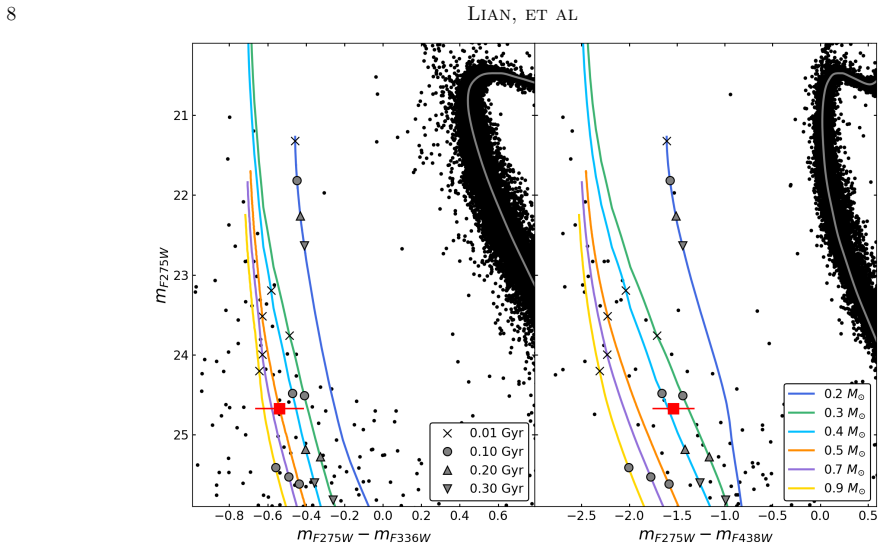
On its own terms, the paper establishes that M53A, a 33.16 ms pulsar in a 255.86-day orbit with a low-mass companion in the globular cluster NGC 5024, has been spinning down at an intrinsic rate between $6.15$ and $7.50 \times 10^{-19}\,\mathrm{s\,s^{-1}}$. After correcting for the Shklovskii effect, the Galactic acceleration, and the cluster's gravitational field, this implies a characteristic age of $0.70$–$0.85$ Gyr and a surface magnetic field of $4.55$–$5.03 \times 10^9$ G. The precise timing position and proper motion allow the companion to be identified in archival Hubble Space Telescope images as a helium white dwarf with mass $M_{\rm WD} = 0.39^{+0.05}_{-0.07}\,M_\odot$, effective temperature $18\,000$ K, and cooling age $0.14^{+0.04}_{-0.03}$ Gyr, so the whole system is only about $0.35$ Gyr old. The low eccentricity of $e = 0.00055732(4)$ matches the empirical eccentricity–period relation for wide Galactic-disk binaries, and the paper argues that M53A is the first clear example in a globular cluster of a young, wide pulsar–He WD binary formed through case B Roche-lobe overflow.
Load-bearing premise
The entire spin-down and age measurement assumes that the earliest Arecibo times of arrival from 1989-1993, which were recorded at a single frequency with unmeasured uncertainties, are not biased by dispersion-measure variations; the paper itself notes that a chromatic trend could masquerade as part of the spin-frequency derivative and shift the derived age.
Editorial extensions
If this is right
- The intrinsic spin-down of M53A is between $6.15$ and $7.50 \times 10^{-19}\,\mathrm{s\,s^{-1}}$, which fixes its characteristic age at $0.70$–$0.85$ Gyr and its magnetic field at $4.55$–$5.03 \times 10^9$ G.
- The optical companion is a helium white dwarf with mass $0.39^{+0.05}_{-0.07}\,M_\odot$ and cooling age $0.14^{+0.04}_{-0.03}$ Gyr; adding the proto-WD phase gives a total age of about $0.35$ Gyr, roughly 2.8 percent of the cluster's age.
- The measured eccentricity of $0.00055732(4)$ is consistent with the Phinney (1992) relation for wide systems, indicating a formation path through case B Roche-lobe overflow like Galactic disk pulsar–He WD binaries.
- The observed second spin-frequency derivative implies a line-of-sight jerk about ten times larger than the cluster potential alone can produce, so either a distant low-mass companion or unmodeled dispersion-measure variations are present.
- In the $P$–$\dot P$ diagram, slow pulsars in low-density clusters such as M53 and M71 sit in the same region as Galactic disk systems, while the young pulsars with $\tau_c < 10^8$ yr are found only in dense clusters, suggesting different formation channels for the two populations.
Reading between the lines
- If the apparent jerk is caused by a distant companion rather than by dispersion-measure variations, M53A would join PSR J1620-26A as one of the few globular-cluster pulsars with a possible planet-mass companion; a few more years of multi-frequency timing would settle this.
- The agreement between the pulsar's characteristic age and the white-dwarf cooling age provides a rare direct calibration of the spin-down age for a recycled pulsar; extending this method to other wide binaries could test whether the standard braking index $n=3$ holds for these systems.
- The fact that a young, wide pulsar binary can form and survive in the second least dense cluster with pulsars suggests that similar systems may await discovery in other low-density clusters, and that their absence so far may be an observational selection effect rather than an evolutionary one.
- The paper's inferred initial spin periods at the end of accretion ($22.9$–$25.7$ ms for braking indices $n=2$–$4$) give a concrete prediction that could be compared with the spin-period distribution of wide disk pulsar–He WD binaries to constrain how efficiently these pulsars were recycled.
Editorial analysis
A structured set of objections, weighed in public.
Referee Report
Summary. This Letter presents the first phase-coherent timing solution for PSR B1310+18A (M53A), a 33-ms binary pulsar in the globular cluster M53, based on a 35-year baseline that combines archival Arecibo data with recent FAST observations. The measured spin period derivative, after subtracting the Shklovskii effect and modeled cluster and Galactic accelerations, is converted into an intrinsic spin-down of 6.15-7.50e-19 s/s, implying a characteristic age of 0.70-0.85 Gyr. The timing position and proper motion allow the identification of the companion in archival HST data as a helium white dwarf with mass 0.39 Msun and cooling age 0.14 Gyr, implying a total system age of about 0.35 Gyr, which is consistent with the young characteristic age. The paper also discusses the eccentricity, the measured second spin-frequency derivative, and the population of slow pulsars in low-density versus high-density globular clusters.
Significance. If the timing result holds, this is a valuable contribution to pulsar astrophysics. M53A is one of the first pulsars discovered in a globular cluster, and this is the first phase-connected solution for it, providing a precise position, proper motion, orbital parameters, and spin-down. The identification of the companion as a young He WD with an independently estimated age is a notable achievement, and the consistency between the radio-derived characteristic age and the optical cooling age strengthens the standard binary-evolution interpretation. The paper also offers an interesting comparative analysis of slow pulsars across clusters of different densities. The authors are transparent about the limitations of the early Arecibo data, which is commendable. However, the spin-down measurement, which underlies the headline age, relies on single-frequency early data whose uncertainties were not measured, and the degeneracy with dispersion-measure variations is not quantitatively explored.
major comments (2)
- [Section 3.3 and Section 2.1] The paper acknowledges that the measured second spin-frequency derivative f2 = -1.08(10)e-27 Hz/s^2 could be produced by dispersion-measure variations 'in the absence of multi-frequency ToAs for the early Arecibo data', but it does not evaluate whether such variations could also bias the first derivative f1, which sets the intrinsic Pdot and the characteristic age of 0.70-0.85 Gyr. Because the early 1989-1993 ToAs are at a single frequency (430 MHz) and their uncertainties are renormalized to force reduced chi2 = 1.0, a time-varying DM during that era can be partially absorbed into the spin parameters. I request a quantitative sensitivity analysis: for example, (a) fit a DM polynomial or a DM offset/trend for the early data, (b) refit f1 after removing the early data or the f2 term, or (c) use the later multi-frequency data to bound plausible DM variations and propagate them to Pdot. Without such a test, the robustness of the claimed 6.15-7.50e-19 s/s interval is not established.
- [Section 3.1 and Section 5.3] The timing proper motion differs from the cluster proper motion by 3.7 sigma, yet the paper simply assumes the pulsar PM equals the cluster PM and discards the measurement. While the physical motivation (escape velocity limit) is reasonable, the paper does not demonstrate that this choice does not introduce a bias in other fitted parameters. The Shklovskii term is small relative to the intrinsic Pdot, so the impact on the spin-down is likely minor, but the adopted PM also enters the xdot analysis (Section 3.5) and the orbital-orientation constraints. I recommend fitting the timing model with a Gaussian prior on the PM from Gaia DR3/Vasiliev & Baumgardt (2021), or at least reporting the timing results with both the measured and assumed PM, to show that the central conclusions are insensitive to this assumption.
minor comments (6)
- [Section 2.1] The sentence 'The uncertainty estimates for the ToAs derived from the above observations were not estimated' is confusingly phrased; it should say that the uncertainties were not measured or not reported. Since a time constant was added in quadrature to force reduced chi2 = 1.0, it would be helpful to state clearly that the reported uncertainties for the early data are therefore not independent.
- [Table 1] There are two typographical issues: 'EF AC' should be 'EFAC', and '2st Spin Frequency derivative' should be '2nd Spin Frequency derivative'.
- [Section 3.3, Eq. (4)] The equation for the maximum jerk from the cluster potential, a_dot_ell,GC,max = -3 v2_mu,0 / r2_c v_ell,max, has unclear notation: the subscript 'mu' on v is unexplained, and the numerator/denominator structure would benefit from parentheses, e.g., (-3 v0^2 / rc^2) v_ell,max.
- [Section 3.5, Eq. (7)] The symbol mu is used both for proper motion and for the position angle of proper motion (Theta_mu); to avoid confusion, use a different symbol such as Theta_mu for the position angle and note the units of mu (mas/yr).
- [Section 5.3] The bullet summarizing the proper motion quotes mu_alpha = -0.36 mas/yr and mu_delta = -0.62 mas/yr, whereas Section 3.1 quotes -0.35 +/- 0.15 and -0.61 +/- 0.22 mas/yr; please make these values consistent throughout.
- [Section 4] The phrase 'compatible with the companion being a He WD rather than a CO one' is stronger than what the data show, since the comparison is based on three photometric bands and the models; consider rephrasing to 'the He WD cooling tracks provide a better fit' to avoid implying a decisive discrimination.
Circularity Check
No significant circularity: the timing-derived spin-down, the cluster-acceleration correction, and the HST white-dwarf properties are independent measurements joined by consistency checks.
full rationale
The paper's central results are measurements, not derivations from an assumed answer. The observed spin frequency derivative f1 comes from a 35-year phase-connected timing fit, and the observed Pdot is corrected for Shklovskii, Galactic, and cluster accelerations using an external cluster model (Freire et al. 2005; Lian et al. 2023). The cluster acceleration correction is small compared to the observed excess: the paper quotes |a_l,GC| <= 0.61e-9 m/s^2 while a_l,P,max = 6.17e-9 m/s^2, so the intrinsic spin-down dominates robustly even if the cluster model were uncertain. This is independently cross-checked with the orbital period derivative, which gives a line-of-sight acceleration consistent with the cluster model and rules out anomalous acceleration. The characteristic age is a standard definition applied to the corrected Pdot, not an input fitted to produce it. The white-dwarf mass and cooling age are derived from HST photometry fitted to independent cooling tracks (Istrate et al. 2014, 2016; Salaris et al. 2010), not from the radio timing solution. The consistency between the WD cooling age plus proto-WD phase and the characteristic age is an interpretation, not a circular reduction. The acknowledged limitation that early single-frequency Arecibo ToAs could let DM variations masquerade as a spin-frequency derivative is a genuine systematic caveat, but it is not a case of a fitted parameter being renamed as a prediction or of an equation reducing to its own input. Self-citations to Lian et al. (2023) and Freire et al. (2005) provide the cluster acceleration model and context, but they are not the source of the central spin-down measurement or the WD properties, and the main conclusion does not reduce to those citations. Therefore the paper shows no significant circularity.
Assumptions & free parameters
free parameters (4)
- EFAC_Arecibo =
1.16
- EFAC_FAST =
1.30
- Time_constant_early_Arecibo =
not reported
- Assumed_pulsar_mass =
1.3 Msun
assumptions (4)
- domain assumption The analytical cluster model of Freire et al. (2005) and Lian et al. (2023) gives the correct line-of-sight acceleration range for M53 at the pulsar's position.
- domain assumption The HST photometry is calibrated to the VEGAMAG system and the WD cooling tracks (Istrate et al. 2014, 2016; Salaris et al. 2010) correctly predict the colors of the companion.
- domain assumption The distance and reddening to M53 (d=18.5 kpc, (m-M)0=16.32, E(B-V)=0.02) are correct.
- ad hoc to paper The pulsar's proper motion equals the cluster proper motion; the measured timing PM is treated as biased by systematics.
Cite this review
Pith. "Pith review of Thirty-five years of timing of M53A with Arecibo and FAST." pith.science (2026). https://pith.science/paper/CU2JGZZD
@misc{pith2026250202042,
  author       = {Pith},
  title        = {Pith review of: Thirty-five years of timing of M53A with Arecibo and FAST},
  year         = {2026},
  howpublished = {\url{https://pith.science/paper/CU2JGZZD}},
  note         = {Machine review of arXiv:2502.02042}
}
abstract
PSR B1310+18A is a 33-ms binary pulsar in a 256-day, low eccentricity orbit with a low-mass companion located in NGC 5024 (M53). In this Letter, we present the first phase-coherent timing solution for this pulsar (designated as M53A) derived from a 35-year timing baseline; this combines the archival Arecibo Observatory data with the recent observations from the Five-hundred-meter Aperture Spherical radio Telescope (FAST). We find that the spin period derivative of the pulsar is between 6.1 and $7.5 \times 10^{-19} \rm \, s\, s^{-1}$, which implies a characteristic age between 0.70 and 0.85 Gyr. The timing solution also includes a precise position and proper motion for the pulsar, enabling the identification of the companion of M53A in Hubble Space Telescope data as a Helium white dwarf (He WD) with a mass of $M_{\rm WD}=0.39^{+0.05}_{-0.07} \, \rm M_{\odot}$ and a cooling age of $0.14^{+0.04}_{-0.03}\, \rm Gyr$, confirming that the system formed recently in the history of the GC. The system resembles, in its spin and orbital characteristics, similarly wide pulsar - He WD systems in the Galactic disk. We conclude by discussing the origin of slow pulsars in globular clusters, showing that none of the slow pulsars in low-density globular clusters are as young as the systems observed in the densest known globular clusters.
Figures


Figures from the paper (3 more)


Reference graph
Works this paper leans on
-
[1]
Abbate, F., Ridolfi, A., Barr, E. D., et al. 2022, MNRAS, 513, 2292, doi: 10.1093/mnras/stac1041
-
[2]
Anderson, S., Kulkarni, S., Prince, T., & Wolszczan, A. 1989, IAUC, 4853, 1
work page 1989
-
[3]
2021, MNRAS, 505, 5957, doi: 10.1093/mnras/stab1474
Baumgardt, H., & Vasiliev, E. 2021, MNRAS, 505, 5957, doi: 10.1093/mnras/stab1474
-
[4]
Bellini, A., Anderson, J., & Bedin, L. R. 2011, PASP, 123, 622, doi: 10.1086/659878
doi:10.1086/659878 2011
-
[5]
Boyles, J., Lorimer, D. R., Turk, P. J., et al. 2011, ApJ, 742, 51, doi: 10.1088/0004-637X/742/1/51
-
[6]
2020, ApJ, 905, 63, doi: 10.3847/1538-4357/abc345
Cadelano, M., Chen, J., Pallanca, C., et al. 2020, ApJ, 905, 63, doi: 10.3847/1538-4357/abc345
-
[7]
Cadelano, M., Ferraro, F. R., Istrate, A. G., et al. 2019, ApJ, 875, 25, doi: 10.3847/1538-4357/ab0e6b
-
[8]
Cadelano, M., Pallanca, C., Ferraro, F. R., et al. 2015, ApJ, 807, 91, doi: 10.1088/0004-637X/807/1/91
Show all 65 references
-
[9]
R., Cadelano, M., et al
Chen, J., Ferraro, F. R., Cadelano, M., et al. 2021, Nature Astronomy, 5, 1170, doi: 10.1038/s41550-021-01445-6
2021 doi
-
[10]
Clark, G. W. 1975, ApJL, 199, L143, doi: 10.1086/181869 9 https://cstr.cn/31116.02.F AST
1975 doi
-
[11]
J., Li, D., et al
Cruces, M., Champion, D. J., Li, D., et al. 2021, MNRAS, 508, 300, doi: 10.1093/mnras/stab2540
2021 doi
-
[12]
Damour, T., & Taylor, J. H. 1991, ApJ, 366, 501, doi: 10.1086/169585
1991 doi
-
[13]
C., Pringle, J
Fabian, A. C., Pringle, J. E., & Rees, M. J. 1975, MNRAS, 172, 15, doi: 10.1093/mnras/172.1.15P
1975 doi
-
[14]
A., & Bridges, T
Forbes, D. A., & Bridges, T. 2010, MNRAS, 404, 1203, doi: 10.1111/j.1365-2966.2010.16373.x
2010
-
[15]
C., Camilo, F., Lorimer, D
Freire, P. C., Camilo, F., Lorimer, D. R., et al. 2001, MNRAS, 326, 901, doi: 10.1046/j.1365-8711.2001.04493.x
2001
-
[16]
Freire, P. C. C., Hessels, J. W. T., Nice, D. J., et al. 2005, ApJ, 621, 959, doi: 10.1086/427748
2005 doi
-
[17]
Hessels, J. W. T. 2008, ApJ, 679, 1433, doi: 10.1086/587832
2008 doi
-
[18]
Freire, P. C. C., Ridolfi, A., Kramer, M., et al. 2017, MNRAS, 471, 857, doi: 10.1093/mnras/stx1533 Gaia Collaboration, Vallenari, A., Brown, A. G. A., et al. 2023, A&A, 674, A1, doi: 10.1051/0004-6361/202243940
2017 doi
- [19]
-
[20]
C., & Rasio, F
Heggie, D. C., & Rasio, F. A. 1996, MNRAS, 282, 1064, doi: 10.1093/mnras/282.3.1064
1996 doi
-
[21]
L., Pietrinferni, A., Cassisi, S., et al
Hidalgo, S. L., Pietrinferni, A., Cassisi, S., et al. 2018, ApJ, 856, 125, doi: 10.3847/1538-4357/aab158
2018 doi
-
[22]
G., Marchant, P., Tauris, T
Istrate, A. G., Marchant, P., Tauris, T. M., et al. 2016, A&A, 595, A35, doi: 10.1051/0004-6361/201628874
2016 doi
-
[23]
G., Tauris, T
Istrate, A. G., Tauris, T. M., Langer, N., & Antoniadis, J. 2014, A&A, 571, L3, doi: 10.1051/0004-6361/201424681
2014 doi
-
[24]
2020, Research in Astronomy and Astrophysics, 20, 064, doi: 10.1088/1674-4527/20/5/64
Jiang, P., Tang, N.-Y., Hou, L.-G., et al. 2020, Research in Astronomy and Astrophysics, 20, 064, doi: 10.1088/1674-4527/20/5/64
2020 doi
-
[25]
Katz, J. I. 1975, Nature, 253, 698, doi: 10.1038/253698a0
1975 doi
-
[26]
Kopeikin, S. M. 1996, ApJL, 467, L93, doi: 10.1086/310201
1996 doi
-
[27]
L., & Ransom, S
Kremer, K., Fuller, J., Piro, A. L., & Ransom, S. M. 2023, MNRAS, 525, L22, doi: 10.1093/mnrasl/slad088
2023 doi
-
[28]
S., Heinke, C
Kremer, K., Ye, C. S., Heinke, C. O., et al. 2024, ApJL, 977, L42, doi: 10.3847/2041-8213/ad9a4e
2024 doi
-
[29]
1991, Nature, 349, 47, doi: 10.1038/349047a0
Wolszczan, A. 1991, Nature, 349, 47, doi: 10.1038/349047a0
1991 doi
-
[30]
M., Knispel, B., et al
Lazarus, P., Tauris, T. M., Knispel, B., et al. 2014, MNRAS, 437, 1485, doi: 10.1093/mnras/stt1996
2014 doi
-
[31]
2023, ApJL, 951, L37, doi: 10.3847/2041-8213/acdee7
Lian, Y., Pan, Z., Zhang, H., et al. 2023, ApJL, 951, L37, doi: 10.3847/2041-8213/acdee7
2023 doi
-
[32]
R., & Kramer, M
Lorimer, D. R., & Kramer, M. 2004, Handbook of Pulsar
2004
-
[33]
S., Ransom, S
Lynch, R. S., Ransom, S. M., Freire, P. C. C., & Stairs, I. H. 2011, ApJ, 734, 89, doi: 10.1088/0004-637X/734/2/89
2011 doi
-
[34]
G., Manchester, R
Lyne, A. G., Manchester, R. N., & D’Amico, N. 1996, ApJL, 460, L41, doi: 10.1086/309972
1996 doi
-
[35]
N., Hobbs, G
Manchester, R. N., Hobbs, G. B., Teoh, A., & Hobbs, M. 2005, AJ, 129, 1993, doi: 10.1086/428488
2005 doi
-
[36]
McMillan, P. J. 2017, MNRAS, 465, 76, doi: 10.1093/mnras/stw2759
2017 doi
-
[37]
2011, International Journal of Modern Physics D, 20, 989, doi: 10.1142/S0218271811019335
Nan, R., Li, D., Jin, C., et al. 2011, International Journal of Modern Physics D, 20, 989, doi: 10.1142/S0218271811019335
2011 doi
-
[38]
2015, Tempo: Pulsar timing data analysis, Astrophysics Source Code Library, record ascl:1509.002
Nice, D., Demorest, P., Stairs, I., et al. 2015, Tempo: Pulsar timing data analysis, Astrophysics Source Code Library, record ascl:1509.002
2015
-
[39]
V., Ransom, S
Padmanabh, P. V., Ransom, S. M., Freire, P. C. C., et al. 2024, A&A, 686, A166, doi: 10.1051/0004-6361/202449303
2024 doi
-
[40]
2021, ApJL, 915, L28, doi: 10.3847/2041-8213/ac0bbd
Pan, Z., Qian, L., Ma, X., et al. 2021, ApJL, 915, L28, doi: 10.3847/2041-8213/ac0bbd
2021 doi
-
[41]
Phinney, E. S. 1992, Philosophical Transactions of the Royal Society of London Series A, 341, 39, doi: 10.1098/rsta.1992.0084
1992
-
[42]
2021, ApJ, 908, 102, doi: 10.3847/1538-4357/abd4d5
Pietrinferni, A., Hidalgo, S., Cassisi, S., et al. 2021, ApJ, 908, 102, doi: 10.3847/1538-4357/abd4d5
2021 doi
-
[43]
P., Bedin, L
Piotto, G., Milone, A. P., Bedin, L. R., et al. 2015, AJ, 149, 91, doi: 10.1088/0004-6256/149/3/91
2015 doi
-
[44]
Ransom, S. M. 2001, PhD thesis, Harvard University, Massachusetts
2001
-
[45]
M., Cordes, J
Ransom, S. M., Cordes, J. M., & Eikenberry, S. S. 2003, ApJ, 589, 911, doi: 10.1086/374806
2003 doi
-
[46]
M., Eikenberry, S
Ransom, S. M., Eikenberry, S. S., & Middleditch, J. 2002, AJ, 124, 1788, doi: 10.1086/342285
2002 doi
-
[47]
C., Di Stefano, R., & Han, Z
Rappaport, S., Podsiadlowski, P., Joss, P. C., Di Stefano, R., & Han, Z. 1995, MNRAS, 273, 731, doi: 10.1093/mnras/273.3.731
1995 doi
- [48]
-
[49]
Ridolfi, A., Freire, P. C. C., Gautam, T., et al. 2022, A&A, 664, A27, doi: 10.1051/0004-6361/202143006
2022 doi
-
[50]
2010, ApJ, 716, 1241, doi: 10.1088/0004-637X/716/2/1241
Isern, J. 2010, ApJ, 716, 1241, doi: 10.1088/0004-637X/716/2/1241
2010 doi
-
[51]
Shklovskii, I. S. 1970, Soviet Ast., 13, 562
1970
-
[52]
Sigurdsson, S., & Phinney, E. S. 1993, ApJ, 415, 631, doi: 10.1086/173190 —. 1995, ApJS, 99, 609, doi: 10.1086/192199
1993 doi
-
[53]
B., Hansen, B
Sigurdsson, S., Richer, H. B., Hansen, B. M., Stairs, I. H., & Thorsett, S. E. 2003, Science, 301, 193, doi: 10.1126/science.1086326
2003 doi
-
[54]
2008, MNRAS, 388, 307, doi: 10.1111/j.1365-2966.2008.13387.x
Sollima, A. 2008, MNRAS, 388, 307, doi: 10.1111/j.1365-2966.2008.13387.x
2008
-
[55]
Stovall, K., Freire, P. C. C., Antoniadis, J., et al. 2019, ApJ, 870, 74, doi: 10.3847/1538-4357/aaf37d
2019 doi
-
[56]
M., Langer, N., & Kramer, M
Tauris, T. M., Langer, N., & Kramer, M. 2012, MNRAS, 425, 1601, doi: 10.1111/j.1365-2966.2012.21446.x
2012
-
[57]
M., Sanyal, D., Yoon, S
Tauris, T. M., Sanyal, D., Yoon, S. C., & Langer, N. 2013, A&A, 558, A39, doi: 10.1051/0004-6361/201321662
2013 doi
- [58]
- [59]
-
[60]
2021, MNRAS, 505, 5978, doi: 10.1093/mnras/stab1475
Vasiliev, E., & Baumgardt, H. 2021, MNRAS, 505, 5978, doi: 10.1093/mnras/stab1475
2021 doi
-
[61]
Verbunt, F., & Freire, P. C. C. 2014, A&A, 561, A11, doi: 10.1051/0004-6361/201321177
2014 doi
-
[62]
W., et al
Wang, L., Peng, B., Stappers, B. W., et al. 2020, ApJ, 892, 43, doi: 10.3847/1538-4357/ab76cc
2020 doi
-
[63]
2024, ApJL, 974, L23, doi: 10.3847/2041-8213/ad7b9e
Wu, Y., Pan, Z., Qian, L., et al. 2024, ApJL, 974, L23, doi: 10.3847/2041-8213/ad7b9e
2024 doi
-
[64]
2024, Science China
Zhou, D., Wang, P., Li, D., et al. 2024, Science China
2024
-
[65]
Physics, Mechanics, and Astronomy, 67, 269512, doi: 10.1007/s11433-023-2362-x
Reviewed August 9, 2026 · model on record in the stance chip above.
Discussion (0). Continue with ORCID to comment.