elasticAI.explorer: Towards a Unified End-to-End Framework for Hardware-Aware Neural Architecture Search
Pith reviewed 2026-06-29 00:13 UTC · model grok-4.3
The pith
elasticAI.explorer translates YAML search spaces into neural models and automates hardware code generation plus on-device benchmarking for NAS.
A machine-rendered reading of the paper's core claim, the machinery that carries it, and where it could break.
Core claim
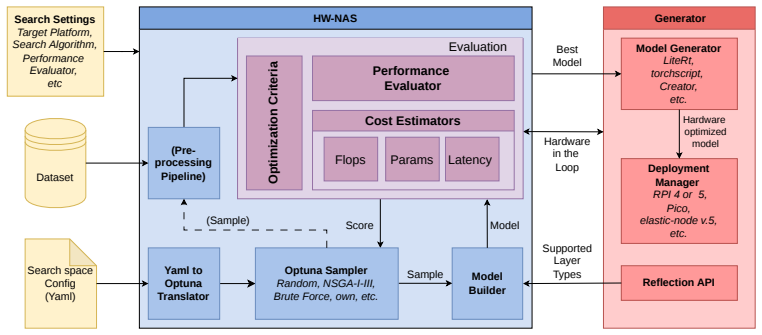
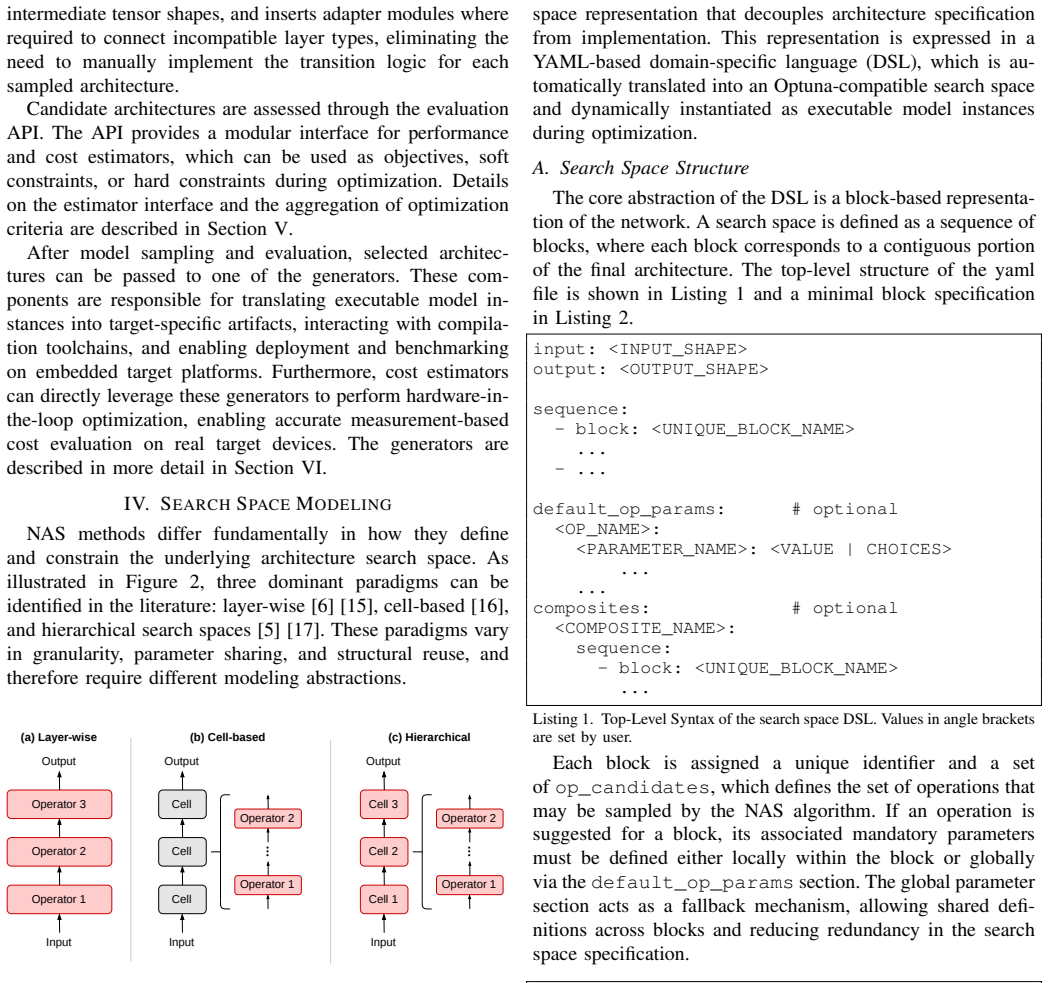
elasticAI.explorer enables hardware-aware NAS through a YAML-based search space specification that dynamically translates into executable neural network models during sampling, while supporting layer-wise, cell-based, and hierarchical search spaces with a unified interface for optimization and deployment, plus integrated hardware-specific code generation, Docker-based cross-compilation toolchains, and automated creation of on-device benchmarking binaries.
What carries the argument
The YAML-based search space specification that dynamically translates into executable neural network models during sampling.
If this is right
- A single interface handles layer-wise, cell-based, and hierarchical search spaces without separate implementations.
- Hardware-in-the-loop workflows become possible by combining architecture sampling with automated cross-compilation and device execution.
- Extensible evaluators supply metrics including FLOPs, parameter count, and latency estimates.
- Engineering overhead drops for adapting NAS to new embedded platforms through the shared deployment pipeline.
Where Pith is reading between the lines
- Teams working on custom accelerators could reuse the same search and benchmarking components instead of rebuilding deployment code for each platform.
- The separation of search-space definition from hardware execution may let the same framework test multiple optimization algorithms on the same device set.
- Automated on-device runs could surface latency patterns that offline estimators miss, guiding tighter hardware-aware constraints.
Load-bearing premise
The YAML-based search space specification and unified interface will enable easy extension to new hardware platforms and custom operators without substantial additional engineering effort.
What would settle it
A demonstration that extending the framework to a new hardware platform or custom operator requires substantial new code outside the YAML interface and Docker toolchains, or that the generated benchmarking binaries fail to execute correctly on target devices.
Figures
read the original abstract
Neural Architecture Search (NAS) has become an important approach for automatically designing neural networks under task-specific and hardware-specific constraints. However, many existing NAS frameworks tightly couple search space definitions, model implementations, and deployment pipelines, making extension to new hardware platforms and custom operators difficult. In this paper, we present the elasticAI.explorer, an extensible Python framework for hardware-aware NAS built on top of Optuna. The framework introduces a YAML-based search space specification that dynamically translates into executable neural network models during sampling. The approach supports layer-wise, cell-based, and hierarchical search spaces while maintaining a unified interface for optimization and deployment. Beyond architecture generation, the framework integrates hardware-specific code generation, Docker-based cross-compilation toolchains, and automated creation of on-device benchmarking binaries, enabling hardware-in-the-loop NAS workflows. The system further provides extensible evaluators for FLOPs, parameter count, and latency estimation. The elasticAI.explorer aims to reduce the engineering overhead of embedded AI deployment and accelerate research on hardware-aware NAS for heterogeneous accelerator platforms
Editorial analysis
A structured set of objections, weighed in public.
Referee Report
Summary. The manuscript presents elasticAI.explorer, a Python framework for hardware-aware Neural Architecture Search (NAS) built on Optuna. It proposes a YAML-based search space specification that dynamically translates into executable neural network models, supporting layer-wise, cell-based, and hierarchical search spaces. The framework integrates hardware-specific code generation, Docker-based cross-compilation, automated on-device benchmarking, and extensible evaluators for metrics such as FLOPs, parameter count, and latency, with the goal of reducing engineering overhead for embedded AI deployment on heterogeneous accelerator platforms.
Significance. If the described framework achieves its stated extensibility and unified interface without hidden coupling, it would offer a valuable tool for accelerating hardware-aware NAS research by providing an end-to-end pipeline from search space definition to on-device evaluation. The integration of Optuna with hardware-in-the-loop workflows addresses a practical need in the field. However, the manuscript provides no empirical validation, code examples, or benchmarks, which substantially weakens the significance assessment.
major comments (2)
- [Abstract] Abstract: The claim that the YAML-based search space specification enables extension to new hardware platforms and custom operators 'without substantial additional engineering effort' is not supported by any schema definition, example of operator registration, description of hardware-specific codegen hooks, or measurement of engineering effort. This directly undermines the central claim of reduced engineering overhead.
- [Abstract] Abstract: No validation data, benchmarks, or implementation details are provided to substantiate the functionality of the integrated components such as Docker-based cross-compilation and automated on-device benchmarking, leaving the practical utility of the framework unverified.
Simulated Author's Rebuttal
Thank you for the referee's constructive comments. We address each major comment below and agree that the manuscript requires additional details to support the claims made in the abstract. Revisions will be made to include the requested substantiation.
read point-by-point responses
-
Referee: [Abstract] Abstract: The claim that the YAML-based search space specification enables extension to new hardware platforms and custom operators 'without substantial additional engineering effort' is not supported by any schema definition, example of operator registration, description of hardware-specific codegen hooks, or measurement of engineering effort. This directly undermines the central claim of reduced engineering overhead.
Authors: We agree that the abstract claim requires concrete support in the manuscript. While the paper describes the YAML-based specification, its dynamic translation to models, and support for layer-wise, cell-based, and hierarchical spaces, it does not include the schema definition, operator registration examples, codegen hooks, or effort measurements. In the revised version, we will add the YAML schema, an example of custom operator registration, and a description of hardware-specific code generation hooks to substantiate the extensibility claim. revision: yes
-
Referee: [Abstract] Abstract: No validation data, benchmarks, or implementation details are provided to substantiate the functionality of the integrated components such as Docker-based cross-compilation and automated on-device benchmarking, leaving the practical utility of the framework unverified.
Authors: The manuscript outlines the design and integration of Docker-based cross-compilation and automated on-device benchmarking as part of the end-to-end pipeline, but does not provide empirical validation, benchmarks, or detailed implementation examples in the text. We will revise the manuscript to include implementation details, code snippets, and preliminary benchmark results for these components to verify their functionality and practical utility. revision: yes
Circularity Check
No circularity: framework description paper contains no derivations or fitted predictions
full rationale
The paper presents a software framework (elasticAI.explorer) with YAML search-space translation, Optuna integration, Docker cross-compilation, and hardware benchmarking. No equations, parameter fitting, predictions, or self-citation chains appear in the provided text. All claims describe implemented features rather than deriving new results from prior ones. The extensibility claim is an engineering assertion, not a mathematical reduction. This matches the default expectation of no circularity for non-derivational work.
Axiom & Free-Parameter Ledger
Reference graph
Works this paper leans on
-
[1]
Neural Architecture Search: A Survey,
T. Elsken, J. H. Metzen, and F. Hutter, “Neural Architecture Search: A Survey,”Journal of Machine Learning Research, vol. 20, no. 55, pp. 1–21, 2019. [Online]. Available: https://www.jmlr.org/papers/v20/ 18-598.html
2019
-
[2]
Nas-bench-101: Towards Reproducible Neural Architecture Search,
C. Ying, A. Klein, E. Christiansen, E. Real, K. Murphy, and F. Hutter, “Nas-bench-101: Towards Reproducible Neural Architecture Search,” inInt. Conf. on Machine Learning. PMLR, 2019, pp. 7105–7114. [Online]. Available: https://proceedings.mlr.press/v97/ying19a.html
2019
-
[3]
Nas-bench-201: Extending the scope of repro- ducible neural architecture search,
X. Dong and Y . Yang, “Nas-bench-201: Extending the Scope of Reproducible Neural Architecture Search,”arXiv preprint arXiv:2001.00326, 2020. [Online]. Available: https://openreview.net/ forum?id=HJxyZkBKDr
-
[4]
T. Akiba, S. Sano, T. Yanase, T. Ohta, and M. Koyama, “Optuna: A next- generation hyperparameter optimization framework,” inProceedings of the 25th ACM Int. Conf. on Knowledge Discovery & Data Mining (SIGKDD), 2019, pp. 2623–2631. [Online]. Available: https: //doi.org/10.1145/3292500.3330701
-
[5]
MnasNet: Platform-Aware Neural Architecture Search for Mobile
M. Tan, B. Chen, R. Pang, V . Vasudevan, and Q. V . Le, “MnasNet: Platform-Aware Neural Architecture Search for Mobile,”CoRR, vol. abs/1807.11626, 2018. [Online]. Available: http://arxiv.org/abs/1807. 11626
work page internal anchor Pith review Pith/arXiv arXiv 2018
-
[6]
FBNet: Hardware-Aware Efficient ConvNet Design via Differentiable Neural Architecture Search
B. Wu, X. Dai, P. Zhang, Y . Wang, F. Sun, Y . Wu, Y . Tian, P. Vajda, Y . Jia, and K. Keutzer, “FBNet: Hardware-Aware Efficient ConvNet Design via Differentiable Neural Architecture Search,”CoRR, vol. abs/1812.03443, 2018. [Online]. Available: http://arxiv.org/abs/1812. 03443
work page internal anchor Pith review Pith/arXiv arXiv 2018
-
[8]
ProxylessNAS: Direct Neural Architecture Search on Target Task and Hardware
[Online]. Available: http://arxiv.org/abs/1812.00332
work page internal anchor Pith review Pith/arXiv arXiv
-
[10]
arXiv preprint arXiv:1908.09791 , year=
[Online]. Available: http://arxiv.org/abs/1908.09791
-
[11]
ChamNet: Towards Efficient Network Design through Platform-Aware Model Adaptation
X. Dai, P. Zhang, B. Wu, H. Yin, F. Sun, Y . Wang, M. Dukhan, Y . Hu, Y . Wu, Y . Jia, P. Vajda, M. Uyttendaele, and N. K. Jha, “ChamNet: Towards Efficient Network Design through Platform-Aware Model Adaptation,”CoRR, vol. abs/1812.08934, 2018. [Online]. Available: http://arxiv.org/abs/1812.08934
work page internal anchor Pith review Pith/arXiv arXiv 2018
-
[12]
Neural Network Intelligence,
Microsoft, “Neural Network Intelligence,” 1 2021. [Online]. Available: https://github.com/microsoft/nni
2021
-
[13]
NASLib: A Modular and Flexible Neural Architecture Search Library,
M. Ruchte, A. Zela, J. Siems, J. Grabocka, and F. Hutter, “NASLib: A Modular and Flexible Neural Architecture Search Library,” https:// github.com/automl/NASLib, 2020
2020
-
[14]
Archai: Platform for Neural Architecture Search,
“Archai: Platform for Neural Architecture Search,” Jul 2022. [Online]. Available: https://www.microsoft.com/en-us/research/project/ archai-platform-for-neural-architecture-search
2022
-
[15]
aw nas: A Modularized and Extensible NAS framework,
X. Ning, C. Tang, W. Li, S. Yang, T. Zhao, N. Zhang, T. Lu, S. Liang, H. Yang, and Y . Wang, “aw nas: A Modularized and Extensible NAS framework,”CoRR, vol. abs/2012.10388, 2020. [Online]. Available: https://arxiv.org/abs/2012.10388
-
[16]
G. Christoph, F. Adrian, H. Tobias, P. P. Bernardo, K. L ¨ubeck, and B. Oliver, “Hardware Accelerator and Neural Network Co-Optimization for Ultra-Low-Power Audio Processing Devices,” in25th Euromicro Conference on Digital System Design (DSD), 2022, pp. 365–369. [Online]. Available: https://doi.org/10.1109/DSD57027.2022.00056
-
[17]
Designing Neural Network Architectures using Reinforcement Learning
B. Baker, O. Gupta, N. Naik, and R. Raskar, “Designing Neural Network Architectures using Reinforcement Learning,” 2017. [Online]. Available: https://arxiv.org/abs/1611.02167
work page internal anchor Pith review Pith/arXiv arXiv 2017
-
[18]
Efficient Neural Architecture Search via Parameter Sharing
H. Pham, M. Y . Guan, B. Zoph, Q. V . Le, and J. Dean, “Efficient Neural Architecture Search via Parameter Sharing,” 2018. [Online]. Available: https://arxiv.org/abs/1802.03268
work page internal anchor Pith review Pith/arXiv arXiv 2018
-
[19]
Construction of Hierarchical Neural Architecture Search Spaces based on Context-free Grammars,
S. Schrodi, D. Stoll, B. Ru, R. Sukthanker, T. Brox, and F. Hutter, “Construction of Hierarchical Neural Architecture Search Spaces based on Context-free Grammars,” 2023. [Online]. Available: https://arxiv.org/abs/2211.01842
-
[20]
H. Benmeziane, K. E. Maghraoui, H. Ouarnoughi, S. Niar, M. Wistuba, and N. Wang, “A Comprehensive Survey on Hardware-Aware Neural Architecture Search,”arXiv preprint arXiv:2101.09336, 2021. [Online]. Available: https://arxiv.org/abs/2101.09336
-
[21]
Deep.Neural.Signal.Pre-Processor – Towards Development of AI-enhanced End-to-End BCIs,
L. Buron, A. Erbsl ¨oh, Z. Ur-Rehman, C. Klaes, K. Seidl, and G. Schiele, “Deep.Neural.Signal.Pre-Processor – Towards Development of AI-enhanced End-to-End BCIs,”Current Directions in Biomedical Engineering, vol. 9, no. 1, pp. 471–474, 2023. [Online]. Available: https://doi.org/10.1515/cdbme-2023-1118
-
[22]
C. Qian, L. Einhaus, and G. Schiele, “ElasticAI-Creator: Optimizing Neural Networks for Time-Series-Analysis for on-Device Machine Learning in IoT Systems,” inProceedings of the 20th ACM Conf. on Embedded Networked Sensor Systems (SenSys ’22), 2023, p. 941–946. [Online]. Available: https://doi.org/10.1145/3560905.3568296
discussion (0)
Sign in with ORCID, Apple, or X to comment. Anyone can read and Pith papers without signing in.