REVIEW 4 major objections 5 minor 27 references
X-ray and TeV gamma-ray emission from the 50-year period binary system PSR J2032+4127/MT91 213
T0 review · 4 major / 5 minor · reviewed 2026-08-14 · deepseek-v4-flash
Pith's one-line read PSR J2032+4127/MT91 213 is a TeV gamma-ray binary whose day-scale, non-correlated X-ray and TeV variability challenges pulsar-wind models.
desk verdict Proceedings paper that re-reports the already-published TeV detection of PSR J2032+4127/MT91 213 and adds one genuinely new but systematics-limited spectral-state comparison; worth a referee, but not the paper to cite for the discovery. read the letter →
The pith
A machine-rendered reading of the paper's core claim, the machinery that carries it, and where it could break.
The reading
What carries the argument
The central object is the shocked wind-collision region between the pulsar wind and the wind or circumstellar disk of the Be star MT91 213, where accelerated particles produce X-rays through synchrotron radiation and TeV gamma rays through inverse Compton scattering. The analysis machinery is a joint spectral decomposition that models the observed VHE region as the sum of a steady power-law baseline from TeV J2032+4130, with its spectral index fixed to the 1-sigma range of an earlier measurement, plus a variable binary component fitted with a power law with or without an exponential cutoff. Fitting the 2017 data split into 'high' and 'low' flux states is what reveals the spectral differences between states.
What would settle it
Re-fit the 2017 VERITAS and MAGIC data with the TeV J2032+4130 baseline spectral index varied across its quoted 1-sigma range and with the baseline normalization left free before and after periastron; if the order-of-magnitude day-scale variability or the difference between the high and low state spectra disappears under any plausible baseline choice, the central claim is not secure.
Extended reading notes
Core claim
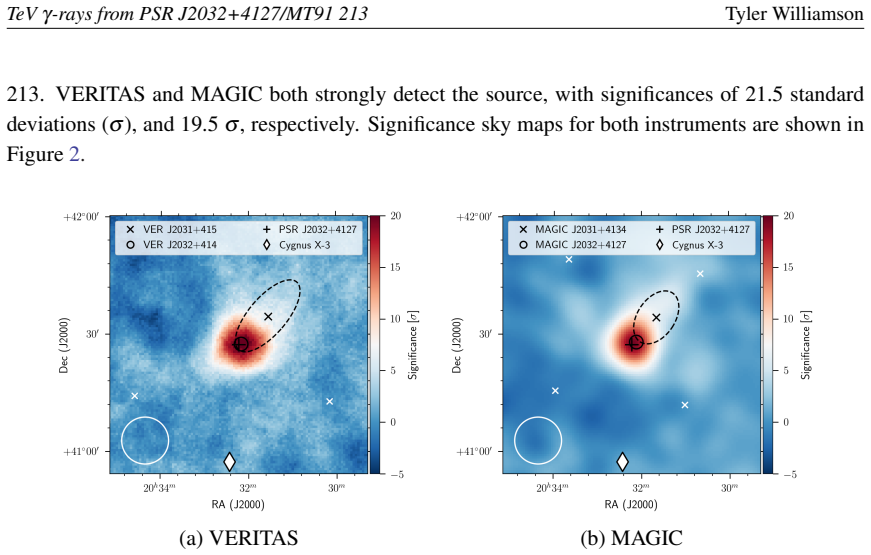
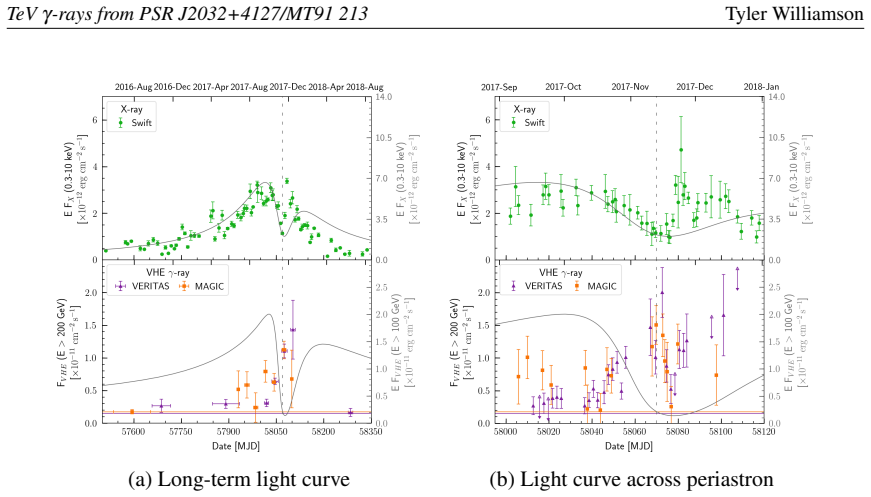
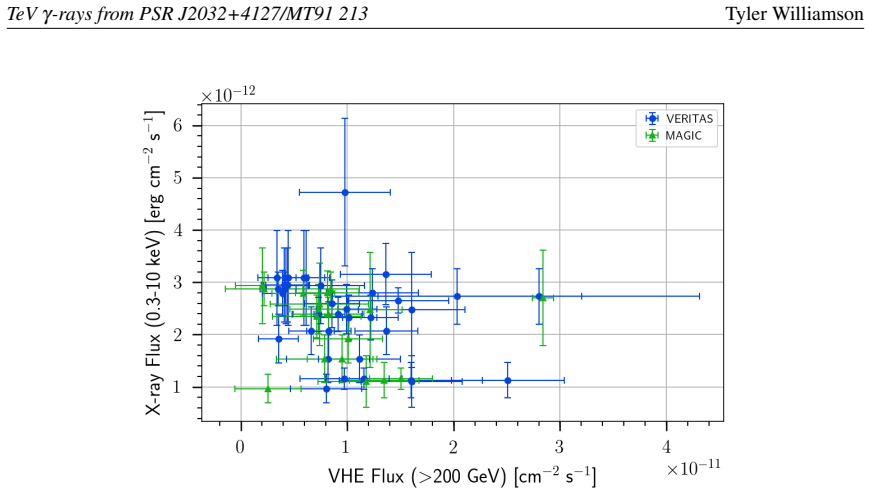
The paper establishes PSR J2032+4127/MT91 213 as a TeV gamma-ray binary by detecting a source coincident with the pulsar at 21.5 sigma with VERITAS and 19.5 sigma with MAGIC, after separating its emission from the overlapping extended source TeV J2032+4130. Over the fall 2017 periastron, both the TeV and X-ray fluxes varied by roughly an order of magnitude on few-day timescales, yet the X-ray and TeV light curves were not in phase; both reached minimum at or shortly after periastron, while other features diverged. Spectrally, the binary component is best described by a power law with a low-energy exponential cutoff, and the low-flux state shows a cutoff around 300-600 GeV. The authors conclude that the observations present serious challenges to existing models of the system, which will require significant revisions.
Load-bearing premise
The extraction of the binary's TeV signal assumes that the nearby extended source TeV J2032+4130 is steady and shaped by a simple power law with its slope fixed to an earlier measurement; if that background is mis-modeled, the binary's brightness, cutoff energy, and state-to-state spectral differences shift.
Editorial extensions
If this is right
- The system becomes the second confirmed pulsar-hosting gamma-ray binary, giving modelers a clean case where the compact object is unambiguously a pulsar and accretion-jet emission is not an option.
- The absence of direct X-ray/TeV correlation, unlike PSR B1259-63, implies the two bands trace different parts of the wind-shock region or different radiative processes and must be reproduced by any successful model.
- The sharp VHE dip about one week after periastron, at a position broadly predicted but much more abrupt than modeled, points to a mechanism such as photon-photon absorption or a disk interaction that is not captured in current model light curves.
- Because GeV emission appears dominated by the pulsar magnetosphere, gating out the pulsed emission should reveal whether a separate GeV component from the intra-binary interaction exists.
- The return of VHE emission to pre-2017 levels by spring 2018 confirms the flare was a periastron-driven transient rather than a persistent change in TeV J2032+4130.
Reading between the lines
- The existing datasets could be re-analyzed with the TeV J2032+4130 baseline index allowed to float across its 1-sigma range, and with a two-dimensional baseline template built from the pre-2016 archival data, to test whether the day-scale variability and high/low spectral differences survive; this is a direct check that the paper does not report.
- If the post-periastron dip is caused by photon-photon absorption near superior conjunction, then a phase-resolved hardening of the spectrum inside the dip should be visible in the current VERITAS and MAGIC data, a prediction that can be tested without new observations.
- The unusual X-ray/TeV phasing suggests that future modeling should treat the stellar disk and wind clumpiness explicitly rather than a smooth wind; a concrete extension would be to compare the X-ray flares with the clump timescales already measured in the weeks before periastron.
Signed reviews
Editorial analysis
A structured set of objections, weighed in public.
Referee Report
Summary. This conference-proceedings paper reports X-ray (Swift-XRT) and very-high-energy (VERITAS, MAGIC) observations of the pulsar/Be-star binary PSR J2032+4127/MT91 213 across its 2017 periastron passage. The authors detect TeV emission from the binary, making it the second gamma-ray binary with a confirmed pulsar companion, and find day-scale variability of up to an order of magnitude in both X-ray and TeV flux, without direct correlation. They extract the binary TeV spectrum by modeling the overlapping extended source TeV J2032+4130 as a power-law baseline, and report a low-state spectral cutoff around 300–600 GeV and a harder high-state spectrum. They compare the light curves with model predictions from Takata et al. and Li et al., and argue that the observed variability challenges current models.
Significance. If the results hold, this paper adds a rare and important object to the small class of gamma-ray binaries with a confirmed pulsar companion, providing strong observational constraints on pulsar-wind interaction models. The analysis benefits from long, multi-instrument coverage and independent detections by VERITAS and MAGIC at 21.5σ and 19.5σ. The paper also usefully highlights the relation between the binary and the extended TeV source TeV J2032+4130. However, the spectral decomposition of the binary emission from the overlapping baseline is the most fragile step, and the lack of propagated baseline systematics weakens the specific spectral-variability claims.
major comments (4)
- [Section 3.1] The spectral decomposition of the binary from the overlapping TeV J2032+4130 baseline is not fully specified. The paper states that the baseline is a power law with spectral index 'constrained by the 1σ range in [8]', but it does not say how this constraint is implemented in the joint fit (fixed, profiled, or prior), nor how the morphology of the extended source is modeled. Since the binary point source lies inside the extended emission (Figure 2), the baseline normalization and index are partially degenerate with the binary flux and spectral index. The paper should propagate systematic uncertainties from the baseline by repeating the fit with baseline parameters varied within the allowed 1σ range (and ideally with alternative spatial templates), and state whether the quoted uncertainties in Table 1 include these systematics. Without this, the low-state cutoff (300–600 GeV) and the high/low-state spectral difference could be artifacts of the decomposition.
- [Section 3, first paragraph] The quoted detection significances of 21.5σ (VERITAS) and 19.5σ (MAGIC) are likely for the combined VHE emission region, not specifically for the binary point-source component after subtracting the TeV J2032+4130 baseline. The paper should clarify what the significances refer to and, more importantly, provide the significance or test statistic of the binary component in the joint spectral fit. This is load-bearing because the central claim is that TeV emission was detected from the binary itself, not merely from the pre-existing extended source.
- [Section 3.1] The claim that 'both instruments significantly favor a power law with a low-energy exponential cutoff' is not supported by the data shown. Table 1 lists χ²/dof only for the PLEC models, with no comparison to the corresponding power-law-only fits. The authors should provide Δχ², a likelihood-ratio test statistic, or a similar measure, for the cutoff in the average 2017 spectrum and for the low-state spectra, so that the reader can judge the significance of the claimed cutoff.
- [Section 3, Figure 3 and Table 1] The paper does not explicitly state that all quoted errors are statistical only, nor does it discuss systematic uncertainties from energy-scale calibration or the choice of the spectral extraction region. For IACT measurements, energy-scale systematics typically affect the inferred cutoff energy and spectral index. The authors should state the statistical nature of the errors and give at least an approximate systematic uncertainty, particularly for the cutoff energies in Table 1.
minor comments (5)
- [Section 1] There is a typo in the first paragraph: 'variablility' should be 'variability'.
- [Section 2.1] The X-ray spectral fit to an absorbed power law is described as 'well fit', but the χ²/dof for that fit is not reported. Please add it.
- [Section 3, Figure 3 caption] The sentence 'Orbital coverage of periastron for all observations are shown in Figure 1' should be '...is shown in Figure 1'.
- [Section 3, Figure 3 and Figure 5] The text refers to 'a model light curve generated by [22] and [10]', but it is unclear whether the gray curves in Figure 3 correspond to one or both models and whether they are predictions or fits to the data. Please clarify in the caption and text.
- [Table 1] The table formatting has a missing space between the '7.9/9' and 'High State' rows; also, the dash for the cutoff in the High State PL row is fine but should be explained in the table notes.
Circularity Check
No significant circularity; the paper is an observational report whose TeV/X-ray detections are made directly from instrument data and compared with external model predictions.
full rationale
The paper does not derive any quantity from fitted parameters that is then relabeled as a prediction. The central observational claims—21.5σ (VERITAS) and 19.5σ (MAGIC) detection of a VHE source at the binary position, order-of-magnitude day-scale variability, and the lack of direct X-ray/TeV correlation—are obtained directly from the two independent IACT datasets and Swift-XRT, with spectral fits reported in Table 1. The only externally constrained input is the spectral index of the underlying TeV J2032+4130 baseline, which is set by the published 1σ range of [8]; the binary component is then extracted by a joint fit (baseline plus binary), not by asserting that the baseline equals the binary. This is a standard background-subtraction procedure and does not make the binary spectrum equal to the prior by construction. The model comparisons in Figure 3 use light curves from Takata et al. (2017, [22]) and Li et al. (2018, [10]) as external predictions, and the paper explicitly notes where these models fail ('unable to explain the rapid increase in X-ray flux...', 'VHE observations show variation on shorter time scales than those anticipated'). Citation [12] is the prior announcement of the same detection by the same collaborations, but the present paper presents its own significances, spectra, and light curves from the underlying observations, so the detection is not imported solely through self-citation. Systematic concerns about the baseline morphology/spectrum and unpropagated systematics would affect the robustness of the spectral-state comparison, but they are not circularity under the definitions used here.
Assumptions & free parameters
assumptions (3)
- domain assumption The VHE emission from the overlapping extended source TeV J2032+4130 at the binary position follows a power law whose spectral index is within the 1 sigma range reported by Aliu et al. (2014, ref [8]).
- domain assumption The orbital solution (model 2 from Ho et al. 2017, ref [6]) correctly describes the binary orbit for phasing observations.
- domain assumption The X-ray and TeV emission arise from synchrotron and inverse Compton radiation in the pulsar wind shock (Section 4).
Cite this review
Pith. "Pith review of X-ray and TeV gamma-ray emission from the 50-year period binary system PSR J2032+4127/MT91 213." pith.science (2026). https://pith.science/paper/CULU5GGM
@misc{pith2026190804165,
  author       = {Pith},
  title        = {Pith review of: X-ray and TeV gamma-ray emission from the 50-year period binary system PSR J2032+4127/MT91 213},
  year         = {2026},
  howpublished = {\url{https://pith.science/paper/CULU5GGM}},
  note         = {Machine review of arXiv:1908.04165}
}
read the original abstract
We report on X-ray and TeV gamma-ray observations of the pulsar/Be star binary PSR J2032+4127/MT91 213. PSR J2032+4127 is a 143-ms gamma-ray pulsar which shares a long period (45-50 year) and highly eccentric orbit with the massive Be star MT91 213. TeV gamma-ray emission was detected from the binary following a coordinated observing campaign over the fall 2017 periastron with VERITAS, MAGIC, and X-ray monitoring with Swift-XRT. The discovery of this gamma-ray binary makes it just the second such source known to contain a pulsar as the compact object. We report on over 100 hours of extensive TeV observations across the periastron passage, which reveal variations in the TeV flux by an order of magnitude over time scales of days. The X-ray flux was also found to be highly variable, although it was not directly correlated with the TeV flux. These observations present serious challenges to existing models of the system, which will require significant revisions. We also discuss the steady and extended TeV source TeV J2032+4130, which lies in the same direction as the binary system, and its potential association with the pulsar.
Figures

Figures from the paper (2 more)

Reference graph
Works this paper leans on
-
[8]
2014, ApJ, 783, 16
Aliu, E., et al. 2014, ApJ, 783, 16
2014
- [1]
-
[2]
http://tevcat2.uchicago.edu
- [3]
- [4]
- [5]
-
[6]
Ho, W. C. G. et al., 2017, MNRAS, 464, 1211
work page 2017
- [7]
Show all 27 references
-
[9]
2017, ApJ, 843, 85
Li, K., et al. 2017, ApJ, 843, 85
2017
-
[10]
2018, ApJ, 857, 123
Li, K., et al. 2018, ApJ, 857, 123
2018
-
[11]
J., et al
Coe, M. J., et al. 2019, MNRAS, 485, 2
2019
-
[12]
U., et al
Abeysekara, A. U., et al. 2018, ApJL, 867, L19
2018
-
[13]
N., et al
Burrows, D. N., et al. 2005, SSRv, 120, 165
2005
-
[14]
A, et al
Arnaud, K. A, et al. 1996, ASP Conf. Ser. 101, Astronomical Data Analysis Software and Systems V , ed. G. Jacoby & J. Barnes (San Francisco, CA: ASP), 17
1996
-
[15]
https://veritas.sao.arizona.edu/
-
[16]
N. Park. 2015, arXiv:1508.07070
2015 arXiv
-
[17]
https://magic.mpp.mpg.de
-
[18]
2016, APh, 72, 76
Aleksi ´c, J., et al. 2016, APh, 72, 76
2016
-
[19]
1994, Astroparticle Physics, 2, 2
Fomin, V ., et al. 1994, Astroparticle Physics, 2, 2
1994
-
[20]
2017, Proc
Maier, G., & Holder, J. 2017, Proc. ICRC (Busan), 35, 747
2017
-
[21]
2013, Proc
Zanin, R., et al. 2013, Proc. ICRC (Rio de Janeiro), 33, 773
2013
-
[22]
2017, ApJ, 836, 2
Takata, J., et al. 2017, ApJ, 836, 2
2017
-
[23]
2018, Journal of Physics G Nuclear Physics, 45, 015201
Bednarek, W., et al. 2018, Journal of Physics G Nuclear Physics, 45, 015201
2018
-
[24]
2005, A&A, 442, 1
Aharonian, F.,et al. 2005, A&A, 442, 1
2005
-
[25]
2014, MNRAS, 439, 1
Chernyakova, M., et al. 2014, MNRAS, 439, 1
2014
-
[26]
2017, ApJ, 837, 175
Sushch, I., & van Soelen, B. 2017, ApJ, 837, 175
2017
-
[27]
Collaboration: Abdalla, H., et al
H.E.S.S. Collaboration: Abdalla, H., et al. 2017, A&A, 612, A2 7
2017
Reviewed August 14, 2026 · model on record in the stance chip above.
Discussion (0). Continue with ORCID to comment.