REVIEW 4 major objections 6 minor 54 references
Autonomous CSI Prediction Framework for O-RAN-Enabled 5G mmWave Vehicular Networks
T0 review · 4 major / 6 minor · reviewed 2026-08-01 · deepseek-v4-flash
Pith's one-line read This paper argues that 5G base stations can predict future mmWave channel states from nothing but the short-range vehicle status messages they already overhear, making proactive beam switching possible without extra feedback.
desk verdict The system design and O-RAN MLOps framing are worth a serious look, but the reported NMSE is computed on per-sample normalized CSI that cannot be inverted for beam management, and the random temporal split leaks correlation, so the headline accuracy claim does not hold as stated. read the letter →
The pith
A machine-rendered reading of the paper's core claim, the machinery that carries it, and where it could break.
The reading
What carries the argument
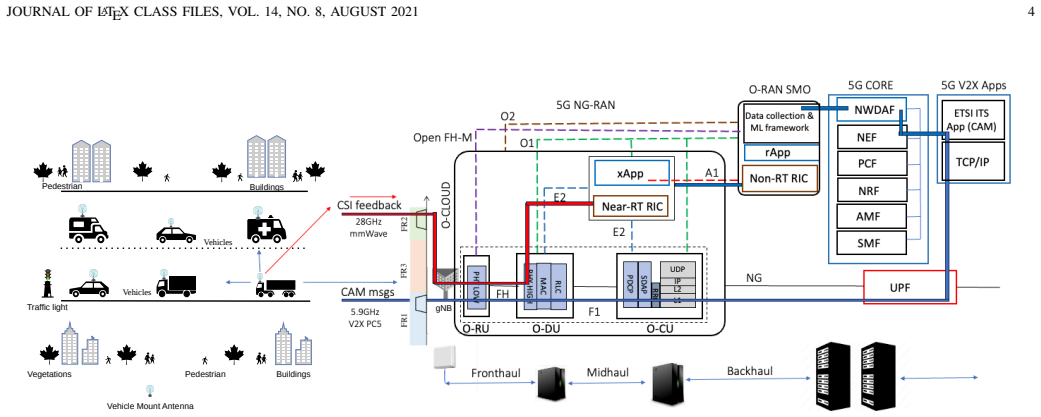
The load-bearing object is the CAM-to-CSI training pair: the gNB overhears Cooperative Awareness Messages (periodic 100 ms vehicle-status broadcasts over the 5.9 GHz sidelink), extracts five mobility features (x, y, z, speed, acceleration), and labels each snapshot with the concurrently measured mmWave CSI vector. This pairing lets the gNB build and refresh its own labeled dataset without any UE involvement, which in turn makes the whole prediction loop autonomous and self-trainable. The predictor itself is a single LSTM layer with 10 hidden units plus a fully connected output head producing 32 real values (the real/imaginary parts of 16 complex CSI coefficients); the LSTM carries temporal s
What would settle it
Take the same urban scenario and run the predictor with a percentage of CAM messages randomly dropped or delayed by more than 100 ms; if NMSE degrades sharply (e.g., doubles) under realistic loss rates, the autonomy claim fails in practice. More directly, a synthetic dataset in which vehicle mobility is random and uncorrelated with future channel state should drive the LSTM to near-chance prediction (NMSE close to 1), confirming that the result depends on the physical CAM–CSI relationship rather than on the architecture alone.
Extended reading notes
Core claim
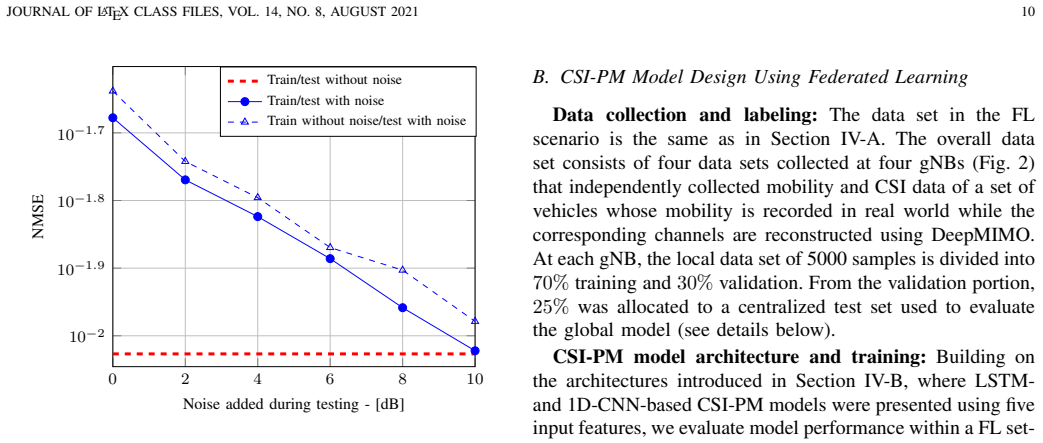
The paper claims that the position, speed, and acceleration found in C-V2X cooperative awareness messages are sufficient inputs for a lightweight LSTM to predict future mmWave CSI accurately enough for proactive beam management. Time-aligned CAM-CSI pairs (CSI split into real and imaginary parts and normalized) form the training set. A ten-hidden-unit LSTM over ten snapshots reaches NMSE 0.0094–0.018 across four base stations, and a federated version reaches 0.0165 on a centralized test set. The predictor also tolerates CSI noise above roughly 10 dB, stays below 0.012 NMSE at a one-second horizon on BS1, and scales to eight-antenna vehicles with little accuracy loss.
Load-bearing premise
The framework collapses if the gNB cannot reliably overhear complete, time-synchronized CAM messages from every vehicle in its cell, since both training labels and inference inputs depend on that stream; the paper assumes this delivery and does not model message loss, delay, or non-broadcasting vehicles.
Editorial extensions
If this is right
- Proactive beam switching becomes possible with no extra uplink feedback: the gNB needs only the CAM stream it already overhears, so beam management overhead and reaction time can both be reduced.
- A single lightweight model (about 2,100 parameters, ~12 microseconds inference) fits inside the near-real-time RIC constraints of O-RAN as an xApp, making deployment practical at the edge.
- Federated learning can produce a global CSI predictor across multiple gNBs (NMSE 0.0165) without sharing raw CSI or mobility data, which helps when individual sites have small or non-representative datasets.
- The predictor remains useful beyond the 100 ms baseline: NMSE stays below 0.012 for BS1 even at a 1 s prediction horizon, so longer-horizon resource management and handover planning become feasible.
- The framework generalizes to multi-antenna vehicles: scaling from 1 to 8 receive antennas raises NMSE by only ~0.0004 on BS1 while inference time stays under 14 microseconds.
Reading between the lines
- The paper explicitly leaves CAM delivery delay and loss out of scope; a realistic deployment where some vehicles do not broadcast CAMs or where messages arrive late would violate the time-alignment assumption, so an end-to-end test with a real sidelink protocol (or even a simple packet-loss model) would be the natural next experiment.
- Because the inputs are generic mobility features, the same framework should transfer to any source of timely vehicle state — e.g., onboard GPS reports via the network or roadside sensors — as long as the 100 ms cadence and the gNB's time-stamping are preserved.
- The reported NMSE numbers are on normalized complex CSI; an unstated but testable consequence is whether a beam-index or beam-angle prediction task would inherit the same accuracy, since beam decisions depend on quantized angles rather than raw complex channel vectors.
- The FL result suggests a path to a continuous self-updating network model: as CAM and CSI data accumulate, the O-RAN MLOps loop could retrain on a schedule, effectively turning the radio network into a self-tuning predictor that adapts to new street layouts or traffic patterns without manual labeling.
Editorial analysis
A structured set of objections, weighed in public.
Referee Report
Summary. The paper proposes an O-RAN-compliant framework for autonomous CSI prediction in 5G mmWave vehicular networks. A gNB collects time-aligned C-V2X CAM mobility data (position, speed, acceleration) and CSI feedback, then trains a lightweight LSTM predictor (with 1D-CNN and Transformer baselines) to output the next CSI vector from a 10-step CAM history. The framework is evaluated per-gNB and in a federated learning mode using the DeepMIMO Dynamic Doppler scenario with 5000 samples at 100 ms periodicity, four gNBs, a 4x4 BS array, and a single-antenna UE for the baseline. Reported NMSE values are 0.0094-0.018 per gNB and 0.0165 for the federated global model, along with complexity, latency, robustness, prediction-horizon, and multi-antenna scalability analyses.
Significance. If the reported accuracy were meaningful in a physical CSI sense, the framework would be a useful step toward proactive beam management with low-overhead, context-aware prediction, and the O-RAN MLOps discussion is a genuine strength. The paper also offers useful architecture comparisons, an FL implementation, and complexity/latency tables. The FL experiment using Flower and the explicit complexity models are transparent. However, the quantitative claims rest on an evaluation protocol that currently does not establish that the predicted quantities are usable physical CSI forecasts or that the model generalizes beyond interpolated training trajectories. The framework idea is sound and the issues are fixable, but the evaluation must be substantially reworked.
major comments (4)
- [Section IV-A, Eq. (3)] The per-sample min-max normalization makes the prediction target non-invertible. The model is trained to predict h_norm = (h - min(h))/(max(h)-min(h)), where min(h) and max(h) are sample-specific statistics of the future CSI vector. At inference, recovering physical h from h_norm requires knowing the future sample's min and max, which are exactly the unknown quantities. The reported NMSE in Eq. (4) and Tables V-VII is therefore computed in the normalized domain. In addition, subtracting the same scalar from both real and imaginary parts of every coefficient is not a complex rotation or scaling, so it changes relative phases and magnitudes across antennas; beam selection depends on the array response. Consequently, even low NMSE in this normalized space does not demonstrate that the output can drive beam switching. Please re-evaluate using a global/fixed normalization or predict the denor
- [Section IV-A, train/test split] The random 70/30 split of 5000 temporally adjacent samples, combined with the L=10 sliding-window construction, creates severe temporal leakage. A test sample at time t uses inputs at t-10,...,t-1; under a random split, many of those neighboring samples (and their targets) are also in the training set with high probability. Since DeepMIMO channel coefficients are deterministic functions of vehicle position (Eq. (1)), the model can effectively interpolate the CAM-to-CSI mapping for the same trajectories rather than forecast unseen channel evolution. This likely inflates the NMSE numbers in Table V and also affects the FL evaluation in Section IV-B. Please use a strict temporal split (e.g., a contiguous training prefix and test suffix, or held-out trajectories) and report results for vehicles and time intervals not seen during training.
- [Section II-B, Table I, Section IV-A] The target CSI vector is underspecified with respect to subcarriers. Section II-B defines the full channel H in C^{M x K} with K=240 OFDM subcarriers, but the model output is described as 2M=32 real values for the baseline N=1 UE configuration. It is unclear whether the predictor targets one representative subcarrier, a subset, or a compressed representation, and whether the same target is used for all K subcarriers. This ambiguity changes the meaning of the reported NMSE and affects reproducibility. Please clarify exactly which subcarriers form the prediction target and how the K dimension is handled.
- [Section II-A and Section III] The framework assumes the gNB overhears all CAM messages from surrounding vehicles and that CAM and CSI streams are perfectly time-aligned; Section III states that exact timing/delay analysis is out of scope. Because CAM loss, delay, or missing broadcasts affect both training labels and inference inputs, the reported accuracy presupposes an idealized C-V2X control plane. The abstract and conclusions claim realistic autonomous operation, so this assumption should either be relaxed in the claims or tested via a sensitivity analysis with respect to CAM drop rate and delivery delay.
minor comments (6)
- [Eq. (3)] Equation (3) is missing parentheses; it should read h_norm = (h - min(h))/(max(h)-min(h)).
- [Section II-C vs Section IV-A] Section II-C says the dataset contains 2000 temporal scenes, while Section IV-A and the FL section state 5000 samples. Please correct the inconsistency.
- [Section IV-B] The first sentence refers to 'architectures introduced in Section IV-B'; this should be Section IV-A.
- [Table VI] Please state whether the same trained weights are used for all prediction horizons or the model is retrained for each horizon. If the same weights are used, clarify how the input window is adjusted for longer horizons.
- [Fig. 6] The axis label says 'Noise added during testing', but the figure compares three scenarios with different training conditions. Clarify the label or caption to avoid confusion.
- [Reference [39]] The DeepMIMO DD1 scenario citation should include the exact version/release and generation parameters to support reproducibility.
Circularity Check
Per-sample min-max normalization makes the reported 'CSI prediction' a non-invertible normalized target, and the random 70/30 split turns the evaluation into interpolation of the fitted mapping.
-
self definitional
[Section IV-A, Eq. (3); Eq. (4); Tables V-VII]
"The resulting CSI vectors are normalized using min-max normalization: hnorm = h−min(h) max(h)−min(h) , (3) ... This normalization maps CSI vectors into the [0,1] interval ... training is performed using the Normalized Mean Squared Error (NMSE) loss function: NMSE= E[||ĥ−h||22]/E[||h||22] , (4)"
Equation (3) defines the prediction target using the true future sample's own min(h) and max(h). The model therefore outputs h_norm, not the physical CSI h; recovering h at inference would require the unknown future sample's min and max, i.e. exactly the quantity being predicted. The NMSE reported in Tables V-VII is computed on this sample-dependent normalized transform, which is not invertible. Thus the claimed 'accurate CSI prediction' reduces by construction to predicting a normalized vector that cannot be converted back to the CSI needed for beam management.
-
fitted input called prediction
[Section IV-A, data collection/training and inference paragraphs]
"The dataset consists of 5000 periodically sampled temporal scenes containing vehicle location (x, y, z coordinates), speed, and acceleration recorded with periodicity ∆τ = 100 ms ... training is conducted on 70% of the samples from each of the four datasets ... We evaluate the CSI-PM model inference on the remaining 30% samples."
The 5000 samples come from continuous real-vehicle trajectories sampled every 100 ms, and Eq. (1) makes CSI a deterministic function of the vehicle position. A random 70/30 split interleaves adjacent temporal samples between training and test, so the LSTM's 10-step input windows of test samples substantially overlap training windows and the test targets are near-copies of training targets. The reported NMSE therefore measures interpolation of the fitted CAM-to-CSI mapping rather than forecasting of unseen conditions, making the 'prediction' statistically forced by the training set.
full rationale
The O-RAN/MLOps contribution is not circular: the proposed architecture is described independently, and there is no load-bearing self-citation — the conference version [35] is only used to contrast the new evaluation, while DeepMIMO [34], Flower [51], and FedAvg [52] are external, reproducible tools. The paper is not simply re-labeling a known result or importing a uniqueness theorem from its own authors. However, the central quantitative claim is compromised by construction. Eq. (3) normalizes each CSI target by that sample's own min/max; because inverting the normalization requires the unknown future sample's min/max, the model is predicting a sample-dependent normalized vector and the reported NMSE is not a metric of physical CSI prediction. This is a by-construction identification failure, not a mere benchmark weakness. In addition, the 70/30 random split over 100 ms samples of continuous trajectories makes the evaluation largely interpolation, further inflating the NMSE numbers. Taken together, the headline accuracy claims reduce partly to the fitting setup rather than to a demonstrated forecast of unseen CSI.
Assumptions & free parameters
free parameters (6)
- LSTM hidden units H =
10
- Input sequence length L =
10
- Training hyperparameters (learning rate, beta1, beta2, batch size) =
0.00005, 0.9, 0.99, 64
- 1D-CNN and Transformer hyperparameters =
1D-CNN: 64 filters, kernel 3; Transformer: d_model=32, 2 layers, 4 heads, ff_dim=64
- FL configuration =
4 clients, 20 rounds, 10 local epochs
- CAM broadcast period Δτ =
100 ms
assumptions (5)
- domain assumption Each gNB overhears all CAM messages from surrounding vehicles via Rel. 16 C-V2X PC5 at 5.9 GHz.
- domain assumption DeepMIMO ray-tracing with 5 paths at 28 GHz is a faithful proxy for real mmWave vehicular channels.
- domain assumption Full unquantized CSI is available at the gNB.
- ad hoc to paper Temporal samples are independent enough for a random 70/30 split.
- domain assumption NMSE computed on min-max normalized CSI vectors is a meaningful accuracy metric.
Cite this review
Pith. "Pith review of Autonomous CSI Prediction Framework for O-RAN-Enabled 5G mmWave Vehicular Networks." pith.science (2026). https://pith.science/paper/CUMYHVRZ
@misc{pith2026260721963,
  author       = {Pith},
  title        = {Pith review of: Autonomous CSI Prediction Framework for O-RAN-Enabled 5G mmWave Vehicular Networks},
  year         = {2026},
  howpublished = {\url{https://pith.science/paper/CUMYHVRZ}},
  note         = {Machine review of arXiv:2607.21963}
}
read the original abstract
Establishing and maintaining 5G mmWave vehicular connectivity poses a challenge due to high user mobility, requiring the design of robust and efficient beam switching procedures. Unlike reactive beam switching based on channel state information (CSI) feedback received from vehicular users, proactive beam switching exploits CSI prediction to prepare in advance for upcoming beam switching decisions. In this paper, we develop a framework for autonomous and self-trainable CSI prediction for mmWave vehicular users. In the proposed framework, base stations (gNBs) collect and label data sets to train a CSI prediction model both independently and using federated learning (FL). The data set combines data extracted from the CSI feedback and cellular vehicle-to-everything (C-V2X) cooperative awareness messages (CAMs) of surrounding vehicles. The framework is placed in the context of machine learning and artificial intelligence (ML/AI)-based Open RAN (O-RAN) applications (rApps and xApps) fed by realistic real-world mobility and CSI data from the DeepMIMO simulator. Detailed evaluation results demonstrate feasibility, accuracy, and flexibility of the proposed CSI prediction framework
Figures


Figures from the paper (3 more)


Reference graph
Works this paper leans on
-
[1]
Millimeter-Wave Beamforming as an Enabling Technology for 5G Cellular Communications: Theoretical Feasibility and Prototype Results,
W. Roh, J.-Y . Seol, J. Park, B. Lee, J. Lee, Y . Kim, J. Cho, K. Cheun, and F. Aryanfar, “Millimeter-Wave Beamforming as an Enabling Technology for 5G Cellular Communications: Theoretical Feasibility and Prototype Results,”IEEE Commun. Mag., vol. 52, no. 2, pp. 106–113, 2014
2014
-
[2]
Millimeter Wave Mobile Communications for 5G Cellular: It Will Work!
T. S. Rappaport, S. Sun, R. Mayzus, H. Zhao, Y . Azar, K. Wang, G. N. Wong, J. K. Schulz, M. Samimi, and F. Gutierrez, “Millimeter Wave Mobile Communications for 5G Cellular: It Will Work!”IEEE Access, vol. 1, pp. 335–349, 2013
2013
-
[3]
Massive MIMO Evolution Toward 3GPP Release 18,
H. Jin, K. Liu, M. Zhang, L. Zhang, G. Lee, E. N. Farag, D. Zhu, E. Onggosanusi, M. Shafi, and H. Tataria, “Massive MIMO Evolution Toward 3GPP Release 18,”IEEE J. Sel. Areas Commun., vol. 41, no. 6, pp. 1635–1654, 2023. JOURNAL OF LATEX CLASS FILES, VOL. 14, NO. 8, AUGUST 2021 12
2023
-
[4]
A Tutorial on Beam Management for 3GPP NR at mmWave Frequencies,
M. Giordani, M. Polese, A. Roy, D. Castor, and M. Zorzi, “A Tutorial on Beam Management for 3GPP NR at mmWave Frequencies,”IEEE Commun. Surveys Tuts., vol. 21, no. 1, pp. 173–196, 2019
2019
-
[5]
Enescu,5G New Radio: A beam-based air interface
M. Enescu,5G New Radio: A beam-based air interface. John Wiley & Sons, 2020
2020
-
[6]
3GPP Release 18 MIMO Enhancements: Channel State Information for Higher Speed Scenarios,
L. Su ´arez, R. Kovalchukov, E. Visotsky, and F. Tosato, “3GPP Release 18 MIMO Enhancements: Channel State Information for Higher Speed Scenarios,” inProc. 2023 15th Int. Congr. Ultra Mod. Telecommun. Control Syst. Workshops (ICUMT), 2023, pp. 250–256
2023
-
[7]
A Novel Mobility Induced Channel Prediction Mechanism for Vehicular Communications,
F. Peng, S. Zhang, Z. Jiang, X. Wang, and W. Chen, “A Novel Mobility Induced Channel Prediction Mechanism for Vehicular Communications,” IEEE Trans. Wireless Commun., vol. 22, no. 5, pp. 3488–3502, 2023
2023
-
[8]
Channel Prediction for Millimeter Wave MIMO-OFDM Communications in Rapidly Time-Varying Frequency- Selective Fading Channels,
C. Lv, J.-C. Lin, and Z. Yang, “Channel Prediction for Millimeter Wave MIMO-OFDM Communications in Rapidly Time-Varying Frequency- Selective Fading Channels,”IEEE Access, vol. 7, pp. 15 183–15 195, 2019
2019
Show all 54 references
-
[9]
Deep Learning Based Predictive Beamforming Design,
J. Zhang, G. Zheng, Y . Zhang, I. Krikidis, and K.-K. Wong, “Deep Learning Based Predictive Beamforming Design,”IEEE Trans. Veh. Technol., vol. 72, no. 6, pp. 8122–8127, 2023
2023
-
[10]
Deep Rein- forcement Learning Based End-to-End Multiuser Channel Prediction and Beamforming,
M. Chu, A. Liu, V . K. N. Lau, C. Jiang, and T. Yang, “Deep Rein- forcement Learning Based End-to-End Multiuser Channel Prediction and Beamforming,”IEEE Trans. Wireless Commun., vol. 21, no. 12, pp. 10 271–10 285, 2022
2022
-
[11]
Deep Learning-Based mmWave Beam Selection for 5G NR/6G With Sub-6 GHz Channel Information: Algorithms and Prototype Validation,
M. S. Sim, Y .-G. Lim, S. H. Park, L. Dai, and C.-B. Chae, “Deep Learning-Based mmWave Beam Selection for 5G NR/6G With Sub-6 GHz Channel Information: Algorithms and Prototype Validation,”IEEE Access, vol. 8, pp. 51 634–51 646, 2020
2020
-
[12]
Channel Prediction Strategy for 3GPP Release 18 Enhanced Type-II Doppler Codebook,
L. Berrah, R. Visoz, and D. Le Ruyet, “Channel Prediction Strategy for 3GPP Release 18 Enhanced Type-II Doppler Codebook,” inProc. 2024 20th Int. Conf. on Wireless and Mobile Comput., Netw. and Commun. (WiMob), 2024, pp. 489–495
2024
-
[13]
Channel Estimation Techniques for Millimeter-Wave Communication Systems: Achievements and Challenges,
K. Hassan, M. Masarra, M. Zwingelstein, and I. Dayoub, “Channel Estimation Techniques for Millimeter-Wave Communication Systems: Achievements and Challenges,”IEEE Open J. Commun. Soc., vol. 1, pp. 1336–1363, 2020
2020
-
[14]
Deep learning-based channel quality indicators prediction for vehicular communication,
J. Kim and D. S. Han, “Deep learning-based channel quality indicators prediction for vehicular communication,”ICT Express, vol. 9, no. 1, pp. 116–121, 2023
2023
-
[15]
Machine learning-based channel prediction in massive MIMO with channel aging,
J. Yuan, H. Q. Ngo, and M. Matthaiou, “Machine learning-based channel prediction in massive MIMO with channel aging,”IEEE Trans. Wireless Commun., vol. 19, no. 5, pp. 2960–2973, 2020
2020
-
[16]
Measurement-Based Prediction of mmWave Channel Parameters Using Deep Learning and Point Cloud,
H. Mi, B. Ai, R. He, A. Bodi, R. Caromi, J. Wang, J. Senic, C. Gentile, and Y . Miao, “Measurement-Based Prediction of mmWave Channel Parameters Using Deep Learning and Point Cloud,”IEEE Open. J. Veh. Technol., vol. 5, pp. 1059–1072, 2024
2024
-
[17]
Deep Learning-Based Channel Prediction With Path Extraction,
M. Meliha, P. Charg ´e, Y . Wang, S. E. Bouzid, C. Henry, C. Bourny, H. Tomaz, and Y . Chen, “Deep Learning-Based Channel Prediction With Path Extraction,”IEEE Wireless Commun. Lett., vol. 14, no. 3, pp. 891– 895, 2025
2025
-
[18]
Sparse Channel Estimation and Hybrid Precoding Using Deep Learning for Millimeter Wave Massive MIMO,
W. Ma, C. Qi, Z. Zhang, and J. Cheng, “Sparse Channel Estimation and Hybrid Precoding Using Deep Learning for Millimeter Wave Massive MIMO,”IEEE Trans. Commun., vol. 68, no. 5, pp. 2838–2849, 2020
2020
-
[19]
Two New Approaches to Channel Prediction Based on Sinusoidal Modelling,
M. Chen, M. Viberg, and T. Ekman, “Two New Approaches to Channel Prediction Based on Sinusoidal Modelling,” inProc. IEEE/SP 13th Workshop Stat. Signal Process., 2005, pp. 697–700
2005
-
[20]
Channel Prediction Using Ordinary Differential Equations for MIMO Systems,
L. Wang, G. Liu, J. Xue, and K.-K. Wong, “Channel Prediction Using Ordinary Differential Equations for MIMO Systems,”IEEE Trans. Veh. Technol., vol. 72, no. 2, pp. 2111–2119, 2023
2023
-
[21]
Transformer Network Based Channel Prediction for CSI Feedback En- hancement in AI-Native Air Interface,
T. Zhou, X. Liu, Z. Xiang, H. Zhang, B. Ai, L. Liu, and X. Jing, “Transformer Network Based Channel Prediction for CSI Feedback En- hancement in AI-Native Air Interface,”IEEE Trans. Wireless Commun., vol. 23, no. 9, pp. 11 154–11 167, 2024
2024
-
[22]
Channel Prediction in High-Mobility Massive MIMO: From Spatio-Temporal Autoregression to Deep Learning,
C. Wu, X. Yi, Y . Zhu, W. Wang, L. You, and X. Gao, “Channel Prediction in High-Mobility Massive MIMO: From Spatio-Temporal Autoregression to Deep Learning,”IEEE J. Sel. Areas Commun., vol. 39, no. 7, pp. 1915–1930, 2021
1915
-
[23]
Channel State Informa- tion Prediction for 5G Wireless Communications: A Deep Learning Approach,
C. Luo, J. Ji, Q. Wang, X. Chen, and P. Li, “Channel State Informa- tion Prediction for 5G Wireless Communications: A Deep Learning Approach,”IEEE Trans. Netw. Sci. Eng., vol. 7, no. 1, pp. 227–236, 2020
2020
-
[24]
Deep Learning for Fading Channel Prediction,
W. Jiang and H. D. Schotten, “Deep Learning for Fading Channel Prediction,”IEEE Open J. Commun. Soc., vol. 1, pp. 320–332, 2020
2020
-
[25]
Deep Learning-Based Path Loss Prediction for Fifth-Generation New Radio Vehicle Communica- tions,
S. Sung, W. Choi, H. Kim, and J.-I. Jung, “Deep Learning-Based Path Loss Prediction for Fifth-Generation New Radio Vehicle Communica- tions,”IEEE Access, vol. 11, pp. 75 295–75 310, 2023
2023
-
[26]
Deep Channel Prediction: A DNN Framework for Receiver Design in Time-Varying Fading Channels,
S. R. Mattu, L. N. Theagarajan, and A. Chockalingam, “Deep Channel Prediction: A DNN Framework for Receiver Design in Time-Varying Fading Channels,”IEEE Trans. Veh. Technol., vol. 71, no. 6, pp. 6439– 6453, 2022
2022
-
[27]
A Low- Complexity Machine Learning Design for mmWave Beam Prediction,
M. Q. Khan, A. Gaber, M. Parvini, P. Schulz, and G. Fettweis, “A Low- Complexity Machine Learning Design for mmWave Beam Prediction,” IEEE Wireless Commun. Lett., vol. 13, no. 6, pp. 1551–1555, 2024
2024
-
[28]
CSI Transfer From Sub-6G to mmWave: Reduced-Overhead Multi-User Hybrid Beamforming,
W. Deng, M. Li, M.-M. Zhao, M.-J. Zhao, and O. Simeone, “CSI Transfer From Sub-6G to mmWave: Reduced-Overhead Multi-User Hybrid Beamforming,”IEEE J. Sel. Areas Commun., vol. 43, no. 3, pp. 973–987, 2025
2025
-
[29]
Energy Consumption of Machine Learning Enhanced Open RAN: A Comprehensive Review,
X. Liang, Q. Wang, A. Al-Tahmeesschi, S. B. Chetty, D. Grace, and H. Ahmadi, “Energy Consumption of Machine Learning Enhanced Open RAN: A Comprehensive Review,”IEEE Access, vol. 12, pp. 81 889– 81 910, 2024
2024
-
[30]
O-RAN ALLIANCE Specifications: WG1 – Use Cases and Overall Architecture Workgroup,
O-RAN Alliance, “O-RAN ALLIANCE Specifications: WG1 – Use Cases and Overall Architecture Workgroup,” Online, Apr. 2025, accessed: 2025-04-10. [Online]. Available: https://specifications.o-ran. org/specifications
2025
-
[31]
Un- derstanding O-RAN: Architecture, Interfaces, Algorithms, Security, and Research Challenges,
M. Polese, L. Bonati, S. D’Oro, S. Basagni, and T. Melodia, “Un- derstanding O-RAN: Architecture, Interfaces, Algorithms, Security, and Research Challenges,”IEEE Commun. Surveys Tuts., vol. 25, no. 2, pp. 1376–1411, 2023
2023
-
[32]
Managing O-RAN Networks: xApp Development From Zero to Hero,
J. F. Santos, A. Huff, D. Campos, K. V . Cardoso, C. B. Both, and L. A. DaSilva, “Managing O-RAN Networks: xApp Development From Zero to Hero,”IEEE Commun. Surveys Tuts., vol. 28, pp. 800–840, 2026
2026
-
[33]
On the Design of Sidelink for Cellular V2X: A Literature Review and Outlook for Future,
A. Bazzi, A. O. Berthet, C. Campolo, B. M. Masini, A. Molinaro, and A. Zanella, “On the Design of Sidelink for Cellular V2X: A Literature Review and Outlook for Future,”IEEE Access, vol. 9, pp. 97 953–97 980, 2021
2021
-
[34]
DeepMIMO: A Generic Deep Learning Dataset for Millimeter Wave and Massive MIMO Applications,
A. Alkhateeb, “DeepMIMO: A Generic Deep Learning Dataset for Millimeter Wave and Massive MIMO Applications,” inProc. of Inf. Theory and Appl. Workshop (ITA), San Diego, CA, Feb 2019, pp. 1–8
2019
-
[35]
Autonomous Self-Trained Channel State Prediction Method for mmWave Vehicular Communications,
A. Orimogunje, V . Ninkovic, E. Twahirwa, G. Gashema, and D. Vuko- bratovic, “Autonomous Self-Trained Channel State Prediction Method for mmWave Vehicular Communications,” inProc. 29th Eur. Wireless Conf. (EW), 2024, pp. 72–76
2024
-
[36]
Sub-6GHz Assisted MAC for Millimeter Wave Vehicular Communications,
B. Coll-Perales, J. Gozalvez, and M. Gruteser, “Sub-6GHz Assisted MAC for Millimeter Wave Vehicular Communications,”IEEE Commun. Mag., vol. 57, no. 3, pp. 125–131, 2019
2019
-
[37]
C-V2X Assisted mmWave V2V Scheduling,
A. Molina-Galan, B. Coll-Perales, and J. Gozalvez, “C-V2X Assisted mmWave V2V Scheduling,” inProc. 2019 IEEE 2nd Connected Autom. Veh. Symp. (CAVS), 2019, pp. 1–5
2019
-
[38]
Low Profile Dual-Band Shared Aperture Array for Vehicle-to-Vehicle Communication,
S. R. Govindarajulu, R. Hokayem, M. N. A. Tarek, M. R. Guerra, and E. A. Alwan, “Low Profile Dual-Band Shared Aperture Array for Vehicle-to-Vehicle Communication,”IEEE Access, vol. 9, pp. 147 082– 147 090, 2021
2021
-
[39]
DeepMIMO Scenario: Dy- namic Doppler (DD1),
Wireless Intelligence Lab, “DeepMIMO Scenario: Dy- namic Doppler (DD1),” Online, Oct. 2024, accessed: 2024- 10-16. [Online]. Available: https://www.deepmimo.net/scenarios/ dynamic-doppler-dd1/
2024
-
[40]
3GPP Evolution from 5G to 6G: A 10-Year Retrospective,
X. Lin, “3GPP Evolution from 5G to 6G: A 10-Year Retrospective,” arXiv preprint arXiv:2412.21077, 2024
2024 arXiv
-
[41]
Embracing AI in 5G- Advanced Toward 6G: A Joint 3GPP and O-RAN Perspective,
X. Lin, L. Kundu, C. Dick, and S. Velayutham, “Embracing AI in 5G- Advanced Toward 6G: A Joint 3GPP and O-RAN Perspective,”IEEE Commun. Stand. Mag., vol. 7, no. 4, pp. 76–83, 2023
2023
-
[42]
5G NR Positioning with OpenAirInterface: Tools and Methodologies,
R. Mundlamuri, R. Gangula, F. Kaltenberger, and R. Knopp, “5G NR Positioning with OpenAirInterface: Tools and Methodologies,” inProc. 2025 20th Wireless On-Demand Netw. Syst. Serv. Conf. (WONS), 2025, pp. 1–7
2025
-
[43]
O-RAN: Analysis of Latency-Critical Interfaces and Overview of Time Sensitive Networking Solutions,
E. Municio, G. Garcia-Aviles, A. Garcia-Saavedra, and X. Costa-P ´erez, “O-RAN: Analysis of Latency-Critical Interfaces and Overview of Time Sensitive Networking Solutions,”IEEE Commun. Stand. Mag., vol. 7, no. 3, pp. 82–89, 2023
2023
-
[44]
Viewing Channel as Sequence Rather Than Image: A 2-D Seq2Seq Approach for Efficient MIMO-OFDM CSI Feedback,
Z. Chen, Z. Zhang, Z. Xiao, Z. Yang, and K.-K. Wong, “Viewing Channel as Sequence Rather Than Image: A 2-D Seq2Seq Approach for Efficient MIMO-OFDM CSI Feedback,”IEEE Trans. Wireless Com- mun., vol. 22, no. 11, pp. 7393–7407, 2023
2023
-
[45]
Spatio-Temporal Representation With Deep Neural Recurrent Network in MIMO CSI Feedback,
X. Li and H. Wu, “Spatio-Temporal Representation With Deep Neural Recurrent Network in MIMO CSI Feedback,”IEEE Wireless Commun. Lett., vol. 9, no. 5, pp. 653–657, 2020
2020
-
[46]
LSTM: A Search Space Odyssey,
K. Greff, R. K. Srivastava, J. Koutn ´ık, B. R. Steunebrink, and J. Schmid- huber, “LSTM: A Search Space Odyssey,”IEEE Trans. Neural Netw. Learn. Syst., vol. 28, no. 10, pp. 2222–2232, 2017
2017
-
[47]
A Comparison of Neural Networks for Wireless Channel Prediction,
O. Stenhammar, G. Fodor, and C. Fischione, “A Comparison of Neural Networks for Wireless Channel Prediction,”IEEE Wireless Commun., vol. 31, no. 3, pp. 235–241, 2024
2024
-
[48]
State-of-the-Art in 1D Convolutional Neural Networks: A Survey,
A. O. Ige and M. Sibiya, “State-of-the-Art in 1D Convolutional Neural Networks: A Survey,”IEEE Access, vol. 12, pp. 144 082–144 105, 2024. JOURNAL OF LATEX CLASS FILES, VOL. 14, NO. 8, AUGUST 2021 13
2024
-
[49]
A Review of Applications in Federated Learning,
L. Li, Y . Fan, M. Tse, and K.-Y . Lin, “A Review of Applications in Federated Learning,”Comput. Ind. Eng., vol. 149, p. 106854, 2020
2020
-
[50]
Federated learning: Applications, challenges and future directions,
S. Bharati, M. R. H. Mondal, P. Podder, and V . S. Prasath, “Federated learning: Applications, challenges and future directions,”Int. Journal of Hybrid Intell. Syst., vol. 18, no. 1-2, pp. 19–35, 2022
2022
-
[51]
Flower: A Friendly Federated Learning Research Framework,
D. J. Beutel, T. Topal, A. Mathur, X. Qiu, J. Fernandez-Marques, Y . Gao, L. Sani, K. H. Li, T. Parcollet, P. P. B. de Gusm ˜aoet al., “Flower: A Friendly Federated Learning Research Framework,”arXiv preprint arXiv:2007.14390, 2020
2007 arXiv
-
[52]
Communication-Efficient Learning of Deep Networks from Decentral- ized Data,
B. McMahan, E. Moore, D. Ramage, S. Hampson, and B. A. y Arcas, “Communication-Efficient Learning of Deep Networks from Decentral- ized Data,” inProc. 20th Int. Conf. Artif. Intell. Stat.PMLR, 2017, pp. 1273–1282
2017
-
[53]
Personalized Federated Learning with Moreau Envelopes,
C. T. Dinh, N. Tran, and J. Nguyen, “Personalized Federated Learning with Moreau Envelopes,” inProc. Adv. Neural Inf. Process. Syst. (NeurIPS), 2020, pp. 21 394–21 405
2020
-
[54]
Byzantine-Resilient Decentralized Stochastic Optimization With Robust Aggregation Rules,
Z. Wu, T. Chen, and Q. Ling, “Byzantine-Resilient Decentralized Stochastic Optimization With Robust Aggregation Rules,”IEEE Trans. Signal Process., vol. 71, pp. 3179–3195, 2023
2023
Reviewed August 1, 2026 · model on record in the stance chip above.
Discussion (0). Sign in to comment.