REVIEW 1 major objections 5 minor 12 references
Simulating Stress Laws under Extremal Dependence: Characterizing What Generative Models Must Preserve
T0 review · 1 major / 5 minor · reviewed 2026-08-15 · deepseek-v4-flash
Pith's one-line read One tail measure decides which stress simulations are valid
desk verdict Solid theorem with a real scope caveat: the sharp characterization depends on strict positivity of the tail density, a regime that excludes asymptotic independence and is under-flagged in the headline. read the letter →
The pith
A machine-rendered reading of the paper's core claim, the machinery that carries it, and where it could break.
The reading
What carries the argument
The engine is the polar factorization of the heavy tail: radius and direction separate, so the tail law takes the form $d\nu^*(r,\phi) = r^{-(s+1)} \varphi^*(\phi)\,dr\,d\phi$ -- a Pareto radial component with index $s$ coupled to an angular density $\varphi^*$ that encodes extremal dependence. The key mechanism is $M_0$-convergence of scaled tail measures (convergence on sets bounded away from the origin), which turns rare joint-stress events into fixed limiting regions $S^*(J)$ and lets the paper prove that equality of $\nu^*$ is both necessary and sufficient. SSGEN operationalizes this by splicing the empirical body to a Pareto radial law paired with an angular law learned from intermediate exceedances; the construction is self-similar in the tail, so a threshold $t(u)=u^\theta$ with $\theta\in(0,1)$ extrapolates to stress levels whose events are effectively unobserved.
What would settle it
Take the two angular laws $H_{-1}$ and $H_{+1}$ from the paper's matched-marginals example (identical marginal and pairwise tail coefficients, different higher-order angular mass) and compute, for large $u$, the ratio of the joint-stress probabilities $P(\min_i \xi_i \ge u)$ under the two laws; Proposition 1 predicts some regular loss system must separate them at first order, so this ratio cannot tend to 1. If a sufficiently precise simulation shows the ratio approaching 1, the necessity half of the sharp characterization is wrong.
Extended reading notes
Core claim
The central discovery is a sharp characterization (Proposition 1): under density-level regular variation, a family of approximations $\{\xi_u\}$ is tail-preserving exactly when its scaled measures satisfy $u^s P(u^{-1}\xi_u \in \cdot) \xrightarrow{M_0} \nu^*$, where $\nu^*$ is the limiting tail measure with polar form $d\nu^*(r,\phi) = r^{-(s+1)} \varphi^*(\phi)\,dr\,d\phi$. This equality is necessary and sufficient for first-order accuracy of $P(\xi_u \in S(u;J)) \sim P(\xi \in S(u;J))$ for every regular asymptotically homogeneous multi-loss system and every nonempty $J$. The same measure governs the limiting scaled conditional laws $\mathrm{Law}(u^{-1}\xi \mid \xi \in S(u;J))$, and its density $\varphi^*$ governs reverse-stress optimization, whose maximizers identify the most plausible stress configurations. Consequently, preserving $\nu^*$ is the sharp first-order criterion for stress-law validity: misspecifying extremal dependence distorts some regular joint-stress probability, and no marginal-tail or pairwise calibration can substitute for the full angular tail law.
Load-bearing premise
The risk-factor density must settle, uniformly in every direction, to a fixed power-law limit with a strictly positive limiting density; if that uniform density-level regular-variation condition fails, the polar form of the tail measure and every theorem built on it can break down.
Editorial extensions
If this is right
- Any generative architecture -- kernel density, normalizing flow, GAN, or diffusion model -- that produces a tail measure equal to $\nu^*$ automatically recovers first-order probabilities of every regular joint-stress event and the corresponding scaled conditional laws.
- Matching only marginal tails or pairwise tail-dependence coefficients is provably insufficient: for any such misspecification there exists a regular multi-loss system whose joint-stress probability is distorted at first order.
- Reverse stress testing transfers: any density-preserving generator, including SSGEN, has the property that its most-plausible stress configurations converge to the true limiting maximizers of $\varphi^*$ on $S^*(J)$; if multiple maximizers exist, every selected configuration attains the same limiting likelihood.
- SSGEN trained on $n^{1-q}$ intermediate exceedances achieves total-variation rate $O_P(n^{-(1-q)(m\wedge\ell)} + n^{-q\gamma/s})$ for the generated conditional law at target event probabilities of order $n^{-r}$, $r\ge 1$, and the same rate transfers losslessly to all measurable stress summaries.
- The balancing threshold $q^* = s(m\wedge\ell)/(\gamma + s(m\wedge\ell))$ makes the tradeoff between statistical learning error and finite-threshold bias explicit, giving the oracle rate $n^{-\gamma(m\wedge\ell)/(\gamma+s(m\wedge\ell))}$.
Reading between the lines
- If the sharp criterion holds, stress-test regulation could be reframed around a single audit object: instead of validating many scenario-specific loss functionals, supervisors could compare a bank's internal model to the benchmark limiting tail measure estimated from market data.
- Because the angular-learning step is modular, a practical model-selection rule for heavy-tailed generators suggests itself: choose the angular estimator with the best total-variation rate, since the validity guarantee reduces to that rate plus the radial tail-index rate.
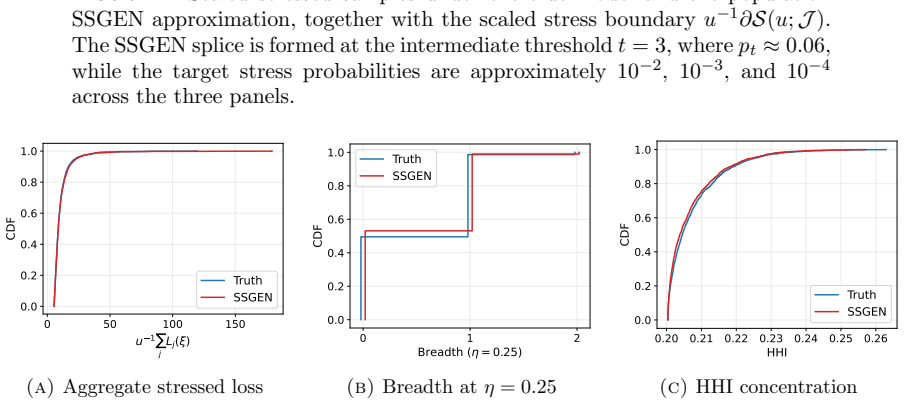
- The matched-marginals construction implies that standard practice of calibrating to pairwise tail dependence can silently miss systemic breadth; a natural testable extension is to benchmark generators on the probability of broad distress under aggregate stress, which depends on higher-order angular structure.
- The reverse-stress transfer principle may generalize beyond likelihood maximization to other plausibility criteria, such as entropic distance, where the limiting objective would be a different functional of the tail density and the same perturbation argument could apply.
Signed reviews
Editorial analysis
A structured set of objections, weighed in public.
Referee Report
Summary. This paper develops a validity criterion for stress-scenario generators of multivariate heavy-tailed risk factors. Under a density-level regular variation assumption (Assumption 1, Eq. (3)), it defines the limiting tail measure ν* and calls a family ξ_u tail-preserving when the scaled measures u^s P(u^{-1}ξ_u ∈ ·) converge to ν* in M0. Proposition 1 asserts that tail preservation is necessary and sufficient for first-order agreement of probabilities P(ξ_u ∈ S(u;J)) and P(ξ ∈ S(u;J)) for all regular asymptotically homogeneous multi-loss systems, and Corollary 1 transfers this to scaled conditional laws. The paper then introduces SSGEN, which splices the empirical body with a Pareto radial component and a finite-threshold angular law learned from intermediate exceedances, and proves population tail preservation, data-driven total-variation rates, and reverse-stress solution rates under learner-agnostic assumptions. Numerical experiments on reinsurance networks compare SSGEN with direct empirical conditioning and t-copula benchmarks. The appendix contains detailed proofs of the main results.
Significance. If the characterization holds, the paper reduces the validation of generative stress models to a clean, testable criterion: preserve the limiting tail measure ν*. The SSGEN construction is architecture-agnostic, with explicit polynomial rates and an oracle tradeoff between threshold depth and estimation error. The matched-marginals example in Appendix C is a valuable demonstration that marginal and pairwise tail calibration do not determine the law of breadth under aggregate stress, strengthening the case for targeting the full angular law. The reverse-stress transfer principle and the data-driven rates for solution sets are substantial additions over the conference version. The proofs are detailed and use standard tools (M0-convergence, epi-convergence, conditioning lemmas, normalization bounds), and I found no fatal gap in the derivations under the stated assumptions.
major comments (1)
- [Section 3.1 (Proposition 1), Eq. (3), and the abstract] The headline claim that equality of limiting tail measures is necessary and sufficient for first-order stress-law accuracy is load-bearing but is proved only under Assumption 1, whose strict positivity φ*(z) > 0 on E\{0} is used throughout (e.g., Lemma 1(ii), Lemma 5, and the lower-bound arguments in the proof of Proposition 1). Strict positivity rules out asymptotic independence and unequal marginal tail indices, regimes in which ν* is supported on a lower-dimensional set and joint events such as {ξ_1 > u, ξ_2 > u} can have probability of order smaller than u^{-s}, governed by hidden regular variation. Two generative families can then share the same ν* but produce different constants, or even different orders, for such joint-stress probabilities. The paper acknowledges that main results are stated under Assumption 1, but the abstract and Proposition 1 present the characterization without this qualification, creating a real correctness risk for practitioners applying the criterion to asymptotically independent heavy-tailed data. The manuscript should explicitly qualify the necessity/sufficiency claim as conditional on the density-level regular variation with positive limiting density, and add a remark or appendix example discussing hidden regular variation and why the criterion does not extend to that regime.
minor comments (5)
- [Section 6.1] For the 'Naive' benchmark, replications with no observations in the target stress region are treated as undefined and dropped; the reported medians are therefore conditional on the estimator being defined. Please report the fraction of defined replications at each β and interpret the box plots accordingly, since this selection can bias the comparison.
- [Section 6.1] The MVT benchmark is described only as a fitted t-copula with marginal models; please specify the marginal estimation method, the degrees-of-freedom estimation, and the choice of calibration so that the comparison is reproducible.
- [Section 6.2 / Algorithm 2] The KDE-based mode-finding uses sequential quadratic programming over Γ_u(J); please describe the initialization and any multi-start strategy, since the KDE objective can be multimodal and the reported solution error depends on these choices.
- [Section 5.2 (Lemma 8, Eq. (17))] The sup-norm angular condition (17) is introduced inside Lemma 8 and then used in Theorem 4; it should be stated as a numbered assumption before Section 5.2 so that Table 1's reference to (17) is self-contained.
- [Section 5.1] The abstract says the method works even when the target event is absent from the sample; the theorem actually covers the regime where the expected number of target observations is constant for r=1 and vanishing for r>1. A sentence clarifying this distinction in Section 5.1 would avoid overstatement.
Circularity Check
No significant circularity: the tail-measure validity criterion is derived from standard regular-variation hypotheses, and the paper's self-citation is only used for positioning, not as load-bearing evidence.
full rationale
The paper's central claim is that equality of limiting tail measures is necessary and sufficient for first-order accuracy of rare joint-stress probabilities and associated conditional laws. Definition 3 merely names this property as 'tail-preserving'; the substantive content is in Proposition 1, which proves both directions against the external benchmark of M0-convergence and continuous convergence of asymptotically homogeneous loss functionals. The forward direction is a direct consequence of the defining convergence, while the converse is nontrivial and is proved by constructing a separating loss functional via Lemma 12; neither direction fits a parameter or target quantity and then re-derives it. The SSGEN construction is an explicit algorithm whose population-level validity is proven in Theorem 1 from Assumption 1 and the polar density representation, not assumed by citation. The data-driven rates in Theorem 3 and Corollary 3 are upper bounds conditional on transparent estimation and second-order assumptions; no fitted constant is renamed as a prediction. The only self-citation is to the authors' conference version (Gupta and Deo, 2026), and the paper explicitly states that the distributional theory, reverse-stress treatment, and Section 5.2 guarantees do not appear there; it is used to delineate novelty, not to justify the load-bearing theorem. Assumption 1's strict positivity is a scope condition: if it fails in asymptotically independent regimes, the theorem's hypotheses fail, but that is a correctness and applicability risk, not a circular step. No circularity pattern from the specified list is present.
Assumptions & free parameters
assumptions (5)
- domain assumption Density Level Regular Variation: t^{s+d} f_ξ(tz) → φ*(z) uniformly on compact subsets of E\{0} (Assumption 1, eq. (3)), with φ* continuous and >0.
- domain assumption Angular and tail-index estimation rates: |ŝ_n - s| = O_P(k_n^{-m}) and TV(Φ^(t_n), Φhat) = O_P(k_n^{-ℓ}) (Assumption 2).
- domain assumption Second-order tail bias: sup_{r>t,ϕ} |r^{s+d} f_ξ(rϕ) - φ*(ϕ)| = O(t^{-γ}) (Assumption 3).
- ad hoc to paper Local identifiability margin for reverse stress (Assumption 4, eq. (16)).
- domain assumption Asymptotic homogeneity and regularity of the loss system (Definition 1 and the regularity condition after eq. (5)).
Cite this review
Pith. "Pith review of Simulating Stress Laws under Extremal Dependence: Characterizing What Generative Models Must Preserve." pith.science (2026). https://pith.science/paper/CV6MNVB2
@misc{pith2026260813056,
  author       = {Pith},
  title        = {Pith review of: Simulating Stress Laws under Extremal Dependence: Characterizing What Generative Models Must Preserve},
  year         = {2026},
  howpublished = {\url{https://pith.science/paper/CV6MNVB2}},
  note         = {Machine review of arXiv:2608.13056}
}
read the original abstract
We study stress-scenario generation for systems driven by multivariate heavy-tailed risk factors. Within regions where several financial losses are simultaneously extreme, stress analysis concerns both the conditional law of the risk factors and the most plausible configurations producing those losses. We show that both are governed by the same limiting tail law. Preserving its measure recovers rare-event probabilities and scaled conditional stress laws, while misspecifying extremal dependence distorts some regular joint-stress probability. Its density governs reverse-stress optimization, whose maximizers identify the most plausible stress configurations. To exploit this common structure in finite samples, we develop SSGEN (Self-Similar Generative Estimation), which learns extremal dependence from intermediate exceedances and extrapolates to rarer levels using a Pareto radial component. Even when the target event is absent from the sample, we establish convergence rates for the generated conditional law, and data-driven reverse-stress solutions.
Figures


Figures from the paper (4 more)


Reference graph
Works this paper leans on
-
[1]
The claim follows from the extended continuous mapping theorem (Van Der Vaart and Wellner, 1996, Theorem 1.11.1). □ A.3.Proofs from Section
work page 1996
- [5]
-
[6]
Heavy-tailed diffusion models.arXiv preprint arXiv:2410.14171,
Kushagra Pandey, Jaideep Pathak, Yilun Xu, Stephan Mandt, Michael Pritchard, Arash Vah- dat, and Morteza Mardani. Heavy-tailed diffusion models.arXiv preprint arXiv:2410.14171,
-
[8]
Hence, by Definition 2, tsP(t−1ξ∈·) M0 −−→ν⋆(·) onE\{0}. Finally, since (19) holds for everyB, dν⋆(r,ϕ) =r −(s+1)φ⋆(ϕ)drdϕ.□ Proof of Proposition 1: Part i) Forward direction:To complete the proof we demonstrate that usP(ξu∈S(u;J))∼ν ⋆(Γ⋆ J ) andu sP(ξ∈S(u;J))∼ν ⋆(Γ⋆ J ).(20) To this end, defineZ u :=u−1ξ, and eZu :=u−1eξu. ThenP eξu∈S(u;J) =P eZu∈Γ u(J) ...
work page 1998
-
[9]
As theM 0-topology is metrizable, there existε >0 and a sequenceu n→∞such that dM0(µun,ν⋆)≥εfor everyn>n 0, whered M0 is any metric generating theM 0-topology. Asymptotic radial tightness ensures that lim M→∞ sup n≥1 µun({z:∥z∥≥M}) = 0.(23) Note that local boundedness implies that for everym >0, lim sup n→∞µun({z:∥z∥≥m})< ∞, or upon takingn 1 sufficiently...
work page 2006
-
[11]
SettingM= max{M 1,M 2}, both optimal values in (26) exceedαwhile both objectives are strictly belowαonB c M; consequently no maximizer of either problem lies inB c M. Further, since the feasible set Γu(J) is contained in{∥z∥>c}, the solution sets are contained in BM∩B cc, wherecis as defined in Lemma 11, for all sufficiently largeu. TakeK J as the closure...
work page 1998
-
[12]
It follows that In,φ≤C Z |bφn(ϕ)−φ n(ϕ)|dϕ= 2CTV bΦ(tn),Φ (tn) , We next boundI n,s
Therefore sup n≥n0,ϕ Z ∞ 0 sy−(s+1)1{yϕ∈Γ n}dy≤ Z ∞ c sy−(s+1)dy=C. It follows that In,φ≤C Z |bφn(ϕ)−φ n(ϕ)|dϕ= 2CTV bΦ(tn),Φ (tn) , We next boundI n,s. Sincebsn→sin probability, the event En :={s/2≤bs n≤3s/2} satisfiesP(E n)→1. By the mean-value theorem, onE n, bsny−(bsn+1)−sy−(s+1) ≤|bsn−s|sup a∈[s/2,3s/2] y−(a+1)(1 +a|logy|). On the region of integrati...
work page 1998
-
[1950]
Denoising diffusion probabilistic models.arXiv preprint arXiv:2006.11239,
Jonathan Ho, Ajay Jain, and Pieter Abbeel. Denoising diffusion probabilistic models.arXiv preprint arXiv:2006.11239,
arXiv 2006
Show all 12 references
-
[2014]
Auto-encoding variational bayes.arXiv preprint arXiv:1312.6114,
Diederik P Kingma and Max Welling. Auto-encoding variational bayes.arXiv preprint arXiv:1312.6114,
-
[2016]
Tail-gan: Learning to simulate tail risk scenarios.arXiv preprint arXiv:2203.01664,
Rama Cont, Mihai Cucuringu, Renyuan Xu, and Chao Zhang. Tail-gan: Learning to simulate tail risk scenarios.arXiv preprint arXiv:2203.01664,
-
[2025]
Observe that fξ(tz) fξ(tz0) → φ⋆(z) φ⋆(z0)
SIMULATING STRESS LAWS UNDER EXTREMAL DEPENDENCE 33 AppendixA.Proofs of Main Results A.1.Proofs from Section 2: Proof of Lemma 1:Fix points (z,z 0)̸=0. Observe that fξ(tz) fξ(tz0) → φ⋆(z) φ⋆(z0). Therefore,f ξ satisfies Resnick (2013), Equation 5.32 withρ=−(s+d). Consequently,...
2013
-
[2026]
URLhttps://arxiv.org/abs/2607.10700. Orris C. Herfindahl.Concentration in the U.S. Steel Industry. PhD thesis, Columbia University,
Reviewed August 15, 2026 · model on record in the stance chip above.
Discussion (0). Continue with ORCID to comment.