REVIEW 3 major objections 5 minor 44 references
On Hermite type sampling Kantorovich operators in the settings of mixed norm Spaces
T0 review · 3 major / 5 minor · reviewed 2026-08-07 · deepseek-v4-flash
Pith's one-line read A Hermite-type sampling Kantorovich operator built from local averages and derivative samples converges uniformly to differentiable signals on $\mathbb{R}\times\mathbb{R}^d$, at rate $w^{-n}$ or better, with a Voronovskaja-type asymptotic…
desk verdict Competent extension of known sampling-operator templates to a new Hermite-Kantorovich combination, but the mixed-norm promise in the title and abstract is unsupported and the simultaneous approximation theorems need a hypothesis fix. read the letter →
The pith
A machine-rendered reading of the paper's core claim, the machinery that carries it, and where it could break.
The reading
What carries the argument
The central object is the operator $K_{n,w}^{\varphi,\psi} f(x,y) = \sum_{k\in\mathbb{Z}}\sum_{m\in\mathbb{Z}^d}\varphi(wx-k)\prod_i\psi_i(wy_i-m_i)\,w^{d+1}\int_{I_k^w}\int_{I_m^w}\sum_{l+|j|\le n}\frac{1}{l!j!}\frac{\partial^{l+|j|}f(u,v)}{\partial u^l\partial v^j}(x-u)^l(y-v)^j\,du\,dv$. The mechanism is Taylor's formula with derivative terms up to order $n$ expanded about the sample nodes $(k/w,m/w)$, followed by averaging over the cubes $[k/w,(k+1)/w]\times\prod_i[m_i/w,(m_i+1)/w]$; the kernels $\varphi,\psi_i$ are required to satisfy a partition of unity and finite absolute moments. The proof machinery consists of the uniform boundedness of the discrete moments $M_\alpha$, the modulus of continuity for bounding the $n$th-order Taylor remainder, and a differentiation identity that writes $\partial^{p+q}K f$ as a weighted sum of lower-order operators applied to derivatives of $f$. That identity is what turns one convergence theorem into simultaneous approximation.
What would settle it
Take $n=2$, $d=1$, a compactly supported cardinal B-spline kernel, and $f(x,y)=x^2$, which satisfies the paper's definition of $C^2$ (only $\partial^2 f$ is required to be bounded and uniformly continuous) but has unbounded $\partial f/\partial x$. Computing $\|K_{2,w}^{\varphi,\psi} f - f\|_\infty$ for $w=10,100,1000$ would show whether the claimed $o(w^{-2})$ uniform convergence holds under the stated hypothesis or only under the stronger $C^2_b$ hypothesis used in the proofs.
Extended reading notes
Core claim
The paper's central claim is that for $f \in C^n_b(\mathbb{R}\times\mathbb{R}^d)$, the Hermite-type sampling Kantorovich operator satisfies $\lim_{w\to\infty}\|K_{n,w}^{\varphi,\psi} f - f\|_\infty = 0$, and under stronger smoothness the error is $O(w^{-n})$ or $O(w^{-n-1})$ with an explicit asymptotic: $w^{n+1}(K_{n,w}^{\varphi,\psi} f(x,y) - f(x,y))$ converges to a finite combination of derivatives $\partial^{l+j}f(x,y)$ multiplied by discrete kernel moments $m_c(\varphi)/(l-c+1)$ and $m_{d_i}(\psi_i)/(j_i-d_i+1)$. The same statements hold for derivatives: $\partial^{p+q}K f \to \partial^{p+q} f$ uniformly for $p+|q|\le n$, with matching rates and a Voronovskaja-type expansion. Thus the operator simultaneously reconstructs a differentiable signal and its derivatives from local averages of the signal's derivatives.
Load-bearing premise
The proofs repeatedly bound every mixed derivative $\partial^{l+j}f$ in the supremum norm, so the results depend on all derivatives of $f$ up to order $n$ being bounded and uniformly continuous; the stated hypotheses, which only guarantee this for the top-order derivatives, are weaker than what the arguments use.
Editorial extensions
If this is right
- For differentiable signals with bounded derivatives, increasing the Hermite order $n$ improves the guaranteed approximation rate from $w^{-1}$ to $w^{-n}$, and one additional derivative buys $w^{-n-1}$.
- The Voronovskaja-type formula identifies the leading error constant in terms of kernel moments, so kernels can be compared or tuned by their moments.
- Simultaneous approximation means the same operator provides estimates of $f$ and its derivatives up to order $n$ from the same sample data, useful for numerical differentiation.
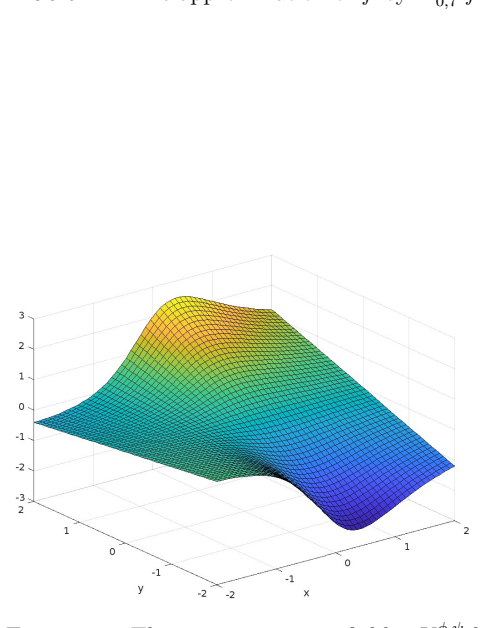
- The numerical implementation with cardinal B-splines shows the predicted improvement: for $w=7$ the reported uniform errors drop from $0.2323$ ($n=0$) to $0.0325$ ($n=1$) to $0.0055$ ($n=2$).
Reading between the lines
- The paper's theorems are uniform-norm statements despite the mixed-norm framing; a genuine $L^{p,q}$ version of the rate and Voronovskaja results is a natural next step that the methods here do not yet provide.
- The differentiation identity suggests an implementation strategy: one pass of the operator can output $f$ and all its derivatives up to order $n$, which could reduce cost in applications needing gradient or Hessian estimates.
- The Voronovskaja constant is a function of kernel moments, so it could be used as an objective for kernel design, e.g., choosing the B-spline degree to minimize the leading error for a given smoothness class.
Editorial analysis
A structured set of objections, weighed in public.
Referee Report
Summary. This paper proposes a multivariate Hermite-type sampling Kantorovich operator K^{φ,ψ}_{n,w} on R×R^d, obtained by replacing point samples in Corso's Hermite sampling operator with local averages of Taylor polynomials up to order n. The authors prove uniform-norm results: convergence of K f to f for f in C^n_b, rates o(w^{-n}) and O(w^{-n-1}) via moduli of continuity, a Voronovskaja-type asymptotic expansion, and simultaneous approximation of derivatives with corresponding rates and asymptotics. The final section gives numerical experiments with cardinal B-splines. The uniform-norm arguments are standard moment/Taylor estimates.
Significance. If the mixed-norm framing is removed, the paper contributes a natural multivariate Kantorovich version of Corso's Hermite sampling operators with explicit uniform rates and a Voronovskaja formula, including simultaneous approximation. The estimates are given with explicit constants and moment conditions, and the B-spline implementation with numerical tables is a useful check. However, the announced mixed-norm setting is entirely absent from the results, and several theorems are stated under hypotheses weaker than those used in their proofs; these issues must be resolved before the paper's claims are supportable.
major comments (3)
- [§1.1, Definition 1, Theorems 2, 4, 5] The statements and proofs are not on the same hypotheses. In §1.1, C^n(R^d) is defined to require ∂^α f ∈ C(R^d) only for |α|=n, so lower-order derivatives need not be bounded. However, Definition 1 involves ∂^{l+j}f for every l+|j|≤n, and the well-definedness estimate preceding Definition 1 bounds ∥∂^{l+j}f∥∞ for all such indices. Theorems 2(i,ii), 4, and 5 state f∈C^n(R×R^d) but their proofs use boundedness and uniform continuity of derivatives of every order up to n. A concrete witness is d=0, n=2, f(x)=x^2: f is in C^2 by the paper's definition, but f' is unbounded, so the quantities ∥∂ K f − f'∥∞ appearing in Theorem 4 are not meaningful and even the definition of K^{φ,ψ}_{2,w}f is not justified by the given well-definedness estimate. The statements and proofs must be harmonized by using C^n_b(R×R^d) (all derivatives of order ≤ n in C_b) throughout.
- [Title, Abstract, §1.1, Theorems 1–6] The paper's announced contribution is approximation in mixed norm spaces, but no result in L^{p,q} or ℓ^{p,q} is proved. After defining L^{p,q}(R×R^d) and ℓ^{p,q}(Z×Z^d) in §1.1, the paper proves only sup-norm statements: Theorems 1–6 assert convergence or estimates in ∥·∥∞ or pointwise limits. No inequality of the form ∥K f − f∥_{L^{p,q}} appears, and the 'modulus of continuity in mixed norm settings' promised in the abstract is never defined (Definition 2 is a sup-norm modulus). This is a load-bearing mismatch between the claimed setting and the actual results. The authors must either prove genuine mixed-norm estimates or revise the title, abstract, and Section 1 to describe uniform-norm approximation only.
- [Theorems 3 and 6] The Voronovskaja-type results assume 'constant discrete moments m_r(φ,u), m_r(ψ_i,u), r=0,...,n+1, i=1,...,d, for all u∈R and not null,' but this condition is not part of the kernel definition in §1.1 and is not verified for the B-spline kernels used in Section 4. Since these theorems are central to the claimed asymptotic results, the constant-moment condition should be stated as a standing hypothesis on the admissible kernels, and the examples in Section 4 should explicitly check it. As written, the reader cannot tell which concrete kernels satisfy the Voronovskaja hypotheses.
minor comments (5)
- [§5, Conclusions] The sentence 'the direct approximation theorems have been proved, including including the uniform convergence theorem' contains a duplicated 'including'.
- [§3, Theorem 4 proof] The phrase 'the operator reduces to the usual Knatorovich operator' should read 'Kantorovich operator'.
- [§1.1] The notation C(R^d) for 'uniformly continuous and bounded' conflicts with standard conventions, where C usually denotes merely continuous functions; consider using C^0_b or C_u to avoid confusion, and define C^n_b explicitly.
- [Definition 1] The interval I^w_k is written as (k/w, k+1/w); this should be the closed interval [k/w, (k+1)/w], and similarly for the product intervals I^w_m.
- [Theorem 3] The phrase 'not null' should be 'non-zero' or 'not identically zero', and the moment condition m_r(χ,u)=constant should be introduced together with the kernel definition rather than only in the theorem statement.
Circularity Check
No circular derivation: the theorems follow from the kernel axioms, Taylor expansion, and moment assumptions; the C^n versus C^n_b hypothesis gap is an assumption mismatch, not circularity.
full rationale
The derivation chain is self-contained. Definition 1 defines K^{phi,psi}_{n,w} directly from the kernel and derivatives, and the well-definedness estimate before it explicitly requires all partial derivatives up to order n to be bounded. Theorem 1 uses Taylor's formula with remainder of order n together with the kernel order-n moment finiteness to obtain uniform convergence; the target result is not assumed. Theorem 2(i)-(iii) derive o(w^{-n}) and O(w^{-n-1}) estimates from the uniform continuity of the order-n derivatives and from the discrete moment conditions, while Theorem 3 obtains the Voronovskaja limit by expanding the remainder terms and using the constant-moment hypotheses; no prior theorem is invoked to force the limit. The simultaneous approximation results in Section 3 are Leibniz-rule identities (Lemma 1) combined with the already-proved base cases, so they do not reduce to their own conclusions. References to earlier work by Butzer, Corso, Costarelli, Vinti and others are external context and kernel constructions, not load-bearing self-citations, and there is no imported uniqueness theorem or ansatz from the authors' own prior papers. The only notable defect is a statement-proof mismatch: C^n is defined in Section 1.1 to require only that derivatives of exact order n lie in C(R^{d+1}), whereas Theorems 2, 4 and 5 are stated for f in C^n but their proofs use ||partial^{l+j}f||_infinity for every l+|j| <= n, and Theorem 4 even asserts sup-norm convergence of partial^{p+q}K f, which presupposes boundedness of that derivative. The proofs evidently require C^n_b, as Proposition 1 and Theorem 1 explicitly state. This is a correctness or hypothesis-clarification issue, not circularity: strengthening the assumption does not rename an input as a prediction, and the estimates remain derived rather than assumed. Therefore the circularity score is 0.
Assumptions & free parameters
assumptions (6)
- domain assumption Kernel of order n: partition of unity sum_k chi(u-k)=1 and uniform convergence of sum_k |u-k|^n |chi(u-k)|, with finite absolute moments M_r.
- domain assumption Function smoothness: f in C^n_b(R times R^d), meaning all partial derivatives up to order n exist, are continuous, and are bounded.
- standard math Multivariate Taylor formula with Lagrange remainder at possibly distinct intermediate points in the box [u,x] times [v,y].
- ad hoc to paper Constant discrete moments m_r(chi,u) independent of u and not identically null, for r=0,...,n+1.
- domain assumption Uniform convergence of derivative series sum_k |u-k|^n |chi^{(l)}(u-k)| for l=1,...,n.
- domain assumption Finite higher-order absolute moments M_{n+1}(phi), M_{n+1}(psi_i) < infinity.
Cite this review
Pith. "Pith review of On Hermite type sampling Kantorovich operators in the settings of mixed norm Spaces." pith.science (2026). https://pith.science/paper/CV75JU7A
@misc{pith2026250602468,
  author       = {Pith},
  title        = {Pith review of: On Hermite type sampling Kantorovich operators in the settings of mixed norm Spaces},
  year         = {2026},
  howpublished = {\url{https://pith.science/paper/CV75JU7A}},
  note         = {Machine review of arXiv:2506.02468}
}
abstract
In this paper, we analyze the convergence behavior of Hermite-type sampling Kantorovich operators in the context of mixed norm spaces. We prove certain direct approximation theorems, including the uniform convergence theorem, the Voronovskaja-type asymptotic formula, and an estimate of error in the approximation in terms of the modulus of continuity in mixed norm settings. Next, we estimate the rate of convergence of these sampling Kantorovich operators in terms of the modulus of continuity. In addition, we obtain simultaneous approximation results of these sampling Kantorovich operators, including the uniform approximation, the asymptotic formula, and the approximation error in terms of the modulus of continuity in mixed settings. Finally, using cardinal $B$-splines, the implementation of differentiable functions has been shown.
Figures


Figures from the paper (6 more)


Reference graph
Works this paper leans on
-
[1]
T. Acar, D. Costarelli and G. Vinti, Linear prediction and simultaneous approximation by m-th order Kantorovich type sampling series, Banach J. Math. Anal. 14 (2020), no. 4, 1481-1508
work page 2020
-
[2]
T. Acar and B. R. Draganov, A strong converse inequality for generalized sampling operators, Ann. Funct. Anal. 13 (2022), no. 3, Paper No. 36, 16 pp
work page 2022
-
[3]
T. Acar, A. Osman, A. Aral, D. Costarelli, M. Turgay and G. Vinti, Convergence of generalized sampling series in weighted spaces, Demonstr. Math. 55 (2022), no. 1, 153-162
work page 2022
-
[4]
A. Aldroubi and K. Gr¨ ochenig, Beurling-Landau-type theorems for nonuniform sampling in shift- invariant spaces, J. Fourier Anal. Appl. 6 (1) (2000) 91-101
work page 2000
-
[5]
A. Aldroubi and K. Gr¨ ochenig, Nonuniform sampling and reconstruction in shift-invariant spaces, SIAM Rev. 43 (4) (2001) 585-620
work page 2001
- [6]
-
[7]
C. Bardaro and I. Mantellini, Asymptotic formulae for multivariate Kantorovich type generalized sampling series, Acta Math. Sin. (Engl. Ser.) 27 (7) (2011), 1247-1258
work page 2011
-
[8]
C. Bardaro, I. Mantellini, R. Stens, J. Vautz and G. Vinti, Generalized sampling approximation for multivariate discontinuous signals and application to image processing, New Perspectives on Approximation and Sampling Theory, Appl. Numer. Harmon. Anal., Birkh¨ auser, Springer, Cham, (2014), 87-114
work page 2014
Show all 44 references
-
[9]
Bardaro, P.L
C. Bardaro, P.L. Butzer, R.L. Stens and G. Vinti, Approximation error of the Whittaker cardinal series in terms of an averaged modulus of smoothness covering discontinuous signals, J. Math. Anal. Appl., 316 (2006) 269-306
2006
-
[10]
Bardaro and I
C. Bardaro and I. Mantellini, A quantitative Voronovskaja formula for generalized sampling opera- tors. East J. Approx. 15, 429–441 (2009)
2009
-
[11]
Bardaro, G
C. Bardaro, G. Vinti, P. L. Butzer and R. L. Stens, Kantorovich-type generalized sampling series in the setting of Orlicz spaces, Sampl. Theory Signal Image Process. 6 (1) (2007), 29-52. HERMITE TYPE SAMPLING KANTOROVICH OPERATORS IN MIXED NORM SPACES 29
2007
-
[12]
Bardaro and I
C. Bardaro and I. Mantellini, Asymptotic formulae for linear combinations of generalized sampling operators, Z. Anal. Anwend. 32(3), 279–298 (2013)
2013
-
[13]
Benedek and R
A. Benedek and R. Panzone, The space Lp with mixed norm, Duke Math. J. 28 (1961) 301-324
1961
-
[14]
Benedek, A.P
A. Benedek, A.P. Calder´ on and R. Panzone, Convolution operators on Banach space valued functions, Proc. Natl. Acad. Sci. USA 48 (1962) 356-365
1962
-
[15]
P. L. Butzer, A survey of the Whittaker-Shannon sampling theorem and some of its extensions. J. Math. Res. Exposit., 3 (1983), 185-212
1983
-
[16]
P. L. Butzer, A. Fischer and R.L. Stens, Generalized sampling approximation of multivariate signals; theory and some application, Note di Matematica. 10(1) (1990), 173-191
1990
-
[17]
P. L. Butzer, A. Fischer and R.L. Stens, Generalized sampling approximation of multivariate signals; general theory, Atti Sem. Mat. Fis. Univ. Modena. 41(1) (1993), 17-37
1993
-
[18]
Butzer, J
P.L. Butzer, J. R. Higgins and R. L. Stens, Classical and approximate sampling theorems: studies in the LP(R) and the uniform norm, J. Approx. Theory. 137(2) (2005), 250-263
2005
-
[19]
P. L. Butzer and R. L. Stens, A modification of the Whittaker-Kotelnikov-Shannon sampling series, Aequntiones Math. 28 (3) (1985), 305-311
1985
-
[20]
P. L. Butzer and R. L. Stens, Linear prediction by samples from the past, In: Advanced Topics in Shannon Sampling and Interpolation Theory (Ed. R. J. Marks II) Springer Texts Electrical Eng, Springer, New York, (1993)
1993
-
[21]
P. L. Butzer and R. L. Stens, Sampling theory for not-necessarily band-limited functions: A historical overview, SIAM Rev. 34 (1992), 40-53
1992
-
[22]
P. L. Butzer, S. Ries and R. L. Stens, Approximation of continuous and discontinuous functions by generalized sampling series, J. Approx. Theory. 50 (1987), 25-39
1987
-
[23]
Cantarini, D
M. Cantarini, D. Costarelli and G. Vinti, Approximation of differentiable and not differentiable signals by the first derivative of sampling Kantorovich operators, J. Math. Anal. Appl. 509 (2022), no. 1, Paper No. 125913, 20 pp
2022
-
[24]
Coroianu, D
L. Coroianu, D. Costarelli, S. G. Gal and G. Vinti, The max-product generalized sampling operators: convergence and quantitative estimates. Appl. Math. Comput. 355, 173–183 (2019)
2019
-
[25]
Corso, Generalized sampling operators with derivatives samples, J
R. Corso, Generalized sampling operators with derivatives samples, J. Math. Anal. Appl. 547 (2025) 129369
2025
-
[26]
Costarelli and G
D. Costarelli and G. Vinti, An inverse result of approximation by sampling Kantorovich series, Proc. Edinb. Math. Soc. (2) 62 (2019), no. 1, 265-280
2019
-
[27]
Costarelli and G
D. Costarelli and G . Vinti, Inverse results of approximation and the saturation order for the sampling Kantorovich series, J. Approx. Theory 242 (2019), 64-82
2019
-
[28]
Costarelli and G
D. Costarelli and G. Vinti, Saturation by the Fourier transform method for the sampling Kantorovich series based on bandlimited kernels, Anal. Math. Phys. 9 (2019), no. 4, 2263- 2280
2019
-
[29]
Fang, Whittaker-Kotelnikov-Shannon sampling theorem and aliasing error, J
G. Fang, Whittaker-Kotelnikov-Shannon sampling theorem and aliasing error, J. Approx. Theory 85 (1996) 115-131
1996
-
[30]
Feichtinger, New results on regular and irregular sampling based on Wiener amalgams,in Proc
H.G. Feichtinger, New results on regular and irregular sampling based on Wiener amalgams,in Proc. Conf. Function Spaces, K. Jarosz, ed., Lecture Notes in Math. 136, Springer-Verlag, New York, 1991, pp. 107-121
1991
-
[31]
Fernandez, Vector-valued singular integral operators on Lp-spaces with mixed norms and ap- plications, Pacific J
D.L. Fernandez, Vector-valued singular integral operators on Lp-spaces with mixed norms and ap- plications, Pacific J. Math. 129 (2) (1987) 257-275
1987
-
[32]
A. G. Garc ´ ıa and P.V. Gerardo, Approximation from shift-invariant spaces by generalized sampling formulas, Appl. Comput. Harmon. Anal. 24 (2008), no. 1, 58-69
2008
-
[33]
Heil, Harmonic Analysis and Applications, Birkh¨ auser, Boston, 2006
C. Heil, Harmonic Analysis and Applications, Birkh¨ auser, Boston, 2006
2006
-
[34]
Jagerman and L.J
D.L. Jagerman and L.J. Fogel, Some general aspects of the sampling theorem, IRE Trans. Inf. Theory 2 (4) (1956) 139-146
1956
-
[35]
Jerri, The Shannon sampling theorem-its various extensions and applications: A review, Proc
A. Jerri, The Shannon sampling theorem-its various extensions and applications: A review, Proc. IEEE, 65 (1977), pp. 1
1977
-
[36]
Jiang and J
Y. Jiang and J. Kou, Semi-Average Sampling for Shift-Invariant Signals in a Mixed Lebesgue Space, Numer. Funct. Anal. Optim. 41:9 (2020) 1045-1064. 30 PUJA SONA W ANE AND A. SATHISH KUMAR
2020
-
[37]
Jiang and W
Y. Jiang and W. Li, Random sampling in multiply generated shif-invariant sub-spaces of mixed Lebesgue spaces Lp,q(R × Rd), J. Comput. Appl. Math. 386, 113237 (2021)
2021
-
[38]
R. Li, b. Liu and R. Liu, Q. Zhang, Nonuniform sampling in principal shift-invariant subspaces of mixed Lebesgue spaces Lp,q(Rd+1), J. Math. Anal. Appl. 453 (2017) 928–941
2017
-
[39]
Linden and N.M
D.A. Linden and N.M. Abramson, A generalization of the sampling theorem, Inf. Control 3 (1) (1960) 26–31, see also Errata: Inf. Control 4 (1) (1961) 95–96
1960
-
[40]
Prashant, D
G. Prashant, D. Patel and S. Sivananthan, Random sampling and reconstruction in reproducing kernel subspace of mixed Lebesgue spaces, Math. Methods Appl. Sci. 46 (2023), no. 5, 5119-5138
2023
-
[41]
Rahman and P
Q.I. Rahman and P. V´ ertesi, On the Lp convergence of Lagrange interpolating entire functions of exponential type, J. Approx. Theory 69 (1992) 302-317
1992
-
[42]
Sun, Nonuniform average sampling and reconstruction of signals with finite rate of innovation, SIAM J
Q. Sun, Nonuniform average sampling and reconstruction of signals with finite rate of innovation, SIAM J. Math. Anal. 38 (5) (2006) 1389-1422
2006
-
[43]
Torres and E
R. Torres and E. Ward, Leibniz’s rule, sampling and wavelets on mixed Lebesgue spaces, J. Fourier Anal. Appl. 21(5) (2015) 1053-1076
2015
-
[44]
Vinti and L
G. Vinti and L. Zampogni, Approximation by means of nonlinear Kantorovich sampling type oper- ators in Orlicz spaces, J. Approx. Theory. 161 (2009), 511-528. Department of Mathematics, Indian Institute of Technology Madras, Chennai-600036, Tamil Nadu, India Email address : ma2...
2009
Reviewed August 7, 2026 · model on record in the stance chip above.
Discussion (0). Sign in to comment.