REVIEW 3 major objections 4 minor 37 references
Comparing the $\mathrm{v}$-number and $h$-polynomials of edge ideals
T0 review · 3 major / 4 minor · reviewed 2026-08-06 · deepseek-v4-flash
Pith's one-line read The $v$-number of an edge ideal and the degree of its $h$-polynomial can be tuned independently on connected graphs: every integer difference, and in fact every pair $(v,d)$ with $1 \leq v \leq d$, is realized by some explicit graph.
desk verdict Solid and publishable in principle, but the proof of Theorem 3.6 has a false step that needs fixing, and the computational claims need code. read the letter →
The pith
A machine-rendered reading of the paper's core claim, the machinery that carries it, and where it could break.
The reading
What carries the argument
The argument runs through three pieces. The $v$-number of an edge ideal is read combinatorially: $v(I(G))$ is the minimum size of an independent set $A$ whose neighbour set $N_G(A)$ is a minimal vertex cover, so $v(I(G))=\min\{|A| \mid A \in \mathcal{A}_G\}$. A gluing lemma (Construction 1 and Lemma 3.2) assembles $n$ graphs $G_i$ into one connected graph $H_n$ by adding new vertices $y_i$, joining $y_i$ to a chosen subset $A_i$ of $G_i$, and making the $y_i$'s a clique; under the hypotheses that $\alpha(G_i)-\alpha(G_i\setminus A_i)$ is odd and $\deg(G_i)-\deg(G_i\setminus A_i)=\alpha(G_i)-\alpha(G_i\setminus A_i)-1$ with matching signs of leading $h$-coefficients, it gives $\deg(h_{R/I(H_n)}(t))=1+\sum_i\deg(h_{R_i/I(G_i)}(t))$, and under $v(I(G_i)) \geq 1+v(I(G_i\setminus A_i))$ it gives $v(I(H_n))=\min_i[1+v(I(G_i\setminus A_i))+\sum_{j\neq i}v(I(G_j))]$. The base graph $G$ of Figure 1 satisfies these hypotheses for $A=\{x_1,\ldots,x_5\}$, giving $v=3>\deg(h)=2$, and iterating the gluing makes the difference arbitrarily large. The final piece is the Hilbert-series formula for edge ideals, which implies $\deg(h_{R/I(G)}(t)) \leq \alpha(G)$; together with $v(I(G)) \leq \beta(G)$ this yields the sum bound $v+\deg(h) \leq n$ and identifies equality with disjoint unions of star graphs.
What would settle it
Compute the $v$-number, $h$-polynomial degree, independence number, and reduced Hilbert series of the induced subgraph $G\setminus A$ for the 11-vertex graph $G$ in Figure 1, where $A=\{x_1,\ldots,x_5\}$; if any quoted value differs from $\alpha(G\setminus A)=2$, $\deg(h_{R/I(G\setminus A)}(t))=2$, $v(I(G\setminus A))=2$, or $(1+4t+t^2)/(1-t)^2$, then Theorem 3.4's construction no longer produces connected graphs with $v(I)-\deg(h)=n$, although the $m\leq 0$ direction of Theorem 3.6 would still hold.
Extended reading notes
Core claim
The paper's central result is Theorem 1.1: for every integer $m$ there is a connected graph $G$ with $v(I(G))-\deg(h_{R/I(G)}(t))=m$. The direction $m>0$ is obtained by gluing $n+1$ copies of an 11-vertex, 25-edge base graph with $v=3$ and degree $2$: adding a new vertex per copy that is joined to five fixed vertices of that copy and connecting all new vertices in a clique makes $v=3(n+1)$ and $\deg(h)=2n+3$. The direction $m \leq 0$ is obtained from an explicit family $H(v,d)$ built from $v$ triangles, a star on the first $v$ vertices, and $d-v$ pendant leaves attached to one triangle vertex; a short-exact-sequence calculation gives $v(I(H(v,d)))=v$ and $\deg(h_{R/I(H(v,d))}(t))=d$ for every $1 \leq v \leq d$. The paper also proves the sharp bound $v(I(G))+\deg(h_{R/I(G)}(t)) \leq n$ and classifies equality as exactly the disjoint unions of star graphs, and a computer search shows the base graph is minimal: no connected graph with fewer vertices, or with 11 vertices and fewer than 25 edges, has $v(I(G))>\deg(h_{R/I(G)}(t))$, while at (11,25) there are exactly two such graphs.
Load-bearing premise
The load-bearing premise is that the computer-algebra values quoted for the auxiliary induced subgraph $G\setminus A$ of the 11-vertex base graph are correct: $\alpha(G\setminus A)=2$, $\deg(h_{R/I(G\setminus A)}(t))=2$, $v(I(G\setminus A))=2$, and reduced Hilbert series $(1+4t+t^2)/(1-t)^2$; the paper supplies code for the base graph $G$ but not for $G\setminus A$, and Theorem 3.4 uses these values to verify the hypotheses of Lemma 3.2 and Lemma 3.3.
Editorial extensions
If this is right
- For every positive integer $n$, the construction yields a connected graph with $v(I)=3(n+1)$ and $\deg(h)=2n+3$, so the $v$-number can be made arbitrarily larger than the $h$-degree.
- For every pair $(v,d)$ with $1 \leq v \leq d$, the family $H(v,d)$ realizes exactly that pair; in particular the $h$-degree can be made arbitrarily larger than the $v$-number while keeping $v=1$.
- On any graph with $n$ vertices, $v(I(G)) + \deg(h_{R/I(G)}(t)) \leq n$, and the only graphs attaining equality are disjoint unions of star graphs.
- All thirteen possible inequality patterns among $v(I(G))$, $\deg(h_{R/I(G)}(t))$, and the Castelnuovo-Mumford regularity occur for edge ideals of connected graphs; some examples depend on the field characteristic through the regularity, while $v$ and the $h$-degree are characteristic-free.
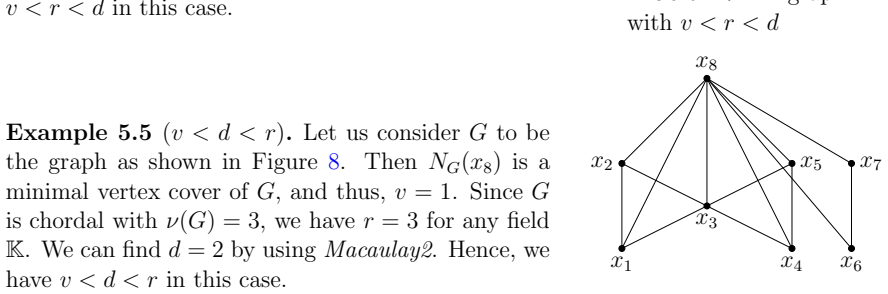
- No connected graph on at most 10 vertices, and no connected graph on 11 vertices with at most 24 edges, has $v(I(G)) > \deg(h_{R/I(G)}(t))$; the two 11-vertex, 25-edge graphs in Figures 1 and 2 are the unique minimal exceptions.
Reading between the lines
- The appendix tables for connected graphs up to 10 vertices suggest the sharper inequality $2v(I(G))+\deg(h_{R/I(G)}(t)) \leq n+1$, which the paper does not assert; proving it would refine Theorem 4.2.
- The gluing lemma is written for any base graphs satisfying its parity, sign, and $v$-number hypotheses, so other base cases besides the 11-vertex example could produce families with different growth rates of $v(I)-\deg(h)$; the paper only explores the one base graph.
- An independent check of the quoted invariants of $G\setminus A$ would settle the main numerical input of Theorem 3.4, since the supplied code covers the base graph but not this auxiliary subgraph.
Editorial analysis
A structured set of objections, weighed in public.
Referee Report
Summary. The paper studies the relative sizes of the v-number v(I(G)), the degree d(G) of the h-polynomial of R/I(G), and the Castelnuovo--Mumford regularity for edge ideals of connected graphs. It claims Theorem 1.1: for every integer m there is a connected graph with v(I(G))-deg(h_{R/I(G)}(t))=m; Theorem 3.4 gives the positive direction by attaching n copies of an 11-vertex base graph (from Jaramillo--Villarreal) to a complete graph, and Theorem 3.6 constructs, for every 1<=v<=d, a connected graph H(v,d) with v(I)=v and deg(h)=d. Section 4 proves the sharp bound v(I(G))+deg(h_{R/I(G)}(t))<=n, with equality exactly for disjoint unions of stars. Section 5 exhibits all thirteen possible inequalities among v, deg(h), and regularity. The paper also reports a computer search showing that the base graph is one of two minimal examples on 11 vertices and 25 edges with v>deg(h), and that no smaller example exists.
Significance. If the results hold, the paper resolves the natural comparison problem between the v-number and the degree of the h-polynomial for connected edge ideals, complementing the known results for regularity by Hibi--Matsuda--Van Tuyl and by Biermann et al. The construction lemmas (Lemmas 3.2 and 3.3) are potentially reusable tools for building graphs with prescribed invariants. The paper ships Macaulay2 code for the two base graphs and includes an exhaustive computer search for minimal counterexamples, which are positive features. However, the proof of the arbitrarily-large-deg(h) direction (Theorem 3.6) contains a false inference, and several load-bearing Macaulay2 computations (for the induced subgraph G\A and for the exhaustive search) are not archived. These gaps currently prevent the paper from being fully verified in its present form.
major comments (3)
- [Section 3, proof of Theorem 3.6] The proof of the lower bound v(I(G)) >= v contains a false inference. After showing that a minimal vertex cover NG(B) contains at most two vertices from each triangle Ti={xi,yi,wi}, the proof asserts 'Consequently, {xi,yi,wi} intersect B is nonempty for each 1<=i<=v.' This is false. In H(2,3) (Construction 3 with v=2, d=3), take B={x2,z1}. Then B is independent and NG(B)={x1,w1,y2,w2} is a minimal vertex cover of H(2,3), yet B intersect T1 is empty. Hence the claimed lower bound |B|>=v does not follow from the preceding sentence. A repair is available: if B misses T1, then to cover the edge y1w1, B must either contain a vertex of T1 or contain a leaf z_j, and since each leaf is adjacent only to w1, one can still obtain the bound |B|>=v by a case analysis. The theorem may be true, but the proof as written is incomplete and needs this additional case.
- [Section 3, proof of Theorem 3.4] The proof relies on Macaulay2 computations for the induced subgraph G\A with A={x1,...,x5}: alpha(G\A)=2, deg(h_{R/I(G\A)})=2, v(I(G\A))=2, and reduced Hilbert series (1+4t+t^2)/(1-t)^2. The appendix contains code for the base graph G but not for G\A or for v(I(G\A)). These data are load-bearing: they are precisely the hypotheses needed to apply Lemmas 3.2 and 3.3 and to conclude v(I(H_n))=3n and deg(h_{R/I(H_n)})=2n+1. Please include the code (or an explicit edge list for G\A and the corresponding commands) so that this step is independently checkable.
- [Section 3, Theorem 3.1] The exhaustive search over all graphs with at most 11 vertices and 25 edges is stated to involve well over 100,000,000 graphs, but no script or detailed description of the search and verification is provided. As a computational theorem, this claim is not independently verifiable from the manuscript as it stands. Since the paper already ships Macaulay2 code elsewhere, please provide the search code or a repository link, or at least a precise description of the filtering and checking procedure.
minor comments (4)
- [Example 5.11] The text first states 'using Macaulay2, one can check that d=8' and later says 'We were not able to verify these values directly using Macaulay2 since the computations would not finish.' Please clarify which values were verified computationally and supply a proof or code for d=8.
- [Section 5] Several examples (e.g., Examples 5.3, 5.5, 5.6, 5.8, 5.9) quote values of d and v obtained with Macaulay2 without shipping the corresponding code. A supplementary file with all such computations would improve reproducibility.
- [Appendix A, Figure 11] The caption does not label the horizontal and vertical axes; please label them as v(I) and deg(h), and state whether the observed inequality 2v(I(G))+deg(h) <= n+1 is a proved result or an empirical observation.
- [Example 5.11, proof of claim] There is a typo: 'let us proof' should be 'let us prove'.
Circularity Check
No significant circularity: the main constructions derive the target invariants from explicit graph data and Hilbert-series computations, and the target values are not assumed as inputs.
full rationale
The derivation chain for Theorem 1.1 starts from explicit graph constructions (Construction 1–3) and computes the v-number and h-polynomial degree using Hilbert-series short exact sequences, the Stanley formula for independent sets, and standard additivity lemmas. The base graph values (v=3, deg h=2 for Figure 1, and the auxiliary values for G\A) are obtained from Macaulay2 computations and from the prior graph of Jaramillo and Villarreal; they are independent checks, not fitted parameters, and the amplified statements v(I(H_n))=3n and deg(h)=2n+1 follow by the lemmas rather than being assumed. Theorem 3.6 similarly proves both equalities for H(v,d) directly from the graph structure. The only self-citation is the standard bound v(I) ≤ beta(G) from Saha and Sengupta ([35]) used in Theorem 4.1/4.2; that is a published theorem with its own proof and is not used to forbid alternatives or to smuggle in the target result. The skeptical concern about a false implication in the proof of Theorem 3.6 is a proof-correctness issue, not circularity, and the unverified Macaulay2 values noted in the text are computational dependencies rather than circular inputs. No step in the paper reduces, by definition or by construction, to its own output.
Assumptions & free parameters
assumptions (7)
- standard math Hilbert-Serre theorem: H_{R/I}(t)=h(t)/(1-t)^{dim R/I} with h(1) not equal to 0.
- standard math Stanley's formula (3.2): H_{R/I(G)}(t)=sum_{i=0}^{alpha(G)} f_{i-1} t^i / (1-t)^i, with f_{i-1} the number of independent sets of size i.
- domain assumption Additivity of regularity, Hilbert series, h-polynomial degree and v-number on disjoint unions (Lemma 2.3), citing [27] and [35].
- domain assumption Combinatorial description of v-number for edge ideals: v(I(G))=min{|A|: A independent and N_G(A) a minimal vertex cover} (Lemma 2.5 from [28]).
- domain assumption For chordal graphs, reg(I(G)) equals the induced matching number nu(G) (Ha-Van Tuyl [21]).
- standard math Regularity bounds from short exact sequences, cited to [7, Theorem 4.6] and [12, Lemma 2.10].
- ad hoc to paper The reported Macaulay2 outputs (v-numbers, Hilbert series, regularities, and the exhaustive search over graphs up to 11 vertices and 25 edges) are correct.
Cite this review
Pith. "Pith review of Comparing the $\mathrm{v}$-number and $h$-polynomials of edge ideals." pith.science (2026). https://pith.science/paper/CVFRDBR2
@misc{pith2026250705700,
  author       = {Pith},
  title        = {Pith review of: Comparing the $\mathrmv$-number and $h$-polynomials of edge ideals},
  year         = {2026},
  howpublished = {\url{https://pith.science/paper/CVFRDBR2}},
  note         = {Machine review of arXiv:2507.05700}
}
abstract
In this paper, we compare the $\mathrm{v}$-numbers and the degree of the $h$-polynomials associated with edge ideals of connected graphs. We prove that the $\mathrm{v}$-number can be arbitrarily larger or smaller than the degree of the $h$-polynomial for the edge ideal of a connected graph. We also establish that for any pair of positive integers $(v,d)$ with $v \leq d$, there exists a connected graph $H(v,d)$ with the $\mathrm{v}$-number equal to $v$ and the degree of $h$-polynomial equal to $d$. Additionally, we show that the sum of the $\mathrm{v}$-number and the degree of the $h$-polynomial is bounded above by $n$, the number of vertices of $G$, and we classify all graphs for which this sum is exactly $n$. Finally, we show that all thirteen possible inequalities among the three invariants, the $\mathrm{v}$-number, the degree of the $h$-polynomial, and the Castelnuovo-Mumford regularity, can occur in the case of edge ideals of connected graphs. Many of these examples rely on a minimal example of a graph whose $\mathrm{v}$-number is more than the degree of its $h$-polynomial. Using a computer search, we show that there are exactly two such graphs on 11 vertices and 25 edges, and no smaller example on fewer vertices, or 11 vertices and less than 25 edges.
Figures


Figures from the paper (8 more)




Reference graph
Works this paper leans on
-
[1]
Siddhi Balu Ambhore, Kamalesh Saha, and Indranath Sengupta, The v-number of binomial edge ideals, Acta Math. Vietnam. 49 (2024), no. 4, 611–628
work page 2024
-
[2]
Taylor Ball, Eduardo Camps, Henry Chimal-Dzul, Delio Jaramillo-Velez, Hiram L´ opez, Nathan Nichols, Matthew Perkins, Ivan Soprunov, German Vera-Mart ´ ınez, and Gwyn Whieldon, Coding theory package for Macaulay2 , J. Softw. Algebra Geom. 11 (2021), no. 1, 113–122
work page 2021
-
[3]
Kieran Bhaskara and Adam Van Tuyl, Comparing invariants of toric ideals of bipartite graphs , Proc. Amer. Math. Soc. Ser. B 10 (2023), 219–232. 24 KAMALESH SAHA AND ADAM V AN TUYL
work page 2023
-
[4]
Jennifer Biermann, Selvi Kara, Augustine O’Keefe, Joseph Skelton, and Gabriel Sosa, Degree of h-polynomials of edge ideals , Preprint (2024), arXiv:2408.12544
work page Pith review arXiv 2024
-
[5]
Prativa Biswas and Mousumi Mandal, A study of v-number for some monomial ideals , Collect. Math. (2024), available at https://doi.org/10.1007/s13348-024-00451-x
-
[6]
Prativa Biswas, Mousumi Mandal, and Kamalesh Saha, Asymptotic behaviour and stability index of v-numbers of graded ideals , Preprint (2024), arXiv:2402.16583
work page Pith review arXiv 2024
-
[7]
Enrico Carlini, Huy T` ai H` a, Brian Harbourne, and Adam Van Tuyl,Ideals of powers and powers of ideals, Lecture Notes of the Unione Matematica Italiana, vol. 27, Springer, Cham, 2020
work page 2020
-
[8]
Yusuf Civan, The v-number and Castelnuovo-Mumford regularity of graphs, J. Algebraic Combin. 57 (2023), no. 1, 161–169
work page 2023
Show all 37 references
-
[9]
Aldo Conca, A note on the v-invariant, Proc. Amer. Math. Soc. 152 (2024), no. 6, 2349–2351
2024
-
[10]
David Cook II, Nauty in Macaulay2 , J. Softw. Algebra Geom. 3 (2011), 1–4
2011
-
[11]
Cooper, Alexandra Seceleanu, Stefan O
Susan M. Cooper, Alexandra Seceleanu, Stefan O. Tohuaneanu, Maria Vaz Pinto, and Rafael H. Villarreal, Generalized minimum distance functions and algebraic invariants of Geramita ideals , Adv. in Appl. Math. 112 (2020), 101940, 34
2020
-
[12]
Algebraic Combin
Hailong Dao, Craig Huneke, and Jay Schweig, Bounds on the regularity and projective dimension of ideals associated to graphs , J. Algebraic Combin. 38 (2013), no. 1, 37–55
2013
-
[13]
Deblina Dey, A. V. Jayanthan, and Kamalesh Saha, On the v-number of binomial edge ideals of some classes of graphs , Internat. J. Algebra Comput. 35 (2025), no. 1, 119–143
2025
-
[14]
Giuseppe Favacchio, Graham Keiper, and Adam Van Tuyl, Regularity and h-polynomials of toric ideals of graphs , Proc. Amer. Math. Soc. 148 (2020), no. 11, 4665–4677
2020
-
[15]
Antonino Ficarra and Emanuele Sgroi, Asymptotic behaviour of the v-number of homogeneous ideals , Preprint (2023), arxiv:2306.14243
2023 arXiv
-
[16]
Algebra Appl
, Asymptotic behavior of integer programming and the v-function of a graded filtration , J. Algebra Appl. (2025), available at https://doi.org/10.1142/S0219498826502361
2025 doi
-
[17]
Luca Fiorindo and Dipankar Ghosh, On the asymptotic behavior of the Vasconcelos invariant for graded modules, Nagoya Math. J. (2025), 1–15
2025
-
[18]
Algebra 671 (2025), 61–74
Dipankar Ghosh and Siddhartha Pramanik, Asymptotic v-numbers of graded (co)homology modules involving powers of an ideal , J. Algebra 671 (2025), 61–74
2025
-
[19]
Grayson and Michael E
Daniel R. Grayson and Michael E. Stillman, Macaulay2, a software system for research in algebraic geometry, available at http://www2.macaulay2.com
-
[20]
Villarreal, Induced matchings and the v-number of graded ideals, Mathematics 9 (2021), no
Gonzalo Grisalde, Enrique Reyes, and Rafael H. Villarreal, Induced matchings and the v-number of graded ideals, Mathematics 9 (2021), no. Paper No. 22, 2860
2021
-
[21]
Algebraic Combin
Huy T` ai H` a and Adam Van Tuyl,Monomial ideals, edge ideals of hypergraphs, and their graded Betti numbers, J. Algebraic Combin. 27 (2008), no. 2, 215–245
2008
-
[22]
Takayuki Hibi, Hiroju Kanno, Kyouko Kimura, Kazunori Matsuda, and Adam Van Tuyl,Homological invariants of Cameron-Walker graphs , Trans. Amer. Math. Soc. 374 (2021), no. 9, 6559–6582
2021
-
[23]
Takayuki Hibi, Kyouko Kimura, Kazunori Matsuda, and Adam Van Tuyl, The regularity and h- polynomial of Cameron-Walker graphs , Enumer. Comb. Appl. 2 (2022), no. 3, Paper No. S2R17, 12
2022
-
[24]
Takayuki Hibi and Kazunori Matsuda, Regularity and h-polynomials of monomial ideals , Math. Nachr. 291 (2018), no. 16, 2427–2434
2018
-
[25]
, Regularity and h-polynomials of binomial edge ideals, Acta Math. Vietnam. 47 (2022), no. 1, 369–374
2022
-
[26]
Takayuki Hibi, Kazunori Matsuda, and Adam Van Tuyl, Regularity and h-polynomials of edge ideals, Electron. J. Combin. 26 (2019), no. 1, Paper No. 1.22, 11. COMPARING THE V-NUMBER AND H-POLYNOMIAL 25
2019
-
[27]
Le Tuan Hoa and Nguyen Duc Tam, On some invariants of a mixed product of ideals , Arch. Math. (Basel) 94 (2010), no. 4, 327–337
2010
-
[28]
Villarreal, The v-number of edge ideals , J
Delio Jaramillo and Rafael H. Villarreal, The v-number of edge ideals , J. Combin. Theory Ser. A 177 (2021), Paper No. 105310, 35
2021
-
[29]
Delio Jaramillo-Velez and Lisa Seccia, Connected domination in graphs and v-numbers of binomial edge ideals, Collect. Math. 75 (2024), no. 3, 771–793
2024
-
[30]
Tatsuya Kataoka, Yuji Muta, and Naoki Terai, The v-numbers of Stanley-Reisner ideals from the viewpoint of Alexander dual complexes , Preprint (2025), arXiv:2504.07535
2025 arXiv
-
[31]
Pure Appl
Manohar Kumar, Ramakrishna Nanduri, and Kamalesh Saha, The slope of the v-function and the Waldschmidt constant, J. Pure Appl. Algebra 229 (2025), no. 2, Paper No. 107881, 13
2025
-
[32]
Kamalesh Saha, The v-number and Castelnuovo-Mumford regularity of cover ideals of graphs , Int. Math. Res. Not. IMRN 11 (2024), 9010–9019
2024
-
[33]
Algebra (2025), available at https://arxiv.org/abs/2406.05567
, Binomial expansion and the v-number, To appear in Commun. Algebra (2025), available at https://arxiv.org/abs/2406.05567
2025 arXiv
-
[34]
Kamalesh Saha and Nirmal Kotal, On the v-number of Gorenstein ideals and Frobenius powers, Bull. Malays. Math. Sci. Soc. 47 (2024), no. 6, Paper No. 167, 17
2024
-
[35]
Algebraic Combin
Kamalesh Saha and Indranath Sengupta, The v-number of monomial ideals , J. Algebraic Combin. 56 (2022), no. 3, 903–927
2022
-
[36]
Stanley, Combinatorics and commutative algebra , Second, Progress in Mathematics, vol
Richard P. Stanley, Combinatorics and commutative algebra , Second, Progress in Mathematics, vol. 41, Birkh¨ auser Boston, Inc., Boston, MA, 1996
1996
-
[37]
Vanmathi and Parangama Sarkar, v-numbers of symbolic power filtrations, Collect
A. Vanmathi and Parangama Sarkar, v-numbers of symbolic power filtrations, Collect. Math. (2025), available at https://doi.org/10.1007/s13348-025-00476-w . (K. Saha) Department of Mathematics, SRM University-AP, Amaravati 522240, Andhra Pradesh, India Email address : kamalesh....
2025 doi
Reviewed August 6, 2026 · model on record in the stance chip above.
Discussion (0). Sign in to comment.