REVIEW 4 major objections 4 minor 81 references
Metallicities of old open clusters: A new Galactic map
T0 review · 4 major / 4 minor · reviewed 2026-08-07 · deepseek-v4-flash
Pith's one-line read Using 600 old open clusters, this paper maps a knee-shaped metallicity gradient in the Milky Way disc: steep inside the solar circle, flat beyond about 12 kpc.
desk verdict A genuinely useful catalogue of old open cluster metallicities, but the vertical gradient headline number is not trustworthy until a joint R-Z fit is done. read the letter →
The pith
A machine-rendered reading of the paper's core claim, the machinery that carries it, and where it could break.
The reading
What carries the argument
The load-bearing machinery is a homogeneous cluster-sample construction combined with a segmented Bayesian fitting model. The sample is built by cross-matching the cluster and membership catalogues of Hunt & Reffert (2023, 2024) and Cantat-Gaudin et al. (2020) to six all-sky catalogues of stellar parameters based on Gaia photometry and XP spectra; each cluster's metallicity is the median over its member stars, and the bright-giant subsample of Andrae et al. (2023) is chosen after a direct comparison with high-resolution spectroscopy as the most accurate and precise of the six. The gradients are obtained from a Bayesian linear-gradient-plus-scatter model extended with a knee: a continuous piecewise-linear function of galactocentric radius with four parameters (knee radius, inner intercept, inner slope, outer slope) plus an intrinsic scatter, fitted by Markov-chain Monte Carlo, with a vertical analogue in $|Z|$. The procedure inherits the assumption, stated in Section 2.4, that the catalogue's zero-point offset is a constant, so that it cancels when slopes are computed.
What would settle it
Observe a few dozen old clusters spread from the inner disc to beyond the knee at roughly 12–15 kpc, take high-resolution spectra of their brightest giants, and compare the resulting cluster metallicities with the Andrae et al. (2023) values used here; if the mean offset varies with galactocentric radius by more than the typical 0.05 dex precision, the knee position, the flat outer slope, and the weak-radial-mixing conclusion would all need revision. A cheaper check is to refit the same Bayesian model after removing clusters with fewer than five giants and see whether the knee and slopes move beyond the quoted uncertainties.
Extended reading notes
Core claim
The paper's central claim is that the old open cluster population defines a sharp, knee-shaped radial metallicity gradient in the Galactic disc, together with a steep vertical gradient. Using the bright-giant metallicities of Andrae et al. (2023) — the bright evolved stars for which that catalogue is most reliable, and the one of six tested catalogues that best reproduces high-resolution spectroscopic values — the authors measure an inner slope of $-0.084 \pm 0.004$ dex kpc$^{-1}$ inside a knee at roughly 10.8–12.4 kpc, an outer slope of $-0.018 \pm 0.056$ dex kpc$^{-1}$, and a vertical gradient of $-0.415 \pm 0.030$ dex kpc$^{-1}$. Binning the clusters by galactocentric radius dissolves the large scatter of the age–metallicity relation: each bin has its own mean metallicity, shifting from about +0.09 dex in the inner disc to about -0.40 dex beyond 12 kpc, with an intra-bin dispersion below 0.08 dex. The authors conclude that the negative radial gradient was already imprinted in the interstellar medium when the clusters formed, that radial mixing has been weak, and that most of the disc's enrichment predates the oldest surviving clusters.
Load-bearing premise
The paper assumes that the systematic offset between Andrae et al. (2023) bright-giant metallicities and true high-resolution values is a constant, independent of radius, metallicity, and cluster properties, even though the calibration sample is small and concentrated near the Sun; if the offset drifts across the disc, the reported gradients would be biased.
Editorial extensions
If this is right
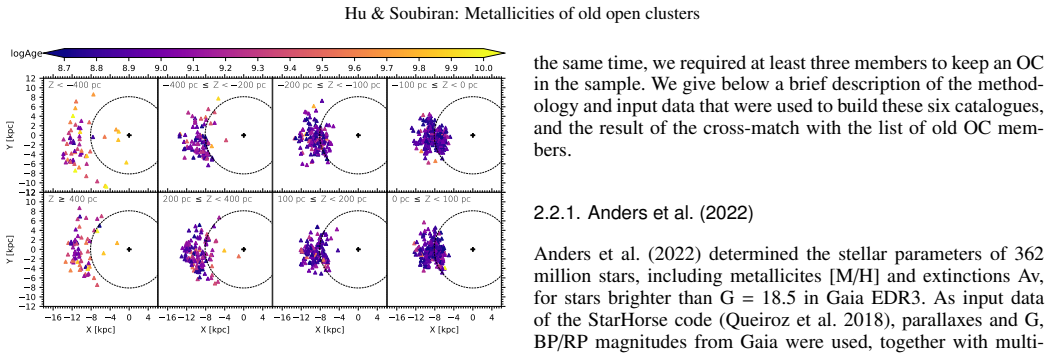
- The disc carries a well-defined chemical structure: every metal-rich old cluster with [M/H] ≥ +0.15 sits inside RG < 7.7 kpc, while metal-poor clusters dominate the outer disc at all ages.
- The inner radial gradient has flattened over time, from about 0.09 dex per kiloparsec for clusters younger than 700 Myr to about 0.06 dex per kiloparsec for clusters older than 2 Gyr.
- The large scatter in the age–metallicity relation is not intrinsic chaos: within each radius bin the relation is tight, so the global scatter is the superposition of populations born at different radii.
- Weak radial mixing follows: clusters record the metallicity of the gas at their birth radii, with per-bin dispersions below 0.08 dex, so the gradient reflects the disc's chemistry at formation rather than later stirring.
- Most of the disc's chemical enrichment happened before about 10 Gyr ago, because almost no cluster falls below [M/H] ≈ -0.55 at any age.
Reading between the lines
- The two admissible knee positions, 10.80 and 12.43 kpc, bracket the region where the Galactic bar's resonances are expected, so a real knee could be a dynamical imprint of the bar or spiral arms; the paper itself does not explore this beyond attributing regime changes at 7 and 11 kpc to the bar.
- A testable extension is to run the same bright-giant pipeline on clusters younger than 500 Myr: if the knee stays fixed while the inner slope steepens with youth, the outer flattening is a fossil of the primordial gas profile rather than a product of dynamical stirring.
- Field red giants in the same 1-kpc bins should show wider metallicity dispersion than these clusters if the clusters' tight scatter partly reflects survival bias — only the least-stirred clusters persist — rather than weak mixing in the disc as a whole.
- The sharp lower envelope at [M/H] ≈ -0.55 could be a selection limit of the cluster census rather than a true chemical floor; deeper searches for old clusters in the inner disc would distinguish a genuine enrichment floor from an incompleteness effect.
Editorial analysis
A structured set of objections, weighed in public.
Referee Report
Summary. The paper constructs a sample of about 600 old open clusters (age ≥ 500 Myr) with metallicities derived as the median of member-star metallicities from all-sky stellar-parameter catalogues based on Gaia DR3. The authors compare six catalogues against high-resolution spectroscopic cluster metallicities and adopt the bright-giant subsample of Andrae et al. (2023) as the most reliable, reporting a typical precision of 0.05 dex. Using this sample, they build metallicity maps, fit a segmented radial gradient with a knee, a vertical gradient, and study the radial gradient as a function of age and the age–metallicity relation in radial bins. They report an inner radial gradient of −0.084 ± 0.004 dex/kpc, an outer gradient of −0.018 ± 0.056 dex/kpc, a vertical gradient of −0.415 ± 0.030 dex/kpc, and argue that the small metallicity dispersion in each radius bin reflects weak radial mixing.
Significance. If the results hold, the paper provides the largest homogeneous all-sky metallicity catalogue of old open clusters to date, extending radial and vertical gradient constraints well beyond previous high-resolution samples. The strength of the work is the careful external calibration against Netopil et al. (2016) and OCCASO (Carbajo-Hijarrubia et al. 2024), and the explicit selection of the best-performing catalogue. The knee-shaped radial gradient is consistent with recent APOGEE-based field-star results, and the small radial-bin dispersions are an interesting and potentially important constraint on radial mixing. However, the vertical gradient and the uniqueness of the knee solution need to be demonstrated more rigorously before these headline conclusions can be fully accepted.
major comments (4)
- [Sec. 4.2, Fig. 5] The vertical metallicity gradient derived in Sec. 4.2 may be a projection of the radial gradient. In the sample, clusters with |Z| > 0.5 kpc are almost exclusively at R_G > 10 kpc (Fig. 5), so a fit of [M/H] versus |Z| alone will recover the radial gradient even if no intrinsic vertical gradient exists. The manuscript does not present a joint two-dimensional fit of [M/H] as a function of R_G and |Z|, nor does it show that the vertical gradient survives after subtracting the radial trend in radial bins. This is load-bearing for the reported value −0.415 ± 0.030 dex/kpc and for the subsequent comparison with literature vertical gradients.
- [Sec. 2.4] The statement that the zero-point offset between Andrae et al. (2023) bright-giant metallicities and high-resolution spectroscopy 'does not affect the value of gradients' assumes that the offset is constant in radius and metallicity. The validation sample covers only a limited radial range and, for the other catalogues in the same comparison, the residuals show a clear metallicity dependence (range compression at [Fe/H] > 0). If a similar, even weaker, dependence exists for the adopted catalogue, the slopes of the radial and vertical gradients would be biased. The authors should either quantify the offset as a function of [Fe/H] and R_G using the available reference samples, or assess how much the gradients change when a conservative linear offset correction is applied.
- [Sec. 4.2, Fig. 6] The knee position in the radial gradient is not unique: the text reports R_G = 12.43 ± 0.04 kpc as the most probable, but a second solution at R_G = 10.80 ± 0.04 kpc appears in the same fit (Fig. 6). Moreover, the outer slope −0.018 ± 0.056 dex/kpc is compatible with zero. The manuscript should provide a comparison between a single-slope model and the segmented model (e.g., AIC or BIC), explain the origin of the bimodality, and specify how the reported knee and outer slope depend on the exclusion of the three outliers (HSC 172, HSC 113, NGC 6791).
- [Sec. 4.3, Table 2] The age dependence of the inner radial gradient could be affected by the differing radial coverage of the age bins. Because the oldest clusters are preferentially located at large R_G, the flattening seen in the two oldest bins may partly reflect selection rather than an intrinsic change of the gradient with time. The authors should verify that the flattening persists when the fit is restricted to the common radial range across all age bins, or when the age bins are matched in their R_G distribution.
minor comments (4)
- [Sec. 4.2, caption of Fig. 6] The knee value quoted in the text (12.43 ± 0.04 kpc) differs from the value printed in the figure caption (11.857 with asymmetric uncertainties); please reconcile the two numbers and specify which of the two solutions each plotted line corresponds to.
- [Sec. 5] The term 'galactentric radius' should be 'galactocentric radius'.
- [Acknowledgements] The word 'leveraring' should be 'leveraging'.
- [Sec. 2.1] The phrase 'Fe/H]=+0.216±0.022' is missing an opening bracket; please fix the typo.
Circularity Check
No significant circularity; the paper is an empirical measurement study whose gradients are fits to externally validated data.
full rationale
The paper's central results — the knee-shaped radial gradient, the vertical gradient, and the per-radius AMR decomposition — are estimates fitted to cluster metallicities derived from Andrae et al. (2023) bright-giant values, which were in turn checked against independent high-resolution spectroscopic samples (Netopil et al. 2016; OCCASO/Carbajo-Hijarrubia et al. 2024). These are measurements interpreted in the light of previous work, not predictions obtained from inputs that already contain the output. The claim that the AMR scatter is explained by superposed populations at different radii is a re-binning and interpretation of the same measured metallicities, not a derived result that reduces by construction to a fitted parameter renamed as a prediction. The paper's self-citations (e.g., Soubiran et al. 2008 for vertical-gradient comparison, Tarricq et al. 2021 for NGC 6791's orbit) are contextual or comparative and are not load-bearing for the derivation. The reader-identified concern that the vertical gradient may be a projection of the radial gradient because high-|Z| clusters are predominantly in the outer disc is a potential statistical confounding or correctness risk, but it is not circularity under the required standard: the paper nowhere defines the vertical gradient as a consequence of the radial gradient, nor does it invoke a self-citation or fitted quantity to force that value by construction. Calibration against external high-resolution spectroscopy provides genuine independent grounding. Accordingly, the appropriate finding is no significant circularity.
Assumptions & free parameters
free parameters (7)
- inner radial gradient slope (mleft) =
-0.084 +/- 0.004 dex/kpc
- outer radial gradient slope (mright) =
-0.018 +/- 0.056 dex/kpc
- knee radius (Rknee) =
11.857 kpc (+0.962/-1.226), alternative solutions 10.80 and 12.43 kpc
- vertical gradient slope (mZ) =
-0.415 +/- 0.030 dex/kpc
- intrinsic scatter sigma =
0.097 dex (radial), 0.076 dex (vertical)
- age-metallicity slopes per RG bin =
+0.002 to -0.040 dex/Gyr
- cluster metallicity uncertainty (MAD) =
0.05 dex typical
assumptions (5)
- domain assumption Andrae+23 bright giant metallicities are accurate at the 0.05 dex level across the range of cluster properties in the sample
- ad hoc to paper The zero-point offset between Andrae+23 and high-res spectroscopy is constant so it cancels in gradients
- domain assumption Median of member [M/H] represents cluster metallicity
- domain assumption RG and Z from Cavallo+24 are accurate (Sun RG=8.122 kpc)
- ad hoc to paper Outliers (HSC 172, HSC 113, NGC 6791) can be excluded from gradient fits
Cite this review
Pith. "Pith review of Metallicities of old open clusters: A new Galactic map." pith.science (2026). https://pith.science/paper/CWMQJPFQ
@misc{pith2026250518378,
  author       = {Pith},
  title        = {Pith review of: Metallicities of old open clusters: A new Galactic map},
  year         = {2026},
  howpublished = {\url{https://pith.science/paper/CWMQJPFQ}},
  note         = {Machine review of arXiv:2505.18378}
}
abstract
Old open clusters (OCs) can constrain the chemical evolution of the Galactic disc through their metallicity gradients and age-metallicity relation but they are affected by low statistics. This work aims to determine precise and homogeneous metallicities for a number of old clusters ($\geq$ 500 Myr) from all-sky catalogues of stellar parameters leveraging Gaia spectrophotometry. Our purpose was to revisit the metallicity distribution of the oldest OCs as a function of their Galactic position and age with improved statistics. Our sample includes ~600 old OCs with a typical precision of 0.05 dex in metallicity. We identified metal-poor or metal-rich clusters never studied before, as well as moving groups as the remnants of dissolving clusters. Galactic maps show a smooth decrease in metallicity from inside to outside the disc. Metal-rich and metal-poor clusters exist at all ages but dominate respectively in the inner and the outer disc, with different scale heights.The radial metallicity gradient was found to have a knee shape with a steep value of -0.084$\pm$0.004 dex/kpc in the inner side and -0.018$\pm$0.056 dex/kpc outside the knee. The inner radial gradient flattens with age. Vertically, the metallicity gradient is -0.415$\pm$0.030 dex/kpc. The large scatter in the distribution of metallicity versus age is nicely explained by the superposition of OC populations standing at different galactocentric distances, each with its own mean metallicity and small dispersion, less than 0.08 dex in radius bins of 1 kpc.Our results are consistent with a negative radial metallicity gradient of interstellar matter that was present in the disc when the clusters formed. The low metallicity dispersion in each radius bin reflects weak radial mixing.
Figures


Figures from the paper (5 more)


Reference graph
Works this paper leans on
-
[1]
, " * write output.state after.block = add.period write newline
ENTRY address archiveprefix author booktitle chapter edition editor howpublished institution eprint journal key month note number organization pages publisher school series title type volume year label extra.label sort.label short.list INTEGERS output.state before.all mid.sentence after.sentence after.block FUNCTION init.state.consts #0 'before.all := #1 ...
-
[2]
write newline
" write newline "" before.all 'output.state := FUNCTION n.dashify 't := "" t empty not t #1 #1 substring "-" = t #1 #2 substring "--" = not "--" * t #2 global.max substring 't := t #1 #1 substring "-" = "-" * t #2 global.max substring 't := while if t #1 #1 substring * t #2 global.max substring 't := if while FUNCTION word.in bbl.in " " * FUNCTION format....
-
[3]
Abdurro'uf, Accetta, K., Aerts, C., et al.\ 2022, , 259, 35
work page 2022
-
[4]
Anders, F., Chiappini, C., Minchev, I., et al.\ 2017, , 600, A70
2017
-
[5]
Anders, F., Khalatyan, A., Queiroz, A. B. A., et al.\ 2022, , 658, A91
work page 2022
-
[6]
Andrae, R., Fouesneau, M., Sordo, R., et al.\ 2023, , 674, A27
work page 2023
-
[7]
Andrae, R., Rix, H.-W., & Chandra, V.\ 2023, , 267, 8
work page 2023
-
[8]
Buder, S., Sharma, S., Kos, J., et al.\ 2021, , 506, 150
work page 2021
Show all 81 references
-
[9]
Cantat-Gaudin, T., Anders, F., Castro-Ginard, A., et al.\ 2020, , 640, A1
2020
-
[10]
& Casamiquela, L.\ 2024, , 99, 101696
Cantat-Gaudin, T. & Casamiquela, L.\ 2024, , 99, 101696
2024
-
[11]
Carbajo-Hijarrubia, J., Casamiquela, L., Carrera, R., et al.\ 2024, , 687, A239
2024
-
[12]
Carrera, R., Bragaglia, A., Cantat-Gaudin, T., et al.\ 2019, , 623, A80
2019
-
[13]
Casamiquela, L., Carrera, R., Jordi, C., et al.\ 2016, , 458, 3150
2016
-
[14]
Casamiquela, L., Soubiran, C., Jofr \'e , P., et al.\ 2021, , 652, A25
2021
-
[15]
Cavallo, L., Spina, L., Carraro, G., et al.\ 2024, , 167, 12
2024
-
[16]
C., Magnier, E
Chambers, K. C., Magnier, E. A., Metcalfe, N., et al.\ 2016, arXiv:1612.05560
2016 arXiv
-
[17]
L., & Wang, J
Chen, L., Hou, J. L., & Wang, J. J.\ 2003, , 125, 1397
2003
-
[18]
Cirasuolo, M., Afonso, J., Carollo, M., et al.\ 2014, , 9147, 91470N
2014
-
[19]
Cropper, M., Katz, D., Sartoretti, P., et al.\ 2018, , 616, A5
2018
-
[20]
M., Skrutskie, M
Cutri, R. M., Skrutskie, M. F., van Dyk, S., et al.\ 2003, 2MASS All Sky Catalog of point sources
2003
-
[21]
M., Wright, E
Cutri, R. M., Wright, E. L., Conrow, T., et al.\ 2013, Explanatory Supplement to the AllWISE Data Release Products, by R. M. Cutri et al., Explanatory Supplement to the AllWISE Data Release Products, 1
2013
-
[22]
De Angeli, F., Weiler, M., Montegriffo, P., et al.\ 2023, , 674, A2
2023
-
[23]
S., Agertz, O., Berbel, A
de Jong, R. S., Agertz, O., Berbel, A. A., et al.\ 2019, 175, 3
2019
-
[24]
M., Freeman, K
De Silva, G. M., Freeman, K. C., Bland-Hawthorn, J., et al.\ 2015, , 449, 2604
2015
-
[25]
S., Monteiro, H., Moitinho, A., et al.\ 2021, , 504, 356
Dias, W. S., Monteiro, H., Moitinho, A., et al.\ 2021, , 504, 356
2021
-
[26]
M., Cunha, K., et al.\ 2020, , 159, 199
Donor, J., Frinchaboy, P. M., Cunha, K., et al.\ 2020, , 159, 199
2020
-
[27]
W., Rix, H.-W., et al.\ 2022, , 928, 23
Eilers, A.-C., Hogg, D. W., Rix, H.-W., et al.\ 2022, , 928, 23
2022
-
[28]
Fallows, C. P. & Sanders, J. L.\ 2024, , 531, 2126
2024
-
[29]
D.\ 1995, , 33, 381
Friel, E. D.\ 1995, , 33, 381
1995
-
[30]
D., Janes, K
Friel, E. D., Janes, K. A., Tavarez, M., et al.\ 2002, , 124, 2693
2002
-
[31]
Fu, X., Bragaglia, A., Liu, C., et al.\ 2022, , 668, A4
2022
-
[32]
Gaia Collaboration, Brown, A. G. A., Vallenari, A., et al.\ 2021, , 649, A1
2021
-
[33]
Gaia Collaboration, Prusti, T., de Bruijne, J. H. J., et al.\ 2016, , 595, A1
2016
-
[34]
Gaia Collaboration, Recio-Blanco, A., Kordopatis, G., et al.\ 2023, , 674, A38
2023
-
[35]
Gaia Collaboration, Vallenari, A., Brown, A. G. A., et al.\ 2023, , 674, A1
2023
-
[36]
R., Fern \'a ndez-Trincado, J
Garro, E. R., Fern \'a ndez-Trincado, J. G., Minniti, D., et al.\ 2023, , 669, A136
2023
-
[37]
GRAVITY Collaboration, Abuter, R., Amorim, A., et al.\ 2018, , 615, L15
2018
-
[38]
Haywood, M., Khoperskov, S., Cerqui, V., et al.\ 2024, , 690, A147
2024
-
[39]
Heiter, U., Soubiran, C., Netopil, M., et al.\ 2014, , 561, A93
2014
-
[40]
Hunt, E. L. & Reffert, S.\ 2023, , 673, A114
2023
-
[41]
Hunt, E. L. & Reffert, S.\ 2024, , 686, A42
2024
-
[42]
A.\ 1979, , 39, 135
Janes, K. A.\ 1979, , 39, 135
1979
-
[43]
C., Dalton, G
Jin, S., Trager, S. C., Dalton, G. B., et al.\ 2024, , 530, 2688
2024
-
[44]
C., Deepak, & Malhotra, S.\ 2024, Frontiers in Astronomy and Space Sciences, 11, 1348321
Joshi, Y. C., Deepak, & Malhotra, S.\ 2024, Frontiers in Astronomy and Space Sciences, 11, 1348321
2024
-
[45]
Katz, D., Sartoretti, P., Guerrier, A., et al.\ 2023, , 674, A5
2023
-
[46]
Khalatyan, A., Anders, F., Chiappini, C., et al.\ 2024, , 691, A98
2024
-
[47]
L., et al.\ 2025, arXiv:2501.06140
Kos, J., Buder, S., Beeson, K. L., et al.\ 2025, arXiv:2501.06140
2025
-
[48]
Magrini, L., Viscasillas V \'a zquez, C., Spina, L., et al.\ 2023, , 669, A119
2023
-
[49]
Marocco, F., Eisenhardt, P. R. M., Fowler, J. W., et al.\ 2021, , 253, 8
2021
-
[50]
Minchev, I., Anders, F., Recio-Blanco, A., et al.\ 2018, , 481, 1645
2018
-
[51]
Montegriffo, P., De Angeli, F., Andrae, R., et al.\ 2023, , 674, A3
2023
-
[52]
Myers, N., Donor, J., Spoo, T., et al.\ 2022, , 164, 85
2022
-
[53]
A., C akmak, H., et al.\ 2022, , 509, 421
Netopil, M., Oralhan, \.I . A., C akmak, H., et al.\ 2022, , 509, 421
2022
-
[54]
Netopil, M., Paunzen, E., Heiter, U., et al.\ 2016, , 585, A150
2016
-
[55]
Nordstr \"o m, B., Mayor, M., Andersen, J., et al.\ 2004, , 418, 989
2004
-
[56]
A., Wolf, C., Bessell, M
Onken, C. A., Wolf, C., Bessell, M. S., et al.\ 2019, , 36, e033
2019
-
[57]
Palla, M., Magrini, L., Spitoni, E., et al.\ 2024, , 690, A334
2024
-
[58]
Pancino, E., Carrera, R., Rossetti, E., et al.\ 2010, , 511, A56
2010
-
[59]
E., Claria, J
Piatti, A. E., Claria, J. J., & Abadi, M. G.\ 1995, , 110, 2813
1995
-
[60]
Queiroz, A. B. A., Anders, F., Santiago, B. X., et al.\ 2018, , 476, 2556
2018
-
[61]
Randich, S., Gilmore, G., Magrini, L., et al.\ 2022, , 666, A121
2022
-
[62]
A., et al.\ 2023, , 674, A29
Recio-Blanco, A., de Laverny, P., Palicio, P. A., et al.\ 2023, , 674, A29
2023
-
[63]
Renaud, F., Ratcliffe, B., Minchev, I., et al.\ 2025, , 694, A56
2025
-
[64]
J., Johnson, J
Schlesinger, K. J., Johnson, J. A., Rockosi, C. M., et al.\ 2014, , 791, 112
2014
-
[65]
V., et al.\ 2008, , 480, 91
Soubiran, C., Bienaym \'e , O., Mishenina, T. V., et al.\ 2008, , 480, 91
2008
-
[66]
Spina, L., Magrini, L., & Cunha, K.\ 2022, Universe, 8, 87
2022
-
[67]
M., et al.\ 2021, , 503, 3279
Spina, L., Ting, Y.-S., De Silva, G. M., et al.\ 2021, , 503, 3279
2021
-
[68]
Steinmetz, M., Matijevi c , G., Enke, H., et al.\ 2020, , 160, 82
2020
-
[69]
Steinmetz, M., Zwitter, T., Siebert, A., et al.\ 2006, , 132, 1645
2006
-
[70]
Tarricq, Y., Soubiran, C., Casamiquela, L., et al.\ 2021, , 647, A19
2021
-
[71]
B.\ 2005, Astronomical Data Analysis Software and Systems XIV, 347, 29
Taylor, M. B.\ 2005, Astronomical Data Analysis Software and Systems XIV, 347, 29
2005
-
[72]
J., Shen, J., & Li, Z.-Y.\ 2021, , 922, 189
Vickers, J. J., Shen, J., & Li, Z.-Y.\ 2021, , 922, 189
2021
-
[73]
Wang, C., Huang, Y., Yuan, H., et al.\ 2022, , 259, 51
2022
-
[74]
T., et al.\ 2023, , 526, 2141
Willett, E., Miglio, A., Mackereth, J. T., et al.\ 2023, , 526, 2141
2023
-
[75]
Yang, G., Zhao, J., Yang, Y., et al.\ 2025, , 169, 214
2025
-
[76]
J., et al.\ 2009, , 137, 4377
Yanny, B., Rockosi, C., Newberg, H. J., et al.\ 2009, , 137, 4377
2009
-
[77]
Ye, X., Wu, W., Allende Prieto, C., et al.\ 2025, , 695, A75
2025
-
[78]
Zhang, R., Lucatello, S., Bragaglia, A., et al.\ 2021, , 654, A77
2021
-
[79]
Zhang, R., Wang, G.-J., Lu, Y., et al.\ 2024, , 692, A212
2024
-
[80]
M., & Rix, H.-W.\ 2023, , 524, 1855
Zhang, X., Green, G. M., & Rix, H.-W.\ 2023, , 524, 1855
2023
-
[81]
Zhong, J., Chen, L., Wu, D., et al.\ 2020, , 640, A127
2020
Reviewed August 7, 2026 · model on record in the stance chip above.
Discussion (0). Continue with ORCID to comment.