REVIEW 3 major objections 4 minor 83 references
An Extreme Stellar Prominence Eruption Observed by LAMOST Time-Domain Spectroscopy
T0 review · 3 major / 4 minor · reviewed 2026-08-12 · deepseek-v4-flash
Pith's one-line read An M dwarf's magnetic field hurled a massive prominence into space, possibly its own CME.
desk verdict The kinematic detection is real and the event is genuinely extreme, but the 'largest mass ratio' headline rests on a spherical-volume assumption and solar density relations that could easily be off by an order of magnitude. read the letter →
The pith
A machine-rendered reading of the paper's core claim, the machinery that carries it, and where it could break.
The reading
What carries the argument
The central object is the Hα line profile asymmetry analyzed with a two-cloud radiative transfer model (Appendix C, Eq. C5). The model treats the erupting prominence as an upper cloud (cloud 1) and the flare emission region as a lower cloud (cloud 2) along the line of sight, with Gaussian optical-depth profiles (Eq. C6). The model yields the source function, optical depth, Doppler shift, and Doppler broadening for each cloud. These parameters are converted to excitation temperature (Eq. C7) and hydrogen column density (Eq. C8), which then feed the mass estimate. The mass calculation (Appendix D) additionally assumes a spherical prominence volume whose radius comes from the projected area (Eq. D9–D13), using solar-like relations between electron density and hydrogen density and between electron density and the second-level hydrogen column density.
What would settle it
Direct measurement of the prominence's physical depth or density would falsify the mass claim: for instance, if a simultaneous EUV or X-ray observation showed no coronal dimming indicative of a large mass loss, or if high spatial resolution imaging (e.g., with a large-aperture telescope like DKIST or the future ELT) resolved the erupting structure as a thin, sheet-like filament with a line-of-sight depth much smaller than the assumed spherical radius, the mass could be reduced to below $10^{18}$ g, negating the record mass ratio while leaving the blueshift detection intact.
Extended reading notes
Core claim
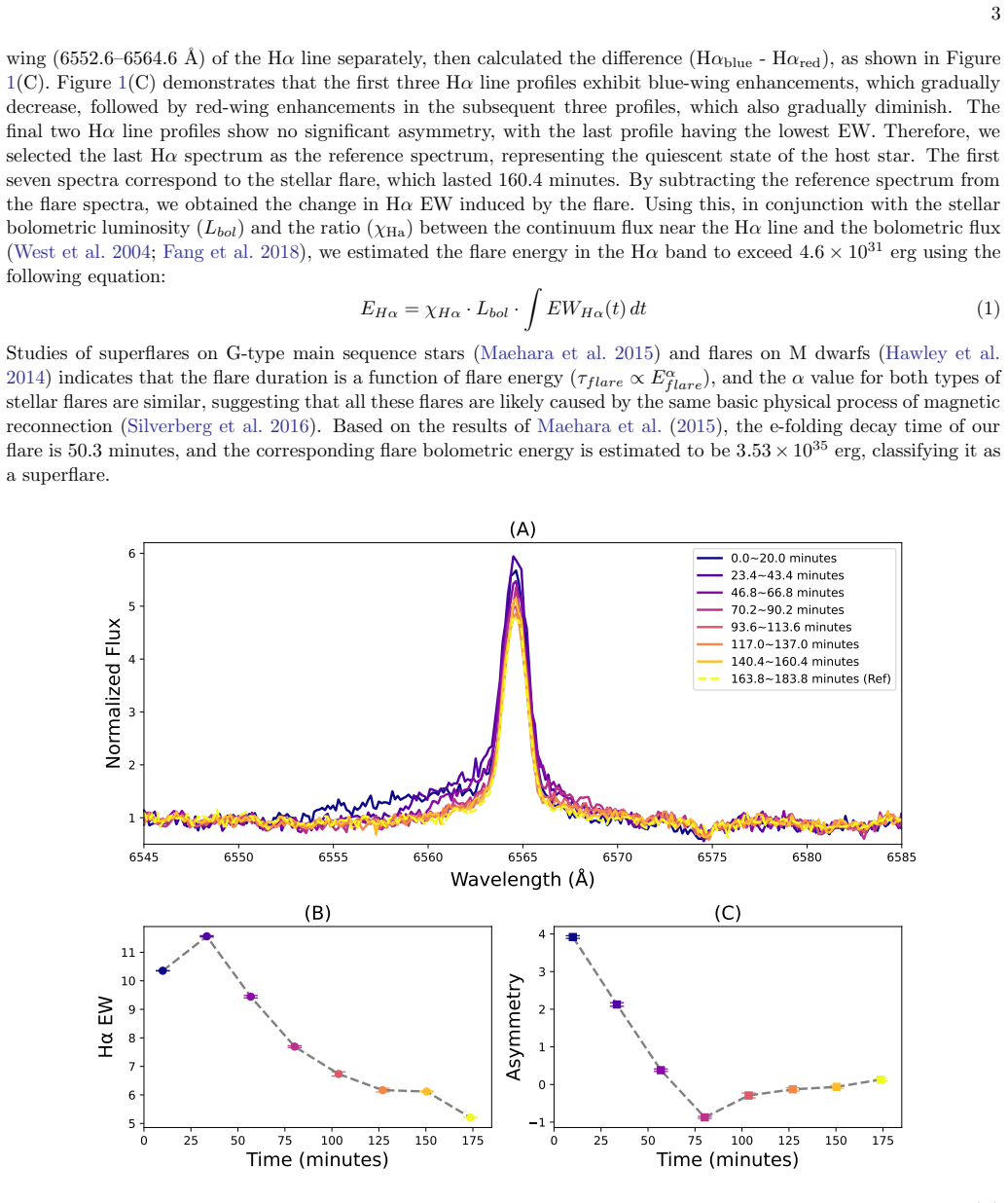
Using eight LAMOST medium-resolution spectra spanning 183.8 minutes, the authors identify a superflare (Hα energy >4.6×$10^{31}$ erg, bolometric energy ≈3.5×$10^{35}$ erg) on the M dwarf LAMOST J044431.62+235627.9. During the impulsive phase and near flare peak, the Hα line shows a blue-wing enhancement that cannot be explained by chromospheric evaporation, reconnection outflows, or co-rotating prominence emission. Their two-cloud model of the most asymmetric profile (first spectrum, 0–20 min) attributes the blue-shifted component (cloud 1) to an erupting prominence with source function S=0.56, optical depth τ=1.49, line-of-sight velocity -229 km/s, and Doppler broadening 4.35 Å. From this fit, the projected area of the prominence is 1.19×$10^{18}$ $m^{2}$ (≈6.8 stellar disk areas), and assuming spherical expansion and solar-like density relations, the mass is 1.6–7.2×$10^{19}$ g. The ratio of this mass to the host star's mass (0.32 M⊙) is the largest among all reported stellar prominence eruptions/CMEs, making this event the most extreme stellar prominence eruption observed to date.
Load-bearing premise
The mass estimate depends on assuming the erupting prominence expands as a sphere whose radius is set by its projected area, and on the applicability of solar prominence density ratios (ne–n2 and ne/nH) to an M dwarf; if the true geometry is a thin sheet or filament, or if the density ratio differs on M dwarfs, the mass could change by orders of magnitude, which would weaken the 'largest mass ratio' claim even though the kinematic detection would stand.
Editorial extensions
If this is right
- If the mass estimate is correct, this event ejects more than 10^19 g of plasma from a low-mass star, which could alter the star's angular momentum and mass-loss budget.
- Because some projected velocities exceed the local escape velocity, the event implies that M-dwarf superflares can indeed drive coronal mass ejections, a key question for stellar CME studies.
- The prominence mass is comparable to the host star's Hα quiescent emission, meaning such eruptions could temporarily dominate the star's spectral energy distribution in Hα.
- If such events are common, they would significantly impact the atmospheres of any orbiting exoplanets, potentially stripping them or altering their chemistry.
- The record-breaking mass ratio provides a new benchmark for models of stellar prominence eruption and CME formation on active M dwarfs.
Reading between the lines
- The mass estimate is extremely sensitive to the assumed geometry (sphere vs. sheet) and to the transferability of solar prominence density relations (N2–ne and ne/nH) to M dwarfs; a more flattened geometry could reduce the mass by orders of magnitude, weakening the 'largest mass ratio' claim even though the kinematic detection would stand.
- If the eruption is confirmed as a CME by future high-cadence multi-line or imaging observations, it would imply that low-mass stars with strong magnetic fields can expel a substantial fraction of their outer atmosphere, which could be a major channel for stellar angular momentum loss.
- The observed blueshift persistence (over one hour) suggests that the erupting structure is large and coherent; a direct test would be to search for coronal dimming in simultaneous EUV or X-ray data for similar events.
- The event's placement in a sample of 22 blue-wing events (Fig. 4) suggests that such extreme eruptions are rare but not absent; a systematic search of LAMOST time-domain spectra might uncover additional cases that can be studied with the same two-cloud technique.
Signed reviews
Editorial analysis
A structured set of objections, weighed in public.
Referee Report
Summary. This manuscript reports time-domain H-alpha spectroscopy from LAMOST of the M dwarf LAMOST J044431.62+235627.9 during a superflare, identifying a strong blue-wing enhancement that the authors interpret as an erupting stellar prominence. Gaussian decomposition gives a projected bulk blueshift of -228 +/- 11 km/s and a maximum blueshift of -605 +/- 15 km/s, with some line-of-sight velocities exceeding the local escape velocity. A two-cloud model is used to extract physical parameters, yielding a projected prominence area of about 6.8 times the stellar disk and a prominence mass of 1.6e19 to 7.2e19 g. The paper's headline claim is that this event has the largest mass ratio of prominence/CME to host star among all reported stellar prominence eruptions/CMEs.
Significance. The time-domain H-alpha data and the Gaussian fitting provide a solid kinematic detection: the blue-wing enhancement, the measured velocities, and the comparison with the escape velocity are well documented and are an important addition to the sparse sample of stellar prominence eruption candidates. The paper is also valuable for compiling a quantitative comparison of H-alpha blue-wing EWs across 22 events. However, the record-setting mass-ratio claim rests entirely on the mass estimate in Appendix D, which depends on an unexplained factor in the luminosity conversion, a spherical-volume assumption, and solar-based density relations. If those assumptions are not substantially better constrained, the central 'largest mass ratio' claim is not yet secured, even though the kinematic result stands.
major comments (3)
- [Appendix D, Eq. (D9)] The factor 1/4 in the conversion from H-alpha EW to line-of-sight H-alpha luminosity is not explained or derived. The equation L_Halpha_bluewing_los = chi_Halpha * L_bol * EW_Halpha_bluewing / 4 is load-bearing: it sets the luminosity used to infer the projected area and hence the radius and mass. The authors should either provide a derivation of this factor (including whether it accounts for the fraction of the stellar disk contributing to the continuum, an anisotropy factor, or a unit conversion) or replace it with a fully referenced standard expression. As written, the factor appears ad hoc.
- [Appendix D, Eqs. (D10)-(D13)] The mass derivation assumes that the erupting prominence expands as a sphere with radius R_CME obtained from the projected area and that the line-of-sight thickness D equals 2 R_CME. Solar prominences are typically filamentary or sheet-like, with a small volume filling factor, and the manuscript provides no observational constraint on D. If D is an order of magnitude smaller than 2 R_CME, the mass in Eq. (D13) drops by a corresponding order of magnitude, which could remove the event from the 'largest mass ratio' position. The record claim therefore needs either a direct constraint on the line-of-sight geometry or a presentation of the mass as a heavily model-dependent upper limit rather than a definitive record.
- [Appendix C, Eq. (C7) and Appendix D, Eqs. (D11)-(D12)] The excitation temperature and column density N2 from the two-cloud model require the departure coefficients b2 and b3, but their values are never stated. In addition, the electron density relation n_e ~ 3.2e8 sqrt(n2) and the hydrogen-to-electron density ratio n_e/n_H ~ 0.2-0.9 are taken from solar prominence studies, and their applicability to an M-dwarf prominence is not discussed. These unquantified inputs propagate directly into n_H and thus into the mass estimate. At minimum, the authors should state the adopted b2/b3 values, test the sensitivity of the mass to plausible ranges of these solar-relation parameters, and add explicit caveats about applying solar prominence scaling laws to active M dwarfs.
minor comments (4)
- [Authors (title page)] There is a typo in the author list: 'Jia-Sheng W ang' should be 'Jia-Sheng Wang'.
- [Section 4, Figure 4] The color-bar labels in Figure 4 are difficult to read because the tick labels are placed at values that do not match the color scale. Please reformat the color bar so that its limits and ticks are clearly visible.
- [Section 2 and Figure 1] The statement that the last spectrum represents the quiescent state should be justified further, because the final spectrum still has an H-alpha EW close to that of the earlier flare spectra and may contain lingering activity. A brief examination of the night-to-night stability of the H-alpha profile would strengthen the reference-subtraction approach.
- [Appendix B, Eq. (B4)] The definition of the maximum velocity for the blue-shifted component as lambda_i - lambda_0 +/- 2*sigma_i is asymmetric in sign; the authors should explain why the plus sign is used for the blueshifted component and whether the quoted -605 km/s corresponds to the blue edge of the Gaussian.
Circularity Check
No significant circularity: the kinematic measurements and EW record are direct observational quantities, and the mass is a model-based inference, not an input renamed as a prediction.
full rationale
The paper's central detections (projected bulk blueshift -228 km/s, maximum -605 km/s, and H-alpha blue-wing EW) come from Gaussian fits to time-domain spectra after subtracting a quiescent reference; none of these quantities is a fitted parameter that is then renamed as the result. The mass estimate (1.6e19-7.2e19 g) is derived in Appendix D through a chain: the two-cloud model fit gives S1 and tau1; Eq. C8 gives column density N2; solar empirical relations (Eqs. D10-D12) give density; Eq. D13 combines this with an assumed spherical volume whose radius comes from a projected area estimated from line luminosity divided by model radiance. This is standard model-based inference: the mass is not equal by construction to any input, and the comparison to other events is an external benchmark rather than a tautology. Self-citations (Lu et al. 2022, 2023; Yang et al. 2022, 2024; Tian et al. 2023; Xu et al. 2022, 2024a,b) are used for contextual methods and sample context, not as a load-bearing uniqueness argument. Unquantified modeling choices (the unexplained factor 1/4 in Eq. D9, unspecified departure coefficients b2/b3, and the spherical-volume assumption) are accuracy risks that could change the mass, but they do not make the derivation circular. The detection and EW record stand independently of the mass estimate.
Assumptions & free parameters
free parameters (5)
- S1 (prominence source function) =
0.56
- tau1 (prominence optical depth) =
1.49
- Delta lambda_D1 (prominence Doppler broadening) =
4.35 A
- ne/nH ratio =
0.2 to 0.9
- Factor 1/4 in Halpha luminosity conversion =
0.25
assumptions (6)
- domain assumption The last Halpha spectrum represents the quiescent state of the star
- domain assumption The blueshifted Halpha component originates from an erupting prominence, not chromospheric evaporation or reconnection outflows
- domain assumption Solar prominence density relations (N2-ne and ne/nH) apply to M dwarf prominences
- ad hoc to paper The prominence expands as a sphere with radius derived from the projected area
- domain assumption Background chromospheric radiation can be neglected after reference subtraction
- ad hoc to paper The factor 1/4 in Eq. D9 is the correct conversion from Halpha EW to luminosity
Cite this review
Pith. "Pith review of An Extreme Stellar Prominence Eruption Observed by LAMOST Time-Domain Spectroscopy." pith.science (2026). https://pith.science/paper/CXGJPW2M
@misc{pith2026241111076,
  author       = {Pith},
  title        = {Pith review of: An Extreme Stellar Prominence Eruption Observed by LAMOST Time-Domain Spectroscopy},
  year         = {2026},
  howpublished = {\url{https://pith.science/paper/CXGJPW2M}},
  note         = {Machine review of arXiv:2411.11076}
}
abstract
We report the detection of an extreme stellar prominence eruption on the M dwarf LAMOST J044431.62+235627.9, observed through time-domain H$\alpha$ spectroscopy with the Large Sky Area Multi-Object Fiber Spectroscopic Telescope (LAMOST). This prominence eruption was accompanied by a superflare lasting over 160.4 minutes. The H$\alpha$ line profile exhibits significant blue-wing enhancement during the impulsive phase and near the flare peak, with a projected bulk blueshift velocity of $-228\pm11$~km~s$^{-1}$ and a maximum blueshift velocity reaching $-605\pm15$~km~s$^{-1}$. Velocity analysis of the eruptive prominence at various heights above the stellar surface indicates that some of the projected ejection velocities along the line of sight exceed the corresponding escape velocities, suggesting a potential coronal mass ejection (CME). The equivalent width (EW) of the H$\alpha$ blue-wing enhancement in this eruption appears to be the largest observed to date and is comparable to the EW of the H$\alpha$ line profile during the quiescent phase of the host star. We performed a two-cloud modeling for the prominence and the associated flare, which suggests that the eruptive prominence has a mass ranging from $1.6 \times 10^{19}~\text{g}$ to $7.2 \times 10^{19}~\text{g}$. More importantly, the mass ratio of the erupting prominence to its host star is the largest among all reported stellar prominence eruptions/CMEs.
Figures


Figures from the paper (2 more)


Reference graph
Works this paper leans on
-
[1]
2014, SoPh, 289, 4117, doi: 10.1007/s11207-014-0559-x
Ahn, K., Chae, J., Cho, K.-S., et al. 2014, SoPh, 289, 4117, doi: 10.1007/s11207-014-0559-x
-
[2]
2016, Nature Geoscience, 9, 452, doi: 10.1038/ngeo2719
Danchi, W. 2016, Nature Geoscience, 9, 452, doi: 10.1038/ngeo2719
doi:10.1038/ngeo2719 2016
-
[3]
2020, Plasma Physics and Controlled Fusion, 62, 014016, doi: 10.1088/1361-6587/ab5406
Antolin, P. 2020, Plasma Physics and Controlled Fusion, 62, 014016, doi: 10.1088/1361-6587/ab5406
-
[4]
Argiroffi, C., Reale, F., Drake, J. J., et al. 2019, Nature Astronomy, 3, 742, doi: 10.1038/s41550-019-0781-4
-
[5]
2024, ApJ, 963, 13, doi: 10.3847/1538-4357/ad1928
Cao, D., & Gu, S. 2024, ApJ, 963, 13, doi: 10.3847/1538-4357/ad1928
-
[6]
2022a, ApJ, 933, 92, doi: 10.3847/1538-4357/ac739b
Chen, H., Tian, H., Li, H., et al. 2022a, ApJ, 933, 92, doi: 10.3847/1538-4357/ac739b
-
[7]
2022b, A&A, 659, A107, doi: 10.1051/0004-6361/202142093
Chen, H., Tian, H., Li, L., et al. 2022b, A&A, 659, A107, doi: 10.1051/0004-6361/202142093
-
[8]
Chen, P. F. 2011, Living Reviews in Solar Physics, 8, 1, doi: 10.12942/lrsp-2011-1
Show all 83 references
-
[9]
2012, Research in Astronomy and Astrophysics, 12, 1197, doi: 10.1088/1674-4527/12/9/003
Cui, X.-Q., Zhao, Y.-H., Chu, Y.-Q., et al. 2012, Research in Astronomy and Astrophysics, 12, 1197, doi: 10.1088/1674-4527/12/9/003
2012 doi
-
[10]
2018, MNRAS, 476, 908, doi: 10.1093/mnras/sty212
Fang, X.-S., Zhao, G., Zhao, J.-K., & Bharat Kumar, Y. 2018, MNRAS, 476, 908, doi: 10.1093/mnras/sty212
2018 doi
-
[11]
Forbes, T. G. 2000, J. Geophys. Res., 105, 23153, doi: 10.1029/2000JA000005
2000 doi
-
[12]
Fuhrmeister, B., Czesla, S., Schmitt, J. H. M. M., et al. 2018, A&A, 615, A14, doi: 10.1051/0004-6361/201732204 12 Gaia Collaboration, Babusiaux, C., van Leeuwen, F., et al. 2018, A&A, 616, A10, doi: 10.1051/0004-6361/201832843
2018 doi
-
[13]
2010, Sun and Geosphere, 5, 7
Gopalswamy, N., Yashiro, S., Michalek, G., et al. 2010, Sun and Geosphere, 5, 7
2010
-
[14]
M., Dun, J
Gu, X. M., Dun, J. P., & Zhong, S. H. 2001, A&A, 380, 704, doi: 10.1051/0004-6361:20011251
2001 doi
-
[15]
2023, AJ, 165, 267, doi: 10.3847/1538-3881/acd1ec
Pascucci, I., & L´ opez-Morales, M. 2023, AJ, 165, 267, doi: 10.3847/1538-3881/acd1ec
2023 doi
-
[16]
L., Davenport, J
Hawley, S. L., Davenport, J. R. A., Kowalski, A. F., et al. 2014, ApJ, 797, 121, doi: 10.1088/0004-637X/797/2/121
2014 doi
-
[17]
2018, PASJ, 70, 62, doi: 10.1093/pasj/psy055
Honda, S., Notsu, Y., Namekata, K., et al. 2018, PASJ, 70, 62, doi: 10.1093/pasj/psy055
2018 doi
-
[18]
D., Li, Y., Fang, C., & Cao, W
Hong, J., Ding, M. D., Li, Y., Fang, C., & Cao, W. 2014, ApJ, 792, 13, doi: 10.1088/0004-637X/792/1/13
2014 doi
-
[19]
R., Foing, B
Houdebine, E. R., Foing, B. H., & Rodono, M. 1990, A&A, 238, 249
1990
-
[20]
J., Poppenh¨ ager, K., et al
Ilin, E., Schmidt, S. J., Poppenh¨ ager, K., et al. 2021, A&A, 645, A42, doi: 10.1051/0004-6361/202039198
2021 doi
-
[21]
2023, ApJ, 948, 9, doi: 10.3847/1538-4357/acb7e8
Inoue, S., Maehara, H., Notsu, Y., et al. 2023, ApJ, 948, 9, doi: 10.3847/1538-4357/acb7e8
2023 doi
-
[22]
B., Enoto, T., et al
Inoue, S., Iwakiri, W. B., Enoto, T., et al. 2024a, ApJL, 969, L12, doi: 10.3847/2041-8213/ad5667
-
[23]
2024b, PASJ, 76, 175, doi: 10.1093/pasj/psae001
Inoue, S., Enoto, T., Namekata, K., et al. 2024b, PASJ, 76, 175, doi: 10.1093/pasj/psae001
-
[24]
Schrijver, C. J. 2022, ApJ, 928, 154, doi: 10.3847/1538-4357/ac589b
2022 doi
-
[25]
C., Lin, J., et al
Ko, Y.-K., Raymond, J. C., Lin, J., et al. 2003, ApJ, 594, 1068, doi: 10.1086/376982
2003 doi
-
[26]
2021, A&A, 646, A34, doi: 10.1051/0004-6361/202039003
Koller, F., Leitzinger, M., Temmer, M., et al. 2021, A&A, 646, A34, doi: 10.1051/0004-6361/202039003
2021 doi
-
[27]
C., et al
Labrosse, N., Heinzel, P., Vial, J. C., et al. 2010, SSRv, 151, 243, doi: 10.1007/s11214-010-9630-6
2010 doi
-
[28]
2022, Serbian Astronomical Journal, 205, 1, doi: 10.2298/SAJ2205001L
Leitzinger, M., & Odert, P. 2022, Serbian Astronomical Journal, 205, 1, doi: 10.2298/SAJ2205001L
2022 doi
-
[29]
2024, MNRAS, 532, 1486, doi: 10.1093/mnras/stae1404
Leitzinger, M., Odert, P., & Greimel, R. 2024, MNRAS, 532, 1486, doi: 10.1093/mnras/stae1404
2024 doi
-
[30]
2011, A&A, 536, A62, doi: 10.1051/0004-6361/201015985
Leitzinger, M., Odert, P., Ribas, I., et al. 2011, A&A, 536, A62, doi: 10.1051/0004-6361/201015985
2011 doi
-
[31]
P., & Song, H.-Q
Li, L.-P., Peter, H., Chitta, L. P., & Song, H.-Q. 2021, Research in Astronomy and Astrophysics, 21, 255, doi: 10.1088/1674-4527/21/10/255
2021 doi
-
[32]
D., Hong, J., Li, H., & Gan, W
Li, Y., Ding, M. D., Hong, J., Li, H., & Gan, W. Q. 2019, ApJ, 879, 30, doi: 10.3847/1538-4357/ab245a
2019 doi
-
[33]
D., Qiu, J., & Cheng, J
Li, Y., Ding, M. D., Qiu, J., & Cheng, J. X. 2015, ApJ, 811, 7, doi: 10.1088/0004-637X/811/1/7
2015 doi
-
[34]
C., Ding, M
Li, Y., Xue, J. C., Ding, M. D., et al. 2018, ApJL, 853, L15, doi: 10.3847/2041-8213/aaa6c0
2018 doi
-
[35]
C., & van Ballegooijen, A
Lin, J., Raymond, J. C., & van Ballegooijen, A. A. 2004, ApJ, 602, 422, doi: 10.1086/380900
2004 doi
-
[36]
2019, Host Stars and their Effects on Exoplanet
Linsky, J. 2019, Host Stars and their Effects on Exoplanet
2019
- [37]
- [38]
-
[39]
2019, Research in Astronomy and Astrophysics, 19, 075, doi: 10.1088/1674-4527/19/5/75
Liu, N., Fu, J.-N., Zong, W., et al. 2019, Research in Astronomy and Astrophysics, 19, 075, doi: 10.1088/1674-4527/19/5/75
2019 doi
-
[40]
Loyd, R. O. P., Mason, J. P., Jin, M., et al. 2022, ApJ, 936, 170, doi: 10.3847/1538-4357/ac80c1
2022 doi
-
[41]
2022, A&A, 663, A140, doi: 10.1051/0004-6361/202142909
Lu, H.-p., Tian, H., Zhang, L.-y., et al. 2022, A&A, 663, A140, doi: 10.1051/0004-6361/202142909
2022 doi
-
[42]
2023, ApJ, 953, 68, doi: 10.3847/1538-4357/acd6a1
Lu, H.-p., Tian, H., Chen, H.-c., et al. 2023, ApJ, 953, 68, doi: 10.3847/1538-4357/acd6a1
2023 doi
-
[43]
L., Zhang, H.-T., Zhao, Y.-H., et al
Luo, A. L., Zhang, H.-T., Zhao, Y.-H., et al. 2012, Research in Astronomy and Astrophysics, 12, 1243, doi: 10.1088/1674-4527/12/9/004
2012 doi
-
[44]
L., Zhao, Y.-H., Zhao, G., et al
Luo, A. L., Zhao, Y.-H., Zhao, G., et al. 2015, Research in Astronomy and Astrophysics, 15, 1095, doi: 10.1088/1674-4527/15/8/002
2015 doi
-
[45]
2015, Earth, Planets and Space, 67, 59, doi: 10.1186/s40623-015-0217-z
Maehara, H., Shibayama, T., Notsu, Y., et al. 2015, Earth, Planets and Space, 67, 59, doi: 10.1186/s40623-015-0217-z
2015 doi
-
[46]
2021, PASJ, 73, 44, doi: 10.1093/pasj/psaa098
Maehara, H., Notsu, Y., Namekata, K., et al. 2021, PASJ, 73, 44, doi: 10.1093/pasj/psaa098
2021 doi
-
[47]
Hock, R. A. 2014, ApJ, 789, 61, doi: 10.1088/0004-637X/789/1/61
2014 doi
-
[48]
O., & Dennis, B
Milligan, R. O., & Dennis, B. R. 2009, ApJ, 699, 968, doi: 10.1088/0004-637X/699/2/968
2009 doi
-
[49]
Keenan, F. P. 2006, ApJL, 642, L169, doi: 10.1086/504592
2006 doi
-
[50]
2024, A&A, 686, A51, doi: 10.1051/0004-6361/202347924
Mohan, A., Mondal, S., Wedemeyer, S., & Gopalswamy, N. 2024, A&A, 686, A51, doi: 10.1051/0004-6361/202347924
2024 doi
-
[51]
J., Cohen, O., et al
Moschou, S.-P., Drake, J. J., Cohen, O., et al. 2019, ApJ, 877, 105, doi: 10.3847/1538-4357/ab1b37
2019 doi
-
[52]
W., Mutabazi, T., & Jurua, E
Muheki, P., Guenther, E. W., Mutabazi, T., & Jurua, E. 2020, MNRAS, 499, 5047, doi: 10.1093/mnras/staa3152
2020 doi
-
[53]
2021, Nature Astronomy, 6, 241, doi: 10.1038/s41550-021-01532-8
Namekata, K., Maehara, H., Honda, S., et al. 2021, Nature Astronomy, 6, 241, doi: 10.1038/s41550-021-01532-8
2021 doi
-
[54]
S., Petit, P., et al
Namekata, K., Airapetian, V. S., Petit, P., et al. 2024, ApJ, 961, 23, doi: 10.3847/1538-4357/ad0b7c
2024 doi
-
[55]
F., Maehara, H., et al
Notsu, Y., Kowalski, A. F., Maehara, H., et al. 2024, ApJ, 961, 189, doi: 10.3847/1538-4357/ad062f
2024 doi
-
[56]
Oliver, R., Soler, R., Terradas, J., & Zaqarashvili, T. V. 2016, ApJ, 818, 128, doi: 10.3847/0004-637X/818/2/128
2016 doi
-
[57]
2024, ApJ, 964, 75, doi: 10.3847/1538-4357/ad24ec 13
Otsu, T., & Asai, A. 2024, ApJ, 964, 75, doi: 10.3847/1538-4357/ad24ec 13
2024 doi
-
[58]
2001, A&A, 374, 1108, doi: 10.1051/0004-6361:20010697
Peter, H. 2001, A&A, 374, 1108, doi: 10.1051/0004-6361:20010697
2001 doi
-
[59]
1971, SoPh, 18, 391, doi: 10.1007/BF00149061
Tandberg-Hanssen, E. 1971, SoPh, 18, 391, doi: 10.1007/BF00149061
1971 doi
-
[60]
R., Winn, J
Ricker, G. R., Winn, J. N., Vanderspek, R., et al. 2015, Journal of Astronomical Telescopes, Instruments, and Systems, 1, 014003, doi: 10.1117/1.JATIS.1.1.014003
2015 doi
-
[61]
2013, ApJS, 209, 5, doi: 10.1088/0067-0049/209/1/5
Shibayama, T., Maehara, H., Notsu, S., et al. 2013, ApJS, 209, 5, doi: 10.1088/0067-0049/209/1/5
2013 doi
-
[62]
M., Kowalski, A
Silverberg, S. M., Kowalski, A. F., Davenport, J. R. A., et al. 2016, ApJ, 829, 129, doi: 10.3847/0004-637X/829/2/129
2016 doi
-
[63]
1995, The nature of solar prominences, Vol
Tandberg-Hanssen, E. 1995, The nature of solar prominences, Vol. 199, doi: 10.1007/978-94-017-3396-0
1995 doi
-
[64]
W., De Pontieu, B., et al
Tian, H., McIntosh, S. W., De Pontieu, B., et al. 2011, ApJ, 738, 18, doi: 10.1088/0004-637X/738/1/18
2011 doi
-
[65]
2023, SCIENTIA SINICA Technologica, 53, 2021, doi: 10.1360/SST-2022-0212
Tian, H., Xu, Y., Chen, H., et al. 2023, SCIENTIA SINICA Technologica, 53, 2021, doi: 10.1360/SST-2022-0212
2023 doi
-
[66]
R., Reeves, K
Tian, H., Young, P. R., Reeves, K. K., et al. 2015, ApJ, 811, 139, doi: 10.1088/0004-637X/811/2/139
2015 doi
-
[67]
M., Odert, P., Leitzinger, M., et al
Veronig, A. M., Odert, P., Leitzinger, M., et al. 2021, Nature Astronomy, 5, 697, doi: 10.1038/s41550-021-01345-9
2021 doi
-
[68]
2019, A&A, 623, A49, doi: 10.1051/0004-6361/201834264
Vida, K., Leitzinger, M., Kriskovics, L., et al. 2019, A&A, 623, A49, doi: 10.1051/0004-6361/201834264
2019 doi
-
[69]
2016, A&A, 590, A11, doi: 10.1051/0004-6361/201527925
Vida, K., Kriskovics, L., Ol´ ah, K., et al. 2016, A&A, 590, A11, doi: 10.1051/0004-6361/201527925
2016 doi
-
[70]
2024, Universe, 10, 313, doi: 10.3390/universe10080313
Vida, K., K˝ ov´ ari, Z., Leitzinger, M., et al. 2024, Universe, 10, 313, doi: 10.3390/universe10080313
2024 doi
-
[71]
P., Li, H
Wang, J., Xin, L. P., Li, H. L., et al. 2021, ApJ, 916, 92, doi: 10.3847/1538-4357/ac096f
2021 doi
-
[72]
L., Chen, J
Wang, R., Luo, A. L., Chen, J. J., et al. 2019, ApJS, 244, 27, doi: 10.3847/1538-4365/ab3cc0
2019 doi
-
[73]
A., Hawley, S
West, A. A., Hawley, S. L., Walkowicz, L. M., et al. 2004, AJ, 128, 426, doi: 10.1086/421364
2004 doi
-
[74]
2022, ApJ, 928, 180, doi: 10.3847/1538-4357/ac5897
Wu, Y., Chen, H., Tian, H., et al. 2022, ApJ, 928, 180, doi: 10.3847/1538-4357/ac5897
2022 doi
-
[75]
D., Tian, H., et al
Xu, Y., Alvarado-G´ omez, J. D., Tian, H., et al. 2024a, ApJ, 971, 153, doi: 10.3847/1538-4357/ad5845
-
[76]
2022, ApJ, 931, 76, doi: 10.3847/1538-4357/ac69d5
Xu, Y., Tian, H., Hou, Z., et al. 2022, ApJ, 931, 76, doi: 10.3847/1538-4357/ac69d5
2022 doi
-
[77]
M., & Dissauer, K
Xu, Y., Tian, H., Veronig, A. M., & Dissauer, K. 2024b, ApJ, 970, 60, doi: 10.3847/1538-4357/ad500b
-
[78]
2024, ApJ, 966, 24, doi: 10.3847/1538-4357/ad2a44
Yang, Z., Tian, H., Zhu, Y., et al. 2024, ApJ, 966, 24, doi: 10.3847/1538-4357/ad2a44
2024 doi
-
[79]
2022, ApJS, 260, 36, doi: 10.3847/1538-4365/ac6607
Yang, Z., Tian, H., Bai, X., et al. 2022, ApJS, 260, 36, doi: 10.3847/1538-4365/ac6607
2022 doi
-
[80]
2021, ApJS, 256, 14, doi: 10.3847/1538-4365/ac0834
Zhang, B., Li, J., Yang, F., et al. 2021, ApJS, 256, 14, doi: 10.3847/1538-4365/ac0834
2021 doi
-
[81]
2012, Research in Astronomy and Astrophysics, 12, 723, doi: 10.1088/1674-4527/12/7/002
Zhao, G., Zhao, Y.-H., Chu, Y.-Q., Jing, Y.-P., & Deng, L.-C. 2012, Research in Astronomy and Astrophysics, 12, 723, doi: 10.1088/1674-4527/12/7/002
2012 doi
-
[82]
2020, ApJ, 905, 23, doi: 10.3847/1538-4357/abca90
Zic, A., Murphy, T., Lynch, C., et al. 2020, ApJ, 905, 23, doi: 10.3847/1538-4357/abca90
2020 doi
-
[83]
2020, ApJS, 251, 15, doi: 10.3847/1538-4365/abbb2d
Zong, W., Fu, J.-N., De Cat, P., et al. 2020, ApJS, 251, 15, doi: 10.3847/1538-4365/abbb2d
2020 doi
Reviewed August 12, 2026 · model on record in the stance chip above.
Discussion (0). Continue with ORCID to comment.