REVIEW 2 major objections 2 minor 22 references
FCDC: Nonvolatile Charge-Domain Attention with HZO Ferroelectric Capacitors
T0 review · 2 major / 2 minor · reviewed 2026-07-04 · grok-4.3
Pith's one-line read Ferroelectric HZO capacitors store KV cache nonvolatily and compute attention in charge domain, projecting 18-35x lower per-token energy than a GPU for long sessions.
desk verdict Simulation study of HZO ferroelectric charge-domain attention cell with small perplexity impact but energy claims that hinge on an unverified noise model substituted into full LLM layers. read the letter →
The pith
A machine-rendered reading of the paper's core claim, the machinery that carries it, and where it could break.
The reading
What carries the argument
The FCDC, an HZO memcapacitor that stores analog weights via nonvolatile remanent polarization and performs charge-domain vector-matrix multiplication for attention.
What would settle it
Fabricate a working FCDC tile, measure its end-to-end energy per token and accuracy on a real multi-hour retrieval-augmented generation workload, and compare the numbers directly against the simulator projections.
Extended reading notes
Core claim
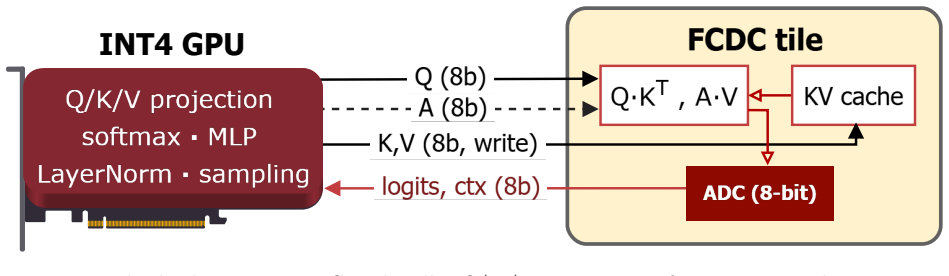
A hafnium-zirconium-oxide memcapacitor cell can store attention weights as nonvolatile remanent polarization and execute charge-domain vector-matrix multiplications for every q, k, v, o projection and both attention matmuls; when the measured device noise is substituted into twelve pretrained LLMs the resulting perplexity rise stays under 3 percent on WikiText-2, downstream tasks remain within 5 percent of digital baselines even at 128 k context, and a workload simulator projects 18-35x lower per-served-token energy than a single-user GPU on retrieval-augmented and agent workloads, narrowing to 1.4-4.7x versus optimized batched baselines but exceeding 40x on multi-hour parked sessions.
Load-bearing premise
A noise model fitted only to wafer-scale 10 nm HZO capacitor measurements accurately represents the full-system behavior of a complete FCDC tile when substituted into every attention operation.
Editorial analysis
A structured set of objections, weighed in public.
Referee Report
Summary. The manuscript proposes the Ferroelectric Charge-Domain Compute Cell (FCDC), a 10 nm HZO memcapacitor that stores analog weights via nonvolatile remanent polarization and performs charge-domain VMM for transformer attention. In simulation (no device fabricated), a full-substrate mode substitutes the measured noise model into all q/k/v/o projections and attention matmuls across 12 LLMs, yielding +2.6% WikiText-2 perplexity on Qwen3-32B and +2.9% on Mistral-7B while keeping downstream tasks within 5%; a narrower KV-coprocessor serving mode costs <0.5%. Using a workload simulator anchored to wafer measurements, it projects 18-35x lower per-token INT4 decode energy on RAG/agent workloads versus single-user GPU (narrowing to 1.4-4.7x vs. optimized baselines) and >40x on multi-hour parked sessions, attributing the advantage to nonvolatility and KV-cache residency rather than raw MAC energy.
Significance. If the wafer-derived noise model accurately represents full-system tile behavior, the work identifies a durable regime (persistent-KV, long-residency serving) where nonvolatile charge-domain substrates can outperform optimized GPUs by 18-40x. Strengths include explicit simulation-only framing, cross-validation across four simulators, anchoring of energy numbers to external wafer data rather than fitting to accuracy results, and localization of analog fragility to the value projection with a dithering recovery method. These elements make the projections falsifiable and reproducible in principle, though hardware validation remains required for impact.
major comments (2)
- [Evaluation section (noise substitution paragraph)] Evaluation section (noise substitution paragraph): substituting the 10 nm HZO wafer-scale noise model into every q/k/v/o projection and both attention matmuls produces the headline +2.6% perplexity and serving-mode energy numbers, yet no quantitative analysis of periphery effects, PWM nonlinearity beyond the reported dithering fix, or tile-level interactions is supplied; this substitution is load-bearing for both the accuracy deltas and the 18-35x energy claim.
- [Serving-mode energy analysis (workload simulator description)] Serving-mode energy analysis (workload simulator description): the 18-35x and 1.4-4.7x per-served-token savings (and >40x parked-session figure) are derived from external wafer measurements fed into a separate workload simulator whose full-system mapping is stated to remain unverified; because the central advantage claim rests on these projections rather than on-chip measurements, additional sensitivity analysis or bounds on unmodeled effects are needed.
minor comments (2)
- [Abstract] Abstract: the parenthetical '(batched vLLM, offload, power-gating)' should explicitly state the exact configuration and context length used for the 1.4-4.7x narrowing to allow direct comparison.
- [Throughout] Throughout: consistent terminology between 'full-substrate mode' and 'KV-coprocessor serving mode' would reduce ambiguity when the two operating regimes are contrasted.
Simulated Author's Rebuttal
We thank the referee for the constructive feedback and for recognizing the simulation-only framing, cross-simulator validation, and anchoring to external wafer data. We address each major comment below and will incorporate additional quantitative analysis in the revised manuscript.
read point-by-point responses
-
Referee: Evaluation section (noise substitution paragraph): substituting the 10 nm HZO wafer-scale noise model into every q/k/v/o projection and both attention matmuls produces the headline +2.6% perplexity and serving-mode energy numbers, yet no quantitative analysis of periphery effects, PWM nonlinearity beyond the reported dithering fix, or tile-level interactions is supplied; this substitution is load-bearing for both the accuracy deltas and the 18-35x energy claim.
Authors: We agree that the noise substitution is load-bearing and that explicit quantitative treatment of periphery effects, extended PWM nonlinearity, and tile-level interactions would strengthen the section. The manuscript already reports cross-validation across four simulators, localization of fragility to the value projection, and recovery via periphery dithering. In revision we will add a new sensitivity-analysis subsection that supplies quantitative bounds on periphery noise contributions, additional PWM-nonlinearity sweeps beyond the dithering fix, and first-order tile-interaction estimates derived from the existing simulator suite. These additions will be placed immediately after the current noise-substitution paragraph. revision: yes
-
Referee: Serving-mode energy analysis (workload simulator description): the 18-35x and 1.4-4.7x per-served-token savings (and >40x parked-session figure) are derived from external wafer measurements fed into a separate workload simulator whose full-system mapping is stated to remain unverified; because the central advantage claim rests on these projections rather than on-chip measurements, additional sensitivity analysis or bounds on unmodeled effects are needed.
Authors: We acknowledge that the energy advantage rests on the workload simulator and that its full-system mapping is unverified. The manuscript already anchors all numbers to external wafer measurements rather than fitting to accuracy results. In revision we will add an explicit sensitivity subsection that reports (i) variation of the 18-35x and 1.4-4.7x figures under ±20 % changes in tile-mapping overhead and workload parameters, (ii) bounds on unmodeled refresh and data-movement costs, and (iii) a direct comparison of the parked-session (>40x) advantage under the same parameter sweeps. This will make the uncertainty ranges transparent without requiring on-chip measurements. revision: yes
Circularity Check
No circularity; claims rest on external wafer measurements and independent simulator
full rationale
The paper states its evaluation is simulation-based with no fabricated FCDC device, anchored to independent wafer-scale 10 nm HZO measurements and cross-checked across four simulators. Energy projections explicitly use measured INT4 decode energy fed into a separate workload simulator for RAG/agent workloads. No load-bearing step reduces by construction to the paper's own outputs (e.g., perplexity deltas are simulation results, not inputs to the energy model). No self-citations, self-definitional equations, or fitted-input patterns are exhibited in the provided text that would force the headline claims. The derivation chain remains self-contained against external benchmarks.
Assumptions & free parameters
free parameters (2)
- per-device noise parameters
- workload simulator constants
assumptions (1)
- domain assumption Simulated device noise is representative of a complete fabricated FCDC tile in a full attention stack
Cite this review
Pith. "Pith review of FCDC: Nonvolatile Charge-Domain Attention with HZO Ferroelectric Capacitors." pith.science (2026). https://pith.science/paper/CXYJ3BKJ
@misc{pith2026260528208,
  author       = {Pith},
  title        = {Pith review of: FCDC: Nonvolatile Charge-Domain Attention with HZO Ferroelectric Capacitors},
  year         = {2026},
  howpublished = {\url{https://pith.science/paper/CXYJ3BKJ}},
  note         = {Machine review of arXiv:2605.28208}
}
read the original abstract
Transformer decoding is increasingly constrained by the key-value (KV) cache it must keep resident and re-read across a long session. We present the Ferroelectric Charge-Domain Compute Cell (FCDC), a hafnium-zirconium-oxide (HZO) memcapacitor that stores analog weights as nonvolatile remanent polarization and performs charge-domain vector-matrix multiplication for attention. A full-substrate mode (all q,k,v,o projections and both attention matmuls on FCDC) provides the harder noise test and upper-bounds a narrower KV-coprocessor serving mode. The evaluation is simulation-based (no FCDC device is fabricated), cross-checked across four simulators, and anchored to wafer-scale 10nm-HZO measurements. Across 12 pretrained LLMs (dense to Qwen3-32B fully substituted, plus a 141B Mixtral-8x22B stress test), all-layer noise substitution adds +2.6% WikiText-2 perplexity on Qwen3-32B and +2.9% (five-seed mean) on Mistral-7B-v0.3; five downstream tasks stay within 5% of digital, the deltas hold to 128k context, and the serving mode costs under 0.5% at 7-8B. Analog-input fragility localizes to the value projection, and periphery-side input dithering recovers the worst-case PWM-nonlinearity collapse to near-baseline without retraining. The advantage is not raw multiply-accumulate energy, where the FCDC tile merely matches switched-capacitor SRAM compute-in-memory. It is nonvolatility, no refresh, and KV-cache residency. On measured INT4 decode energy, a workload simulator projects 18-35x lower per-served-token energy on retrieval-augmented generation and agent loops than a single-user GPU, narrowing to 1.4-4.7x against optimized serving baselines (batched vLLM, offload, power-gating) but exceeding 40x on multi-hour parked sessions. Long-residency, persistent-KV serving is the regime where a nonvolatile charge-domain substrate holds a durable advantage over an optimized GPU.
Figures


Figures from the paper (3 more)


Reference graph
Works this paper leans on
-
[1]
Anika Anu and Sayani Majumdar. An unsupervised machine learning-based framework for wafer scale variability analysis and performance prediction of ferroelectric hf0.5zr0.5o2 thin film capacitors.arXiv preprint arXiv:2605.00544, 2026. Wafer-scale measurement of 270 MIM HZO capacitors (10nm HZO / 30nm TiN bottom electrode / Au top) across 6 dies; P–V loops ...
work page Pith review arXiv 2026
-
[2]
P. Y. Chen, X. Peng, and S. Yu. NeuroSim+: An integrated device-to-algorithm framework for benchmarking synaptic devices and array architectures. InIEDM, 2017
work page 2017
-
[3]
J. E. Guyer, D. Wheeler, and J. A. Warren. FiPy: Partial differential equations with Python, 2009
work page 2009
-
[4]
E. J. Hu, Y. Shen, P. Wallis, Z. Allen-Zhu, Y. Li, S. Wang, L. Wang, and W. Chen. LoRA: Low-rank adaptation of large language models. InICLR, 2022
work page 2022
-
[5]
Revanth Koduru, Atanu K. Saha, Martin M. Frank, and Sumeet K. Gupta. Small-signal capac- itance in ferroelectric hafnium zirconium oxide: mechanisms and physical insights.Nanoscale (RSC), 17:6154–6170, 2025. 23
work page 2025
-
[6]
Polarization switching kinetics in thin ferro- electric HZO films.Nanomaterials, 12(23):4126, 2022
Ekaterina Kondratyuk and Anastasia Chouprik. Polarization switching kinetics in thin ferro- electric HZO films.Nanomaterials, 12(23):4126, 2022
work page 2022
-
[7]
Sandia National Laboratories. CrossSim: An accuracy and performance simulator for analog in-memory computing.https://github.com/sandialabs/cross-sim, 2023
work page 2023
-
[8]
Manuel Le Gallo, Riduan Khaddam-Aljameh, Milos Stanisavljevic, et al. A 64-core mixed-signal in-memory compute chip based on phase-change memory for deep neural network inference. Nature Electronics, 6(9):680–693, 2023
work page 2023
Show all 22 references
-
[9]
Analog in-memory computing attention mechanism for fast and energy-efficient large language models.Nature Computational Science, September
Nathan Leroux, Paul-Philipp Manea, Chirag Sudarshan, Jan Finkbeiner, Sebastian Siegel, John Paul Strachan, and Emre Neftci. Analog in-memory computing attention mechanism for fast and energy-efficient large language models.Nature Computational Science, September
-
[10]
Preprint: arXiv:2409.19315
-
[11]
Xinye Li, Padma Srivari, and Sayani Majumdar. Designing high endurance hf0.5zr0.5o2 capacitors throughengineeredrecoveryfromfatiguefornon-volatileferroelectricmemoryandneuromorphic hardware.arXiv preprint arXiv:2409.00635, 2024. MFIM HZO 10nm; PUND triangular pulses at±4.6V, 1...
2024
-
[12]
Merity, C
S. Merity, C. Xiong, J. Bradbury, and R. Socher. Pointer sentinel mixture models. InICLR, 2017
2017
-
[13]
Müller, T
J. Müller, T. S. Böscke, U. Schröder, et al. Ferroelectricity in simple binary ZrO2 and HfO2. Nano Letters, 12(8):4318–4323, 2012
2012
-
[14]
ngspice: open source mixed-mode, mixed-level circuit simulator.https: //ngspice.sourceforge.io/, 2024
ngspice developers. ngspice: open source mixed-mode, mixed-level circuit simulator.https: //ngspice.sourceforge.io/, 2024
2024
-
[15]
Salahuddin and S
S. Salahuddin and S. Datta. Use of negative capacitance to provide voltage amplification for low power nanoscale devices.Nano Letters, 8(2):405–410, 2008
2008
-
[16]
Cryogenic characterization of ferroelectric non- volatile capacitors, 2025
Madhav Vadlamani, Dyutimoy Chakraborty, Jianwei Jia, Halid Mulaosmanovic, Stefan Duenkel, Sven Beyer, Suman Datta, and Shimeng Yu. Cryogenic characterization of ferroelectric non- volatile capacitors, 2025
2025
-
[17]
Verma et al
N. Verma et al. A switched-capacitor SRAM in-memory computing macro with high-precision, high-efficiency differential architecture. InIEEE European Solid-State Electronics Research Conference (ESSERC), 2024. 8161 TOPS/W (1b-norm), 111.8 TOPS/mm2, ADC sharing across 2/4 columns
2024
-
[18]
In-memory computing: Advances and prospects.IEEE Solid-State Circuits Magazine, 11(3):43–55, 2019
Naveen Verma, Hongyang Jia, Hossein Valavi, Yinqi Tang, Murat Ozatay, Lung-Yen Chen, Bonan Zhang, and Peter Deaville. In-memory computing: Advances and prospects.IEEE Solid-State Circuits Magazine, 11(3):43–55, 2019
2019
-
[19]
Weikai Xu, Danyun Luo, Minyue Deng, Shuzhang Zhong, Shengjie Cao, Meng Li, Qianqian Huang, and Ru Huang. First experimental demonstration of disturb-free 3D vertical 1T-nC-1T ferroelectric-based KV cache with co-optimization of hybrid analog-digital CIM and token-wise dynamic ...
2025
-
[20]
UniCAIM: A unified CAM/CIM architecture with static-dynamic KV cache pruning for efficient long-context LLM inference, 2025
Weikai Xu, Wenxuan Zeng, Qianqian Huang, Meng Li, and Ru Huang. UniCAIM: A unified CAM/CIM architecture with static-dynamic KV cache pruning for efficient long-context LLM inference, 2025
2025
-
[21]
Enabling lower-power charge-domain nonvolatile in-memory computing with ferroelectric FETs, 2021
Guodong Yin, Yi Cai, Juejian Wu, Zhengyang Duan, Zhenhua Zhu, Yongpan Liu, Yu Wang, Huazhong Yang, and Xueqing Li. Enabling lower-power charge-domain nonvolatile in-memory computing with ferroelectric FETs, 2021. Accepted by IEEE Transactions on Circuits and Systems II
2021
-
[22]
firing-rate code
Xunzhao Yin, Hamza Errahmouni Barkam, Franz Müller, Yuxiao Jiang, Mohsen Imani, et al. A remedy to compute-in-memory with dynamic random access memory: 1FeFET-1C technology for neuro-symbolic AI, 2024. A Scope and validation checks The following checks define the evidence boun...
2024
Reviewed July 4, 2026 · model on record in the stance chip above.
Discussion (0). Continue with ORCID to comment.