Thermal emission from dark matter-heated neutron stars in the Galactic Center
Pith reviewed 2026-06-27 17:51 UTC · model grok-4.3
The pith
Dark matter heating leaves neutron stars in the Galactic Center below current detection limits
A machine-rendered reading of the paper's core claim, the machinery that carries it, and where it could break.
Core claim
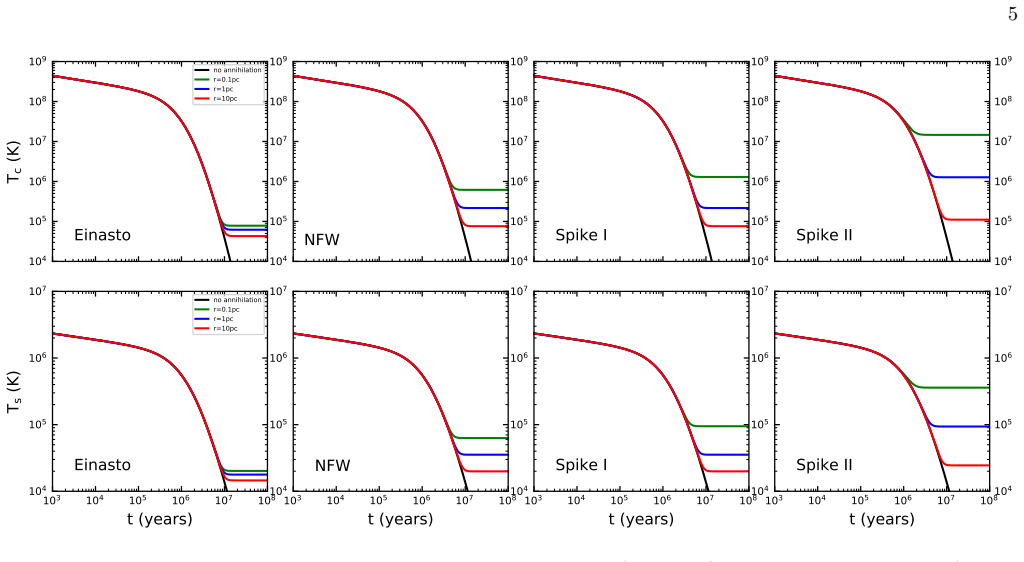
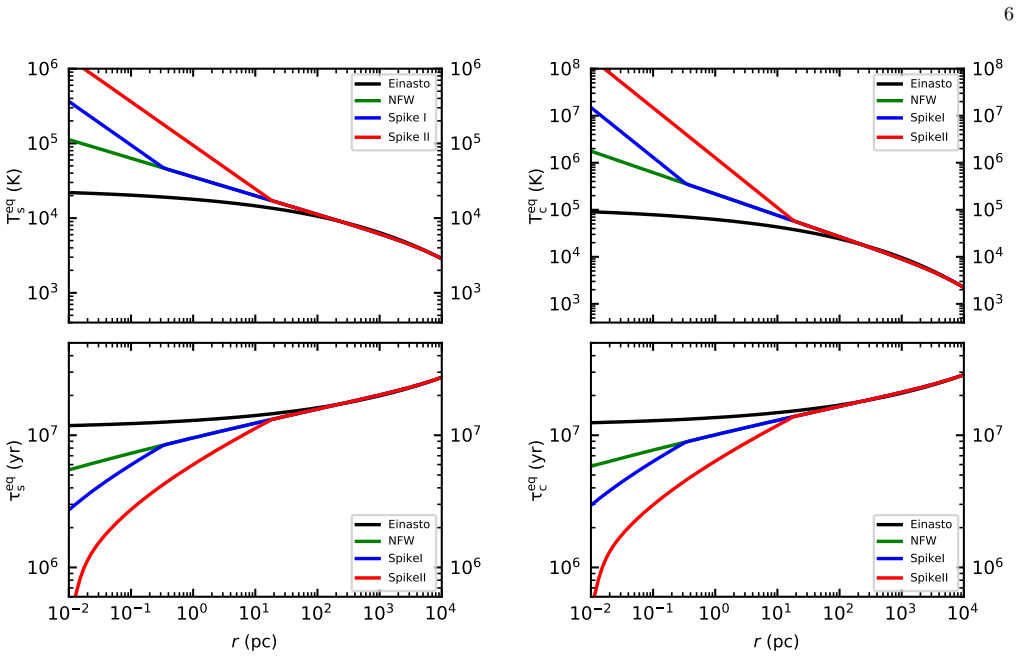
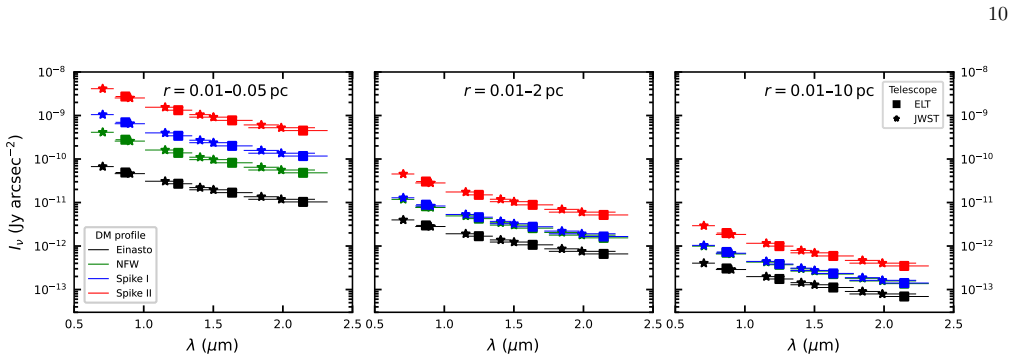
Neutron stars older than about 10 million years in the Galactic Center reach an equilibrium surface temperature of 10^4 to 10^6 K set by the balance between heating from dark matter capture and annihilation and the star's cooling. The temperature depends on location and the ambient dark matter density profile, which the authors vary from cored to cuspy forms that may include a central spike. With a spike the emission would appear in ultraviolet and soft X-ray bands, yet strong interstellar extinction and large hydrogen column densities reduce the observable flux density from an individual star to below 0.1 nJy. The integrated emission from the whole neutron star population produces an averag
What carries the argument
Equilibrium surface temperature reached when dark matter capture and annihilation heating balances neutron star cooling, evaluated across cored-to-cuspy dark matter density profiles that may include spikes.
If this is right
- Neutron stars older than 10 million years settle at equilibrium temperatures between 10,000 and 1 million Kelvin.
- A central dark matter density spike shifts the thermal emission into ultraviolet and soft X-ray bands.
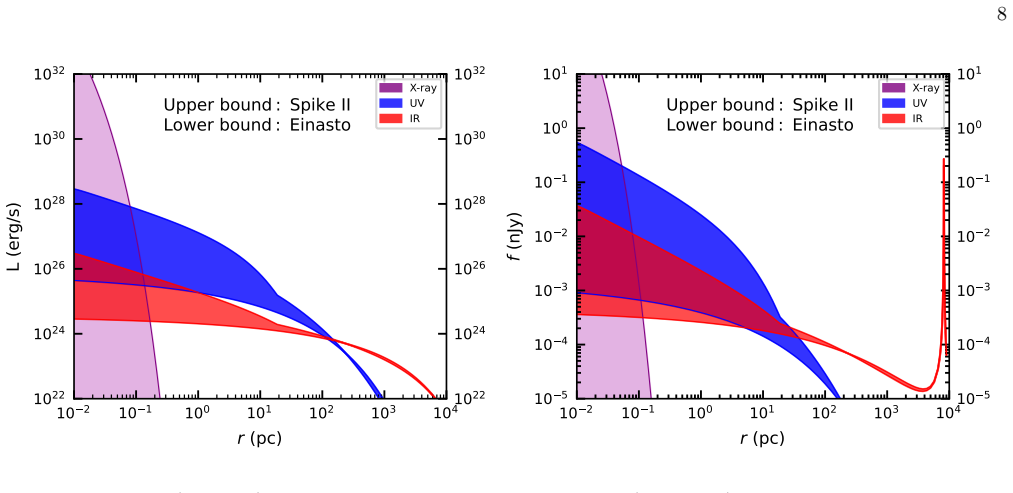
- Interstellar extinction keeps the flux from any single neutron star below 0.1 nJy.
- The neutron star population produces a cumulative infrared surface brightness of at most 10^{-9} Jy arcsec^{-2}.
- Thermal signatures from these stars remain below the sensitivity of current instruments.
Where Pith is reading between the lines
- Similar heating calculations could be applied to neutron stars in other high-density dark matter regions with lower extinction to test the same mechanism.
- If the equilibrium temperatures are reached, non-detection in deeper surveys would constrain either the dark matter density or the capture efficiency.
- Future ultraviolet or soft X-ray instruments with greater sensitivity might reach the predicted fluxes if extinction models are refined.
- The approach could be tested by comparing predicted and observed temperatures for any old neutron stars identified in less obscured fields.
Load-bearing premise
Neutron stars older than about 10 million years reach an equilibrium surface temperature set solely by the balance of dark matter heating against cooling, and the chosen dark matter density profiles correctly describe the ambient density at neutron star locations in the Galactic Center.
What would settle it
A measured surface temperature for an old neutron star in the Galactic Center lying well outside the 10,000 to 1 million Kelvin range, or a detected flux density from an individual star exceeding 0.1 nJy after extinction correction.
Figures
read the original abstract
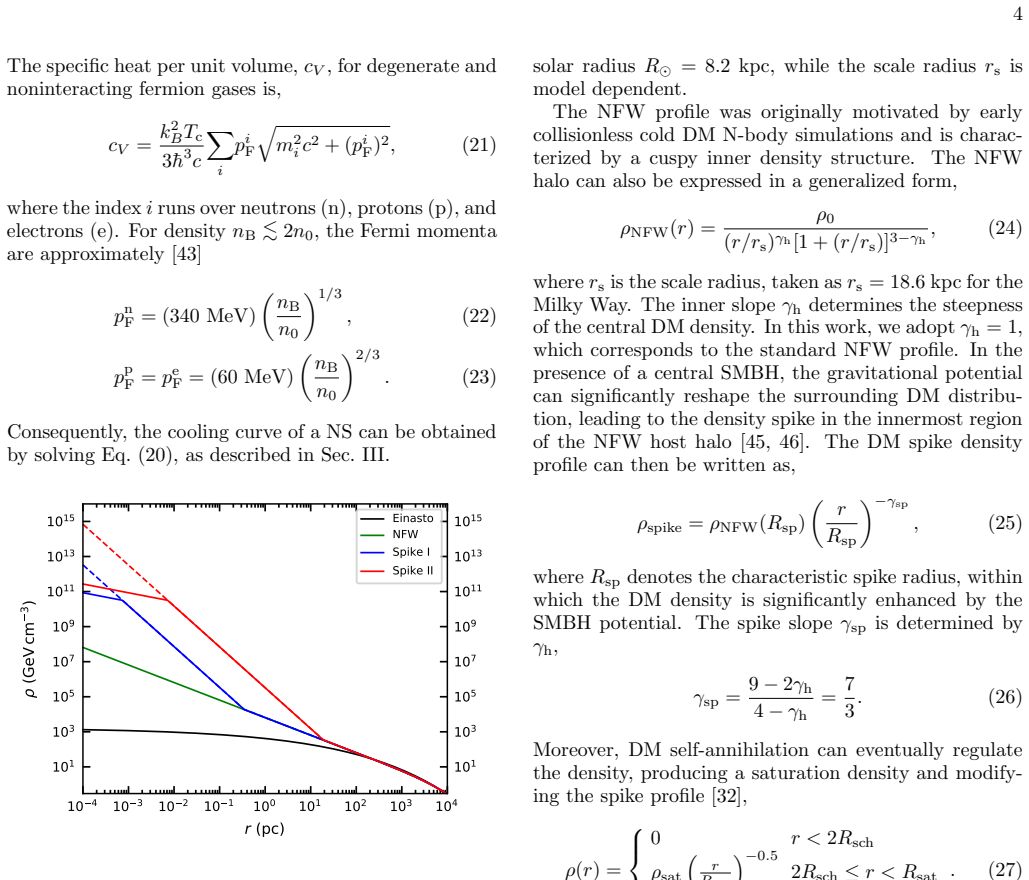
We investigate the thermal impact of dark matter (DM) capture and annihilation on neutron stars (NSs) in the Galactic Center (GC). Accounting for both kinetic energy deposition and internal annihilation, we systematically evaluate the influence of various DM density profiles, ranging from cored to cuspy distributions, on the late-time thermal evolution of NSs. For NSs older than $\sim 10^7~\mathrm{yr}$, the surface temperature approaches an equilibrium value $T_\mathrm{s}^{\mathrm{eq}} \sim 10^4$--$10^6~\mathrm{K}$, depending on the stellar location and the ambient DM density. In the presence of a density spike, enhanced heating shifts the emission toward ultraviolet (UV) and soft x-ray bands; however, strong interstellar extinction and large hydrogen column densities significantly suppress the observable flux density. We further provide an estimate of the cumulative infrared surface brightness from the NS population in the GC. The predicted flux density from an individual NS remains below $\sim 0.1\,\mathrm{nJy}$, while the integrated emission yields an average surface brightness $I_\nu \lesssim 10^{-9}\,\mathrm{Jy\,arcsec^{-2}}$, corresponding to a signal-to-noise ratio well below current detection thresholds. Our results indicate that thermal signatures from DM-heated NSs in the GC remain below the sensitivity limits of current instruments, although nearby systems with lower extinction may provide more promising targets for detection.
Editorial analysis
A structured set of objections, weighed in public.
Referee Report
Summary. The paper examines the thermal effects of dark matter capture and annihilation heating on neutron stars in the Galactic Center. It evaluates multiple DM density profiles (cored to cuspy with spikes) and finds that NSs older than ~10^7 yr reach equilibrium surface temperatures of 10^4--10^6 K. Enhanced heating from density spikes shifts emission to UV/soft X-rays, but interstellar extinction suppresses the observable flux; individual NS fluxes are predicted below ~0.1 nJy and the integrated surface brightness below 10^{-9} Jy arcsec^{-2}, remaining below current instrument thresholds. Nearby systems with lower extinction are suggested as better targets.
Significance. If the equilibrium temperature calculations and extinction modeling hold, the result indicates that DM-heated NS thermal signatures in the GC are not detectable with present instruments, while identifying lower-extinction nearby targets as more promising. The systematic comparison across DM profiles is a strength, as is the explicit inclusion of both kinetic deposition and annihilation heating.
major comments (1)
- [§4 (equilibrium temperature and flux estimates)] The central claim that fluxes remain below detection thresholds rests on the equilibrium temperature reached for NSs ≳10^7 yr. The manuscript should provide an explicit sensitivity test (e.g., in §4 or §5) showing how the adopted DM density profiles and spike parameters propagate into the final flux upper limits; without this, the conclusion that signals are undetectable is tied to the weakest modeling assumption.
minor comments (2)
- [Abstract] The abstract states T_s^eq ~10^4--10^6 K but does not reference the specific cooling curves or capture-rate formulae used; adding a brief pointer to the relevant equations would improve traceability.
- [Results section on integrated emission] Figure captions (or the text near the cumulative brightness estimate) should clarify whether the reported I_ν includes only the DM-heated component or also standard NS cooling.
Simulated Author's Rebuttal
We thank the referee for their constructive feedback and positive assessment of the manuscript. We address the single major comment below.
read point-by-point responses
-
Referee: [§4 (equilibrium temperature and flux estimates)] The central claim that fluxes remain below detection thresholds rests on the equilibrium temperature reached for NSs ≳10^7 yr. The manuscript should provide an explicit sensitivity test (e.g., in §4 or §5) showing how the adopted DM density profiles and spike parameters propagate into the final flux upper limits; without this, the conclusion that signals are undetectable is tied to the weakest modeling assumption.
Authors: We agree that an explicit sensitivity test would improve clarity. While the manuscript already systematically varies DM density profiles (cored to cuspy with spikes) and reports the resulting equilibrium temperature range of 10^4--10^6 K, we will add a dedicated paragraph and table in the revised §4 (or new §5 subsection) that explicitly maps each profile and spike parameter set to the corresponding equilibrium temperature, emitted spectrum, and attenuated flux upper limit. This will demonstrate that even the highest-heating (spiked) cases yield individual fluxes ≲0.1 nJy and integrated surface brightness ≲10^{-9} Jy arcsec^{-2} after extinction, confirming the non-detection conclusion is robust across the modeled range. revision: yes
Circularity Check
No significant circularity detected
full rationale
The paper computes NS equilibrium temperatures from the balance of DM capture/annihilation heating against cooling, then derives fluxes using external DM density profiles (cored to cuspy with spikes) and standard capture rates. No steps in the abstract or described chain reduce by construction to fitted inputs, self-definitions, or load-bearing self-citations; the below-threshold result follows from these independent inputs without renaming or tautological reduction. This is consistent with the reader's score of 2.0 and the absence of any quoted internal inconsistency.
Axiom & Free-Parameter Ledger
axioms (2)
- domain assumption DM capture and annihilation deposit energy that can balance NS cooling for old stars
- domain assumption DM density profiles (cored to cuspy with spikes) correctly describe the ambient density at NS locations
Reference graph
Works this paper leans on
-
[1]
T. Daylan, D. P. Finkbeiner, D. Hooper, T. Linden, S. K. N. Portillo, N. L. Rodd, and T. R. Slatyer, Phys. Dark Universe12, 1 (2016), arXiv:1402.6703
Pith/arXiv arXiv 2016
-
[2]
L. Goodenough and D. Hooper, Possible Evidence For Dark Matter Annihilation In The Inner Milky Way From The Fermi Gamma Ray Space Telescope (2009), arXiv:0910.2998
Pith/arXiv arXiv 2009
-
[3]
Linden, inThe Galactic Center: Feeding and Feed- back in a Normal Galactic Nucleus, Vol
T. Linden, inThe Galactic Center: Feeding and Feed- back in a Normal Galactic Nucleus, Vol. 303, edited by L. O. Sjouwerman, C. C. Lang, and J. Ott (Cambridge University Press, Cambridge, England, 2014) p. 403
2014
-
[4]
K. N. Abazajian, J. Cosmol. Astropart. Phys.2011(03), 010, arXiv:1011.4275
Pith/arXiv arXiv 2011
-
[5]
N. Mirabal, Mon. Not. R. Astron. Soc.436, 2461 (2013), arXiv:1309.3428
Pith/arXiv arXiv 2013
-
[6]
J. Bramante and T. Linden, Phys. Rev. Lett.113, 191301 (2014), arXiv:1405.1031
Pith/arXiv arXiv 2014
-
[7]
Goldman and S
I. Goldman and S. Nussinov, Phys. Rev. D40, 3221 (1989)
1989
- [8]
-
[9]
M. Baryakhtaret al., Dark Matter In Extreme Astro- physical Environments (2022), Snowmass 2021 White Pa- per, arXiv:2203.07984
arXiv 2022
-
[10]
A. K. Mishra, Can Orbital Decay of Accreting Binary Pulsars Probe Dark Matter? (2025), arXiv:2507.06178
arXiv 2025
-
[11]
D. Liang and L. Shao, J. Cosmol. Astropart. Phys.2023 (08), 016, arXiv:2303.05107
arXiv 2023
-
[12]
M. H. Chan and C. M. Lee, Mon. Not. R. Astron. Soc. 524, L61 (2023), arXiv:2306.02536
arXiv 2023
-
[13]
I. John, R. K. Leane, and T. Linden, Phys. Rev. D109, 123041 (2024), arXiv:2311.16228. 11
arXiv 2024
-
[14]
I. John, R. K. Leane, and T. Linden, Phys. Rev. D112, 023028 (2025), arXiv:2405.12267
arXiv 2025
- [15]
-
[16]
R. K. Leane and J. Smirnov, Phys. Rev. Lett.126, 161101 (2021), arXiv:2010.00015
arXiv 2021
-
[17]
D. Croon and J. Smirnov, J. Cosmol. Astropart. Phys. 2024(11), 046, arXiv:2309.02495
arXiv 2024
-
[18]
R. K. Leane, T. Linden, P. Mukhopadhyay, and N. Toro, Phys. Rev. D103, 075030 (2021), arXiv:2101.12213
arXiv 2021
-
[19]
M. Baryakhtar, J. Bramante, S. W. Li, T. Linden, and N. Raj, Phys. Rev. Lett.119, 131801 (2017), arXiv:1704.01577
Pith/arXiv arXiv 2017
- [20]
-
[21]
G. Bertone and M. Fairbairn, Phys. Rev. D77, 043515 (2008), arXiv:0709.1485
Pith/arXiv arXiv 2008
-
[22]
A. de Lavallaz and M. Fairbairn, Phys. Rev. D81, 123521 (2010), arXiv:1004.0629
Pith/arXiv arXiv 2010
-
[23]
R. Genzelet al., Astrophys. J.594, 812 (2003), arXiv:astro-ph/0305423
Pith/arXiv arXiv 2003
-
[24]
Y. Levin and A. M. Beloborodov, Astrophys. J. Lett. 590, L33 (2003), arXiv:astro-ph/0303436
Pith/arXiv arXiv 2003
-
[25]
M. Freitag, P. Amaro-Seoane, and V. Kalogera, Astro- phys. J.649, 91 (2006), arXiv:astro-ph/0603280
Pith/arXiv arXiv 2006
-
[26]
C. Hopman and T. Alexander, Astrophys. J. Lett.645, L133 (2006), arXiv:astro-ph/0603324
Pith/arXiv arXiv 2006
-
[27]
D. Aharon and H. B. Perets, Astrophys. J. Lett.830, L1 (2016), arXiv:1609.01715
Pith/arXiv arXiv 2016
-
[28]
Kim and M
C. Kim and M. B. Davies, J. Korean Astron. Soc.51, 165 (2018)
2018
-
[29]
D. Bose, T. N. Maity, and T. S. Ray, J. Cosmol. As- tropart. Phys.2022(05), 001, arXiv:2108.12420
arXiv 2022
-
[30]
J. F. Acevedo, R. K. Leane, and L. Santos- Olmsted, J. Cosmol. Astropart. Phys.2024(03), 042, arXiv:2309.10843
arXiv 2024
-
[31]
P. Ullio, H. Zhao, and M. Kamionkowski, Phys. Rev. D 64, 043504 (2001), arXiv:astro-ph/0101481
Pith/arXiv arXiv 2001
- [32]
-
[33]
Z.-Q. Shen, G.-W. Yuan, C.-Z. Jiang, Y.-L. S. Tsai, Q. Yuan, and Y.-Z. Fan, Mon. Not. R. Astron. Soc.527, 3196 (2024), arXiv:2303.09284
arXiv 2024
-
[34]
Gould, Astrophys
A. Gould, Astrophys. J.321, 571 (1987)
1987
-
[35]
S. D. McDermott, H.-B. Yu, and K. M. Zurek, Phys. Rev. D85, 023519 (2012), arXiv:1103.5472
Pith/arXiv arXiv 2012
-
[36]
T. Marrod´ an Undagoitia and L. Rauch, J. Phys. G43, 013001 (2016), arXiv:1509.08767
Pith/arXiv arXiv 2016
-
[37]
J. Bramante, A. Delgado, and A. Martin, Phys. Rev D 96, 063002 (2017), arXiv:1703.04043
arXiv 2017
-
[38]
Generozov, N
A. Generozov, N. C. Stone, B. D. Metzger, and J. P. Ostriker, Mon. Not. R. Astron. Soc.478, 4030 (2018)
2018
-
[39]
N. F. Bell, G. Busoni, S. Robles, and M. Virgato, J. Cos- mol. Astropart. Phys.2024(04), 006, arXiv:2312.11892
arXiv 2024
-
[40]
C.-S. Chen and Y.-H. Lin, J. High Energy Phys.2018 (08), 069, arXiv:1804.03409
Pith/arXiv arXiv 2018
-
[41]
S. L. Shapiro and S. A. Teukolsky,Black Holes, White Dwarfs and Neutron Stars: The Physics of Compact Ob- jects(Wiley, New York, 1983)
1983
-
[42]
E. H. Gudmundsson, C. J. Pethick, and R. I. Epstein, Astrophys. J.272, 286 (1983)
1983
-
[43]
Chandrasekhar,An introduction to the study of stellar structure(University of Chicago Press, Chicago, 1939)
S. Chandrasekhar,An introduction to the study of stellar structure(University of Chicago Press, Chicago, 1939)
1939
-
[44]
J. F. Navarro, C. S. Frenk, and S. D. M. White, Astro- phys. J.462, 563 (1996), arXiv:astro-ph/9508025
Pith/arXiv arXiv 1996
-
[45]
P. Gondolo and J. Silk, Phys. Rev. Lett.83, 1719 (1999), arXiv:astro-ph/9906391
Pith/arXiv arXiv 1999
-
[46]
L. Sadeghian, F. Ferrer, and C. M. Will, Phys. Rev. D 88, 063522 (2013), arXiv:1305.2619
Pith/arXiv arXiv 2013
-
[47]
Merritt, inCoevolution of Black Holes and Galaxies, edited by L
D. Merritt, inCoevolution of Black Holes and Galaxies, edited by L. C. Ho (Cambridge University Press, Cam- bridge, England, 2004) p. 263, arXiv:astro-ph/0301257
Pith/arXiv arXiv 2004
-
[48]
S. Mashchenko, J. Wadsley, and H. M. P. Couchman, Science319, 174 (2008), arXiv:0711.4803
Pith/arXiv arXiv 2008
-
[49]
F. Valenciano, J. M. Camalich, A. Di Cintio, J. F. Navarro, G. Battaglia, R. Errani, and J. I. Read, Cored galaxies in cuspy dark matter halos (2025), arXiv:2512.15886
arXiv 2025
-
[50]
Einasto, Trudy Astrofizicheskogo Instituta Alma-Ata 5, 87 (1965)
J. Einasto, Trudy Astrofizicheskogo Instituta Alma-Ata 5, 87 (1965)
1965
-
[51]
Amoleet al.(PICO Collaboration), Phys
C. Amoleet al.(PICO Collaboration), Phys. Rev. D100, 022001 (2019), arXiv:1902.04031. [52]https://cxc.harvard.edu/toolkit/pimms.jsp
Pith/arXiv arXiv 2019
-
[52]
Sch¨ odel, F
R. Sch¨ odel, F. Nogueras-Lara, E. Gallego-Cano, B. Shahzamanian, A. T. Gallego-Calvente, and A. Gar- dini, Astron. Astrophys.641, A102 (2020)
2020
-
[53]
E. Pfahl and A. Loeb, Astrophys. J.615, 253 (2004), arXiv:astro-ph/0309744
Pith/arXiv arXiv 2004
-
[54]
S. Johnston, M. Kramer, D. R. Lorimer, A. G. Lyne, M. McLaughlin, B. Klein, and R. N. Manchester, Mon. Not. R. Astron. Soc.373, L6 (2006), arXiv:astro- ph/0606465
arXiv 2006
-
[55]
J. S. Deneva, J. M. Cordes, and T. J. W. Lazio, Astro- phys. J. Lett.702, L177 (2009), arXiv:0908.1331
Pith/arXiv arXiv 2009
-
[56]
J. A. Kenneaet al., Astrophys. J. Lett.770, L24 (2013), arXiv:1305.2128
Pith/arXiv arXiv 2013
-
[57]
F. Abbateet al., Open J. Astrophys.8, 54252 (2025), arXiv:2512.16155
arXiv 2025
-
[58]
J. Wongphechauxsornet al., Mon. Not. R. Astron. Soc. 527, 3208 (2024), arXiv:2310.14008
arXiv 2024
-
[59]
M. E. Lower, S. Dai, S. Johnston, and E. D. Barr, Astro- phys. J. Lett.967, L16 (2024), arXiv:2404.09098
arXiv 2024
-
[60]
K. I. Perez, V. Gajjar, S. Bogdanov, J. P. Halpern, P. B. Demorest, S. Croft, M. Lebofsky, D. H. E. MacMahon, and A. P. V. Siemion, Astrophys. J.998, 147 (2026)
2026
-
[61]
Klein, M
B. Klein, M. Kramer, P. M¨ uller, and R. Wielebinski, in Young Neutron Stars and Their Environments, IAU Sym- posium, Vol. 218, edited by F. Camilo and B. M. Gaensler (Astronomical Society of the Pacific, San Francisco, Cal- ifornia, 2004) p. 133
2004
-
[62]
J.-P. Macquart, N. Kanekar, D. A. Frail, and S. M. Ran- som, Astrophys. J.715, 939 (2010), arXiv:1004.1643
Pith/arXiv arXiv 2010
-
[63]
J. Dexter and R. M. O’Leary, Astrophys. J. Lett.783, L7 (2014), arXiv:1310.7022
Pith/arXiv arXiv 2014
-
[64]
J. M. Cordes and T. J. W. Lazio, Astrophys. J.475, 557 (1997), arXiv:astro-ph/9608028
Pith/arXiv arXiv 1997
-
[65]
R. P. Eatough, M. Kramer, B. Klein, R. Karuppusamy, D. J. Champion, P. C. C. Freire, N. Wex, and K. Liu, inNeutron Stars and Pulsars: Challenges and Opportu- nities after 80 years, IAU Symposium, Vol. 291, edited by J. van Leeuwen (Cambridge University Press, Cam- bridge, England, 2013) pp. 382–384, arXiv:1210.3770
Pith/arXiv arXiv 2013
-
[66]
R. P. Eatoughet al., Mon. Not. R. Astron. Soc.507, 5053 (2021), arXiv:2108.05241
arXiv 2021
-
[67]
Torneet al.(EHT Collaboration), Astrophys
P. Torneet al.(EHT Collaboration), Astrophys. J.959, 14 (2023), arXiv:2308.15381
arXiv 2023
-
[68]
S. K. Ocker and J. M. Cordes, Astrophys. J.1002, 3 (2026). 12
2026
-
[69]
J. M. Cordes and T. J. W. Lazio, arXiv e-prints (2002), arXiv:astro-ph/0207156
Pith/arXiv arXiv 2002
-
[70]
L. G. Spitleret al., Astrophys. J. Lett.780, L3 (2014), arXiv:1309.4673
Pith/arXiv arXiv 2014
-
[71]
Boodram and C
O. Boodram and C. O. Heinke, Mon. Not. R. Astron. Soc.512, 4239–4247 (2022)
2022
-
[72]
Abbate, A
F. Abbate, A. Mastrobuono-Battisti, M. Colpi, A. Pos- senti, A. C. Sippel, and M. Dotti, Mon. Not. R. Astron. Soc.473, 927–936 (2017)
2017
-
[73]
J.-P. Macquart and N. Kanekar, Astrophys. J.805, 172 (2015), arXiv:1504.02492
Pith/arXiv arXiv 2015
- [74]
-
[75]
T. Paumardet al., Astrophys. J.643, 1011 (2006), arXiv:astro-ph/0601268
Pith/arXiv arXiv 2006
-
[76]
C.-A. Faucher-Gigu` ere and V. M. Kaspi, Astrophys. J. 643, 332 (2006), arXiv:astro-ph/0512585
Pith/arXiv arXiv 2006
-
[77]
N. Raj, P. Shivanna, and G. N. Rachh, Phys. Rev. D 109, 123040 (2024), arXiv:2403.07496
arXiv 2024
discussion (0)
Sign in with ORCID, Apple, or X to comment. Anyone can read and Pith papers without signing in.