REVIEW 4 major objections 7 minor 62 references
Adversarial Transform Particle Filters
T0 review · 4 major / 7 minor · reviewed 2026-08-08 · deepseek-v4-flash
Pith's one-line read ATPF learns a pushforward map minimizing kernel MMD between the prior ensemble and a self-normalized importance-sampling posterior estimate, combining particle-filter consistency with EnKF particle diversity.
desk verdict A sensible NLEAF variant with promising experiments, but the main convergence-rate theorem rests on an assumption that cannot hold for the implemented algorithm. read the letter →
The pith
A machine-rendered reading of the paper's core claim, the machinery that carries it, and where it could break.
The reading
What carries the argument
The load-bearing object is the kernel maximum mean discrepancy combined with self-normalized importance weights $w_t(x')\propto w_{t-1}(x')p_{\varepsilon_t}(y_t-H_t(x'))$. Restricting test functions to the unit ball of an RKHS turns the inner supremum into the explicit objective $E_{x,x'\sim P_t}K(G_t(x),G_t(x'))-2E_{x\sim P_t,y\sim Q_t}K(G_t(x),y)+E_{y,y'\sim Q_t}K(y,y')$, so the bi-level adversarial optimization reduces to a one-level loss estimated by V-statistics and SNIS. An optimal-transport penalty $\lambda_t E_{x\sim P_t}\|G_t(x)-x\|_2^2$ regularizes the transform, and joint training across time treats the forecast maps as activation layers of a deep network. The theory then rides on covering numbers of the test-function and transformation classes and on an oracle assumption that a transformation in a Besov space exactly pushes the prior to the posterior.
What would settle it
Run ATPF on a designed state-space model whose posterior is not in the assumed smoothness class—for example a posterior with a point mass at zero or a heavy-tailed mixture—with increasing $N_1$ and $N_2$, and check whether the empirical MMD and RMSE decay at the claimed rate or plateau at a positive floor. A plateau would indicate the oracle-pushforward assumption fails and the excess-risk bound no longer controls the error.
Extended reading notes
Core claim
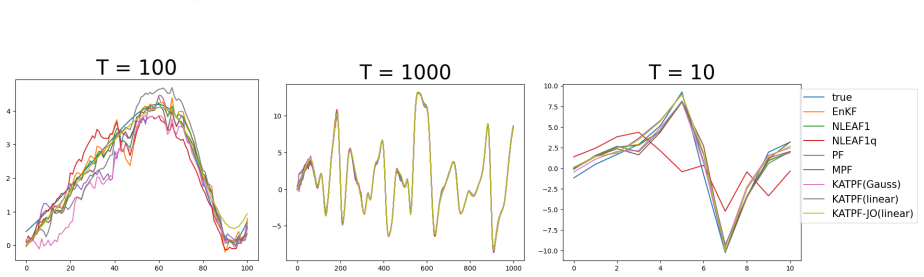
The paper's central claim is that the analysis step of filtering can be solved by minimizing $\mathrm{MMD}(G_t\#\hat P_t\,\|\,Q_t)$, where $\hat P_t$ is the prior ensemble, $Q_t$ is the posterior, and $G_t$ ranges over neural-network transformations. Because the MMD only needs expectations of test functions, the posterior side can be estimated consistently by self-normalized importance sampling, preserving the particle filter's statistical guarantees; because the update moves particles rather than collapsing weights, the ensemble retains the diversity associated with the EnKF. Making the test-function class the unit ball of a reproducing kernel Hilbert space collapses the adversarial inner supremum into the closed-form squared MMD, and an optimal-transport regularizer $\lambda_t E_{x\sim P_t}\|G_t(x)-x\|_2^2$ keeps the map stable. The paper proves nonasymptotic excess-risk bounds whose three terms correspond to SNIS bias, the weighted empirical process, and the empirical process of the transformation class, with explicit rates for Gaussian and linear kernels, and derives forecast-step bounds showing the analysis error propagates through Lipschitz dynamics plus evolution noise. Experiments on a skewed nonlinear model, rainfall data, Lorenz63, and Lorenz96 report lower RMSE than EnKF, NLEAF, and particle-filter baselines, often with far fewer particles than the PF.
Load-bearing premise
The convergence-rate results assume that for every time step the true posterior is exactly the pushforward of the estimated prior by a transformation of a specified smoothness class; if the posterior has point mass, sharp discontinuities, or severe weight collapse so that no such transformation exists, the approximation-error term does not vanish and the stated rates do not apply.
Editorial extensions
If this is right
- A nonlinear, non-Gaussian posterior can be tracked by a transformed ensemble without resampling, so the filter avoids the particle collapse that standard PFs suffer under deterministic dynamics or high-dimensional weight degeneracy.
- The kernel-MMD reformulation removes the inner discriminator step, so training the transform network is a single-level minimization rather than an alternating adversarial game.
- Jointly optimizing the transforms across time stacks the forecast steps into a deep network and, in the Lorenz experiments, yields lower RMSE than sequential training.
- The forecast-step bounds imply the analysis MMD propagates to the next prior at worst multiplied by a Lipschitz constant plus an evolution-noise term, so error does not diverge without bound under contractive dynamics.
- With a linear kernel the loss reduces to matching the posterior mean, and the stated rate $O(d((\log N_1)/\sqrt{N_1}+1/\sqrt{N_2}))$ gives an explicit particle budget for mean tracking.
Reading between the lines
- Because MMD with a characteristic kernel controls weak convergence, the training objective should in principle match the whole posterior, not just its moments; the paper's comparisons emphasize RMSE, so an editorial test is to compare predictive intervals and tail quantiles on the skewed model and the rainfall model.
- The method still inherits the particle filter's dependence on SNIS weights, and the $\chi^2(Q_t\|P_t)$ factor in the bound grows with weight collapse; a concrete extension suggested by the discussion is to introduce annealing distributions between prior and posterior and learn a sequence of smaller transforms.
- The theoretical rates hinge on an oracle transformation of a fixed smoothness class; direct measurement of the residual MMD after training very expressive networks would separate the statistical error from the approximation error in practice.
- The framework effectively treats filtering as distribution-to-distribution regression, so advances in distributional learning—other kernels, Sinkhorn losses, or flow-based parameterizations—could transfer directly to filtering; this is an inference, not a claim made by the paper.
Editorial analysis
A structured set of objections, weighed in public.
Referee Report
Summary. The paper proposes the Adversarial Transform Particle Filter (ATPF), a filtering method that learns deterministic transformations of prior particles by minimizing an MMD-type discrepancy against a self-normalized importance sampling (SNIS) estimate of the posterior. The method is presented in three variants: a vanilla ATPF, a kernel-based KATPF using RKHS test functions, and a joint-optimization version (ATPF-JO) that trains all time-step transformations together. The theoretical section gives a decomposition of the excess risk into SNIS bias, weighted empirical-process fluctuations, and prior-ensemble approximation error; states generalization bounds for the analysis step (Theorem 2) and Lipschitz-type bounds for the forecast step (Propositions 2 and 3); and derives convergence rates under Besov-smoothness and neural-network-complexity assumptions (Propositions 4 and 5). Experiments on a nonlinear two-stage model, a rainfall observation model, and Lorenz63/Lorenz96 systems compare RMSE and posterior behavior against EnKF, NLEAF, PF, MPF, PFGR, and ETPF baselines.
Significance. If the theoretical guarantees were valid for the implemented algorithm, the paper would make a valuable contribution: it offers a principled way to combine the asymptotic consistency of importance-sampling-based filtering with the diversity-preserving transformation structure of ensemble Kalman methods, and its empirical results on nonlinear and non-Gaussian benchmarks are competitive. The paper deserves credit for spelling out a three-term excess-risk decomposition, for providing a fairly complete empirical-process analysis with explicit assumptions, and for releasing code and data. However, as detailed below, a central assumption in the convergence-rate analysis (Assumption 6) is incompatible with the finite-particle representation used in Algorithm 1, and the proof of Proposition 1 contains an algebraic error. These issues affect the main theoretical claims and require substantive revision.
major comments (4)
- [Section 4.2, Assumption 6 and Proposition 4, Eq. (25)] Assumption 6 is not compatible with the algorithm as implemented. In Section 3 and Algorithm 1, \hat P_t is the empirical distribution of the N1 forecast particles (Algorithm 1, lines 5–9), i.e., an atomic measure. For any absolutely continuous posterior Q_t—which is the situation in every Section 5 experiment—there is no deterministic map G'_t in a Besov space with G'_t#\hat P_t = Q_t, because the pushforward of an atomic measure is atomic. Consequently, inf_{G_t ∈ G_t} MMD(G_t#\hat P_t ∥ Q_t) does not vanish for finite N1, and the rate in Eq. (25) omits an irreducible N1-discretization error. If \hat P_t in Assumption 6 is instead intended to mean the true prior P_t, then the notation conflicts with the definition in Section 3 ("let \hat P_t and P_t be the estimated and the ground truth prior"), and the theoretical object no longer matches the empirical objective optimized in Eq. (12) and Algorithm 1. The analysis-step convergence claim therefore needs either an additional discretization term or a reformulation of the oracle assumption.
- [Appendix A, Proposition 1 proof] The proof of Proposition 1 contains an invalid equality: the displayed chain begins with d_FD(P∥Q) = sup_{f∈FD}|E_P f − E_Q f| = sup_{∥f∥_H≤1}|E_P f − E_Q f|^2, which asserts MMD = MMD^2 without a square on the left-hand side. The statement of Proposition 1 and Eq. (10) are standard, and the later derivation of the RKHS form is correct once the first equality is read as the squared MMD, but as printed the proof does not prove the proposition. Please correct the display and use consistent squared/unsquared MMD notation throughout Section 3.1 and Theorem 2.
- [Section 4.1, Theorem 2 and Assumption 5] The exponential-in-N2 concentration in Theorem 2 relies on Assumption 5 (strong log-concavity of P_t) through Theorem 4. In the Lorenz63 and Lorenz96 experiments the state evolution is deterministic and chaotic, so P_t is not obviously strongly log-concave, and no verification is provided. If Assumption 5 fails, the paper's own Theorem 6 supplies only a polynomial rate. The authors should either state where Assumption 5 is expected to hold or qualify Theorem 2's bound as conditional on a condition that is not verified in the main experiments.
- [Section 3, Eq. (9) and Algorithm 1] The theoretical analysis treats x'^j_t, j=1,...,N2, as i.i.d. draws from the true prior P_t, but Algorithm 1 maintains the x' particles through sequential reweighting, resampling, inflation, and forecast steps. After the first time step these particles are not i.i.d. from P_t; they are a sequentially dependent, resampled particle approximation. The SNIS bias and concentration bounds in Theorem 2 and Theorems 3–6 are derived under the i.i.d. assumption, so they do not directly justify the sequential filtering algorithm. The paper should either prove the bounds conditionally on the forecast ensemble and the filtering history, or explicitly state that the theory covers a single analysis step with fresh i.i.d. prior samples and that the sequential algorithm is an approximation to that setting.
minor comments (7)
- [Section 5.2] The phrase "95% credit intervals" should be "95% credible intervals."
- [Section 3, Eq. (9)] The notation w_t(x) is used for both the unnormalized product w_{t-1}(x)p_ε_t(y_t − H_t(x)) and the renormalized weights; please clarify the distinction.
- [Appendix A, Corollary 1 proof] There is a typo in "right-hande side" that should read "right-hand side."
- [Section 4.2, Eq. (22)] The three covering-number cases (γ-finite spectrum, γ-exponential decay, γ-polynomial decay) are not labeled in the display; please label them or refer to them explicitly in the text.
- [Appendix C] The localization description uses both l and k to denote the window size, with "2l + 1" and "2k + 1" appearing in the same paragraph; the notation should be made consistent.
- [Appendix B, Table 4] The arrow "↗" in Table 4 is not explained in the caption or text; please define it.
- [Section 5.1] The phrase "1-dimension 2-stage state-space model" is awkward; consider rewriting as "one-dimensional two-stage state-space model."
Circularity Check
No significant circularity: the ATPF derivation is self-contained, with the SNIS posterior estimate serving as an external target and all key bounds inherited from standard external results.
full rationale
The derivation chain is not circular. The training objective (Eq. 9/12) minimizes the MMD between a pushforward of the estimated prior and an SNIS estimate of the posterior; the target is the Bayes posterior defined by Eq. 3, not an output of the learned transformation. The main generalization bound (Theorem 2/7) is a standard empirical-process decomposition into three terms: the SNIS bias (cited to Agapiou et al. 2017), the stochastic error of the weighted empirical process, and an empirical-process term for the transformation class. None of these terms is defined in terms of the quantity being bounded, and the consistency claim is inherited from the external SNIS theory rather than manufactured inside the paper. The convergence-rate results (Propositions 4-5) rely on external covering-number and neural-network approximation theorems (Suzuki 2019; Liang 2021) and on an explicit oracle assumption (Assumption 6), not on the authors' own prior work. There are no self-citations in the reference list, so no self-citation chain can be load-bearing. The W2 surrogate equivalence in Eqs. 13-14 is imported from external work (Xu et al. 2024) and could be questioned on correctness or formality grounds, but it is not a circular reduction. The main caveat is that Assumption 6, requiring an oracle Besov pushforward map to the exact posterior, is strong and may not hold for the finite-particle implementation of Algorithm 1; however, that is an assumption-strength and correctness concern, not evidence that the paper's claims reduce to their inputs by construction.
Assumptions & free parameters
free parameters (4)
- OT regularization weight lambda_t =
0.001, 0.0, 0.2, or tuned lambda* per experiment
- Gaussian kernel bandwidth w =
median pairwise L2 distance among particles
- Neural network architecture and training hyperparameters =
not reported in the text
- Covariance inflation parameter delta =
selected by likelihood of the data
assumptions (6)
- domain assumption Assumption 1: M_t, H_t are continuous and p_eta_t, p_epsilon_t are C^1.
- domain assumption Assumption 2: weights and test functions are uniformly bounded by B.
- domain assumption Assumption 4: test functions and weights are beta-Lipschitz.
- domain assumption Assumption 5: the prior P_t is strongly log-concave with parameter gamma_t.
- ad hoc to paper Assumption 6: there exists an oracle G'_t in a Besov space such that G'_t#\hat P_t = Q_t.
- standard math Lemma A.1 in Xu et al. (2024) establishes the equivalence between Equation 13 and Equation 14.
Cite this review
Pith. "Pith review of Adversarial Transform Particle Filters." pith.science (2026). https://pith.science/paper/CYKCYP3H
@misc{pith2026250206165,
  author       = {Pith},
  title        = {Pith review of: Adversarial Transform Particle Filters},
  year         = {2026},
  howpublished = {\url{https://pith.science/paper/CYKCYP3H}},
  note         = {Machine review of arXiv:2502.06165}
}
read the original abstract
The particle filter (PF) and the ensemble Kalman filter (EnKF) are widely used for approximate inference in state-space models. From a Bayesian perspective, these algorithms represent the prior by an ensemble of particles and update it to the posterior with new observations over time. However, the PF often suffers from weight degeneracy in high-dimensional settings, whereas the EnKF relies on linear Gaussian assumptions that can introduce significant approximation errors. In this paper, we propose the Adversarial Transform Particle Filter (ATPF), a novel filtering framework that combines the strengths of the PF and the EnKF through adversarial learning. Specifically, importance sampling is used to ensure statistical consistency as in the PF, while adversarially learned transformations, such as neural networks, allow accurate posterior matching for nonlinear and non-Gaussian systems. In addition, we incorporate kernel methods to ease optimization and leverage regularization techniques based on optimal transport for better statistical properties and numerical stability. We provide theoretical guarantees, including generalization bounds for both the analysis and forecast steps of ATPF. Extensive experiments across various nonlinear and non-Gaussian scenarios demonstrate the effectiveness and practical advantages of our method.
Figures


Figures from the paper (7 more)


Reference graph
Works this paper leans on
-
[1]
Importance sampling: Intrinsic dimension and computational cost
Sergios Agapiou, Omiros Papaspiliopoulos, Daniel Sanz-Alonso, and Andrew M Stuart. Importance sampling: Intrinsic dimension and computational cost. Statistical Science, pp.\ 405--431, 2017
work page 2017
-
[2]
Empirical processes associated with v-statistics and a class of estimators under random censoring
Michael G Akritas. Empirical processes associated with v-statistics and a class of estimators under random censoring. The Annals of Statistics, pp.\ 619--637, 1986
work page 1986
-
[3]
Kernels for vector-valued functions: A review
Mauricio A Alvarez, Lorenzo Rosasco, Neil D Lawrence, et al. Kernels for vector-valued functions: A review. Foundations and Trends in Machine Learning , 4 0 (3): 0 195--266, 2012
work page 2012
-
[4]
An ensemble adjustment kalman filter for data assimilation
Jeffrey L Anderson. An ensemble adjustment kalman filter for data assimilation. Monthly weather review, 129 0 (12): 0 2884--2903, 2001
work page 2001
-
[5]
An adaptive covariance inflation error correction algorithm for ensemble filters
Jeffrey L Anderson. An adaptive covariance inflation error correction algorithm for ensemble filters. Tellus A: Dynamic meteorology and oceanography, 59 0 (2): 0 210--224, 2007
work page 2007
-
[6]
A non-gaussian ensemble filter update for data assimilation
Jeffrey L Anderson. A non-gaussian ensemble filter update for data assimilation. Monthly Weather Review, 138: 0 4186--4198, 2010
work page 2010
-
[7]
Wasserstein generative adversarial networks
Martin Arjovsky, Soumith Chintala, and L \'e on Bottou. Wasserstein generative adversarial networks. In International conference on machine learning, pp.\ 214--223. PMLR, 2017
work page 2017
-
[8]
A tutorial on particle filters for online nonlinear/non-gaussian bayesian tracking
M Sanjeev Arulampalam, Simon Maskell, Neil Gordon, and Tim Clapp. A tutorial on particle filters for online nonlinear/non-gaussian bayesian tracking. IEEE Transactions on signal processing, 50 0 (2): 0 174--188, 2002
work page 2002
Show all 62 references
-
[9]
Sequential data assimilation techniques in oceanography
Laurent Bertino, Geir Evensen, and Hans Wackernagel. Sequential data assimilation techniques in oceanography. International Statistical Review, 71 0 (2): 0 223--241, 2003
2003
-
[10]
Adaptive sampling with the ensemble transform kalman filter
Craig H Bishop, Brian J Etherton, and Sharanya J Majumdar. Adaptive sampling with the ensemble transform kalman filter. part i: Theoretical aspects. Monthly weather review, 129 0 (3): 0 420--436, 2001
2001
-
[11]
B. P. Carlin, N. G. Polson, and D. S. Stoffer. A monte carlo approach to nonnormal and nonlinear state-space modeling. Journal of the American Statistical Association, 87: 0 493--500, 1992
1992
-
[12]
On the statistical properties of generative adversarial models for low intrinsic data dimension
Saptarshi Chakraborty and Peter L Bartlett. On the statistical properties of generative adversarial models for low intrinsic data dimension. arXiv preprint arXiv:2401.15801, 2024
2024 arXiv
-
[13]
Sequential data assimilation with a nonlinear quasi-geostrophic model using monte carlo methods to forecast error statistics
Geir Evensen. Sequential data assimilation with a nonlinear quasi-geostrophic model using monte carlo methods to forecast error statistics. Journal of Geophysical Research: Oceans, 99 0 (C5): 0 10143--10162, 1994
1994
-
[14]
The ensemble kalman filter: Theoretical formulation and practical implementation
Geir Evensen. The ensemble kalman filter: Theoretical formulation and practical implementation. Ocean dynamics, 53: 0 343--367, 2003
2003
-
[15]
Variational wasserstein gradient flow
Jiaojiao Fan, Qinsheng Zhang, Amirhossein Taghvaei, and Yongxin Chen. Variational wasserstein gradient flow. arXiv preprint arXiv:2112.02424, 2021
2021 arXiv
-
[16]
Data assimilation for the geosciences: From theory to application
Steven J Fletcher. Data assimilation for the geosciences: From theory to application. Elsevier, 2022
2022
-
[17]
Covariance tapering for interpolation of large spatial datasets
Reinhard Furrer, Marc G Genton, and Douglas Nychka. Covariance tapering for interpolation of large spatial datasets. Journal of Computational and Graphical Statistics, 15 0 (3): 0 502--523, 2006
2006
-
[18]
Gamerman
D. Gamerman. Markov chain monte carlo for dynamics generalized linear models. Biometrika, 85: 0 215--227, 1998
1998
-
[19]
C. J. Geyer. Markov chain M onte C arlo maximum likelihood. Interface Proceedings, 1991
1991
-
[20]
Generative adversarial nets
Ian Goodfellow, Jean Pouget-Abadie, Mehdi Mirza, Bing Xu, David Warde-Farley, Sherjil Ozair, Aaron Courville, and Yoshua Bengio. Generative adversarial nets. Advances in neural information processing systems, 27, 2014
2014
-
[21]
Novel approach to nonlinear/non-gaussian bayesian state estimation
Neil J Gordon, David J Salmond, and Adrian FM Smith. Novel approach to nonlinear/non-gaussian bayesian state estimation. In IEE proceedings F (radar and signal processing), volume 140, pp.\ 107--113. IET, 1993
1993
-
[22]
A Distribution-Free Theory of Nonparametric Regression
L \'a szl \'o Gy \"o rfi, Michael Kohler, Adam Krzyżak, and Harro Walk. A Distribution-Free Theory of Nonparametric Regression. 2002. URL https://api.semanticscholar.org/CorpusID:43315484
2002
-
[23]
Advances in importance sampling
Timothy Classen Hesterberg. Advances in importance sampling. Stanford University, 1988
1988
-
[24]
Efficient data assimilation for spatiotemporal chaos: A local ensemble transform kalman filter
Brian R Hunt, Eric J Kostelich, and Istvan Szunyogh. Efficient data assimilation for spatiotemporal chaos: A local ensemble transform kalman filter. Physica D: Nonlinear Phenomena, 230 0 (1-2): 0 112--126, 2007
2007
-
[25]
The variational formulation of the fokker--planck equation
Richard Jordan, David Kinderlehrer, and Felix Otto. The variational formulation of the fokker--planck equation. SIAM journal on mathematical analysis, 29 0 (1): 0 1--17, 1998
1998
-
[26]
R. E. Kalman. A new approach to linear filtering and prediction problems. Journal of Basic Engineering, 82: 0 35--45, 1960
1960
-
[27]
Understanding the ensemble kalman filter
Matthias Katzfuss, Jonathan R Stroud, and Christopher K Wikle. Understanding the ensemble kalman filter. The American Statistician, 70 0 (4): 0 350--357, 2016
2016
-
[28]
Ensemble kalman methods for high-dimensional hierarchical dynamic space-time models
Matthias Katzfuss, Jonathan R Stroud, and Christopher K Wikle. Ensemble kalman methods for high-dimensional hierarchical dynamic space-time models. Journal of the American Statistical Association, 115 0 (530): 0 866--885, 2020
2020
-
[29]
Introduction to kalman filter and its applications
Youngjoo Kim, Hyochoong Bang, et al. Introduction to kalman filter and its applications. Introduction and Implementations of the Kalman Filter, 1: 0 1--16, 2018
2018
-
[30]
A note on importance sampling using standardized weights
Augustine Kong. A note on importance sampling using standardized weights. University of Chicago, Dept. of Statistics, Tech. Rep, 348: 0 14, 1992
1992
-
[31]
Recursive monte carlo filters: algorithms and theoretical analysis
Hans R K \"u nsch. Recursive monte carlo filters: algorithms and theoretical analysis. Annals of Statistics, pp.\ 1983--2021, 2005
1983
-
[32]
Bellman filtering and smoothing for state--space models
Rutger-Jan Lange. Bellman filtering and smoothing for state--space models. Journal of Econometrics, 238 0 (2): 0 105632, 2024
2024
-
[33]
A moment matching ensemble filter for nonlinear non-gaussian data assimilation
Jing Lei and Peter Bickel. A moment matching ensemble filter for nonlinear non-gaussian data assimilation. Monthly Weather Review, 139 0 (12): 0 3964--3973, 2011
2011
-
[34]
How well generative adversarial networks learn distributions
Tengyuan Liang. How well generative adversarial networks learn distributions. Journal of Machine Learning Research, 22 0 (228): 0 1--41, 2021
2021
-
[35]
Stein variational gradient descent: A general purpose bayesian inference algorithm
Qiang Liu and Dilin Wang. Stein variational gradient descent: A general purpose bayesian inference algorithm. Advances in neural information processing systems, 29, 2016
2016
-
[36]
Implicit regularization in nonconvex statistical estimation: Gradient descent converges linearly for phase retrieval and matrix completion
Cong Ma, Kaizheng Wang, Yuejie Chi, and Yuxin Chen. Implicit regularization in nonconvex statistical estimation: Gradient descent converges linearly for phase retrieval and matrix completion. In International Conference on Machine Learning, pp.\ 3345--3354. PMLR, 2018
2018
-
[37]
Concentration inequalities for log-concave distributions with applications to random surface fluctuations
Alexander Magazinov and Ron Peled. Concentration inequalities for log-concave distributions with applications to random surface fluctuations. The Annals of Probability, 50 0 (2): 0 735--770, 2022
2022
-
[38]
Fastslam 2.0: An improved particle filtering algorithm for simultaneous localization and mapping that provably converges
Michael Montemerlo, Sebastian Thrun, Daphne Koller, Ben Wegbreit, et al. Fastslam 2.0: An improved particle filtering algorithm for simultaneous localization and mapping that provably converges. In IJCAI, volume 3, pp.\ 1151--1156, 2003
2003
-
[39]
Rao-blackwellised particle filtering for dynamic bayesian networks
Kevin Murphy and Stuart Russell. Rao-blackwellised particle filtering for dynamic bayesian networks. In Sequential Monte Carlo methods in practice, pp.\ 499--515. Springer, 2001
2001
-
[40]
Improving regularised particle filters
Christian Musso, Nadia Oudjane, and Francois Le Gland. Improving regularised particle filters. In Sequential Monte Carlo methods in practice, pp.\ 247--271. Springer, 2001
2001
-
[41]
Merging particle filter for sequential data assimilation
Shinya Nakano, Genta Ueno, and Tomoyuki Higuchi. Merging particle filter for sequential data assimilation. Nonlinear Processes in Geophysics, 14 0 (4): 0 395--408, 2007
2007
-
[42]
Diffusion models are minimax optimal distribution estimators
Kazusato Oko, Shunta Akiyama, and Taiji Suzuki. Diffusion models are minimax optimal distribution estimators. In International Conference on Machine Learning, pp.\ 26517--26582. PMLR, 2023
2023
-
[43]
Optimal approximation of piecewise smooth functions using deep relu neural networks
Philipp Petersen and Felix Voigtlaender. Optimal approximation of piecewise smooth functions using deep relu neural networks. Neural Networks, 108: 0 296--330, 2018
2018
-
[44]
A localized particle filter for high-dimensional nonlinear systems
Jonathan Poterjoy. A localized particle filter for high-dimensional nonlinear systems. Monthly Weather Review, 144 0 (1): 0 59--76, 2016
2016
-
[45]
Overview of global data assimilation developments in numerical weather-prediction centres
Florence Rabier. Overview of global data assimilation developments in numerical weather-prediction centres. Quarterly Journal of the Royal Meteorological Society: A journal of the atmospheric sciences, applied meteorology and physical oceanography, 131 0 (613): 0 3215--3233, 2005
2005
-
[46]
Hierarchical text-conditional image generation with clip latents
Aditya Ramesh, Prafulla Dhariwal, Alex Nichol, Casey Chu, and Mark Chen. Hierarchical text-conditional image generation with clip latents. arXiv preprint arXiv:2204.06125, 1 0 (2): 0 3, 2022
2022 arXiv
-
[47]
A nonparametric ensemble transform method for bayesian inference
Sebastian Reich. A nonparametric ensemble transform method for bayesian inference. SIAM Journal on Scientific Computing, 35 0 (4): 0 A2013--A2024, 2013
2013
-
[48]
Venezuelan rainfall data analysed by using a bayesian space--time model
Bruno Sanso and Lelys Guenni. Venezuelan rainfall data analysed by using a bayesian space--time model. Journal of the Royal Statistical Society: Series C (Applied Statistics), 48 0 (3): 0 345--362, 1999
1999
-
[49]
Log-concavity and strong log-concavity: a review
Adrien Saumard and Jon A Wellner. Log-concavity and strong log-concavity: a review. Statistics surveys, 8: 0 45, 2014
2014
-
[50]
Approximation theorems of mathematical statistics
Robert J Serfling. Approximation theorems of mathematical statistics. John Wiley & Sons, 2009
2009
-
[51]
Shephard and M
N. Shephard and M. Pitt. Likelihood analysis of non-gaussian measurement time series. Biometrika, 84: 0 653--667, 1997
1997
-
[52]
Maximum mean discrepancy
Alexander J Smola, A Gretton, and K Borgwardt. Maximum mean discrepancy. In 13th international conference, ICONIP, pp.\ 3--6, 2006
2006
-
[53]
Obstacles to high-dimensional particle filtering
Chris Snyder, Thomas Bengtsson, Peter Bickel, and Jeff Anderson. Obstacles to high-dimensional particle filtering. Monthly Weather Review, 136 0 (12): 0 4629--4640, 2008
2008
-
[54]
High-dimensional ensemble kalman filter with localization, inflation, and iterative updates
Hao-Xuan Sun, Shouxia Wang, Xiaogu Zheng, and Song Xi Chen. High-dimensional ensemble kalman filter with localization, inflation, and iterative updates. Quarterly Journal of the Royal Meteorological Society, 150 0 (765): 0 4870--4884, 2024
2024
-
[55]
Adaptivity of deep relu network for learning in besov and mixed smooth besov spaces: optimal rate and curse of dimensionality
Taiji Suzuki. Adaptivity of deep relu network for learning in besov and mixed smooth besov spaces: optimal rate and curse of dimensionality. In International Conference on Learning Representations, volume 7, 2019
2019
-
[56]
High-Dimensional Statistics: A Non-Asymptotic Viewpoint
Martin Wainwright. High-Dimensional Statistics: A Non-Asymptotic Viewpoint. 2019. ISBN 9781108498029. doi:10.1017/9781108627771
2019 doi
-
[57]
The implicit and explicit regularization effects of dropout
Colin Wei, Sham Kakade, and Tengyu Ma. The implicit and explicit regularization effects of dropout. In International Conference on Machine Learning, pp.\ 10181--10192. PMLR, 2020
2020
-
[58]
Bayesian learning via stochastic gradient langevin dynamics
Max Welling and Yee W Teh. Bayesian learning via stochastic gradient langevin dynamics. In Proceedings of the 28th international conference on machine learning (ICML-11), pp.\ 681--688. Citeseer, 2011
2011
-
[59]
A note on the particle filter with posterior gaussian resampling
Xiaozhen Xiong, Ionel Michael Navon, and Bahri Uzunoglu. A note on the particle filter with posterior gaussian resampling. Tellus A: Dynamic Meteorology and Oceanography, 58 0 (4): 0 456--460, 2006
2006
-
[60]
Normalizing flow neural networks by jko scheme
Chen Xu, Xiuyuan Cheng, and Yao Xie. Normalizing flow neural networks by jko scheme. Advances in Neural Information Processing Systems, 36, 2024
2024
-
[61]
On function approximation in reinforcement learning: Optimism in the face of large state spaces
Zhuoran Yang, Chi Jin, Zhaoran Wang, Mengdi Wang, and Michael I Jordan. On function approximation in reinforcement learning: Optimism in the face of large state spaces. arXiv preprint arXiv:2011.04622, 2020
2011 arXiv
-
[62]
write newline
" write newline "" before.all 'output.state := FUNCTION n.dashify 't := "" t empty not t #1 #1 substring "-" = t #1 #2 substring "--" = not "--" * t #2 global.max substring 't := t #1 #1 substring "-" = "-" * t #2 global.max substring 't := while if t #1 #1 substring * t #2 gl...
Reviewed August 8, 2026 · model on record in the stance chip above.
Discussion (0). Continue with ORCID to comment.