Energy Poverty as a Structural Trap: The Role of Housing Efficiency and Non-Convex Technology
Pith reviewed 2026-06-25 21:44 UTC · model grok-4.3
The pith
Energy poverty arises when housing efficiency falls below a critical threshold that makes thermal comfort impossible no matter how much energy is purchased.
A machine-rendered reading of the paper's core claim, the machinery that carries it, and where it could break.
Core claim
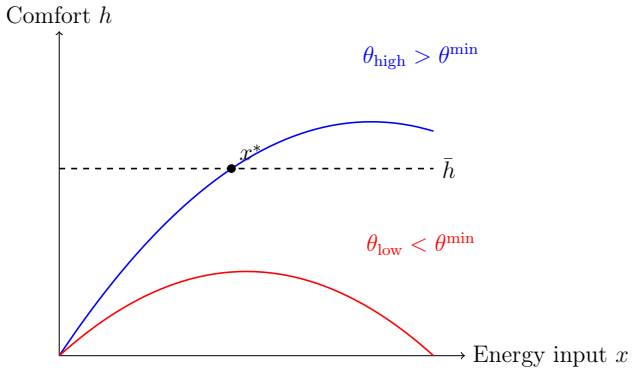
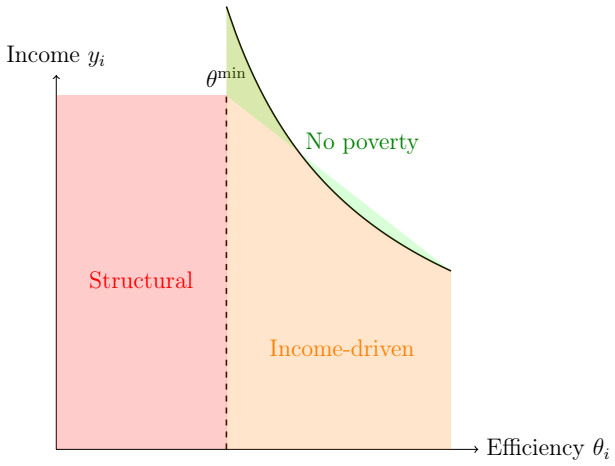
Indoor thermal comfort is produced through a non-convex technology that couples energy input with dwelling efficiency, generating a critical efficiency threshold below which the minimum comfort level is physically unattainable regardless of energy purchases, so that households below this threshold suffer from structural energy poverty that income transfers alone cannot cure.
What carries the argument
The non-convex technology for producing indoor thermal comfort that features a sharp critical efficiency threshold.
If this is right
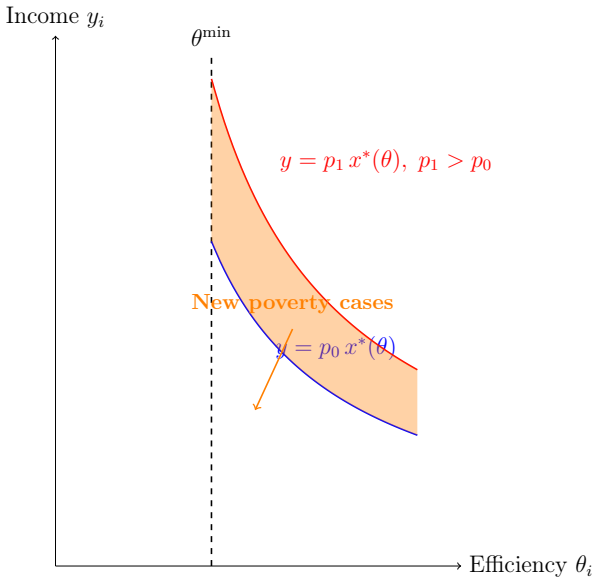
- Energy price shocks are strongly regressive because they hit low-efficiency households hardest.
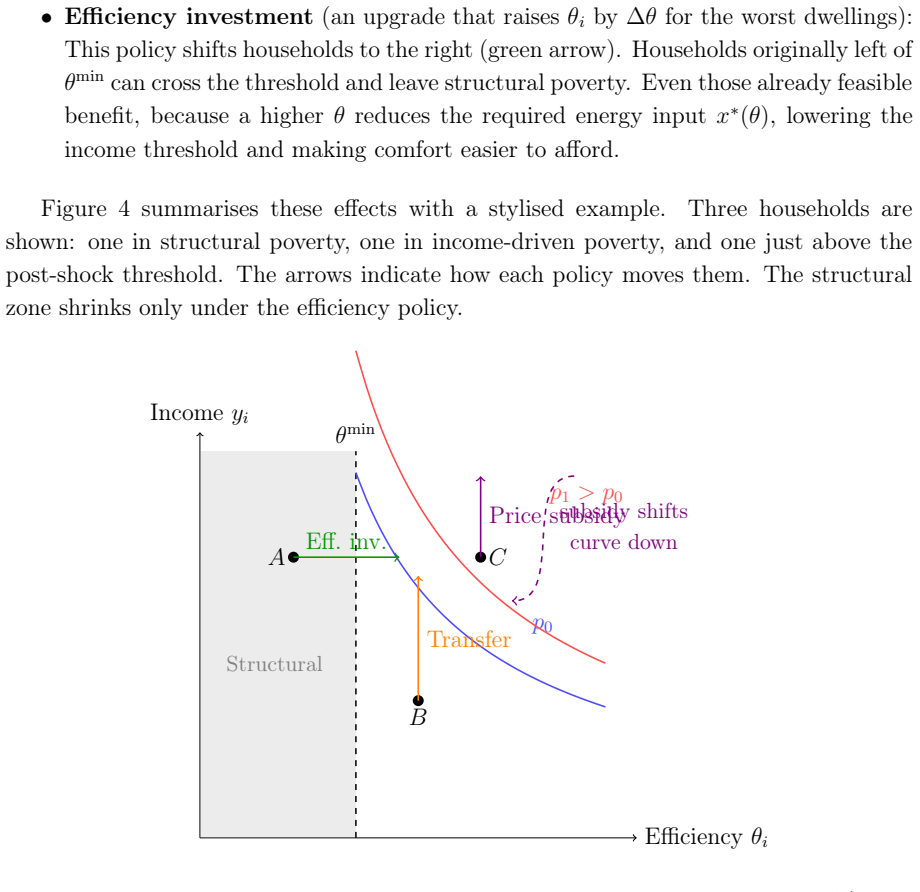
- Efficiency investments dominate income transfers and price subsidies in reducing energy poverty.
- A cost-effective anti-poverty strategy must combine targeted retrofits with temporary income support.
Where Pith is reading between the lines
- Programs aimed at energy poverty should sequence housing upgrades ahead of ongoing cash transfers in the least efficient stock.
- Data on energy poverty could usefully be stratified by measured dwelling efficiency after income is controlled for.
- Field trials that vary retrofit intensity while holding transfers fixed would directly test the relative effectiveness the model predicts.
Load-bearing premise
Indoor thermal comfort is produced by a non-convex technology with a sharp critical efficiency threshold below which comfort is physically unattainable regardless of energy input.
What would settle it
Empirical observation of whether households living in dwellings below the modeled efficiency threshold can achieve standard comfort levels by purchasing arbitrarily large quantities of energy.
Figures
read the original abstract
Energy poverty persists even among households that are not income-poor, suggesting a deeper mechanism than mere budget constraints. We develop a model in which indoor thermal comfort is produced through a non-convex technology that couples energy input with dwelling efficiency. A critical efficiency threshold emerges below which the minimum comfort level is physically unattainable, regardless of how much energy is purchased. Households below this threshold suffer from structural energy poverty, which income transfers alone cannot cure. The model yields three sharp policy predictions: energy price shocks are strongly regressive, efficiency investments dominate income transfers and price subsidies in reducing energy poverty, and a cost-effective anti-poverty strategy must combine targeted retrofits with temporary income support. The results are illustrated with symbolic diagrams and formal proofs.
Editorial analysis
A structured set of objections, weighed in public.
Referee Report
Summary. The paper develops a theoretical model in which indoor thermal comfort is produced via a non-convex technology coupling energy input with dwelling efficiency. A critical efficiency threshold emerges below which minimum comfort is physically unattainable regardless of energy purchases, creating structural energy poverty that income transfers cannot resolve. The model generates three policy predictions—energy price shocks are strongly regressive, efficiency investments dominate income transfers and price subsidies, and cost-effective strategies combine targeted retrofits with temporary income support—and illustrates results with symbolic diagrams and formal proofs.
Significance. If the non-convex technology is specified such that the threshold emerges endogenously rather than by assumption, and the three policy predictions follow rigorously without reducing to the threshold definition, the paper would supply a mechanism-based rationale for prioritizing housing efficiency interventions over pure income support in energy poverty policy, with implications for targeting in housing and energy programs.
major comments (2)
- [Abstract] Abstract: The central claim that households below the threshold suffer structural energy poverty immune to income transfers rests on the threshold emerging from the non-convex technology rather than being imposed as a primitive. The abstract states the threshold 'emerges' but supplies no functional form, production function, or derivation; without this it is impossible to confirm the unattainability region is not generated by construction, which would make the income-vs-efficiency distinction tautological.
- [Abstract] The three policy predictions (regressivity of price shocks, dominance of efficiency investments, and combined strategy) are load-bearing on the existence of an unattainability region. If the technology specification allows any finite energy input to achieve comfort above some efficiency level (as would occur under convex or strictly asymptotic forms), the distinction between structural and income-based poverty collapses; the manuscript must demonstrate that the non-convexity is independent of the claimed results rather than chosen to produce them.
minor comments (1)
- The abstract refers to 'symbolic diagrams and formal proofs' but does not indicate where these appear or how they are numbered; ensure all diagrams are labeled and proofs are cross-referenced to specific equations or propositions in the main text.
Simulated Author's Rebuttal
We thank the referee for the careful reading and for identifying the need to make the endogenous emergence of the threshold more transparent already in the abstract. The full manuscript (Section 2 and Proposition 1) specifies a non-convex production function from which the unattainability region is derived rather than imposed; we respond to each comment below and indicate the revisions we will make.
read point-by-point responses
-
Referee: [Abstract] Abstract: The central claim that households below the threshold suffer structural energy poverty immune to income transfers rests on the threshold emerging from the non-convex technology rather than being imposed as a primitive. The abstract states the threshold 'emerges' but supplies no functional form, production function, or derivation; without this it is impossible to confirm the unattainability region is not generated by construction, which would make the income-vs-efficiency distinction tautological.
Authors: Section 2 defines thermal comfort via the non-convex mapping C(E, η) = η · (1 − exp(−αE)) for η ≥ η*, with C = 0 otherwise, where the cutoff η* is the smallest efficiency level at which the asymptotic limit of C exceeds the minimum comfort standard; this cutoff is obtained by solving the inequality lim E→∞ C(E, η) ≥ C_min and is therefore a derived property of the functional form, not a primitive. Proposition 1 then proves that for η < η* no finite E attains C_min. We will revise the abstract to include one sentence referencing this non-convex coupling and the resulting endogenous threshold. revision: yes
-
Referee: [Abstract] The three policy predictions (regressivity of price shocks, dominance of efficiency investments, and combined strategy) are load-bearing on the existence of an unattainability region. If the technology specification allows any finite energy input to achieve comfort above some efficiency level (as would occur under convex or strictly asymptotic forms), the distinction between structural and income-based poverty collapses; the manuscript must demonstrate that the non-convexity is independent of the claimed results rather than chosen to produce them.
Authors: Sections 3–4 and the appendix explicitly contrast the non-convex case with its convex counterpart: under convexity the unattainability region vanishes, price shocks cease to be strongly regressive in the structural sense, and income transfers alone suffice to reach the comfort standard. The non-convex specification is motivated by engineering data on minimum insulation levels required for any positive heat retention and is not reverse-engineered; the policy rankings follow directly from the existence of the derived region. We will add a short clause to the abstract noting that the three predictions rely on this endogenous non-convexity. revision: yes
Circularity Check
No significant circularity; model derivation is self-contained
full rationale
The paper presents an explicit theoretical model in which non-convex technology couples energy input and dwelling efficiency to produce an emergent critical threshold below which comfort is unattainable. The structural energy poverty result and the three policy predictions follow directly as mathematical consequences of this setup, illustrated via symbolic diagrams and formal proofs. No equations or text indicate that any prediction reduces to a fitted parameter, a self-citation chain, or a renaming of an input; the non-convexity is stated as the modeling primitive rather than derived from prior self-work. The derivation therefore remains independent of the target claims.
Axiom & Free-Parameter Ledger
Reference graph
Works this paper leans on
-
[1]
Eurostat.(2024).EU-SILC indicators: Inability to keep home adequately warm.Avail- able athttps://ec.europa.eu/eurostat/statistics-explained/
2024
-
[2]
(2024).La povertà energetica in Italia – Rapporto 2024
Osservatorio Italiano sulla Povertà Energetica (OIPE). (2024).La povertà energetica in Italia – Rapporto 2024
2024
-
[3]
(2025).At-risk-of-poverty rate by sex, EU-SILC survey
Eurostat. (2025).At-risk-of-poverty rate by sex, EU-SILC survey. Available athttps: //ec.europa.eu/eurostat/databrowser/
2025
-
[4]
(2024).Energy Prices and Costs in Europe
European Commission. (2024).Energy Prices and Costs in Europe. COM(2024) 136 final
2024
-
[5]
(1991).Fuel Poverty: From Cold Homes to Affordable Warmth
Boardman, B. (1991).Fuel Poverty: From Cold Homes to Affordable Warmth. Bel- haven Press
1991
-
[6]
(2012).Getting the Measure of Fuel Poverty
Hills, J. (2012).Getting the Measure of Fuel Poverty. Department of Energy and Climate Change.London
2012
-
[7]
Bouzarovski, S., & Petrova, S. (2015). A global perspective on domestic energy de- privation: Overcoming the energy poverty–fuel poverty binary.Energy Research & Social Science, 10, 31–40
2015
-
[8]
Thomson, H. (2016). Fuel poverty in the European Union: a concept in need of definition?People, Place and Policy Online, 10(1), 5-24
2016
-
[9]
Papada, L., & Kaliampakos, D. (2016). Measuring energy poverty in Greece.Energy Policy, 94, 157–165
2016
-
[10]
Sareen, S., &Haarstad, H.(2021).Digitalisationasadriveroftransformativeenviron- mental governance? Exploring the shaping of energy poverty policy.Environmental Innovation and Societal Transitions, 41, 93-95
2021
-
[11]
Bouzarovski, S., Brajković, J., Robić, S., Brown, C., Vuchkova, I. (2024). Energy poverty in the Energy Community region: Interrogating policy formulation and cov- erageEuropean Urban and Regional Studies,31(2), 184-199
2024
-
[12]
16(6),51
Berti, K., Bienvenido Huertas, D., Bellicoso, A., Rubio-Bellido, C (2023) Implications of energy poverty and climate change in Italian regionsEnergy Efficiency. 16(6),51
2023
-
[13]
C., Laguillo, A., Sevilla, E (2023)
Barrella, R., Romero, J. C., Laguillo, A., Sevilla, E (2023). Assessing the impact of shallow renovation on energy poverty: a primary data study.Energies, 16(21), 7237
2023
-
[14]
(2024).Energy Poverty Indicators and Rec- ommendations – 2024 Update
Energy Poverty Advisory Hub (EPAH). (2024).Energy Poverty Indicators and Rec- ommendations – 2024 Update. European Commission
2024
-
[15]
(2016–2020).Member State Reports on Energy Poverty
European Energy Poverty Observatory (EPOV). (2016–2020).Member State Reports on Energy Poverty. European Commission. 9
2016
-
[16]
(2021).Resources and Indicators.https: //energy-poverty.ec.europa.eu
Energy Poverty Advisory Hub (EPAH). (2021).Resources and Indicators.https: //energy-poverty.ec.europa.eu
2021
-
[17]
Dasgupta, P., & Ray, D. (1986). Inequality as a determinant of malnutrition and unemployment: theory.Economic Journal, 96(384), 1011–1034
1986
-
[18]
V., & Newman, A
Banerjee, A. V., & Newman, A. F. (1993). Occupational choice and the process of development.Journal of Political Economy, 101(2), 274–298. 10
1993
discussion (0)
Sign in with ORCID, Apple, or X to comment. Anyone can read and Pith papers without signing in.