REVIEW 2 major objections 4 minor 42 references
The Family of Alpha,[a,b] Stochastic Orders: Risk vs. Expected Value
T0 review · 2 major / 4 minor · reviewed 2026-08-14 · deepseek-v4-flash
Pith's one-line read This paper introduces a family of stochastic orders that generalize second-order stochastic dominance and rank lotteries in which one option has higher expected value but is also riskier.
desk verdict New α,[a,b]-concave orders with real comparative-statics payoff; the main stress-test worry is a misread of the dominance direction, but there is a genuine sign typo in Proposition 3's proof. read the letter →
The pith
A machine-rendered reading of the paper's core claim, the machinery that carries it, and where it could break.
The reading
What carries the argument
The central object is the generator set $I_{\alpha,[a,b]}$ of increasing functions $u$ on $[a,b]$ for which $u(b)-u(x)$ is $\alpha$-convex, i.e. $(u(b)-u(x))^{1/\alpha}$ is convex; the order compares distributions by requiring $\mathbb{E}[u(Y)]\ge\mathbb{E}[u(X)]$ for every $u$ in this set. Because $I_{\alpha,[a,b]}$ is a closed convex cone containing constants, the order's maximal generator is exactly this set. A practical sufficient condition is supplied by the $n,[a,b]$-sufficient order, which requires integral inequalities for products $\prod_{i=1}^n\max\{c_i-x,0\}$; for $n=2$ this reduces to two explicit integral conditions that are easy to check and are used throughout the applications.
What would settle it
A concrete way to test the central claim is to take the two lotteries of Example 1 with $a=0$, $b=1$, $\lambda=1/2$, $\alpha=2$, so the risky lottery pays $0$ with probability $1/4$ and $1$ with probability $3/4$ and the safe lottery pays $1/2$ for sure; searching for any utility in $I_{2,[0,1]}$ that ranks the risky lottery above the safe one would refute the claimed dominance, and an experimental subject who satisfies the elasticity bound while choosing the risky lottery would falsify the behavioral interpretation.
Extended reading notes
Core claim
The paper's central claim is that the relation $F\succeq_{\alpha,[a,b]-I}G$ defined by $\int_a^b u\,dF\ge \int_a^b u\,dG$ for every increasing $u$ with $u(b)-u(x)$ $\alpha$-convex is a genuine stochastic order that strictly generalizes second-order stochastic dominance. At $\alpha=1$ it is SOSD; for $\alpha>1$ it is weaker, does not force any inequality between expectations, and retains enough structure -- a closed convex generator, translation invariance on shifted intervals, and a maximal generator equal to the defining function class -- to support economic comparative statics. The economic content is the smooth-function condition $u(x)u''(x)/(u'(x))^2\ge(\alpha-1)/\alpha$, which says the coefficient of risk aversion must exceed a fixed fraction of the reward-sensitivity ratio $u'(x)/u(x)$; larger $\alpha$ keeps only more concave preferences. The applications show that with a $2$-convex marginal utility, a future-income distribution that is both better and riskier in the $2$-order raises savings; that in a binary self-protection problem a condition on first and second moments determines whether to forgo a profitable-in-expectation protective expenditure; and that in a Bayesian search game an $\alpha,[0,1]$-concave shift in beliefs lowers the equilibrium matching probability.
Load-bearing premise
The load-bearing premise is that the relevant decision makers are drawn from $I_{\alpha,[a,b]}$, which forces $u'(b)=0$ at the upper endpoint, and in the savings application that the marginal utility $u'$ is $2$-convex on $[0,Rx+\bar{y}]$ -- a condition that excludes CRRA utilities and holds only for a nearby parametric family.
Editorial extensions
If this is right
- For $\alpha>1$ the $\alpha,[a,b]$-concave order is weaker than SOSD: every SOSD ranking is preserved, but new comparisons become possible, including cases where the dominant lottery has the lower expected value.
- In the two-period consumption-savings model, if marginal utility is $2$-convex on $[0,Rx+\bar{y}]$ and $F$ dominates $G$ in the $2,[0,Rx+\bar{y}]$-sufficient (or concave) order, then savings under $G$ are at least as high as under $F$, so the precautionary motive outweighs the permanent-income motive.
- In the binary self-protection problem, spending more on self-protection is rejected exactly when the expected loss under the low-effort lottery is higher and inequality (4) holds, because the high-effort lottery is then $2$-concave-dominated.
- In the Bayesian search game, if beliefs shift upward in the $\alpha,[0,1]$-concave order, the highest equilibrium probability of matching decreases, provided $l\ge\alpha k$.
- For functions with $-f\in I_{2,[a,b]}$, the Hermite-Hadamard inequality holds with the improved constants $t\ge1/3$ and $\gamma\ge2/(3+\sqrt{3})$.
Reading between the lines
- A natural extension the paper leaves implicit is to use the same ordering in portfolio or insurance choice, where $\alpha$ would quantify how much risk aversion is needed before the lower-mean, lower-risk prospect wins.
- Because the order's definition depends on the interval $[a,b]$, one could calibrate the upper endpoint $b$ as the wealth level at which marginal utility is plausibly zero and then export rankings to smaller supports via the monotonicity property; the paper notes the mechanism but does not develop it into a calibration recipe.
- The two-lottery construction in Example 1 suggests a simple experiment: varying $\alpha$ changes the probability of the high outcome, so an individual's choices across such pairs reveal the smallest $\alpha$ for which they count as 'very concave' in the paper's sense.
Signed reviews
Editorial analysis
A structured set of objections, weighed in public.
Referee Report
Summary. The paper introduces a family of integral stochastic orders, the α,[a,b]-concave orders, defined through the generator I_{α,[a,b]} of increasing functions u for which u(b)−u(x) is α-convex. For α=1 the order coincides with second-order stochastic dominance; for α>1 it is weaker than SOSD and can rank pairs of lotteries in which one lottery has both a higher expected value and higher risk. The paper proves structural properties (monotonicity in α and b, translation invariance), gives a sufficient integral condition via the n,[a,b]-sufficient order, partially characterizes the 2-sufficient case, and derives comparative statics in a consumption-savings problem, a self-protection problem, and a Diamond-type search game, together with a Hermite-Hadamard-type inequality. The main claimed application is that under a 'very convex' marginal utility condition, a riskier income distribution with higher expected value leads to higher precautionary saving.
Significance. If the technical issues described below are fixed, the family of orders is a genuinely useful addition to the stochastic-dominance toolbox: it is self-contained, defined from first principles, and it addresses a real gap by allowing comparisons when expected value and risk move in opposite directions. The paper's strengths include explicit examples showing that the order ranks lotteries that classical orders cannot compare, a sufficient condition that is easy to apply, and honest statements of limitations, such as the zero-derivative restriction at the right endpoint and the exclusion of CRRA utilities in the saving application. The applications are economically meaningful and are derived rather than fitted. However, the central application currently contains a serious notational/interpretive error in the prose, and the proofs of the key technical lemmas behind the sufficient order contain reversed inequality signs. These issues are repairable but must be corrected before the results can be relied upon as printed.
major comments (2)
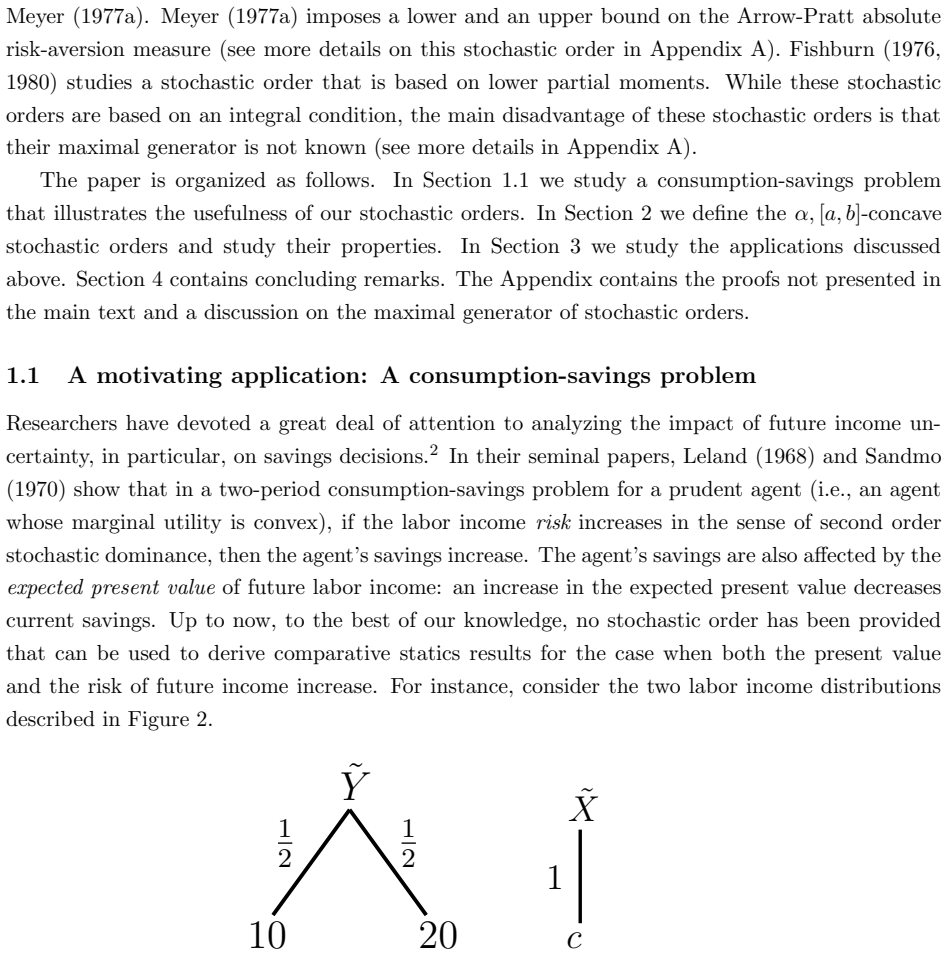
- [Section 3.1 / Proposition 5] The prose misidentifies which distribution is 'better and riskier'. In Example 1 the dominating lottery in the α,[a,b]-concave order is the safe lottery with the lower expected value, while the dominated lottery has the higher expected value and is riskier. Therefore the statement F≽_{2,[0,Rx+ȳ]−I}G ⇒ g(G)≥g(F) is exactly the precautionary-saving dominance claim: savings are higher under the riskier, higher-expected-value distribution G. The sentences in Section 1.1 ('the income's distribution is better (it has a higher expected value) and riskier') and after Proposition 5 ('when F is better and riskier than G ... savings under G are higher') describe the opposite identification and should be rewritten. As printed, the prose tells the reader that the theorem proves the permanent-income effect dominates, which is the reverse of the intended comparative static.
- [Appendix B.2, proof of Lemma 3 and proof of Proposition 4] The inequality directions in these proofs are reversed relative to Definition 3 and Proposition 4. For F≽_{2,[a,b]−S}G, Lemma 2 gives D_F−D_G=(c2−c1)∫(F−G)+2∫∫(F−G)≤0, so condition (3) is ∫∫(F−G)≤0 and condition (2) is (b−c)∫(F−G)+2∫∫(F−G)≤0. The proof of Proposition 4 writes the same expression as ≥0, and the proof of Lemma 3 asserts that the order implies ∫∫(F−G)≥0 and that condition (2) holds with ≥0. These are the opposite signs from the stated conditions. The lemma itself is true and the argument can be repaired: if ∫(F−G)≤0 then the expression is automatically non-positive, while if ∫(F−G)>0 the original condition at b gives the needed bound. But the proofs as written establish the wrong inequalities, and since Lemma 3 is used in the proof of Proposition 5, this sign bookkeeping must be fixed before the applications can be considered verified.
minor comments (4)
- [Example 3 proof] The denominator in 'α/(a+1)u(b)' should be 'α+1', not 'a+1'.
- [Section 2, after Definition 1] The elasticity characterization with the normalization u(b)=0 is confusing because u takes non-positive values on [a,b]; the condition should be stated in terms of v(x)=u(b)−u(x) or with an explicit sign convention.
- [Example 1 / Introduction] The labels X and Y are swapped between the Introduction's Figure 1 and Example 1 in Section 2; this swap is a source of the 'better and riskier' ambiguity and should be made consistent throughout.
- [Proposition 5 / Appendix A] The restriction that u′ be 2-convex entails u″(b)=0 at the upper endpoint; this is the reason CRRA utilities are excluded. The paper acknowledges the analogous restriction for I_{α,[a,b]}, but the main text should also flag it for the u′ condition used in the saving application.
Circularity Check
No circularity: the new orders and their comparative statics are derived from explicit definitions and external theorems, not from their own conclusions.
full rationale
The paper defines the α,[a,b]-concave orders explicitly in Definition 2 and proves its properties from that definition; Proposition 5 and the other applications are consequences of the defining integral inequality applied to -u′ when u′ is assumed 2-convex, not fitted or assumed conclusions. The n-sufficient order is introduced as a separate sufficient condition (Definition 3, Proposition 3) and proved via standard convex approximation (Theorem 1) plus multinomial expansions, so it does not smuggle in the target order. Maximal-generator claims rely on Müller (1997)'s external Corollary 3.8 and on closure properties proved in Proposition 12; these are independent support, not self-citations. The few self-citations (Light 2018; Lehrer and Light 2018) are contextual literature mentions and are not load-bearing. The paper contains no fitted parameter disguised as a prediction and no imported uniqueness theorem. The only flagged concern is the sign/direction of inequalities in the proofs of Propositions 3 and 5, which is a mathematical-correctness issue rather than circular reasoning, and therefore does not affect the circularity score.
Assumptions & free parameters
assumptions (7)
- standard math The sum and pointwise limits of alpha-convex functions are alpha-convex.
- standard math Muller (1997) Corollary 3.8: a convex cone of functions containing constants and closed under pointwise convergence equals its maximal generator.
- standard math Russell and Seo (1989) approximation: every continuous convex decreasing function u with u(b)=0 can be uniformly approximated by sums of positive multiples of max{c_i-x,0}.
- standard math Topkis's monotone comparative statics theorems for supermodular games and parameterized optimization.
- domain assumption The agent's utility u is strictly increasing, strictly concave, and continuously differentiable (Section 1.1).
- domain assumption The agent's marginal utility u' is 2,[0,Rx+ȳ]-convex (Proposition 5).
- domain assumption In the Bayesian game, l >= alpha*k for the type-convexity of the effort function (Proposition 7).
Cite this review
Pith. "Pith review of The Family of Alpha,[a,b] Stochastic Orders: Risk vs. Expected Value." pith.science (2026). https://pith.science/paper/D2AUJQGP
@misc{pith2026190806398,
  author       = {Pith},
  title        = {Pith review of: The Family of Alpha,[a,b] Stochastic Orders: Risk vs. Expected Value},
  year         = {2026},
  howpublished = {\url{https://pith.science/paper/D2AUJQGP}},
  note         = {Machine review of arXiv:1908.06398}
}
abstract
In this paper we provide a novel family of stochastic orders that generalizes second order stochastic dominance, which we call the $\alpha,[a,b]$-concave stochastic orders. These stochastic orders are generated by a novel set of "very" concave functions where $\alpha$ parameterizes the degree of concavity. The $\alpha,[a,b]$-concave stochastic orders allow us to derive novel comparative statics results for important applications in economics that cannot be derived using previous stochastic orders. In particular, our comparative statics results are useful when an increase in a lottery's riskiness changes the agent's optimal action in the opposite direction to an increase in the lottery's expected value. For this kind of situation, we provide a tool to determine which of these two forces dominates -- riskiness or expected value. We apply our results in consumption-savings problems, self-protection problems, and in a Bayesian game.
Figures

Reference graph
Works this paper leans on
-
[1]
Robust comparative statics in large dynamic economies,
Acemoglu, D. and M. K. Jensen (2015): “Robust comparative statics in large dynamic economies,” Journal of Political Economy , 123, 587–640
work page 2015
-
[2]
The theory of precautionary saving: an overview of recent developments,
Baiardi, D., M. Magnani, and M. Menegatti (2019): “The theory of precautionary saving: an overview of recent developments,” Review of Economics of the Household , 1–30
work page 2019
-
[3]
Risk aversion and precautionary savings in dynamic settings,
Bommier, A. and F. L. Grand (2018): “Risk aversion and precautionary savings in dynamic settings,” Management Science, 65, 1386–1397
work page 2018
-
[4]
Even (mixed) risk lovers are prudent,
Crainich, D., L. Eeckhoudt, and A. Trannoy(2013): “Even (mixed) risk lovers are prudent,” American Economic Review, 103, 1529–35
work page 2013
-
[5]
The s-convex orders among real random variables, with applications,
Denuit, M., C. Lefevre, and M. Shaked (1998): “The s-convex orders among real random variables, with applications,” Mathematical Inequalities and Their Applications , 1, 585–613
work page 1998
-
[6]
Tradeoffs for downside risk- averse decision-makers and the self-protection decision,
Denuit, M. M., L. Eeckhoudt, L. Liu, and J. Meyer (2016): “Tradeoffs for downside risk- averse decision-makers and the self-protection decision,” The Geneva Risk and Insurance Review, 41, 19–47
work page 2016
-
[7]
Aggregate demand management in search equilibrium,
Diamond, P. A. (1982): “Aggregate demand management in search equilibrium,” Journal of Political Economy, 881–894
work page 1982
-
[8]
Self-insurance, self-protection and increased risk aver- sion,
Dionne, G. and L. Eeckhoudt (1985): “Self-insurance, self-protection and increased risk aver- sion,” Economics Letters, 17, 39–42
work page 1985
Show all 42 references
-
[9]
Selected topics on Hermite-Hadamard inequalities and applications,
Dragomir, S. S. and C. Pearce (2003): “Selected topics on Hermite-Hadamard inequalities and applications,” Working paper
2003
-
[10]
The impact of prudence on optimal prevention,
Eeckhoudt, L. and C. Gollier (2005): “The impact of prudence on optimal prevention,” Economic Theory, 26, 989–994
2005
-
[11]
Putting risk in its proper place,
Eeckhoudt, L. and H. Schlesinger (2006): “Putting risk in its proper place,” American Economic Review, 280–289
2006
-
[12]
Market insurance, self-insurance, and self-protection,
Ehrlich, I. and G. S. Becker (1972): “Market insurance, self-insurance, and self-protection,” Journal of Political Economy , 80, 623–648
1972
-
[13]
Increasing Nth degree risk,
Ekern, S. (1980): “Increasing Nth degree risk,” Economics Letters, 6, 329–333
1980
-
[14]
Higher-degree stochastic dominance optimality and efficiency,
Fang, Y. and T. Post (2017): “Higher-degree stochastic dominance optimality and efficiency,” European Journal of Operational Research, 261, 984–993
2017
-
[15]
Continua of stochastic dominance relations for bounded probability distributions,
Fishburn, P. C. (1976): “Continua of stochastic dominance relations for bounded probability distributions,” Journal of Mathematical Economics , 295–311. ——— (1980): “Stochastic dominance and moments of distributions,” Mathematics of Operations Research, 5, 94–100
1976
-
[16]
The extreme points of subsets of s-concave probabilities and a geometric localization theorem,
Fradelizi, M. and O. Gu´edon (2004): “The extreme points of subsets of s-concave probabilities and a geometric localization theorem,” Discrete & Computational Geometry , 327–335. 36
2004
-
[17]
New methods in the classical economics of uncertainty: Comparing risks,
Gollier, C. and M. S. Kimball (2018): “New methods in the classical economics of uncertainty: Comparing risks,” The Geneva Risk and Insurance Review , 43, 5–23
2018
-
[18]
Rules for ordering uncertain prospects,
Hadar, J. and W. R. Russell (1969): “Rules for ordering uncertain prospects,” The American Economic Review, 59, 25–34
1969
-
[19]
Distributional comparative statics,
Jensen, M. K. (2017): “Distributional comparative statics,” The Review of Economic Studies , 581–610
2017
-
[20]
The effect of interest rates on consumption in an income fluctuation problem,
Lehrer, E. and B. Light (2018): “The effect of interest rates on consumption in an income fluctuation problem,” Journal of Economic Dynamics and Control , 94, 63–71
2018
-
[21]
Saving and uncertainty: The precautionary demand for saving,
Leland, H. E. (1968): “Saving and uncertainty: The precautionary demand for saving,” The Quarterly Journal of Economics , 465–473
1968
-
[22]
Preferred by “all
Leshno, M. and H. Levy (2002): “Preferred by “all” and preferred by “most” decision makers: Almost stochastic dominance,” Management Science, 1074–1085
2002
-
[23]
(2015): Stochastic dominance: Investment decision making under uncertainty , Springer
Levy, H. (2015): Stochastic dominance: Investment decision making under uncertainty , Springer
2015
-
[24]
Precautionary saving in a Markovian earnings environment,
Light, B. (2018): “Precautionary saving in a Markovian earnings environment,” Review of Eco- nomic Dynamics, 138–147
2018
-
[25]
The Increasing Convex Order and the Trade–off of Size for Risk,
Liu, L. and J. Meyer (2017): “The Increasing Convex Order and the Trade–off of Size for Risk,” Journal of Risk and Insurance , 84, 881–897. Lov´asz, L. and M. Simonovits (1993): “Random walks in a convex body and an improved volume algorithm,” Random structures & algorithms , 359–412
2017
-
[26]
A Diamond-Stiglitz approach to the demand for self- protection,
Meyer, D. J. and J. Meyer (2011): “A Diamond-Stiglitz approach to the demand for self- protection,” Journal of Risk and Uncertainty , 42, 45–60
2011
-
[27]
Rationalizability, learning, and equilibrium in games with strategic complementarities,
Milgrom, P. and J. Roberts (1990): “Rationalizability, learning, and equilibrium in games with strategic complementarities,” Econometrica, 1255–1277. M¨uller, A. (1997): “Stochastic orders generated by integrals: a unified study,” Advances in Applied Probability, 29, 414–428. M...
1990
-
[28]
Robust comparative statics of risk changes,
Nocetti, D. C. (2015): “Robust comparative statics of risk changes,” Management Science, 62, 1381–1392
2015
-
[29]
Peajcariaac, J. E. and Y. L. Tong (1992): Convex functions, partial orderings, and statistical applications, Academic Press
1992
-
[30]
Standard stochastic dominance,
Post, T. (2016): “Standard stochastic dominance,” European Journal of Operational Research , 248, 1009–1020
2016
-
[31]
Linear tests for decreasing absolute risk aversion stochastic dominance,
Post, T., Y. Fang, and M. Kopa (2014): “Linear tests for decreasing absolute risk aversion stochastic dominance,” Management Science, 1615–1629. 37
2014
-
[32]
General linear formulations of stochastic dominance criteria,
Post, T. and M. Kopa (2013): “General linear formulations of stochastic dominance criteria,” European Journal of Operational Research, 230, 321–332
2013
-
[33]
On some recent applications of stochastic convex ordering theorems to some functional inequalities for convex functions: A Survey,
Rajba, T. (2017): “On some recent applications of stochastic convex ordering theorems to some functional inequalities for convex functions: A Survey,” Developments in Functional Equations and Related Topics, 231–274
2017
-
[34]
Increasing risk: I. A definition,
Rothschild, M. and J. E. Stiglitz (1970): “Increasing risk: I. A definition,” Journal of Eco- nomic theory, 2, 225–243
1970
-
[35]
(1964): Principles of mathematical analysis , vol
Rudin, W. (1964): Principles of mathematical analysis , vol. 3, McGraw-hill New York
1964
-
[36]
Representative sets for stochastic dominance rules,
Russell, W. R. and T. K. Seo (1989): “Representative sets for stochastic dominance rules,” in Studies in the Economics of Uncertainty , Springer, 59–76
1989
-
[37]
The effect of uncertainty on saving decisions,
Sandmo, A. (1970): “The effect of uncertainty on saving decisions,” The Review of Economic Studies, 353–360
1970
-
[38]
Shaked, M. and J. G. Shanthikumar (2007): Stochastic orders, Springer Science & Business Media
2007
-
[39]
Minimizing a submodular function on a lattice,
Topkis, D. M. (1978): “Minimizing a submodular function on a lattice,” Operations Research, 305–321. ——— (1979): “Equilibrium points in nonzero-sum n-person submodular games,” Siam Journal on Control and Optimization , 773–787. ——— (2011): Supermodularity and Complementarity, ...
1978
-
[40]
Generalized almost stochastic dominance,
Tsetlin, I., R. L. Winkler, R. J. Huang, and L. Y. Tzeng (2015): “Generalized almost stochastic dominance,” Operations Research, 63, 363–377
2015
-
[41]
Stochastic dominance tests for decreasing absolute risk-aversion II: general random variables,
Vickson, R. (1977): “Stochastic dominance tests for decreasing absolute risk-aversion II: general random variables,” Management Science, 478–489
1977
-
[42]
Third-degree stochastic dominance,
Whitmore, G. A. (1970): “Third-degree stochastic dominance,” The American Economic Review, 60, 457–459. 38
1970
Reviewed August 14, 2026 · model on record in the stance chip above.
Discussion (0). Continue with ORCID to comment.