REVIEW 3 major objections 4 minor 26 references
Energy and Performance Analysis of STTRAM Caches for Mobile Applications
T0 review · 3 major / 4 minor · reviewed 2026-08-14 · deepseek-v4-flash
Pith's one-line read Short-retention STTRAM caches can cut mobile cache energy by 85–87 percent with only single-digit latency overhead when retention time matches application cache block lifetimes.
desk verdict Useful mobile-workload characterization for reduced-retention STTRAM caches, with a genuine instruction-cache finding; absolute energy numbers are conditional on an unvalidated device premise and one text inconsistency. read the letter →
The pith
A machine-rendered reading of the paper's core claim, the machinery that carries it, and where it could break.
The reading
What carries the argument
The load-bearing mechanism is the reduced-retention STTRAM bit cell: shrinking the magnetic tunnel junction's planar area lowers thermal stability, dropping retention time from years to microseconds or milliseconds and reducing write current, write pulse, and write energy. Around that cell, the paper builds a per-block expiration counter (two bits per block in the experiments, a four-state finite state machine) that tracks how long each line has been in the cache and evicts it just before retention expires, turning potential data corruption into a measurable class of misses called expiration misses. The cache block lifetime—how long a line must survive before eviction or invalidation—is the design variable that selects the retention time. Together these pieces translate a device-level tradeoff (retention vs. write cost) into an architecture-level energy/performance tradeoff that can be tuned per application.
What would settle it
Fabricate or measure STTRAM arrays with retention times of 1 ms, 10 ms, and 100 ms and compare their write energy, write latency, and retention-failure rates to the MTJ model used in the paper; if write energy at 10 ms is not substantially below 100 ms, or if uncorrected retention failures appear within the cache-block lifetimes, the predicted 85–87 percent savings would not hold in hardware.
Extended reading notes
Core claim
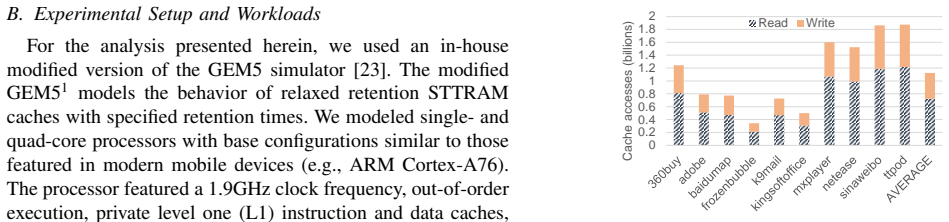
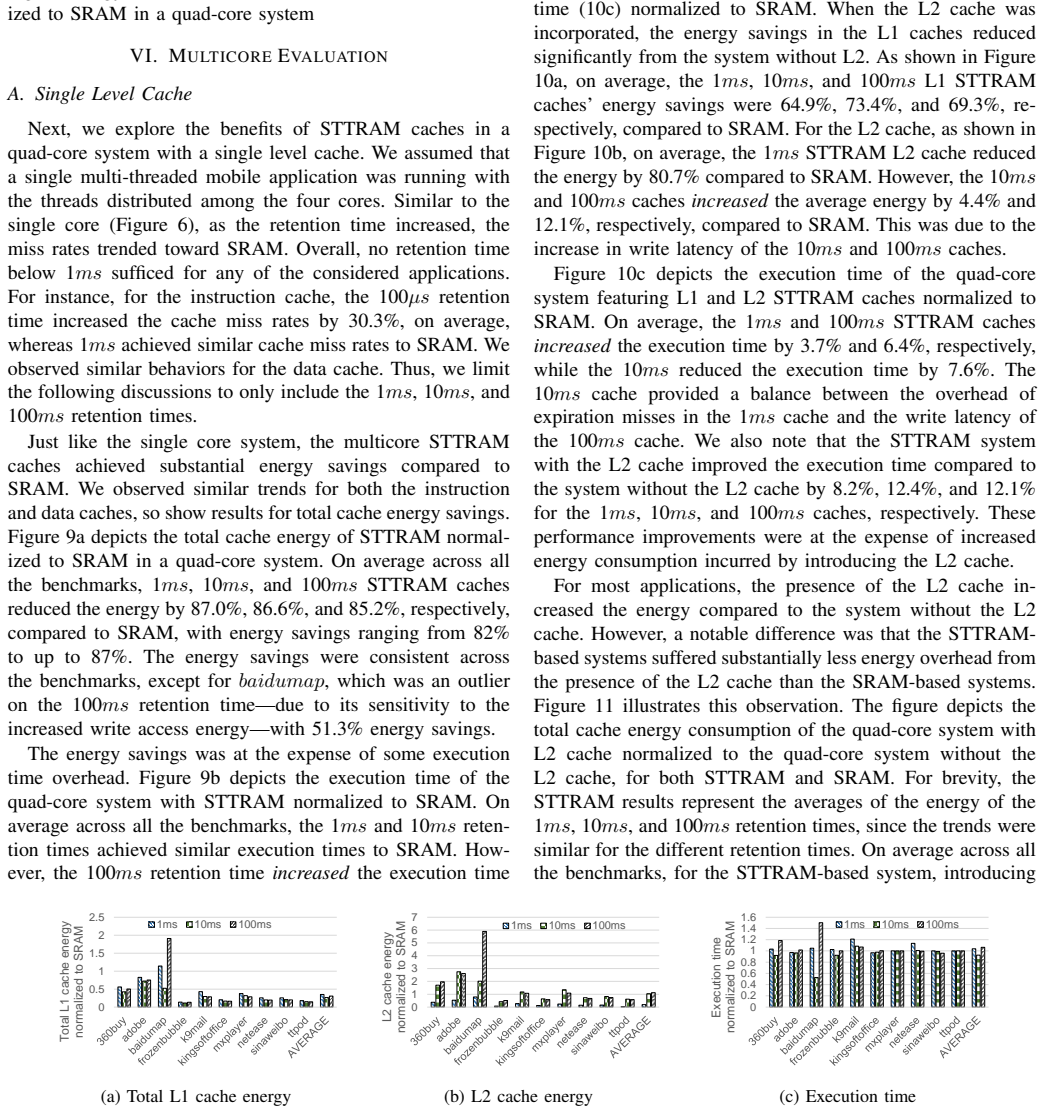
On the paper's own terms, the central claim is that reduced-retention STTRAM caches can deliver most of STTRAM's energy advantage over SRAM while avoiding its usual write penalties, and that for mobile workloads the right retention time is set by cache block lifetimes rather than a one-size-fits-all default. Concretely, the paper reports 85.2–87.0 percent total cache energy reduction at 1 ms, 10 ms, and 100 ms retention times for a quad-core system with a single level of cache, and as high as 87.3 percent in the single-core study, with execution time close to SRAM for 1 ms and 10 ms. The mechanism that makes this work is a per-block counter that evicts a line just before its retention expires, converting long-retention write overhead into rare expiration misses. The paper also shows that mobile applications' cache block lifetimes mostly fall between 1 ms and 100 ms, that the best retention time varies by application (10 ms is best for five of ten instruction caches and seven of ten data caches), and that an asymmetric design with different retention times on different cores yields a further 9.6 percent energy saving over the best homogeneous choice.
Load-bearing premise
The whole comparison depends on being able to build STTRAM memory cells with the chosen short retention times at the modeled write energy, write speed, and reliability—if such cells cannot be made, the energy savings exist only in simulation.
Editorial extensions
If this is right
- Mobile SoC designers could replace SRAM L1/L2 caches with short-retention STTRAM and cut total cache energy by roughly 85–87 percent while keeping execution time within a few percent of SRAM for most workloads.
- Retention time should be treated as a tunable parameter per application: no single retention time is best for all mobile apps, and 10 ms is the sweet spot for a majority of the tested workloads.
- Because mobile instruction caches also show application-dependent behavior, retention-time specialization must cover both the instruction cache and the data cache, unlike in earlier desktop-oriented studies where a single retention time sufficed for the instruction cache.
- An asymmetric per-core retention design is a low-cost way to gain another roughly 10 percent energy saving over the best homogeneous STTRAM cache, by letting the operating system schedule threads to the core whose retention time best matches their needs.
- Adding a second cache level changes the tradeoff: an STTRAM L2 can improve execution time by 8–12 percent over a single-level STTRAM system, but the extra level costs energy; STTRAM's added energy is much smaller than SRAM's (32.4% versus 6.0x in the paper's comparison).
Reading between the lines
- A testable extension would be to measure real cache block lifetimes on a phone under interactive use (touch, scrolling, background sync) to see whether the 1 ms–100 ms window holds outside the ten benchmark applications studied; if real lifetimes concentrate below 1 ms, short-retention STTRAM would need aggressive refresh or error correction.
- The paper's energy numbers assume the per-block counter itself costs only a few bits and negligible energy. An inference beyond the paper is that in a real implementation, the counter updates and the dirty-block writebacks on expiration could add enough traffic to erode the savings, especially in data caches with many writes.
- If reduced-retention magnetic tunnel junctions cannot be manufactured at the modeled write energy and reliability, the architecture-level conclusion still holds qualitatively: the argument only needs some technology whose write cost scales down with retention time, so other resistive memories with tunable retention might show the same pattern.
Signed reviews
Editorial analysis
A structured set of objections, weighed in public.
Referee Report
Summary. The paper studies reduced-retention STTRAM caches for mobile applications, arguing that mobile workloads have cache-block lifetime distributions and read/write ratios that make short-retention STTRAM particularly attractive. Using gem5 full-system simulations of ten Moby/Android benchmarks and NVSim-based cache energy models, the authors report large cache energy savings relative to SRAM for both single-core and quad-core systems, quantify expiration misses, propose retention-time specialization per benchmark, and present an asymmetric per-core retention-time design. The central quantitative claim is that 1 ms, 10 ms, and 100 ms STTRAM caches reduce total cache energy by 85.2% to 87.0% in a quad-core single-level-cache system, and that single-core instruction-cache savings can reach 87.3%, with only single-digit-percent execution-time overheads in most configurations.
Significance. If the modeled device parameters and simulation results hold, the paper provides a useful characterization of mobile applications' cache-block behavior in the context of reduced-retention STTRAM and gives evidence that large cache energy savings are available without large performance penalties. The work is a legitimate architectural-application study rather than a circular derivation: it combines an external full-system simulator (gem5), an external circuit-level energy model (NVSim), and an external mobile benchmark suite (Moby), and it ships or references the modified simulator. The analysis of expiration misses and the observation that instruction-cache retention-time requirements vary across mobile benchmarks are potentially valuable for later cache design. The main limitations are the unvalidated device-level premise that 1 ms-100 ms retention STTRAM can be fabricated with the modeled write energy, latency, and reliability, and several evaluation details that are stated rather than quantified.
major comments (3)
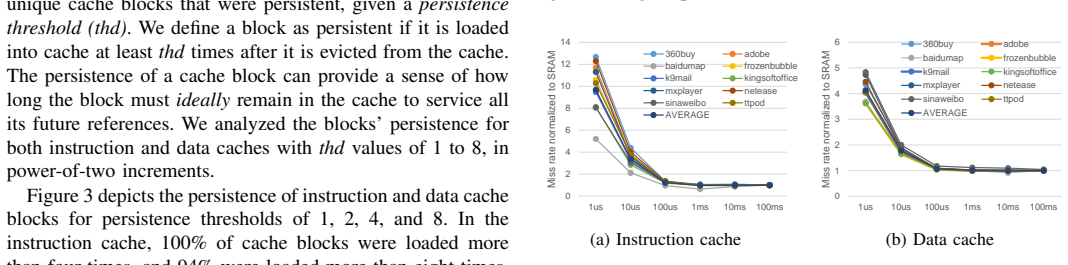
- [V.A] The text contains a direct numerical contradiction that undermines the reported single-core energy savings. The second paragraph states that 'the 1 µs retention time increased the energy consumption by 7.1%, and by up to 86.4% for 360buy,' but two sentences later it says 'The average energy savings for the other retention times ranged from 57% for 10 µs to 87.3% for 1µs.' If the 1 µs retention time increased the average instruction-cache energy by 7.1%, it cannot also produce 87.3% average savings. Please reconcile these statements with Figure 7a and state precisely which retention times correspond to the 57% and 87.3% figures; the current wording is self-contradictory.
- [III.A] The central quantitative claim is conditional on the unvalidated device-level premise stated in the first sentence of Section III.A: 'We assume that STTRAM caches can be fabricated as desired with different retention times.' The paper reduces MTJ planar area following [8] to obtain 1 ms-100 ms retention times and then feeds the resulting write pulse, write current, and resistance values into NVSim, but it does not validate that such reduced-retention cells have the modeled write energy, write latency, and reliability, and it explicitly defers reliability and process-variation effects to outside scope. Since the reported 85%-87% energy savings depend directly on write energy and the latency overhead depends on expiration-miss behavior, this assumption is load-bearing. Please add a sensitivity analysis showing how much the write energy and write latency would have to degrade before the headline energy and performance conclusions change, or provide experimental/silicon validation from prior reduced-retention STTRAM work.
- [V.B and VII.B] The claimed benefits of retention-time specialization and the asymmetric L1 cache design are evaluated under a strong oracle-like assumption that is not modeled or tested. In Section V.B, the 'best retention time' per benchmark is used after an assumed 10M-instruction sampling interval from prior work [16], and in Section VII.B the asymmetric design is compared against an application-specific homogeneous configuration where the best retention time on all cores is already known. No runtime profiling overhead, sampling accuracy, thread-migration cost, or sensitivity to workload phase changes is included. As written, the 9.6% asymmetric-design savings and the 5.7%-20.2% specialization savings are upper bounds rather than validated runtime results. Please state this limitation explicitly and, if possible, add a simple overhead model for profiling and migration.
minor comments (4)
- [III.A.2] The description of the per-block counter is ambiguous about whether a read hit resets the counter or only a miss/fetch resets it. The sentence 'the counter is reset to the initial state whenever a new fetch operation occurs for the block' could mean either a cache fill or any access; please clarify, since this directly affects the expiration-miss counts in Section IV.C.
- [III.B] The phrase 'retention times ranging from 1 µs to 100 ms in *10 increments' is informal; please write explicitly '1 µs, 10 µs, 100 µs, 1 ms, 10 ms, 100 ms' so that the retention-time grid is unambiguous.
- [IV.C] The observation that expiration misses are an insufficient criterion for energy and latency is interesting, but it is not quantified. Please report the correlation or at least a concrete example where a higher expiration-miss count coexists with lower energy or latency, beyond the qualitative statement.
- [VI.A] In Figure 9b, the 100 ms retention time increases average execution time by 10.8%, but the text says this is driven by baidumap, whose execution time is 3x SRAM. Reporting the mean without the median or a per-benchmark breakdown makes the latency claim hard to interpret; please show whether the overhead is concentrated in one outlier.
Circularity Check
No significant circularity: the central energy/latency comparison is produced by an external gem5+NVSim+Moby simulation chain; self-citations appear only in optional retention-specialization designs and do not drive the headline result.
full rationale
The paper's central claim—reduced-retention STTRAM caches cut cache energy by 85.2–87.3% with modest latency impact—derives from simulations using the external gem5 simulator, the external NVSim circuit model, and the external Moby mobile benchmark suite, with STTRAM MTJ scaling taken from the independent Chun et al. model [8]. None of these inputs is defined in terms of the paper's conclusions, so the headline result is not circular. The authors do cite their own prior LARS [16] and HALLS [26] work, but only to motivate optional sampling-based retention specialization and multi-bank asymmetry; these citations are not load-bearing for the main STTRAM-vs-SRAM comparison. Section V.B's 'best retention time' results are in-sample selections from the same simulated data (an upper-bound exploration of specialization), rather than independent predictions, so they are a methodological caveat but not a circular derivation. The paper also transparently states its key device assumption ('We assume that STTRAM caches can be fabricated as desired with different retention times') and defers reliability/fabrication validation, which is a correctness risk rather than circularity. Overall, the derivation chain is self-contained against external benchmarks and simulators; the low score reflects the presence of minor, non-load-bearing self-citations and the in-sample nature of the specialization comparison, not any circular reduction of the main result.
Assumptions & free parameters
free parameters (4)
- Retention time grid =
1us, 10us, 100us, 1ms, 10ms, 100ms
- Best retention time per benchmark =
Varies per benchmark, majority 10ms
- Sampling interval =
10M instructions
- Per-block counter state count N =
4 (two bits per block)
assumptions (5)
- domain assumption STTRAM caches can be fabricated with desired reduced retention times at the modeled energy and latency.
- domain assumption The MTJ scaling model from Chun et al. accurately predicts write pulse, write current, and resistance values for reduced-retention cells.
- domain assumption A two-bit per-block counter prevents data corruption from expired cache blocks with negligible overhead.
- domain assumption The ten Moby benchmarks running on Android ICS in gem5 are representative of mobile application workloads.
- domain assumption The modified gem5 simulator and NVSim faithfully model the processor and STTRAM cache behavior.
Cite this review
Pith. "Pith review of Energy and Performance Analysis of STTRAM Caches for Mobile Applications." pith.science (2026). https://pith.science/paper/D3EE7NSP
@misc{pith2026190804744,
  author       = {Pith},
  title        = {Pith review of: Energy and Performance Analysis of STTRAM Caches for Mobile Applications},
  year         = {2026},
  howpublished = {\url{https://pith.science/paper/D3EE7NSP}},
  note         = {Machine review of arXiv:1908.04744}
}
read the original abstract
Spin-Transfer Torque RAMs (STTRAMs) have been shown to offer much promise for implementing emerging cache architectures. This paper studies the viability of STTRAM caches for mobile workloads from the perspective of energy and latency. Specifically, we explore the benefits of reduced retention STTRAM caches for mobile applications. We analyze the characteristics of mobile applications' cache blocks and how those characteristics dictate the appropriate retention time for mobile device caches. We show that due to their inherently interactive nature, mobile applications' execution characteristics---and hence, STTRAM cache design requirements---differ from other kinds of applications. We also explore various STTRAM cache designs in both single and multicore systems, and at different cache levels, that can efficiently satisfy mobile applications' execution requirements, in order to maximize energy savings without introducing substantial latency overhead.
Figures


Figures from the paper (7 more)





Reference graph
Works this paper leans on
-
[8]
K. C. Chun, H. Zhao, J. D. Harms, T.-H. Kim, J.-P. Wang, and C. H. Kim, “A scaling roadmap and performance evaluation of in-plane and perpendicular mtj based stt-mrams for high-density cache memory,” IEEE Journal of Solid-State Circuits , vol. 48, no. 2, pp. 598–610, 2013
work page 2013
-
[16]
Lars: Logically adaptable retention time sttram cache for embedded systems,
K. Kuan and T. Adegbija, “Lars: Logically adaptable retention time sttram cache for embedded systems,” in Design, Automation & Test in Europe Conference & Exhibition, 2018. DATE’18. IEEE Computer Society, 2018
work page 2018
-
[1]
“Cortex-a76,” https://developer.arm.com/ip-products/processors/cortex- a/cortex-a76, accessed: April 2019
work page 2019
-
[2]
A survey of architectural techniques for improving cache power efficiency,
S. Mittal, “A survey of architectural techniques for improving cache power efficiency,” Sustainable Computing: Informatics and Systems , vol. 4, pp. 33–43, 2014
work page 2014
-
[3]
Spin-transfer torque mag- netic random access memory (stt-mram),
D. Apalkov, A. Khvalkovskiy, S. Watts, V . Nikitin, X. Tang, D. Lottis, K. Moon, X. Luo, E. Chen, A. Ong et al. , “Spin-transfer torque mag- netic random access memory (stt-mram),” ACM Journal on Emerging Technologies in Computing Systems (JETC) , vol. 9, no. 2, p. 13, 2013
work page 2013
-
[4]
An energy-efficient memory-based high-throughput vlsi architecture for convolutional networks,
M. Kang, S. K. Gonugondla, M.-S. Keel, and N. R. Shanbhag, “An energy-efficient memory-based high-throughput vlsi architecture for convolutional networks,” in 2015 IEEE International Conference on Acoustics, Speech and Signal Processing (ICASSP) . IEEE, 2015, pp. 1037–1041
work page 2015
-
[5]
Relaxing non-volatility for fast and energy-efficient stt-ram caches,
C. W. Smullen, V . Mohan, A. Nigam, S. Gurumurthi, and M. R. Stan, “Relaxing non-volatility for fast and energy-efficient stt-ram caches,” in High Performance Computer Architecture (HPCA), 2011 IEEE 17th International Symposium on . IEEE, 2011, pp. 50–61
work page 2011
-
[6]
Cache revive: architecting volatile stt-ram caches for enhanced performance in cmps,
A. Jog, A. K. Mishra, C. Xu, Y . Xie, V . Narayanan, R. Iyer, and C. R. Das, “Cache revive: architecting volatile stt-ram caches for enhanced performance in cmps,” in Proceedings of the 49th Annual Design Automation Conference. ACM, 2012, pp. 243–252
work page 2012
Show all 26 references
-
[7]
Cache decay: exploiting gen- erational behavior to reduce cache leakage power,
S. Kaxiras, Z. Hu, and M. Martonosi, “Cache decay: exploiting gen- erational behavior to reduce cache leakage power,” ACM SIGARCH Computer Architecture News, vol. 29, no. 2, pp. 240–251, 2001
2001
-
[9]
Highly reliable and low-power nonvolatile cache memory with advanced perpendicular stt-mram for high-performance cpu,
H. Noguchi, K. Ikegami, N. Shimomura, T. Tetsufumi, J. Ito, and S. Fujita, “Highly reliable and low-power nonvolatile cache memory with advanced perpendicular stt-mram for high-performance cpu,” in 2014 Symposium on VLSI Circuits Digest of Technical Papers , June 2014, pp. 1–2
2014
-
[10]
Multi retention level stt-ram cache designs with a dynamic refresh scheme,
Z. Sun, X. Bi, H. H. Li, W.-F. Wong, Z.-L. Ong, X. Zhu, and W. Wu, “Multi retention level stt-ram cache designs with a dynamic refresh scheme,” in Proceedings of the 44th Annual IEEE/ACM International Symposium on Microarchitecture. ACM, 2011, pp. 329–338
2011
-
[11]
A coherent hybrid sram and stt-ram l1 cache architecture for shared memory multicores,
J. Wang, Y . Tim, W.-F. Wong, Z.-L. Ong, Z. Sun, and H. Li, “A coherent hybrid sram and stt-ram l1 cache architecture for shared memory multicores,” in Design Automation Conference (ASP-DAC), 2014 19th Asia and South Pacific . IEEE, 2014, pp. 610–615
2014
-
[12]
Dasca: Dead write prediction assisted stt- ram cache architecture,
J. Ahn, S. Yoo, and K. Choi, “Dasca: Dead write prediction assisted stt- ram cache architecture,” in 2014 IEEE 20th International Symposium on High Performance Computer Architecture (HPCA) , Feb 2014, pp. 25–36
2014
-
[13]
Energy reduction for stt-ram using early write termination,
P. Zhou, B. Zhao, J. Yang, and Y . Zhang, “Energy reduction for stt-ram using early write termination,” in Proceedings of the 2009 International Conference on Computer-Aided Design . ACM, 2009, pp. 264–268
2009
-
[14]
Probabilistic replacement strategies for improving the lifetimes of nvm-based caches,
E. Reed, A. R. Alameldeen, H. Naeimi, and P. Stolt, “Probabilistic replacement strategies for improving the lifetimes of nvm-based caches,” in Proceedings of the International Symposium on Memory Systems . ACM, 2017, pp. 166–176
2017
-
[15]
Brloop: Constructing balanced retimed loop to architect stt-ram-based hybrid cache for vliw processors,
K. Qiu, Y . Zhu, Y . Xu, Q. Huo, and C. J. Xue, “Brloop: Constructing balanced retimed loop to architect stt-ram-based hybrid cache for vliw processors,” Microelectronics Journal, vol. 83, pp. 137 – 146, 2019
2019
-
[17]
Spec cpu2006,
“Spec cpu2006,” http://www.spec.org/cpu2006, accessed: March 2019
2019
-
[18]
Exploring energy-efficient cache design in emerging mobile platforms,
K. Yan, L. Peng, M. Chen, and X. Fu, “Exploring energy-efficient cache design in emerging mobile platforms,” ACM Transactions on Design Automation of Electronic Systems (TODAES), vol. 22, no. 4, p. 58, 2017
2017
-
[19]
The parsec benchmark suite: Characterization and architectural implications,
C. Bienia, S. Kumar, J. P. Singh, and K. Li, “The parsec benchmark suite: Characterization and architectural implications,” in Proceedings of the 17th international conference on Parallel architectures and compilation techniques. ACM, 2008, pp. 72–81
2008
-
[20]
Full-system analysis and characterization of interactive smartphone applications,
A. Gutierrez, R. G. Dreslinski, T. F. Wenisch, T. Mudge, A. Saidi, C. Emmons, and N. Paver, “Full-system analysis and characterization of interactive smartphone applications,” in 2011 IEEE International Symposium on Workload Characterization (IISWC) . IEEE, 2011, pp. 81–90
2011
-
[21]
Yield and reliability improvement techniques for emerging nonvolatile stt-mram,
W. Kang, L. Zhang, W. Zhao, J. Klein, Y . Zhang, D. Ravelosona, and C. Chappert, “Yield and reliability improvement techniques for emerging nonvolatile stt-mram,” IEEE Journal on Emerging and Selected Topics in Circuits and Systems , vol. 5, no. 1, pp. 28–39, March 2015
2015
-
[22]
Non-volatile processor based on mram for ultra-low-power iot devices,
S. Senni, L. Torres, G. Sassatelli, and A. Gamatie, “Non-volatile processor based on mram for ultra-low-power iot devices,”ACM Journal on Emerging Technologies in Computing Systems (JETC), vol. 13, no. 2, p. 17, 2017
2017
-
[23]
The gem5 simulator,
N. Binkert, B. Beckmann, G. Black, S. K. Reinhardt, A. Saidi, A. Basu, J. Hestness, D. R. Hower, T. Krishna, S. Sardashti et al. , “The gem5 simulator,” Computer Architecture News, vol. 40, no. 2, p. 1, 2012
2012
-
[24]
Nvsim: A circuit-level performance, energy, and area model for emerging nonvolatile mem- ory,
X. Dong, C. Xu, Y . Xie, and N. P. Jouppi, “Nvsim: A circuit-level performance, energy, and area model for emerging nonvolatile mem- ory,” Computer-Aided Design of Integrated Circuits and Systems, IEEE Transactions on, vol. 31, no. 7, pp. 994–1007, 2012
2012
-
[25]
Moby: A mobile benchmark suite for architectural simulators,
Y . Huang, Z. Zha, M. Chen, and L. Zhang, “Moby: A mobile benchmark suite for architectural simulators,” in 2014 IEEE International Sympo- sium on Performance Analysis of Systems and Software (ISPASS). IEEE, 2014, pp. 45–54
2014
-
[26]
Halls: An energy-efficient highly adaptable last level stt-ram cache for multicore systems,
K. Kuan and T. Adegbija, “Halls: An energy-efficient highly adaptable last level stt-ram cache for multicore systems,” IEEE Transactions on Computers, 2019
2019
Reviewed August 14, 2026 · model on record in the stance chip above.
Discussion (0). Continue with ORCID to comment.