REVIEW 3 major objections 7 minor 77 references
CMOS Image Sensors for CEvNS Detection at Nuclear Reactors
T0 review · 3 major / 7 minor · reviewed 2026-08-11 · deepseek-v4-flash
Pith's one-line read A ~100 g CMOS image-sensor array could detect reactor coherent neutrino scattering at 3σ in about 17 days.
desk verdict A coherent feasibility study with a genuinely new frame-veto idea and a real analytic IDB model; the discovery-time numbers are projections that hinge on unvalidated parameter combinations and a spatial-independence assumption. read the letter →
The pith
A machine-rendered reading of the paper's core claim, the machinery that carries it, and where it could break.
The reading
What carries the argument
The argument rests on an analytical model of intrinsic detector background (IDB) that treats dark current as a Poisson process per pixel and readout noise as Gaussian, then convolves the two into a per-pixel probability density. To turn pixel probabilities into event rates, the model counts connected clusters of pixels above a four-sigma threshold using polykings, the shapes a cluster of up to four pixels can make on a square lattice, so the probability of a spurious n-electron event is a polynomial in the per-pixel activation probability and the number of empty neighbors. A second piece is the CEvNS signal calculation, which convolves the reactor antineutrino spectrum with the Standard-Model coherent cross section, applies a silicon quenching factor and a Fano-limited Gaussian resolution, and evaluates discovery significance with the profile-likelihood ratio formula for small Poisson counts. The active-shielding machinery uses Poisson statistics of cosmic muons: at 1000 fps, a frame coincident with a muon trigger is rejected, leaving more than 90 percent live time while removing muon-induced neutron backgrounds.
What would settle it
Build a prototype with the Table I specifications and place it at a reactor site with a measured muon veto; if the measured dark current exceeds 1.5 e-/pix/s, the readout noise at 1000 fps exceeds 1 e-, the sensitive thickness falls below 725 microns, or the event rate in [0.065, 0.158 keVee] exceeds the predicted CEvNS signal plus the 100 DRU flat background, then the claimed 17-day detection time is falsified.
Extended reading notes
Core claim
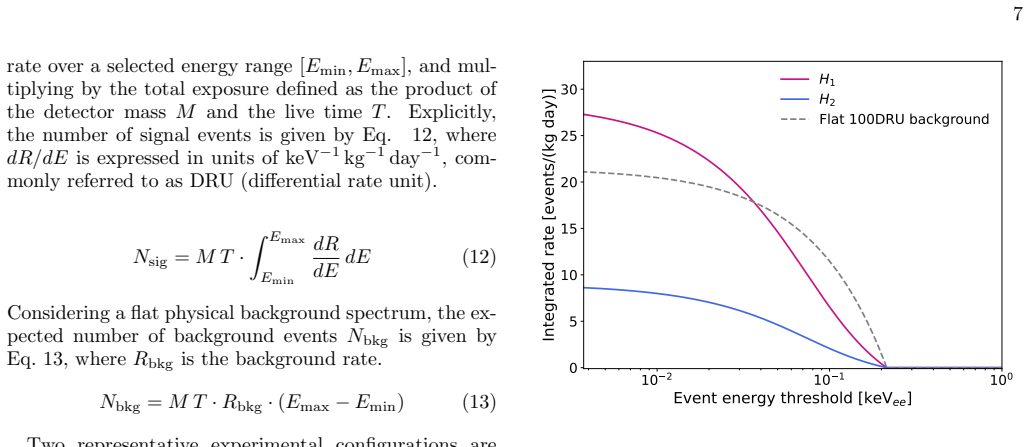
The central claim is that CIS technology, long used for cameras, can be repurposed as a low-threshold, high-frame-rate neutrino detector, combining the single-electron sensitivity previously demonstrated in silicon sensors that read each pixel multiple times with the temporal resolution that serial-readout devices lack. The authors show that the combination of 725-micron fully depleted silicon, 1 Mpix, 15-micron pixels, about 100 g mass in 256 sensors, 1 to 0.2 electron readout noise, and 1000 fps yields an instrumental background that can be pushed above a 0.064 keVee threshold, leaving a window near [0.065, 0.158 keVee] where the CEvNS signal exceeds the 100 DRU flat physical background. In the strong-flux scenario H1 = 0.014 GWth/m2, the profile-likelihood significance reaches 3 sigma in 17 days, and in 7 days at 0.2 e- noise; in a lower-flux scenario H2, about ten times longer is needed. The paper presents this as evidence that a feasible CIS-based detector could deliver the first compact, surface-operable reactor CEvNS observation and enable reactor monitoring applications.
Load-bearing premise
The whole timing estimate hangs on one premise: a single CMOS detector can be built that simultaneously has 725-micron fully depleted silicon, roughly one million 15-micron pixels, 1 (or 0.2) electron readout noise at 1000 frames per second, and a dark current of 1.5 electrons per pixel per second, even though each of these specifications has only been seen separately in different devices.
Editorial extensions
If this is right
- At H1 = 0.014 GWth/m2, a 100 g CIS detector with 1 e- noise, 1.5 e-/pix/s dark current, and 1000 fps reaches 3-sigma CEvNS detection in 17 days; at 200 fps the same detector needs about 44 days.
- Lowering readout noise to 0.2 e- shortens the 1000 fps detection time to about 7 days, because the energy threshold can drop from about 0.072 keVee to about 0.027 keVee while keeping the instrumental background below the signal window.
- Frame rejection based on coincident cosmic-muon triggers keeps live time above about 90 percent at 1000 fps and suppresses the muon-induced neutron background that otherwise dominates surface reactor sites.
- For reduced-flux or longer-baseline scenarios (H2 = 0.004 GWth/m2), the required observation time is roughly an order of magnitude larger, around 150 days for the reference detector.
- At 1 e- noise and 200 fps, the detector is already suitable for reactor monitoring and low-energy response validation; sub-electron noise extends sensitivity to beyond-Standard-Model searches such as neutrino magnetic moments and light mediators.
Reading between the lines
- The polyking cluster-counting model applies to any pixelated low-threshold imager, not just CIS, so the same formalism could quantify spurious event rates from dark current and readout noise in other silicon detector families and give a common yardstick for comparing technologies.
- The paper samples but does not solve the frame-rate tradeoff: for fixed dark current and readout noise, there is likely an optimal frames-per-second value that balances muon-veto dead time, per-frame dark-current accumulation, and readout-noise sampling.
- If future devices reach the assumed dark current at lower temperature and sub-electron noise, the threshold could drop below 0.027 keVee, where the H1 signal rate is still substantial; the model would then need to include multi-pixel partial-charge-collection effects before claims at those thresholds solidify.
- The 100 DRU flat background is an assumption carried over from other silicon and germanium measurements; a dedicated background measurement with a thick CIS would be the natural next step, since the IDB model alone cannot validate that number.
Editorial analysis
A structured set of objections, weighed in public.
Referee Report
Summary. This manuscript proposes the use of CMOS image sensors (CIS) for detecting reactor coherent elastic neutrino-nucleus scattering (CEvNS). It develops an active-shielding strategy based on rejecting frames coincident with muon triggers, and an analytical 'polyking' model for intrinsic detector backgrounds from dark current and readout noise. Using a flat 100 DRU physical background and a ~100 g detector with the parameters in Table I (1 Mpix, 15 µm pixels, 725 µm thickness, 1 or 0.2 e- readout noise, 1000 fps), the authors compute 3σ detection times with the Asimov significance formula: 17 days for H1 = 0.014 GW_th/m² at 1 e- noise and about 7 days at 0.2 e- noise. The signal calculation uses the Huber antineutrino flux, the Standard Model CEvNS cross section, and a measured quenching parameterization.
Significance. If the stated assumptions hold, the paper provides the first quantitative sensitivity study for CEvNS with CIS and identifies a potentially compact, fast detector for reactor monitoring and safeguards. Its strengths include the use of standard external inputs (Huber flux, SM cross section, measured quenching), a transparent analytical background model with concrete falsifiable predictions, and a clear presentation of the significance calculation. The active-shielding-by-frame-rejection concept is a useful adaptation of rare-event techniques to high-frame-rate pixel sensors. However, the central detection-time claims rest on three unvalidated assumptions: the absence of correlated readout/dark-current noise in the polyking model, the simultaneous technological feasibility of all Table I parameters, and a flat 100 DRU physical background. These issues make the headline numbers conditional, but the framework itself is sound and the paper could become convincing with targeted additions.
major comments (3)
- [Section II.C / Appendix A, Eqs. (A2)-(A6)] The polyking cluster probabilities are factorized as products of single-pixel activation probabilities, p^s q^{v(s)}, which is exact only if pixel values are spatially independent. At 1000 fps with column-parallel readout, CIS noise typically contains row/column common-mode and power-supply correlated components, and dark current is spatially correlated through hot pixels and defect clusters. A residual correlated component of even 0.3-0.5 e- RMS would make simultaneous threshold crossings far more likely than p^s, potentially raising the IDB by orders of magnitude at the 0.065 keVee analysis threshold and thereby invalidating the 17-day (H1, 1 e-) and 7-day (0.2 e-) detection times in Table II. The manuscript neither states the independence assumption as a limitation nor adds a covariance term or a bound on the allowed correlated component; this must be addressed, for example by extending the model with a correlation term or by validating it on measured CIS dark-frame noise images.
- [Section IV / Table I] The detector parameters in Table I are drawn from separate demonstrations rather than from a single device. The 725 µm fully depleted thickness is demonstrated in a CMOS-DEPFET operating at ~9.8 e- noise and 1.1 MHz; sub-electron noise is shown in a 64x64 DEPFET array or in Skipper-CMOS with 18 µm epitaxial thickness; no cited sensor simultaneously achieves 1 Mpix, 15 µm pixels, 1000 fps, sub-electron noise, and a dark current of 1.5 e-/pix/s. The statement that the design is 'technologically feasible' is therefore an extrapolation. Because the headline detection times are conditional on the simultaneous realization of all Table I parameters, the paper should either cite a device that meets all specifications or clearly reframe the results as a parametric sensitivity study with a technology-development roadmap.
- [Section II.B / Sections III.B and IV] The physical background is assumed to be a flat 100 DRU, justified by Skipper-CCD Compton measurements and by the expectation that active shielding removes the neutron-induced exponential low-energy component. No measurement exists for the proposed CIS technology in the sub-100 eV region, and a flat spectrum is not guaranteed: surface backgrounds, residual Cherenkov photons, or gamma-induced events could introduce a non-flat spectral shape. Since the detection times in Table II scale directly with the background rate, the paper should include a sensitivity scan over the background rate and spectral shape (e.g., 30, 100, and 300 DRU, optionally with an exponential low-energy component) to show how the 17-day and 7-day claims would change if the background assumption is violated.
minor comments (7)
- [Section IV] The statement that the active-shielding inefficiency 'increases the observation time by 20%' is only true for the 1000 fps case; at 200 fps the dead-time fraction is about 63%, which is correctly reflected in Table II but not in the text. Please specify the frame rate when quoting this number.
- [Appendix B, Eq. (B6)] The energy resolution uses sigma_RN = 2 e- for all scenarios, even when the detector readout noise is taken as 0.2 e- or 1 e- in Table II. This is a conservative choice, but it is inconsistent with the detector parameters used elsewhere and could underestimate the signal acceptance for the low-noise configurations; a justification or a scan over this value would be helpful.
- [Appendix A] The derivation would be clearer if the probability for a given total charge Q were written explicitly as a sum over partitions of the product of per-pixel charge probabilities; Eqs. (A2)-(A6) alone give only the probability of a cluster of a given size and do not show how the charge distribution enters the calculation.
- [Section II.B] The muon rate of 200 Hz is adopted as 'representative' without an explicit scaling from the veto geometry; since the live-time calculation depends on this rate, a more detailed estimate or a range of plausible values would strengthen the analysis.
- [References] References [8] and [66] are the same article, and [10] and [65] also appear to be the same work; please consolidate to avoid duplicate citations.
- [Figure 3] The saw-tooth structure in the left panel is not explained in the text; a sentence describing its origin would help the reader interpret the model behavior.
- [Section III.A] The phrase 'set at the value to 0.215 keV' should be reworded to 'set to the value of 0.215 keV' for clarity.
Circularity Check
No significant circularity: detection-time claims follow from external physics inputs and an analytic detector-background model, without fitted parameters or self-citation chains.
full rationale
The paper's central quantities (CEvNS rate, IDB rate, and 3-sigma exposure) are computed by inserting assumed detector parameters into standard analytic expressions. The neutrino flux uses external tabulated reactor spectra and the SM CEvNS cross section; the recoil-to-ionization conversion uses a measured quenching parameterization. The IDB model in Appendix A derives cluster probabilities from the single-pixel convolution of Poisson dark current and Gaussian readout noise using polyking combinatorics; this is a direct calculation, not an inversion of the desired detection time. No parameter is fitted to the detection-time output, and no existing known result is merely renamed as a prediction. The detector-feasibility claim rests on citations to separately demonstrated components (thick DMAPS, low-noise Skipper-CMOS, fast readout ASICs); although several of these works include the present authors, the citations are used as external evidence of component capability rather than as a load-bearing uniqueness argument. The main vulnerability, the spatial independence of pixels in Eq. A3, is an explicit simplifying assumption of the model, and questioning it is a physics-risk concern rather than circular reasoning. Accordingly, the derivation is self-contained for circularity purposes.
Assumptions & free parameters
free parameters (7)
- Flat physical background rate =
100 DRU
- Dark current lambda_DC =
1.5 e-/pix/s (Table I)
- Readout noise sigma_RN =
1 e- (baseline), 0.5 e-, 0.2 e- (improved)
- Frame rate =
200, 500, 1000 fps
- Muon rate in vetoed volume =
200 Hz
- Muon-induced neutron moderation time =
tau_n ~ 450 microseconds
- Event threshold multiplier =
4x readout noise
assumptions (7)
- standard math CEvNS Standard Model cross section with Helm-type form factor
- standard math Huber antineutrino flux parameterization
- standard math Chavarria quenching parameterization for silicon nuclear recoils
- domain assumption Flat physical background between ~15 eV and 215 eVee
- domain assumption Muon arrivals follow a Poisson process and single-frame rejection gives >90% live time
- domain assumption CEvNS charge spreads to at most 4 pixels in a 15 micron pixel device
- domain assumption Readout noise and dark current are independent and described by Gaussian/Poisson convolution
Cite this review
Pith. "Pith review of CMOS Image Sensors for CEvNS Detection at Nuclear Reactors." pith.science (2026). https://pith.science/paper/D43RXJK3
@misc{pith2026260807676,
  author       = {Pith},
  title        = {Pith review of: CMOS Image Sensors for CEvNS Detection at Nuclear Reactors},
  year         = {2026},
  howpublished = {\url{https://pith.science/paper/D43RXJK3}},
  note         = {Machine review of arXiv:2608.07676}
}
abstract
In this work we present Complementary Metal-Oxide-Semiconductor (CMOS) Image Sensors (CIS) for reactor neutrino experiments targeting coherent elastic neutrino-nucleus scattering (CEvNS). We have developed an active-shielding strategy for physical background reduction along with an analytical model describing the impact of intrinsic detector backgrounds from dark current and readout noise at a given frame rate (fps). Assuming a conservative background of 100 DRU, and a feasible CIS-based detector with $\sim$100g of sensitive silicon mass, 1$e^-$ of readout noise, and 200fps, it can detect CEvNS in less than 50 days at 16 meters from a 3.6 GW thermal reactor core. Improving the detector performance to 0.2$e^-$ readout noise and 1000fps substantially reduces the detection time to about 7 days. These results establish CIS technology as a promising platform for reactor monitoring and precision neutrino measurements, with thick CMOS sensors featuring parallel and non-destructive readout emerging as particularly attractive candidates for next-generation CEvNS experiments.
Figures


Figures from the paper (8 more)


Reference graph
Works this paper leans on
-
[1]
12,E min andE max respectively
Optimal spectrum energy range In order to determine the spectrum energy range that maximize the significance for the CEvNS detection, we perform a two-dimensional scan over the lower and upper integration limits of Eq. 12,E min andE max respectively. 8 For each range [E min, Emax], we compute the expected number of signal and background events, and calcul...
-
[2]
all cluster sizes 1≤s≤4
-
[3]
all cluster geometries of sizes
-
[4]
all charge partitions ofQintospositive integers, including their permutations across pixels. Appendix B: Quenching factor and detector resolution To relate the differential nuclear recoil rate from Eq. 8 to the differential ionization rate measured by an APS detector, the nuclear quenching factor must be taken into account. The quenching factor is defined...
-
[5]
B. K. Cogswell and P. Huber, Detection of breeding blan- kets using antineutrinos, Science & Global Security24, 114 (2016)
work page 2016
-
[7]
E. Houston, S. Bogetic, O. Akindele, M. Bergevin, A. Bernstein, and S. Dazley, Neutrino-detector design for safeguarding small modular reactors, Physical Review Applied21, 064061 (2024)
work page 2024
-
[8]
A. Bernstein, N. Bowden, B. L. Goldblum, P. Huber, I. Jovanovic, and J. Mattingly, Colloquium: Neutrino de- tectors as tools for nuclear security, Reviews of Modern Physics92, 011003 (2020)
work page 2020
-
[9]
G. Fernandez Moroni, P. Machado, I. Martinez-Soler, Y. Perez-Gonzalez, D. Rodrigues, and S. Rosauro- Alcaraz, The physics potential of a reactor neutrino ex- periment with skipper ccds: measuring the weak mixing angle, Journal of High Energy Physics2021(2021)
work page 2021
Show all 77 references
-
[10]
Fernandez-Moroni, R
G. Fernandez-Moroni, R. Harnik, P. A. N. Machado, I. Martinez-Soler, Y. F. Perez-Gonzalez, D. Rodrigues, and S. Rosauro-Alcaraz, The physics potential of a reac- tor neutrino experiment with skipper-ccds: searching for new physics with light mediators, Journal of High Energy P...
2022
-
[11]
Aguilar-Arevalo (CONNIE and Atucha-II Collabora- tions), Search for reactor-produced millicharged parti- cles with skipper-ccds at the connie and atucha-ii exper- iments, Phys. Rev. Lett.134, 071801 (2025)
2025
-
[12]
Ackermann, H
N. Ackermann, H. Bonet, A. Bonhomme, C. Buck, K. F¨ ulber, J. Hakenm¨ uller, J. Hempfling, G. Heusser, M. Lindner, W. Maneschg, K. Ni, M. Rank, T. Rink, E. S´ anchez Garc ´ ıa, I. Stalder, H. Strecker, R. Wink, and J. Woenckhaus, Direct observation of coherent elas- tic antine...
2025
-
[13]
Tiffenberg, M
J. Tiffenberg, M. Sofo-Haro, A. Drlica-Wagner, R. Essig, Y. Guardincerri, S. Holland, T. Volansky, and T.-T. Yu, Single-Electron and Single-Photon Sensitivity with a Sil- icon Skipper CCD, Phys. Rev. Lett.119, 131802 (2017)
2017
-
[15]
A. Aguilar-Arevaloet al.(CONNIE Collaboration), Search for coherent elastic neutrino-nucleus scattering at a nuclear reactor with CONNIE 2019 data, Journal of High Energy Physics2022, 1 (2022)
2022
-
[16]
Crisleret al.(SENSEI Collaboration), SENSEI: First direct-detection constraints on Sub-GeV dark matter from a surface run, Phys
M. Crisleret al.(SENSEI Collaboration), SENSEI: First direct-detection constraints on Sub-GeV dark matter from a surface run, Phys. Rev. Lett.121, 061803 (2018)
2018
-
[17]
Abramoffet al.(SENSEI Collaboration), SENSEI: Direct-detection constraints on Sub-GeV dark matter from a shallow underground run using a prototype Skip- per CCD, Phys
O. Abramoffet al.(SENSEI Collaboration), SENSEI: Direct-detection constraints on Sub-GeV dark matter from a shallow underground run using a prototype Skip- per CCD, Phys. Rev. Lett.122, 161801 (2019)
2019
-
[18]
Baraket al.(SENSEI Collaboration), SENSEI: Direct- detection results on sub-GeV dark matter from a new Skipper CCD, Phys
L. Baraket al.(SENSEI Collaboration), SENSEI: Direct- detection results on sub-GeV dark matter from a new Skipper CCD, Phys. Rev. Lett.125, 171802 (2020)
2020
-
[19]
Arnquistet al.(DAMIC-M Collaboration), First con- straints from damic-m on sub-gev dark-matter particles interacting with electrons, Phys
I. Arnquistet al.(DAMIC-M Collaboration), First con- straints from damic-m on sub-gev dark-matter particles interacting with electrons, Phys. Rev. Lett.130, 171003 (2023)
2023
-
[20]
A. A. Aguilar-Arevalo, N. Avalos, X. Bertou, C. Boni- fazi, G. Cancelo, B. A. Cervantes-Vergara, C. Chavez, F. Chierchie, G. C. Corrˆ ea, J. C. D’Olivo,et al., Searches for ce{\nu}ns and physics beyond the stan- dard model using skipper-ccds at connie, arXiv preprint arXiv:240...
2024 arXiv
-
[21]
Janesick, Scientific charge-couple devices, Scientific charge-coupled devices, Bellingham, W A: SPIE Optical Engineering Press, 2001, xvi, 906 p
J. Janesick, Scientific charge-couple devices, Scientific charge-coupled devices, Bellingham, W A: SPIE Optical Engineering Press, 2001, xvi, 906 p. SPIE Press mono- graph, PM 83. ISBN 081943698483(2001)
2001
-
[22]
D. J. Schlegel, S. Ferraro, G. Aldering, C. Baltay, S. BenZvi, R. Besuner, G. A. Blanc, A. S. Bolton, A. Bonaca, D. Brooks,et al., A spectroscopic road map for cosmic frontier: Desi, desi-ii, stage-5, arXiv preprint arXiv:2209.03585 (2022)
2022 arXiv
-
[23]
Crill, Progress in technology for exoplanet missions, JPL document D-108825 (2023)
B. Crill, Progress in technology for exoplanet missions, JPL document D-108825 (2023)
2023
-
[24]
B. J. Rauscher, S. Holland, E. Kan, D. Kelly, L. Miko, D. B. Mott, and A. Waczynski, Radiation tolerant, pho- ton counting, visible, and near-ir detectors for space coronagraphs, inSpace Telescopes and Instrumentation 2022: Optical, Infrared, and Millimeter Wave, Vol. 12180 (S...
2022
-
[25]
A. M. Botti, B. A. Cervantes-Vergara, C. R. Chavez, F. Chierchie, A. Drlica-Wagner, J. Estrada, G. F. Mo- roni, S. E. Holland, B. J. I. Gimenez, A. J. Lapi,et al., Single-quantum measurement with a multiple-amplifier sensing charge-coupled device, IEEE Transactions on 13 Elect...
2024
-
[26]
Sofo-Haro, K
M. Sofo-Haro, K. Donlon, J. Estrada, S. Holland, F. Fahim, and C. Leitz, Achieving single-electron sen- sitivity at enhanced speed in fully depleted ccds with double-gate mosfets, Physical Review Letters133, 121003 (2024)
2024
-
[27]
Tiffenberg, D
J. Tiffenberg, D. Ega˜ na-Ugrinovic, M. S. Haro, P. Du, R. Essig, G. Fernandez-Moroni, and S. Uemura, Dual- sided charge-coupled devices, Physical Review Applied 22, 014008 (2024)
2024
-
[28]
Fossum, Cmos image sensors: electronic camera-on- a-chip, IEEE Transactions on Electron Devices44, 1689 (1997)
E. Fossum, Cmos image sensors: electronic camera-on- a-chip, IEEE Transactions on Electron Devices44, 1689 (1997)
1997
-
[29]
M.-W. Seo, S. Kawahito, K. Kagawa, and K. Yasutomi, A 0.27 e-rms read noise 220-µv/e-conversion gain reset- gate-less cmos image sensor with 0.11-µm cis process, IEEE Electron Device Letters36, 1344 (2015)
2015
-
[30]
Boukhayma, A
A. Boukhayma, A. Peizerat, and C. Enz, A sub-0.5 elec- tron read noise vga image sensor in a standard cmos pro- cess, IEEE Journal of solid-state circuits51, 2180 (2016)
2016
-
[31]
J. Ma, S. Masoodian, Y. Song, K. Odame, E. Fossum, and D. Hondongwa, Quanta image sensor (qis): Early research progress, inOptics InfoBase Conference Papers (2013)
2013
-
[32]
Fossum, J
E. Fossum, J. Ma, S. Masoodian, L. Anzagira, and R. Zizza, The quanta image sensor: Every photon counts,url:https://digitalcommons.dartmouth.edu/ cgi/viewcontent.cgi?article=4432&context=facoa (2016)
2016
-
[33]
Corporation, Orca-quest qcmos camera, technical note,url:https://www.hamamatsu.com/content/ dam/hamamatsu-photonics/sites/documents/99_ SALES_LIBRARY/sys/SCAS0154E_C15550-20UP_tec
H. Corporation, Orca-quest qcmos camera, technical note,url:https://www.hamamatsu.com/content/ dam/hamamatsu-photonics/sites/documents/99_ SALES_LIBRARY/sys/SCAS0154E_C15550-20UP_tec. pdfHamamatsu.com (2021)
2021
-
[34]
W. Snoeys, Cmos monolithic active pixel sensors for high energy physics, Nuclear Instruments and Methods in Physics Research Section A: Accelerators, Spectrometers, Detectors and Associated Equipment765, 167 (2014)
2014
-
[35]
G. A. Rinella, A. Collaboration,et al., The alpide pixel sensor chip for the upgrade of the alice inner tracking system, Nuclear Instruments and Methods in Physics Re- search Section A: Accelerators, Spectrometers, Detectors and Associated Equipment845, 583 (2017)
2017
-
[36]
Senyukov, J
S. Senyukov, J. Baudot, A. Besson, G. Claus, L. Cousin, A. Dorokhov, W. Dulinski, M. Goffe, C. Hu-Guo, and M. Winter, Charged particle detection performances of cmos pixel sensors produced in a 0.18µm process with a high resistivity epitaxial layer, Nuclear Instruments and Met...
2013
-
[37]
Hirono, M
T. Hirono, M. Barbero, P. Breugnon, S. Godiot, T. Hemperek, F. H¨ ugging, H. Kr¨ uger, J. Liu, P. Pan- gaud, I. Peric,et al., Cmos pixel sensors on high resis- tive substrate for high-rate, high-radiation environments, Nuclear Instruments and Methods in Physics Research Sectio...
2016
-
[38]
T. Wang, P. Rymaszewski, M. Barbero, Y. Degerli, S. Godiot, F. Guilloux, T. Hemperek, T. Hirono, H. Kr¨ uger, J. Liu,et al., Development of a depleted monolithic cmos sensor in a 150 nm cmos technology for the atlas inner tracker upgrade, Journal of Instrumenta- tion12(01), C01039
-
[39]
Pantouvakis, M
C. Pantouvakis, M. Rignanese, T. Zenger, S. Ciarlantini, A. Zingaretti, P. Azzi, C. Bonini, D. Chiappara, S. Mat- tiazzo, D. Pantano, J. Wyss, A. Apresyan, N. Bacchetta, L. Bolla, A. Hayrapetyan, C. Pe˜ na, N. Salvador, S. Xie, I. Zoi, D. Falchieri, S. Garbolino, L. Pancheri, ...
-
[40]
Da Rocha Rolo, A
M. Da Rocha Rolo, A. Andreazza, G. Ambrosi, F. Al- fonsi, G. Balbi, G.-F. Dalla Betta, T. Croci, M. Caccia, D. Chiappara, T. Corradino, S. Durando, D. Falchieri, A. Gabrielli, P. Giubilato, S. Garbolino, R. Iuppa, M. Mandurrino, S. Mattiazzo, C. Neub¨ user, L. Pancheri, D. Pan...
2025
-
[41]
Peric, Active pixel sensors in high-voltage cmos tech- nologies for atlas, Journal of Instrumentation7(08), C08002
I. Peric, Active pixel sensors in high-voltage cmos tech- nologies for atlas, Journal of Instrumentation7(08), C08002
-
[42]
Acharya, R
S. Acharya, R. Acosta Hernandez, D. Adamov´ a, A. Adler, J. Adolfsson, D. Agguiaro, G. Aglieri Rinella, M. Agnello, F. Agnese, N. Agrawal,et al., Alice upgrades during the lhc long shutdown 2, Journal of instrumenta- tion19, P05062 (2024)
2024
-
[43]
A. S. Triolo, Calibration of the upgraded alice in- ner tracking system, arXiv preprint arXiv:2302.00433 (2023)
2023 arXiv
-
[44]
G. A. Carini, G. W. Deptuch, F. Fahim, L. A. Kad lubowski, P. Klabbers, S. Lauxtermann, P.-O. Pet- terson, and T. Zimmerman, Hybridized maps with an in- pixel a-to-d conversion readout asic, Nuclear Instruments and Methods in Physics Research Section A: Acceler- ators, Spectro...
2019
-
[45]
Maffessanti, K
S. Maffessanti, K. Hansen, S. Aschauer, A. Castoldi, F. Erdinger, C. Fiorini, P. Fischer, P. Kalavakuru, H. Kl¨ ar, M. Manghisoni,et al., A 64k pixel cmos-depfet module for the soft x-rays dssc imager operating at mhz- frame rates, Scientific reports13, 11799 (2023)
2023
-
[46]
Castoldi, M
A. Castoldi, M. Ghisetti, C. Guazzoni, S. Aschauer, L. Str¨ uder, K. Hansen, S. Maffessanti, C. Danilevski, D. Lomidze, M. Turcato, and M. Porro, Qualification of the x-ray spectral performance of the depfet pixels of the dssc imager, Nuclear Instruments and Methods in Physics...
2023
-
[47]
Aschauer, P
S. Aschauer, P. Majewski, G. Lutz, H. Soltau, P. Holl, R. Hartmann, D. Schlosser, U. Paschen, S. Wey- ers, S. Dreiner, M. Klusmann, J. Hauser, D. Kalok, A. Bechteler, K. Heinzinger, M. Porro, B. Titze, and L. Str¨ uder, First results on depfet active pixel sensors fabricated i...
-
[48]
M. Porro, Ultra-low noise imaging of soft x-rays at rates of up to 4.5 mega-frames per second using the dssc cam- era at the european xfel, in2025 IEEE Nuclear Science Symposium (NSS), Medical Imaging Conference (MIC) and Room Temperature Semiconductor Detector Confer- ence (R...
2025
-
[49]
Hansen, H
K. Hansen, H. Kl¨ ar, P. Kalavakuru, C. Reckleben, A. Venzmer, E. W¨ ustenhagen, R. Schappeit, O.-C. Zei- des, F. Okrent, C. Wunderer, M. Lemke, H. Graafsma, I. Schlosser, M. Manghisoni, E. Riceputi, S. Aschauer, L. Str¨ uder, J. Soldat, M. Tangl, F. Erdinger, A. Kugel, P. Fis...
2019
-
[50]
G. Lutz, M. Porro, S. Aschauer, S. W¨ olfel, and L. Str¨ uder, The depfet sensor-amplifier structure: A method to beat 1/f noise and reach sub-electron noise in pixel detectors, Sensors16, 10.3390/s16050608 (2016)
2016 doi
-
[51]
B¨ ahr, H
A. B¨ ahr, H. Kluck, P. Lechner, J. Ninkovic, J. Schiek, H. Shi, W. Treberspurg, and J. Treis, First measurement results from DANAE - Demonstrating DePFET RNDR on a prototype Matrix, SciPost Phys. Proc. , 066 (2023)
2023
-
[52]
Sofo-Haro, K
M. Sofo-Haro, K. Donlon, J. Estrada, S. Holland, F. Fahim, and C. Leitz, Achieving single-electron sen- sitivity at enhanced speed in fully depleted ccds with double-gate mosfets, Phys. Rev. Lett.133, 121003 (2024)
2024
-
[53]
A. J. Lapi, M. Sofo-Haro, B. C. Parpillon, A. Birman, G. Fernandez-Moroni, L. Rota, F. A. Bessia, A. Gupta, C. R. C. Blanco, F. Chierchie, J. Segal, C. J. Kenney, A. Dragone, S. Li, D. Braga, A. Fenigstein, J. Estrada, and F. Fahim, Skipper-in-cmos: Nondestructive readout with...
2024
-
[54]
K. D. Stefanov, A. S. Clarke, and A. D. Holland, Fully depleted pinned photodiode cmos image sensor with re- verse substrate bias, IEEE Electron Device Letters38, 64 (2016)
2016
-
[55]
C. Ma, Y. Liu, J. Li, Q. Zhou, Y. Chang, and X. Wang, A 4mp high-dynamic-range, low-noise cmos image sensor, inImage Sensors and Imaging Systems 2015, Vol. 9403 (International Society for Optics and Photonics, 2015) p. 940305
2015
-
[56]
X. Wang, C. Ma, Y. Liu, Y. Li, and Q. Zhou, A 4m, 1.4 e-noise, 96db dynamic range, back-side illuminated cmos image sensor, inProceedings of the International Image Sensor Workshop(2015)
2015
-
[57]
Quinn, F
A. Quinn, F. Fahim, and D. Braga, A cryogenic readout integrated circuit with analog pile-up and in-pixel adc for high frame rate skipper ccd-in-cmos sensors, in2024 IEEE Nuclear Science Symposium (NSS), Medical Imag- ing Conference (MIC) and Room Temperature Semicon- ductor D...
2024
-
[58]
Quinn, M
A. Quinn, M. B. Valentin, T. Zimmerman, D. Braga, S. Memik, and F. Fahim, A cryogenic readout ic with 100 ksps in-pixel adc for skipper ccd-in-cmos sensors, in2023 IEEE International Symposium on Circuits and Systems (ISCAS)(IEEE, 2023) pp. 1–5
2023
-
[59]
Ackermann, S
N. Ackermann, S. Armbruster, H. Bonet, C. Buck, K. F¨ ulber, J. Hakenm¨ uller, J. Hempfling, G. Heusser, M. Lindner, W. Maneschg,et al., Conus+ experiment, The European Physical Journal C84, 1265 (2024)
2024
-
[60]
Bonet, A
H. Bonet, A. Bonhomme, C. Buck, K. F¨ ulber, J. Hak- enm¨ uller, J. Hempfling, G. Heusser, T. Hugle, M. Lind- ner, W. Maneschg,et al., Full background decomposition of the conus experiment, The European Physical Journal C83, 195 (2023)
2023
-
[61]
A. M. Botti, S. Uemura, G. F. Moroni, L. Barak, M. Cababie, R. Essig, E. Etzion, D. Rodrigues, N. Saf- fold, M. Sofo Haro,et al., Constraints on the electron- hole pair creation energy and fano factor below 150 ev from compton scattering in a skipper ccd, Physical Re- view D10...
2022
-
[62]
G. F. Moroni, F. Chierchie, J. Tiffenberg, A. Botti, M. Cababie, G. Cancelo, E. L. Depaoli, J. Estrada, S. E. Holland, D. Rodrigues, I. Sidelnik, M. S. Haro, L. Stefanazzi, and S. Uemura, Skipper charge-coupled de- vice for low-energy-threshold particle experiments above groun...
2022
-
[63]
P. Du, D. Egana-Ugrinovic, R. Essig, and M. Shola- purkar, Sources of low-energy events in low-threshold dark matter and neutrino detectors, Phys. Rev. X12, 011009 (2022), arXiv:2011.13939 [hep-ph]
2022 arXiv
-
[64]
G. F. Moroni, F. Chierchie, L. Giardino, J. Tiffenberg, and J. Estrada, Measurement of photons emitted by high- energy charged particles as background in single-photon resolving image sensors, IEEE Transactions on Nuclear Science72, 2948 (2025)
2025
-
[65]
Barak, I
L. Barak, I. M. Bloch, A. Botti, M. Cababie, G. Can- celo, L. Chaplinsky, F. Chierchie, M. Crisler, A. Drlica- Wagner, R. Essig, J. Estrada, E. Etzion, G. Fernan- dez Moroni, D. Gift, S. E. Holland, S. Munagavalasa, A. Orly, D. Rodrigues, A. Singal, M. S. Haro, L. Ste- fanazzi...
2022
-
[66]
M. S. Haro, G. Fernandez Moroni, and J. Tiffenberg, Studies on Small Charge Packet Transport in High- Resistivity Fully Depleted CCDs, IEEE Transactions on Electron Devices67, 1993 (2020)
2020
-
[67]
Huber, Determination of antineutrino spectra from nu- clear reactors, Physical Review C—Nuclear Physics84, 024617 (2011)
P. Huber, Determination of antineutrino spectra from nu- clear reactors, Physical Review C—Nuclear Physics84, 024617 (2011)
2011
-
[68]
Vogel and J
P. Vogel and J. Engel, Neutrino electromagnetic form factors, Physical Review D39, 3378 (1989)
1989
-
[69]
E. e. a. Depaoli, Deployment and performance of a Low- Energy-Threshold Skipper-CCD inside a nuclear reactor, JHEP10, 155, arXiv:2401.07885 [hep-ex]
-
[70]
Ackermann, H
N. Ackermann, H. Bonet, A. Bonhomme, C. Buck, K. F¨ ulber, J. Hakenm¨ uller, J. Hempfling, G. Heusser, M. Lindner, W. Maneschg,et al., Direct observation of coherent elastic antineutrino–nucleus scattering, Nature 643, 1229 (2025)
2025
-
[71]
Goupy, H
C. Goupy, H. Abele, G. Angloher, A. Bento, L. Canonica, F. Cappella, L. Cardani, N. Casali, R. Cerulli, I. Colan- toni,et al., Exploring coherent elastic neutrino-nucleus scattering of reactor neutrinos with the nucleus experi- ment, SciPost Physics Proceedings , 053 (2023)
2023
-
[72]
Ashenfelter, A
J. Ashenfelter, A. Balantekin, C. Baldenegro, H. Band, C. Bass, D. Bergeron, D. Berish, L. Bignell, N. Bowden, J. Boyle,et al., The prospect reactor antineutrino ex- periment, Nuclear Instruments and Methods in Physics Research Section A: Accelerators, Spectrometers, Detec- to...
2019
-
[73]
Cowan, K
G. Cowan, K. Cranmer, E. Gross, and O. Vitells, Asymp- totic formulae for likelihood-based tests of new physics, Eur. Phys. J. C71, 1554 (2011), [Erratum: Eur. Phys. J. C 73, 2501 (2013)]
2011
-
[74]
A. M. Botti, C. Chavez, M. Sofo-Haro, C. Miller, F. Chierchie, M. Jonas, M. Lisovenko, H. Gutti, D. Czaplewski, A. Lathrop,et al., A multichannel silicon 15 package for large-scale skipper-ccd experiments, IEEE Sensors Journal25, 8813 (2025)
2025
-
[75]
Aguilar-Arevalo, F
A. Aguilar-Arevalo, F. A. Bessia, N. Avalos, D. Baxter, X. Bertou, C. Bonifazi, A. Botti, M. Cababie, G. Can- celo, B. A. Cervantes-Vergara,et al., The oscura experi- ment, arXiv preprint arXiv:2202.10518 (2022)
2022 arXiv
-
[76]
Glaser, R
A. Glaser, R. J. Goldston, and P. Huber, Detectability of covert fissile material production in nuclear fusion re- actors via antineutrino emissions, Phys. Rev. Appl.25, 064004 (2026)
2026
-
[77]
S. W. Golomb,Polyominoes: puzzles, patterns, problems, and packings, Vol. 16 (Princeton University Press, 1996)
1996
-
[78]
Chavarria, J
A. Chavarria, J. Collar, J. Pena, P. Privitera, A. Robin- son, B. Scholz, C. Sengul, J. Zhou, J. Estrada, F. Izraele- vitch,et al., Measurement of the ionization produced by sub-kev silicon nuclear recoils in a ccd dark matter de- tector, Physical Review D94, 082007 (2016)
2016
-
[79]
Rodrigues, M
D. Rodrigues, M. Cababie, I. G. Florenciano, A. Botti, J. Estrada, G. Fernandez-Moroni, A. G. Magnoni, J. Tiff- enberg, and S. Uemura, Unraveling fano noise and the partial-charge-collection effect in x-ray spectra below 1 kev, Physical Review Applied20, 054014 (2023)
2023
Reviewed August 11, 2026 · model on record in the stance chip above.
Discussion (0). Continue with ORCID to comment.