REVIEW 3 major objections 5 minor 161 references
ReveaLLAGN 1: JWST Emission-Line Spectra Reveal Low-Luminosity AGN with UV-Deficient SEDs and Warm Molecular Gas
T0 review · 3 major / 5 minor · reviewed 2026-08-03 · deepseek-v4-flash
Pith's one-line read JWST spectra of eight low-luminosity AGN reveal a transition at an Eddington ratio near 10^-3.5 where the ionizing ultraviolet output drops by up to an order of magnitude, indicating a switch to a radiatively inefficient accretion flow.
desk verdict A valuable JWST dataset and a plausible but not yet nailed transition at log L/LEdd ~ -3.5, with the main caveat being the bolometric correction used to compute Eddington ratios. read the letter →
The pith
A machine-rendered reading of the paper's core claim, the machinery that carries it, and where it could break.
The reading
What carries the argument
The argument rests on two main tools. First, a conditional linear model fits separate slopes and intercepts to the [Ne V] 14.3 µm versus 2-10 keV X-ray luminosity relation above and below a threshold Eddington ratio; the best fit (by BIC) places the break at log(L_bol/L_Edd) = -3.5 (+0.6/-1.0). Second, diagnostic line ratios ([Ne V]/[Ne II], [Ar III]/[Ar II], [S IV]/[S III]) are compared with grids from shock and photoionization models; the data systematically favor power-law photoionization models (without a UV bump) over disk models or shocks alone. These tools together localize the change in ionizing photon production to the accretion state of the black hole.
What would settle it
A direct measurement of bolometric luminosity from multi-wavelength SEDs for a sample of LLAGN spanning the critical Eddington ratio, followed by a recomputation of the [Ne V]–X-ray relation, would settle the claim. If the break vanishes or moves by more than the quoted uncertainty when using SED-based L_bol, the claimed accretion-state transition would be falsified. Alternatively, finding a low-Eddington LLAGN with strong [Ne V] at fixed X-ray luminosity (i.e., no suppression) would already contradict the observed relation.
Extended reading notes
Core claim
The central discovery is that low-luminosity AGN below log(L_bol/L_Edd) ~ -3.5 have a UV-deficient ionizing continuum. Using [Ne V] 14.3 µm as a proxy for photons above 97 eV, the authors find that the relation between [Ne V] and 2-10 keV X-ray luminosity breaks at this Eddington ratio: at fixed X-ray luminosity, [Ne V] emission is suppressed by up to an order of magnitude in the low-Eddington regime. The observed ratios of high- to low-ionization lines are consistent with photoionization by a power-law SED without a thermal UV bump, rather than by the standard accretion-disk SED of higher-luminosity AGN. Together, these results indicate a genuine change in the ionizing spectrum near this ac
Load-bearing premise
The paper's division between low- and high-Eddington sources relies on bolometric luminosities derived from a single X-ray bolometric correction calibrated on more luminous AGN; if that correction is wrong for LLAGN, the claimed transition at log(L_bol/L_Edd) ~ -3.5 could shift or disappear.
Editorial extensions
If this is right
- If correct, LLAGN below log(L_bol/L_Edd) ~ -3.5 are powered by radiatively inefficient accretion flows with little or no standard thin-disk UV emission, meaning mechanical feedback (jets/outflows) is the dominant energy output in this regime.
- The suppression of [Ne V] at low Eddington ratios implies that using this line as a bolometric indicator for low-luminosity AGN will systematically underestimate the accretion power unless the Eddington ratio is taken into account.
- The elevated H2 excitation temperatures and H2/PAH ratios indicate that kinetic-mode feedback, via shocks or X-ray irradiation, heats the molecular interstellar medium in LLAGN, which may affect star formation in galaxy centers.
- The detection of nuclear silicate emission in most targets suggests that optically thin dust survives at parsec scales around low-luminosity black holes, informing models of the torus and dust distribution in the absence of a classic torus.
Reading between the lines
- An extension not explored in the paper: the same break might appear in other high-ionization lines like [O IV] 26 µm or [Ne VI] 7.6 µm; if so, it would strengthen the claim that the UV deficit is a general property of the ionizing continuum, not a peculiarity of the [Ne V] line.
- A testable prediction: the location of the break at log(L_bol/L_Edd) ~ -3.5 is close to theoretical expectations for the transition to radiatively inefficient accretion; direct SED-based L_bol measurements for the same sources would show whether the break remains at the same Eddington ratio or moves, which would distinguish between an intrinsic accretion-state change and an artifact of the adopted
- If the UV-deficient SED is real, one might expect the optical/UV continuum of these LLAGN to lack the characteristic 'big blue bump'; this could be tested with spatially resolved UV spectroscopy or by searching for a soft X-ray excess in high-quality X-ray data.
Editorial analysis
A structured set of objections, weighed in public.
Referee Report
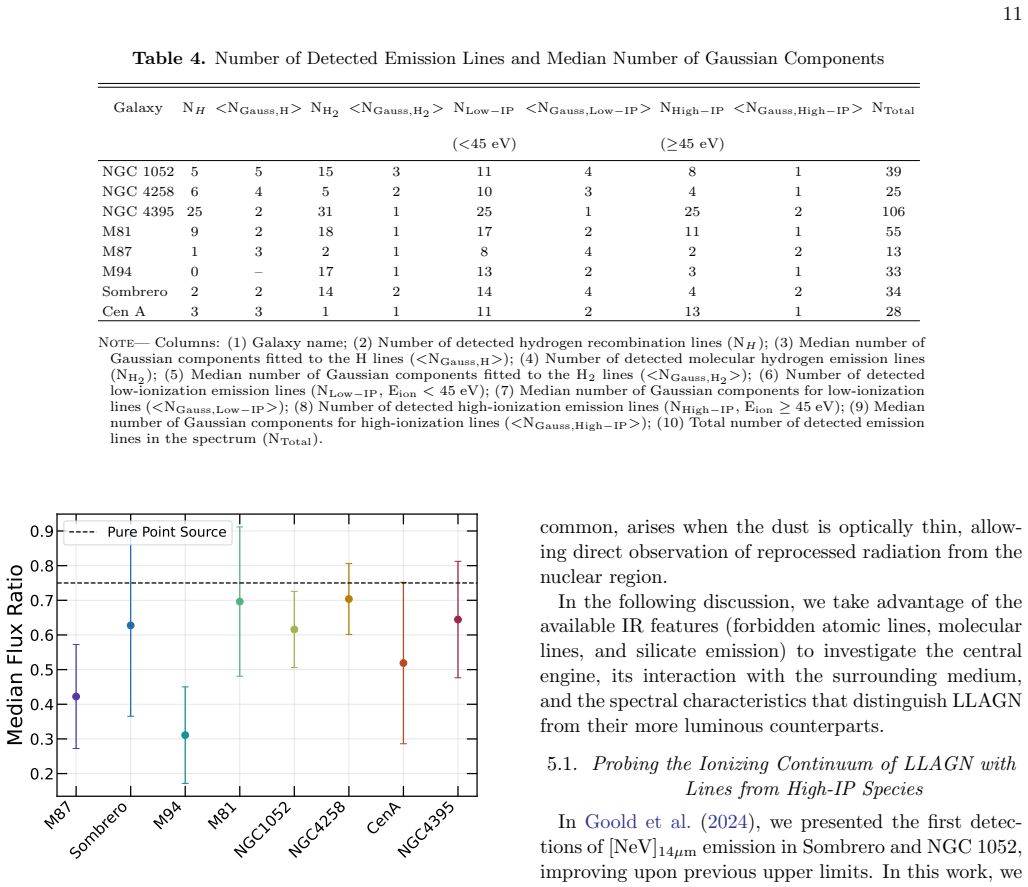
Summary. The paper presents JWST NIRSpec and MIRI/MRS spectra of eight low-luminosity AGN (LLAGN), including Cen A from archival data. The authors measure a large set of infrared emission lines, including high-ionization species such as [Ne V] 14.3 µm and [O IV] 26 µm, and use them to argue that below log(L_bol/L_Edd) ≈ -3.5 the ionizing continuum becomes increasingly deficient in UV photons. The main evidence is a conditional linear model fit to the [Ne V]–L_2-10 keV relation, which prefers a break at that Eddington ratio (ΔBIC ≈ 9), and a set of diagnostic line-ratio diagrams in which the LLAGN are better matched by photoionization models with a power-law, UV-bump-free SED than by accretion-disk SEDs or shocks. Additional results include elevated rotational H2 excitation temperatures, H2/PAH ratios consistent with AGN, and compact nuclear silicate emission in most targets.
Significance. If the claimed transition is correct, it provides a direct, IR-based diagnostic for the switch from a standard thin disk to a radiatively inefficient accretion flow in LLAGN, a regime that is otherwise difficult to probe. The observational strengths are substantial: high-quality JWST data, a careful line-fitting pipeline with Monte Carlo uncertainties, explicit spatial-concentration checks against point-source encircled-energy profiles, and public release of reduced cubes and extracted spectra. The H2 aperture correction is tested against sky subtraction, and the [Ne V]–[O IV] correlation is extended to lower luminosities than previous samples. The weaknesses concern the robustness of the Eddington-ratio axis and the statistical weight of the break, both of which are load-bearing for the headline claim.
major comments (3)
- [§2.3, Eq. (2); §5.1.2, Fig. 6] The Eddington-ratio split that defines the claimed -3.5 transition is computed from the Duras et al. (2020) KX(L2-10 keV) bolometric correction, calibrated on ~1000 luminous Type 1/2 AGN with standard SEDs. The paper itself reports a median absolute difference of 0.54 dex between this proxy and direct SED-integrated L_bol for the four LLAGN with available SEDs (NGC 1052, M87, Cen A, Sombrero) — exactly the sources that occupy the low-Eddington branch. Because z = log(KX) + log(LX) - log(L_Edd), any systematic error in KX for UV-deficient LLAGN directly shifts the split variable. If the true KX is lower, the low-branch points shift to lower z and the fitted z0 could move by more than the quoted +0.6/-1.0 dex, or the break could vanish. Please test robustness: recompute the conditional fit with SED-based L_bol for the four sources, with an alternative bolometric correction, or with z defin
- [§5.1.2, Fig. 6] The statistical evidence for a break is modest: ΔBIC ≈ 9 with a threshold plus separate slopes/intercepts (2 extra parameters). The two branch slopes are consistent with each other within 1σ (0.957±0.109 vs. 0.845±0.190), so the claimed effect is essentially an offset, not a change in slope. The paper does not state how many sources lie in each branch; from Table 1, only a handful (≈5–6) lie below -3.5. The quoted threshold uncertainty is also asymmetric and large. Please report the number of sources per branch, show residual plots, and run a leave-one-out or bootstrap analysis to confirm that the offset is not driven by one or two extreme low-LX points. The abstract's 'order of magnitude' decrease should be quantified with the actual model offset and its uncertainty.
- [§5.1.1, Fig. 5] The 'power-law' photoionization grid that the LLAGN ratios agree with is constructed from the Sombrero SED (Fernández-Ontiveros et al. 2023), i.e., from a UV-deficient LLAGN that is itself part of the sample. This does not by itself invalidate the comparison, but it weakens the claim that the data are 'consistent with a UV-deficient SED' because the grid was built from a UV-deficient source. The argument would be much stronger if the UV-bump amplitude were a free parameter (e.g., varying the fraction of thermal disk emission) and the models showed that the data prefer a reduced or zero bump. Also, the full model description is deferred to 'Acharya et al., in prep.'; the paper should include enough detail (ionizing SED shape, metallicity, density, column, and the exact CLOUDY parameter ranges used) to allow reproduction, since this is the primary evidence for the central 'UV-deficient SED
minor comments (5)
- [Fig. 6 caption] The caption says sources with log(L_Bol/L_Edd) less than -3 are plotted as circles and higher as triangles, while the text and abstract use -3.5. Reconcile this inconsistency.
- [Abstract and §5.1.2 vs. §6] The threshold is quoted as -3.5 +0.6/-1.0 in Section 5.1.2 but -3.5 +0.8/-0.7 in the Conclusions. Which uncertainty is correct?
- [§2.3] Typo: 'Given this offest' should be 'offset'. Also, the statement that the observed offset is larger than the ~0.1 dex spread in X-ray bolometric corrections (kX ~16–20) is unclear: kX is not defined, and the relationship between kX scatter and L_bol scatter should be shown explicitly.
- [Table 1] The last two columns list L_bol and log(L_Bol/L_Edd) without separation, e.g., '42.71−4.21' reads ambiguously. Use separate columns or a clear format such as 'log L_bol = 42.71, log(L/L_Edd) = −4.21'.
- [§3.1] The description of the H2 aperture correction ('scaling each measured flux by the ratio of its value in the native aperture to that measured in a larger 1.2'' aperture, under the assumption that the spatial distribution of the emission is roughly constant') is somewhat confusing — if the distribution is roughly constant, the correction could be area-based; if it is not, the ratio itself is the empirical correction. Clarify the procedure and its validation.
Circularity Check
No significant circularity: the empirical [NeV]–LX break and line-ratio model comparisons are independent of the quantities they are used to infer.
full rationale
The derivation chain is not circular. The central empirical result—an offset in [NeV] 14.3 µm at fixed 2–10 keV X-ray luminosity between sources above and below log(Lbol/LEdd) ≈ −3.5—is obtained by fitting the conditional linear model (Eq. 11) to the observed L[NeV]–LX data; Lbol enters only to define the binning variable and is not fitted to the [NeV] data or to the line ratios. The claimed UV deficiency rests on two independent legs: (i) the measured [NeV]/[NeII], [ArIII]/[ArII], and [SIV]/[SIII] ratios, which are direct observables, and (ii) CLOUDY photoionization grids computed externally from the Sombrero SED (Fernández-Ontiveros et al. 2023), not from the line ratios being tested. Section 2.3 notes a 0.54 dex median offset between X-ray-based and SED-integrated Lbol for NGC 1052, M87, Cen A, and Sombrero; this is a calibration uncertainty in the Eddington-ratio axis, not a construction that forces the [NeV] offset. Self-citations (Goold et al. 2024 for reduction/line-fitting, Fernández-Ontiveros et al. 2023 for the power-law grid) are transparent and refer to reproducible or observational products, not to an unverified uniqueness claim or ansatz. No prediction reduces to its input by definition.
Assumptions & free parameters
free parameters (3)
- Eddington threshold z0 of conditional linear model =
log(Lbol/LEdd) = -3.5 (+0.6/-1.0); conclusions quote -3.5 (+0.8/-0.7)
- Duras et al. (2020) bolometric correction constants =
a = 15.33, b = 11.48, c = 16.2
- Slopes of conditional linear model =
high-Edd slope m1 = 0.957 ± 0.109; low-Edd slope m2 = 0.845 ± 0.190
assumptions (6)
- domain assumption H2 level populations follow a Boltzmann distribution under LTE
- ad hoc to paper H2 surface brightness is roughly constant between native and 1.2'' apertures
- ad hoc to paper Duras et al. (2020) X-ray bolometric correction applies to LLAGN
- domain assumption Line emission is co-spatial with the unresolved point-source continuum within the extraction aperture
- domain assumption CLOUDY and MAPPINGS V models with stated parameter ranges (log U -3 to -1.5, n_e 2-5; shock n_H=1, v=150-300 km/s) accurately predict IR line ratios
- domain assumption The archival comparison sample has consistent X-ray, BH mass, and distance calibrations
Cite this review
Pith. "Pith review of ReveaLLAGN 1: JWST Emission-Line Spectra Reveal Low-Luminosity AGN with UV-Deficient SEDs and Warm Molecular Gas." pith.science (2026). https://pith.science/paper/D56K23DU
@misc{pith2026260116977,
  author       = {Pith},
  title        = {Pith review of: ReveaLLAGN 1: JWST Emission-Line Spectra Reveal Low-Luminosity AGN with UV-Deficient SEDs and Warm Molecular Gas},
  year         = {2026},
  howpublished = {\url{https://pith.science/paper/D56K23DU}},
  note         = {Machine review of arXiv:2601.16977}
}
abstract
We present near- and mid-infrared spectra of eight Low-Luminosity Active Galactic Nuclei (LLAGN), spanning nearly four orders of magnitude in black hole mass and Eddington ratio, obtained with JWST/NIRSpec and MIRI as part of the ReveaLLAGN program along with identical archival data of Cen A. The high spatial resolution of JWST cleanly separates AGN emission from host-galaxy contamination, enabling detections of high-ionization potential lines more than an order of magnitude fainter than previously measured. Emission-line diagnostics reveal a transition at log($L_{bol}/L_{Edd}$) ~ -3.5, where the spectral energy distribution becomes increasingly deficient in ultraviolet photons. We find that rotational H$_2$ excitation temperatures are elevated (~500 K higher) compared to both higher-luminosity AGN and star-forming galaxies, while the H$_2$(0-0)S(3)/PAH$_{11.3 \mu m}$ ratios are consistent with those observed in the AGN population. We discuss the possible roles of outflows, jets, and X-ray dominated regions in shaping the interstellar medium surrounding LLAGN. Silicate emission at ~10 $\mu$m, localized to the nuclear region, is detected in most ReveaLLAGN targets. This dataset offers the first comprehensive JWST-based characterization of infrared emission lines in the nuclear regions of LLAGN.
Figures


Figures from the paper (7 more)


Reference graph
Works this paper leans on
-
[1]
Abel, N. P., & Satyapal, S. 2008, ApJ, 678, 686, doi: 10.1086/529013
doi:10.1086/529013 2008
-
[2]
Allamandola, L. J., Tielens, A. G. G. M., & Barker, J. R. 1985, ApJL, 290, L25, doi: 10.1086/184435
doi:10.1086/184435 1985
-
[3]
Argyriou, I., Glasse, A., Law, D. R., et al. 2023, A&A, 675, A111, doi: 10.1051/0004-6361/202346489
-
[4]
2019, MNRAS, 489, 2177, doi: 10.1093/mnras/stz2289
Asmus, D. 2019, MNRAS, 489, 2177, doi: 10.1093/mnras/stz2289
-
[5]
Asmus, D., Gandhi, P., H¨ onig, S. F., Smette, A., & Duschl, W. J. 2015, MNRAS, 454, 766, doi: 10.1093/mnras/stv1950 Astropy Collaboration, Price-Whelan, A. M., Lim, P. L., et al. 2022, ApJ, 935, 167, doi: 10.3847/1538-4357/ac7c74
-
[6]
Baldi, R. D., Williams, D. R. A., McHardy, I. M., et al. 2018, MNRAS, 476, 3478, doi: 10.1093/mnras/sty342 —. 2021, MNRAS, 500, 4749, doi: 10.1093/mnras/staa3519
-
[7]
Bi, S., Feng, H., & Ho, L. C. 2020, ApJ, 900, 124, doi: 10.3847/1538-4357/aba761
-
[8]
P., Jord´ an, A., Mei, S., et al
Blakeslee, J. P., Jord´ an, A., Mei, S., et al. 2009, ApJ, 694, 556, doi: 10.1088/0004-637X/694/1/556
Show all 161 references
-
[9]
J., Neugebauer, G., Matthews, K., et al
Bock, J. J., Neugebauer, G., Matthews, K., et al. 2000, AJ, 120, 2904, doi: 10.1086/316871 B¨ oker, T., Arribas, S., L¨ utzgendorf, N., et al. 2022, A&A, 661, A82, doi: 10.1051/0004-6361/202142589
2000 doi
-
[10]
2022, JWST Calibration Pipeline, Zenodo, doi: 10.5281/ZENODO.7038885
Bushouse, H., Eisenhamer, J., Dencheva, N., et al. 2022, JWST Calibration Pipeline, Zenodo, doi: 10.5281/ZENODO.7038885
2022 doi
-
[11]
2009, MNRAS, 394, 660, doi: 10.1111/j.1365-2966.2008.14377.x
Cappellari, M., Neumayer, N., Reunanen, J., et al. 2009, MNRAS, 394, 660, doi: 10.1111/j.1365-2966.2008.14377.x
2009
-
[12]
2011, MNRAS, 413, 813, doi: 10.1111/j.1365-2966.2010.18174.x
Cappellari, M., Emsellem, E., Krajnovi´ c, D., et al. 2011, MNRAS, 413, 813, doi: 10.1111/j.1365-2966.2010.18174.x
2011
-
[13]
2023, RMxAA, 59, 327, doi: 10.22201/ia.01851101p.2023.59.02.12
Chatzikos, M., Bianchi, S., Camilloni, F., et al. 2023, RMxAA, 59, 327, doi: 10.22201/ia.01851101p.2023.59.02.12
2023 doi
-
[14]
2016, Nature, 533, 504, doi: 10.1038/nature18006
Cheung, E., Bundy, K., Cappellari, M., et al. 2016, Nature, 533, 504, doi: 10.1038/nature18006
2016 doi
-
[15]
2001, MNRAS, 324, L33, doi: 10.1046/j.1365-8711.2001.04642.x
Chiaberge, M., Capetti, A., & Celotti, A. 2001, MNRAS, 324, L33, doi: 10.1046/j.1365-8711.2001.04642.x
2001
-
[16]
E., & Tielens, A
Chiar, J. E., & Tielens, A. G. G. M. 2006, ApJ, 637, 774, doi: 10.1086/498406
2006 doi
-
[17]
Constantin, A., & Seth, A. C. 2012, Advances in Astronomy, 2012, 178060, doi: 10.1155/2012/178060
2012 doi
-
[18]
1997, A&A, 323, 71
Contini, M. 1997, A&A, 323, 71
1997
-
[19]
Contini, M., & Viegas, S. M. 2001, ApJS, 132, 211, doi: 10.1086/318956
2001 doi
-
[20]
J., Springel, V., White, S
Croton, D. J., Springel, V., White, S. D. M., et al. 2006, MNRAS, 365, 11, doi: 10.1111/j.1365-2966.2005.09675.x de Vaucouleurs, G., de Vaucouleurs, A., Corwin, Herold G., J., et al. 1991, Third Reference Catalogue of Bright Galaxies (Springer-Verlag) den Brok, M., Seth, A. C....
2006
-
[21]
D., De Rosa, G., Croxall, K., et al
Denney, K. D., De Rosa, G., Croxall, K., et al. 2014, ApJ, 796, 134, doi: 10.1088/0004-637X/796/2/134 Di Matteo, T., Springel, V., & Hernquist, L. 2005, Nature, 433, 604, doi: 10.1038/nature03335
2014 doi
-
[22]
M., & Rieke, G
Diamond-Stanic, A. M., & Rieke, G. H. 2010, ApJ, 724, 140, doi: 10.1088/0004-637X/724/1/140
2010 doi
-
[23]
T., & Li, A
Draine, B. T., & Li, A. 2001, ApJ, 551, 807, doi: 10.1086/320227 —. 2007, ApJ, 657, 810, doi: 10.1086/511055
2001 doi
-
[24]
T., Dale, D
Draine, B. T., Dale, D. A., Bendo, G., et al. 2007, ApJ, 663, 866, doi: 10.1086/518306
2007 doi
-
[25]
P., Satyapal, S., & Marcu, D
Dudik, R. P., Satyapal, S., & Marcu, D. 2009, ApJ, 691, 1501, doi: 10.1088/0004-637X/691/2/1501
2009 doi
-
[26]
C., et al
Dumont, A., Neumayer, N., Seth, A. C., et al. 2025, arXiv e-prints, arXiv:2503.09697, doi: 10.48550/arXiv.2503.09697
2025 doi
-
[27]
2020, A&A, 636, A73, doi: 10.1051/0004-6361/201936817
Duras, F., Bongiorno, A., Ricci, F., et al. 2020, A&A, 636, A73, doi: 10.1051/0004-6361/201936817
2020 doi
-
[28]
1995, MNRAS, 273, 649, doi: 10.1093/mnras/273.3.649
Efstathiou, A., & Rowan-Robinson, M. 1995, MNRAS, 273, 649, doi: 10.1093/mnras/273.3.649
1995 doi
-
[29]
C., & Trump, J
Elitzur, M., Ho, L. C., & Trump, J. R. 2014, MNRAS, 438, 3340, doi: 10.1093/mnras/stt2445
2014 doi
-
[30]
2006, ApJL, 648, L101, doi: 10.1086/508158
Elitzur, M., & Shlosman, I. 2006, ApJL, 648, L101, doi: 10.1086/508158
2006 doi
-
[31]
W., Gordon, K
Engelbracht, C. W., Gordon, K. D., Rieke, G. H., et al. 2005, ApJL, 628, L29, doi: 10.1086/432613
2005 doi
-
[32]
A., & Flohic, H
Eracleous, M., Hwang, J. A., & Flohic, H. M. L. G. 2010, ApJS, 187, 135, doi: 10.1088/0067-0049/187/1/135 Event Horizon Telescope Collaboration, Akiyama, K.,
2010 doi
-
[33]
2019, ApJL, 875, L1, doi: 10.3847/2041-8213/ab0ec7
Alberdi, A., et al. 2019, ApJL, 875, L1, doi: 10.3847/2041-8213/ab0ec7
2019 doi
- [34]
- [35]
- [36]
-
[37]
2023, A&A, 675, A74, doi: 10.1051/0004-6361/202245516
Feltre, A., Gruppioni, C., Marchetti, L., et al. 2023, A&A, 675, A74, doi: 10.1051/0004-6361/202245516
2023 doi
-
[38]
J., Done, C., Jin, C., Landt, H., & Ward, M
Ferland, G. J., Done, C., Jin, C., Landt, H., & Ward, M. J. 2020, MNRAS, 494, 5917, doi: 10.1093/mnras/staa1207
2020 doi
-
[39]
J., Chatzikos, M., Guzm´ an, F., et al
Ferland, G. J., Chatzikos, M., Guzm´ an, F., et al. 2017, RMxAA, 53, 385, doi: 10.48550/arXiv.1705.10877 22 Fern´ andez-Ontiveros, J. A., L´ opez-Gonzaga, N., Prieto, M. A., et al. 2019, MNRAS, 485, 5377, doi: 10.1093/mnras/stz716 Fern´ andez-Ontiveros, J. A., L´ opez-L´ opez,...
- [40]
-
[41]
C., Harms, R
Ford, H. C., Harms, R. J., Tsvetanov, Z. I., et al. 1994, ApJL, 435, L27, doi: 10.1086/187586 F¨ orster Schreiber, N. M., Roussel, H., Sauvage, M., &
1994 doi
-
[42]
2004, A&A, 419, 501, doi: 10.1051/0004-6361:20040963
Charmandaris, V. 2004, A&A, 419, 501, doi: 10.1051/0004-6361:20040963
2004 doi
-
[43]
1992, Catalogue of Optical Radial Velocities (Observatoire de Lyon) Garc ´ ıa-Bernete, I., Rigopoulou, D., Donnan, F
Paturel, G. 1992, Catalogue of Optical Radial Velocities (Observatoire de Lyon) Garc ´ ıa-Bernete, I., Rigopoulou, D., Donnan, F. R., et al. 2024, A&A, 691, A162, doi: 10.1051/0004-6361/202450086 Gonz´ alez-Mart ´ ın, O., Masegosa, J., M´ arquez, I., Guainazzi, M., & Jim´ enez...
1992 doi
-
[44]
2024, ApJ, 966, 204, doi: 10.3847/1538-4357/ad3065
Goold, K., Seth, A., Molina, M., et al. 2024, ApJ, 966, 204, doi: 10.3847/1538-4357/ad3065
2024 doi
-
[45]
Ressler, M. E. 2004, ApJ, 605, 156, doi: 10.1086/381791
2004 doi
-
[47]
D., Alexander, D
Goulding, A. D., Alexander, D. M., Bauer, F. E., et al. 2012, ApJ, 755, 5, doi: 10.1088/0004-637X/755/1/5
2012 doi
-
[48]
L., & Danese, L
Granato, G. L., & Danese, L. 1994, MNRAS, 268, 235, doi: 10.1093/mnras/268.1.235
1994 doi
-
[49]
K., Ricci, C., Temple, M
Gupta, K. K., Ricci, C., Temple, M. J., et al. 2024, A&A, 691, A203, doi: 10.1051/0004-6361/202450567
2024 doi
-
[50]
2016, MNRAS, 462, 1757, doi: 10.1093/mnras/stw1716
Gutkin, J., Charlot, S., & Bruzual, G. 2016, MNRAS, 462, 1757, doi: 10.1093/mnras/stw1716
2016 doi
-
[51]
W., Spoon, H
Hao, L., Weedman, D. W., Spoon, H. W. W., et al. 2007, ApJL, 655, L77, doi: 10.1086/511973
2007 doi
-
[52]
J., Ford, H
Harms, R. J., Ford, H. C., Tsvetanov, Z. I., et al. 1994, ApJL, 435, L35, doi: 10.1086/187588
1994 doi
-
[53]
2015, ApJ, 803, 110, doi: 10.1088/0004-637X/803/2/110
Hatziminaoglou, E., Hern´ an-Caballero, A., Feltre, A., & Pi˜ nol Ferrer, N. 2015, ApJ, 803, 110, doi: 10.1088/0004-637X/803/2/110
2015 doi
-
[54]
P., Hogg, D
Haynes, M. P., Hogg, D. E., Maddalena, R. J., Roberts, M. S., & van Zee, L. 1998, AJ, 115, 62, doi: 10.1086/300166
1998 doi
-
[55]
M., & Best, P
Heckman, T. M., & Best, P. N. 2014, ARA&A, 52, 589, doi: 10.1146/annurev-astro-081913-035722
2014 doi
-
[56]
2010, ARA&A, 48, 21, doi: 10.1146/annurev-astro-081309-130815
Henning, T. 2010, ARA&A, 48, 21, doi: 10.1146/annurev-astro-081309-130815
2010 doi
-
[57]
Spoon, H. W. W. 2006, ApJ, 648, 323, doi: 10.1086/505701
2006 doi
-
[58]
Ho, L. C. 1999, ApJ, 516, 672, doi: 10.1086/307137 —. 2002, ApJ, 564, 120, doi: 10.1086/324399 —. 2008, ARA&A, 46, 475, doi: 10.1146/annurev.astro.45.051806.110546
1999 arXiv
-
[59]
C., Filippenko, A
Ho, L. C., Filippenko, A. V., & Sargent, W. L. W. 1997, ApJS, 112, 315, doi: 10.1086/313041
1997 doi
- [60]
- [61]
-
[62]
2022, A&A, 661, A80, doi: 10.1051/0004-6361/202142663
Jakobsen, P., Ferruit, P., Alves de Oliveira, C., et al. 2022, A&A, 661, A80, doi: 10.1051/0004-6361/202142663
2022 doi
-
[63]
R., Gebhardt, K., Shen, J., et al
Jardel, J. R., Gebhardt, K., Shen, J., et al. 2011, ApJ, 739, 21, doi: 10.1088/0004-637X/739/1/21
2011 doi
-
[64]
2012, MNRAS, 425, 907, doi: 10.1111/j.1365-2966.2012.21272.x
Jin, C., Ward, M., & Done, C. 2012, MNRAS, 425, 907, doi: 10.1111/j.1365-2966.2012.21272.x
2012
- [65]
-
[66]
D., Karachentseva, V
Karachentsev, I. D., Karachentseva, V. E., Huchtmeier, W. K., & Makarov, D. I. 2004, AJ, 127, 2031, doi: 10.1086/382905
2004 doi
-
[67]
J., & Tielens, A
Kemper, F., Vriend, W. J., & Tielens, A. G. G. M. 2004, ApJ, 609, 826, doi: 10.1086/421339
2004 doi
-
[68]
Kormendy, J., & Ho, L. C. 2013, ARA&A, 51, 511, doi: 10.1146/annurev-astro-082708-101811
2013 doi
-
[69]
J., Ricci, C., Trakhtenbrot, B., et al
Koss, M. J., Ricci, C., Trakhtenbrot, B., et al. 2022, ApJS, 261, 2, doi: 10.3847/1538-4365/ac6c05
2022 doi
-
[70]
E., Godard, B., Guillard, P., Gusdorf, A., & Pineau des Forˆ ets, G
Kristensen, L. E., Godard, B., Guillard, P., Gusdorf, A., & Pineau des Forˆ ets, G. 2023, A&A, 675, A86, doi: 10.1051/0004-6361/202346254
2023 doi
-
[71]
L., & Watts, D
Zakamska, N. L., & Watts, D. J. 2019, MNRAS, 487, 1823, doi: 10.1093/mnras/stz1316
2019 doi
-
[72]
Law, D. R., E. Morrison, J., Argyriou, I., et al. 2023, AJ, 166, 45, doi: 10.3847/1538-3881/acdddc
2023 doi
-
[73]
Leger, A., & Puget, J. L. 1984, A&A, 137, L5 23
1984
-
[74]
T., Packham, C., Rosario, D
Leist, M. T., Packham, C., Rosario, D. J. V., et al. 2024, AJ, 167, 96, doi: 10.3847/1538-3881/ad1886
2024 doi
- [75]
-
[76]
Li, A., & Draine, B. T. 2012, ApJL, 760, L35, doi: 10.1088/2041-8205/760/2/L35
2012 doi
-
[77]
P., Shi, Q
Li, M. P., Shi, Q. J., & Li, A. 2008, MNRAS, 391, L49, doi: 10.1111/j.1745-3933.2008.00553.x
2008
-
[78]
J., et al
Macchetto, F., Marconi, A., Axon, D. J., et al. 1997, ApJ, 489, 579, doi: 10.1086/304823
1997 doi
-
[79]
M., Markoff, S
Maitra, D., Miller, J. M., Markoff, S. B., & King, A. L. 2011, in AAS/High Energy Astrophysics Division, Vol. 12, AAS/High Energy Astrophysics Division #12, 8.13
2011
-
[81]
2004, MNRAS, 351, 169, doi: 10.1111/j.1365-2966.2004.07765.x
Marconi, A., Risaliti, G., Gilli, R., et al. 2004, MNRAS, 351, 169, doi: 10.1111/j.1365-2966.2004.07765.x
2004
-
[82]
2008, ApJ, 681, 905, doi: 10.1086/588718
Markoff, S., Nowak, M., Young, A., et al. 2008, ApJ, 681, 905, doi: 10.1086/588718
2008 doi
-
[83]
E., Levenson, N
Mason, R. E., Levenson, N. A., Shi, Y., et al. 2009, ApJL, 693, L136, doi: 10.1088/0004-637X/693/2/L136
2009 doi
-
[84]
2013, ApJ, 777, 164, doi: 10.1088/0004-637X/777/2/164
Nemmen, R., & Alonso-Herrero, A. 2013, ApJ, 777, 164, doi: 10.1088/0004-637X/777/2/164
2013 doi
-
[85]
E., Rodr ´ ıguez-Ardila, A., Martins, L., et al
Mason, R. E., Rodr ´ ıguez-Ardila, A., Martins, L., et al. 2015, ApJS, 217, 13, doi: 10.1088/0067-0049/217/1/13
2015 doi
-
[86]
D., Satyapal, S., Laor, A., et al
McKaig, J. D., Satyapal, S., Laor, A., et al. 2024, ApJ, 976, 130, doi: 10.3847/1538-4357/ad7a79
2024 doi
-
[87]
McQuinn, K. B. W., Skillman, E. D., Dolphin, A. E., Berg, D., & Kennicutt, R. 2016, AJ, 152, 144, doi: 10.3847/0004-6256/152/5/144
2016 doi
-
[88]
Meisenheimer, K., Tristram, K. R. W., Jaffe, W., et al. 2007, A&A, 471, 453, doi: 10.1051/0004-6361:20066967
2007 doi
-
[89]
Mezcua, M., & Prieto, M. A. 2014, ApJ, 787, 62, doi: 10.1088/0004-637X/787/1/62
2014 doi
-
[90]
V., Wagner, A
Mukherjee, D., Bicknell, G. V., Wagner, A. Y., Sutherland, R. S., & Silk, J. 2018, MNRAS, 479, 5544, doi: 10.1093/mnras/sty1776 M¨ uller-S´ anchez, F., Prieto, M. A., Mezcua, M., et al. 2013, ApJL, 763, L1, doi: 10.1088/2041-8205/763/1/L1
2018 doi
-
[91]
M., Falcke, H., & Wilson, A
Nagar, N. M., Falcke, H., & Wilson, A. S. 2005, A&A, 435, 521, doi: 10.1051/0004-6361:20042277
2005 doi
-
[92]
1995, ApJ, 452, 710, doi: 10.1086/176343
Narayan, R., & Yi, I. 1995, ApJ, 452, 710, doi: 10.1086/176343
1995 doi
-
[93]
S., Storchi-Bergmann, T., & Eracleous, M
Nemmen, R. S., Storchi-Bergmann, T., & Eracleous, M. 2014, MNRAS, 438, 2804, doi: 10.1093/mnras/stt2388
2014 doi
-
[94]
2008, ApJ, 685, 160, doi: 10.1086/590483
Elitzur, M. 2008, ApJ, 685, 160, doi: 10.1086/590483
2008 doi
-
[95]
2024, lmfit/lmfit-py: 1.3.2, 1.3.2, Zenodo, doi: 10.5281/zenodo.12785036
Newville, M., Otten, R., Nelson, A., et al. 2024, lmfit/lmfit-py: 1.3.2, 1.3.2, Zenodo, doi: 10.5281/zenodo.12785036
2024 doi
-
[96]
2009, ApJ, 707, 1550, doi: 10.1088/0004-637X/707/2/1550
Nikutta, R., Elitzur, M., & Lacy, M. 2009, ApJ, 707, 1550, doi: 10.1088/0004-637X/707/2/1550
2009 doi
-
[97]
2010, ApJ, 724, 1193, doi: 10.1088/0004-637X/724/2/1193 O’Halloran, B., Satyapal, S., & Dudik, R
Ogle, P., Boulanger, F., Guillard, P., et al. 2010, ApJ, 724, 1193, doi: 10.1088/0004-637X/724/2/1193 O’Halloran, B., Satyapal, S., & Dudik, R. P. 2006, ApJ, 641, 795, doi: 10.1086/500529
2010 doi
-
[98]
2023, A&A, 679, A37, doi: 10.1051/0004-6361/202346549
Osorno, J., Nagar, N., Richtler, T., et al. 2023, A&A, 679, A37, doi: 10.1051/0004-6361/202346549
2023 doi
-
[99]
T., Roche, P
Packham, C., Radomski, J. T., Roche, P. F., et al. 2005, ApJL, 618, L17, doi: 10.1086/427691
2005 doi
-
[100]
2019, ApJ, 871, 257, doi: 10.3847/1538-4357/aaf9a9
Park, J., Hada, K., Kino, M., et al. 2019, ApJ, 871, 257, doi: 10.3847/1538-4357/aaf9a9
2019 doi
-
[101]
Peeters, E., Spoon, H. W. W., & Tielens, A. G. G. M. 2004, ApJ, 613, 986, doi: 10.1086/423237
2004 doi
-
[102]
W., Braatz, J
Pesce, D. W., Braatz, J. A., Condon, J. J., & Greene, J. E. 2018, ApJ, 863, 149, doi: 10.3847/1538-4357/aad3c2
2018 doi
-
[103]
M., Bentz, M
Peterson, B. M., Bentz, M. C., Desroches, L.-B., et al. 2005, ApJ, 632, 799, doi: 10.1086/444494
2005 doi
- [104]
-
[105]
M., Anderson, S
Plotkin, R. M., Anderson, S. F., Brandt, W. N., et al. 2012, ApJL, 745, L27, doi: 10.1088/2041-8205/745/2/L27
2012 doi
-
[106]
2019, ApJS, 243, 26, doi: 10.3847/1538-4365/ab29fd
Porth, O., Chatterjee, K., Narayan, R., et al. 2019, ApJS, 243, 26, doi: 10.3847/1538-4365/ab29fd
2019 doi
-
[107]
2016, MNRAS, 457, 3801, doi: 10.1093/mnras/stw166
Espada, D., & Gonz´ alez-Mart ´ ın, O. 2016, MNRAS, 457, 3801, doi: 10.1093/mnras/stw166
2016 doi
-
[108]
2014, MNRAS, 442, 2145, doi: 10.1093/mnras/stu1006
Schartmann, M. 2014, MNRAS, 442, 2145, doi: 10.1093/mnras/stu1006
2014 doi
-
[109]
2021, MNRAS, 506, 562, doi: 10.1093/mnras/stab1704
Mezcua, M. 2021, MNRAS, 506, 562, doi: 10.1093/mnras/stab1704
2021 doi
-
[110]
A., P´ erez Garc ´ ıa, A
Prieto, M. A., P´ erez Garc ´ ıa, A. M., & Rodr ´ ıguez Espinosa, J. M. 2002, MNRAS, 329, 309, doi: 10.1046/j.1365-8711.2002.04985.x
2002
-
[111]
A., Reunanen, J., Tristram, K
Prieto, M. A., Reunanen, J., Tristram, K. R. W., et al. 2010, MNRAS, 402, 724, doi: 10.1111/j.1365-2966.2009.15897.x
2010
-
[112]
1999, ApJ, 520, 298, doi: 10.1086/307439
Quataert, E., & Narayan, R. 1999, ApJ, 520, 298, doi: 10.1086/307439
1999 doi
-
[113]
T., Pi˜ na, R
Radomski, J. T., Pi˜ na, R. K., Packham, C., et al. 2003, ApJ, 587, 117, doi: 10.1086/367612
2003 doi
-
[114]
1991, Nature, 349, 138, doi: 10.1038/349138a0 24
Rawlings, S., & Saunders, R. 1991, Nature, 349, 138, doi: 10.1038/349138a0 24
1991 doi
-
[115]
2018, MNRAS, 478, L122, doi: 10.1093/mnrasl/sly079
Dolag, K. 2018, MNRAS, 478, L122, doi: 10.1093/mnrasl/sly079
2018 doi
-
[116]
J., Pesce, D
Reid, M. J., Pesce, D. W., & Riess, A. G. 2019, ApJL, 886, L27, doi: 10.3847/2041-8213/ab552d
2019 doi
-
[117]
2013, MNRAS, 430, 2002, doi: 10.1093/mnras/stt026
Riffel, R., Rodr ´ ıguez-Ardila, A., Aleman, I., et al. 2013, MNRAS, 430, 2002, doi: 10.1093/mnras/stt026
2013 doi
-
[118]
A., Souza-Oliveira, G
Riffel, R. A., Souza-Oliveira, G. L., Costa-Souza, J. H., et al. 2025, ApJ, 982, 69, doi: 10.3847/1538-4357/adb8dd
2025 doi
-
[119]
A., Zakamska, N
Riffel, R. A., Zakamska, N. L., & Riffel, R. 2020, MNRAS, 491, 1518, doi: 10.1093/mnras/stz3137
2020 doi
-
[120]
Moorwood, A. F. M. 2002, A&A, 389, 374, doi: 10.1051/0004-6361:20020607 Rodr ´ ıguez-Ardila, A., Prieto, M. A., Portilla, J. G., &
2002 doi
-
[121]
Tejeiro, J. M. 2011, ApJ, 743, 100, doi: 10.1088/0004-637X/743/2/100
2011 doi
-
[122]
2019, A&A, 630, A58, doi: 10.1051/0004-6361/201936249
Roueff, E., Abgrall, H., Czachorowski, P., et al. 2019, A&A, 630, A58, doi: 10.1051/0004-6361/201936249
2019 doi
-
[123]
J., et al
Roussel, H., Helou, G., Hollenbach, D. J., et al. 2007, ApJ, 669, 959, doi: 10.1086/521667
2007 doi
-
[124]
1996, ApJ, 460, 284, doi: 10.1086/176968
Roy, J.-R., Belley, J., Dutil, Y., & Martin, P. 1996, ApJ, 460, 284, doi: 10.1086/176968
1996 doi
-
[125]
2022, Universe, 8, 356, doi: 10.3390/universe8070356
Sajina, A., Lacy, M., & Pope, A. 2022, Universe, 8, 356, doi: 10.3390/universe8070356
2022 doi
-
[126]
M., Bolatto, A
Sandstrom, K. M., Bolatto, A. D., Bot, C., et al. 2012, ApJ, 744, 20, doi: 10.1088/0004-637X/744/1/20
2012 doi
-
[127]
2008, ApJ, 677, 926, doi: 10.1086/529014
Heckman, T. 2008, ApJ, 677, 926, doi: 10.1086/529014
2008 doi
-
[128]
2007, ApJL, 663, L9, doi: 10.1086/519995
Dudik, R. 2007, ApJL, 663, L9, doi: 10.1086/519995
2007 doi
-
[129]
Schawinski, K., Koss, M., Berney, S., & Sartori, L. F. 2015, MNRAS, 451, 2517, doi: 10.1093/mnras/stv1136
2015 doi
-
[130]
2021, Nature Astronomy, 5, 928, doi: 10.1038/s41550-021-01394-0
Shi, F., Li, Z., Yuan, F., & Zhu, B. 2021, Nature Astronomy, 5, 928, doi: 10.1038/s41550-021-01394-0
2021 doi
-
[131]
A., Li, A., Li, M
Smith, H. A., Li, A., Li, M. P., et al. 2010, ApJ, 716, 490, doi: 10.1088/0004-637X/716/1/490
2010 doi
-
[132]
Smith, J. D. T., Draine, B. T., Dale, D. A., et al. 2007, ApJ, 656, 770, doi: 10.1086/510549
2007 doi
-
[133]
C., & Westpfahl, D
Speights, J. C., & Westpfahl, D. J. 2012, ApJ, 752, 52, doi: 10.1088/0004-637X/752/1/52
2012 doi
-
[134]
Spinoglio, L., & Malkan, M. A. 1992, ApJ, 399, 504, doi: 10.1086/171943
1992 doi
-
[135]
Spoon, H. W. W., Hern´ an-Caballero, A., Rupke, D., et al. 2022, ApJS, 259, 37, doi: 10.3847/1538-4365/ac4989
2022 doi
-
[136]
M., Haynes, M
Springob, C. M., Haynes, M. P., Giovanelli, R., & Kent, B. R. 2005, ApJS, 160, 149, doi: 10.1086/431550
2005 doi
-
[137]
2006, ApJ, 642, 81, doi: 10.1086/500828
Sturm, E., Hasinger, G., Lehmann, I., et al. 2006, ApJ, 642, 81, doi: 10.1086/500828
2006 doi
-
[138]
2002, A&A, 393, 821, doi: 10.1051/0004-6361:20021043
Sturm, E., Lutz, D., Verma, A., et al. 2002, A&A, 393, 821, doi: 10.1051/0004-6361:20021043
2002 doi
-
[139]
2005, ApJL, 629, L21, doi: 10.1086/444359
Sturm, E., Schweitzer, M., Lutz, D., et al. 2005, ApJL, 629, L21, doi: 10.1086/444359
2005 doi
-
[140]
2018, MAPPINGS V: Astrophysical plasma modeling code, Astrophysics Source Code Library, record ascl:1807.005
Sutherland, R., Dopita, M., Binette, L., & Groves, B. 2018, MAPPINGS V: Astrophysical plasma modeling code, Astrophysics Source Code Library, record ascl:1807.005
2018
-
[141]
2022, ApJ, 941, 47, doi: 10.3847/1538-4357/ac9d8f
Sutter, J., & Fadda, D. 2022, ApJ, 941, 47, doi: 10.3847/1538-4357/ac9d8f
2022 doi
-
[142]
Tielens, A. G. G. M. 2008, ARA&A, 46, 289, doi: 10.1146/annurev.astro.46.060407.145211
2008
-
[143]
A., & Fazio, G
Tommasin, S., Spinoglio, L., Malkan, M. A., & Fazio, G. 2010, ApJ, 709, 1257, doi: 10.1088/0004-637X/709/2/1257
2010 doi
-
[144]
L., Dressler, A., Blakeslee, J
Tonry, J. L., Dressler, A., Blakeslee, J. P., et al. 2001, ApJ, 546, 681, doi: 10.1086/318301
2001 doi
-
[145]
R., Impey, C
Trump, J. R., Impey, C. D., Kelly, B. C., et al. 2011, ApJ, 733, 60, doi: 10.1088/0004-637X/733/1/60
2011 doi
-
[146]
1977, ApJS, 35, 281, doi: 10.1086/190481
Turner, J., Kirby-Docken, K., & Dalgarno, A. 1977, ApJS, 35, 281, doi: 10.1086/190481
1977 doi
-
[147]
V., & Fabian, A
Vasudevan, R. V., & Fabian, A. C. 2007, MNRAS, 381, 1235, doi: 10.1111/j.1365-2966.2007.12328.x
2007
-
[148]
Voit, G. M. 1992, MNRAS, 258, 841, doi: 10.1093/mnras/258.4.841
1992 doi
-
[149]
L., Barth, A
Walsh, J. L., Barth, A. J., Ho, L. C., & Sarzi, M. 2013, ApJ, 770, 86, doi: 10.1088/0004-637X/770/2/86
2013 doi
-
[150]
D., Nowak, M
Wang, Q. D., Nowak, M. A., Markoff, S. B., et al. 2013, Science, 341, 981, doi: 10.1126/science.1240755
2013 doi
-
[151]
2017, MNRAS, 465, 3291, doi: 10.1093/mnras/stw2944
Weinberger, R., Springel, V., Hernquist, L., et al. 2017, MNRAS, 465, 3291, doi: 10.1093/mnras/stw2944
2017 doi
-
[152]
W., Glasse, A., et al
Wells, M., Pel, J. W., Glasse, A., et al. 2015, PASP, 127, 646, doi: 10.1086/682281
2015 doi
-
[153]
2006, ApJ, 639, 157, doi: 10.1086/499226
Wu, Y., Charmandaris, V., Hao, L., et al. 2006, ApJ, 639, 157, doi: 10.1086/499226
2006 doi
-
[154]
Xie, Y., & Ho, L. C. 2019, ApJ, 884, 136, doi: 10.3847/1538-4357/ab4200 —. 2022, ApJ, 925, 218, doi: 10.3847/1538-4357/ac32e2
2019 doi
-
[155]
C., Li, A., & Shangguan, J
Xie, Y., Ho, L. C., Li, A., & Shangguan, J. 2018, ApJ, 860, 154, doi: 10.3847/1538-4357/aac3dc
2018 doi
-
[156]
C., Zhuang, M.-Y., & Shangguan, J
Xie, Y., Ho, L. C., Zhuang, M.-Y., & Shangguan, J. 2021, ApJ, 910, 124, doi: 10.3847/1538-4357/abe404
2021 doi
-
[157]
2017, ApJS, 228, 6, doi: 10.3847/1538-4365/228/1/6
Xie, Y., Li, A., & Hao, L. 2017, ApJS, 228, 6, doi: 10.3847/1538-4365/228/1/6
2017 doi
-
[158]
Q., Luo, B., Brandt, W
Xue, Y. Q., Luo, B., Brandt, W. N., et al. 2016, ApJS, 224, 15, doi: 10.3847/0067-0049/224/2/15
2016 doi
-
[159]
2012, ApJ, 761, 130, doi: 10.1088/0004-637X/761/2/130
Yuan, F., Bu, D., & Wu, M. 2012, ApJ, 761, 130, doi: 10.1088/0004-637X/761/2/130
2012 doi
-
[160]
2015, ApJ, 804, 101, doi: 10.1088/0004-637X/804/2/101 25
Yuan, F., Gan, Z., Narayan, R., et al. 2015, ApJ, 804, 101, doi: 10.1088/0004-637X/804/2/101 25
2015 doi
-
[161]
2014, ARA&A, 52, 529, doi: 10.1146/annurev-astro-082812-141003
Yuan, F., & Narayan, R. 2014, ARA&A, 52, 529, doi: 10.1146/annurev-astro-082812-141003
2014 doi
-
[162]
C., & Li, A
Zhang, L., Ho, L. C., & Li, A. 2022, ApJ, 939, 22, doi: 10.3847/1538-4357/ac930f
2022 doi
-
[163]
C., & Shangguan, J
Zhuang, M.-Y., Ho, L. C., & Shangguan, J. 2019, ApJ, 873, 103, doi: 10.3847/1538-4357/ab0650
2019 doi
Reviewed August 3, 2026 · model on record in the stance chip above.
Discussion (0). Continue with ORCID to comment.