REVIEW 4 major objections 4 minor 1 cited by
The Corona-Australis star-forming region: New insights on its formation history from detailed stellar and disk analysis
T0 review · 4 major / 4 minor · reviewed 2026-08-05 · deepseek-v4-flash
Pith's one-line read A single supernova may explain Corona Australis's twin clusters.
desk verdict Useful data paper with a clearly labeled speculative formation scenario; the load-bearing assumption is an unobserved 15 Msun progenitor. read the letter →
The pith
A machine-rendered reading of the paper's core claim, the machinery that carries it, and where it could break.
The reading
What carries the argument
Two geometric constraints carry the argument. First, expansion traceback: Gaia DR3 proper motions are used to rewind CrA-North stars to their most compact configuration (3.72 Myr ago) and to estimate when CrA-Main and CrA-North were closest (2.64 pc). Second, the momentum-transfer argument: the typical supernova momentum of about 25,000 solar-mass km/s can explain the CrA-Main cloud's observed 2.8 km/s motion only if the explosion occurred within about 2 pc of the cloud, since the intercepted fraction scales with the square of the distance. Together these place the explosion site south of CrA-North and identify the pulsar as a candidate remnant. Supporting tools include isochrone ages from c
What would settle it
Measure the three-dimensional velocity of the CrA-Main cloud and the full space motion of RX J1856.5-3754. If the pulsar's trajectory does not pass within a few parsecs of the predicted explosion point 3.72 Myr ago, or if the cloud is not receding from that point at about 2.8 km/s, the supernova-trigger scenario is refuted.
Extended reading notes
Core claim
Using Gaia DR3 proper motions, the authors rewind the CrA-North members and find that they were most compact 3.72 ± 0.01 Myr ago, the same epoch at which the centers of CrA-North and CrA-Main were at their minimum separation of 2.64 pc (estimated as 3.86 ± 0.23 Myr ago). They argue that a roughly 15-solar-mass star, formed in the same early episode as CrA-North but at the upper end of the expected 8–15 solar-mass range for a cluster of CrA-North's stellar mass, exploded as a supernova about 2 pc south of CrA-North's center at that time. Because the momentum a supernova can deliver to a cloud scales with the inverse square of distance, the explosion must have been this close to explain the ob
Load-bearing premise
The scenario requires that CrA-North once contained a star near the top of the expected mass range (about 15 solar masses) that exploded as a supernova about 3.72 Myr ago; this star is not directly observed, and its existence is inferred from the cluster's total stellar mass.
Editorial extensions
If this is right
- If the scenario is correct, the age difference between CrA-Main and CrA-North and their current separation are not coincidental: both follow from the same supernova event 3.72 Myr ago.
- The low disk fraction in CrA-North (about 11%, versus 39% in CrA-Main, and about a third of other associations of similar age) is explained as environmental destruction by the massive star and its supernova, predicting a spatial gradient in disk survival.
- The complex becomes a concrete example of sequential, supernova-triggered star formation in a small, isolated cloud, bridging the gap between massive OB associations and low-mass star-forming regions.
- The pulsar RX J1856.5-3754, if it is the remnant, links a nearby neutron star to a specific parent cluster and supernova event, fixing its birth site and age.
- CrA-Main should lose its gas within a few Myr and become unbound, providing an observable instance of infant mortality among clusters.
Reading between the lines
- A direct test: measure the three-dimensional space motion of the CrA-Main cloud and of RX J1856.5-3754. If the pulsar's trajectory does not pass near the predicted explosion point 3.72 Myr ago, or the cloud is not receding from that point at about 2.8 km/s, the scenario fails.
- If the interpretation generalizes, the 8–15 solar-mass stars that are common in small clusters may frequently dominate the dynamical evolution of their natal clouds, implying that supernova feedback operates at lower stellar masses than usually considered.
- The predicted disk-survival gradient (fewer disks close to the explosion site) can be compared with photoevaporation and shock-destruction models, providing a quantitative calibration of disk lifetimes in hostile environments.
- The same traceback approach applied to other clusters in the Sco-Cen chain could reveal whether similar supernova-triggered kicks explain the observed age gradients in those chains.
Editorial analysis
A structured set of objections, weighed in public.
Referee Report
Summary. The paper presents a detailed census of the Corona Australis star-forming complex using Gaia DR3, 2MASS, WISE, and ALMA data, dividing it into CrA-Main and CrA-North. It derives interstellar absorption, stellar multiplicity, ages from CMD isochrone fitting, and disk fractions from SED slopes. It finds CrA-Main younger (~3 Myr) and bound, CrA-North older (~6.7 Myr), unbound, and expanding, with a traceback epoch of 3.72 Myr. The paper then proposes a formation scenario: an 18 Myr old 15 Msun star formed near UCL, a 7 Myr old episode created CrA-North, and a 3.72 Myr old supernova south of CrA-North kicked the cloud and triggered CrA-Main star formation, possibly producing the pulsar RX J1856.5-3754.
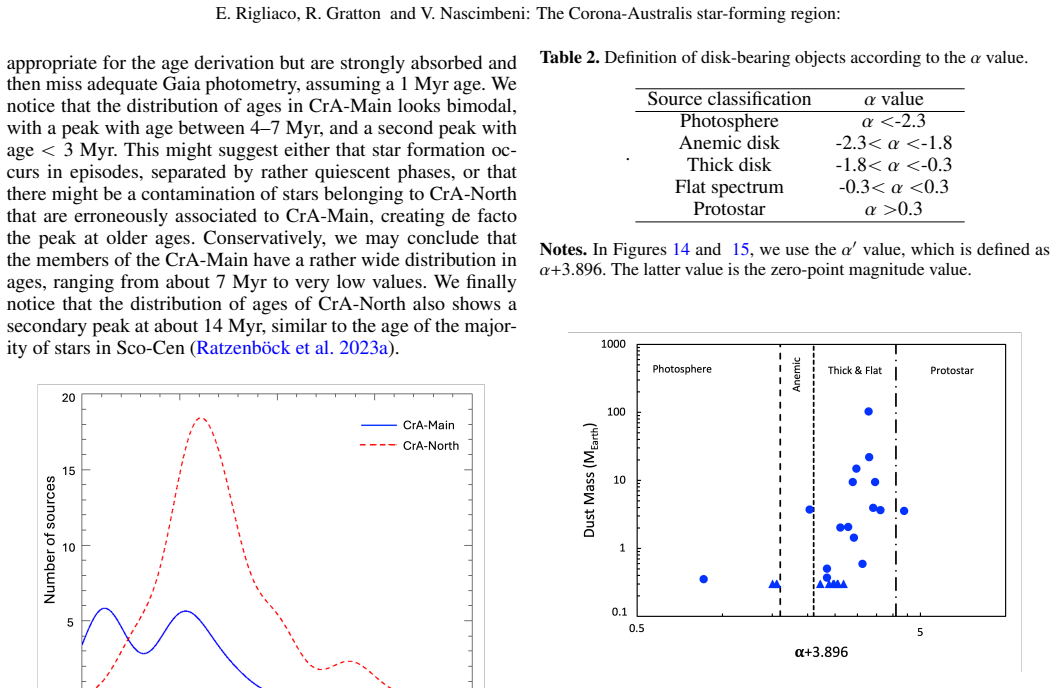
Significance. If correct, this would be a rare local example of sequential supernova-triggered star formation in an isolated cloud, with a possible neutron-star association. The paper's strengths are the careful multiwavelength stellar census, the explicit treatment of multiplicity completeness (Monte Carlo sensitivity maps), the SED-based disk classification with cross-checks against ALMA dust masses, and the transparent presentation of the traceback analysis. The disk-fraction results and the bound/unbound dichotomy are solid observational contributions independent of the speculative SN scenario. The proposed scenario is honestly labeled as an assumption, but it is used to build the main conclusion, so its evidentiary base needs strengthening.
major comments (4)
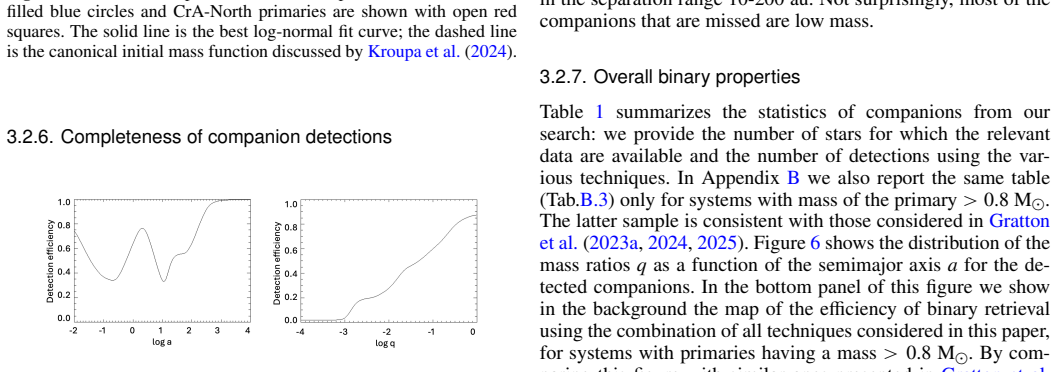
- [Sec. 4.3] The central claim depends on an unobserved 15 Msun progenitor in CrA-North. The paper states 'we might assume that a 15 Msun star exploded as a SN' and justifies it with the Weidner et al. (2010) expectation of 8-15 Msun for a 130 Msun association. This is a statistical upper-end assumption, not a detection. If the most massive star was below the core-collapse limit, there is no SN, no kick, and no trigger for CrA-Main. The 18 Myr formation epoch is derived by adding the 14.2 Myr PARSEC lifetime to the 3.72 Myr expansion age, so it is not independent evidence. Please replace this with a quantitative assessment: e.g., the probability that a 130 Msun association produced a star >8 Msun given the IMF, plus a search for observable relics (SNR, neutron star, runaway companion, chemical anomalies). As written, the Sec. 5 conclusion stating the 15 Msun star exploded overstates the support.
- [Sec. 4.3, momentum/geometry] The SN location 'about 2 pc south of CrA-North' is chosen to reproduce the observed relative motion of Main and North. The argument scales the intercepted momentum with the square of the SN-cloud distance and assumes a progenitor cloud radius of 1.5 pc. Both quantities are unconstrained: the current CrA-Main core radius is not necessarily the radius of the cloud 3.72 Myr ago, and the momentum fraction of 15% depends on the cloud structure and SN blast-wave geometry. The paper should show how the inferred SN position and the required kick vary over a plausible range of cloud radii (e.g., 0.5-3 pc) and SN momenta. Without this, the scenario is a fit, not a prediction.
- [Sec. 3.3 and Sec. 4.2] The traceback epoch for CrA-North is quoted as 3.72 +/- 0.01 Myr from the minimum of the median distance. This formal uncertainty is unrealistically small because the method assumes free expansion, neglects the galactic potential and internal dynamics, and ignores systematic errors in proper motions and membership. The paper acknowledges these caveats, but then uses 3.72 Myr as an exact input to set the SN epoch and to match the pulsar age to 0.01 Myr. Please provide a more realistic systematic uncertainty and propagate it to the SN epoch and to the pulsar coincidence probability.
- [Sec. 5, pulsar RX J1856.5-3754] The claimed probability of chance coincidence (<1e-5) for the pulsar association is a posteriori and does not account for the fact that RX J1856.5-3754 is a well-known nearby neutron star already in the field. The paper's own argument that its high proper motion (332 mas/yr) places its birthplace far away if the spin-down age is correct is a serious tension. The proposed solution—recent disruption of a multiple system—is another unobserved element. The pulsar identification should be presented as a speculative aside with a corrected trials factor (e.g., the number of known neutron stars within ~10 pc), not as a supporting pillar of the formation scenario.
minor comments (4)
- [Sec. 2] The rejection of 16 stars as 'clearly much older' non-members is described qualitatively; a quantitative criterion (e.g., distance above the 10 Myr isochrone in both CMDs) would aid reproducibility.
- [Sec. 3.3] The adopted CrA-Main age of 3 +/- 1 Myr is strongly influenced by assigning 1 Myr to nine deeply embedded stars. This assumption should be explicitly flagged in Table 5 and in the abstract, where the age is quoted without this caveat.
- [Fig. 12] The dashed line (closest-neighbor distance) is multiplied by 15 to match the vertical scale; this is not indicated in the caption and makes the line visually misleading.
- [Appendix B] Table B.4 lists 'Ampl.' without units or a definition in the caption; some columns (e.g., S/N(PMa)) lack units. Please clarify.
Circularity Check
No significant circularity: the SN-trigger scenario is explicitly hypothetical, and its kinematic inputs (Gaia traceback age, relative motion, external pulsar data) are independent; no prediction reduces to a fit by construction.
full rationale
The central formation-history scenario rests on assumptions, but not on circular reductions. The 3.72 Myr epoch is measured from the Gaia proper-motion traceback of CrA-North (Sec. 4.2, Fig. 12), independently of the pulsar age; the paper even notes that RX J1856.5-3754's large proper motion initially argues against its membership. The SN position ~2 pc south of CrA-North is derived from the observed direction of CrA-Main's relative motion (Sec. 4.3, Fig. 13), not used as an input to generate that motion. The 15 Msun progenitor is explicitly an assumption ("we might assume that a 15 Msun star exploded as a SN", Sec. 4.3), and the 14.2 Myr + 3.72 Myr = ~18 Myr lifetime calculation is a consistency check with the external UCL encounter epoch, not a fitted parameter renamed as a prediction. The pulsar match is an external, falsifiable coincidence (position within ~8 pc and age within 0.01 Myr) that was not used to set the traceback epoch. Self-citations (e.g., Gratton et al. 2023b, 2024, 2025) are methodological, concerning binary-search techniques, and do not carry the formation-history claim. The paper repeatedly frames the scenario as provisional ("we propose", "If this interpretation is correct", "possible"), so the weakest link — existence of the 15 Msun star — is a limitation in evidentiary support, not circularity.
Assumptions & free parameters
free parameters (5)
- Assigned age of 9 embedded CrA-Main stars =
1 Myr
- CrA-cloud core radius for SN momentum interception =
1.5 pc
- CrA-North progenitor mass (most massive star) =
15 M☉
- Original CrA-complex cloud mass =
~4000 M☉ (factor 2)
- Reddening law parameter RV =
4
assumptions (6)
- domain assumption Gaia DR3 astrometry and photometry are accurate at the level assumed for membership, ages, and proper-motion traceback.
- domain assumption Baraffe et al. (2015) isochrones correctly reproduce colors and magnitudes of young low-mass stars in CrA.
- domain assumption CrA-North expands freely, unaffected by self-gravity or the galactic potential, so the traceback minimum dates its dispersal.
- domain assumption The momentum received by the cloud from a SN scales as the square of the ratio of cloud radius to SN distance, with all momentum within the cloud radius intercepted.
- ad hoc to paper The most massive star in a 130 M☉ association follows the Weidner et al. (2010) mass expectation.
- domain assumption Pulsar spin-down age (3.72±0.06 Myr) equals the true age of RX J1856.5-3754.
invented entities (2)
-
Progenitor SN star in CrA-North (roughly 15 M☉, exploded about 3.72 Myr ago about 2 pc south of CrA-North center)
independent evidence
-
Recent disruption of a multiple system involving RX J1856.5-3754
Cite this review
Pith. "Pith review of The Corona-Australis star-forming region: New insights on its formation history from detailed stellar and disk analysis." pith.science (2026). https://pith.science/paper/D5KKEGFI
@misc{pith2026250819757,
  author       = {Pith},
  title        = {Pith review of: The Corona-Australis star-forming region: New insights on its formation history from detailed stellar and disk analysis},
  year         = {2026},
  howpublished = {\url{https://pith.science/paper/D5KKEGFI}},
  note         = {Machine review of arXiv:2508.19757}
}
read the original abstract
The star-forming complex of Corona Australis (CrA) is one of the closest and most isolated molecular clouds. It belongs to a chain of clusters that show age gradients with distance from the galactic plane. We aim to provide suggestions regarding its formation history by examining the stellar and disk populations, stellar multiplicity, and interstellar absorption. We made a census of stars and disks using Gaia DR3 and infrared data. Interstellar absorption in the direction of each star was derived by comparing SpTy from the literature and Gaia colors. Stellar multiplicity analysis accounts for both direct observation of visual companions (Gaia data and high-contrast imaging) and indirect detection of the presence of companions (eclipsing and spectroscopic binaries, and astrometry). The properties of the disks were obtained from the slopes of the spectral energy distributions. As found in previous studies, the CrA complex can be divided into two regions: a younger region (CrA-Main: 3+/-1Myr) and an older one (CrA-North: 6.7+/-0.3Myr), slightly younger than previously thought. While CrA-Main still appears bound to the gas, CrA-North is unbound and expanding. The stars that belong to CrA-North were in the most compact configuration 3.72Myr ago. At that time, CrA-Main and CrA-North were much closer to each other than they appear now. The fraction of disk-bearing stars is higher in Main than in North, as also expected due to the younger age of CrA-Main. We propose a formation history scenario for the CrA-complex. It started between 15 and 18 Myr ago with SNe explosions in the Upper Centaurus-Lupus complex, followed by a quiescent phase with little star formation. A star formation episode about 7Myr ago formed CrA-North stars. About 3.7Myr ago, a second SN explosion south of CrA-North triggered star formation in CrA-Main. This last SN might have been the origin of the pulsar RX J1856.5-3754.
Figures


Figures from the paper (13 more)





Forward citations
Cited by 1 Pith paper
-
Analysis of the young disk around WRAY 15-1880: does it contain a primitive planetary system?
A candidate 0.3-7.6 MJup companion is reported in the gap of the ~2.8 Myr pre-transitional disk around WRAY 15-1880, with an ALMA blob interpreted as a vortex at the m=1 Lindblad resonance.
Reference graph
Works this paper leans on
-
[1]
Ackermann, M., Ajello, M., Allafort, A., et al. 2012, ApJ, 755, 22
work page 2012
-
[2]
2014, in Pro- tostars and Planets VI, ed
Alexander, R., Pascucci, I., Andrews, S., Armitage, P., & Cieza, L. 2014, in Pro- tostars and Planets VI, ed. H. Beuther, R. S. Klessen, C. P. Dullemond, & T. Henning, 475–496
2014
-
[3]
Alves, J., Lombardi, M., & Lada, C. J. 2014, A&A, 565, A18
work page 2014
-
[4]
Ambartsumian, V . A. 1937, AZh, 14, 207
work page 1937
-
[5]
2015, A&A, 577, A42
Baraffe, I., Homeier, D., Allard, F., & Chabrier, G. 2015, A&A, 577, A42
2015
-
[6]
2020, MNRAS, 496, 1922
Belokurov, V ., Penoyre, Z., Oh, S., et al. 2020, MNRAS, 496, 1922
2020
-
[7]
D., et al
Beuther, H., Gieser, C., Soler, J. D., et al. 2024, A&A, 682, A81
2024
-
[8]
Bogdanov, S. & Ho, W. C. G. 2024, ApJ, 969, 53
work page 2024
Show all 69 references
-
[9]
G., Hartman, J
Bouma, L. G., Hartman, J. D., Bhatti, W., Winn, J. N., & Bakos, G. Á. 2019, ApJS, 245, 13
2019
-
[10]
2006, ApJ, 652, 1572
Brandeker, A., Jayawardhana, R., Khavari, P., Haisch, Karl E., J., & Mardones, D. 2006, ApJ, 652, 1572
2006
-
[11]
M., et al
Bresnahan, D., Ward-Thompson, D., Kirk, J. M., et al. 2018, A&A, 615, A125
2018
-
[12]
A., Tenenbaum, P., Twicken, J
Caldwell, D. A., Tenenbaum, P., Twicken, J. D., et al. 2020, Research Notes of the American Astronomical Society, 4, 201 Cambrésy, L. 1999, A&A, 345, 965
2020
-
[13]
A., Clayton, G
Cardelli, J. A., Clayton, G. C., & Mathis, J. S. 1989, ApJ, 345, 245
1989
-
[14]
F., Liu, H
Cazzoletti, P., Manara, C. F., Liu, H. B., et al. 2019, A&A, 626, A11
2019
-
[15]
G., Bressan, A., et al
Costa, G., Shepherd, K. G., Bressan, A., et al. 2025, A&A, 694, A193 De Grandis, D., Rigoselli, M., Mereghetti, S., et al. 2022, MNRAS, 516, 4932
2025
-
[16]
2005, PASJ, 57, S1
Dobashi, K., Uehara, H., Kandori, R., et al. 2005, PASJ, 57, S1
2005
-
[17]
Esplin, T. L. & Luhman, K. L. 2022, AJ, 163, 64
2022
-
[18]
Feiden, G. A. 2016, A&A, 593, A99 Gaia Collaboration, Arenou, F., Babusiaux, C., et al. 2023a, A&A, 674, A34 Gaia Collaboration, Prusti, T., de Bruijne, J. H. J., et al. 2016, A&A, 595, A1 Gaia Collaboration, Vallenari, A., Brown, A. G. A., et al. 2023b, A&A, 674, A1
2016
-
[19]
Galli, P. A. B., Bouy, H., Olivares, J., et al. 2020, A&A, 634, A98
2020
-
[20]
2024, A&A, 685, A119
Gratton, R., Bonavita, M., Mesa, D., et al. 2024, A&A, 685, A119
2024
-
[21]
2025, A&A, 694, A175
Gratton, R., Bonavita, M., Mesa, D., et al. 2025, A&A, 694, A175
2025
-
[22]
Green, D. A. 2025, Journal of Astrophysics and Astronomy, 46, 14
2025
-
[23]
1995, ApJ, 452, 736 Haugbølle, T., Padoan, P., & Nordlund, Å
Hartigan, P., Edwards, S., & Ghandour, L. 1995, ApJ, 452, 736 Haugbølle, T., Padoan, P., & Nordlund, Å. 2018, ApJ, 854, 35
1995
-
[24]
2023, A&A, 674, A10
Holl, B., Sozzetti, A., Sahlmann, J., et al. 2023, A&A, 674, A10
2023
-
[25]
X., Vanderburg, A., Pál, A., et al
Huang, C. X., Vanderburg, A., Pál, A., et al. 2020, Research Notes of the Amer- ican Astronomical Society, 4, 204
2020
-
[26]
Hwang, H.-C., Ting, Y .-S., & Zakamska, N. L. 2022, MNRAS, 512, 3383
2022
-
[27]
2012, Annual Review of Nuclear and Particle Science, 62, 407
Janka, H.-T. 2012, Annual Review of Nuclear and Particle Science, 62, 407
2012
-
[28]
Kaplan, D. L. 2008, in American Institute of Physics Conference Series, V ol. 983, 40 Years of Pulsars: Millisecond Pulsars, Magnetars and More, ed. C. Bassa, Z. Wang, A. Cumming, & V . M. Kaspi (AIP), 331–339
2008
-
[29]
L., van Kerkwijk, M
Kaplan, D. L., van Kerkwijk, M. H., & Anderson, J. 2007, ApJ, 660, 1428
2007
-
[30]
2022, A&A, 657, A7 Köhler, R., Neuhäuser, R., Krämer, S., et al
Kervella, P., Arenou, F., & Thévenin, F. 2022, A&A, 657, A7 Köhler, R., Neuhäuser, R., Krämer, S., et al. 2008, A&A, 488, 997
2022
-
[31]
2024, arXiv e-prints, arXiv:2410.07311
Kroupa, P., Gjergo, E., Jerabkova, T., & Yan, Z. 2024, arXiv e-prints, arXiv:2410.07311
2024 arXiv
-
[32]
Krumholz, M. R. & Tan, J. C. 2007, ApJ, 654, 304
2007
-
[33]
Lada, C. J. 1987, in IAU Symposium, V ol. 115, Star Forming Regions, ed. M. Pe- imbert & J. Jugaku, 1
1987
-
[34]
Lada, C. J. & Lada, E. A. 2003, ARA&A, 41, 57
2003
-
[35]
J., Muench, A
Lada, C. J., Muench, A. A., Luhman, K. L., et al. 2006, AJ, 131, 1574
2006
-
[36]
2018, A&A, 616, A2
Lindegren, L., Hernández, J., Bombrun, A., et al. 2018, A&A, 616, A2
2018
-
[37]
2019, MNRAS, 490, 3806 Neuhäuser, R
Nardiello, D., Borsato, L., Piotto, G., et al. 2019, MNRAS, 490, 3806 Neuhäuser, R. & Forbrich, J. 2008, in Handbook of Star Forming Regions, V ol- ume II, ed. B. Reipurth, V ol. 5 (ASP Monograph Series), 735
2019
-
[38]
Oudmaijer, R. D. & Parr, A. M. 2010, MNRAS, 405, 2439
2010
-
[39]
Pecaut, M. J. & Mamajek, E. E. 2013, ApJS, 208, 9
2013
-
[40]
J., Mamajek, E
Pecaut, M. J., Mamajek, E. E., & Bubar, E. J. 2012, ApJ, 746, 154
2012
-
[41]
Penoyre, Z., Belokurov, V ., & Evans, N. W. 2022, MNRAS, 513, 2437
2022
-
[42]
E., Caratti o Garatti, A., Bourke, T
Peterson, D. E., Caratti o Garatti, A., Bourke, T. L., et al. 2011, ApJS, 194, 43
2011
-
[43]
& Dincer, F
Pfalzner, S. & Dincer, F. 2024, ApJ, 963, 122
2024
-
[44]
A., Krumholz, M
Pokhrel, R., Gutermuth, R. A., Krumholz, M. R., et al. 2021, ApJ, 912, L19
2021
-
[45]
2025, A&A, 693, A175
Posch, L., Alves, J., Miret-Roig, N., et al. 2025, A&A, 693, A175
2025
-
[46]
2023, A&A, 679, L10
Posch, L., Miret-Roig, N., Alves, J., et al. 2023, A&A, 679, L10
2023
-
[47]
2009, A&A, 496, 533
Posselt, B., Neuhäuser, R., & Haberl, F. 2009, A&A, 496, 533
2009
-
[48]
A., Batten, A
Pourbaix, D., Tokovinin, A. A., Batten, A. H., et al. 2004, A&A, 424, 727 Ratzenböck, S., Großschedl, J. E., Alves, J., et al. 2023a, A&A, 678, A71 Ratzenböck, S., Großschedl, J. E., Möller, T., et al. 2023b, A&A, 677, A59
2004
-
[49]
Reynolds, J. H. 1916, MNRAS, 76, 645
1916
-
[50]
Reynolds, S. P. 2008, ARA&A, 46, 89
2008
-
[51]
R., Winn, J
Ricker, G. R., Winn, J. N., Vanderspek, R., et al. 2015, Journal of Astronomical
2015
-
[52]
2023, A&A, 671, A82
Rigliaco, E., Gratton, R., Ceppi, S., et al. 2023, A&A, 671, A82
2023
-
[53]
S., & Richards, J
Shivvers, I., Bloom, J. S., & Richards, J. W. 2014, MNRAS, 441, 343
2014
-
[54]
2011, ApJ, 736, 137
Sicilia-Aguilar, A., Henning, T., Kainulainen, J., & Roccatagliata, V . 2011, ApJ, 736, 137
2011
-
[55]
2013, A&A, 551, A34
Sicilia-Aguilar, A., Henning, T., Linz, H., et al. 2013, A&A, 551, A34
2013
-
[56]
2012, in From Atoms to Pebbles: Herschel’s view of Star and Planet Formation, 29
Sicilia-Aguilar, A., Henning, T., Linz, H., Krause, O., & André, P. 2012, in From Atoms to Pebbles: Herschel’s view of Star and Planet Formation, 29
2012
-
[57]
M., et al
Sissa, E., Gratton, R., Alcalà, J. M., et al. 2019, A&A, 630, A132
2019
-
[58]
F., Cutri, R
Skrutskie, M. F., Cutri, R. M., Stiening, R., et al. 2006, AJ, 131, 1163
2006
-
[59]
2021, MNRAS, 507, 1381
Squicciarini, V ., Gratton, R., Bonavita, M., & Mesa, D. 2021, MNRAS, 507, 1381
2021
-
[60]
L., & Pauldrach, A
Sternberg, A., Hoffmann, T. L., & Pauldrach, A. W. A. 2003, ApJ, 599, 1333
2003
-
[61]
2024, Nature, 631, 49
Swiggum, C., Alves, J., Benjamin, R., et al. 2024, Nature, 631, 49
2024
-
[62]
Taylor, K. N. R. & Storey, J. W. V . 1984, MNRAS, 209, 5P
1984
-
[63]
2018, ApJS, 235, 6 van Kerkwijk, M
Tokovinin, A. 2018, ApJS, 235, 6 van Kerkwijk, M. H. & Kulkarni, S. R. 2001, A&A, 380, 221 Vaˇnko, M., Ammler-von Eiff, M., Pribulla, T., et al. 2013, MNRAS, 431, 2230
2018
-
[64]
& Naab, T
Walch, S. & Naab, T. 2015, MNRAS, 451, 2757
2015
-
[65]
Walter, F. M. & Lattimer, J. M. 2002, ApJ, 576, L145
2002
-
[66]
Weidner, C., Kroupa, P., & Bonnell, I. A. D. 2010, MNRAS, 401, 275
2010
-
[67]
L., Eisenhardt, P
Wright, E. L., Eisenhardt, P. R. M., Mainzer, A. K., et al. 2010, AJ, 140, 1868
2010
-
[68]
T., Wang, J
Xie, J. T., Wang, J. B., Wang, N., Manchester, R., & Hobbs, G. 2024, ApJ, 963, L39
2024
-
[69]
Technique
Zucker, C., Speagle, J. S., Schlafly, E. F., et al. 2020, A&A, 633, A51 Article number, page 15 of 19 A&A proofs: manuscript no. aa55158-25 Appendix A: Mass budget of the CrA-complex The CrA-complex is made of two components: CrA-Main and CrA-North. CrA-Main is made of stars a...
2020
Reviewed August 5, 2026 · model on record in the stance chip above.
Discussion (0). Sign in to comment.