REVIEW 3 major objections 6 minor 24 references
Energy of Quantum Coulomb Liquid
T0 review · 3 major / 6 minor · reviewed 2026-08-14 · deepseek-v4-flash
Pith's one-line read Path-integral Monte Carlo computations yield first-principles energies of the quantum Coulomb liquid across the liquid range of dense stellar matter, and those energies imply ionic heat capacities down to about two-thirds of the classical…
desk verdict A competent PIMC extension of Coulomb-liquid energies to the dense stellar-matter regime, with a real but explicitly flagged finite-size uncertainty that the referee should push on. read the letter →
The pith
A machine-rendered reading of the paper's core claim, the machinery that carries it, and where it could break.
The reading
What carries the argument
The carrying mechanism is the ring-polymer representation of quantum nuclei: each of the $N=250$ distinguishable particles becomes a closed chain of $M$ beads linked by kinetic springs, with an Ewald potential between same-numbered beads and the primitive approximation for the link action, so that the quantum partition function becomes a classical polymer sampling problem solved by Metropolis moves. Energies are obtained from the thermodynamic estimator $E = \langle 3N/(2\tau) - (R_m - R_{m-1})^2/(4\lambda \tau^2) + V(R_m)\rangle$ and extrapolated in $1/M \to 0$ at each $(r_s,\Gamma)$; the Wigner-Kirkwood expansion supplies the analytic limits against which the high-$r_s$ data are checked.
What would settle it
Repeat the calculation for $N=500$ or $N=1000$ particles at a few points of Table 1 (for example $r_s = 1200, 12000, 120000$ at $\Gamma=100$ and $\Gamma=10$): if the extrapolated energies move by more than the quoted $\pm 0.007$ statistical error, or if the high-$r_s$ agreement with the Wigner-Kirkwood expansion disappears, the paper's central claim that the heat capacity can be reliably determined from the Table 1 data collapses.
Extended reading notes
Core claim
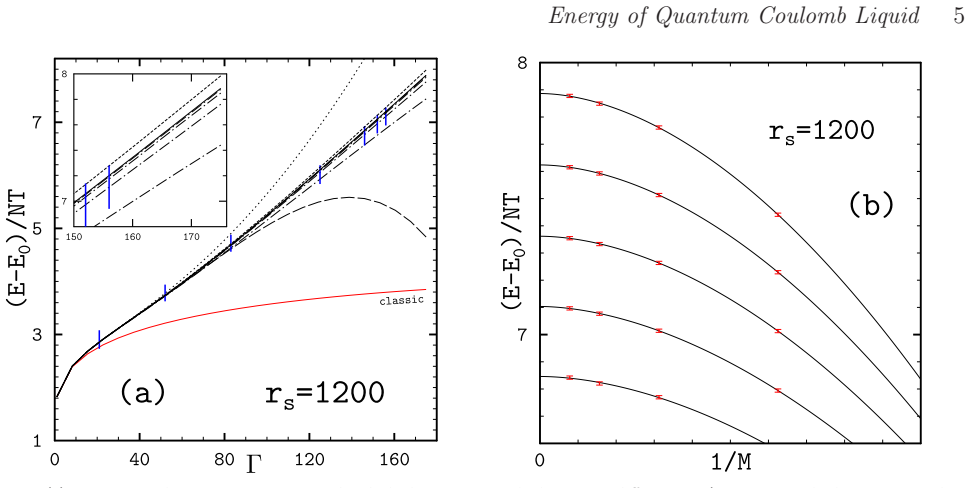
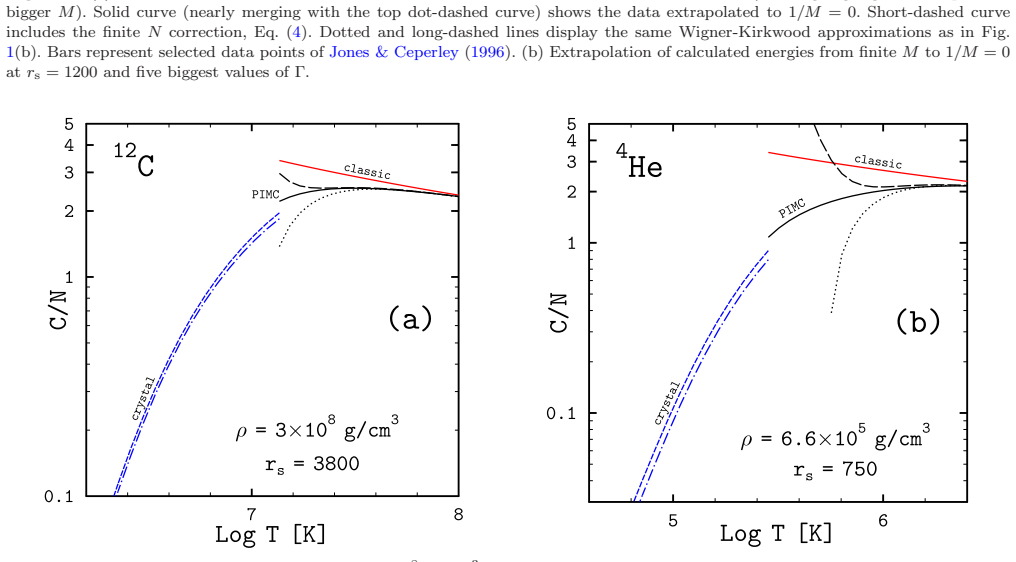
The central claim is that the thermal energy of the quantum Coulomb liquid, $(E - E_0)/NT$, can be obtained from first principles for strongly coupled liquid plasmas over the entire liquid range up to melting, $\Gamma \lesssim 175$, and for ion-sphere radii $r_s = 600$–$120000$, using the primitive approximation to the path-integral action and an $M \to \infty$ extrapolation of ring-polymer size. At $r_s = 1200$ the results are compatible with the earlier $N=54$ Path Integral Monte Carlo data of Jones & Ceperley (1996), while at large $r_s$ they converge to the classical energy plus the first and second Wigner-Kirkwood corrections, which the author reads as evidence that finite-size effects at $N=250$ are small in this regime. On this basis the data are presented as a reliable source of ionic specific heat in dense stellar fluids, and the paper shows that the quantum liquid specific heat falls below the classical value, with total stellar heat capacity possibly as low as $2/3$ of the classical estimate.
Load-bearing premise
The load-bearing premise is that 250 particles in the simulation cell already represent the infinite plasma well enough that the omitted finite-size correction is negligible, including at the largest $r_s$, where the author chooses not to apply the Jones-Ceperley correction.
Editorial extensions
If this is right
- The Table 1 energies provide a first-principles equation-of-state input for ionic thermal properties of white-dwarf cores and neutron-star crusts at $r_s \ge 600$.
- Ionic heat capacity in the liquid can be substantially lower than the classical OCP value, so white-dwarf cooling models that use classical heat capacities may underestimate stellar ages.
- The specific-heat jump at melting is much reduced once quantum effects are included from first principles, until a first-principles solid-phase thermodynamics is computed.
- The Wigner-Kirkwood expansion is adequate for $r_s \gtrsim 10000$–$20000$, so analytic corrections remain useful in that density range.
- The latent heat of crystallization is only weakly dependent on $r_s$, decreasing from about $0.77 T$ classically to about $0.71 T$ at $r_s = 1200$, which affects the crystallization delay in white-dwarf cooling.
Reading between the lines
- The paper does not state this, but the same approach could be run at a second system size (e.g., $N=500$ or $1000$) at a handful of $(r_s,\Gamma)$ points to settle whether the omitted finite-$N$ correction is truly negligible; this is the natural check the author defers.
- A direct continuation suggested by the text is to compute first-principles reaction rates for nuclear burning in strongly coupled plasma from the same path-integral code, which would affect models of bursts, flashes, and type Ia supernovae.
- The discrepancy between the Jones-Ceperley finite-$N$ formula and the high-$r_s$ agreement with Wigner-Kirkwood suggests the finite-size correction may itself be $r_s$-dependent; a testable prediction is that any $N$-dependence at fixed $\Gamma$ weakens as $r_s$ grows.
- If the reduced heat-capacity trend holds, the location and sharpness of the white-dwarf luminosity-function bump from crystallization may shift, because both latent heat and liquid specific heat enter the cooling age; this is an astrophysical consequence the paper only sketches.
Signed reviews
Editorial analysis
A structured set of objections, weighed in public.
Referee Report
Summary. The manuscript reports path-integral Monte Carlo (PIMC) calculations of the thermal energy of a quantum one-component plasma of distinguishable nuclei in a uniform electron background, using N=250 particles, periodic Ewald interactions, the primitive link action, and an extrapolation in the number of beads M to 1/M=0. Results are tabulated for Γ=1--175 and rs=600--120000, compared with Jones & Ceperley at rs=1200 and with Wigner-Kirkwood expansions at high rs, and used to compute ion heat capacities for carbon and helium. The central claim is that the data determine reliably the ion heat capacity in dense stellar matter, with quantum effects possibly lowering the stellar heat capacity to about two-thirds of the classical value.
Significance. If the calculations are correct, the dataset fills a genuine gap for strongly coupled quantum Coulomb liquids at rs≥600 and provides directly useful input for white-dwarf and neutron-star crust cooling models. The paper has several concrete strengths: it is a direct simulation with no fitted target quantities, it performs a 1/M extrapolation rather than relying on a single bead number, and it checks against independent Jones & Ceperley data and Wigner-Kirkwood expansions. The main limitations are the unresolved finite-size systematics at N=250 and the lack of a quantitative uncertainty budget for the derived heat capacity. The manuscript makes specific numerical predictions that independent simulations could test.
major comments (3)
- [Sec. 3, Eq. (4)] The finite-size correction is explicitly not applied and no N-dependence study is provided. At rs=1200, Γ=175, Eq. (4) gives (E_N-E_∞)/T ≈ -0.098, about 1% of the tabulated thermal energy, and its derivative contributes roughly 0.1 to C/N, comparable to the quantum reduction displayed in Fig. 3. The argument that agreement with the Wigner-Kirkwood expansion at high rs implies that the N-correction is negligible is not conclusive, because the WK expansion is an asymptotic high-temperature series for the thermodynamic limit and agreement in the total thermal energy does not control the temperature derivative that enters the heat capacity. Please either apply Eq. (4) or a conservative bracket based on its quoted uncertainty and propagate it through Table 1 and Fig. 3, or perform additional N=500 and N=1000 runs at representative (Γ,rs) points to demonstrate convergence.
- [Sec. 3 and Fig. 3] The statistical error is stated as a global 90% confidence interval of ±0.007 for the entire dataset, but no per-point statistical errors are given and the uncertainty in the 1/M extrapolation is not quantified. Since the paper's central astrophysical claim concerns the heat capacity, which is obtained by differentiating a smooth fit to only 25 Γ values, the absence of an error propagation analysis leaves the phrase 'reliably determine the heat capacity' unsupported. Please provide per-point error bars, extrapolation uncertainties, and an explicit statement of how the ±0.007 interval and the M-extrapolation uncertainty propagate into C/N.
- [Sec. 4, Fig. 3] The heat-capacity curves are produced by fitting the Table 1 energies at fixed rs with an unspecified smooth curve and differentiating it, but no fitting formula, number of parameters, residuals, or sensitivity analysis is reported. With Γ spacing ΔΓ=7.25 and the largest quantum effects near the melting point, the derivative, and hence the conclusion that the heat capacity can fall to two-thirds of the classical value, may depend on the arbitrary choice of fit. Please specify the fit, show residuals, and give an uncertainty estimate for the derived C/N.
minor comments (6)
- [Throughout] The word 'classic' is used where 'classical' is standard; for example, 'classic liquid energy' and 'classic values' should be changed for consistency with the physics literature.
- [Sec. 1] The statement that Γ=1 signals the gas-liquid transition is misleading; the one-component plasma with a uniform background has no gas-liquid phase transition, and Γ≈1 merely separates weak- and strong-coupling regimes.
- [Table 1] The column headers '15e3', '3e4', and '12e4' should be typeset as 15000, 30000, and 120000 for readability and consistency with the text.
- [Sec. 3] The actual values of Mmin used for each rs, along with the number of Metropolis steps and equilibration details, are not reported; without these the 1/M extrapolation cannot be reproduced or assessed.
- [Eq. (4)] The parenthetical uncertainty notation, e.g., 0.035(18) and 0.0018(1), should be explicitly defined, and the statement that the correction is per particle and in units of T should be made in the text.
- [Figs. 1--3] The figures do not show error bars or uncertainty bands; given the claimed ±0.007 statistical uncertainty and the systematic M-extrapolation uncertainty, adding error bars or bands would substantially improve the reader's ability to judge the significance of the quantum reduction.
Circularity Check
No circularity: the PIMC energy calculation is a self-contained numerical simulation with external benchmarks used only for validation.
full rationale
The paper's central claim is a direct path-integral Monte Carlo computation of the quantum Coulomb liquid energy, with no fitted target quantities entering the simulation. The primitive approximation is stated to become exact in the M → ∞ limit, and the finite-M results are extrapolated in 1/M to obtain the exact quantum energy for the simulated finite system. This extrapolation is a convergence procedure, not a fit to the desired thermodynamic-limit answer. The classical Caillol energy fit and the Wigner-Kirkwood expansions are used as external comparisons to validate the PIMC results, not as inputs to the calculation. The only questionable step, the decision not to apply the Jones-Ceperley finite-N correction because of apparent agreement with Wigner-Kirkwood at high rs, is an accuracy or systematic-error concern, not a circularity: the PIMC energies do not reduce by construction to WK results or to the classical fit. The derived heat capacities are obtained by differentiating a smooth fit to the computed energies, so they inherit the simulation data rather than being defined by the classic approximation. Self-citations to Baiko, Potekhin & Yakovlev (2001) and Chugunov & Baiko (2005) are used only for crystal-phase model comparisons and do not support the liquid-phase first-principles result. No step in the derivation chain equates a predicted quantity with an input by definition, and no fitted parameter is renamed as a prediction.
Assumptions & free parameters
assumptions (5)
- domain assumption Primitive approximation for the path-integral link action becomes exact as M tends to infinity, and linear extrapolation in 1/M from Mmax=8Mmin is adequate.
- domain assumption The OCP model: point ions in a uniform incompressible electron background, with no electron screening and no ionization effects.
- domain assumption Ions are distinguishable particles, so exchange symmetry is neglected.
- domain assumption Ewald potential with periodic boundary conditions adequately represents the infinite system.
- ad hoc to paper Finite-size correction from Jones & Ceperley 1996 is not applied, and the N=250 finite-size error is assumed negligible at high rs.
Cite this review
Pith. "Pith review of Energy of Quantum Coulomb Liquid." pith.science (2026). https://pith.science/paper/D5PVQMGY
@misc{pith2026190801600,
  author       = {Pith},
  title        = {Pith review of: Energy of Quantum Coulomb Liquid},
  year         = {2026},
  howpublished = {\url{https://pith.science/paper/D5PVQMGY}},
  note         = {Machine review of arXiv:1908.01600}
}
abstract
Using Metropolis method to compute path integrals, the energy of quantum strongly-coupled Coulomb liquid ($1 \leq \Gamma \leq 175$) composed of distinguishable atomic nuclei and uniform incompressible electron background is calculated from first principles. The range of considered temperatures and densities represents fully-ionized layers of white dwarfs and neutron stars. In particular, the results allow one to determine reliably the heat capacity of ions in dense fluid stellar matter, which is a crucial ingredient for modelling thermal evolution of compact degenerate stars.
Figures

Reference graph
Works this paper leans on
-
[1]
Baiko D. A., Potekhin A. Y., and Yakovlev D. G., 2001, Phys. Rev. E, 64, 057402
work page 2001
-
[2]
D., and Tassoul M., 1991, Astrophys
Brassard P., Fontaine G., Wesemael F., Kawaler S. D., and Tassoul M., 1991, Astrophys. J., 367, 601
work page 1991
-
[3]
Brush S. G., Sahlin H. L., and Teller E., 1966, J. Chem. Phys., 45, 2102
work page 1966
- [4]
- [5]
-
[6]
Chabrier G., Ashcroft N. W., and DeWitt H. E., 1992, Nature, 360, 48
work page 1992
-
[7]
Chugunov A. I. and Baiko D. A., 2005, Physica A, 352, 397
work page 2005
-
[8]
D'Antona F. and Mazzitelli I., 1990, Annu. Rev. Astron. Astrophys., 28, 139
work page 1990
Show all 24 references
-
[9]
F., and Reddy S., 2017, Astrophys
Deibel A., Cumming A., Brown E. F., and Reddy S., 2017, Astrophys. J., 839, 95
2017
-
[10]
DeWitt H. E. and Slattery W. L., 1999, Contrib. Plasm. Phys., 39, 97
1999
-
[11]
T., 2000, Rev
G \"a nsicke B. T., 2000, Rev. Mod. Astron., 13, 151
2000
-
[12]
P., 1973, Phys
Hansen J. P., 1973, Phys. Rev. A, 8, 3096
1973
-
[13]
Hansen J. P. and Viellefosse P., 1975, Phys. Lett. A, 53, 187
1975
-
[14]
Holzmann M., Clay R. C. III, Morales M. A., Tubman N. M., Ceperley D. M., and Pierleoni C., 2016, Phys. Rev. B, 94, 035126
2016
-
[15]
Jones M. D. and Ceperley D. M., 1996, Phys. Rev. Lett., 76, 4572
1996
-
[16]
Lamb D. Q. and Van Horn H. M., 1975, Astrophys. J., 200, 306
1975
-
[17]
and Graham R
Militzer B. and Graham R. L., 2006, J. Phys. Chem. Sol., 67, 2136
2006
-
[18]
Militzer B., 2016, Comp. Phys. Comm., 204, 88
2016
-
[19]
Montgomery M. H. and Winget D. E., 1999, Astrophys. J., 526, 976
1999
-
[20]
R., 2014, Mon
Piersanti L., Tornambe A., and Yungelson L. R., 2014, Mon. Not. Roy. Astron. Soc., 445, 3239
2014
-
[21]
Pollock E. L. and Militzer B., 2004, Phys. Rev. Lett., 92, 021101
2004
-
[22]
Potekhin A. Y. and Chabrier G., 2000, Phys. Rev. E, 62, 8554
2000
-
[23]
L., Doolen G
Slattery W. L., Doolen G. D., and DeWitt H. E., 1982, Phys. Rev. A, 26, 2255
1982
-
[24]
M., 1979, Physics Today, Jan., 23
Van Horn H. M., 1979, Physics Today, Jan., 23
1979
Reviewed August 14, 2026 · model on record in the stance chip above.
Discussion (0). Continue with ORCID to comment.