REVIEW 3 major objections 5 minor 44 references
MiDashengLM-Gen: Unified Audio Scene Generation via LLM-Driven Autoregressive Flow Matching
T0 review · 3 major / 5 minor · reviewed 2026-08-16 · deepseek-v4-flash
Pith's one-line read The paper claims that a single end-to-end model can generate mixed audio scenes—speech, music, and sound effects together—with speech intelligibility close to that of dedicated text-to-speech systems, while retaining variable-length and…
desk verdict A credible end-to-end unified audio-scene model with a strong intelligibility result, but the headline WER needs the tokenizer's own reconstruction WER reported before the 2.79% number is interpretable. read the letter →
The pith
A machine-rendered reading of the paper's core claim, the machinery that carries it, and where it could break.
The reading
What carries the argument
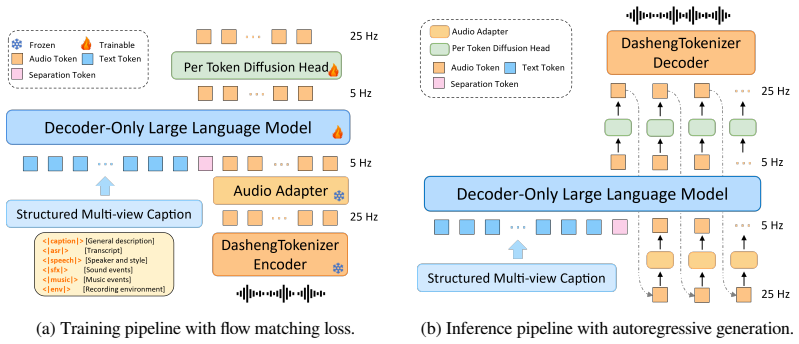
The load-bearing mechanism is per-token conditional flow matching over DashengTokenizer's high-dimensional semantic-acoustic latents, with the LLM hidden state as the conditioning signal. Structured multi-view captions decompose a scene into six textual views—global description, transcript, speaker, effects, music, and environment—each marked by special tokens, letting the LLM condition different control factors separately. An alignment stage first projects 25 Hz encoder frames, grouped to $k=5$ frames into 5 Hz tokens, into the LLM token space; then the LLM autoregressively predicts each token's flow field, and a DiT decoder with width greater than the latent dimension solves a 10-step Euler ODE, with a stop head determining generation length.
What would settle it
Measure the tokenizer's own encode-decode reconstruction WER on the Seed-TTS English test set, encoding speech and decoding with DashengTokenizer plus the vocoder without any LLM generation. If this reconstruction WER is at or above the model's 2.79%, then the LLM contributes none of the claimed intelligibility and the result is bounded by the frozen encoder.
Extended reading notes
Core claim
MiDashengLM-Gen is presented as the first general text-to-audio scene generator trained end to end in a single model: a Qwen3 LLM encodes the structured caption and audio history, and a DiT-based flow-matching decoder produces each 200 ms audio token conditioned on the LLM hidden state. Speech intelligibility measured by WER on Seed-TTS English falls to 2.79%, down from 12.15% for the previous unified model and within a factor of 2.2 of dedicated TTS at 1.24%. The model supports variable-length output through a learned stop head and multilingual generation. The paper identifies two design requirements: an audio-text alignment stage that maps audio latents into the LLM token space before generation training, and a DiT width that strictly exceeds the audio latent dimension for convergence.
Load-bearing premise
The frozen DashengTokenizer encoder is assumed to preserve enough phonetic and acoustic detail, after grouping five 25 Hz frames into one 200 ms token, that near-TTS intelligibility is possible; if this latent space loses phonemic information, no amount of LLM conditioning can recover it.
Editorial extensions
If this is right
- If the claims hold, end-to-end LLM-based generation closes most of the intelligibility gap with dedicated TTS, making scene generators usable for dialogue in games and film preproduction.
- Variable-length generation means one model can produce a 1-to-20-second scene without post-hoc stitching or fixed-duration constraints.
- Multilingual speech with competitive WERs may reduce the need for separate TTS adapters in mixed-audio pipelines.
- The width-must-exceed-latent-dimension rule gives a concrete scaling guideline for future LLM-conditioned audio decoders.
- The alignment-stage ablation suggests that cross-modal token mapping must be learned before generation training, not from scratch.
Reading between the lines
- If the tokenizer's own reconstruction WER is not substantially below 2.79%, part of the claimed intelligibility may be inherited from the frozen encoder rather than from the LLM-driven generative process; the paper reports STFT distance but not this ceiling.
- The 5 Hz grouping into 200 ms tokens likely limits temporal precision for fast consonants and could explain residual gaps in low-resource languages; a testable extension is variable-rate grouping or $k=1$ tokens.
- The width condition suggests a general principle for any high-dimensional continuous latent: a diffusion decoder's hidden width must exceed latent rank to avoid manifold expansion failure, which may transfer to video and multimodal generation.
- Because the paper reports only objective metrics, a subjective listening test on scene coherence would be a natural next check; the demo page hints at this but the paper does not include it.
Signed reviews
Editorial analysis
A structured set of objections, weighed in public.
Referee Report
Summary. The manuscript introduces MiDashengLM-Gen, a unified audio scene generation model that couples a pretrained Qwen3 LLM with per-token conditional flow matching over continuous latents produced by a frozen DashengTokenizer encoder. It uses structured multi-view captions, an audio-text alignment pre-training stage, and a learned stop head to support variable-length, multilingual generation of mixed scenes containing speech, music, and sound effects. Experiments report improved speech intelligibility on the Seed-TTS benchmark (English WER 2.79% vs. 12.15% for Dasheng AudioGen), competitive multilingual WERs on the MiniMax-Speech test set, emotion expressiveness results on CV3-Eval, and mixed-scene generation results on MECAT. Ablations study the importance of audio-text alignment and the scaling of DiT width relative to audio latent dimensionality.
Significance. If the results hold, this is a meaningful advance for unified audio scene generation: it demonstrates that an LLM combined with per-token flow matching over a continuous semantic-acoustic latent can bring speech intelligibility much closer to dedicated TTS systems than prior unified models, while retaining mixed-scene and multilingual capability. The main WER claims are evaluated on external benchmarks (Seed-TTS, MiniMax-Speech, CV3-Eval) rather than only on self-created data, and the authors release code and checkpoints, which are concrete strengths. The use of a self-created tokenizer and MECAT benchmark introduces a mild self-evaluation risk, and the absence of uncertainty quantification tempers the comparative claims.
major comments (3)
- [Section 3.1-3.2 and Table 4] The frozen DashengTokenizer encoder and decoder used to produce and reconstruct audio latents define an upper bound on achievable intelligibility, yet the paper never reports the tokenizer's own reconstruction WER on the Seed-TTS benchmark. Figure 3 reports only STFT L2 distance (topline 1.30) and Table 4 reports only generated-audio WER, so the headline comparison of 2.79% to Qwen3-TTS's 1.24% cannot be attributed to the proposed LLM/flow-matching architecture without knowing the codec oracle. If encode-decode through the frozen tokenizer already yields WER near 2.7%, the model is effectively operating at the codec ceiling and the claimed 2.2x gap is dominated by tokenizer loss; if the oracle is much lower, a real generation gap remains. Please report the encode-decode WER/CER of the frozen tokenizer on the same Seed-TTS and multilingual evaluation sets, and discuss how the oracle affects the abstract's claim.
- [Section 4.5, Table 10 and Figure 3] The paper claims that 'the DiT width must strictly exceed the audio latent dimensionality' and states this generalizes across LLM scales and latent dimensions, but Table 10 contradicts this: for 1280-dimensional latents with both Qwen3-0.6B and Qwen3-4B, width equal to 1280 converges successfully. Figure 3 only demonstrates failure at width 768 for 768-dimensional latents. Please revise the claim to a threshold phenomenon, explain why equality fails at 768 but succeeds at 1280, and define the criteria used to mark convergence in Table 10.
- [Section 4.2-4.4, Tables 4-8] All reported metrics are point estimates without confidence intervals, error bars, or significance tests, while several comparative conclusions rest on small differences (e.g., Table 7 S00 CLAP 0.35 vs. 0.34; Table 8 S0A FAD 1.54 vs. 1.75). Given the emphasis on 'consistently lower FAD' and 'better' claims in Section 4.4, please provide variance estimates or significance tests, such as bootstrap intervals over evaluation items or multiple sampling runs, and temper claims for differences that are not statistically distinguished.
minor comments (5)
- [Abstract] The hyperlinks appear as bare footnote markers (1, 2, 3); please render them as actual URLs in the final version so that the code, checkpoint, and demo links are directly accessible.
- [Section 4.5, Table 10] The parameter counts and depth configurations for the 'fixed parameter budget' are not reported; please include them so the convergence comparisons across width/depth trade-offs are reproducible.
- [Table 4] A CER value of '>100' is not a valid error rate; please provide the actual values or explain the transcription pathology that produces this result.
- [Section 3.2] The sentence 'Instead of full-sequence flow matching that generates the entire audio latent sequence in one pass we perform' is missing punctuation; additionally, define z_hist explicitly in a displayed equation or in the text adjacent to Eq. (3).
- [Section 1 and throughout] The claim that MiDashengLM-Gen 'represents a first approach for general text-to-audio generation with one end-to-end trained model' is difficult to verify against related work cited in Section 2 (UniAudio, AudioX, UniFlow-Audio, Dasheng AudioGen); please provide a precise definition of the claimed first or soften the phrasing.
Circularity Check
No circularity: the intelligibility and multilingual claims are measured on external benchmarks; same-group tokenizer and MECAT are inputs/evaluation infrastructure, not re-derived outputs.
full rationale
Score 0. I find no step in which a claimed prediction or derived result is equivalent, by the paper's own equations or by a self-citation chain, to an input or fitted parameter. The central intelligibility claim (EN WER 2.79% vs. Qwen3-TTS 1.24%, Seed-TTS) is an empirical measurement on an externally defined benchmark; nothing in Sections 3.1-3.2 is fitted to that benchmark, and no equation identifies the generated latents with the conditioning captions. The frozen DashengTokenizer/MiDashengLM encoder is reused prior infrastructure rather than a quantity re-derived from the present model, and the absence of a standalone tokenizer-reconstruction WER is a diagnostics gap, not a circular reduction; it does not make the reported number an identity. Similarly, MECAT is a held-out benchmark from the same group, but self-created evaluation data is not a derivation loop unless the model was fitted to it, which the paper does not claim. The 'DiT width must exceed latent dimensionality' observation is presented as an empirical sweep (Table 10) and is explicitly linked to an external theoretical result [44], so it is a fitted empirical pattern rather than a fitted parameter renamed as a prediction. Self-citations appear as supporting context (tokenizer, captions, alignment, benchmark), but none carries an unverified 'uniqueness' or 'necessity' premise that forces the headline result. Correctness risks, such as the missing oracle WER or the self-created MECAT benchmark, are limitations or missing baselines, not circularity.
Assumptions & free parameters
free parameters (3)
- CFG guidance scale =
2.0
- Stop threshold tau =
0.5
- Stop loss weight lambda =
0.01
assumptions (5)
- standard math Flow matching with an Euler ODE solver correctly estimates the generative vector field.
- domain assumption The frozen DashengTokenizer latent space retains enough semantic and acoustic detail for generation.
- domain assumption Grouping 5 latent frames into a 200 ms token preserves phonetic detail needed for intelligible speech.
- domain assumption Qwen3's pretrained language capabilities transfer to audio-centric token sequences after fine-tuning.
- domain assumption The width-rank convergence principle from image diffusion transfers to audio latents.
Cite this review
Pith. "Pith review of MiDashengLM-Gen: Unified Audio Scene Generation via LLM-Driven Autoregressive Flow Matching." pith.science (2026). https://pith.science/paper/D653BWCJ
@misc{pith2026260811804,
  author       = {Pith},
  title        = {Pith review of: MiDashengLM-Gen: Unified Audio Scene Generation via LLM-Driven Autoregressive Flow Matching},
  year         = {2026},
  howpublished = {\url{https://pith.science/paper/D653BWCJ}},
  note         = {Machine review of arXiv:2608.11804}
}
read the original abstract
Generating coherent audio scenes that simultaneously blend speech, music, and sound effects remains a significant challenge. Current approaches typically rely on a disjointed pipeline where a frozen, decoupled text encoder feeds a separate audio decoder, limiting cross-modal optimization and leading to poor speech intelligibility. To overcome these limitations, we introduce MiDashengLM-Gen, an end-to-end framework that couples a pre-trained Large Language Model (LLM) with per-token conditional flow matching for autoregressive, variable-length mixed-audio scene generation. MiDashengLM-Gen represents a first approach for general text-to-audio generation with one end-to-end trained model. Empirical evaluations demonstrate that MiDashengLM-Gen drastically improves speech intelligibility over existing unified models. On the Seed-TTS benchmark, English Word Error Rate (WER) drops from 12.15% to 2.79%, approaching the performance of dedicated Text-to-Speech (TTS) systems (1.24%). Furthermore, the framework extends effectively to multilingual settings, yielding highly competitive multilingual WERs compared to existing baselines. Lastly, the model maintains competitive mixed-audio generation quality on the MECAT benchmark. Code and checkpoints are available at https://github.com/xiaomi-research/midashenglm-gen and https://huggingface.co/mispeech/midashenglm-gen, and the demo page is available at https://xingws.github.io/midashenglm-gen-demo/.
Figures


Reference graph
Works this paper leans on
-
[1]
Hangrui Hu, Xinfa Zhu, Ting He, Dake Guo, Bin Zhang, Xiong Wang, Zhifang Guo, Ziyue Jiang, Hongkun Hao, Zishan Guo, Xinyu Zhang, Pei Zhang, Baosong Yang, Jin Xu, Jingren Zhou, and Junyang Lin. Qwen3-tts technical report. 2026. arXiv preprint arXiv:2601.15621
arXiv 2026
-
[2]
Seed-tts: A family of high-quality versatile speech generation models
Philip Anastassiou, Jui Chung, Aaditya Deepak, Sefik Emre Florez, Yunyang He, Shun Jiang, Tom Kaftan, Jia Li, Fangxun Lin, Yanxi Luo, et al. Seed-tts: A family of high-quality versatile speech generation models. arXiv preprint arXiv:2406.02430, 2024
arXiv 2024
-
[3]
Simple and controllable music generation
Jade Copet, Felix Kreuk, Itai Gat, Tal Remez, David Kant, Gabriel Synnaeve, Yossi Adi, and Alexandre Défossez. Simple and controllable music generation. In Advances in Neural Informa- tion Processing Systems (NeurIPS), 2023
work page 2023
-
[4]
Andrea Agostinelli, Timo I. Denk, Zalán Borsos, Jesse Engel, Mauro Verzetti, Antoine Caillon, Qingqing Huang, Aren Jansen, Adam Roberts, Marco Tagliasacchi, Matt Sharifi, Neil Zeghidour, and Christian Frank. MusicLM: Generating music from text. In International Conference on Machine Learning (ICML Workshop), 2023
work page 2023
- [5]
-
[6]
Chia-Yu Hung, Navonil Majumder, Zhifeng Kong, Ambuj Mehrish, Amir Ali Bagherzadeh, Chuan Li, Rafael Valle, Bryan Catanzaro, and Soujanya Poria. Tangoflux: Super fast and faith- ful text to audio generation with flow matching and clap-ranked preference optimization. 2024. arXiv preprint arXiv:2412.21037
arXiv 2024
-
[7]
Uniaudio: An audio foundation model toward universal audio generation
Dongchao Yang, Jinchuan Tian, Xu Tan, Rongjie Huang, Songxiang Liu, Xuankai Chang, Ji- atong Shi, Sheng Zhao, Jiang Bian, Zhou Zhao, Xixin Wu, and Helen Meng. Uniaudio: An audio foundation model toward universal audio generation. In IEEE International Conference on Acoustics, Speech and Signal Processing (ICASSP), 2024
work page 2024
-
[8]
Uniflow-audio: Unified flow matching for audio generation from omni-modalities
Xuenan Xu, Jiahao Mei, Zihao Zheng, Ye Tao, Zeyu Xie, Yaoyun Zhang, Haohe Liu, Yuning Wu, Ming Yan, Wen Wu, Chao Zhang, and Mengyue Wu. Uniflow-audio: Unified flow matching for audio generation from omni-modalities. 2025. arXiv preprint arXiv:2509.24391
arXiv 2025
Show all 44 references
-
[9]
Dasheng audiogen: A unified model for generating coherent audio scenes from text
Jiahao Mei, Heinrich Dinkel, Yadong Niu, Xingwei Sun, Gang Li, Yifan Liao, Jiahao Zhou, Junbo Zhang, Jian Luan, and Mengyue Wu. Dasheng audiogen: A unified model for generating coherent audio scenes from text. arXiv preprint arXiv:2605.27838, 2026
2026 arXiv
-
[10]
Denoising diffusion probabilistic models
Jonathan Ho and Pieter Jain, Ajay Abbeel. Denoising diffusion probabilistic models. InAdvances in Neural Information Processing Systems (NeurIPS), volume 33, pages 6840–6851, 2020
2020
-
[11]
Yaron Lipman, Ricky T. Q. Chen, Heli Ben-Hamu, Maximilian Nicklas, Matt Le, Moham- mad Esmaeilpour, and Aditya Grover. Flow matching for generative modeling. arXiv preprint arXiv:2210.02747, 2022
2022 arXiv
-
[12]
Make-an-audio: Text-to-audio generation with prompt- enhanced diffusion models
Rongjie Huang, Jiawei Huang, Dongchao Yang, Yi Ren, Luping Liu, Mingze Li, Zhenhui Ye, Jinglin Liu, Xiang Yin, and Zhou Zhao. Make-an-audio: Text-to-audio generation with prompt- enhanced diffusion models. In International Conference on Machine Learning (ICML), 2023
2023
-
[13]
Plumbley
Haohe Liu, Yi Yuan, Xubo Liu, Xinhao Mei, Qiuqiang Kong, Qiao Tian, Yuping Wang, Wenwu Wang, Yuxuan Wang, and Mark D. Plumbley. Audioldm 2: Learning holistic audio generation with self-supervised pretraining. IEEE/ACM Transactions on Audio, Speech and Language Pro- cessing, 2023
2023
-
[14]
Jen-1: Text-guided universal music generation with omnidirectional diffusion models
Peike Li, Boyu Chen, Yuying Li, and Yaolong Li. Jen-1: Text-guided universal music generation with omnidirectional diffusion models. arXiv preprint arXiv:2308.04729, 2023
2023 arXiv
-
[15]
Weiss, Mike Schuster, Navdeep Jaitly, Zongheng Yang, Zhifeng Chen, Yu Zhang, Yuxuan Wang, Rj Skerrv-Ryan, Rif A
Jonathan Shen, Ruoming Pang, Ron J. Weiss, Mike Schuster, Navdeep Jaitly, Zongheng Yang, Zhifeng Chen, Yu Zhang, Yuxuan Wang, Rj Skerrv-Ryan, Rif A. Saurous, Yannis Agiomvrgian- nakis, and Yonghui Wu. Natural tts synthesis by conditioning wavenet on mel spectrogram pre- dictio...
2018
-
[16]
Fastspeech: Fast, robust and controllable text to speech
Yi Ren, Yangjun Ruan, Xu Tan, Tao Qin, Sheng Zhao, Zhou Zhao, and Tie-Yan Liu. Fastspeech: Fast, robust and controllable text to speech. InAdvances in Neural Information Processing Systems (NeurIPS), 2019
2019
-
[17]
Conditional variational autoencoder with adversarial learning for end-to-end text-to-speech
Jaehyeon Kim, Jungil Kong, and Juhee Son. Conditional variational autoencoder with adversarial learning for end-to-end text-to-speech. In International Conference on Machine Learning (ICML), 2021
2021
-
[18]
Neural codec language models are zero-shot text to speech synthesizers
Chengyi Wang, Sanyuan Chen, Yu Wu, Ziqiang Zhang, Long Zhou, Shujie Liu, Zhuo Chen, Yanqing Liu, Huaming Wang, Jinyu Li, et al. Neural codec language models are zero-shot text to speech synthesizers. arXiv preprint arXiv:2301.02111, 2023
2023 arXiv
-
[19]
Soundstorm: Efficient parallel audio generation
Zalán Borsos, Matt Sharifi, Damien Vincent, Eugene Kharitonov, Neil Zeghidour, and Marco Tagliasacchi. Soundstorm: Efficient parallel audio generation. In Advances in Neural Information Processing Systems (NeurIPS), 2023
2023
-
[20]
Minimax- speech: Intrinsic zero-shot text-to-speech with a learnable speaker encoder
Bowen Zhang, Yichong Gu, Xin Jiang, Jian Li, Jiang Bian, and Deng Cai. Minimax- speech: Intrinsic zero-shot text-to-speech with a learnable speaker encoder. arXiv preprint arXiv:2505.07916, 2025
2025 arXiv
-
[21]
F5-tts: A fairytaler that fakes fluent and faithful speech with flow matching
Yushen Chen, Zhikang Niu, Ziyang Ma, Keqi Deng, Chunhui Wang, Jian Zhao, Kai Yu, and Xie Chen. F5-tts: A fairytaler that fakes fluent and faithful speech with flow matching. arXiv preprint arXiv:2410.06885, 2024
2024 arXiv
-
[22]
Cosyvoice 3: Multi-lingual multi-timbre multi-style speech generation with controllable emotion
Zhihao Du, Qian Chen, Siqi Zheng, Zhifu Wen, Yanmin Li, Shiliang Wu, and Jian Lu. Cosyvoice 3: Multi-lingual multi-timbre multi-style speech generation with controllable emotion. arXiv preprint arXiv:2505.17589, 2025
2025 arXiv
-
[23]
Audiox: Diffusion transformer for anything-to-audio generation
Zeyue Tian, Yizhu Jin, Zhaoyang Liu, Ruibin Yuan, Xu Tan, Qifeng Chen, Wei Xue, and Yike Guo. Audiox: Diffusion transformer for anything-to-audio generation. arXiv preprint arXiv:2503.10522, 2025
2025 arXiv
-
[24]
Bagpiper: Solving open-ended audio tasks via rich captions
Jinchuan Tian, Haoran Wang, Bo-Hao Su, Chien-yu Huang, Qingzheng Wang, Jiatong Shi, William Chen, Xun Gong, Siddhant Arora, Chin-Jou Li, et al. Bagpiper: Solving open-ended audio tasks via rich captions. arXiv preprint arXiv:2602.05220, 2026
2026 arXiv
-
[25]
Dashengtokenizer: One layer is enough for unified audio understanding and generation
Heinrich Dinkel, Xingwei Sun, Gang Li, Jiahao Mei, Yadong Niu, Jizhong Liu, Xiyang Li, Yifan Liao, Jiahao Zhou, Junbo Zhang, and Jian Luan. Dashengtokenizer: One layer is enough for unified audio understanding and generation. 2026. arXiv preprint arXiv:2602.23765
2026
-
[26]
Qwen3 technical report
An Yang, Baosong Yang, Beichen Zhang, Binyuan Hui, Bo Wang, et al. Qwen3 technical report. arXiv preprint arXiv:2505.09388, 2025
2025 arXiv
-
[27]
Midashenglm: Efficient audio understanding with general audio captions
Heinrich Dinkel, Gang Li, Jizhong Liu, Jian Luan, Yadong Niu, Xingwei Sun, Tianzi Wang, Qiyang Xiao, Junbo Zhang, and Jiahao Zhou. Midashenglm: Efficient audio understanding with general audio captions. arXiv preprint arXiv:2508.03983, 2025
2025
-
[28]
Vocos: Closing the gap between time-domain and fourier-based neural vocoders for high-quality audio synthesis
Hubert Siuzdak. Vocos: Closing the gap between time-domain and fourier-based neural vocoders for high-quality audio synthesis. In ICLR, 2024
2024
-
[29]
Llm.int8(): 8-bit matrix multiplication for transformers at scale
Tim Dettmers, Mike Lewis, Younes Belkada, and Luke Zettlemoyer. Llm.int8(): 8-bit matrix multiplication for transformers at scale. Advances in Neural Information Processing Systems, 35, 2022
2022
-
[30]
Acavcaps: Enabling large-scale training for fine-grained and diverse audio understanding
Yadong Niu, Tianzi Wang, Heinrich Dinkel, Xingwei Sun, Jiahao Zhou, Gang Li, Jizhong Liu, Junbo Zhang, and Jian Luan. Acavcaps: Enabling large-scale training for fine-grained and diverse audio understanding. In ICASSP 2026-2026 IEEE International Conference on Acoustics, Speec...
2026
-
[31]
Acav100m: Automatic curation of large-scale datasets for audio-visual video represen- tation learning
Sangho Lee, Jiwan Chung, Youngjae Yu, Gunhee Kim, Thomas Breuel, Gal Chechik, and Yale Song. Acav100m: Automatic curation of large-scale datasets for audio-visual video represen- tation learning. In Proceedings of the IEEE/CVF International Conference on Computer Vision , page...
2021
-
[32]
Emilia: An extensive, multilingual, and diverse speech dataset for large-scale speech generation
Haorui He, Zengqiang Shang, Chaoren Wang, Xuyuan Li, Yicheng Gu, Hua Hua, Liwei Liu, Chen Yang, Jiaqi Li, Peiyang Shi, et al. Emilia: An extensive, multilingual, and diverse speech dataset for large-scale speech generation. In IEEE Spoken Language Technology Workshop (SLT), 2024
2024
-
[33]
Weiss, Viet Dang, Ye Jia, Yonghui Wu, Yu Zhang, and Zhifeng Chen
Heiga Zen, Rob Clark, Ron J. Weiss, Viet Dang, Ye Jia, Yonghui Wu, Yu Zhang, and Zhifeng Chen. Libritts: A corpus derived from librispeech for text-to-speech. In Interspeech, 2019
2019
-
[34]
The LJ speech dataset
Keith Ito and Linda Johnson. The LJ speech dataset. https://keithito.com/ LJ-Speech-Dataset/ , 2017
2017
-
[35]
AISHELL-3: A multi-speaker mandarin TTS corpus and the baselines
Yao Shi, Hui Bu, Xin Xu, Shaoji Zhang, and Ming Li. AISHELL-3: A multi-speaker mandarin TTS corpus and the baselines. In Interspeech, 2021
2021
-
[36]
WenetSpeech4TTS: A 12,800-hour mandarin TTS corpus for large-scale speech generation
Linhan Ma, Yue Du, Ziyang Wang, Qijie Ye, Haoyue Bai, Ziyue Zhang, Xuenan Xu, Dong Yu, Zhuo Wang, and Benyou Fan. WenetSpeech4TTS: A 12,800-hour mandarin TTS corpus for large-scale speech generation. In Interspeech, 2024
2024
-
[37]
Audiocaps: Gener- ating captions for audios in the wild
Chris Dongjoo Kim, Byeongchang Kim, Hyunmin Lee, and Gunhee Kim. Audiocaps: Gener- ating captions for audios in the wild. In Proceedings of the Conference of the North American Chapter of the Association for Computational Linguistics (NAACL), 2019
2019
-
[38]
Funasr: A fundamental end-to-end speech recognition toolkit
Zhifu Gao, Shiliang Zhang, Ian McLoughlin, and Zhijie Yan. Funasr: A fundamental end-to-end speech recognition toolkit. In Interspeech, 2023
2023
-
[39]
Robust speech recognition via large-scale weak supervision
Alec Radford, Jong Wook Kim, Tao Xu, Greg Brockman, Christine McLeavey, and Ilya Sutskever. Robust speech recognition via large-scale weak supervision. International Confer- ence on Machine Learning , 2023
2023
-
[40]
emotion2vec: Self-supervised pre-training for speech emotion representation
Ziyang Ma, Zhisheng Zheng, Jiaxin Ye, Jinchao Li, Zhifu Gao, Shiliang Zhang, and Xie Chen. emotion2vec: Self-supervised pre-training for speech emotion representation. arXiv preprint arXiv:2312.15185, 2024
2024 arXiv
-
[41]
Mecat: A multi-experts constructed benchmark for fine-grained audio understanding tasks
Yadong Niu, Tianzi Wang, Heinrich Dinkel, Xingwei Sun, Jiahao Zhou, Gang Li, Jizhong Liu, Xunying Liu, Junbo Zhang, and Jian Luan. Mecat: A multi-experts constructed benchmark for fine-grained audio understanding tasks. 2025. arXiv preprint arXiv:2507.23511
2025 arXiv
-
[42]
Fréchet audio distance: A reference-free metric for evaluating music enhancement algorithms
Kevin Kilgour, Mauricio Zuberı, Dominik Roblek, and Matt Sharifi. Fréchet audio distance: A reference-free metric for evaluating music enhancement algorithms. In Interspeech, 2019
2019
-
[43]
CLAP: Learn- ing audio concepts from natural language supervision
Benjamin Elizalde, Soham Deshmukh, Mahmoud Al Ismail, and Huaming Wang. CLAP: Learn- ing audio concepts from natural language supervision. InIEEE International Conference on Acous- tics, Speech and Signal Processing (ICASSP), 2023
2023
-
[44]
Diffusion transformers with rep- resentation autoencoders
Boyang Zheng, Nanye Ma, Shengbang Tong, and Saining Xie. Diffusion transformers with rep- resentation autoencoders. arXiv preprint arXiv:2510.11690, 2025. 14
2025 arXiv
Reviewed August 16, 2026 · model on record in the stance chip above.
Discussion (0). Continue with ORCID to comment.