REVIEW 1 major objections 4 minor 24 references
Cosmetic two-strand twists on fibered knots
T0 review · 1 major / 4 minor · reviewed 2026-08-14 · deepseek-v4-flash
Pith's one-line read Fibered knots in rational homology spheres admit no cosmetic generalized crossing changes, and separating odd-order twists can be cosmetic only for order one.
desk verdict A solid generalization of Kalfagianni's fibered-knot result to rational homology spheres, with one genuinely compressed argument in Corollary 2.4 that looks repairable without affecting the main theorems. read the letter →
The pith
A machine-rendered reading of the paper's core claim, the machinery that carries it, and where it could break.
The reading
What carries the argument
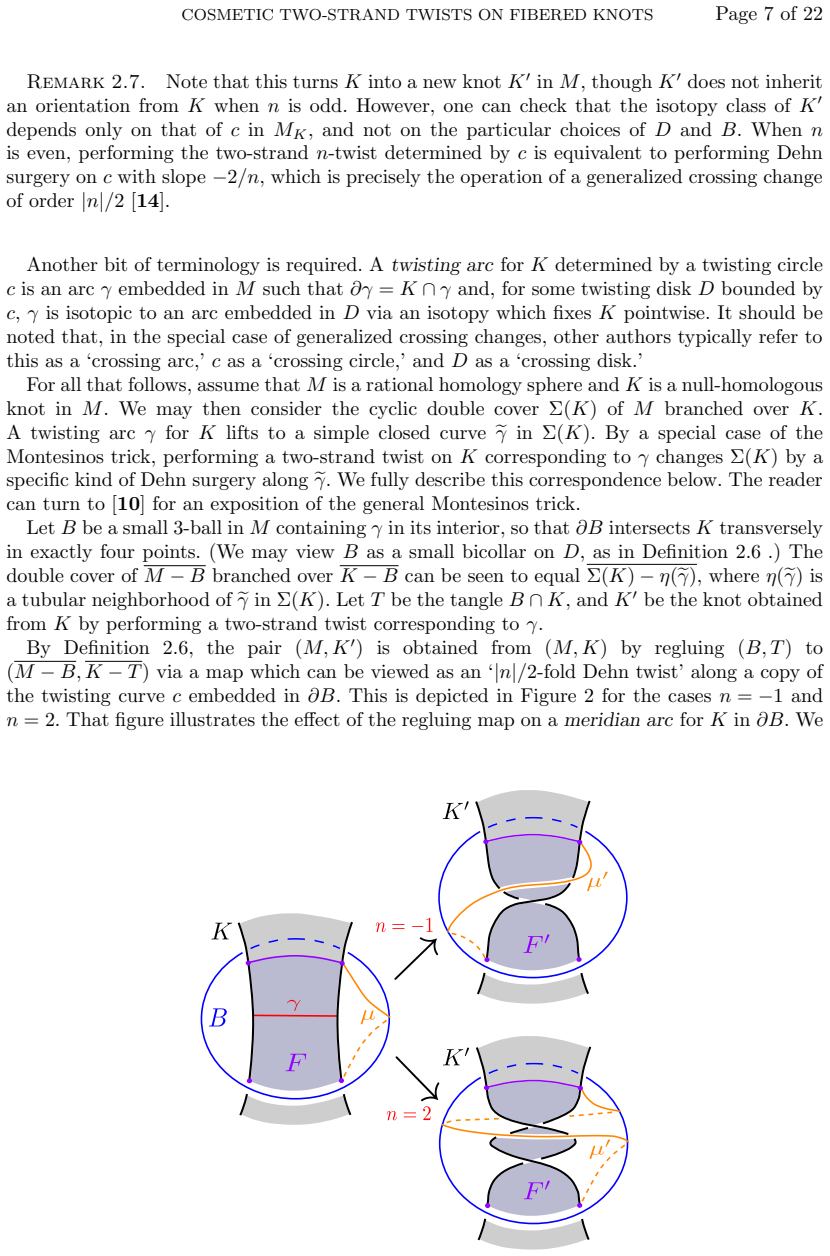
The central object is the two-strand n-twist: a local modification inside a 3-ball that adds |n| half-twists to two oppositely oriented strands of a knot, specified by an unknotted twisting circle c and a twisting arc γ. Its key feature is the Montesinos correspondence: in the double cover of the ambient manifold branched along K, the arc γ lifts to a simple closed curve ~γ, and the two-strand n-twist becomes Dehn surgery along ~γ with slope 1/n in the surface framing. The proof's load-bearing identity is Theorem 3.4: when the twist transforms one fiber surface into another, the squared monodromies of the two fibered knots differ by the n-th power of a Dehn twist along a curve α isotopic to ~γ, up to conjugation in the mapping class group. If the two knots are isotopic, that power of a Dehn twist becomes a commutator, so a non-commutator theorem for powers of Dehn twists forces α, and hence the lifted arc, to be trivial. For |n|≥2 Proposition 2.9 converts this into nugatority; for n=±1 the same correspondence yields only the weaker notion of weakly nugatory, which the paper defines and uses to prove Theorem 1.4.
What would settle it
Find a fibered knot in a rational homology sphere together with a non-nugatory twisting circle for which an even-order two-strand twist returns an isotopic knot; that single example would falsify Theorem 1.2, while a search of small fibered knots could turn it up or lend support.
Extended reading notes
Core claim
On the paper's own terms, the central discovery is that fiberedness imposes a rigid algebraic constraint on any two-strand twist that could secretly preserve the knot. The proof passes to the double cover of M branched over K, where the lifted twisting arc is a knot that undergoes Dehn surgery of slope 1/n. By analyzing the monodromies of the two fibered knots, the paper derives that the n-th power of a Dehn twist along the lifted arc must be a commutator in the mapping class group of the fiber surface; a known non-commutator theorem then forces that arc to be unknotted, and a Montesinos-trick argument converts this into nugatority when |n|≥2. This yields Theorem 1.2 (no cosmetic generalized crossing changes on fibered knots in rational homology spheres) and Theorem 1.3 (under the separating-arc hypothesis, a cosmetic twist must have order ±1, and at most one of the two signs can occur). The order-one case falls outside this argument, and the paper shows by example that it genuinely behaves differently, proving instead via double branched covers that every cosmetic band surgery on the unknot is weakly nugatory (Theorem 1.4).
Load-bearing premise
Everything rests on transferring a closed-surface algebraic fact to surfaces with boundary: a nonzero power of a Dehn twist about a non-trivial curve in a punctured surface cannot equal a commutator, and if that transfer fails the main theorems lose their final step.
Editorial extensions
If this is right
- The generalized cosmetic crossing conjecture—no non-nugatory crossing change can preserve a knot—now holds for every fibered knot in a rational homology sphere, not just in the 3-sphere.
- For a fibered knot satisfying the separating-arc hypothesis, a two-strand twist of order greater than one cannot be cosmetic; the only possible cosmetic orders are -1 and 1, and at most one of those two twists can be cosmetic.
- Every non-coherent band surgery on the unknot that returns an unknot is weakly nugatory, so the unknot admits no genuinely exotic cosmetic band surgery.
- When an even-order twist preserves a fibered knot, the lifted twisting arc must be unknotted in the double branched cover, giving a concrete and checkable obstruction.
- Odd-order twists behave differently from even-order ones: cosmetic examples exist on the unknot and the figure-eight knot, so the separating hypothesis in Theorem 1.3 cannot simply be dropped.
Reading between the lines
- This suggests a sharp test for Question 4.7: a non-weakly-nugatory cosmetic band surgery on any knot would have to be one whose lifted twisting arc is knotted in the double branched cover, since Proposition 4.6 classifies the unknotted-lift case.
- One could extend the monodromy-difference analysis to other fibered knots in the order-one case: the discrepancy between squared monodromies is then a product of Dehn twists of mixed signs, and any tool that bounds its commutator length would fill the gap the paper leaves open.
- The connect-sum construction spreading the unknot example to every knot means that a large family of 'non-trivial' cosmetic band surgeries degenerates to weakly nugatory; genuinely exotic examples, if any exist, must be sought among knots whose double branched covers are not the 3-sphere.
- An algorithmic computation in small mapping class groups—checking which powers of Dehn twists on once-punctured surfaces are commutators—would test the extension step behind Theorems 1.2 and 1.3 directly and independently of the 3-manifold arguments.
Signed reviews
Editorial analysis
A structured set of objections, weighed in public.
Referee Report
Summary. This paper studies cosmetic two-strand twists on knots in rational homology spheres, generalizing generalized crossing changes and non-coherent band surgery. The main results are Theorem 1.2, stating that fibered knots in rational homology spheres admit no cosmetic generalized crossing changes, and Theorem 1.3, stating that under a separating-arc hypothesis a two-strand twist can be cosmetic only for n=±1 and at most once. The proofs pass to the double branched cover and combine Ni's classification of Dehn surgeries on product manifolds, Gabai's taut surface theorem, and Kotschick's commutator obstruction, with the technical core in Theorem 3.4. The second half introduces the notion of weakly nugatory two-strand twists, shows that a cosmetic order-one twist on the unknot must be weakly nugatory (Theorem 1.4), and discusses examples showing that the hypotheses of Theorem 1.3 are sharp.
Significance. The paper is a substantial contribution to the study of cosmetic surgeries and crossing changes. If the results hold, Theorem 1.2 resolves the generalized cosmetic crossing conjecture for all fibered knots in rational homology spheres, generalizing Kalfagianni's result for S^3. Theorem 1.3 is a new and sharp restriction on odd-order twists, and the examples make it clear that the separating hypothesis is necessary. The introduction of weakly nugatory twists and the proof that cosmetic band surgery on the unknot is weakly nugatory answer a natural question left open by prior work. The proofs are well-structured and rely on deep external theorems, and the paper is transparent about the limitations of its methods (see Section 4.3 and the discussion after Theorem 1.4).
major comments (1)
- [2.2, Corollary 2.4] The proof of Corollary 2.4 is incomplete in a load-bearing way. After capping S to obtain a closed surface Ŝ and applying Theorem 2.3, the proof asserts 'Since α is such a curve' (meaning separating) without having established that α is separating. The needed observation is that a curve that is null-homotopic in a closed orientable surface is separating, and that attaching once-punctured tori along the boundary of S preserves the separation property of a curve in Int(S); without this, the conclusion that α bounds a disk in S does not follow. In addition, Theorem 2.3 applies only when the capped surface has genus at least 2, so the case where S is a disk (where Ŝ is a torus) requires a separate argument. This gap is the final step in the proofs of Theorems 1.2 and 1.3, so it must be repaired.
minor comments (4)
- [4.2, statement of Theorem 1.4] The heading 'Theorem 1.3 1.' should read 'Theorem 1.4'.
- [Definition 4.4] The phrase 'c′ intersectsc' should be 'c′ intersects c'.
- [4.2, proof of Proposition 4.6] The equality μ′ = μ ± λ is asserted without explaining that it follows from Δ(μ′, λ) = 1, which was established in the proof of Proposition 2.9; a brief justification would improve clarity.
- [3, proof of Theorem 1.3] The statement that 'the two-strand −1 and 1-twists determined by the same twisting circle are related by a standard crossing change' is terse; it is the 2-twist on either knot that is the crossing change, and spelling this out would aid the reader.
Circularity Check
No significant circularity: the proofs reduce to external theorems and explicit constructions, not to their own conclusions.
full rationale
The paper's derivation chain is self-contained against external results and does not fit parameters or rename targets as predictions. Theorem 1.2 and Theorem 1.3 are proved by combining the Montesinos trick, Gabai's taut-surface result, Ni's classification of Dehn surgeries in product manifolds, Kotschick's commutator-length theorem (as extended by Kalfagianni), and the uniqueness of fiber surfaces. The final step invokes Corollary 2.4 to convert a commutator equation into triviality of a curve, then Proposition 2.9 to upgrade unknottedness to nugatory; neither of these assumes the desired theorem. The notion 'weakly nugatory' is introduced as a classification device after the main theorems, and Theorem 1.4 is established from Gordon-Luecke plus Proposition 4.6 rather than being baked into a definition. The examples of Section 4.1 are explicit diagrams used to show that hypotheses cannot be removed, not predictions obtained from the theorems. The only load-bearing soft spot is the compressed inference in Corollary 2.4 that a curve bounding a disk in the capped surface must already bound a disk in the original surface; this is a missing topological justification, not a circular step, and it does not amount to assuming the conclusion. No self-citation chain supplies the central claim. Accordingly, the paper warrants a circularity score of 0.
Assumptions & free parameters
assumptions (6)
- standard math Equivalence of minimum genus, fiber surface, and isotopy for null-homologous knots in rational homology spheres (Proposition 2.1, built from Kobayashi [16] and Waldhausen [24]).
- standard math Montesinos trick correspondence: a two-strand n-twist lifts to Dehn surgery along the lifted twisting arc with slope 1/n in the surface framing (Lemma 2.8, refining Lidman-Moore [18]).
- standard math Ni's classification of Dehn surgeries on knots in product manifolds (Theorem 2.5 of [20]).
- standard math Kotschick's result, as used by Kalfagianni: powers of Dehn twists along nontrivial curves are not commutators in mapping class groups of closed surfaces of genus at least 2 (Theorem 2.3 of [14], from [17]).
- standard math Gabai's taut surface theorem: at most one filling slope can make a taut surface fail to be taut (Corollary 2.4 of [7]).
- standard math Gordon-Luecke theorem: knots in S3 are determined by their complements (Theorem 2 of [11]).
Cite this review
Pith. "Pith review of Cosmetic two-strand twists on fibered knots." pith.science (2026). https://pith.science/paper/D6P67C2M
@misc{pith2026190805701,
  author       = {Pith},
  title        = {Pith review of: Cosmetic two-strand twists on fibered knots},
  year         = {2026},
  howpublished = {\url{https://pith.science/paper/D6P67C2M}},
  note         = {Machine review of arXiv:1908.05701}
}
abstract
Let $K$ be a knot in a rational homology sphere $M$. This paper investigates the question of when modifying $K$ by adding $m>0$ half-twists to two oppositely-oriented strands, while keeping the rest of $K$ fixed, produces a knot isotopic to $K$. Such a two-strand twist of order $m$, as we define it, is a generalized crossing change when $m$ is even and a non-coherent band surgery when $m=1$. A cosmetic two-strand twist on $K$ is a non-nugatory one that produces an isotopic knot. We prove that fibered knots in $M$ admit no cosmetic generalized crossing changes. Further, we show that if $K$ is fibered, then a two-strand twist of odd order $m$ that is determined by a separating arc in a fiber surface for $K$ can only be cosmetic if $m=\pm 1$. After proving these theorems, we further investigate cosmetic two-strand twists of odd orders. Through two examples, we find that the second theorem above becomes false if `separating' is removed, and that a key technical proposition fails when the order equals 1. A closer look at an order-one example, an instance of cosmetic band surgery on the unknot, reveals it to be nearly trivial in a sense that we name `weakly nugatory'. We correct the technical proposition to obtain a means of using double branched covers to show that certain band surgeries are weakly nugatory. As an application, we prove that every cosmetic band surgery on the unknot is of this type.
Figures


Figures from the paper (8 more)


Reference graph
Works this paper leans on
-
[1]
C. Balm, S. Friedl, E. Kalfagianni, and M. Powell , Cosmetic crossings and Seifert matrices , Comm. Anal. Geom., 20 (2012), pp. 235–253
work page 2012
-
[2]
C. J. Balm and E. Kalfagianni, Knots without cosmetic crossings, Topology Appl., 207 (2016), pp. 33–42
work page 2016
-
[3]
D. Buck, K. Ishihara, M. Rathbun, and K. Shimokawa , Band surgeries and crossing changes between fibered links, J. Lond. Math. Soc., 94 (2016), pp. 557–582
work page 2016
-
[4]
G. Burde and H. Zieschang, Knots, de Gruyter Studies in Mathematics, Walter de Gruyter, Berlin, New York, 2003
work page 2003
-
[5]
A. L. Edmonds, A topological proof of the equivariant dehn lemma, Trans. Amer. Math. Soc., 297 (1986), pp. 605–615
work page 1986
-
[6]
B. Farb and D. Margalit , A Primer on Mapping Class Groups , Princeton University Press, Princeton, NJ, 2012
work page 2012
-
[7]
Gabai, Foliations and the topology of 3-manifolds
D. Gabai, Foliations and the topology of 3-manifolds. II , J. Diff. Geom., 26 (1987), pp. 461–478
work page 1987
-
[8]
Gonz´alez-Acuna, Open books , Lecture notes, University of Iowa, (1975)
F. Gonz´alez-Acuna, Open books , Lecture notes, University of Iowa, (1975)
work page 1975
Show all 24 references
-
[9]
C. M. Gordon, Knots whose branched cyclic coverings have periodic homology, Trans. Amer. Math. Soc., 168 (1972), pp. 357–370
1972
-
[10]
Ser., 15 (2009), pp
, Dehn surgery and 3-manifolds , Low dimensional topology, IAS/Park City Math. Ser., 15 (2009), pp. 21–71
2009
-
[11]
C. M. Gordon and J. Luecke , Knots are determined by their complements , J. Amer. Math. Soc., 2 (1989), pp. 371–415
1989
-
[12]
Ichihara, I
K. Ichihara, I. D. Jong, and H. Masai, Cosmetic banding on knots and links, Osaka J. Math, 55 (2018), pp. 731–745
2018
-
[13]
Jang, X.-S
B. Jang, X.-S. Lin, S. Wang, and Y.-Q. Wu , Achirality of knots and links , Topol. Appl., 119 (2002), pp. 185–208
2002
-
[14]
Kalfagianni, Cosmetic crossing changes of fibered knots, J
E. Kalfagianni, Cosmetic crossing changes of fibered knots, J. Reine Angew. Math., 669 (2012), pp. 151– 164. Page 22 of 22 COSMETIC TWO-STRAND TWISTS ON FIBERED KNOTS
2012
-
[15]
Kirby, Problems in low dimensional manifold theory , in Algebraic and Geometric Topology, Part 2, Proc
R. Kirby, Problems in low dimensional manifold theory , in Algebraic and Geometric Topology, Part 2, Proc. Sympos. Pure Math., vol. XXXII, Providence, RI, 1978, Amer. Math. Soc., pp. 273–312
1978
-
[16]
Kobayashi, Fibered links and unknotting operations, Osaka Journal of Mathematics, 26 (1989), pp
T. Kobayashi, Fibered links and unknotting operations, Osaka Journal of Mathematics, 26 (1989), pp. 699– 742
1989
-
[17]
Kotschick, Quasi-homomorphisms and stable lengths in mapping class groups , Proc
D. Kotschick, Quasi-homomorphisms and stable lengths in mapping class groups , Proc. Amer. Math. Soc., 132 (2004), pp. 3167–3175
2004
-
[18]
Lidman and A
T. Lidman and A. Moore , Cosmetic surgery in L-spaces and nugatory crossings , Trans. Amer. Math. Soc., 369 (2017), pp. 3639–3654
2017
-
[19]
A. H. Moore and M. Vazquez, Recent advances on the non-coherent band surgery model for site-specific recombination, arXiv:1810.0875, (2018)
2018
-
[20]
Ni, Dehn surgeries on knots in product manifolds , J
Y. Ni, Dehn surgeries on knots in product manifolds , J. Topol., 4 (2011), pp. 799–816
2011
-
[21]
Rolfsen, Knots and links, vol
D. Rolfsen, Knots and links, vol. 346, Amer. Math. Soc., Providence, RI, 2003
2003
-
[22]
Schultens, Introduction to 3-manifolds , vol
J. Schultens, Introduction to 3-manifolds , vol. 151 of Graduate Studies in Mathematics, Amer. Math. Soc., 2014
2014
-
[23]
Torisu, On nugatory crossings for knots , Topology App., 92 (1999), pp
I. Torisu, On nugatory crossings for knots , Topology App., 92 (1999), pp. 119–129
1999
-
[24]
Waldhausen, On irreducible 3-manifolds which are sufficiently large, Ann
F. Waldhausen, On irreducible 3-manifolds which are sufficiently large, Ann. of Math., 87 (1968), pp. 56– 88
1968
Reviewed August 14, 2026 · model on record in the stance chip above.
Discussion (0). Continue with ORCID to comment.