REVIEW 2 major objections 3 minor 1 cited by
Momentum-Dependent Spin Splitting by Collinear Antiferromagnetic Ordering
T0 review · 2 major / 3 minor · reviewed 2026-08-14 · deepseek-v4-flash
Pith's one-line read Collinear antiferromagnetic order alone can generate momentum-dependent spin splitting without atomic spin-orbit coupling.
desk verdict Useful symmetry classification of spin splitting in collinear AFMs without SOC, but the central 'necessary condition' is only necessary: bipartite lattices with odd hoppings satisfy it and still show no splitting, so the 32-point-group tables need a caveat. read the letter →
The pith
A machine-rendered reading of the paper's core claim, the machinery that carries it, and where it could break.
The reading
What carries the argument
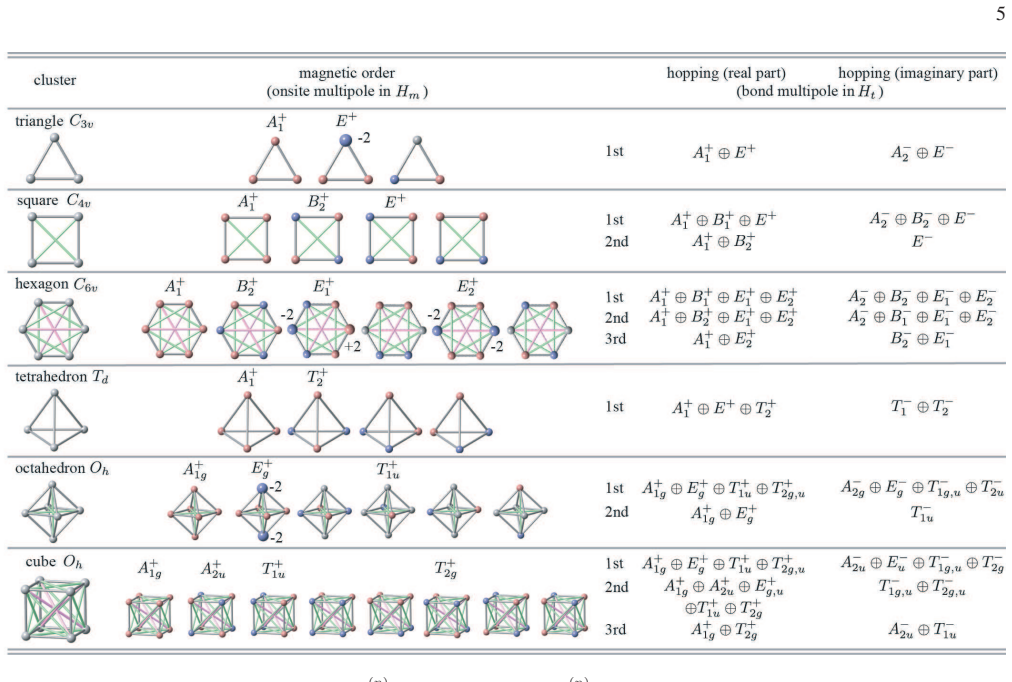
The load-bearing mechanism is the microscopic multipole decomposition of a tight-binding Hamiltonian on a cluster of magnetic sites. The ordered moments are represented by onsite electric multipoles $Q^{(0)}_{\Gamma\gamma}$ (with Pauli-matrix products $\rho_\mu,\tau_\nu$ encoding the sublattice degrees of freedom), and the kinetic part by wave-vector-dependent bond multipoles $Q^{(n)}_{\Gamma\gamma}(\mathbf{k})$ of the $n$-th neighbor hopping plus magnetic toroidal multipoles $T^{(n)}_{\Gamma\gamma}(\mathbf{k})$ (odd-parity, time-reversal-odd bond objects). Because interactions in the Hamiltonian couple only objects in the same irreducible representation, the multiplication of bond multipoles effectively generates the conjugate field of the ordering multipole; Appendix B shows, for the tetragonal model, how products of toroidal hopping terms produce an effective quadrupole $\tilde{Q}^{(0)}_{xy}$ of order $k_xk_y$ even when no direct quadrupole hopping exists. The classification tables for 32 point groups then list which ordering irreps activate which symmetric spin-splitting polynomials, up to sixth order in $\mathbf{k}$.
What would settle it
Take any collinear antiferromagnet with negligible atomic spin-orbit coupling and a known ordered multipole $Q^{(0)}_{\Gamma\gamma}$; compute the tight-binding hopping multipoles of its crystal structure and compare irreducible representations. If the condition predicts a splitting of a given form (say $k_xk_y\sigma$) but spin-resolved angle-resolved photoemission or quantum-oscillation measurements show no such even-in-$\mathbf{k}$ spin splitting, the central claim fails; conversely, observing spin splitting in a collinear antiferromagnet whose hopping multipoles do not share an irrep with the order would also disprove it.
Extended reading notes
Core claim
The central claim is that spin-split bands can appear in collinear antiferromagnets even when atomic spin-orbit coupling is negligible and the Hamiltonian has exact SU(2) spin-rotation symmetry. In that limit, time reversal combined with a spin rotation enforces $\varepsilon_\sigma(\mathbf{k})=\varepsilon_\sigma(-\mathbf{k})$, so the only possible spin splitting is symmetric in $\mathbf{k}$, expressed by even-parity electric multipoles in momentum space: $\varepsilon_\sigma(\mathbf{k})=\sum_{\Gamma\gamma}X_{\Gamma\gamma}Q_{\Gamma\gamma}(\mathbf{k})\sigma$. The paper identifies the microscopic condition for a nonzero anisotropic field $X_{\Gamma\gamma}$: in a cluster tight-binding model, the hopping part contains bond multipoles $Q^{(n)}_{\Gamma\gamma}(\mathbf{k})$ and magnetic toroidal multipoles $T^{(n)}_{\Gamma\gamma}(\mathbf{k})$, and the collinear order creates an onsite mean-field multipole $Q^{(0)}_{\Gamma\gamma}$; when a hopping multipole, or a higher-order product of toroidal multipoles, transforms as the same irreducible representation of the point group as the mean-field multipole, the order activates a k-dependent spin splitting of the form $Q_{\Gamma\gamma}(\mathbf{k})\sigma$. The argument is demonstrated in four-sublattice pyrochlore and tetragonal models and then organized into a classification of the allowed second-, fourth-, and sixth-order spin-splitting forms under all 32 crystallographic point groups.
Load-bearing premise
The argument assumes atomic spin-orbit coupling is weak enough to ignore, so the only spin splitting that can appear under collinear order is symmetric in momentum; if spin-orbit coupling is not negligible, extra antisymmetric terms appear and the classification is incomplete.
Editorial extensions
If this is right
- Collinear antiferromagnets with weak atomic spin-orbit coupling can exhibit spin-split Fermi surfaces in zero field, with the splitting even in momentum (for example proportional to $k_xk_y\sigma$).
- The symmetric spin-split dispersion produces a symmetric spin conductivity tensor, so an electric current or temperature gradient can generate a pure spin current along the ordered-moment direction without atomic spin-orbit coupling.
- A shear strain can induce a uniform magnetization in the direction of the collinear antiferromagnetic order, realizing a piezomagnetic (magnetostriction) response.
- The 32-point-group classification lists which collinear antiferromagnetic ordering patterns activate which spin-splitting forms, providing a direct guide for searching candidate materials among light-element and 3d transition-metal compounds.
- In strictly bipartite lattices, chiral symmetry forbids the spin splitting, so the effect requires multisublattice clusters or hoppings that break the bipartite condition.
Reading between the lines
- Inference: the irreducible-representation match can be used as a quick computational screen: for any candidate collinear antiferromagnet, compare the irrep of the ordered-moment multipole with the irreps of its hopping multipoles, and only systems with a match need be examined in detail.
- Inference: because the splitting scale from the perturbation analysis is roughly $(t^{(1)})^2/h$, materials with large inter-site hopping and moderate exchange constants should show the effect most strongly; selecting for that ratio, rather than for heavy elements, is a testable material-design rule.
- Inference: if spin currents generated this way have a well-defined spin quantization axis (the ordered moment), then antiferromagnetic spintronic devices based on these materials could avoid the spin-relaxation channels associated with atomic spin-orbit coupling; the paper notes the current is well-defined but does not develop the device consequence.
Signed reviews
Editorial analysis
A structured set of objections, weighed in public.
Referee Report
Summary. The manuscript develops a multipole-based symmetry analysis of momentum-dependent spin splitting in collinear antiferromagnets without atomic spin-orbit coupling. After establishing that spin-rotation symmetry restricts the splitting to even-in-k (symmetric) forms, the authors show in two tight-binding models (pyrochlore and tetragonal) that a collinear AFM mean field can generate such a splitting via hopping multipoles in the same irreducible representation. They then propose a classification of second- and higher-order spin-splitting types for the 32 crystallographic point groups and discuss consequences for spin-current generation and piezomagnetic responses.
Significance. The paper is potentially useful and, for the worked examples, clean: the pyrochlore and tetragonal band calculations are explicit, Appendix A gives a simple proof of the chiral-symmetry exclusion, and the multipole tables are a convenient reference. The central idea—that anisotropic hopping combined with collinear AFM order can mimic spin-orbit coupling—is timely and relevant. The main weakness is that the general point-group tables are presented as a correspondence between ordering irrep and spin splitting without incorporating the bipartite chiral-symmetry exclusion demonstrated in the authors' own Appendix A; as a result the tables can overpredict spin splitting for important material classes.
major comments (2)
- [Sec. III B; Appendix A; Tables V and VI] The condition stated in Sec. III B ('the hopping matrix ... belongs to the same irrep. Γ of the MF multipole') is presented as the necessary condition, and the paper is careful to call it necessary; nevertheless the surrounding presentation and Tables V and VI invite a sufficiency reading, and the authors' own example shows the condition is not sufficient. In the tetragonal model with t^(2)_a = t^(2)_b = 0 and finite t^(1)_b, Table IV gives T_x^(1b)T_y^(1b) ~ sin k_x sin k_y, which is B2 under C4v, the same irrep as h_xy; yet Fig. 2(d) shows spin-degenerate bands. Appendix A proves the general reason: any bipartite lattice with opposite sublattice spin polarization has chiral symmetry and hence no spin splitting. Tables V and VI list the multipole/irrep combinations that give spin-split forms without encoding this bipartite exclusion. Consequently the classification overpredicts for bipartite materials, including several in the candidate list (MnF2, FeBO3). Please amend the tables and text to state explicitly that the irrep condition is not sufficient, and incorporate the chiral-symmetry exclusion into the general classification.
- [Sec. III C] Section III C introduces Tables V and VI with 'Similar analysis can be straightforwardly extended to any other point groups' and does not provide the derivation or a proof that the listed irreps are actually associated with nonzero spin splitting in a lattice model. Since the irrep condition is only necessary, the tables cannot be read as a constructive classification without additional conditions. I request either a derivation of the tables (or a reference to a complete derivation), or an explicit statement of the assumptions under which the SS column is realized, together with the bipartite caveat.
minor comments (3)
- [Sec. III B] The text 'Sec. ??he discussion is generalized' appears to be a typesetting error; it should likely read 'Sec. III C.'
- [Appendix B] Equations (B9) and (B10) contain denominators such as Q'^(1)_0(k) and [Q'^(1)_0(k) ± Q^(2)_0(k)]^2; the validity of the perturbative expansion at parameter values where these vanish should be stated.
- [Tables V and VI] The caption should define the SS column explicitly as the form of ε_σ(k) − ε_{−σ}(k) for a given irrep, and note that it lists allowed forms, not guaranteed splittings.
Circularity Check
No significant circularity: the selection rule is a group-theoretic condition verified by explicit tight-binding models, not an input fitted to the predicted outcome.
full rationale
The paper's central result is a symmetry condition: for a collinear AFM with negligible SOC, a k-dependent spin splitting of the form Q(k)sigma appears only when a hopping multipole or a product of hopping multipoles shares the irrep of the mean-field multipole Q^(0). This is not a tautology. It is derived by explicitly decomposing the tight-binding Hamiltonians for the pyrochlore and tetragonal models (Eqs. (2)-(5)) into multipole operators and then computing the band structures, e.g., the kxky sigma splitting in Fig. 2(d). The perturbative derivation in Appendix B (Eqs. (B9)-(B12)) independently shows how Q^(2)_xy(k) or products T_x T_y generate the effective quadrupole coupling, without assuming the conclusion. No parameter is fitted to the claimed spin splitting; hopping amplitudes and mean fields are chosen as inputs and the dispersion is calculated. The multipole basis is taken from the authors' earlier group-theoretic work (Refs. 34-36, 38), but that is a parameter-free classification, and the present paper's own explicit examples are self-contained. The paper even states a limitation in Appendix A: in bipartite systems, chiral symmetry forbids spin splitting even when the same-irrep condition is satisfied, which shows the condition is genuinely necessary rather than sufficient and is not a renamed restatement of the answer. Therefore no circular step can be exhibited with the paper's equations; the classification's possible overprediction for bipartite lattices is a correctness concern, not circularity.
Assumptions & free parameters
assumptions (3)
- domain assumption The electronic Hamiltonian has SU(2) spin-rotation symmetry because atomic spin-orbit coupling is negligible.
- domain assumption The antiferromagnetic order is represented by a local mean-field potential Hm proportional to spin σ, with no spin-dependent hopping.
- standard math The multipole expansion of the hopping matrix into bond multipoles Q(n)Γγ(k) and T(n)Γγ(k) is complete for the symmetry analysis.
Cite this review
Pith. "Pith review of Momentum-Dependent Spin Splitting by Collinear Antiferromagnetic Ordering." pith.science (2026). https://pith.science/paper/D6Q7C5FR
@misc{pith2026190808680,
  author       = {Pith},
  title        = {Pith review of: Momentum-Dependent Spin Splitting by Collinear Antiferromagnetic Ordering},
  year         = {2026},
  howpublished = {\url{https://pith.science/paper/D6Q7C5FR}},
  note         = {Machine review of arXiv:1908.08680}
}
abstract
We clarify the macroscopic symmetry and microscopic model-parameter conditions for emergence of spin-split electronic band structure in collinear antiferromagnets without atomic spin-orbit coupling. By using the microscopic multipole descriptions, we elucidate the fundamental degree of freedom in a cluster unit of an antiferromagnet giving rise to an effective spin-orbit interaction through the anisotropic kinetic motions of electrons. We show a correspondence of the ordering patterns and resultant momentum-dependent spin splitting for 32 crystallographic point groups after demonstrating two intuitive examples of four-sublattice pyrochlore and tetragonal systems. Our study unveils potential features of collinear antiferromagnets with considerably weak spin-orbit coupling in light-element materials and 3$d$ transition metal oxides, which can be utilized for a spin-current generation by electric (thermal) current and a magneto-striction effect.
Figures

Forward citations
Cited by 1 Pith paper
-
Symmetry, microscopy and spectroscopy signatures of altermagnetism
A review of the symmetry, microscopic origin, and detection of altermagnetism, a collinear magnetic phase with alternating spin polarization in momentum space.
Reference graph
Works this paper leans on
-
[1]
author T. Kimura , author T. Goto , author H. Shintani , author K. Ishizaka , author T. Arima , and author Y. Tokura , journal Nature volume 426 , pages 55 ( year 2003 )
work page 2003
-
[2]
author M. Fiebig , journal J. Phys. D: Appl. Phys. volume 38 , pages R123 ( year 2005 )
work page 2005
-
[3]
Khomskii , journal Physics volume 2 , pages 20 ( year 2009 )
author D. Khomskii , journal Physics volume 2 , pages 20 ( year 2009 )
work page 2009
-
[4]
author J. E. Hirsch , journal Phys. Rev. Lett. volume 83 , pages 1834 ( year 1999 )
work page 1999
-
[5]
author J. Sinova , author D. Culcer , author Q. Niu , author N. A. Sinitsyn , author T. Jungwirth , and author A. H. MacDonald , journal Phys. Rev. Lett. volume 92 , pages 126603 ( year 2004 )
work page 2004
-
[6]
author B. A. Bernevig , author T. L. Hughes , and author S.-C. Zhang , journal Science volume 314 , pages 1757 ( year 2006 )
work page 2006
-
[7]
author J. Sinova , author S. O. Valenzuela , author J. Wunderlich , author C. H. Back , and author T. Jungwirth , journal Rev. Mod. Phys. volume 87 , pages 1213 ( year 2015 )
work page 2015
-
[8]
author F. Herman , author C. D. Kuglin , author K. F. Cuff , and author R. L. Kortum , journal Phys. Rev. Lett. volume 11 , pages 541 ( year 1963 )
work page 1963
Show all 54 references
-
[9]
Levitov , author Y
author L. Levitov , author Y. V. Nazarov , and author G. Eliashberg , journal Sov. Phys. JETP volume 61 , pages 133 ( year 1985 )
1985
-
[10]
Fujimoto , journal Phys
author S. Fujimoto , journal Phys. Rev. B volume 72 , pages 024515 ( year 2005 )
2005
-
[11]
Orenstein and author J
author J. Orenstein and author J. E. Moore , journal Phys. Rev. B volume 87 , pages 165110 ( year 2013 )
2013
-
[12]
Hayami , author H
author S. Hayami , author H. Kusunose , and author Y. Motome , journal Phys. Rev. B volume 90 , pages 024432 ( year 2014 )
2014
-
[13]
Yoda , author T
author T. Yoda , author T. Yokoyama , and author S. Murakami , journal Sci. Rep. volume 5 , pages 12024 ( year 2015 )
2015
-
[14]
Fu , journal Phys
author L. Fu , journal Phys. Rev. Lett. volume 115 , pages 026401 ( year 2015 )
2015
-
[15]
Zhong , author J
author S. Zhong , author J. E. Moore , and author I. Souza , journal Phys. Rev. Lett. volume 116 , pages 077201 ( year 2016 )
2016
-
[16]
Jungwirth , author X
author T. Jungwirth , author X. Marti , author P. Wadley , and author J. Wunderlich , journal Nat. Nanotech. volume 11 , pages 231 ( year 2016 )
2016
-
[17]
Baltz , author A
author V. Baltz , author A. Manchon , author M. Tsoi , author T. Moriyama , author T. Ono , and author Y. Tserkovnyak , journal Rev. Mod. Phys. volume 90 , pages 015005 ( year 2018 )
2018
-
[18]
S mejkal , author R
author L. S mejkal , author R. Gonz \'a lez-Hern \'a ndez , author T. Jungwirth , and author J. Sinova , journal arXiv:1901.00445 ( year 2019 )
1901 arXiv
-
[19]
Suzuki , author T
author M.-T. Suzuki , author T. Koretsune , author M. Ochi , and author R. Arita , journal Phys. Rev. B volume 95 , pages 094406 ( year 2017 )
2017
-
[20]
Li , author A
author X. Li , author A. H. MacDonald , and author H. Chen , journal arXiv:1902.10650 ( year 2019 )
1902 arXiv
-
[21]
Hitomi and author Y
author T. Hitomi and author Y. Yanase , journal J. Phys. Soc. Jpn. volume 85 , pages 124702 ( year 2016 )
2016
-
[22]
Ishitobi and author K
author T. Ishitobi and author K. Hattori , journal J. Phys. Soc. Jpn. volume 88 , pages 063708 ( year 2019 )
2019
-
[23]
Hayami , author H
author S. Hayami , author H. Kusunose , and author Y. Motome , journal J. Phys.: Condens. Matter volume 28 , pages 395601 ( year 2016 )
2016
-
[24]
Th \"o le and author N
author F. Th \"o le and author N. A. Spaldin , journal Philos. Trans. R. Soc. A volume 376 , pages 20170450 ( year 2018 )
2018
-
[25]
Di Matteo and author M
author S. Di Matteo and author M. R. Norman , journal Phys. Rev. B volume 96 , pages 115156 ( year 2017 )
2017
-
[26]
Hayami , author Y
author S. Hayami , author Y. Yanagi , author H. Kusunose , and author Y. Motome , journal Phys. Rev. Lett. volume 122 , pages 147602 ( year 2019 )
2019
-
[27]
Massarelli , author B
author G. Massarelli , author B. Wu , and author A. Paramekanti , journal arXiv:1904.04280 ( year 2019 )
1904 arXiv
-
[28]
Naka , author S
author M. Naka , author S. Hayami , author H. Kusunose , author Y. Yanagi , author Y. Motome , and author H. Seo , journal arXiv:1902.02506 ( year 2019 )
1902 arXiv
-
[29]
Dresselhaus , journal Phys
author G. Dresselhaus , journal Phys. Rev. volume 100 , pages 580 ( year 1955 )
1955
-
[30]
author E. I. Rashba , journal Sov. Phys. Solid State volume 2 , pages 1109 ( year 1960 )
1960
-
[31]
Katsura , author N
author H. Katsura , author N. Nagaosa , and author A. V. Balatsky , journal Phys. Rev. Lett. volume 95 , pages 057205 ( year 2005 )
2005
-
[32]
Tokura and author S
author Y. Tokura and author S. Seki , journal Adv. Mater. volume 22 , pages 1554 ( year 2010 )
2010
-
[33]
Hayami_PhysRevB.98.165110
note The classification of the spin-split band structure in the presence of the SOC is shown in Ref. Hayami_PhysRevB.98.165110
-
[34]
Hayami and author H
author S. Hayami and author H. Kusunose , journal J. Phys. Soc. Jpn. volume 87 , pages 033709 ( year 2018 )
2018
-
[35]
Hayami , author M
author S. Hayami , author M. Yatsushiro , author Y. Yanagi , and author H. Kusunose , journal Phys. Rev. B volume 98 , pages 165110 ( year 2018 )
2018
-
[36]
Watanabe and author Y
author H. Watanabe and author Y. Yanase , journal Phys. Rev. B volume 98 , pages 245129 ( year 2018 )
2018
-
[37]
See also Appendix sec:Effective spin-orbit coupling for different phase conventions
note The phase factor reflecting each sublattice position directly represents the symmetry within a unit cell, although the phase convention is arbitrary. See also Appendix sec:Effective spin-orbit coupling for different phase conventions
-
[38]
Suzuki , author T
author M.-T. Suzuki , author T. Nomoto , author R. Arita , author Y. Yanagi , author S. Hayami , and author H. Kusunose , journal Phys. Rev. B volume 99 , pages 174407 ( year 2019 )
2019
-
[39]
author S. V. Gallego , author J. M. Perez-Mato , author L. Elcoro , author E. S. Tasci , author R. M. Hanson , author K. Momma , author M. I. Aroyo , and author G. Madariaga , journal J. Appl. Crystallogr. volume 49 , pages 1750 ( year 2016 )
2016
-
[40]
author M. V. Lobanov , author M. Greenblatt , author N. C. El’ad , author J. D. Jorgensen , author D. V. Sheptyakov , author B. H. Toby , author C. E. Botez , and author P. W. Stephens , journal J. Phys.: Condens. Matter volume 16 , pages 5339 ( year 2004 )
2004
-
[41]
Gitgeatpong , author Y
author G. Gitgeatpong , author Y. Zhao , author M. Avdeev , author R. O. Piltz , author T. J. Sato , and author K. Matan , journal Phys. Rev. B volume 92 , pages 024423 ( year 2015 )
2015
-
[42]
Moussa , author M
author F. Moussa , author M. Hennion , author J. Rodriguez-Carvajal , author H. Moudden , author L. Pinsard , and author A. Revcolevschi , journal Phys. Rev. B volume 54 , pages 15149 ( year 1996 )
1996
-
[43]
Calder , author V
author S. Calder , author V. O. Garlea , author D. F. McMorrow , author M. D. Lumsden , author M. B. Stone , author J. C. Lang , author J.-W. Kim , author J. A. Schlueter , author Y. G. Shi , author K. Yamaura , et al. , journal Phys. Rev. Lett. volume 108 , pages 257209 ( year 2012 )
2012
-
[44]
Ohgushi , author J.-i
author K. Ohgushi , author J.-i. Yamaura , author H. Ohsumi , author K. Sugimoto , author S. Takeshita , author A. Tokuda , author H. Takagi , author M. Takata , and author T.-h. Arima , journal Phys. Rev. Lett. volume 110 , pages 217212 ( year 2013 )
2013
-
[45]
Solana-Madruga , author A
author E. Solana-Madruga , author A. M. Ar\'evalo-L\'opez , author A. J. Dos santos Garc\' a , author C. Ritter , author C. Cascales , author R. S\'aez-Puche , and author J. P. Attfield , journal Phys. Rev. B volume 97 , pages 134408 ( year 2018 )
2018
-
[46]
Sale , author Q
author M. Sale , author Q. Xia , author M. Avdeev , and author C. D. Ling , journal Inorg. Chem. volume 58 , pages 4164 ( year 2019 )
2019
-
[47]
Xu , author M
author D. Xu , author M. Avdeev , author P. D. Battle , and author X.-Q. Liu , journal Inorg. Chem. volume 56 , pages 2750 ( year 2017 )
2017
-
[48]
Yamani , author Z
author Z. Yamani , author Z. Tun , and author D. Ryan , journal Can. J. Phys. volume 88 , pages 771 ( year 2010 )
2010
-
[49]
Jauch , author M
author W. Jauch , author M. Reehuis , and author A. Schultz , journal Acta Crystallogr. A volume 60 , pages 51 ( year 2004 )
2004
-
[50]
author A. F. May , author Y. Liu , author S. Calder , author D. S. Parker , author T. Pandey , author E. Cakmak , author H. Cao , author J. Yan , and author M. A. McGuire , journal Phys. Rev. B volume 95 , pages 174440 ( year 2017 )
2017
-
[51]
author A. M. Kalashnikova , author A. V. Kimel , author R. V. Pisarev , author V. N. Gridnev , author A. Kirilyuk , and author T. Rasing , journal Phys. Rev. Lett. volume 99 , pages 167205 ( year 2007 )
2007
-
[52]
Jacobs , journal J
author I. Jacobs , journal J. Appl. Phys. volume 34 , pages 1106 ( year 1963 )
1963
-
[53]
Harima , journal J
author H. Harima , journal J. Phys. Chem. Solids volume 63 , pages 1035 ( year 2002 )
2002
-
[54]
Yamaura , author K
author J. Yamaura , author K. Ohgushi , author H. Ohsumi , author T. Hasegawa , author I. Yamauchi , author K. Sugimoto , author S. Takeshita , author A. Tokuda , author M. Takata , author M. Udagawa , et al. , journal Phys. Rev. Lett. volume 108 , pages 247205 ( year 2012 )
2012
Reviewed August 14, 2026 · model on record in the stance chip above.
Discussion (0). Continue with ORCID to comment.