REVIEW 3 major objections 5 minor 3 cited by
Scintillometry of Fast Radio Bursts: Resolution effects in two-screen models
T0 review · 3 major / 5 minor · reviewed 2026-08-15 · deepseek-v4-flash
Pith's one-line read Two scattering screens on an FRB line of sight quench only the broad scintillation, and the suppression is gradual, not a sudden loss of all scintillation.
desk verdict Corrects a common FRB two-screen assumption and gives new analytic results, but the central factorization ansatz is only tested against simulations that share it. read the letter →
The pith
A machine-rendered reading of the paper's core claim, the machinery that carries it, and where it could break.
The reading
What carries the argument
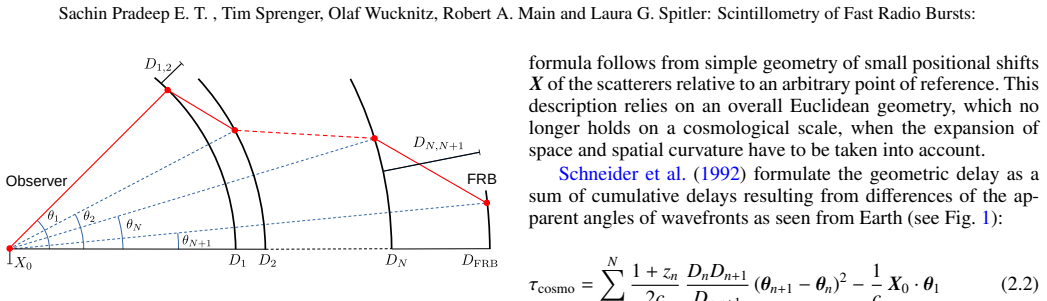
The control parameter is the Resolution Power, $\mathrm{RP}=L_\mathrm{MW}L_\mathrm{host}/(\lambda D_\mathrm{MW,host})$, the ratio of the angular size one screen subtends at the other to the angular resolution of the other screen; $\mathrm{RP}\ll1$ is unresolved, $\mathrm{RP}\gg1$ fully resolved, and it enters directly in the phase of the mixed delay term, determining when the two-screen response factorizes. The other load-bearing object is the factorization of the complex amplitude field, $f(\theta_\mathrm{MW},\theta_\mathrm{host})=f_\mathrm{MW}(\theta_\mathrm{MW})f_\mathrm{host}(\theta_\mathrm{host})$, which through the Isserlis theorem yields the product-form ACF identity $1+\mathrm{ACF}=\prod_n(1+\mathrm{ACF}_n)$ and hence the general modulation index $m=\sqrt{2N-1}$.
What would settle it
Measure the full-spectrum spectral autocorrelation of a burst showing two clearly separated scintillation bandwidths at high signal-to-noise. If the zero-lag ACF peaks at $m^2=3$ with the wide-narrow shape given by $\mathrm{ACF}_\mathrm{MW}\mathrm{ACF}_\mathrm{host}+\mathrm{ACF}_\mathrm{MW}+\mathrm{ACF}_\mathrm{host}$, the two-screen product picture holds; a peak near $m^2=2$ with a simple sum of Lorentzians would contradict it. A second check is to observe whether the broad scintillation bandwidth flattens from a $\nu^4$ scaling toward $\nu^1$ as frequency decreases, with the modulation index dropping from $\sqrt{3}$ toward 1 over the same band.
Extended reading notes
Core claim
The central claim is that two thin scattering screens that do not resolve each other act as statistically independent multiplicative filters on the complex field, $R(\nu)=R_\mathrm{MW}(\nu)R_\mathrm{host}(\nu)$, so the normalized intensity autocorrelation satisfies $1+\mathrm{ACF}=\prod_n(1+\mathrm{ACF}_n)$, giving $\mathrm{ACF}=\mathrm{ACF}_\mathrm{MW}\mathrm{ACF}_\mathrm{host}+\mathrm{ACF}_\mathrm{MW}+\mathrm{ACF}_\mathrm{host}$ and a total modulation index $m=\sqrt{2N-1}$, in particular $m=\sqrt{3}$ for two screens. When the screens do resolve each other, the cross term in the geometric delay involving both screens becomes non-negligible, and the paper shows analytically and in simulations that this gradually broadens and quenches only the broad-scale scintillation, leaving the narrow scintillation intact, with the total modulation index falling from $\sqrt{3}$ toward 1 as the Resolution Power grows. The paper also derives an updated formula for the distance between the FRB and its host-galaxy screen, corrects a redshift factor in a widely used cosmological delay expression, and shows that for one-dimensional elongated screens the resolution effect and the distance estimate depend on the relative orientation of the screens.
Load-bearing premise
The load-bearing premise is that the two screens' complex amplitude fields are statistically independent, $f(\theta_\mathrm{MW},\theta_\mathrm{host})=f_\mathrm{MW}(\theta_\mathrm{MW})f_\mathrm{host}(\theta_\mathrm{host})$, meaning scatterer positions and magnifications on one screen do not depend on the angle of rays arriving from the other; if that coupling is real, the product-form ACF, the $\sqrt{3}$ modulation index, and the unresolved-regime predictions all break down.
Editorial extensions
If this is right
- A burst seen through two unresolved screens should show a total modulation index $m=\sqrt{3}\approx1.73$ at zero ACF lag rather than the single-screen $m=1$; measuring $m>1$ becomes a clean multi-screen diagnostic.
- As the Resolution Power passes through 1, only the broad scintillation is affected: its bandwidth broadens and its modulation drops below 1, while the narrow scintillation keeps its original bandwidth and modulation, so the total modulation index falls from $\sqrt{3}$ toward 1.
- Multi-frequency observations should show the broad scintillation bandwidth scaling as $\nu_s\propto\nu^\alpha$ with $\alpha\approx4$ in the unresolved regime, flattening toward $\alpha\approx1$ as RP grows toward lower frequencies; a screen resolving an incoherent emission region instead gives $\alpha\approx3$.
- The corrected distance formula $D_\mathrm{h,FRB}D_\mathrm{MW}\lesssim(1+z_\mathrm{FRB})D_\mathrm{FRB}^2\,\nu_{s,\mathrm{MW}}/(8\pi\nu^2 m_\mathrm{MW}\tau_{s,\mathrm{h}})$ tightens previous upper limits on how far the host screen can be from the FRB, and earlier formulas should be interpreted as upper limits rather than exact distances.
- For elongated one-dimensional screens, mutual resolution depends on orientation: parallel screens quench broad scintillation while perpendicular screens do not, so distance and size estimates from resolution arguments require two-dimensional or well-aligned screens.
Reading between the lines
- Inference: If the product-plus-sum ACF is confirmed observationally, the common practice of modelling a two-screen spectral ACF as a sum of Lorentzians will systematically overestimate the narrow-screen modulation index; fitting the full product form should replace that approximation.
- Inference: The same factorization logic applies to any smooth spectral structure, such as the intrinsic burst envelope or an unremoved instrumental bandpass, so deviations from $1+\mathrm{ACF}=\prod(1+\mathrm{ACF}_i)$ could serve as a model-independent way to detect unresolved spectral structure in FRB emission itself.
- Inference: Because $\mathrm{RP}\propto\nu^{-3}$ for screens whose angular size scales as $\nu^{-2}$, a single wide-band observation could capture the full unresolved-to-resolved transition within one source, providing a direct probe of screen sizes and distances without multi-epoch monitoring.
- Inference: Applied to pulsars, the paper's conjecture that many mildly anisotropic screens resolving one another can mimic an isotropic scattering screen suggests a population test: pulsars with more distant screens should show more isotropic scattering, an effect that could be checked against existing pulsar scintillation surveys.
Signed reviews
Editorial analysis
A structured set of objections, weighed in public.
Referee Report
Summary. The paper develops a two-screen geometrical-optics model for FRB scintillation and scattering. It defines a Resolution Power (RP) and argues that when one screen resolves the other, only the broader-scale scintillation is quenched and that the quenching is gradual. The main theoretical results are a product form for the spectral ACF in the unresolved regime (Eq. 4.22), a combined modulation index m = sqrt(2N-1) (Eq. 4.26), and a distance-estimation formula (Eq. 7.6). The predictions are tested with a new simulation code, FRB_scintillator, whose random image distributions implement the same factorized screen ansatz. The paper also addresses 1D screens, self-noise, and multi-frequency trends.
Significance. If the central claims hold, the paper usefully corrects the common assumption that a screen resolving another screen is equivalent to resolving an incoherent source, and it provides practical diagnostics for two-screen FRB scintillation. The Isserlis-based derivation of the ACF product term is clean; the simulations reproduce the theoretical Lorentzian scales and the sqrt(3) modulation index in the unresolved regime; and the paper is commendably transparent about finite-image shot noise, Lorentzian-fit biases, and model limitations. The distance formula and the 1D-screen caution are directly usable by observers. However, the factorization assumption is load-bearing for all key predictions and is shared by the simulations, so the external validity of the quantitative claims is not yet established. In addition, the parameter inconsistencies in Section 6 and Table B.1 must be fixed before the simulation comparisons can be assessed.
major comments (3)
- [Section 6.1.1 and Table B.1] The injected parameters used to support the quantitative agreement in the unresolved case are internally inconsistent. Table B.1 lists for the unresolved run D_src=684 Mpc, D_host,src=2 kpc, L_host=20 AU, and tau_s,host / nu_s,host = 19 ms / 8.3 kHz; inserting the first three values into Eq. (4.9) gives tau_s,host about 1.8e-5 s, not 19 ms, and the quoted nu_s,host is also incompatible with Eq. (4.15), which for 19 ms gives about 8 Hz. Section 6.1.1 quotes injected values nu_s,MW about 0.16 MHz and nu_s,host about 250 Hz, while Table B.1 gives nu_s,MW about 0.39 MHz and nu_s,host about 8.3 kHz. Because the central claim that the simulations reproduce the injected scintillation bandwidths rests on these numbers, the table and text must be corrected and the actual parameter set used for the Fig. 8a run stated exactly.
- [Section 3, Eqs. (3.6) and (3.10); Section 4, Eqs. (4.20)-(4.26)] The factorized ansatz f(theta_MW, theta_host) = f_MW(theta_MW) x f_host(theta_host) is load-bearing for the product-form ACF (Eq. 4.21), the m = sqrt(2N-1) result (Eq. 4.26), and the unresolved-regime predictions. The paper explicitly calls the independence of the two screens' positions and magnifications a "crucial approximation" in Section 3, yet the FRB_scintillator simulations use the same ansatz (Eq. 3.10), so the agreement in Sections 6.1-6.3 and Fig. 13 does not test it. Since the field arriving at the second screen is produced by the first screen, the second screen's image properties can in principle depend on theta_MW. I recommend either an independent numerical check, such as a full wave-optics two-phase-screen calculation for one representative configuration, or a clear statement in the abstract and conclusions that all central predictions are conditional on this ansatz.
- [Section 7.2, Eqs. (7.3)-(7.4)] Equations (7.3) and (7.4) are taken from Gwinn et al. (1998), which treats a screen resolving an incoherent extended source, and are then applied to a screen resolving another scattering screen. The paper states that these formulas are supported by the simulations, but those simulations are built on the same factorized, geometrical-optics screen model whose independence assumption is the point at issue. A derivation or at least an explicit physical argument for why the coherent two-screen case should follow the same RP dependence would remove a substantial part of the circularity; without it, the distance formula (Eq. 7.6), which cancels the broadening factor with the modulation index, rests on an empirical fit rather than on a derived relation.
minor comments (5)
- [Section 6.3] The sentence "the host screen scintillation has a fit value of nu_s,MW about 1 kHz" should read nu_s,host.
- [Fig. 16 caption and Section 7.4.1] The Fig. 16 caption states alpha about 2 in the resolved region, while the text reports alpha = 0.9 +/- 0.33 for the highly resolved regime; please reconcile these values.
- [Section 3.1, Eq. (3.12)] With the definition L = 4 theta_L D in Eq. (3.9), the mixed-delay phase at the rms scattering angles is a factor of 16 smaller than the stated 2 pi RP; please clarify which angular size is being inserted.
- [Section 8] Summary item 2 says the completely resolved regime gives m_tot = 1, whereas Section 6.3 reports m_tot about 1.3 for RP about 10; please clarify whether the former is meant as an asymptotic statement.
- [Throughout] There are numerous typographical errors, including "emssion", "nottemporally coherent", "elogated", "shwoing", and "observabels"; a careful proofreading pass is needed.
Circularity Check
No load-bearing circularity: the product-form ACF and sqrt(3) modulation follow from a stated, acknowledged factorization ansatz; simulation agreement is internal consistency, not an independent test of that ansatz.
full rationale
The derivation chain is self-contained rather than circular. The product-form ACF (Eqs. 4.21-4.22) and the m = sqrt(3) result for two unresolved screens (Eq. 4.26) are derived from the stated statistical-independence assumption f(theta_MW, theta_host) = f_MW(theta_MW) x f_host(theta_host) (Eq. 3.6), combined with the Isserlis theorem (Eq. 4.11) and the factorization of the response function (Eq. 4.20). The paper explicitly identifies the independence assumption as 'a crucial approximation' and defers more general models to future work, so the result is honestly conditional rather than smuggled in. The FRB_scintillator simulations implement the same factorized screen model (Eq. 3.10), so agreement between theory and simulation is an internal-consistency check of the code and the mathematics, not an independent empirical test of the ansatz; that shared-assumption caveat is a real limitation but does not make the derivation circular. The resolution-power quenching curves (Eqs. 7.3-7.4) are taken from Gwinn et al. (1998), an external source, and the paper explicitly notes they were derived for an incoherent extended source and found to agree with the simulations; no fitted parameter is renamed as a prediction. Self-citations (Sprenger et al. 2022, Main et al. 2022) supply background and prior building blocks but are not load-bearing uniqueness claims. No step in the paper's argument reduces to its own input by construction.
Assumptions & free parameters
free parameters (5)
- Screen sizes LMW, Lhost =
3.5 to 165 AU depending on simulation (Table B.1)
- Screen distances Dsrc, DMW, Dhost,src =
e.g., 684 Mpc, 1.29-2.3 kpc, 2-4 kpc (Table B.1)
- Number of images per screen =
1000 (87460 simulations in Section 7.2)
- 2-sigma width factor in L = 4 theta_L D =
4
- ACF Lorentzian fit constants (m^2, HWHM, C) =
fitted per simulation
assumptions (7)
- domain assumption Thin-screen, geometric-optics approximation (Williamson 1972)
- domain assumption Frozen, frequency-independent screen images within an observation
- domain assumption Statistical independence of the two screens' complex amplitude fields
- standard math Complex Gaussian statistics and Isserlis theorem
- domain assumption theta_L proportional to nu^-2 scaling for screen sizes
- domain assumption Dsrc approximately Dhost approximately DMW,host in the distance formula
- domain assumption Flat LambdaCDM cosmology with H0 = 68 km/s/Mpc, Omega_m = 0.315
Cite this review
Pith. "Pith review of Scintillometry of Fast Radio Bursts: Resolution effects in two-screen models." pith.science (2026). https://pith.science/paper/D6TC4JAY
@misc{pith2026250504576,
  author       = {Pith},
  title        = {Pith review of: Scintillometry of Fast Radio Bursts: Resolution effects in two-screen models},
  year         = {2026},
  howpublished = {\url{https://pith.science/paper/D6TC4JAY}},
  note         = {Machine review of arXiv:2505.04576}
}
read the original abstract
Fast Radio Bursts (FRBs) exhibit scintillation and scattering, often attributed to interactions with plasma screens in the Milky Way and the host galaxy. When these two screens appear "point-like" to each other, two scales of scintillation can be observed with sufficient frequency resolution. A screen perceives a second screen as extended or resolved when the angular size of the latter is smaller than the angular resolution of the former. We define the ratio of these two as the Resolution Power (RP). Previous observational studies have argued that, in the resolving regime, scintillations disappear, assuming that a screen resolving another screen is equivalent to a screen resolving an incoherent emission region. In this theoretical and simulation-based study of resolving effects in two-screen scenarios, we argue that resolving quenches only the relatively broad-scale scintillation and that this quenching is a gradual process. We present qualitative and quantitative predictions for dynamic spectra, spectral autocorrelation functions (ACF), and modulation indices in resolved and unresolved regimes of two-screen systems. We show that the spectral ACF of a two-screen system has a product term in addition to the sum of individual screen contributions, causing the total modulation index to rise to \sqrt(3) in the unresolved regime. To aid in discovering resolving systems, we also present observable trends in multi-frequency observations of a screen resolving another screen or incoherent emission. Additionally we introduce a new formula to estimate the distance between the FRB and the screen in its host galaxy. We also show that this formula, like previous ones in the literature, is only applicable to screens that are two-dimensional in the plane of the sky.
Figures


Figures from the paper (12 more)


Forward citations
Cited by 3 Pith papers
-
Detection of Partial Coherence due to Multipath Propagation for FRB 20220413B with CHIME/FRB
FRB 20220413B's components share a common Milky Way scintillation pattern but show no phase-coherent lensing signature, so the complex morphology is not confirmed as plasma lensing.
-
Discovery and Localization of the Swift-Observed FRB 20241228A in a Star-forming Host Galaxy
FRB 20241228A is localized to a star-forming galaxy at z=0.1614, with a stringent X-ray limit from Swift follow-up 112 seconds after the burst.
-
Semi-supervised morphological classification of fast radio bursts from the second CHIME/FRB catalogue
A simulation-trained convolutional autoencoder identifies three distinct FRB morphological classes and classifies repeatability with 86% recall.
Reference graph
Works this paper leans on
-
[1]
, " * write output.state after.block = add.period write newline
ENTRY address archiveprefix author booktitle chapter edition editor howpublished institution eprint journal key month note number organization pages publisher school series title type volume year label extra.label sort.label short.list INTEGERS output.state before.all mid.sentence after.sentence after.block FUNCTION init.state.consts #0 'before.all := #1 ...
-
[2]
write newline
" write newline "" before.all 'output.state := FUNCTION n.dashify 't := "" t empty not t #1 #1 substring "-" = t #1 #2 substring "--" = not "--" * t #2 global.max substring 't := t #1 #1 substring "-" = "-" * t #2 global.max substring 't := while if t #1 #1 substring * t #2 global.max substring 't := if while FUNCTION word.in bbl.in " " * FUNCTION format....
-
[3]
2023, Science, 380, 599
Anna-Thomas , R., Connor , L., Dai , S., et al. 2023, Science, 380, 599
2023
-
[4]
Bannister , K. W., Deller , A. T., Phillips , C., et al. 2019, Science, 365, 565
work page 2019
-
[5]
Brisken , W. F., Macquart , J. P., Gao , J. J., et al. 2010, , 708, 232
work page 2010
-
[6]
J., Wharton , R
Chatterjee , S., Law , C. J., Wharton , R. S., et al. 2017, , 541, 58
2017
- [7]
- [8]
Show all 75 references
-
[9]
S., Simha , S., Mannings , A., et al
Chittidi , J. S., Simha , S., Mannings , A., et al. 2021, , 922, 173
2021
-
[10]
C., et al
Connor , L., van Leeuwen , J., Oostrum , L. C., et al. 2020, , 499, 4716
2020
-
[11]
Cordes , J. M. & Chatterjee , S. 2019, , 57, 417
2019
-
[12]
Cordes , J. M. & Lazio , T. J. W. 2002, arXiv e-prints, astro
2002
-
[13]
Cordes , J. M. & Lazio , T. J. W. 2003, arXiv e-prints, astro
2003
-
[14]
M., Rickett , B
Cordes , J. M., Rickett , B. J., Stinebring , D. R., & Coles , W. A. 2006, , 637, 346
2006
-
[15]
Cordes , J. M. & Wasserman , I. 2016, , 457, 232
2016
-
[16]
& Lu , W
Dai , L. & Lu , W. 2017, , 847, 19
2017
-
[17]
Etherington , I. M. H. 1933, Philosophical Magazine, 15, 761
1933
-
[18]
T., Ravi , V., Ocker , S
Faber , J. T., Ravi , V., Ocker , S. K., et al. 2024, arXiv e-prints, arXiv:2405.14182
2024 arXiv
-
[19]
2018, , 478, 1209
Farah , W., Flynn , C., Bailes , M., et al. 2018, , 478, 1209
2018
-
[20]
2023, , 520, 2995
Feldbrugge , J. 2023, , 520, 2995
2023
-
[21]
R., Britton , M
Gwinn , C. R., Britton , M. C., Reynolds , J. E., et al. 1998, , 505, 928
1998
-
[22]
Hackstein , S., Br \"u ggen , M., Vazza , F., & Rodrigues , L. F. S. 2020, , 498, 4811
2020
-
[23]
S., Stinebring , D
Hill , A. S., Stinebring , D. R., Asplund , C. T., et al. 2005, , 619, L171
2005
-
[24]
L., Pen , U.-L., & Feldbrugge , J
Jow , D. L., Pen , U.-L., & Feldbrugge , J. 2023, , 525, 2107
2023
-
[25]
L., Wu , X., & Pen , U.-L
Jow , D. L., Wu , X., & Pen , U.-L. 2024, Proceedings of the National Academy of Science, 121, e2406783121
2024
-
[26]
A., Ward , C
Kerr , M., Coles , W. A., Ward , C. A., et al. 2018, , 474, 4637
2018
-
[27]
Koopmans , L. H. 1974, The spectral analysis of time series (New York: Academic Press)
1974
-
[28]
M., Jessner , A., et al
Kramer , M., Xilouris , K. M., Jessner , A., et al. 1997, , 322, 846
1997
-
[29]
Kumar , P., Beniamini , P., Gupta , O., & Cordes , J. M. 2024, , 527, 457
2024
-
[30]
Lambert , H. C. & Rickett , B. J. 1999, , 517, 299
1999
-
[31]
R., Bailes , M., McLaughlin , M
Lorimer , D. R., Bailes , M., McLaughlin , M. A., Narkevic , D. J., & Crawford , F. 2007, Science, 318, 777
2007
-
[32]
Macquart , J. P. 2004, , 422, 761
2004
-
[33]
& Koay , J
Macquart , J.-P. & Koay , J. Y. 2013, , 776, 125
2013
-
[34]
A., Bethapudi , S., Marthi , V
Main , R. A., Bethapudi , S., Marthi , V. R., et al. 2023, , 522, L36
2023
-
[35]
A., Hilmarsson , G
Main , R. A., Hilmarsson , G. H., Marthi , V. R., et al. 2022, , 509, 3172
2022
-
[36]
Marcote , B., Nimmo , K., Hessels , J. W. T., et al. 2020, , 577, 190
2020
-
[37]
Marcote , B., Paragi , Z., Hessels , J. W. T., et al. 2017, , 834, L8
2017
-
[38]
2015, , 528, 523
Masui , K., Lin , H.-H., Sievers , J., et al. 2015, , 528, 523
2015
-
[39]
2014, , 780, L33
McQuinn , M. 2014, , 780, L33
2014
-
[40]
1992, Philosophical Transactions of the Royal Society of London
Narayan, R. 1992, Philosophical Transactions of the Royal Society of London. Series A: Physical and Engineering Sciences, 341, 151
1992
-
[41]
2025, , 637, 48
Nimmo , K., Pleunis , Z., Beniamini , P., et al. 2025, , 637, 48
2025
-
[42]
K., Cordes , J
Ocker , S. K., Cordes , J. M., & Chatterjee , S. 2021, , 911, 102
2021
-
[43]
K., Cordes , J
Ocker , S. K., Cordes , J. M., Chatterjee , S., et al. 2023, , 519, 821
2023
-
[44]
K., Cordes , J
Ocker , S. K., Cordes , J. M., Chatterjee , S., et al. 2022, , 931, 87
2022
-
[45]
K., Cordes , J
Ocker , S. K., Cordes , J. M., Chatterjee , S., et al. 2024, , 527, 7568
2024
-
[46]
S., Karastergiou , A., Posselt , B., et al
Oswald , L. S., Karastergiou , A., Posselt , B., et al. 2021, , 504, 1115
2021
-
[47]
& Loeb , A
Padmanabhan , H. & Loeb , A. 2023, , 946, L18
2023
-
[48]
2020, , 641, A6
Planck Collaboration , Aghanim , N., Akrami , Y., et al. 2020, , 641, A6
2020
-
[49]
X., Macquart , J.-P., McQuinn , M., et al
Prochaska , J. X., Macquart , J.-P., McQuinn , M., et al. 2019, Science, 366, 231
2019
-
[50]
Prochaska , J. X. & Neeleman , M. 2018, , 474, 318
2018
-
[51]
M., Farah , W., et al
Qiu , H., Shannon , R. M., Farah , W., et al. 2020, , 497, 1382
2020
-
[52]
J., Main , R., Ocker , S
Reardon , D. J., Main , R., Ocker , S. K., et al. 2025, Nature Astronomy [ [arXiv] 2410.21390 ]
2025 arXiv
-
[53]
Rickett , B. J. 1977, , 15, 479
1977
-
[54]
Rickett , B. J. 1990, , 28, 561
1990
-
[55]
D., Bannister , K
Ryder , S. D., Bannister , K. W., Bhandari , S., et al. 2023, Science, 382, 294
2023
-
[56]
W., Deller , A
Sammons , M. W., Deller , A. T., Glowacki , M., et al. 2023, , 525, 5653
2023
-
[57]
Schneider , P., Ehlers , J., & Falco , E. E. 1992, Gravitational Lenses (Springer)
1992
-
[58]
2021, Research Notes of the AAS, 5, 271
Schoen, E., Leung, C., Masui, K., et al. 2021, Research Notes of the AAS, 5, 271
2021
-
[59]
2024, arXiv e-prints, arXiv:2410.07307
Shin , K., Leung , C., Simha , S., et al. 2024, arXiv e-prints, arXiv:2410.07307
2024 arXiv
-
[60]
& Ravi , V
Simard , D. & Ravi , V. 2020, , 899, L21
2020
-
[61]
N., Prochaska , J
Simha , S., Burchett , J. N., Prochaska , J. X., et al. 2020, , 901, 134
2020
-
[62]
2022, , 515, 6198
Sprenger , T., Main , R., Wucknitz , O., Mall , G., & Wu , J. 2022, , 515, 6198
2022
-
[63]
2021, , 500, 1114
Sprenger , T., Wucknitz , O., Main , R., Baker , D., & Brisken , W. 2021, , 500, 1114
2021
-
[64]
Stock , A. M. & van Kerkwijk , M. H. 2025, , 980, 80
2025
-
[65]
P., Bassa , C
Tendulkar , S. P., Bassa , C. G., Cordes , J. M., et al. 2017, , 834, L7
2017
-
[66]
E., McLaughlin , M
Turner , J. E., McLaughlin , M. A., Cordes , J. M., et al. 2021, , 917, 10
2021
-
[67]
A., Melrose , D
Walker , M. A., Melrose , D. B., Stinebring , D. R., & Zhang , C. M. 2004, , 354, 43
2004
-
[68]
Williamson , I. P. 1972, , 157, 55
1972
-
[69]
Wu , Z., Verbiest , J. P. W., Main , R. A., et al. 2022, , 663, A116
2022
-
[70]
A., Zhu , W.-W., et al
Wu , Z.-W., Main , R. A., Zhu , W.-W., et al. 2024, Science China Physics, Mechanics, and Astronomy, 67, 219512
2024
-
[71]
& Zhang , B
Xu , S. & Zhang , B. 2016, , 832, 199
2016
-
[72]
M., Manchester , R
Yao , J. M., Manchester , R. N., & Wang , N. 2017, , 835, 29
2017
-
[73]
2023, Reviews of Modern Physics, 95, 035005
Zhang , B. 2023, Reviews of Modern Physics, 95, 035005
2023
-
[74]
R., & van Kerkwijk , M
Zhu , H., Baker , D., Pen , U.-L., Stinebring , D. R., & van Kerkwijk , M. H. 2023, , 950, 109
2023
-
[75]
2018, , 865, 147
Zhu , W., Feng , L.-L., & Zhang , F. 2018, , 865, 147
2018
Reviewed August 15, 2026 · model on record in the stance chip above.
Discussion (0). Continue with ORCID to comment.