REVIEW 5 major objections 6 minor 57 references
AvatarPerfect: User-Assisted 3D Gaussian Splatting Avatar Refinement with Automatic Pose Suggestion
T0 review · 5 major / 6 minor · reviewed 2026-08-11 · deepseek-v4-flash
Pith's one-line read 2D painting of suggested views beats direct 3D Gaussian deletion for cleaning up avatars, the paper claims.
desk verdict A well-built interactive system for refining 3DGS avatars, but the headline quality claim rests on a weak user study; it deserves peer review with requests for stronger evidence. read the letter →
The pith
A machine-rendered reading of the paper's core claim, the machinery that carries it, and where it could break.
The reading
What carries the argument
The central object is the per-Gaussian visibility weight $v^p_i=T^p_i\alpha^p_i$ from the 3DGS $\alpha$-blending equation, summed over pixels to give $v^I_i$ for a rendered image. Accumulating these visibility vectors over the input video and the edited frames yields the history $V$; the pose-suggestion step minimizes $\sum_i \mathrm{clip}(V[i]-\bar V)\,\sigma(G,D(z),\tau)[i]$ over body-pose latent $z$ and camera $\tau$, which selects views where the least-seen Gaussians occupy the most pixels. Everything else—the painting tools, the masked training loss, the oversampling of edited frames—exists to make that chosen view informative and to transfer the 2D fix back into 3D without forgetting the original video.
What would settle it
A decisive check: render the initial avatar under many poses, flag pixels where the output diverges from a ground-truth free-motion frame or where raters identify floating splats and color anomalies, then compare those locations with the accumulated per-Gaussian visibility from the training video; if artifact regions are not enriched in low-visibility Gaussians, the pose-suggestion objective is not the source of the reported gain and random pose selection should perform equally.
Extended reading notes
Core claim
On the paper's own terms, the discovery is that 'barely visible' is a computable, optimizing target: each Gaussian's contribution $v^p_i=T^p_i\alpha^p_i$ to every pixel accumulates into a visibility history, and the next view is chosen to maximize the screen-space presence of the least-seen Gaussians while a pose decoder keeps the body natural. The user then corrects that rendered frame with three 2D tools (background erase, solid-color inpaint, and diffusion inpaint), and the avatar is updated by additional training on the original video plus the masked edited frame, with edited frames oversampled so the fix sticks. The paper reports that after five such iterations the refined avatars beat the direct-deletion editor on IoU, PSNR, and SSIM for both avatars used, and that crowdsourced viewers chose them as higher quality in 11 of 12 motion/avatar pairs.
Load-bearing premise
The pose suggestion assumes a correlation between how rarely a Gaussian was visible in the input video (and prior edited frames) and how likely it is to produce a visible artifact in a new pose.
Editorial extensions
If this is right
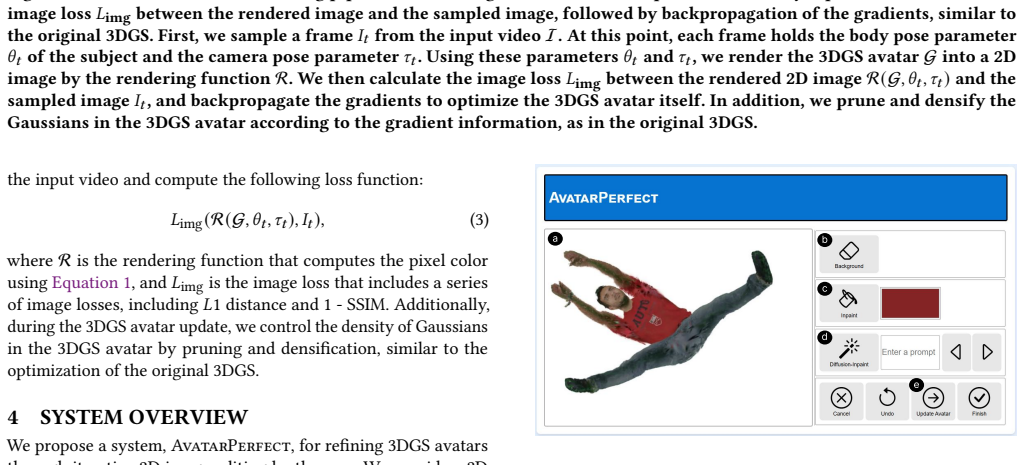
- Cleanup no longer requires selecting individual Gaussians in 3D; the user only paints on the suggested rendered image and presses 'update avatar'.
- Because edited frames are added with a binary mask while original frames are still sampled, corrections are local and the avatar keeps its appearance elsewhere on the body.
- The same visibility objective proposes nontrivial body poses, not just new camera angles, exposing occluded areas where the two classic artifacts form.
- The reported quality gains imply direct 3D deletion is at a structural disadvantage: deleting whole Gaussians can expose previously hidden color errors, while masked retraining repairs them in place.
Reading between the lines
- Going beyond the paper, the same visibility loop should generalize to any artifact type that leaves a visible trace in a rendered image, as long as a per-element visibility measure exists; the paper notes meshes, NeRFs, and SDFs would each need a new such measure.
- A natural extension is to automate the painter: an artifact detector operating on suggested views could close most of the same gaps, leaving the human to judge only ambiguous edits.
- Because the visibility history weights edited frames by only $w=0.01$ but training oversamples them at probability $0.3$, there is an unexplored explore/exploit knob: raising or lowering $w$ controls how fast the system stops revisiting improved regions.
- The pose suggestion could double as a diagnostic: applying it to a freshly trained avatar predicts where novel-pose artifacts are most likely before any user edit begins.
Signed reviews
Editorial analysis
A structured set of objections, weighed in public.
Referee Report
Summary. This paper presents AvatarPerfect, an interactive system for refining pre-trained 3D Gaussian Splatting (3DGS) avatars. The system renders the avatar under a suggested body/camera pose, lets the user paint over artifacts using background, inpaint, and diffusion-inpaint tools, and then updates the avatar via additional training with the original monocular video plus the edited images. A Gaussian-visibility-based optimization selects the next pose to show. The authors report a user study (4 participants) comparing AvatarPerfect with SuperSplat (deletion-only, fixed body pose) on two avatars using IoU, PSNR, and SSIM, plus a crowdsourced preference study (30 evaluators, 12 pairs). They conclude that AvatarPerfect enables users to obtain higher-quality refined 3DGS avatars than the existing 3DGS editor.
Significance. If the results hold, the paper offers a promising alternative to direct 3D Gaussian editing: a 2D-painting workflow with automatic pose suggestion. The system is clearly described, and the idea of using Gaussian visibility to guide the user to likely artifact locations is interesting. The manuscript also honestly discusses several limitations. However, the empirical evidence is preliminary: the main comparison has a very small sample, no statistical inference, and the baseline is restricted in a way that does not isolate the pose-suggestion contribution. The pose-suggestion objective also contains a technical ambiguity. With these issues addressed, the work could be a useful contribution to interactive 3D avatar refinement.
major comments (5)
- [Section 7.3, Table 2] The headline claim of higher quality is based on means of two refined results per avatar per condition, with no variance, confidence intervals, or significance tests. The reported differences are small (e.g., IoU 0.9094 vs 0.9115 and 0.8636 vs 0.8713; PSNR +0.4 dB; SSIM +0.008). At n=4 participants and 2 avatars, these gaps are plausibly due to individual differences. The conclusion in Section 9 that the system 'significantly enhances' visual quality is not supported by the data. Per-participant results and an appropriate statistical analysis (or a clear pilot framing) are needed.
- [Sections 7.1.3 and 7.3] The comparison confounds the editing paradigm with the pose-suggestion contribution. SuperSplat is restricted to Gaussian deletion and a fixed canonical body pose; AvatarPerfect additionally offers inpainting/diffusion editing and additional training. The observed improvements could stem from those components rather than from the proposed automatic pose suggestion. An ablation (e.g., AvatarPerfect with random or user-chosen poses, or with manual camera-only pose selection) is required to substantiate the central novelty.
- [Section 5.2.2, Eq. (8)] The objective function contains an undefined quantity \bar{V} and, as written, does not directly reward displaying barely visible Gaussians. The term clip(V[i]-\bar{V}) is zero for low-visibility Gaussians, so the sum only penalizes candidate views that show already-visible Gaussians, and it is indifferent to whether low-visibility Gaussians appear. This does not match the stated goal of 'display as many Gaussians as possible, which are less visible'. Please correct the formulation, define \bar{V}, and provide a derivation or intuition for how the objective selects views with many low-visibility Gaussians.
- [Sections 5.2.1 and 5.2.2] The central assumption that 'barely visible Gaussians are more likely to generate visual artifacts' is never tested against artifact location data. Without such validation, it is unclear whether the pose-suggestion optimization points users to views where artifacts actually occur. A simple test would be to correlate per-Gaussian visibility in the input video with artifact presence in the initial avatar, e.g., by comparing visibility of deleted/edited Gaussians in user trials with that of all Gaussians.
- [Section 7.4, Table 4] The crowdsourced preference percentages are reported without any significance testing, and the 'Same quality' responses are not incorporated. For example, in the Avatar 1 (P1 & P3) fencing row, SuperSplat was preferred by 71.4% of evaluators; the paper explains this in the text but does not test whether the overall 11/12 preference for Ours is statistically reliable. Binomial tests or confidence intervals for each pair, as well as an analysis aggregating the 12 questions, are needed.
minor comments (6)
- [Section 1, Keywords] The keyword 'Gaussian splitting' should be 'Gaussian Splatting'.
- [Section 7.1.1] The phrase 'four male' is awkward; consider 'four participants (all male, aged 21–26)'.
- [Figure 1 and elsewhere] The word 'Gaussian' is misspelled as 'Gaussain' in several places (e.g., Figure 1 caption); please correct these typos.
- [Table 4] The 'Same quality' row is never discussed in the text; a sentence interpreting these responses would help.
- [Section 5.2.2] The use of the pose decoder D and the latent code dimension (z ∈ R32) is only briefly mentioned; a few more details in the main text or a clear reference to the supplement would improve reproducibility.
- [Figure 9 caption] The caption claims 'less than 10 minutes per avatar', while Table 3 reports total times of about 635–658 seconds for the same five-iteration protocol; clarify which process the caption refers to.
Circularity Check
No circularity; the pose-suggestion objective and the quality metrics are distinct, and the empirical claim is not forced by construction.
full rationale
The paper's derivation chain does not reduce to its inputs. The automatic pose suggestion (Eq. 8) is an active-view optimization over accumulated Gaussian visibility (Eq. 7), not a fit to the evaluation outcome. The quantitative evaluation compares against SAM-derived masks from a held-out free-motion video and standard image metrics (IoU, PSNR, SSIM); the IoU mask threshold uses Gaussian visibility, but that is a measurement choice consistent with the paper's stated artifact model, not a parameter fitted to the result. Hand-set hyperparameters (w = 0.01, sampling probability 0.3) are constants, not fitted predictions. Self-citations in related work (e.g., iPose, PaintersView) are contextual and not load-bearing for the central claim. The main weakness is the very small user study (n = 4, no significance tests), which is an evidence-quality concern rather than circularity.
Assumptions & free parameters
free parameters (4)
- w (weight for edited images in visibility aggregation) =
0.01
- sampling probability of edited images during additional training =
0.3
- Gaussian visibility threshold for foreground mask in IoU evaluation =
0.5
- overlap threshold for Erase Splat tool in baseline =
0.01
assumptions (4)
- domain assumption Artifacts are more likely to occur in Gaussians that were barely visible in the input video.
- domain assumption User 2D edits, used as additional training images under a mask, transfer correctly to the 3DGS avatar.
- domain assumption Gaussian visibility v_p^i = T_i alpha_i is a valid proxy for how much a Gaussian is observed.
- domain assumption The pretrained pose decoder D produces natural body poses during pose optimization.
Cite this review
Pith. "Pith review of AvatarPerfect: User-Assisted 3D Gaussian Splatting Avatar Refinement with Automatic Pose Suggestion." pith.science (2026). https://pith.science/paper/D7A2TTRL
@misc{pith2026241215609,
  author       = {Pith},
  title        = {Pith review of: AvatarPerfect: User-Assisted 3D Gaussian Splatting Avatar Refinement with Automatic Pose Suggestion},
  year         = {2026},
  howpublished = {\url{https://pith.science/paper/D7A2TTRL}},
  note         = {Machine review of arXiv:2412.15609}
}
read the original abstract
Creating high-quality 3D avatars using 3D Gaussian Splatting (3DGS) from a monocular video benefits virtual reality and telecommunication applications. However, existing automatic methods exhibit artifacts under novel poses due to limited information in the input video. We propose AvatarPerfect, a novel system that allows users to iteratively refine 3DGS avatars by manually editing the rendered avatar images. In each iteration, our system suggests a new body and camera pose to help users identify and correct artifacts. The edited images are then used to update the current avatar, and our system suggests the next body and camera pose for further refinement. To investigate the effectiveness of AvatarPerfect, we conducted a user study comparing our method to an existing 3DGS editor SuperSplat, which allows direct manipulation of Gaussians without automatic pose suggestions. The results indicate that our system enables users to obtain higher quality refined 3DGS avatars than the existing 3DGS editor.
Figures


Figures from the paper (8 more)



Reference graph
Works this paper leans on
-
[1]
Thiemo Alldieck, Marcus Magnor, Weipeng Xu, Christian Theobalt, and Ger- ard Pons-Moll. 2018. Detailed human avatars from monocular video. In 2018 International Conference on 3D Vision (3DV) . IEEE, 98–109
work page 2018
-
[2]
Andreas Bircher, Mina Kamel, Kostas Alexis, Helen Oleynikova, and Roland Siegwart. 2016. Receding horizon" next-best-view" planner for 3d exploration. In 2016 IEEE international conference on robotics and automation (ICRA) . IEEE, 1462–1468
work page 2016
-
[3]
Manuel Brack, Patrick Schramowski, Björn Deiseroth, and Kristian Kersting
-
[4]
John Brooke. 1986. System usability scale (SUS): a quick-and-dirty method of system evaluation user information. Reading, UK: Digital equipment co ltd 43 (1986), 1–7
work page 1986
-
[5]
David Charatan, Sizhe Lester Li, Andrea Tagliasacchi, and Vincent Sitzmann
-
[6]
Dave Zhenyu Chen, Yawar Siddiqui, Hsin-Ying Lee, Sergey Tulyakov, and Matthias Nießner. 2023. Text2tex: Text-driven texture synthesis via diffusion models. In Proceedings of the IEEE/CVF International Conference on Computer Vision. 18558–18568
work page 2023
-
[7]
Xiao Chen, Quanyi Li, Tai Wang, Tianfan Xue, and Jiangmiao Pang. 2024. GenNBV: Generalizable Next-Best-View Policy for Active 3D Reconstruction. In Proc. CVPR. 16436–16445
work page 2024
-
[8]
Yiwen Chen, Zilong Chen, Chi Zhang, Feng Wang, Xiaofeng Yang, Yikai Wang, Zhongang Cai, Lei Yang, Huaping Liu, and Guosheng Lin. 2024. Gaussianeditor: Swift and controllable 3d editing with gaussian splatting. In Proceedings of the IEEE/CVF Conference on Computer Vision and Pattern Recognition . 21476–21485
2024
Show all 57 references
-
[9]
Cl Connolly. 1985. The determination of next best views. In Proceedings. 1985 IEEE international conference on robotics and automation , Vol. 2. IEEE, 432–435
1985
-
[10]
Harnaik Dhami, Vishnu D Sharma, and Pratap Tokekar. 2023. Pred-nbv: Prediction-guided next-best-view planning for 3d object reconstruction. In Proc. IROS. IEEE, 7149–7154
2023
-
[11]
Same quality
Yi He, Xi Yang, Chia-Ming Chang, Haoran Xie, and Takeo Igarashi. 2023. Effi- cient Human-in-the-loop System for Guiding DNNs Attention. Association for Computing Machinery, New York, NY, USA, 294–306. https://doi.org/10.1145/ 3581641.3584074 AvatarPerfect: User-Assisted 3D Gau...
2023
-
[12]
Matt-Heun Hong, Zachary Nolan Sunberg, and Danielle Albers Szafir. 2024. Cieran: Designing Sequential Colormaps via In-Situ Active Preference Learning. In Proc. CHI. 1–15
2024
-
[13]
Yunzhong Hou, Stephen Gould, and Liang Zheng. 2024. Learning to Select Views for Efficient Multi-View Understanding. In Proc. CVPR. 20135–20144
2024
-
[14]
Hezhen Hu, Zhiwen Fan, Tianhao Wu, Yihan Xi, Seoyoung Lee, Georgios Pavlakos, and Zhangyang Wang. 2024. Expressive Gaussian Human Avatars from Monocular RGB Video. arXiv preprint arXiv:2407.03204 (2024)
2024 arXiv
-
[15]
Liangxiao Hu, Hongwen Zhang, Yuxiang Zhang, Boyao Zhou, Boning Liu, Sheng- ping Zhang, and Liqiang Nie. 2024. GaussianAvatar: Towards Realistic Human Avatar Modeling from a Single Video via Animatable 3D Gaussians. In Proc. CVPR
2024
-
[16]
Liren Jin, Xieyuanli Chen, Julius Rückin, and Marija Popović. 2023. Neu-nbv: Next best view planning using uncertainty estimation in image-based neural rendering. In 2023 IEEE/RSJ International Conference on Intelligent Robots and Systems (IROS). IEEE, 11305–11312
2023
-
[17]
Bernhard Kerbl, Georgios Kopanas, Thomas Leimkühler, and George Drettakis
-
[18]
Berg, Wan-Yen Lo, Piotr Dollár, and Ross Girshick
Alexander Kirillov, Eric Mintun, Nikhila Ravi, Hanzi Mao, Chloe Rolland, Laura Gustafson, Tete Xiao, Spencer Whitehead, Alexander C. Berg, Wan-Yen Lo, Piotr Dollár, and Ross Girshick. 2023. Segment Anything. arXiv:2304.02643 (2023)
2023 arXiv
-
[19]
Yuki Koyama and Masataka Goto. 2022. BO as assistant: Using Bayesian opti- mization for asynchronously generating design suggestions. In Proc. UIST. 1–14
2022
-
[20]
3D Gaussian Splatting for Real-Time Radiance Field Rendering.ACM Trans. Graph. 42, 4 (July 2023)
2023
-
[21]
Jiahui Lei, Yufu Wang, Georgios Pavlakos, Lingjie Liu, and Kostas Daniilidis
-
[22]
J. P. Lewis, Matt Cordner, and Nickson Fong. 2000. Pose space deformation: a unified approach to shape interpolation and skeleton-driven deformation. In Proc. SIGGRAPH (SIGGRAPH ’00) . ACM Press/Addison-Wesley Publishing Co., USA, 165–172. https://doi.org/10.1145/344779.344862
2000
-
[23]
Yuki Koyama, Issei Sato, Daisuke Sakamoto, and Takeo Igarashi. 2017. Sequential line search for efficient visual design optimization by crowds. ACM Trans. Graph. 36, 4 (2017), 1–11
2017
-
[24]
Zhe Li, Zerong Zheng, Lizhen Wang, and Yebin Liu. 2024. Animatable gaus- sians: Learning pose-dependent gaussian maps for high-fidelity human avatar modeling. In Proc. CVPR. 19711–19722
2024
-
[25]
GART: Gaussian articulated template models. In Proc. CVPR. 19876–19887
-
[26]
Jingyuan Liu, Li-Yi Wei, Ariel Shamir, and Takeo Igarashi. 2024. iPose: Interactive Human Pose Reconstruction from Video. In Proc. CHI. 1–14
2024
-
[27]
Zhan Li, Zhang Chen, Zhong Li, and Yi Xu. 2024. Spacetime gaussian feature splatting for real-time dynamic view synthesis. In Proc. CVPR. 8508–8520
2024
-
[28]
Matthew Loper, Naureen Mahmood, Javier Romero, Gerard Pons-Moll, and Michael J. Black. 2015. SMPL: A Skinned Multi-Person Linear Model. ACM Trans. Graphics (Proc. SIGGRAPH Asia) 34, 6 (Oct. 2015), 248:1–248:16
2015
-
[29]
Jing Lin, Ailing Zeng, Haoqian Wang, Lei Zhang, and Yu Li. 2023. One-stage 3d whole-body mesh recovery with component aware transformer. In Proceedings of the IEEE/CVF Conference on Computer Vision and Pattern Recognition . 21159– 21168
2023
-
[30]
Srinivasan, Matthew Tancik, Jonathan T
Ben Mildenhall, Pratul P. Srinivasan, Matthew Tancik, Jonathan T. Barron, Ravi Ramamoorthi, and Ren Ng. 2020. NeRF: Representing Scenes as Neural Radiance Fields for View Synthesis. In Proc. ECCV
2020
-
[31]
Wen Liu, Zhixin Piao, Jie Min, Wenhan Luo, Lin Ma, and Shenghua Gao. 2019. Liq- uid warping gan: A unified framework for human motion imitation, appearance transfer and novel view synthesis. In Proc. ICCV. 5904–5913
2019
-
[32]
Menaka Naazare, Francisco Garcia Rosas, and Dirk Schulz. 2022. Online next- best-view planner for 3D-exploration and inspection with a mobile manipulator robot. IEEE Robotics and Automation Letters 7, 2 (2022), 3779–3786
2022
-
[33]
Miguel Mendoza, J Irving Vasquez-Gomez, Hind Taud, L Enrique Sucar, and Carolina Reta. 2020. Supervised learning of the next-best-view for 3d object reconstruction. Pattern Recognition Letters 133 (2020), 224–231
2020
-
[34]
Georgios Pavlakos, Vasileios Choutas, Nima Ghorbani, Timo Bolkart, Ahmed A. A. Osman, Dimitrios Tzionas, and Michael J. Black. 2019. Expressive Body Capture: 3D Hands, Face, and Body from a Single Image. In Proceedings IEEE Conf. on Computer Vision and Pattern Recognition (CVPR)
2019
-
[35]
Arthur Moreau, Jifei Song, Helisa Dhamo, Richard Shaw, Yiren Zhou, and Ed- uardo Pérez-Pellitero. 2024. Human gaussian splatting: Real-time rendering of animatable avatars. In Proc. CVPR. 788–798
2024
-
[36]
Robin Rombach, Andreas Blattmann, Dominik Lorenz, Patrick Esser, and Björn Ommer. 2022. High-Resolution Image Synthesis With Latent Diffusion Models. In Proc. CVPR. 10684–10695
2022
-
[37]
Haokai Pang, Heming Zhu, Adam Kortylewski, Christian Theobalt, and Marc Habermann. 2024. Ash: Animatable gaussian splats for efficient and photoreal human rendering. In Proc. CVPR. 1165–1175
2024
-
[38]
Ryusuke Takahama, Yukino Baba, Nobuyuki Shimizu, Sumio Fujita, and Hisashi Kashima. 2018. Adaflock: Adaptive feature discovery for human-in-the-loop predictive modeling. In Proc. AAAI, Vol. 32
2018
-
[39]
PlayCanvas. 2023. SuperSplat. https://github.com/playcanvas/supersplat
2023
-
[40]
Junjie Wang, Jiemin Fang, Xiaopeng Zhang, Lingxi Xie, and Qi Tian. 2024. Gaus- sianeditor: Editing 3d gaussians delicately with text instructions. In Proceedings of the IEEE/CVF Conference on Computer Vision and Pattern Recognition . 20902– 20911
2024
-
[41]
Zhijing Shao, Zhaolong Wang, Zhuang Li, Duotun Wang, Xiangru Lin, Yu Zhang, Mingming Fan, and Zeyu Wang. 2024. SplattingAvatar: Realistic Real-Time Human Avatars with Mesh-Embedded Gaussian Splatting. In Proc. CVPR
2024
-
[42]
Jing Wu, Jia-Wang Bian, Xinghui Li, Guangrun Wang, Ian Reid, Philip Torr, and Victor Adrian Prisacariu. 2024. GaussCtrl: multi-view consistent text-driven 3D Gaussian splatting editing. arXiv preprint arXiv:2403.08733 (2024)
2024 arXiv
-
[43]
Yuka Takahashi, Tsukasa Fukusato, and Takeo Igarashi. 2019. PaintersView: Automatic Suggestion of Optimal Viewpoints for 3D Texture Painting. In Proc. SIGGRAPH Asia Technical Briefs. Association for Computing Machinery, New York, NY, USA. https://doi.org/10.1145/3355088.3365159
2019
-
[44]
Zhirong Wu, Shuran Song, Aditya Khosla, Fisher Yu, Linguang Zhang, Xiaoou Tang, and Jianxiong Xiao. 2015. 3d shapenets: A deep representation for volu- metric shapes. In Proc. CVPR. 1912–1920
2015
-
[45]
Guanjun Wu, Taoran Yi, Jiemin Fang, Lingxi Xie, Xiaopeng Zhang, Wei Wei, Wenyu Liu, Qi Tian, and Xinggang Wang. 2024. 4d gaussian splatting for real- time dynamic scene rendering. In Proc. CVPR. 20310–20320
2024
-
[46]
Jiahui Yu, Yuning Jiang, Zhangyang Wang, Zhimin Cao, and Thomas Huang
-
[47]
Shihao Wu, Wei Sun, Pinxin Long, Hui Huang, Daniel Cohen-Or, Minglun Gong, Oliver Deussen, and Baoquan Chen. 2014. Quality-driven Poisson-guided au- toscanning. Proc. SIGGRAPH Asia 33 (2014), 203:1–203:12. Issue 6
2014
-
[48]
Shunyuan Zheng, Boyao Zhou, Ruizhi Shao, Boning Liu, Shengping Zhang, Liqiang Nie, and Yebin Liu. 2024. Gps-gaussian: Generalizable pixel-wise 3d gaussian splatting for real-time human novel view synthesis. In Proc. CVPR . 19680–19690
2024
-
[49]
Kenta Yamamoto, Yuki Koyama, and Yoichi Ochiai. 2022. Photographic lighting design with photographer-in-the-loop bayesian optimization. InProc. UIST. 1–11
2022
-
[50]
Zhongyi Zhou and Koji Yatani. 2022. Gesture-Aware Interactive Machine Teach- ing with In-Situ Object Annotations. In Proc. UIST. Association for Computing Machinery, New York, NY, USA. https://doi.org/10.1145/3526113.3545648
2022
-
[51]
Jingyu Zhuang, Di Kang, Yan-Pei Cao, Guanbin Li, Liang Lin, and Ying Shan
-
[52]
Zehao Yu, Anpei Chen, Binbin Huang, Torsten Sattler, and Andreas Geiger. 2024. Mip-splatting: Alias-free 3d gaussian splatting. In Proc. CVPR. 19447–19456
2024
-
[54]
Yijun Zhou, Yuki Koyama, Masataka Goto, and Takeo Igarashi. 2021. Inter- active exploration-exploitation balancing for generative melody composition. In Proceedings of the 26th International Conference on Intelligent User Interfaces . 43–47
2021
-
[57]
ACM Transactions on Graphics (TOG) 43, 4 (2024), 1–12
Tip-editor: An accurate 3d editor following both text-prompts and image- prompts. ACM Transactions on Graphics (TOG) 43, 4 (2024), 1–12
2024
-
[2016]
Unitbox: An advanced object detection network. In Proc. MM. 516–520
-
[2023]
Illume: Rationalizing vision-language models through human interactions. In Proc. ICML. PMLR, 3021–3037
-
[2024]
pixelsplat: 3d gaussian splats from image pairs for scalable generalizable 3d reconstruction. In Proc. CVPR. 19457–19467
Reviewed August 11, 2026 · model on record in the stance chip above.
Discussion (0). Continue with ORCID to comment.