REVIEW 3 major objections 6 minor 2 cited by
Scattered synchrotron emission and a giant torus revealed in polarized light in the nearest radio galaxy Centaurus A
T0 review · 3 major / 6 minor · reviewed 2026-08-08 · deepseek-v4-flash
Pith's one-line read Spectropolarimetry of Centaurus A reveals a beamed jet seen in reflected, polarized light.
desk verdict New targeted spectropolarimetry of Cen A's knot delivers real surprises, but the key angle and polarization degree are small residuals after an uncertain ISP subtraction, so the sweeping interpretation outruns the evidence. read the letter →
The pith
A machine-rendered reading of the paper's core claim, the machinery that carries it, and where it could break.
The reading
What carries the argument
The central mechanism is the hidden-NLR scattering geometry: a giant circumnuclear torus with vertical half-thickness 10.5–44.7 pc hides the bright inner narrow-line region, and the observed signal is light that escapes through the dust funnel and scatters once off dust in the outermost NLR. The key observable that carries the argument is the vector subtraction of interstellar polarization on the normalized Stokes $q$–$u$ plane: using a nearby pure-starlight region as the interstellar-polarization reference rotates the knot's polarization angle from roughly 115° (the dust-lane value) to 146°, exactly perpendicular to the radio jet. This subtraction is what exposes the intrinsic AGN component in both continuum and narrow lines.
What would settle it
Measure interstellar polarization toward several field stars in the same dust lane as the knot; if the reference-region polarization differs by more than about 0.5%, the derived intrinsic polarization and the 146° angle would shift and the scattering geometry would not be uniquely required. Alternatively, detecting a broad H-alpha line in a deeper polarized spectrum, or a big blue bump in ultraviolet nuclear spectra, would break the synchrotron-reflection interpretation.
Extended reading notes
Core claim
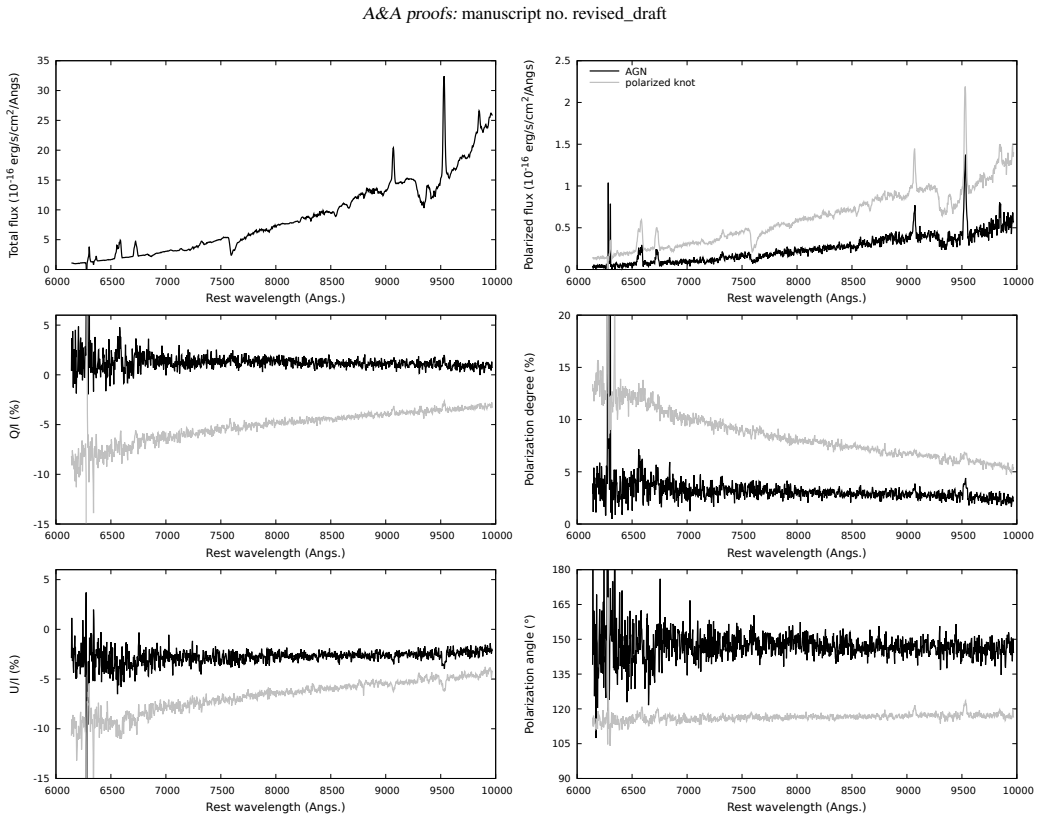
The authors claim that the continuum emission of Cen A's buried active nucleus is dominated by beamed synchrotron radiation, not by thermal accretion-disk emission, and that this radiation reaches us only after scattering off the exposed outer part of the narrow-line region. After subtracting the interstellar polarization measured in a nearby pure-starlight region, the scattered AGN light has 2–4% polarization whose angle is almost wavelength-independent and orthogonal to the jet position angle, while the narrow lines are polarized at 3–5% with the same perpendicular orientation. The absence of broad lines in the polarized spectrum rules out the usual type-2 hidden-BLR picture at 99% or higher probability. The authors therefore propose that a vertically extended torus (10–45 pc from the equatorial plane) obscures the base of the NLR, and that both the synchrotron continuum and the NLR line photons are polarized by a single scattering event in the NLR wind, producing the observed perpendicular polarization. They take this as confirmation of the prediction that beamed jet radiation can be seen in reflection.
Load-bearing premise
The whole decomposition rests on assuming that the polarization measured in the pure-starlight reference region is exactly the interstellar polarization along the line of sight to the polarized knot, so that a vector subtraction removes all dust-lane contamination.
Editorial extensions
If this is right
- Cen A becomes the first confirmed case of a beamed synchrotron jet observed in reflected, polarized light, validating long-standing predictions that beamed jet radiation can be seen in reflection.
- A new class of hidden-NLR active galaxies is defined, with NGC 4258 and 3C 270 as the other known members; such objects should show LINER-like spectra, no broad lines in polarized flux, and highly polarized narrow lines perpendicular to the jet.
- The torus in Cen A must extend tens of parsecs vertically, implying a high covering factor and a larger obscuring structure than standard unification tori, consistent with the diffuse mid-infrared and roughly 110 pc-scale millimeter continuum already observed.
- Surveys of misdirected BL Lac objects—low-power, non-thermal radio galaxies with jets near the line of sight—should be the hunting ground for additional hidden-NLR AGNs.
- The non-detection of a broad H-alpha line at 99% or higher probability means the nucleus likely lacks a standard broad-line region, consistent with an advection-dominated accretion flow and a synchrotron-dominated continuum.
Reading between the lines
- If the geometry is right, spatially resolved imaging polarimetry of the NLR on 10–100 pc scales should show a polarization angle pattern that rotates systematically with position relative to the jet axis; this is testable with current instrumentation and would distinguish single-scattering from multiple-scattering alternatives.
- The interstellar-polarization correction is the fragile step: measuring interstellar polarization toward several independent stars in the dust lane near the knot would test whether the pure-starlight reference region is truly representative, since a spatial gradient in grain alignment would shift the intrinsic angle away from 146°.
- Time-domain monitoring of the polarized knot could separate the synchrotron and scattering components: a beamed synchrotron flare should appear in the polarized continuum with a delay relative to the radio core, while the narrow-line polarization should remain stable.
- The hidden-NLR class may be more common than recognized among low-luminosity FR I galaxies; applying the same spectropolarimetric analysis to other dust-lane-dominated cores could reveal more members.
Editorial analysis
A structured set of objections, weighed in public.
Referee Report
Summary. The paper presents VLT/FORS2 spectropolarimetry of the nuclear region of Centaurus A, targeting the compact polarized knot discovered by Schreier et al. (1996), a SE cloud, and an intermediate region M. The authors detect narrow AGN emission lines in the knot, find strong ISP-dominated polarization with P ≈ 15% at 6100 Å falling to ≈5% at 10000 Å, and after subtracting the region-M Stokes vector as an ISP template obtain an 'intrinsic' polarization of 2–4% with a position angle ≈146°, perpendicular to the jet PA of 55°. They report that the narrow lines are polarized at 3–5% with the same perpendicular angle, and that no broad Hα component is present in the polarized flux at ≥99% probability. They interpret the result as beamed synchrotron radiation from the jet scattered by the outer NLR, with a giant (≥10 pc) circumnuclear torus hiding the inner NLR, and propose a new class of 'hidden-NLR AGNs'.
Significance. If the ISP subtraction is robust, this is an important result: Cen A would be the first clear case of beamed BL Lac-like synchrotron emission observed in reflection, confirming a specific prediction of Blandford & Rees (1978) and Antonucci & Barvainis (1990), and it would establish a new observational class with two additional candidates (NGC 4258, 3C 270). The paper's strengths are its new high-quality FORS2 spectropolarimetric data with careful line identification, the quantitative no-broad-line constraint based on 2577 SDSS type-1 profiles, and the anchoring of the model to independent literature constraints (MIR diffuse emission, ALMA millimeter continuum, X-ray polarization, prior torus modeling). The weakness is that the central polarization-angle result is a small residual of two ~10% vectors, and the systematic uncertainty in the assumed ISP template is not quantified. This is a correctness-risk that can be addressed with additional analysis; the raw observational facts and the no-BLR constraint appear credible.
major comments (3)
- [Sect. 3.4, Eq. (5), Tables 2–3] The central observational claim — that the intrinsic polarization angle of the knot is 146°, perpendicular to the radio jet — rests on a small difference between two large measured Stokes vectors. After subtracting the region M q,u values from the knot values (Eq. 5), the residuals are q_int ~ 0.001–0.03 and u_int ~ -0.04 (Table 3), compared with observed q,u of about -0.077 and -0.096 (Table 2). The quoted uncertainties (0.6% in P, 4° in θ) are statistical only and do not include the systematic error in taking region M as the exact ISP toward the knot. Region M is a separate 1.5″-long aperture and is not cospatial with the knot; Schreier et al. (1996) showed that the dust-lane polarization varies on subarcsecond scales, and the paper itself shows that the SE cloud has a several-percent lower P at the same angle. A shift of only ~0.5–1% in q_ISP or u_ISP would drive q_int toward zero or negative and change the recovered angle by tens of degrees, destroying both the 2–4% P and the claimed orthogonality. The authors should either estimate and propagate this systematic uncertainty quantitatively (e.g., from the spatial gradient between M and the knot or from alternative ISP tracers) or demonstrate that the choice of region M is robust to such variations.
- [Sect. 3.4, Fig. 8, Table 3] The paper presents the 'intrinsic AGN polarization' as P = 2–4% while explicitly noting that the correction removes only ISP and not the host starlight contribution. Because the knot spectrum shows strong Ca ii triplet absorption (Fig. 5), starlight is a significant fraction of the total flux, and the quoted P is therefore only a lower limit on the true intrinsic polarization. The paper's line-versus-continuum comparison (Table 3: P ≈ 4–5% in lines versus 2–3% in adjacent continuum) could be biased if the starlight fraction differs between line and continuum bins. The authors should quantify the stellar dilution (e.g., via a stellar template fit) and report starlight-corrected values, or clearly state in the abstract and conclusions that the 2–4% figure is starlight-diluted.
- [Sect. 4.1, Fig. 9] The inferred vertical half-thickness of the torus, 10.5–44.7 pc, is derived by combining the projected distance between the radio core and the knot (0.6″–2.4″ from different references) with the assumption that the knot lies at the outer boundary of the torus and that the scattering occurs on the outermost NLR. This is a geometric model inference rather than a direct detection of a torus, and the factor-of-four range already indicates the sensitivity to the adopted core position. The title's phrase 'giant torus revealed' overstates the observational status; the torus is a plausible interpretation. The authors should soften this claim and explicitly list the model assumptions (e.g., that the scattered-light region is beyond the torus rim) in the abstract or conclusions.
minor comments (6)
- [Abstract and Sect. 1] The abstract uses 'by the mean of' where 'by means of' is intended, and the introduction contains 'Fanaro ff-Riley' with a missing space; please copyedit.
- [Eq. (4)] Equation (4) defines θ = 1/2 arctan(u/q); since q is negative in the observed data, the authors should state that the two-argument arctangent (atan2) is used to place θ in the correct quadrant.
- [Sects. 3.5 and 4.1] Two key comparisons rely on unpublished work: the 2577-profile sample and the 3C 270 spectropolarimetry are both cited as 'Jiang et al., in prep.'; for a journal submission these should be available (e.g., as arXiv preprints) or the claims should be rephrased as preliminary.
- [Fig. 8 caption] The caption states that the spectrum is 'corrected for the polluting contribution from the host starlight polarization estimated thanks to region M', but the correction made in Sect. 3.4 is for interstellar polarization, not starlight; the caption is misleading and should be reworded.
- [Table 2] Table 2 lists two identical groups of rows labelled '[S III]cb', '[S III]', and '[S III]cr'; if this is not a typo, the labels should distinguish the two measurements, and if it is a typo the duplicate rows should be removed.
- [Conclusion] The phrase 'beyond doubt' in the conclusion is stronger than the evidence warrants, given the systematic issues noted above; a more cautious formulation would be appropriate.
Circularity Check
No equation-level circularity: the key intrinsic angle and no-BLR limit are new measurements, not fitted inputs; the low score reflects minor in-preparation self-citations and a systematic-uncertainty concern in the ISP correction rather than a circular derivation.
full rationale
The derivation chain runs from the FORS2 spectropolarimetry (Sect. 2) to the detection of polarized narrow lines, the interstellar-polarization subtraction in Eq. (5), the resulting 146-degree intrinsic angle, and the hidden-NLR/synchrotron interpretation. None of these steps reduces a prediction to an input by construction: Eq. (5) is a standard vector subtraction using independently measured Stokes parameters from region M, and the intrinsic angle is a numerical consequence of those measurements rather than a fitted parameter. The no-BLR claim uses the SDSS type-1 sample of Jiang et al. (in prep.) as a sensitivity benchmark; although this is an in-preparation co-author paper, it does not assume the absence of a BLR in Cen A and is externally falsifiable, so it is not load-bearing circularity. The synchrotron and giant-torus model is anchored by external literature constraints (Bailey et al. 1986; Radomski et al. 2008; McCoy et al. 2017; Ehlert et al. 2022; Balmaverde et al. 2016). The principal vulnerability is observational rather than logical: the ISP correction assumes region M's polarization equals the ISP toward the knot, and because the intrinsic Stokes values are small residuals of two ~10% vectors, a spatial dust-polarization gradient could shift the recovered angle; this is a systematic-error concern, not a circular-derivation concern.
Assumptions & free parameters
free parameters (1)
- P(lambda) power-law index k =
-1.9 (knot), -2.1 (SE cloud), -2.2 (region M)
assumptions (6)
- domain assumption Region M's polarization is purely interstellar (dichroic) and equal to the ISP toward the polarized knot.
- domain assumption Host starlight is essentially unpolarized and only dilutes P, not theta.
- domain assumption The NLR is optically thin, so narrow-line photons undergo single scattering while the continuum may already be polarized before scattering.
- domain assumption The jet position angle is 55 +/- 7 degrees, so the expected perpendicular polarization angle is near 145 degrees.
- domain assumption The Balmaverde et al. (2016) result that the bright innermost NLR extends to about 10 pc in low-luminosity AGNs applies to Cen A.
- domain assumption The unpublished 2577-object SDSS sample is representative of type-1 AGN broad Halpha profiles for detection statistics.
invented entities (1)
-
Giant circumnuclear torus with vertical half-thickness 10.5-44.7 pc in Cen A
independent evidence
Cite this review
Pith. "Pith review of Scattered synchrotron emission and a giant torus revealed in polarized light in the nearest radio galaxy Centaurus A." pith.science (2026). https://pith.science/paper/D7BJABJF
@misc{pith2026250205002,
  author       = {Pith},
  title        = {Pith review of: Scattered synchrotron emission and a giant torus revealed in polarized light in the nearest radio galaxy Centaurus A},
  year         = {2026},
  howpublished = {\url{https://pith.science/paper/D7BJABJF}},
  note         = {Machine review of arXiv:2502.05002}
}
read the original abstract
Centaurus A (Cen A) is the closest radio galaxy and a prime example of a low-luminosity active galactic nucleus (AGN), exhibiting complex emissions across the electromagnetic spectrum. The nature of its continuum emission, particularly the mechanisms powering it, has been a subject of considerable debate due to the fact that the AGN is deeply buried in dust. This study aims to elucidate the origin of the continuum emission in Cen A and determine the geometrical arrangement of matter in the nuclear region by the mean of optical and near-infrared spectropolarimetry. We obtained spectropolarimetric data of Cen A using the VLT/FORS2. The analysis revealed a region showing strong and narrow emission lines associated with AGN activity. After correction for interstellar polarization in the dust lane (but not for starlight), the intrinsic polarization of the scattered AGN light exhibits a polarization degree of 2-4%, decreasing from optical to near-infrared, associated with a polarization position angle perpendicular to the radio jet axis. We exclude the presence of hidden broad line in our polarized flux spectrum at more than 99% probability. Narrow emission lines are found to be strongly polarized and orthogonal to the jet position angle. We demonstrate that a beamed synchrotron jet, scattering onto the narrow line region (NLR) best fits all the observational properties reported in this paper and the literature. In this model, the base of the NLR is obscured by a giant circumnuclear region and can only become visible through perpendicular scattering onto the outermost part of the NLR, naturally producing high polarization degrees and polarization angles perpendicular to the radio structure. This study provides strong evidence that Cen A defines a new class of hidden-NLR AGNs and supports old predictions that beamed synchrotron jets can be observed in reflection.
Figures


Figures from the paper (6 more)



Forward citations
Cited by 2 Pith papers
-
XRISM analysis of the complex Fe K$\alpha$ line in Centaurus A
XRISM's precision X-ray detector shows the iron K-alpha line of Centaurus A is a narrow doublet plus a broad component, implying emitting gas spans roughly 0.001 to 10 parsecs.
-
The central engine of low-luminosity radio galaxy 3C 270 (NGC 4261)
Polarized-light spectra of 3C 270 show no hidden broad-line region or big blue bump, indicating a radiatively inefficient accretion flow in this low-luminosity radio galaxy.
Reference graph
Works this paper leans on
- [1]
-
[2]
1993, ARA&A, 31, 473
Antonucci, R. 1993, ARA&A, 31, 473
1993
-
[3]
2012, Astronomical and Astrophysical Transactions, 27, 557
Antonucci, R. 2012, Astronomical and Astrophysical Transactions, 27, 557
2012
- [4]
-
[5]
Antonucci, R. R. J. & Miller, J. S. 1985, ApJ, 297, 621
1985
-
[6]
Bailey, J., Sparks, W. B., Hough, J. H., & Axon, D. J. 1986, Nature, 322, 150
work page 1986
-
[7]
Balmaverde, B., Capetti, A., Moisio, D., Baldi, R. D., & Marconi, A. 2016, A&A, 586, A48
work page 2016
- [8]
Show all 61 references
-
[9]
2019, MNRAS, 488, L1
Bianchi, S., Antonucci, R., Capetti, A., et al. 2019, MNRAS, 488, L1
2019
-
[10]
Blandford, R. D. & Rees, M. J. 1978, Phys. Scr, 17, 265
1978
-
[11]
P., Ró˙ za´nska, A., et al
Borkar, A., Adhikari, T. P., Ró˙ za´nska, A., et al. 2021, MNRAS, 500, 3536
2021
-
[12]
A., Dunlop, J
Bruce, V . A., Dunlop, J. S., Mortlock, A., et al. 2016, MNRAS, 458, 2391
2016
-
[13]
Bryant, J. J. & Hunstead, R. W. 1999, MNRAS, 308, 431
1999
-
[14]
O., Feigelson, E
Burns, J. O., Feigelson, E. D., & Schreier, E. J. 1983, ApJ, 273, 128
1983
-
[15]
J., Chiaberge, M., et al
Capetti, A., Axon, D. J., Chiaberge, M., et al. 2007, A&A, 471, 137
2007
-
[16]
2019, A&A, 623, A79
Combes, F., García-Burillo, S., Audibert, A., et al. 2019, A&A, 623, A79
2019
-
[17]
R., Ferrazzoli, R., Marinucci, A., et al
Ehlert, S. R., Ferrazzoli, R., Marinucci, A., et al. 2022, ApJ, 935, 116
2022
-
[18]
& Hall, J
Elvius, A. & Hall, J. S. 1964, Lowell Observatory Bulletin, 6, 123
1964
-
[19]
A., Kraft, R
Evans, D. A., Kraft, R. P., Worrall, D. M., et al. 2004, ApJ, 612, 786 García-Burillo, S., Alonso-Herrero, A., Ramos Almeida, C., et al. 2021, A&A, 652, A98 García-Burillo, S., Combes, F., Ramos Almeida, C., et al. 2019, A&A, 632, A61 García-Burillo, S., Hicks, E. K. S., Alons...
2004
-
[20]
Goodrich, R. W. & Miller, J. S. 1994, ApJ, 434, 82 H. E. S. S. Collaboration, Abdalla, H., Abramowski, A., et al. 2018, A&A, 619, A71
1994
-
[21]
Harris, G. L. H., Rejkuba, M., & Harris, W. E. 2010, PASA, 27, 457 Hönig, S. F. & Beckert, T. 2007, MNRAS, 380, 1172
2010
-
[22]
F., Hayward, C
Hopkins, P. F., Hayward, C. C., Narayanan, D., & Hernquist, L. 2012, Monthly Notices of the Royal Astronomical Society, 420, 320
2012
-
[23]
Hopkins, P. F. & Quataert, E. 2010, MNRAS, 407, 1529
2010
-
[24]
H., Bailey, J
Hough, J. H., Bailey, J. A., Rouse, M. F., & Whittet, D. C. B. 1987, MNRAS, 227, 1P
1987
-
[25]
2024, PASJ[arXiv:2406.14488]
Iwata, T., Tanimoto, A., Odaka, H., et al. 2024, PASJ[arXiv:2406.14488]
2024 arXiv
-
[26]
2019, FORS Pipeline User Manual
Izzo, C., de Bilbao, L., & Larsen, J. 2019, FORS Pipeline User Manual. VLT- MAN-ESO-19500-4106
2019
-
[27]
C., Ferrarese, L., van den Bosch, F., & O’Connell, R
Jaffe, W., Ford, H. C., Ferrarese, L., van den Bosch, F., & O’Connell, R. W. 1993, Nature, 364, 213
1993
-
[28]
2021, Nature Astronomy, 5, 1017
Janssen, M., Falcke, H., Kadler, M., et al. 2021, Nature Astronomy, 5, 1017
2021
-
[29]
J., Ricci, C., Trakhtenbrot, B., et al
Koss, M. J., Ricci, C., Trakhtenbrot, B., et al. 2022, ApJS, 261, 2
2022
-
[30]
P., Forman, W., Jones, C., et al
Kraft, R. P., Forman, W., Jones, C., et al. 2000, ApJ, 531, L9
2000
-
[31]
Liu, B. F. & Taam, R. E. 2009, ApJ, 707, 233
2009
-
[32]
J., et al
Marconi, A., Capetti, A., Axon, D. J., et al. 2001, ApJ, 549, 915
2001
-
[33]
R., et al
Marin, F., Barnouin, T., Ehlert, S. R., et al. 2023, MNRAS, 526, 6321
2023
-
[34]
S., et al
McCoy, M., Ott, J., Meier, D. S., et al. 2017, ApJ, 851, 76
2017
-
[35]
B., Kewley, L
McPartland, C., Sanders, D. B., Kewley, L. J., & Leslie, S. K. 2019, MNRAS, 482, L129
2019
-
[36]
Meisenheimer, K., Tristram, K. R. W., Jaffe, W., et al. 2007, A&A, 471, 453
2007
-
[37]
1983, in Planetary Nebulae, ed
Mendoza, C. 1983, in Planetary Nebulae, ed. L. H. Aller, V ol. 103, 143–172
1983
-
[38]
Miller, J. S. & Goodrich, R. W. 1990, ApJ, 355, 456
1990
-
[39]
1995, Nature, 373, 127
Miyoshi, M., Moran, J., Herrnstein, J., et al. 1995, Nature, 373, 127
1995
-
[40]
2022, MNRAS, 509, 2637
Netzer, H. 2022, MNRAS, 509, 2637
2022
-
[41]
M., Cohen, M
Ogle, P. M., Cohen, M. H., Miller, J. S., et al. 1997, ApJ, 482, L37
1997
-
[42]
2010, A&A, 519, A45
Ojha, R., Kadler, M., Böck, M., et al. 2010, A&A, 519, A45
2010
-
[43]
E., Shaw, R
Osterbrock, D. E., Shaw, R. A., & Veilleux, S. 1990, ApJ, 352, 561
1990
-
[44]
H., Young, S., et al
Packham, C., Hough, J. H., Young, S., et al. 1996, MNRAS, 278, 406
1996
-
[45]
& Algaba, J
Park, J. & Algaba, J. C. 2022, Galaxies, 10, 102
2022
-
[46]
S., Biretta, J
Perlman, E. S., Biretta, J. A., Zhou, F., Sparks, W. B., & Macchetto, F. D. 1999, AJ, 117, 2185
1999
-
[47]
Peterson, B. M. 1997, An Introduction to Active Galactic Nuclei (Cambridge University Press)
1997
-
[48]
C., Bland-Hawthorn, J., Green, J
Quillen, A. C., Bland-Hawthorn, J., Green, J. D., et al. 2008, MNRAS, 384, 1469
2008
-
[49]
T., Packham, C., Levenson, N
Radomski, J. T., Packham, C., Levenson, N. A., et al. 2008, ApJ, 681, 141 Ramos Almeida, C., Levenson, N. A., Rodríguez Espinosa, J. M., et al. 2009, ApJ, 702, 1127 Ramos Almeida, C., Martínez González, M. J., Asensio Ramos, A., et al. 2016, MNRAS, 461, 1387
2008
-
[50]
Rieger, F. M. & Aharonian, F. A. 2009, A&A, 506, L41 Rodríguez-Ardila, A. & Fonseca-Faria, M. A. 2020, ApJ, 895, L9
2009
-
[51]
J., Capetti, A., Macchetto, F., Sparks, W
Schreier, E. J., Capetti, A., Macchetto, F., Sparks, W. B., & Ford, H. J. 1996, ApJ, 459, 535
1996
-
[52]
H., Hines, D
Shi, Y ., Rieke, G. H., Hines, D. C., et al. 2006, ApJ, 653, 127
2006
-
[53]
& Meadows, V
Simpson, C. & Meadows, V . 1998, ApJ, 505, L99
1998
-
[54]
2015, A&A, 576, A77
Smette, A., Sana, H., Noll, S., et al. 2015, A&A, 576, A77
2015
-
[55]
Tran, H. D. 1995, ApJ, 440, 565
1995
-
[56]
2021, ApJ, 922, 85 van Dokkum, P
Tzanavaris, P., Yaqoob, T., LaMassa, S., Ptak, A., & Yukita, M. 2021, ApJ, 922, 85 van Dokkum, P. G. 2001, PASP, 113, 1420 van Dokkum, P. G., Bloom, J., & Tewes, M. 2012, L.A.Cosmic: Laplacian Cos- mic Ray Identification
2021
-
[57]
& Antonucci, R
Whysong, D. & Antonucci, R. 2004, ApJ, 602, 116
2004
-
[58]
J., Schmidt, G
Wilkes, B. J., Schmidt, G. D., Smith, P. S., Mathur, S., & McLeod, K. K. 1995, ApJ, 455, L13
1995
-
[59]
J., Wills, D., Breger, M., Antonucci, R
Wills, B. J., Wills, D., Breger, M., Antonucci, R. R. J., & Barvainis, R. 1992, ApJ, 398, 454
1992
-
[60]
N., & Grosso, N
Younes, G., Porquet, D., Sabra, B., Reeves, J. N., & Grosso, N. 2012, A&A, 539, A104
2012
-
[61]
H., Axon, D
Young, S., Hough, J. H., Axon, D. J., Bailey, J. A., & Ward, M. J. 1995, MNRAS, 272, 513 Article number, page 13 of ??
1995
Reviewed August 8, 2026 · model on record in the stance chip above.
Discussion (0). Continue with ORCID to comment.