A Computational Model for Measuring Adaptability Among U.S. Farmers: Evidence from 1997-2022
Pith reviewed 2026-06-27 07:52 UTC · model grok-4.3
The pith
Environmental payoff-biased selection has driven US counties to adopt crop traits that maximize adaptability and yield in their local environments.
A machine-rendered reading of the paper's core claim, the machinery that carries it, and where it could break.
Core claim
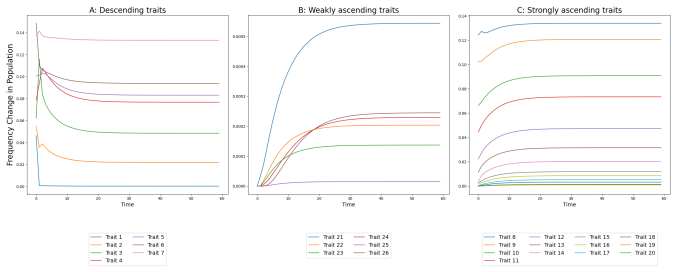
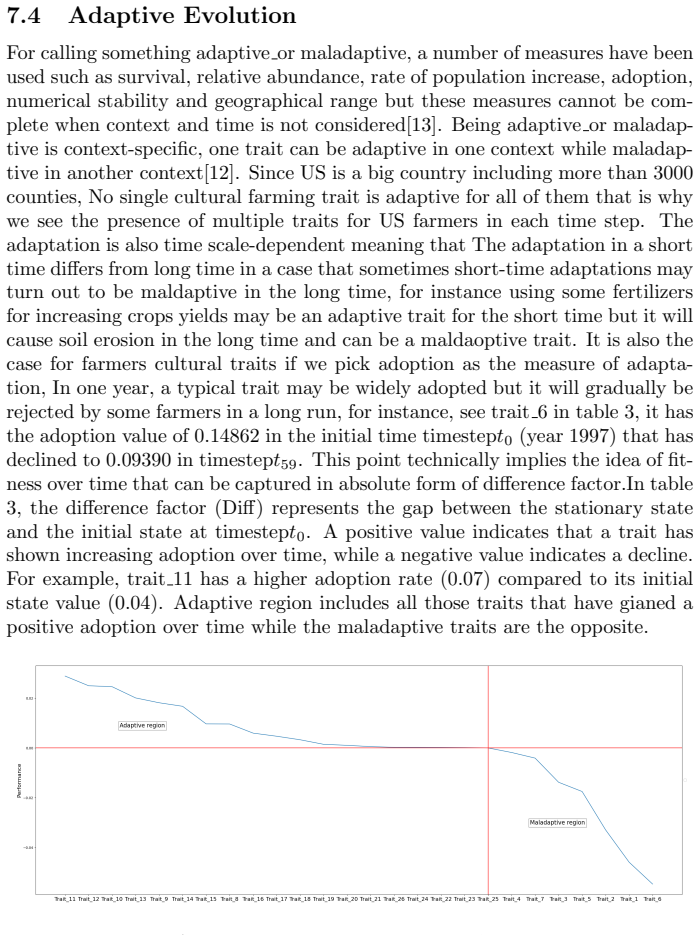
Agricultural crops are a type of cultural trait and the way farmers of US counties select them can itself result in county-level cultural traits. Using real-world data from 1997 to 2022, we have developed a systematic framework to study the selective mechanisms behind these traits. Our findings indicate that environmental payoff-biased selection has driven counties to adopt traits that maximize their adaptability and yield within their specific environments. These empirical results align with existing theoretical literature. Additionally, a clear long-term selective trend is evident, showing that US counties are gradually developing a specific set of more complex combinatorial traits, which
What carries the argument
Computational framework modeling county-level crop choices as cultural traits under environmental payoff-biased selection, measured from aggregate production data.
Load-bearing premise
Crop choices function as cultural traits transmitted and selected by payoff-biased mechanisms that can be measured at county scale from aggregate production data.
What would settle it
A reanalysis of the 1997-2022 county production data that finds no correlation between local environmental conditions and adopted crop combinations, or no increase in combinatorial trait complexity over time, would falsify the claim.
Figures
read the original abstract
Agricultural crops are a type of cultural trait and the way farmers of US counties select them can itself result in county-level cultural traits. Using real-world data from 1997 to 2022, we have developed a systematic framework to study the selective mechanisms behind these traits. Our findings indicate that environmental payoff-biased selection has driven counties to adopt traits that maximize their adaptability and yield within their specific environments. These empirical results align with existing theoretical literature [3,16]. Additionally, a clear long-term selective trend is evident, showing that US counties are gradually developing a specific set of more complex combinatorial traits, which provide greater payoffs by enhancing the farmers' environmental adaptability. This study serves as a strong case for empirically modeling the cultural evolutionary processes among US farmers.
Editorial analysis
A structured set of objections, weighed in public.
Referee Report
Summary. The paper develops a computational framework analyzing U.S. county-level crop production data (1997–2022) to treat crop choices as culturally transmitted traits under environmental payoff-biased selection. It concludes that this selection has driven counties toward trait combinations maximizing local adaptability and yield, with evidence of a long-term trend toward more complex combinatorial traits, consistent with prior theory.
Significance. If the framework can isolate cultural transmission mechanisms from confounding economic and policy drivers using only aggregate statistics, the work would supply rare empirical evidence for cultural evolutionary dynamics at scale in agriculture. The alignment with theoretical predictions [3,16] and the multi-decade panel would strengthen the case for payoff-biased models outside laboratory settings.
major comments (3)
- [Methods / Model description] The manuscript provides no description of the computational model, equations, or fitting procedure used to quantify payoff-biased selection or adaptability. Without these, it is impossible to determine whether the estimated selection coefficients are identified or merely reflect aggregate correlations.
- [Results / Identification] County-level production aggregates are the joint outcome of individual decisions, prices, subsidies, seed markets, and regulations. The central claim that observed shifts reflect payoff-biased cultural transmission therefore requires an explicit identification strategy (instrumental variables, fixed effects, or individual-level data) that separates these channels; none is visible.
- [Results / Trend analysis] The claim of a 'clear long-term selective trend' toward more complex combinatorial traits is presented without reported statistical tests, robustness checks, or controls for changing market conditions over the 25-year window.
minor comments (2)
- [Introduction] The abstract states that results 'align with existing theoretical literature [3,16]' but does not indicate whether the model recovers the same functional forms or parameter regimes as those references.
- [Model] Notation for 'adaptability' and 'combinatorial traits' is introduced without formal definition or measurement protocol.
Simulated Author's Rebuttal
We thank the referee for the constructive comments on our manuscript. We address each major point below and will revise the paper to improve clarity and rigor where appropriate.
read point-by-point responses
-
Referee: [Methods / Model description] The manuscript provides no description of the computational model, equations, or fitting procedure used to quantify payoff-biased selection or adaptability. Without these, it is impossible to determine whether the estimated selection coefficients are identified or merely reflect aggregate correlations.
Authors: We agree the current version lacks sufficient detail on the model. The abstract references a systematic framework, but the full text does not present the equations or fitting procedure explicitly. In revision we will add a dedicated Methods subsection with the payoff-biased selection equations, the optimization procedure applied to the 1997–2022 county crop data, and the exact definition of the adaptability metric. This will allow readers to evaluate identification directly. revision: yes
-
Referee: [Results / Identification] County-level production aggregates are the joint outcome of individual decisions, prices, subsidies, seed markets, and regulations. The central claim that observed shifts reflect payoff-biased cultural transmission therefore requires an explicit identification strategy (instrumental variables, fixed effects, or individual-level data) that separates these channels; none is visible.
Authors: We acknowledge that aggregate county data cannot fully isolate cultural transmission from economic and policy factors. In the revision we will add county fixed effects, time-varying controls for observed crop prices and subsidy rates where available from USDA sources, and an explicit discussion of remaining identification limitations. Individual-level farmer data are not present in the public dataset we use, so we cannot pursue that route; we will therefore frame the results as consistent with payoff-biased selection rather than claiming definitive causal isolation. revision: partial
-
Referee: [Results / Trend analysis] The claim of a 'clear long-term selective trend' toward more complex combinatorial traits is presented without reported statistical tests, robustness checks, or controls for changing market conditions over the 25-year window.
Authors: We will add formal trend tests (linear and nonlinear regressions of trait complexity on year), robustness checks across sub-periods and geographic subsets, and controls for market conditions (e.g., commodity price indices and policy changes). These additions will be placed in a new Results subsection with accompanying tables and figures. revision: yes
Circularity Check
No circularity: empirical framework relies on external data and prior theory without self-referential reduction
full rationale
The abstract describes a computational framework applied to 1997-2022 county-level production data to identify environmental payoff-biased selection on crop traits, with results stated to align with independent theoretical literature [3,16]. No equations, fitting procedures, or derivation steps are supplied that reduce a claimed prediction to a fitted input by construction, invoke self-citation as the sole justification for a uniqueness claim, or rename an empirical pattern as a novel derivation. The central claim therefore rests on observable aggregate statistics interpreted through an external theoretical lens rather than on any of the enumerated circular patterns.
Axiom & Free-Parameter Ledger
Reference graph
Works this paper leans on
-
[1]
If we are all cultural darwinians what’s the fuss about? clarifying recent disagreements in the field of cultural evolution.Biology & philosophy, 30:481–503, 2015
Alberto Acerbi and Alex Mesoudi. If we are all cultural darwinians what’s the fuss about? clarifying recent disagreements in the field of cultural evolution.Biology & philosophy, 30:481–503, 2015. 3This distribution has been confirmed by using KS test for various distributions such as normal,lognormal, exponential, gamma and beta. 15
2015
-
[2]
Understanding agriculture within the frameworks of cumulative cultural evolution, gene-culture co-evolution, and cultural niche construction.Human Ecology, 47:483–497, 2019
Arie Altman and Alex Mesoudi. Understanding agriculture within the frameworks of cumulative cultural evolution, gene-culture co-evolution, and cultural niche construction.Human Ecology, 47:483–497, 2019
2019
-
[3]
Random drift and culture change.Proceedings of the Royal Society of London
R Alexander Bentley, Matthew W Hahn, and Stephen J Shennan. Random drift and culture change.Proceedings of the Royal Society of London. Series B: Biological Sciences, 271(1547):1443–1450, 2004
2004
-
[4]
Stochasticity in cultural evolu- tion: a revolution yet to happen.History and philosophy of the life sciences, 40:1–24, 2018
Sylvain Billiard and Alexandra Alvergne. Stochasticity in cultural evolu- tion: a revolution yet to happen.History and philosophy of the life sciences, 40:1–24, 2018
2018
-
[5]
” red ocher” caches from the michigan area: A possible case of cultural drift.Southwestern Journal of Anthropology, 19(1):89–108, 1963
Lewis R Binford. ” red ocher” caches from the michigan area: A possible case of cultural drift.Southwestern Journal of Anthropology, 19(1):89–108, 1963
1963
-
[6]
Springer Science & Business Media, 2013
Gregory R Bowman, Vijay S Pande, and Frank No´ e.An introduction to Markov state models and their application to long timescale molecular sim- ulation, volume 797. Springer Science & Business Media, 2013
2013
-
[7]
University of Chicago press, 1988
Robert Boyd and Peter J Richerson.Culture and the evolutionary process. University of Chicago press, 1988
1988
-
[8]
Why culture is common, but cultural evolution is rare
Robert Boyd, Peter J Richerson, et al. Why culture is common, but cultural evolution is rare. InProceedings-british academy, volume 88, pages 77–94. Oxford University Press Inc., 1996
1996
-
[9]
Number 16
Luigi Luca Cavalli-Sforza and Marcus W Feldman.Cultural transmission and evolution: A quantitative approach. Number 16. Princeton University Press, 1981
1981
-
[10]
How dar- winian is cultural evolution?Philosophical Transactions of the Royal So- ciety B: Biological Sciences, 369(1642):20130368, 2014
Nicolas Claidi` ere, Thomas C Scott-Phillips, and Dan Sperber. How dar- winian is cultural evolution?Philosophical Transactions of the Royal So- ciety B: Biological Sciences, 369(1642):20130368, 2014
2014
-
[11]
Oxford University Press, USA, 2007
Robin Ian MacDonald Dunbar and Louise Barrett.Oxford handbook of evolutionary psychology. Oxford University Press, USA, 2007
2007
-
[12]
Cultural transmission and the evolution of human behaviour: a general approach based on the price equation.Journal of evolutionary biology, 27(2):231– 241, 2014
Claire El Mouden, J-B Andr´ e, Olivier Morin, and Daniel Nettle. Cultural transmission and the evolution of human behaviour: a general approach based on the price equation.Journal of evolutionary biology, 27(2):231– 241, 2014
2014
-
[13]
Cultural adaptation.The international Encyclopedia of anthro- pology, 2018
Roy Ellen. Cultural adaptation.The international Encyclopedia of anthro- pology, 2018
2018
-
[14]
Springer Science & Business Media, 1999
Agner Fog.Cultural selection. Springer Science & Business Media, 1999
1999
-
[15]
Number 25
John Thomas Gulick.Evolution, racial and habitudinal. Number 25. Carnegie institution of Washington, 1905. 16
1905
-
[16]
Joseph Henrich. Cultural transmission and the diffusion of innovations: Adoption dynamics indicate that biased cultural transmission is the pre- dominate force in behavioral change.American anthropologist, 103(4):992– 1013, 2001
2001
-
[17]
princeton University press, 2016
Joseph Henrich.The secret of our success: How culture is driving human evolution, domesticating our species, and making us smarter. princeton University press, 2016
2016
-
[18]
The evolution of cultural evolu- tion.Evolutionary Anthropology: Issues, News, and Reviews: Issues, News, and Reviews, 12(3):123–135, 2003
Joseph Henrich and Richard McElreath. The evolution of cultural evolu- tion.Evolutionary Anthropology: Issues, News, and Reviews: Issues, News, and Reviews, 12(3):123–135, 2003
2003
-
[19]
Princeton University Press, 2011
Stephen P Hubbell.The unified neutral theory of biodiversity and biogeog- raphy (MPB-32). Princeton University Press, 2011
2011
-
[20]
Social learning strategies: Bridge-building between fields.Trends in cognitive sciences, 22(7):651–665, 2018
Rachel L Kendal, Neeltje J Boogert, Luke Rendell, Kevin N Laland, Mike Webster, and Patricia L Jones. Social learning strategies: Bridge-building between fields.Trends in cognitive sciences, 22(7):651–665, 2018
2018
-
[21]
The neutral theory of molecular evolution.Scientific Amer- ican, 241(5):98–129, 1979
Motoo Kimura. The neutral theory of molecular evolution.Scientific Amer- ican, 241(5):98–129, 1979
1979
-
[22]
OUP Oxford, 2015
Tim Lewens.Cultural evolution: conceptual challenges. OUP Oxford, 2015
2015
-
[23]
University of Chicago Press, 2011
Alex Mesoudi.Cultural evolution: How Darwinian theory can explain hu- man culture and synthesize the social sciences. University of Chicago Press, 2011
2011
-
[24]
Cultural selection and biased transformation: two dynamics of cultural evolution.Philosophical Transactions of the Royal Society B, 376(1828):20200053, 2021
Alex Mesoudi. Cultural selection and biased transformation: two dynamics of cultural evolution.Philosophical Transactions of the Royal Society B, 376(1828):20200053, 2021
2021
-
[25]
What is cumulative cultural evolution? Proceedings of the Royal Society B, 285(1880):20180712, 2018
Alex Mesoudi and Alex Thornton. What is cumulative cultural evolution? Proceedings of the Royal Society B, 285(1880):20180712, 2018
2018
-
[26]
University of Chicago press, 2008
Peter J Richerson and Robert Boyd.Not by genes alone: How culture transformed human evolution. University of Chicago press, 2008
2008
-
[27]
Underappreciated features of cultural evolution.Philosophical Transactions of the Royal Society B, 376(1828):20200259, 2021
Marco Smolla, Fredrik Jansson, Laurent Lehmann, Wybo Houkes, Franz J Weissing, Peter Hammerstein, Sasha RX Dall, Bram Kuijper, and Magnus Enquist. Underappreciated features of cultural evolution.Philosophical Transactions of the Royal Society B, 376(1828):20200259, 2021
2021
-
[28]
John Wiley & Sons, 2016
Carel P Van Schaik.The primate origins of human nature. John Wiley & Sons, 2016. 17
2016
discussion (0)
Sign in with ORCID, Apple, or X to comment. Anyone can read and Pith papers without signing in.