REVIEW 3 major objections 6 minor 20 references
Gamification of Immersive Cervical Rehabilitation Exercises in VR: An Exploratory Study on Chin Tuck and Range of Motion Exercises
T0 review · 3 major / 6 minor · reviewed 2026-08-15 · deepseek-v4-flash
Pith's one-line read The paper claims two gamified VR neck exercises—a survival-based chin tuck game and a space-themed range-of-motion game—are usable, engaging, and perceived as health-valuable for healthy young users.
desk verdict A solid exploratory usability study of two genuinely novel VR gamification strategies for neck exercises, with an honest limitations section but a real movement-detection validity gap that should be fixed or clearly scoped before the 'suitable for the intended exercises' claim is taken at face value. read the letter →
The pith
A machine-rendered reading of the paper's core claim, the machinery that carries it, and where it could break.
The reading
What carries the argument
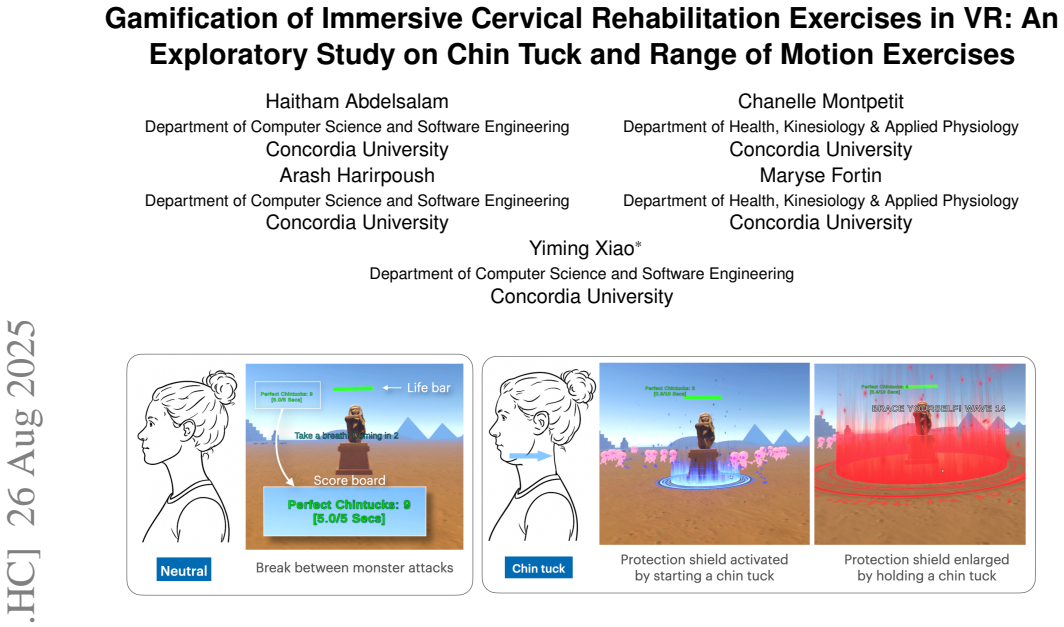
The load-bearing mechanism is headset-only kinematic tracking with per-user calibration. For the chin tuck game, the headset's calibrated neutral position is used as the origin; a valid chin tuck is registered when backward displacement along the headset's Z-axis exceeds a configurable threshold while lateral and rotational movement stays minimal, activating the shield. For the ROM game, six calibration points define the user's maximum reach; gameplay uses head-orientation raycasting with fixation timing to guide a spaceship along those points, and lateral flexion is detected by headset Z-axis rotation exceeding a threshold with a reset-to-neutral check. All interaction, feedback, scoring, and level progression is driven by these head-position and rotation signals plus configurable parameters stored in JSON files.
What would settle it
Equip 10–15 participants with a marker-based motion-capture reference or have a therapist watch 20 chin-tuck attempts while playing the game. If the game registers a shield-triggering chin tuck for head translations or tilts that are not true chin tucks, or misses true chin tucks, then the detection logic is not reliable enough to deliver the prescribed exercise.
Extended reading notes
Core claim
The central claim is that the two proposed VR games successfully gamify two different kinds of cervical rehabilitation exercises—the chin tuck, a deep-neck-muscle strengthening movement, and neck range-of-motion exercise. The chin tuck game uses a survival and level-progression reward (defending a sacred artifact from monster attacks), and the ROM game uses an ambient reward (unlocking constellations), rather than the token/coin collection seen in earlier rehabilitation games. In the user study, the chin tuck game scored 83.0 and the ROM game 90.4 on the System Usability Scale, both significantly above the 68 threshold; all but one user-experience item were significantly above neutral; and 16 of 19 participants completed the chin tuck game's final 10-second-hold level. The authors take these results as evidence that the two gamification strategies work well for usability, engagement, and perceived health value, and as a foundation for future longitudinal testing with chronic neck pain patients.
Load-bearing premise
The entire system rests on the assumption that a consumer VR headset's positional and rotational readings correctly identify a chin tuck and a lateral flexion; the authors explicitly did not validate tracking accuracy for these exercises in this study.
Editorial extensions
If this is right
- If the results replicate, the survival-and-level-progression strategy offers a template for gamifying muscle-strengthening neck exercises, which have been largely neglected relative to ROM exercises.
- The ambient constellation reward provides an alternative to token-collection mechanics that may be better suited to slow, controlled movement tasks and to patients who find fast-paced reward chasing stressful.
- The configurable parameters, personalized calibration, and session logs make the system adaptable to therapist-supervised dosing and to future adaptive-difficulty algorithms.
- The high SUS scores and participants' stated willingness to use the games 2–3 times per week for six weeks or longer suggest the approach could address adherence and accessibility barriers in home-based neck rehabilitation.
Reading between the lines
- If the headset tracking is validated against a reference standard, the same calibration-and-threshold approach could extend to other precision movements, such as cervical retraction with resistance or balance-while-tracking tasks, without changing the core game engine.
- The participants' comments about shield-activation timing versus monster-attack duration hint that the detection threshold and the wave timing interact; tightening the feedback loop may matter more than adding game content.
- The study's sample is young and mostly VR-familiar; the strongest next test is mid-age chronic neck pain patients, who carry the adherence burden this design aims to fix and who may tolerate the games' pacing differently.
Signed reviews
Editorial analysis
A structured set of objections, weighed in public.
Referee Report
Summary. The paper presents two novel VR rehabilitation games for cervical exercises: an Indiana Jones-themed chin tuck game using a survival/level-progression mechanic and a space-themed neck range-of-motion game using an ambient constellation-revealing reward. The authors report a preliminary user study with 19 healthy young adults (some with mild self-limited neck pain) that evaluates usability, engagement, and perceived health value via the System Usability Scale (SUS), an 11-item custom UX questionnaire, free-form comments, and gameplay logs. Both games received high SUS scores (83.0 and 90.4, both significantly above 68), most UX ratings were significantly above neutral, and participants expressed willingness to use the games long-term. The paper also discusses limitations, notably the lack of dedicated tracking accuracy validation.
Significance. If the reported results hold, the paper offers two concrete gamification designs, including a survival/level-progression mechanic for chin tuck exercises and an ambient reward mechanism for ROM exercises, which are underexplored in VR neck rehabilitation. Strengths include close collaboration with certified athletic therapists in protocol design, a configurable system with session logging that could support future clinical use, and transparent reporting of statistical tests. However, the significance is limited by the lack of exercise-specific movement detection validation, the preliminary healthy-young-adult cohort, and the absence of a control condition. The paper's main contribution is as an exploratory design study, not as evidence of clinical efficacy.
major comments (3)
- [Section 3.2.2, 3.3.2, and Section 6] The central claim that the games are 'suitable for the intended exercises' is not secured because the headset-based movement detection has not been validated against a reference standard. In Section 3.2.2, a chin tuck is registered from backward head translation along the Z-axis, but a chin tuck is primarily a retraction of the chin relative to the neck, not a whole-head translation; torso lean, chair slide, or neck extension can produce the same Z displacement and be rewarded as a valid chin tuck. In Section 3.3.2, lateral flexion is detected from headset rotation about the Z-axis, which conflates head roll with cervical lateral flexion, and the ROM angles are computed from headset world-space positions, which are sensitive to head translation as well as orientation. The authors acknowledge in Section 6 that they did not perform additional accuracy validation, citing prior reliability studies of HMD tracking; however, those studies validate gross head tracking, not the exercise-specific event classifiers used here. This gap directly affects the interpretation of the high SUS and UX scores as evidence that the games deliver the intended therapeutic movements. I recommend either adding a validation study (e.g., against optical motion capture or therapist observation) or clearly re-scoping the claims to 'perceived usability and engagement' without asserting exercise fidelity.
- [Section 4 and Section 5.1] The statistical analysis does not correct for multiple comparisons. The paper reports Wilcoxon signed-rank tests for each of the 11 UX items for each game (22 tests total) and claims that 'for all the UX questions for both games, their scores are significantly better than the neutral score of 3 (p < 0.02) except for the chin tuck game, the question related to the challenging level of the physical exercise received a score of 3.6±1.3 (p=0.062)'. With 22 comparisons, the family-wise error rate is inflated; a Bonferroni correction would set alpha at approximately 0.0023, and many of the reported p-values in the 0.01–0.02 range would no longer be significant, and the borderline chin-tuck challenge item would not be an isolated exception. This weakens the claim of uniformly positive UX. I recommend reporting corrected p-values, using a global test (e.g., a mixed-effects model or Friedman's test per game), or clearly labeling these results as exploratory without invoking strict significance thresholds.
- [Section 3.3.2] There is an internal inconsistency in how head movements are measured for the ROM game. The interaction is described as using head orientation rather than position ('The system uses head orientation rather than position information from the VR headset to interact with the virtual environment'), but the maximum angles for flexion, extension, lateral flexion, and rotation are computed from calibrated headset positions ('the system logs the headset’s world-space position for that orientation'). If the position values are the primary source of the angle calculations, a user can artificially inflate measured ROM by translating the head or torso toward a target rather than rotating the neck, which further compromises the validity of the reported angular metrics. Please clarify the exact computation and justify why position-based angles are appropriate for measuring cervical ROM.
minor comments (6)
- [Figure 1 caption] There is a typo: 'the duration of a chink tuck becomes longer' should be 'chin tuck'.
- [Section 3.2.4] The text says 'Loosing the game will result in a sad music with a damaged artifact' – 'Loosing' should be 'Losing', and 'a sad music' should be 'sad music'.
- [Section 4] The sentence 'attitude towards the design elements of the games' is written as 'altitude towards the design elements'; please correct this typo.
- [Section 4] The sentence beginning 'F or these questions' has a stray space – should be 'For these questions'.
- [Section 5.1 and Table 1] The claim that '16 out of 19 participants were able to win the game by performing 10 sets of 10-second chin tucks' is ambiguous; based on the protocol in Section 3.2.1, it should be '10 chin tucks' rather than '10 sets'.
- [Section 2 and 6] The phrase 'for the first time' regarding the survival/level-progression strategy for chin tuck exercises is a strong claim that may be difficult to substantiate given the rapid growth of VR rehabilitation literature; consider softening to 'to our knowledge'.
Circularity Check
No circularity: the usability, engagement, and perceived-health-value claims rest on direct SUS/UX questionnaire measurements tested against external benchmarks (SUS > 68, Likert > 3), not on any fitted parameter or self-citation chain.
full rationale
This paper contains no derivation chain that reduces to its own inputs, so the circularity score is 0. The central claims are empirical usability and engagement assessments: SUS scores (chin tuck 83.0 +/- 16.1, ROM 90.4 +/- 9.5) are one-sample t-tested against the external SUS benchmark of 68, and the eleven custom UX items are Wilcoxon-tested against the neutral score of 3 (Sections 4 and 5.1). These outcomes are measured via questionnaires, and the SUS/UX results do not reduce by construction to any game configuration or detection threshold. The chin-tuck and lateral-flexion detection thresholds are configurable parameters 'kept the same value advised by co-author CM' (Sections 3.2.2 and 3.3.2); they are expert-set constants, not parameters fitted to the outcome data, so the high questionnaire scores are not statistically forced by the detectors. Gameplay metrics (perfect chin-tuck counts, ROM angles) are raw session logs; the ROM 'max angles' are computed from the per-user calibration envelope by definition, but they are reported as descriptive measurements and compared only to expected physiological ranges as verified by the collaborating athletic therapist, not used to derive the usability claim. There are no self-citations among the twenty references; the only reliance on prior tracking work is external (Guo et al. [8]; Trinidad-Fernandez et al. [18]). The Section 6 limitation explicitly discloses that 'we didn't perform additional accuracy validation for our application' because prior studies 'have reported good reliability of movement tracking in existing VR headsets.' This is a validity caveat about whether the headset detectors capture true cervical movements and a correctness risk for future clinical deployment, but it does not constitute circular reasoning under any of the enumerated patterns. The concern that the games may reward compensatory movements (e.g., torso lean registered as a chin tuck) is an external-validity issue, which per review rules does not raise the circularity score.
Assumptions & free parameters
free parameters (2)
- Chin tuck detection threshold =
Not reported (expert-selected value advised by co-author CM)
- Lateral flexion detection threshold =
Not reported (expert-selected value advised by co-author CM)
assumptions (3)
- domain assumption VR headset positional and rotational tracking accurately captures head movements for detecting chin tucks, neck range-of-motion targeting, and lateral flexion.
- domain assumption SUS and the custom 11-item UX questionnaire are valid measures of usability, engagement, and perceived health value.
- domain assumption A convenience sample of healthy young adults, some with mild self-limited pain, can indicate usability and engagement for the eventual chronic neck pain population.
Cite this review
Pith. "Pith review of Gamification of Immersive Cervical Rehabilitation Exercises in VR: An Exploratory Study on Chin Tuck and Range of Motion Exercises." pith.science (2026). https://pith.science/paper/D7L7XHMS
@misc{pith2026250818580,
  author       = {Pith},
  title        = {Pith review of: Gamification of Immersive Cervical Rehabilitation Exercises in VR: An Exploratory Study on Chin Tuck and Range of Motion Exercises},
  year         = {2026},
  howpublished = {\url{https://pith.science/paper/D7L7XHMS}},
  note         = {Machine review of arXiv:2508.18580}
}
read the original abstract
Chronic neck pain is a prevalent condition that affects millions of individuals worldwide, causing significant individual suffering and socioeconomic burdens. Although exercise rehabilitation is a staple in relieving pain and improving muscle function for the condition, traditional one-on-one rehabilitation sessions are costly and suffer from poor adherence and accessibility for the patients. Thanks to the increasing accessibility and recent advancements in sensing and display technology, virtual reality (VR) offers the potential to tackle the challenges in traditional exercise rehabilitation, particularly through gamification. However, still in its infancy, VR-based neck exercise rehabilitation lacks exploration in effective gamification strategies and existing prototypes. To address the knowledge gap, we conduct an exploratory study on the gamification strategies for VR-based cervical rehabilitation exercises by using chin tuck and neck range of motion exercises as examples. Specifically, with different game themes, we investigate a survival and level progression strategy for muscle strengthening (chin tuck) exercise for the first time, and the suitability of ambient reward for a neck range of motion exercise. Through a preliminary user study, we assess the proposed novel VR neck rehabilitation games and they demonstrate excellent usability, engagement, and perceived health value.
Figures


Figures from the paper (4 more)


Reference graph
Works this paper leans on
-
[1]
T. W. Barreto and J. H. Svec. Chronic neck pain: Nonpharmacologic treatment. Am Fam Physician, 100(3):180–182, 2019. 1
work page 2019
-
[2]
J. Brooke et al. Sus-a quick and dirty usability scale. Usability evalu- ation in industry, 189(194):4–7, 1996. 5
work page 1996
-
[3]
R. Campbell, M. Evans, M. Tucker, B. Quilty, P. Dieppe, and J. L. Donovan. Why don’t patients do their exercises? understanding non- compliance with physiotherapy in patients with osteoarthritis of the knee. J Epidemiol Community Health , 55(2):132–8, 2001. 1
work page 2001
-
[4]
E. Chaplin, C. Karatzios, and C. Benaim. Clinical applications of virtual reality in musculoskeletal rehabilitation: A scoping review. Healthcare (Basel), 11(24), 2023. 2
work page 2023
-
[5]
M. Chiu, E. Tochilnikova, and C. Harteveld. From novelty to clinical practice: Exploring vr exergames with physical therapists. Proc. ACM Hum.-Comput. Interact., 8(CHI PLAY), Oct. 2024. 2
work page 2024
-
[6]
G. . N. P. Collaborators. Global, regional, and national burden of neck pain, 1990-2020, and projections to 2050: a systematic analysis of the global burden of disease study 2021. Lancet Rheumatol, 6(3):e142– e155, 2024. 2
work page 1990
-
[7]
D. Collado-Mateo, A. M. Lav ´ın-P´erez, C. Pe ˜nacoba, J. Del Coso, M. Leyton-Rom´an, A. Luque-Casado, P. Gasque, M. Fern ´andez-Del- Olmo, and D. Amado-Alonso. Key factors associated with adherence to physical exercise in patients with chronic diseases and older adults: An umbrella review. Int J Environ Res Public Health , 18(4), 2021. 1
work page 2021
-
[8]
Q. Guo, L. Zhang, L. L. Han, C. Gui, G. Chen, C. Ling, W. Wang, and Q. Gao. Effects of virtual reality therapy combined with conventional rehabilitation on pain, kinematic function, and disability in patients with chronic neck pain: Randomized controlled trial. JMIR Serious Games, 12:e42829, 2024. 2, 5, 8
work page 2024
Show all 20 references
-
[9]
J. Hao, Z. He, Z. Chen, and A. Remis. Virtual reality training versus conventional rehabilitation for chronic neck pain: A systematic review and meta-analysis. PM&R, 16(10):1143–1153, 2024. 1, 2
2024
-
[10]
Himler, G
P. Himler, G. T. Lee, D. I. Rhon, J. L. Young, C. E. Cook, and C. Rent- meester. Understanding barriers to adherence to home exercise pro- grams in patients with musculoskeletal neck pain. Musculoskelet Sci Pract, 63:102722, 2023. 1
2023
-
[11]
Kazeminasab, S
S. Kazeminasab, S. A. Nejadghaderi, P. Amiri, H. Pourfathi, M. Araj- Khodaei, M. J. M. Sullman, A. A. Kolahi, and S. Safiri. Neck pain: global epidemiology, trends and risk factors.BMC Musculoskelet Dis- ord, 23(1):26, 2022. 1, 8
2022
-
[12]
Mouatt, A
B. Mouatt, A. Smith, M. Mellow, G. Parfitt, R. Smith, and T. Stanton. The use of virtual reality to influence motivation, affect, enjoyment, and engagement during exercise: A scoping review. Frontiers in Vir- tual Reality, 1, 2020. 1, 2
2020
-
[13]
K. E. Naugle, X. A. Cervantes, C. L. Boone, B. Wind, and K. M. Naugle. Exploring actual and perceived levels of physical activity intensity during virtual reality active games. Frontiers in Sports and Active Living, 6, 2024. 1
2024
-
[14]
E. Orr, T. Arbel, M. Levy, Y . Sela, O. Weissberger, O. Liran, and J. Lewis. Virtual reality in the management of patients with low back and neck pain: a retrospective analysis of 82 people treated solely in the metaverse. Arch Physiother, 13(1):11, 2023. 2, 5
2023
-
[15]
Smith, R
V . Smith, R. R. Warty, J. A. Sursas, O. Payne, A. Nair, S. Krishnan, F. da Silva Costa, E. M. Wallace, and B. V ollenhoven. The effective- ness of virtual reality in managing acute pain and anxiety for medical inpatients: Systematic review. J Med Internet Res , 22(11):e17980,
-
[16]
Steilen, R
D. Steilen, R. Hauser, B. Woldin, and S. Sawyer. Chronic neck pain: making the connection between capsular ligament laxity and cervical instability. Open Orthop J, 8:326–45, 2014. 1
2014
-
[17]
Tosto-Mancuso, L
J. Tosto-Mancuso, L. Tabacof, J. E. Herrera, E. Breyman, S. Dewil, M. Cortes, L. Correa-Esnard, C. P. Kellner, N. Dangayach, and D. Pu- trino. Gamified neurorehabilitation strategies for post-stroke motor recovery: Challenges and advantages. Curr Neurol Neurosci Rep , 22(3):18...
2022
-
[18]
Trinidad-Fern ´andez, B
M. Trinidad-Fern ´andez, B. Bossavit, J. Salgado-Fern ´andez, S. Abbate-Chica, A. J. Fern ´andez-Leiva, and A. I. Cuesta-Vargas. Head-mounted display for clinical evaluation of neck movement validation with meta quest 2. Sensors, 23(6), 2023. 1, 8
2023
-
[19]
V oinescu, J
A. V oinescu, J. Sui, and D. Stanton Fraser. Virtual reality in neurore- habilitation: An umbrella review of meta-analyses. J Clin Med, 10(7),
-
[20]
A. R. Youssef, M. Gumaa, and A. Al-Kabbany. A telehealth system for managing faulty neck posture using sensors of standalone wear- ables. In 2024 6th International Conference on Communications, Sig- nal Processing, and their Applications (ICCSPA), pp. 1–7, 2024. 2
2024
Reviewed August 15, 2026 · model on record in the stance chip above.
Discussion (0). Continue with ORCID to comment.