REVIEW 3 major objections 4 minor 1 cited by
Simplicial degree in complex networks. Applications of Topological Data Analysis to Network Science
T0 review · 3 major / 4 minor · reviewed 2026-08-14 · deepseek-v4-flash
Pith's one-line read A single Laplacian matrix computes all higher-order simplicial degrees.
desk verdict Solid algebraic core, shaky empirical wrapper: the simplicial-degree framework and the multi-combinatorial Laplacian are worth engaging, but the 'for every dataset' claims overrun the evidence as presented. read the letter →
The pith
A machine-rendered reading of the paper's core claim, the machinery that carries it, and where it could break.
The reading
What carries the argument
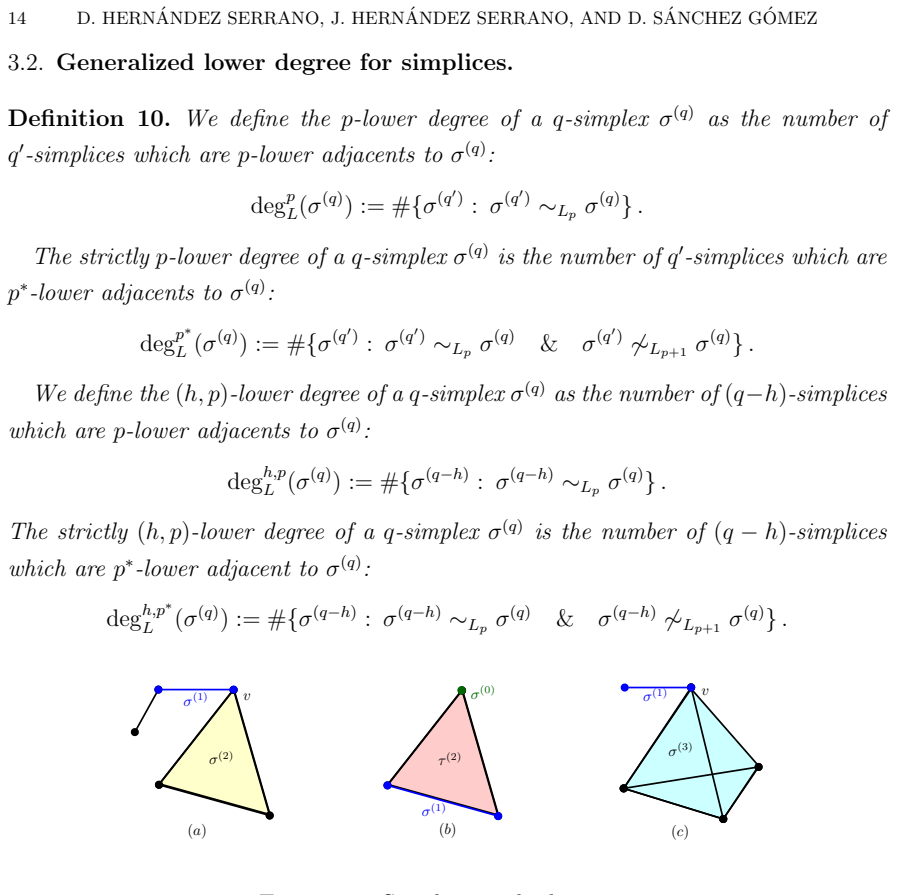
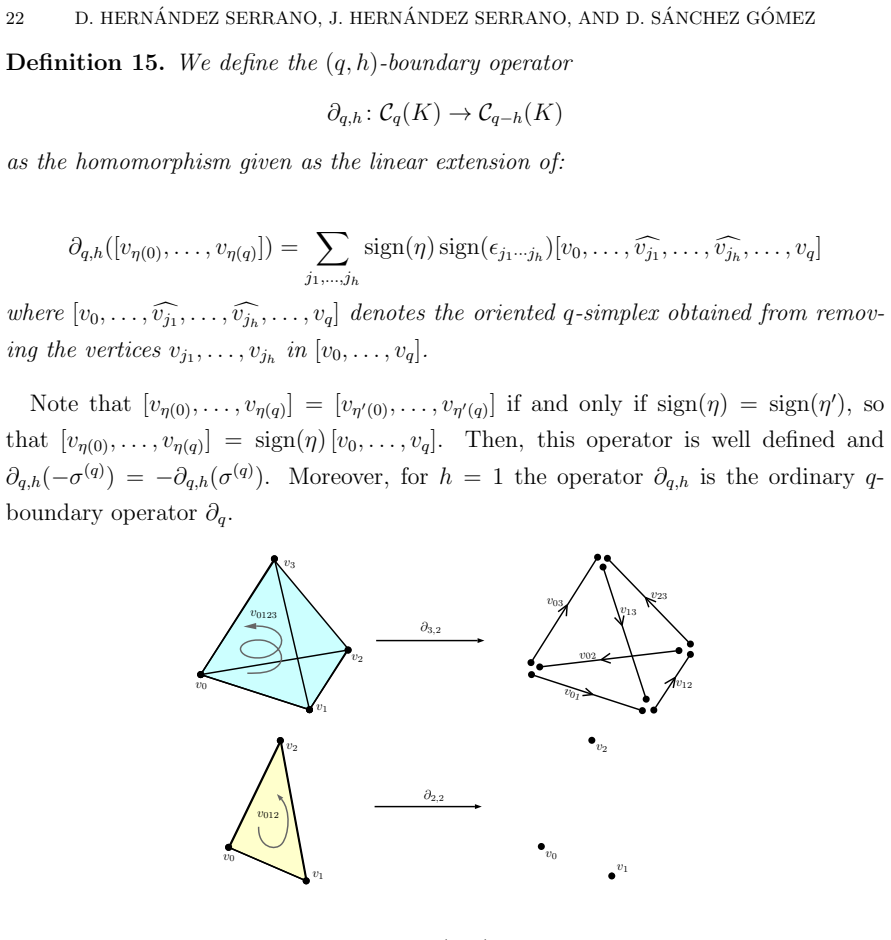
The carrying object is the multi-parameter boundary operator $\partial_{q,h}:C_q(K)\to C_{q-h}(K)$, which removes $h$ vertices from an oriented $q$-simplex with the appropriate signs, together with its adjoint coboundary and the resulting multi-combinatorial Laplacian $\Delta_{q,h,h'}=\partial_{q+h,h}\circ\partial^*_{q+h,h}+\partial^*_{q,h'}\circ\partial_{q,h'}$. It generalizes the graph and $q$-combinatorial Laplacians, and its matrix entries encode the new degrees; the strict $(h,p^*)$-upper degree is further related to the non-strict one by an inclusion-exclusion formula with binomial coefficients. The applied analysis rests on the maximal upper simplicial degree and the maximal simplicial degree of Definition 14, which count distinct facets containing a simplex and, for the latter, also distinct facets containing its strict faces.
What would settle it
Compute the diagonal and off-diagonal entries of $L_{q,h,h'}$ by direct enumeration on a small oriented simplicial complex and compare them with the definitions of the higher-order degrees: any mismatch would falsify Theorem 1. Separately, on a dataset such as congress-bills, remove the 25-node cap (or raise it) and re-fit the maximal upper and maximal simplicial degree distributions; if the more-pronounced decay and the difference from the classical node degree distribution vanish, the empirical claims are falsified.
Extended reading notes
Core claim
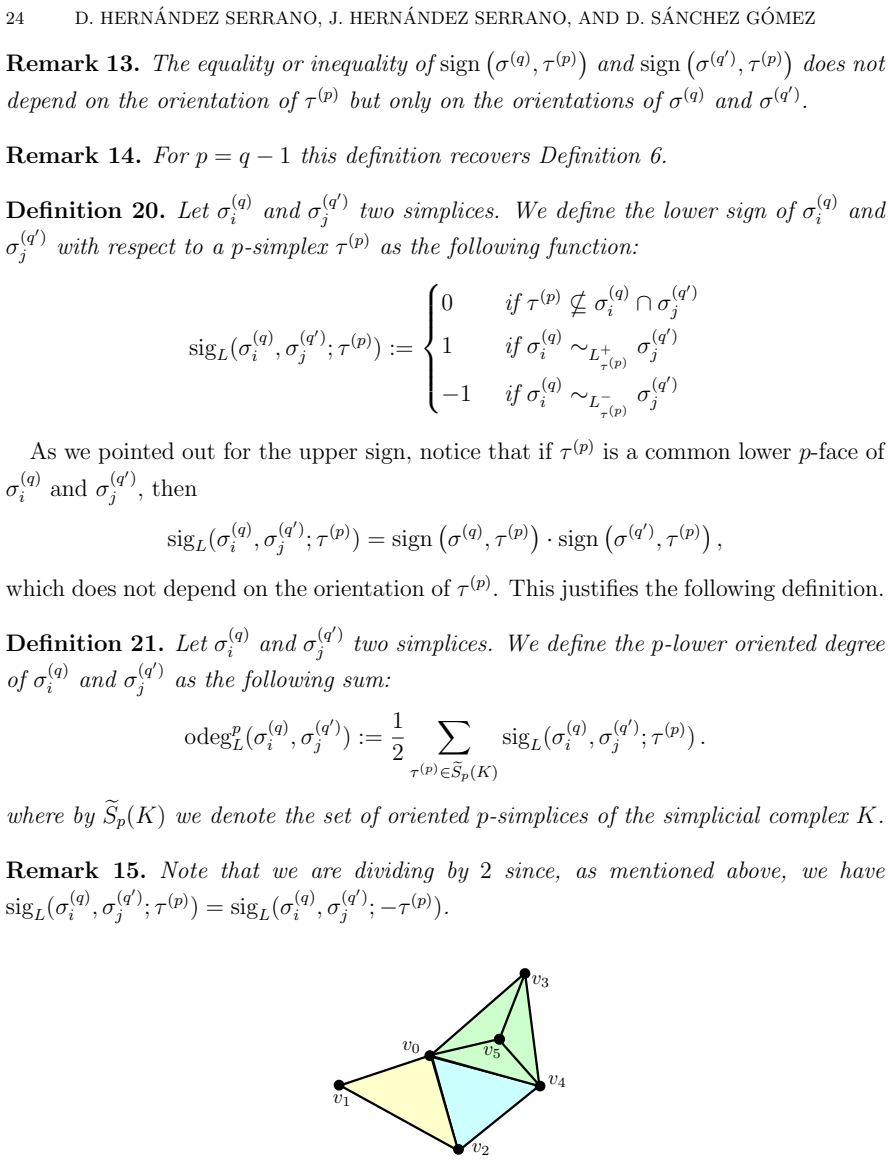
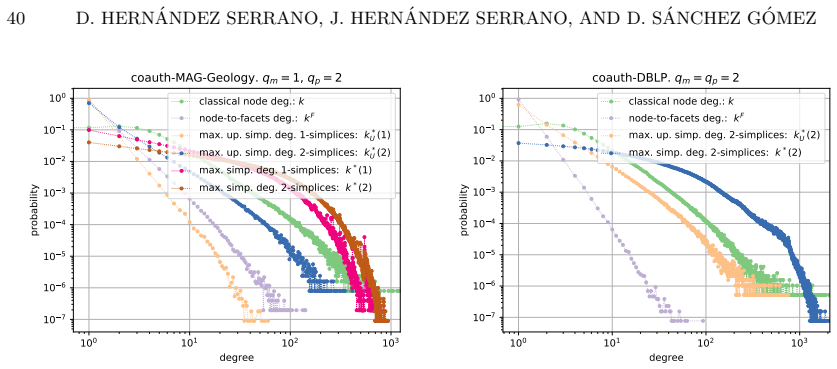
The central claim is Theorem 1: for an oriented simplicial complex, the $(i,j)$-th entry of the multi-combinatorial Laplacian matrix $L_{q,h,h'}=B_{q+h,h}B_{q+h,h}^t+B_{q,h'}^tB_{q,h'}$ is the higher-order upper degree $\deg^{h,q+h}_U(\sigma_i^{(q)})$ plus the lower count $\binom{q+1}{q-h'+1}$ on the diagonal, and the sum of upper and lower oriented degrees off the diagonal. Theorems 2, 3, and 4 give closed formulas for the general $p$-lower degree, $p$-upper degree, and $p$-adjacency (and maximal $p$-adjacency) degrees in terms of products of boundary-matrix entries. Empirically the paper claims that for all 17 datasets the maximal upper simplicial degree distribution is closer to a power law with a more pronounced decay, and that the maximal simplicial degree distribution is generally surprisingly different from the classical node degree distribution, revealing fewer and smaller simplicial hubs.
Load-bearing premise
The empirical conclusions depend on treating the 25-node-truncated, duplicate-free facet lists as faithful enough to compare distribution shapes, and on judging 'closer to a power law' by visual inspection of log-log plots; if either fails, the empirical claims lose support, although the algebraic theorems would stand.
Editorial extensions
If this is right
- The graph Laplacian and the $q$-combinatorial Laplacian are recovered as the $h=h'=1$ case, so the multi-combinatorial Laplacian is a genuine common generalization.
- The 'q-simplex to facets degree' of earlier work, previously left as a searching-and-counting procedure, becomes an explicit sum of strict upper degrees.
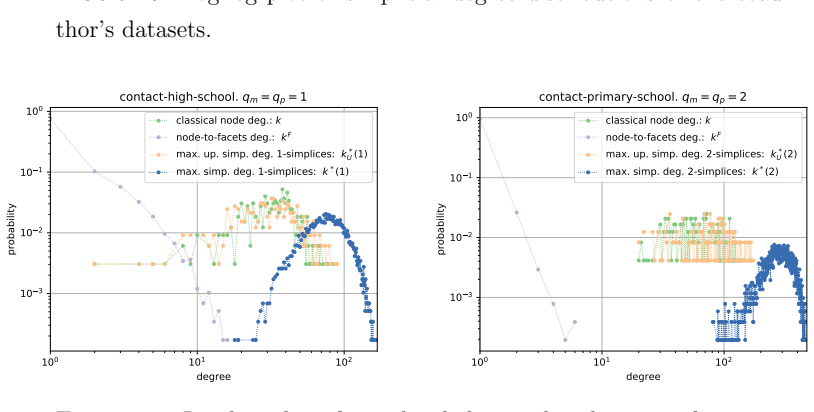
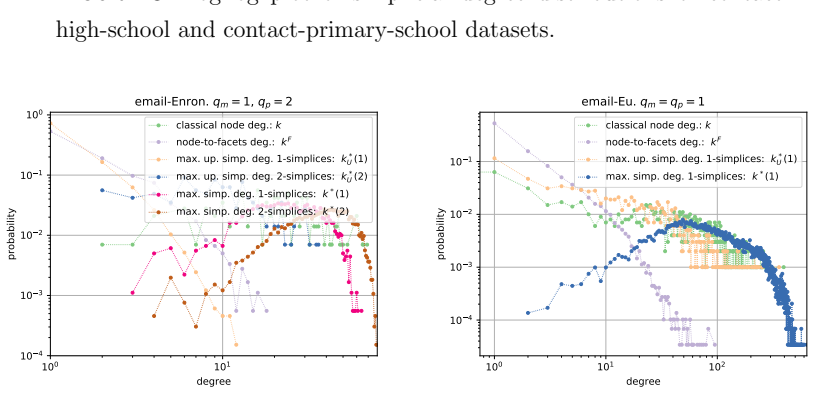
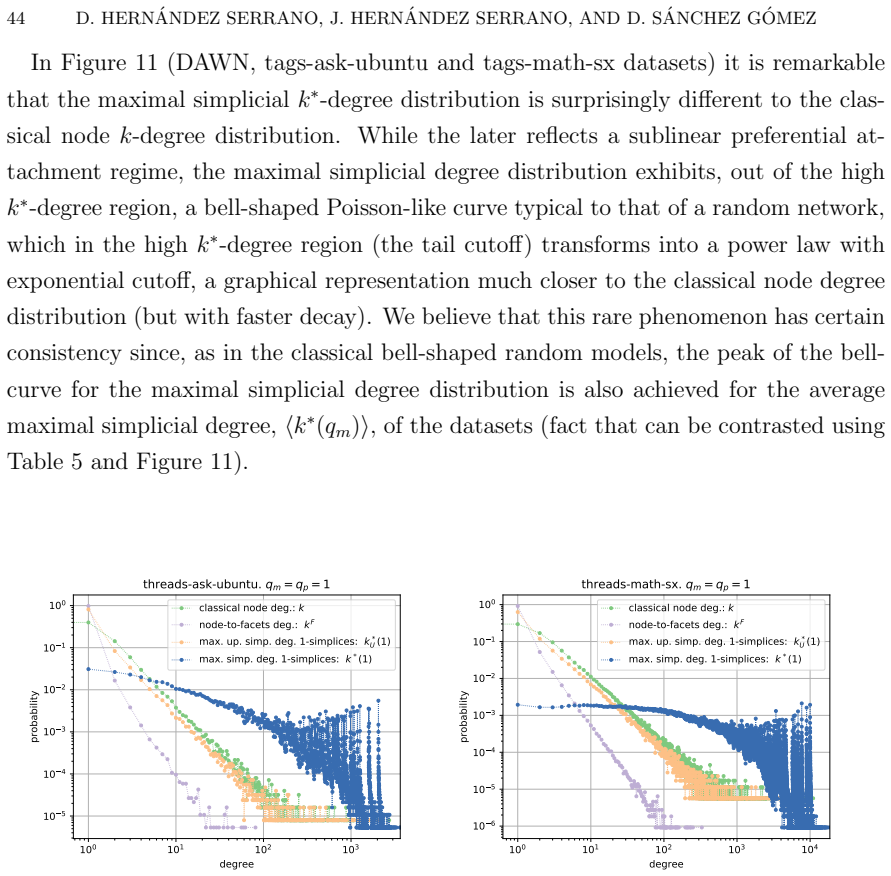
- For all 17 datasets, the maximal upper simplicial degree distribution is closer to a power law with a more pronounced decay, including datasets whose classical node degree is not scale-free.
- The maximal simplicial degree distribution differs in general from the classical node degree distribution, with higher small-degree saturation or bell-shaped random-network behavior.
- Datasets of the same type (coauthorship, email, tags, threads) exhibit similar higher-order connectivity patterns.
Reading between the lines
- If the 25-node cap mostly removes very rare large facets, the qualitative shape comparisons should survive; a direct test would rebuild one coauthorship or congress dataset without the cap and check the distributions.
- Because the multi-parameter boundary operator does not square to zero, its kernel is not ordinary simplicial cohomology; the spectrum of the multi-Laplacian could nonetheless be tested as a new invariant, for instance by checking whether its low eigenvalues change under simplicial subdivision.
- The paper's observation that higher-dimensional simplices show more random-looking degree distributions suggests a testable scaling law: fit the tail exponent $\gamma^*$ as a function of simplex dimension and see whether it increases monotonically toward the random-network value.
Signed reviews
Editorial analysis
A structured set of objections, weighed in public.
Referee Report
Summary. The paper proposes new notions of higher-order lower, upper, and adjacency degrees for simplices of possibly different dimensions in a simplicial complex, together with a 'multi-combinatorial Laplacian' built from multi-parameter boundary operators. Theorem 1 states that the entries of this Laplacian matrix are exactly the new diagonal degrees and oriented off-diagonal adjacency degrees, while Theorems 2-4 give closed formulas for the generalized lower, upper, and adjacency degrees. The authors also apply the newly defined maximal upper and maximal simplicial degrees to 17 real-world datasets from Benson et al., claiming that the maximal upper simplicial degree distribution is closer to a power law with more pronounced decay, and that the maximal simplicial degree distribution is surprisingly different from the classical node degree distribution.
Significance. If the theoretical part is correct, it fills a genuine gap: existing simplicial degree notions mostly compare simplices of the same dimension, whereas this paper gives a unified formalism for arbitrary-dimensional comparisons and encodes several of the resulting degrees as entries of a single Laplacian-type matrix. The algebraic definitions are explicit, Theorem 1 is a direct and checkable computation, and the worked examples help the reader. The connection of formula (9) to the earlier 'q-simplex to facets degree' of Moore et al. is also useful. However, the advertised empirical findings are not currently supported: three of the seventeen datasets are missing from the degree-statistics tables and figures, and the 'closer to a power law' claim is based on visual inspection of log-log plots with no fitting or statistical comparison. The theoretical core is likely salvageable, but the empirical side of the central claims needs substantial reworking or restriction.
major comments (3)
- [Section 5.1, Tables 4-5] The abstract and Section 5.2 state conclusions for '17 real-world datasets', but Tables 4 and 5 report degree statistics for only 14 datasets, and Figures 7-12 cover only 13 datasets. congress-bills, tags-stack-overflow, and threads-stack-overflow are absent without any explanation. This matters because congress-bills is the dataset for which the authors themselves note that the 25-node cap produces a tail that does not tend to zero (Section 5.1, after Table 2), and tags-stack-overflow and threads-stack-overflow are the two largest datasets in Table 1 by number of simplices. The omission must be disclosed, and either the missing tables and figures must be provided or every '17 dataset' claim must be restricted to the 14 datasets actually analyzed.
- [Section 5.2, bullet list and degree-distribution discussion] The statement that 'for every analysed dataset the degree distribution associated with the maximal upper simplicial degree follows a power-law distribution similar to that of the corresponding distributions associated with the classical node and node-to-facets degree, but with a more pronounced decay' is not supported by any quantitative analysis. The evidence is visual inspection of log-log plots: no exponents are estimated, no standard errors or confidence intervals are given, and no comparison is made to alternative distributions or to a fitted power-law baseline. The authors' own caveat in Section 5.2 that 'empirical data is not enough to properly fit real-world degree distributions' and the Section 5.1 warning that the 25-node cap may cause exaggerated tail cutoffs directly undermine the word 'prove' in the bullet list. Please replace the proof language with descriptive observations or provide formal fits and goodness-of-fit tests.
- [Definition 15, Section 4.1] The generalized boundary operator ∂_{q,h} is not unambiguously defined because the summation is written as ∑_{j1,...,jh} without specifying the index set. If the sum ranges over ordered h-tuples, then each (q−h)-face is produced multiple times, which would contradict Example 5, where ∂_{2,2}(v_ijk) is computed as v_i − v_j + v_k with one term per removed vertex. This is load-bearing because the matrices B_{q,h} used in Theorems 1-4 are the matrix representations of this operator. The definition should be clarified by writing, for example, 1 ≤ j1 < ⋯ < jh ≤ q, and the sign convention should be stated consistently with that convention.
minor comments (4)
- [Theorem 3] The statement of Theorem 3 does not require p ≥ q, but the formula uses h = p − q and h′ = p − q′, so if p < q the exponents are negative and the boundary matrices are undefined. Either add the assumption p ≥ q (and p ≥ q′) or state separately that deg_p^U(σ^(q)) = 0 when p < q.
- [Section 5.2, parameter inequality] The displayed inequality γ* ≥ γ*_U ≥ γ_F ≥ γ is presented as if it were read off from the figures, but no degree exponents are estimated anywhere in the paper. This should be explicitly labeled as a tentative observation or removed until actual fits are performed.
- [Reproducibility] The manuscript does not describe the algorithm used to compute the maximal upper and maximal simplicial degrees from the facet lists, nor does it provide code or pseudocode. Since the statistics in Tables 4 and 5 are central to the empirical claims, a brief algorithmic description or a link to code would substantially improve verifiability.
- [Typos and notation] There are several minor typographical issues, including 'ad thus' in Example 1 and 'simplical network' in the conclusions; a careful proofreading pass is recommended.
Circularity Check
No significant circularity: the multi-combinatorial Laplacian and degree formulas are derived from explicit definitions, and the empirical limitations are not reductions of the derivation to its inputs.
full rationale
The theoretical chain is self-contained. Definition 15 defines the (q,h)-boundary operator from face removals and signs, with no reference to the new degree notions; Definition 22 defines the multi-combinatorial Laplacian as a sum of products of this boundary operator and its adjoint. Theorem 1 then proves that the diagonal entries equal the upper/lower degree counts and the off-diagonal entries equal the oriented degrees by expanding the matrix products; this is a direct derivation, not an identity imposed by definition. Theorems 2-4 similarly express degree counts as indicators (min(1, sum of |b||b| terms)) applied to boundary-matrix entries, again reducing to the definitions of lower/upper adjacency. No parameter is fitted to a subset of data and then renamed a prediction. The only self-citation, [24], appears in the conclusions as a pointer to future centrality measures and is not load-bearing for any theorem or empirical claim. The empirical section relies on the external Benson et al. dataset [3] and honestly flags the 25-node cap issue in Section 5.1 after Table 2; the absence of three datasets from Tables 4 and 5 is a completeness gap for the 'for every dataset' assertion, but it does not make any derivation equivalent to its own input. Overall, the derivation chain is non-circular.
Assumptions & free parameters
assumptions (4)
- standard math Standard algebraic topology of oriented simplicial complexes: chain groups, boundary operators, adjoint coboundary operators, and the q-combinatorial Laplacian behave as stated in Munkres and Goldberg.
- domain assumption The 17 datasets, when reduced to unordered distinct simplices, form simplicial complexes whose closed faces represent real interactions; repeated occurrences are ignored.
- domain assumption The 25-node truncation inherited from Benson et al. data is mild enough that tail features of the distributions are interpretable.
- ad hoc to paper Visual inspection of log-log degree distributions is sufficient to conclude that distributions are closer to a power law.
Cite this review
Pith. "Pith review of Simplicial degree in complex networks. Applications of Topological Data Analysis to Network Science." pith.science (2026). https://pith.science/paper/DAD4WC54
@misc{pith2026190802583,
  author       = {Pith},
  title        = {Pith review of: Simplicial degree in complex networks. Applications of Topological Data Analysis to Network Science},
  year         = {2026},
  howpublished = {\url{https://pith.science/paper/DAD4WC54}},
  note         = {Machine review of arXiv:1908.02583}
}
read the original abstract
Network Science provides a universal formalism for modelling and studying complex systems based on pairwise interactions between agents. However, many real networks in the social, biological or computer sciences involve interactions among more than two agents, having thus an inherent structure of a simplicial complex. We propose new notions of higher-order degrees of adjacency for simplices in a simplicial complex, allowing any dimensional comparison among them and their faces, which as far as we know were lacked in the literature. We introduce multi-parameter boundary and coboundary operators in an oriented simplicial complex and also a novel multi-combinatorial Laplacian is defined, which generalises the graph and combinatorial Laplacian. To illustrate the potential applications of these theoretical results, we perform a structural analysis of higher-order connectivity in simplicial-complex networks by studying the associated distributions with these simplicial degrees in 17 real-world datasets coming from different domains such as coauthor networks, cosponsoring Congress bills, contacts in schools, drug abuse warning networks, e-mail networks or publications and users in online forums. We find rich and diverse higher-order connectivity structures and observe that datasets of the same type reflect similar higher-order collaboration patterns. Furthermore, we show that if we use what we have called the maximal simplicial degree (which counts the distinct maximal communities in which our simplex and all its strict sub-communities are contained), then its degree distribution is, in general, surprisingly different from the classical node degree distribution.
Figures


Figures from the paper (9 more)



Forward citations
Cited by 1 Pith paper
-
Centrality measures in simplicial complexes: applications of Topological Data Analysis to Network Science
The paper generalizes graph centrality measures to simplicial complexes using the authors' prior higher-order adjacency framework, but the proposed normalizations contain a binomial counting error.
Reference graph
Works this paper leans on
-
[1]
Atkin, From cohomology in physics to q-connectivity in social science , Internat
R.H. Atkin, From cohomology in physics to q-connectivity in social science , Internat. J. Man- Machine Studies 4 (1972) 139–167
1972
-
[2]
Barab´asi and M
A. Barab´asi and M. P´osfai, Network Science, Cambridge University Press, Cambridge (2016)
2016
-
[3]
Benson, R
A.R. Benson, R. Adebe, M.T.Schaub, A. Jadbabaie and J. Kleinberg, Simplicial closure and higher-order link prediction , Proc. Natl. Acad. Sci. 115(48) (2018)
2018
-
[4]
Barab´asi and A
A. Barab´asi and A. R´eka, Statistical mechanics of complex networks , Rev. Modern Phys. 74, 1 (2002)
2002
-
[5]
M. Belkin and P. Niyogi , Laplacian Eigenmaps for Dimensionality Reduction and Data Rep- resentation, Neural Comp. 15 (2003) 1373-1396
work page 2003
-
[6]
Bianconi and O.T
G. Bianconi and O.T. Courtney , Generalized network structures: The configuration model and the canonical ensemble of simplicial complexes , Phys. Rev. E. 93 (6) (2016)
2016
-
[7]
Bianconi and A.P
G. Bianconi and A.P. Kartun-Giles, Beyond the clustering coefficient: A topological analysis of node neighbourhoods in complex networks , Chaos, Solitons and Fractals: X 1 (2019)
2019
-
[8]
Bullo, Lectures on Network Systems , CreateSpace (2018)
F. Bullo, Lectures on Network Systems , CreateSpace (2018)
work page 2018
Show all 41 references
-
[9]
Carstens and K.J
C.J. Carstens and K.J. Horadam , Persistent homology of collaboration networks , Math. Probl. Eng. (2013)
2013
-
[10]
Chung, The Laplacian of a Hypergraph, in: Expanding Graphs: Proc
F. Chung, The Laplacian of a Hypergraph, in: Expanding Graphs: Proc. DIMACS Ser. Discrete Math. Theoret. Comput. Sci (1993)
1993
-
[11]
Chung, Spectral Graph Theory,in: CBMS Regional Conference Series in Mathematics, No 92, AMS (1996)
F. Chung, Spectral Graph Theory,in: CBMS Regional Conference Series in Mathematics, No 92, AMS (1996)
1996
-
[12]
Chung, H
M.K. Chung, H. Lee, A. DiChristofano, H. Ombao and V. Solo , Exact topological in- ference of the resting-state brain networks in twins , Network Neuroscience, 3(3) (2019) 674–694. SIMPLICIAL DEGREE IN COMPLEX NETWORKS 47
2019
-
[13]
Cvetcovi ´c and S
D. Cvetcovi ´c and S. Simi ´c, Graph Spectra in Computer Science , Linear Algebra and its Applications 434 (6) (2011) 1545–15-62
2011
-
[14]
Ekmann , Harmonische Funktionen und Randwertaufgaben in einem Komplex , Comment
B. Ekmann , Harmonische Funktionen und Randwertaufgaben in einem Komplex , Comment. Math. Helv. 17 (1) (1944) 240–255
1944
-
[15]
Estrada and G.J
E. Estrada and G.J. Ross, Centralities in simplicial complexes. Applications to protein inter- action networks, J. Theoret. Biol. 438 (2018) 46–60
2018
-
[16]
Gameiro, Y
M. Gameiro, Y. Hiraoka, S. Izumi, M. Kramar, K. Mischaikow and V. Nanda , A topological measurement of protein compressibility, Japan J. Indust. Appl. Math 32 (2015) 1–17
2015
-
[17]
Ghrist, Barcodes: The persistent topology of data , Bull
R. Ghrist, Barcodes: The persistent topology of data , Bull. Amer. Math. Soc. 45 (2008), 61–75
2008
-
[18]
Giusti, R
C. Giusti, R. Ghrist and S. Bassett , Two’s company, three (or more) is a simplex , Journal of Computational Neuroscience 41 (1) (2015) 1–14
2015
-
[19]
Giusti, E
C. Giusti, E. Pastalkova, C. Curto and V. Itskov , Clique topology reveals intrinsic geo- metric structure in neural correlations. , Proc. Natl. Acad. Sci. 112 (44) (2015). ,,,,,,,
2015
-
[20]
Goldberg , Combinatorial Laplacians of Simplicial Complexes , Annandale-on-Hudson, New York (2012)
T.E. Goldberg , Combinatorial Laplacians of Simplicial Complexes , Annandale-on-Hudson, New York (2012)
2012
-
[21]
Hansen and R
J. Hansen and R. Ghrist , Toward a spectral theory of cellular sheaves , J. Appl. Comput. Topol. 3 (2018) 315-358
2018
-
[22]
Horak and J
D. Horak and J. Jost , Spectra of combinatorial Laplace operators on simplicial complexes , Adv. Math. 244 (2013) 303–336
2013
-
[23]
Hiraoka, T
Y. Hiraoka, T. Nakamura, A. Hirata, E.G. Escolar, K. Matsue and Y. Nishiura , Hierarchical structures of amorphous solids characterized by persistent homology , Proc. Natl. Acad. Sci.113, 26 (2019) 7035-7040
2019
-
[24]
Hern ´andez Serrano and D
D. Hern ´andez Serrano and D. S ´anchez G ´omez, Centrality measures in simplicial com- plexes: applications of TDA to Network Science , arXiv: 1908.02967[math.AT] (2019)
2019 arXiv
-
[25]
Kusano, K
G. Kusano, K. Fukumizu and Y. Hiraoka, Persistence weighted Gaussian kernel for topolog- ical data analysis , Proceedings of the 33rd International Conference on International Conference on Machine Learning 48 (2016) 2004-2013
2016
-
[26]
Lee, M.K
H. Lee, M.K. Chung, H. Kang, H. Choi, S. Ha, Y. Huh, E. Kim and D.S. Lee , Coiden- tification of Group-Level Hole Structures in Brain Networks via Hodge Laplacian , MICCAI 2019, LNCS 11767 (2019) 674?682
2019
-
[27]
Maletic and M
S. Maletic and M. Rajkovic , Combinatorial Laplacian and entropy of simplicial complexes associated with complex networks , Eur. Phys. J. Special Topics 212 (2012) 77–97
2012
-
[28]
Maletic and M
S. Maletic and M. Rajkovic, Consensus formation on a simplicial complex of opinions , Phys. A 397 (2014) 111–120
2014
-
[29]
Maletic and M
S. Maletic and M. Rajkovic and D. Vasiljevi ´c, Simplicial Complexes of Networks and Their Statistical Properties , In: Bubak M., van Albada G.D., Dongarra J., Sloot P.M.A. (eds) Computational Science ICCS 2008. ICCS 2008. Lecture Notes in Computer Science, vol 5102. Springer,...
2008
-
[30]
Mohar, The Laplacian Spectrum of Graphs, Graph Theory, Combinatorics, and Applications (1991) 871–898
B. Mohar, The Laplacian Spectrum of Graphs, Graph Theory, Combinatorics, and Applications (1991) 871–898. 48 D. HERN ´ANDEZ SERRANO, J. HERN ´ANDEZ SERRANO, AND D. S ´ANCHEZ G ´OMEZ
1991
-
[31]
Moore, R.J
T.J. Moore, R.J. Drost, and A. Swami , The Communications and Networks Collaborative Technology Alliance Publication Network: A Case Study on Graph and Simplicial Complex Anal- ysis, Computational and Information Sciences Directorate, ARL, US Army research Laboratory (2015)
2015
-
[32]
Muhammad and M
A. Muhammad and M. Egerstedt, Control Using higher-order Laplacians in Network Topolo- gies, Proc. of 17th International Symposium on Mathematical Theory of Networks and Systems, Kyoto (2006) 1024–1038
2006
-
[33]
Mukherjee and J
S. Mukherjee and J. Steenbergen , Random walks on simplicial complexes and harmonics , Random Struct. Algorithms (2013)
2013
-
[34]
J. R. Munkres , Elements of algebraic topology , Addison-Wesley Publishing Company, Menlo Park, CA, 1984
1984
-
[35]
Patania and P
A. Patania and P. Giovanni and F. Vaccarino , The shape of collaborations , EPJ Data Science 6(1) (2017)
2017
-
[36]
Parzanchevski and R
O. Parzanchevski and R. Rosenthal, Simplicial complexes: Spectrum, homology and random walks, Random Struct. Algorithms 50 (2) (2017) 225-261
2017
-
[37]
Petri, P
G. Petri, P. Expert, F. Turkheimer, R. Carhart-Harris, D. Nutt, P.J. Hellyer and F. Vaccarino, Homological scaffolds of brain functional networks, J. R. Soc. Interface 11 (2014)
2014
-
[38]
Sizemore, J.E
A.E. Sizemore, J.E. Phillips-Cremins, R. Ghrist and S. Bassett , The importance of the whole: topological data analysis for the network neuroscientist , Network Neuroscience 3(3) (2019) 656–673
2019
-
[39]
Xia and G.W
K. Xia and G.W. Wei, Persistent homology analysis of protein structure, flexibility and folding , Int. J. Numer. Methods Biomed. Eng. 30 (8) (2014) 814–844
2014
-
[40]
Xia and G.W
K. Xia and G.W. Wei, Multidimensional persistence in biomolecular data , IJ. Comput. Chem. 36 (20) (2015) 1502–1520
2015
-
[41]
Appendix We give in this section the proofs of Theorems 2, 3 and 4. 7.1. Proof of Theorem 2. Let p,h and h′ be non negative integers, put q = p + h, q′ = p + h′ and fix {τ (q′) 1 ,...,τ (q′) m },{σ(q) 1 ,...,σ (q) n } and{γ(p) 1 ,...,γ (p) r } basis ofCq′(K), Cq(K) andCp(K) res...
Reviewed August 14, 2026 · model on record in the stance chip above.
Discussion (0). Continue with ORCID to comment.