REVIEW 3 major objections 5 minor 12 references
On Flying Backwards: Preventing Run-away of Small, Low-speed, Fixed-wing UAVs in Strong Winds
T0 review · 3 major / 5 minor · reviewed 2026-08-14 · deepseek-v4-flash
Pith's one-line read This paper claims that a nonlinear, wind-aware guidance law with airspeed reference compensation can prevent small, low-speed fixed-wing UAVs from being blown backwards off their path in winds exceeding the aircraft's airspeed, with…
desk verdict The airspeed compensation is a real new piece of practical guidance logic and the flight data back it up, but the formal safety guarantee is inherited from prior work and does not cover the modified closed loop. read the letter →
The pith
A machine-rendered reading of the paper's core claim, the machinery that carries it, and where it could break.
The reading
What carries the argument
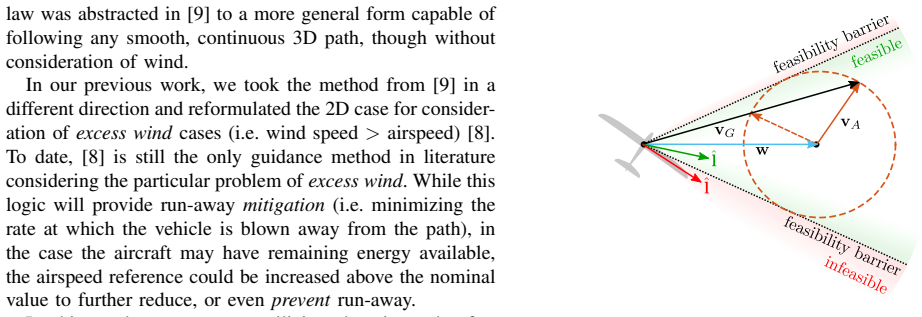
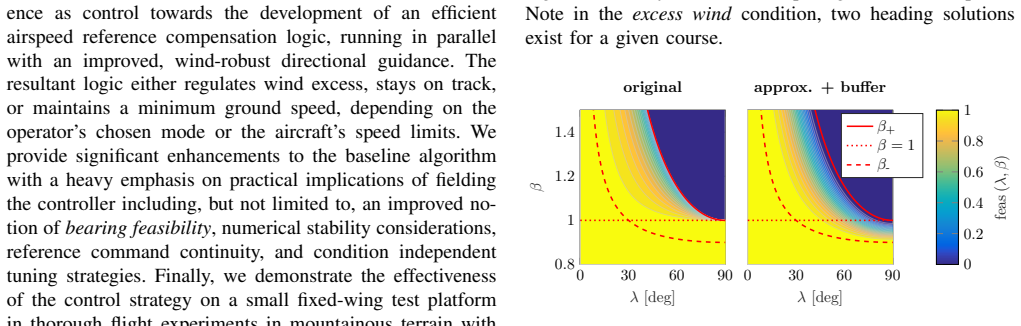
The load-bearing object is the bearing feasibility function $\mathrm{feas}(\lambda,\beta)$ — a smooth approximation of the "feasibility cone" that marks which ground courses are attainable when wind speed approaches or exceeds airspeed. It is computed from the wind ratio $\beta = w/v_A$ and the angle $\lambda$ between the wind and the desired bearing, with a tunable buffer zone below $\beta=1$ to keep commands continuous at the critical boundary. This single function is used everywhere: it rotates the feasible look-ahead vector, zeroes out curvature corrections near the boundary, and gates the airspeed increments and the adaptive gain $k_{adj}$ that ensures curvature convergence. The second piece of machinery is the airspeed reference compensator, which adds wind-excess and track-error increments to the nominal airspeed ref, saturating at $v_{A,max}$, and augments $\beta$ to $\beta_G$ when minimum forward ground speed is commanded.
What would settle it
Run the same controller with the airspeed compensation loop disabled while wind exceeds airspeed: if the aircraft diverges from the path instead of converging to the safety heading, the assumed carry-over of the safety-objective convergence proof is falsified. Alternatively, in simulation, bias the wind estimate by a constant 1 m/s: if steady-state track error grows linearly with the bias rather than remaining bounded, the claimed robustness to wind-estimate error is not supported.
Extended reading notes
Core claim
The paper's central discovery is that run-away can be prevented by reformulating the guidance law in air-mass coordinates and by treating "bearing feasibility" as a smooth, continuous quantity rather than a binary one. For a bearing defined by angle $\lambda$ between the wind vector and the desired course, and wind ratio $\beta = w/v_A$, the feasibility function $\mathrm{feas}(\lambda,\beta)$ transitions smoothly from 1 (fully feasible) to 0 (infeasible), with a deliberately added buffer zone near $\beta = 1$ to avoid command jumping when gusts cross the critical line. In feasible conditions, the ground-based look-ahead vector is rotated by the wind-triangle angle $x = \sin^{-1}(\beta \sin \lambda)$ to produce an air-mass relative heading reference, with an added curvature correction term; in infeasible conditions, the controller switches to a "safety" look-ahead vector that faces the aircraft against the wind, the strategy proven in the authors' prior work to minimize the rate of run-away. Running in parallel is an airspeed reference compensation loop: a wind-excess increment $\Delta v^w_A$ and a track-error increment $\Delta v^e_A$ raise the airspeed only as much as is needed to stay on track, and a minimum-forward-ground-speed mode augments the wind ratio to $\beta_G = (w + v_{G,min})/v_A$ so that the same feasibility logic enforces forward progress.
Load-bearing premise
The convergence proof for the "safety" (infeasible-bearing) control law is taken from the authors' earlier paper [8] and is assumed to still hold after they changed the feasibility function, added adaptive gain scheduling, and added airspeed reference compensation, without a fresh proof or simulation of the combined closed loop.
Editorial extensions
If this is right
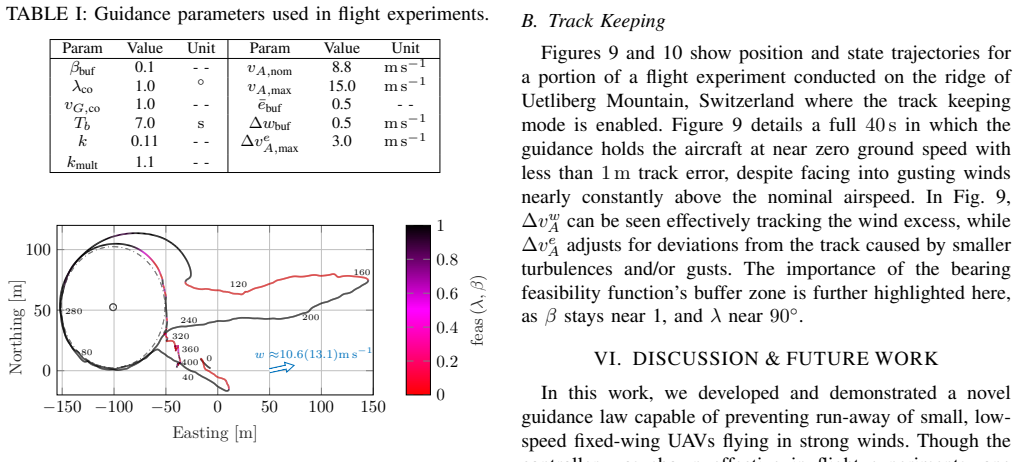
- Small, low-speed fixed-wing UAVs can maintain track-keeping errors below 1 meter in winds that gust above the aircraft's nominal airspeed, as demonstrated in flight over mountain terrain.
- A commanded minimum forward ground speed can be maintained by raising the airspeed reference only when needed, with a demonstrated mean undershoot of about 0.5 m/s.
- The same guidance law works continuously from calm conditions through the excess-wind regime, because the feasibility buffer zone and smooth saturation remove reference command discontinuities.
- The algorithm runs on a low-cost autopilot (168 MHz MCU, 192 kB RAM) with a standard sensor suite, so it is deployable without model-based assumptions or special hardware.
- When track keeping is enabled, the aircraft can hold near-zero forward ground speed while facing into gusts above nominal airspeed, effectively loitering in place.
Reading between the lines
- If the stability carry-over from [8] is valid, the buffer-zone feasibility shaping should generalize to other constraint-boundary problems, such as obstacle/no-fly-zone avoidance, where smooth transition between feasible and infeasible actions is needed.
- The method's practical effectiveness appears to hinge on the quality of the online wind estimate; the paper's own discussion implies a testable scaling law between wind-estimation noise tuning and tracking performance, which could be made quantitative.
- The minimum-forward-ground-speed trick of augmenting $\beta_G = (w + v_{G,min})/v_A$ is a compact feed-forward mechanism that could be extended to envelope protection (e.g. staying above a stall-speed margin) by reinterpreting $v_{G,min}$ as a safety margin on ground progress.
- The stall incident reported at $t=135$ s suggests the next natural extension is coupling the lateral guidance with longitudinal/angle-of-attack protection; a longitudinal controller that shares the wind estimate and feasibility signal could prevent the low-level stall that the current architecture leaves unguarded.
Signed reviews
Editorial analysis
A structured set of objections, weighed in public.
Referee Report
Summary. The paper proposes a lateral-directional guidance law for small, low-speed fixed-wing UAVs that explicitly accounts for online wind estimates, together with an airspeed reference compensation scheme for excess-wind conditions (wind speed at or above airspeed). The directional guidance law modifies the authors' earlier work in [8] by introducing a smooth buffered feasibility function, an adaptive lateral gain, and curvature-rotation improvements. The airspeed compensation logic adds speed increments based on wind excess, track error, and a minimum forward ground speed requirement. The claims are supported by two flight experiments in mountainous terrain with gusts up to 13 m/s, reporting track-keeping errors below 1 m in a 40 s segment and a mean ground-speed undershoot of 0.5 m/s over a longer period.
Significance. If the claims hold, the paper addresses a genuine operational gap for small BVLOS fixed-wing UAVs: maintaining path tracking when wind speeds approach or exceed airspeed. The practical contribution is strong: the algorithm runs on a low-cost Pixhawk platform, uses only standard sensor suites, and the flight results show a level of performance that is notable for the platform class. The paper also provides useful engineering enhancements, such as a smooth feasibility transition, a curvature-rotation limiter, and a clearly tabulated parameter set. However, the theoretical support for the central safety claim is substantially inherited from the authors' prior paper [8] and is not re-established for the modified closed loop. The experimental evidence, while valuable, is limited in duration and scope relative to the strength of the abstract claims. The paper is therefore of interest to the community, but the gap between the claimed guarantee and the provided analysis and data needs to be closed or the claims need to be substantially qualified.
major comments (3)
- [III-C, Eq. (28)] The statement that the convergence analysis of the safety objective (28) 'may be found in [8] which is similarly applicable to the present formulation' is not sufficient support for the central claim. The present closed loop differs from [8] in three ways that affect the Lyapunov argument: the feasibility function is replaced by the buffered approximation (4)-(6), the lateral gain is state- and wind-dependent through (31), and the airspeed reference becomes a time-varying control through (33)-(40). The safety objective (28) treats the airspeed vector as an equilibrium quantity aligned opposite to the wind; once airspeed is actively commanded by (37), the convergence proof in [8] does not automatically transfer. Please provide a re-derivation for the modified controller or, at minimum, a numerical stability study over the claimed operating envelope.
- [IV, Eqs. (33)-(40)] The airspeed compensation logic is presented heuristically; no equilibrium or convergence analysis is given for the combined system with the infeasible-bearing law. In particular, the claim that the logic 'enables either mitigation, prevention, or over-powering of excess wind induced run-away' requires that the equilibrium vG = 0, e = 0 is stable under the saturated increments in (33)-(37). Because these increments enter a feedback loop with the directional guidance and the lower-level attitude/airspeed loops, the absence of any stability argument or simulation leaves the general prevention claim unsupported. The flight data show one 40 s track-keeping segment and one 7 min flight, which is not enough to establish the general behavior.
- [V, Figs. 8-10] The experimental evidence is not yet sufficient for the strength of the abstract claims. Figure 10 covers a single 40 s track-keeping period, and the stall event at (VI) in Fig. 8 shows that the closed loop can lose stabilization precisely in the excess-wind regime the paper targets. The paper should either report aggregate statistics over repeated runs (mean and worst-case track error, duration in excess wind) or explicitly restrict the claims to the demonstrated conditions. In particular, the sentence 'track-keeping errors of less than 1 meter consistently maintained during a representative duration' should be tied to the full dataset, not to one segment.
minor comments (5)
- [V, text near 'eachother'] The phrase 'compatible with eachother' contains a typo; it should read 'compatible with each other'.
- [Table I, row for vG,co] The parameter vG,co appears as a ground-speed cutoff in Eq. (12), but the table lists its value as '1.0 - -' without a unit. The units should be stated clearly; presumably m/s.
- [Eq. (38)] The definition betaG = (w + vG,min)/vA is confusing because w and vA are vector norms in the rest of the paper; please add norms or clarify the notation.
- [Fig. 3] The labels beta+ and beta- are used in the right panel of Fig. 3 before the corresponding equations are introduced; defining them in the caption or introducing them before the figure would improve readability.
- [Section III-D, Eq. (30)] The derivation of the k bound from (29) is only sketched; adding one line showing the substitution of vG0 = vA + w and lambda0 = 0 into the arcsine argument would make the inequality in (30) easier to verify.
Circularity Check
No circular derivation: the new guidance and airspeed-compensation results are validated by independent flight data; the only self-citation is the inherited infeasible-bearing convergence proof, which is a rigor transfer rather than a circular reduction.
full rationale
The paper's central empirical claims—track-keeping errors below 1 m and a mean forward-ground-speed undershoot of 0.51 m/s—are measured flight outcomes, not quantities fitted from the data they are used to explain. All guidance parameters in Table I are fixed beforehand and held constant across both flight tests, and the control equations in Secs. II-IV define command generation without assuming those outcomes. The derived quantities, such as the feasibility function approximation (Eqs. 4-6), the adaptive gain (Eqs. 31-32), and the airspeed increments (Eqs. 33-40), are introduced as controller design, not as predictions recovered from the experiments. The only potentially load-bearing self-citation is in Sec. III-C: 'Convergence analysis of the safety objectives (28) defined for look-ahead law (27) may be found in [8] which is similarly applicable to the present formulation.' This cites the authors' prior peer-reviewed work for the infeasible-bearing convergence, and the transfer to the modified feasibility function, adaptive gain, and airspeed compensation is not re-derived. That is a correctness/rigor gap—the modifications alter the closed-loop dynamics, so the cited proof does not automatically cover the present controller—but it is not a circular reduction: the new contributions are not defined in terms of the experimental endpoints, and the flight data provide independent evidence. No equation reduces to its inputs by construction, no fitted parameter is renamed as a prediction, and no known empirical result is merely relabeled. Score 2 reflects the one minor self-citation, which is not the source of the paper's new empirical predictions.
Assumptions & free parameters
free parameters (11)
- beta_buf =
0.1
- lambda_co =
1.0 deg
- vG_co =
1.0 (unit not specified in table)
- T_b =
7.0 s
- k =
0.11
- k_mult =
1.1
- vA_nom =
8.8 m/s
- vA_max =
15.0 m/s
- ebar_buf =
0.5
- Delta_w_buf =
0.5 m/s
- Delta_v_e_A_max =
3.0 m/s
assumptions (4)
- domain assumption Quasi-steady wind assumption: wind is constant over the guidance-loop timescale.
- domain assumption Coordinated-turn/unicycle model: normal acceleration commands are applied about the airspeed vector and roll angle is derived from the coordinated turn assumption.
- ad hoc to paper The safety-objective convergence proof from [8] transfers unchanged to the present modified guidance law.
- standard math The arcsine argument in the curvature rotation (Eq. 23) remains within the domain [-1, 1] under the adaptive gain bound (Eq. 30).
Cite this review
Pith. "Pith review of On Flying Backwards: Preventing Run-away of Small, Low-speed, Fixed-wing UAVs in Strong Winds." pith.science (2026). https://pith.science/paper/DBCUU2KS
@misc{pith2026190801381,
  author       = {Pith},
  title        = {Pith review of: On Flying Backwards: Preventing Run-away of Small, Low-speed, Fixed-wing UAVs in Strong Winds},
  year         = {2026},
  howpublished = {\url{https://pith.science/paper/DBCUU2KS}},
  note         = {Machine review of arXiv:1908.01381}
}
read the original abstract
Small, low-speed fixed-wing Unmanned Aerial Vehicles (UAVs) operating autonomously, beyond-visual-line-of-sight (BVLOS) will inevitably encounter winds rising to levels near or exceeding the vehicles' nominal airspeed. In this paper, we develop a nonlinear lateral-directional path following guidance law with explicit consideration of online wind estimates. Energy efficient airspeed reference compensation logic is developed for excess wind scenarios (i.e. when the wind speed rises above the airspeed), enabling either mitigation, prevention, or over-powering of excess wind induced run-away from a given path. The developed guidance law is demonstrated on a representative small, low-speed test UAV in two flight experiments conducted in mountainous regions of Switzerland with strong, turbulent wind conditions, gusts reaching up to 13 meters per second. We demonstrate track-keeping errors of less than 1 meter consistently maintained during a representative duration of gusting, excess winds and a mean ground speed undershoot of 0.5 meters per second from the commanded minimum forward ground speed demonstrated in over 5 minutes of the showcased flight results.
Figures

Figures from the paper (6 more)




Reference graph
Works this paper leans on
- [8]
-
[1]
S. Park, J. Deyst and J. P. How
11em plus .33em minus .07em @technote 4000 4000 100 4000 4000 500 `\.=1000 = #1 #1 #1 0pt [0pt][0pt] #1 * \| ** #1 \@IEEEauthorblockNstyle \@IEEEauthorblockAstyle \@IEEEauthordefaulttextstyle \@IEEEauthorblockconfadjspace -0.25em \@IEEEauthorblockNtopspace 0.0ex \@IEEEauthorblockAtopspace 0.0ex \@IEEEauthorblockNinterlinespace 2.6ex \@IEEEauthorblockAinte...
arXiv 2007
-
[2]
P. Oettershagen, T. Stastny, T. Hinzmann, K. Rudin, T. Mantel, A. Melzer, B. Wawrzacz, G. Hitz, and R. Siegwart, ``Robotic technologies for solar-powered uavs: Fully autonomous updraft-aware aerial sensing for multiday search-and-rescue missions,'' Journal of Field Robotics , vol. 35, no. 4, pp. 612--640, 2018
work page 2018
- [3]
- [4]
-
[5]
H. G. de Marina , Y. A. Kapitanyuk , M. Bronz , G. Hattenberger , and M. Cao , ``Guidance algorithm for smooth trajectory tracking of a fixed wing uav flying in wind flows,'' in 2017 IEEE International Conference on Robotics and Automation (ICRA) , pp. 5740--5745, May 2017
work page 2017
-
[6]
R. W. Beard, J. Ferrin, and J. Humpherys, ``Fixed wing uav path following in wind with input constraints,'' IEEE Transactions on Control Systems Technology , vol. 22, pp. 2103--2117, Nov 2014
work page 2014
-
[7]
S. Park, J. Deyst and J. P. How , ``Performance and lyapunov stability of a nonlinear path following guidance method,'' Journal of Guidance, Control, and Dynamics , vol. 30, no. 6, pp. 1718--1728, 2007
work page 2007
Show all 12 references
-
[9]
Furieri, T
L. Furieri, T. Stastny, L. Marconi, R. Siegwart, and I. Gilitschenski, ``Gone with the wind: Nonlinear guidance for small fixed-wing aircraft in arbitrarily strong windfields,'' in 2017 American Control Conference (ACC) , pp. 4254--4261, May 2017
2017
-
[10]
N. Cho, Y. Kim, and S. Park, ``Three-dimensional nonlinear differential geometric path-following guidance law,'' Journal of Guidance, Control, and Dynamics , 2015
2015
-
[11]
Stastny and R
T. Stastny and R. Siegwart , ``Nonlinear model predictive guidance for fixed-wing uavs using identified control augmented dynamics,'' in 2018 International Conference on Unmanned Aircraft Systems (ICUAS) , pp. 432--442, June 2018
2018
-
[12]
K. R. Bruce, J. R. Kelly, and L. H. Person, `` NASA B737 flight test results of the total energy control system,'' AIAA Guidance Navigation and Control (GNC) Conference , 1987
1987
Reviewed August 14, 2026 · model on record in the stance chip above.
Discussion (0). Continue with ORCID to comment.