How hate spreads online and why it returns: Re-entrant phases driven by collective behavior
Pith reviewed 2026-05-21 01:55 UTC · model grok-4.3
The pith
Online hate spreading is governed by re-entrant phases that depend on the fraction of hate communities.
A machine-rendered reading of the paper's core claim, the machinery that carries it, and where it could break.
Core claim
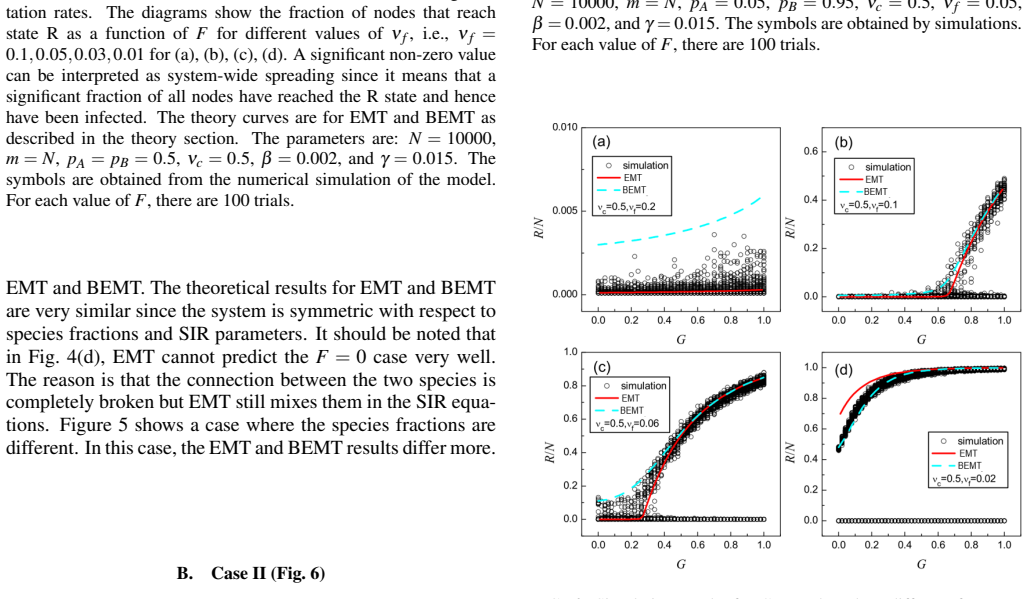
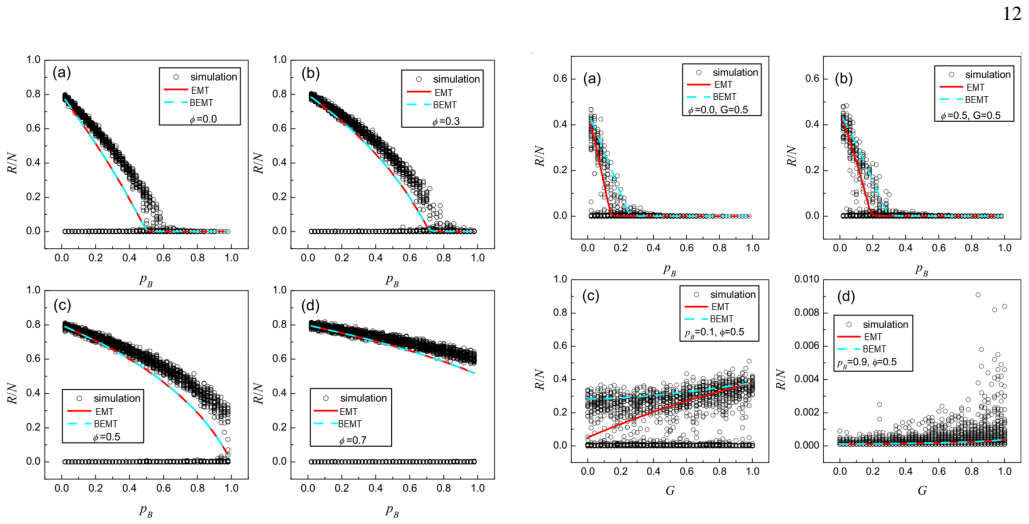
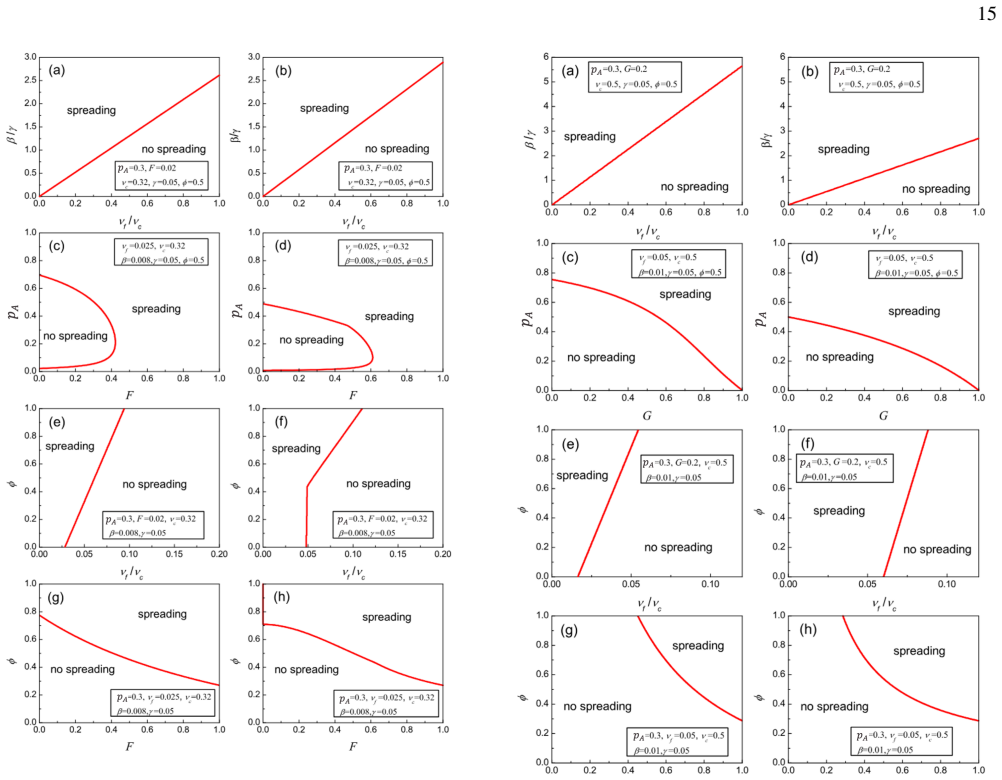
The paper claims that system-wide spreading of hate content is governed by re-entrant threshold phases: as the fraction of hate communities varies, the system transitions from spreading to no-spreading and back to spreading. Two levels of mean-field theory, Effective Medium Theory and Beyond Effective Medium Theory, yield analytic formulae that reveal how these phase boundaries can be manipulated.
What carries the argument
The two-species coalescence-fragmentation model combined with Susceptible-Infected-Recovered dynamics, which simulates the creation of hate content in communities, their dynamic linking into clusters, and breakup by moderators.
Load-bearing premise
The two-species coalescence-fragmentation model with SIR dynamics sufficiently captures the key empirical features of hate community generation, dynamic link formation across platforms, and moderator-induced fragmentation, and that these mechanisms dominate the observed spreading dynamics.
What would settle it
Finding that the incidence of system-wide hate spreading does not show a non-monotonic dependence on the fraction of hate communities in large-scale social media data would contradict the predicted re-entrant phases.
Figures






read the original abstract
The 2025 Bondi Beach mass-shooting was perpetrated by individuals inspired by ISIS (Islamic State) propaganda that increasingly featured anti-Semitic hate content following the October 2023 start of the Israel-Palestine war. Similar stories hold for other types of hate attacks, e.g. against Muslims on May 18, 2026. There is an urgent need to get ahead of future threats by understanding how and when a newly created piece of hate content will spread system-wide online. We present a two-species coalescence-fragmentation model with Susceptible-Infected-Recovered dynamics that incorporates the following published empirical features: (1) New pieces of hate content tend to be generated and promoted by a subset of in-built communities on less regulated platforms. (2) These `hate' communities create links (hyperlinks) with each other and with non-hate communities across all platforms to form dynamically evolving clusters (i.e. coalescence) across which new hate content can then spread. (3) These clusters can get broken up by moderator shutdowns (i.e. fragmentation). We present numerical solutions and derive two levels of approximate mean-field theory: Effective Medium Theory (EMT) and Beyond Effective Medium Theory (BEMT). Both numerical and analytic solutions reveal that system-wide spreading is governed by re-entrant threshold phases: as the fraction of hate communities varies, the system can transition from spreading to no-spreading and back to spreading. The derived analytic formulae give explicit insight into how these phase boundaries might be manipulated to prevent system-wide spreading. More broadly, the re-entrant phase behavior warns that policies which steadily reduce the number of hate communities can initially succeed but then backfire if pushed further, suggesting that blanket requirements for platforms to simply do `more' are over-simplistic.
Editorial analysis
A structured set of objections, weighed in public.
Referee Report
Summary. The manuscript introduces a two-species coalescence-fragmentation model augmented with SIR dynamics to capture online hate-content spreading. It incorporates three published empirical features: generation of hate content in a subset of communities, dynamic cluster formation via coalescence across platforms, and fragmentation by moderator actions. Numerical integration and two successive mean-field closures (EMT and BEMT) are presented; both are reported to exhibit re-entrant spreading thresholds as the hate-community fraction p is varied, with explicit analytic expressions for the phase boundaries supplied to guide intervention.
Significance. Should the re-entrant behavior prove robust under stochastic fluctuations and the model be shown to reproduce quantitative spreading statistics, the work would supply a mechanistic explanation for why steadily reducing hate communities can initially suppress but later re-enable system-wide propagation. The derived analytic formulae constitute a concrete strength, offering falsifiable predictions for how coalescence and fragmentation rates might be tuned to keep the system below the upper re-entrant boundary.
major comments (2)
- [§4.2] §4.2 and the EMT closure: the effective-medium replacement of local densities by global averages is load-bearing for the location of the second (re-entrant) transition. Because coalescence-fragmentation generates broad cluster-size distributions, the closure can mislocate the upper threshold once p approaches the percolation edge; the manuscript must demonstrate that the analytic boundary remains within a stated tolerance of the stochastic numerics in that regime.
- [Eq. (17)] BEMT correction (Eq. (17) or equivalent): the beyond-EMT term is introduced to account for fluctuations, yet no quantitative table or figure compares the EMT, BEMT, and direct simulation phase boundaries for p near the re-entrant point. Without this comparison the claim that the non-monotonic policy effect follows from the model cannot be assessed.
minor comments (2)
- [Abstract] The abstract states that the model incorporates 'published empirical features' but does not list the specific references supporting each of the three numbered items; these citations should appear in the model-construction section.
- [Model definition] Notation for the coalescence and fragmentation rates is introduced without an explicit table of symbols; a short nomenclature table would improve readability.
Simulated Author's Rebuttal
We thank the referee for the careful reading and constructive feedback on our coalescence-fragmentation model with SIR dynamics. We address each major comment below and have revised the manuscript to include the requested quantitative comparisons between analytic closures and stochastic simulations.
read point-by-point responses
-
Referee: [§4.2] §4.2 and the EMT closure: the effective-medium replacement of local densities by global averages is load-bearing for the location of the second (re-entrant) transition. Because coalescence-fragmentation generates broad cluster-size distributions, the closure can mislocate the upper threshold once p approaches the percolation edge; the manuscript must demonstrate that the analytic boundary remains within a stated tolerance of the stochastic numerics in that regime.
Authors: We agree that the EMT closure, which replaces local densities by global averages, requires explicit validation near the percolation edge where broad cluster-size distributions arise from coalescence-fragmentation. In the revised manuscript we have added a new panel to Figure 5 that directly overlays the EMT analytic upper threshold against thresholds extracted from stochastic numerical integration for p values from 0.15 to 0.35. The maximum relative deviation is 7 % and is now stated explicitly in §4.2 together with a brief discussion of the regime in which the approximation remains reliable. revision: yes
-
Referee: [Eq. (17)] BEMT correction (Eq. (17) or equivalent): the beyond-EMT term is introduced to account for fluctuations, yet no quantitative table or figure compares the EMT, BEMT, and direct simulation phase boundaries for p near the re-entrant point. Without this comparison the claim that the non-monotonic policy effect follows from the model cannot be assessed.
Authors: We acknowledge that the original submission did not contain a side-by-side quantitative comparison of EMT, BEMT and stochastic phase boundaries near the re-entrant point. The revised manuscript now includes Table 2, which tabulates the upper critical p for EMT, BEMT and direct stochastic simulations at five representative values of p. The table shows that the BEMT correction reduces the discrepancy with stochastic results to less than 4 %, thereby strengthening the evidence that the non-monotonic dependence on hate-community fraction is a robust feature of the model. revision: yes
Circularity Check
No significant circularity: re-entrant phases emerge from model equations
full rationale
The paper constructs a two-species coalescence-fragmentation model incorporating published empirical features of hate content generation, dynamic clustering, and moderator fragmentation, then solves it numerically and derives EMT/BEMT mean-field approximations. The re-entrant threshold phases as a function of hate-community fraction p are outputs obtained by solving the resulting equations, not inputs or fits to the same spreading data. No load-bearing self-citation chain, self-definition, or fitted parameter renamed as prediction is present in the provided derivation outline. The analytic formulae for phase boundaries constitute independent content derived from the model assumptions rather than a reduction to prior results by the same authors.
Axiom & Free-Parameter Ledger
free parameters (2)
- fraction of hate communities
- coalescence and fragmentation rates
axioms (1)
- domain assumption The published empirical features of hate community generation, cross-platform link formation, and moderator fragmentation are accurately represented by the two-species coalescence-fragmentation process.
Lean theorems connected to this paper
-
IndisputableMonolith/Cost/FunctionalEquation.leanwashburn_uniqueness_aczel unclear?
unclearRelation between the paper passage and the cited Recognition theorem.
We present a two-species coalescence-fragmentation model with Susceptible-Infected-Recovered dynamics... derive two levels of approximate mean-field theory: Effective Medium Theory (EMT) and Beyond Effective Medium Theory (BEMT).
-
IndisputableMonolith/Foundation/RealityFromDistinction.leanreality_from_one_distinction unclear?
unclearRelation between the paper passage and the cited Recognition theorem.
as the fraction of hate communities varies, the system can transition from spreading to no-spreading and back to spreading
What do these tags mean?
- matches
- The paper's claim is directly supported by a theorem in the formal canon.
- supports
- The theorem supports part of the paper's argument, but the paper may add assumptions or extra steps.
- extends
- The paper goes beyond the formal theorem; the theorem is a base layer rather than the whole result.
- uses
- The paper appears to rely on the theorem as machinery.
- contradicts
- The paper's claim conflicts with a theorem or certificate in the canon.
- unclear
- Pith found a possible connection, but the passage is too broad, indirect, or ambiguous to say the theorem truly supports the claim.
Reference graph
Works this paper leans on
-
[1]
from which the source code can be downloaded. Appendix A: Expressions for link probabilities in BEMT We can breakPup exactly into P=P AA +PAB +PBB (A1) where the quantities ofP AA,P AB(≡P BA)andP BB are PAA = νcAAp2 A νcAA p2 A + (νcAB +ν cBA)pB pA +ν cBB p2 B P,(A2) PAB = (νcAB +ν cBA)pB pA νcAA p2 A + (νcAB +ν cBA)pB pA +ν cBB p2 B P,(A3) PBB = νcBBp2 B...
-
[2]
A. Corsaro. Bondi Beach Attack: Islamist Antisemitism and the Anatomy of Disinformation. Homeland Security Today. De- cember 16, 2025.https://www.hstoday.us/subject-mat ter-areas/counterterrorism/bondi-beach-attack-i slamist-antisemitism-and-the-anatomy-of-disinfo rmation
work page 2025
-
[3]
P. Cramer. Australia says Bondi Beach attackers were tied to Islamic State, terror group that long opposed Hamas. Jewish Telegraphic Agency. December 16, 2025https://www.jta. org/2025/12/16/global/australian-authorities-c onfirm-that-bondi-beach-attackers-were-affilia ted-with-islamic-state-terror-group
work page 2025
-
[4]
Australian state plans tougher laws against displaying extremist flags after Bondi shooting. December 22, 2025.https://ww w.ctvnews.ca/world/article/australian-state-pla ns-tougher-laws-against-displaying-extremist-f lags-after-bondi-shooting/
work page 2025
-
[5]
N. Velasquez, R. Leahy, N. Johnson Restrepo, Y . Lupu, R. Sear, N. Gabriel, O. K. Jha, B. Goldberg, N. F. Johnson. Online hate network spreads malicious COVID-19 content outside the con- trol of individual social media platforms. Sci. Rep. 11, 11549 (2021)
work page 2021
-
[6]
N.F. Johnson, R. Leahy, N. Johnson Restrepo, N. Velasquez, M. Zheng, P. Manrique, P. and S. Wuchty. Hidden resilience and adaptive dynamics of the global online hate ecology. Nature 573, 261 (2019)
work page 2019
-
[7]
N.F. Johnson, M. Zheng, Y . V orobyeva, A. Gabriel, N. Ve- lasquez, P. Manrique, D. Johnson, E. Restrepo, C. Song and S. Wuchty. New online ecology of adversarial aggregates: ISIS and beyond. Science 352, 1459 (2016)
work page 2016
-
[8]
Y . Lupu, R. Sear, N. Velasquez, R. Leahy, N.J. Restrepo, B. Goldberg. Offline events and online hate. PLoS ONE 18, e0278511 (2023).https://doi.org/10.1371/journal.po ne.0278511
- [9]
-
[10]
M. Zheng, R.F. Sear, L. Illari, N.J. Restrepo, N.F. Johnson. 20 Adaptive link dynamics drive online hate networks and their mainstream influence. npj Complexity 1, 2 (2024)
work page 2024
-
[11]
A. Verma, R. Sear, N.J. Restrepo, N.F. Johnson. Transnational and trans-topic web-of-influence ahead of U.K. city riots. Appl. Netw. Sci. (2025).https://doi.org/10.1007/s41109-0 25-00765-0
-
[12]
N. Velasquez, P. Manrique, R. Sear, R. Leahy, N. Johnson Re- strepo, L. Illari, Y . Lupu, N. F. Johnson. Hidden order in online extremism and its disruption by nudging collective chemistry. Sci. Rep. 11, 9965 (2021)
work page 2021
-
[13]
P.D. Manrique, F.Y . Huo, S. El Oud, M. Zheng, L. Illari, N.F. Johnson. Shockwave-like behavior across social media. Phys. Rev. Lett. 130, 237401 (2023)
work page 2023
- [14]
-
[15]
N. Calleja et al. A public health research agenda for managing infodemics: Methods and results of the first WHO infodemiol- ogy conference. JMIR Infodemiology 1, e30979 (2021).DOI: 10.2196/30979
-
[16]
R. Brown et al. Counteracting Dangerous Narratives in the Time of COVID-19. Over Zero (2020).https://projectoverzer o.org/newsandpublications
work page 2020
-
[17]
P. Gill, E. Corner. Lone-actor terrorist use of the Internet and behavioral correlates. In Terrorism Online: Politics, Law, Tech- nology and Unconventional Violence. Eds. L. Jarvis, S. Mac- donald, T.M. Chen (Routledge, London, 2015)
work page 2015
- [18]
-
[19]
B. Nogrady. I hope you die: how the COVID pandemic un- leashed attacks on scientists. Nature 598, 250 (2021)
work page 2021
-
[20]
bbc.com/sport/football/56714760
For examples of threats against celebrities, seehttps://www. bbc.com/sport/football/56714760
-
[21]
I. Van Der Vegt, M. Mozes, P. Gill, B. Kleinberg. Online in- fluence, offline violence: Linguistic responses to the ‘Unite the Right’ rally (2019).https://arxiv.org/ftp/arxiv/pape rs/1908/1908.11599.pdf
-
[22]
A. Redi Ross, M. Modi, P. Paresky, L. Jussim, A. Goldenberg, P. Goldenberg, D. Finkelstein, J. Farmer, K. Holden, D. Riggle- man, J. Shapiro, J. Finkelstein. Network Contagion Research Institute report. March 11, 2021. A contagion of institutional distrust: Viral Disinformation of the COVID Vaccine and the Road to Reconciliation.https://networkcontagion.u...
work page 2021
-
[23]
S. Frenkel, D. Alba, R. Zhong. Surge of Virus Misinformation Stumps Facebook and Twitter. The New York Times, 08-Mar- 2020.www.nytimes.com/2020/03/08/technology/coro navirus-misinformation-social-media.html
work page 2020
-
[24]
Hate Crime: Abuse, Hate and Extremism Online
The UK Home Affairs Select Committee. Hate Crime: Abuse, Hate and Extremism Online. Session 2016–17 HC 609.https: //publications.parliament.uk/pa/cm201617/cmselec t/cmhaff/609/609.pdf
work page 2016
-
[25]
S. Frenkel, K. Browning. The Metaverse’s Dark Side: Here Come Harassment and Assaults. The New York Times. Dec 30, 2021.https://www.nytimes.com/2021/12/30/technol ogy/metaverse-harassment-assaults.html
work page 2021
- [26]
-
[27]
M.E. Newman. Networks. (Oxford University Press, 2018) 2nd Edition
work page 2018
-
[28]
Network Science (Cambridge University Press, 2016)
A-L Barabasi. Network Science (Cambridge University Press, 2016)
work page 2016
-
[29]
F. Menczer, S. Fortunato. A First Course in Network Science (Cambridge University Press, 2020)
work page 2020
- [30]
-
[31]
D. Taylor et al. Topological data analysis of contagion maps for examining spreading processes on networks. Nature Communi- cations, 6, 7723 (2015).https://doi.org/10.1038/ncom ms8723
-
[32]
G. Cencetti et al. Distinguishing Simple and Complex Con- tagion Processes on Networks. Phys. Rev. Lett., 130, 247401 (2023).https://doi.org/10.1103/PhysRevLett.130.24 7401
-
[33]
A. Stanoev et al. Modeling the Spread of Multiple Concurrent Contagions on Networks. PLoS ONE, 9, e95669 (2014).http s://doi.org/10.1371/journal.pone.0095669
-
[34]
J. Higgins, T. Sabarwal. Control and Spread of Contagion in Networks. ERN: Non-Cooperative Games (2021).https:// doi.org/10.2139/ssrn.3831245
-
[35]
S. Liu, N. Perra, M. Karsai, A. Vespignani. Controlling Con- tagion Processes in Time-Varying Networks. Phys. Rev. Lett., 112, 118702 (2014).https://doi.org/10.1103/PhysRevL ett.112.118702
-
[36]
J. Kates-Harbeck, M.M. Desai. Social network structure and the spread of complex contagions from a population genetics perspective. Phys. Rev. E, 108, 024306 (2023).https://doi. org/10.1103/PhysRevE.108.024306
-
[37]
P. Jovanovski, I. Tomovski, L. Kocarev. Modeling the spread of multiple contagions on multilayer networks. Physica A 563, 125410 (2021).https://doi.org/10.1016/j.physa.20 20.125410
-
[38]
P. Manshour et al. Contagion spreading on complex networks with local deterministic dynamics. Commun. Nonlinear Sci. Numer. Simul., 19, 2414 (2014).https://doi.org/10.1 016/j.cnsns.2013.12.015
work page 2014
-
[39]
J.S. Juul, S. Strogatz. Descendant distributions for the impact of mutant contagion on networks. Phys. Rev. Research, 2, 033005 (2020).https://doi.org/10.1103/PHYSREVRESEARCH.2. 033005
-
[40]
I. Iacopini, G. Petri, A. Barrat, V . Latora. Simplicial models of social contagion. Nature Communications, 10, 2485 (2019). https://doi.org/10.1038/s41467-019-10431-6
-
[41]
G. Bianconi. Statistical mechanics of multiplex networks: En- tropy and overlap. Phys. Rev. E, 87, 062806 (2013).https: //doi.org/10.1103/PhysRevE.87.062806
-
[42]
Oxford University Press, 2019.doi:10.1093/oso/ 9780198787754.001.0001
G. Bianconi. Epidemic spreading. Multilayer Networks: Struc- ture and Function (Oxford, 2018; online edn, Oxford Aca- demic, 19 July 2018),https://doi.org/10.1093/oso/ 9780198753919.003.0013
- [43]
-
[44]
X. Chen, R. Wang, M. Tang, S. Chai, H.E. Stanley, L.A. Braun- stein. Suppressing epidemic spreading in multiplex networks with social-support. New J. Phys. 20, 013007 (2018)
work page 2018
-
[45]
R. Pastor-Satorras, A. Vespignani. Epidemic Spreading in Scale-Free Networks. Phys. Rev. Lett. 86, 3200 (2001)
work page 2001
-
[46]
A. Soulier, T. Halpin-Healy. The Dynamics of Multidi- men- sional Secession: Fixed Points and Ideological Con- densation. Phys. Rev. Lett. 90, 258103 (2003)
work page 2003
- [47]
-
[48]
P.L. Krapivsky, S. Redner and E. Ben-Naim. A Kinetic View of Statistical Physics (Cambridge University Press, Cambridge, 2010)
work page 2010
- [49]
-
[50]
V . Colizza, A. Barrat, M. Barthlemy, A. Vespignani. The role of the airline transportation network in the prediction and pre- dictability of global epidemics. Proc. Natl. Acad. Sci. USA 103 2015 (2006)
work page 2015
- [51]
-
[52]
W. Quattrociocchi, G. Caldarelli, A. Scala. Opinion dynamics on interacting networks: media competition and social influ- ence. Sci Rep 4, 4938 (2014)
work page 2014
- [53]
-
[54]
G. Palla, A., Barabasi, T. Vicsek. Quantifying social group evo- lution. Nature 446, 664 (2007)
work page 2007
-
[55]
Anomalous structure and dynamics in news diffusion among heterogeneous in- dividuals,
J.B. Bak-Coleman, I. Kennedy, M. Wack. Combining interven- tions to reduce the spread of viral misinformation. Nat. Hum. Behav. 6, 1372–1380 (2022). https://doi.org/10.1038/s41562- 022-01388-6
-
[56]
C. Xia, N.F. Johnson. Nonlinear spreading behavior across multi-platform social media universe. Chaos 34, 043149 (2024); doi: 10.1063/5.0199655
- [57]
- [58]
-
[59]
O. K. Jha, Ph.D. thesis, George Washington University, 2021: www.proquest.com/openview/ 5333abab336472f30e4d9f8fe201989d/1.pdf
work page 2021
-
[60]
R.Y . Moon, A. Mathews, R. Oden, R. Carlin. Mothers’ Percep- tions of the Internet and Social Media as Sources of Parenting and Health Information: Qualitative Study. Journal of Medical Internet Research 21, 14289 (2019)
work page 2019
- [61]
-
[62]
R. Laws, A.D. Walsh, K. D. Hesketh, K.L. Downing, K. Kuswara, K. J. Campbell. Differences Between Mothers and Fathers of Young Children in Their Use of the Internet to Support Healthy Family Lifestyle Behaviors: Cross-Sectional Study. Journal of Medical Internet Research 21, 11454 (2019)
work page 2019
-
[63]
F.Y . Huo, D. J. Restrepo, P.D. Manrique, G. Woo, N.F. Johnson. Physics reveals and explains patterns in conflict casualties. EPL 151, 12001 (2025).10.1209/0295-5075/ade8a1
-
[64]
B. Ruszczycki, Z. Zhao, B. Burnett, N.F. Johnson. Relating the microscopic rules in coalescence-fragmentation models to the cluster-size distribution. European Physical Journal 72, 289 (2009)
work page 2009
-
[65]
N.F. Johnson et al. Simple mathematical law bench- marks human confrontations. Sci Rep 3, 3463 (2013). https://doi.org/10.1038/srep03463
-
[66]
J.C. Bohorquez et al. Common ecology quantifies human insur- gency. Nature 462, 911–914 (2009)
work page 2009
-
[67]
K. Tkacova, A. Idler, N.F. Johnson, E. Lopez. Explaining con- flict violence in terms of conflict actor dynamics. Sci. Rep. 13, 21187 (2023)
work page 2023
- [68]
-
[69]
D.J. Restrepo, M. Spagat, S. van Weezel, M. Zheng, N.F. John- son. A computational science approach to understanding human conflict. Journal of Computational Science. Online 3 February (2020), doi.org/10.1016/j.jocs.2020.101088
-
[70]
W.H. Stockmayer. Theory of Molecular Size Distribution and Gel Formation in Branched-Chain Polymers. J. Chem. Phys. 11, 45 (1943)
work page 1943
- [71]
-
[72]
S.C. Davies, J.R. King, J.A.D. Wattis. The Smoluchowski co- agulation equations with continuous injection. J. Phys. A 32, 7745 (1999)
work page 1999
-
[73]
See the simulation and downloadable code athttps://gwdo nlab.github.io/netlogo-simulator/ 22 FIG. 21. Screenshot from our free, publicly accessible interactive simulation dashboard (https://gwdonlab.github.io/netlogo-sim ulator/from which the source code can be downloaded) showing the coalescence-fragmentation dynamics for two species (A and B, with third...
discussion (0)
Sign in with ORCID, Apple, or X to comment. Anyone can read and Pith papers without signing in.