REVIEW 3 major objections 5 minor 39 references
Observation of the electric Breit-Rabi Effect
T0 review · 3 major / 5 minor · reviewed 2026-08-06 · deepseek-v4-flash
Pith's one-line read The electric Breit-Rabi effect is observed for the first time in 171Yb hyperfine transitions.
desk verdict A credible first direct measurement of the electric Breit-Rabi effect; the E4 case is solid, the E6 claim lacks a reported significance test, and the field calibration rests on one 1995 reference value. read the letter →
The pith
A machine-rendered reading of the paper's core claim, the machinery that carries it, and where it could break.
The reading
What carries the argument
The central object is the electric Breit-Rabi formula, the closed-form eigenvalue of the coupled hyperfine-plus-Stark Hamiltonian in the basis of hyperfine states with the same $m_F$. The $2\times2$ matrix contains off-diagonal tensor coupling $-\alpha_t E^2/\sqrt{2}$ between $|3/2,\pm1/2\rangle$ and $|1/2,\pm1/2\rangle$; diagonalizing it produces the square-root form above. The unmixed stretched states provide the linear-in-$E^2$ reference, and the same eigenvectors determine the field-dependent E1 transition rates that the paper verifies through the ratio of the two spectral peaks.
What would settle it
A decisive check would be to measure the same $^{171}$Yb $6s6p\ {}^1P_1$ Stark shifts with the electric field calibrated by an independent method, for example an electrode pair whose gap is measured to better than 0.1% or a second reference transition with an accurately known Stark rate; if the field scale shifted by more than 0.14 (kV/cm)/kV, the residuals of the electric Breit-Rabi fit would develop visible $E^4$ and $E^6$ structure.
Extended reading notes
Core claim
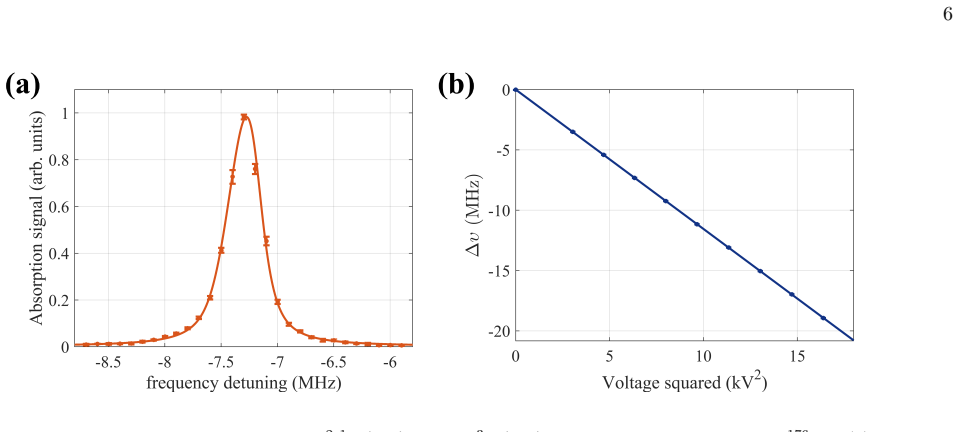
The central discovery is that the hyperfine levels of the $6s6p\ {}^1P_1$ state of $^{171}$Yb mix under a DC electric field exactly as a two-state Hamiltonian predicts, producing high-order Stark shifts. Diagonalizing $H_\mathrm{hfs}+H_S$ in the $m_F=\pm1/2$ manifold gives the electric Breit-Rabi formula $$f_{F',m'_F}(E)=\pm \frac{1}{4}\left[\alpha_t $E^{2}$+3A_\mathrm{hfs}-3A_\mathrm{hfs}\sqrt{1+\frac{2}{3}x+$x^{2}$}\right],\quad x=\frac{\alpha_t $E^{2}$}{A_\mathrm{hfs}},$$ while the stretched $|3/2,\pm3/2\rangle$ states stay unmixed and shift linearly with $E^2$. Measured transition shifts from $x=0$ to $x=0.9$ follow this curve; polynomial fits require $E^4$ and $E^6$ terms and show no $E^8$ term above noise. Fitting yields $\alpha_t=-19.35(8)(6)$ kHz/(kV/cm)$^2$ and $\Delta\alpha_s=57.99(7)(19)$ kHz/(kV/cm)$^2$, and the hyperfine constant $A_\mathrm{hfs}=-212.4(1)$ MHz.
Load-bearing premise
The load-bearing premise is that the absolute electric field at the atoms is correctly set by calibrating against the published Stark shift rate of the $^{176}$Yb $3P_1$ transition; the paper notes that a geometric calibration of the electrode gap agrees only at 1.4 $\sigma$ with a 5% uncertainty, so the spectroscopic reference carries the whole field scale.
Editorial extensions
If this is right
- The electric Breit-Rabi formula supplies parameter-free predictions for hyperfine-level Stark shifts in the intermediate-field regime, so no separate $E^4$ or $E^6$ polarizability coefficients are needed.
- The measured $\alpha_t$ and $\Delta\alpha_s$ for the $6s6p\ {}^1P_1$ level provide data relevant to blackbody-radiation shift evaluation in ytterbium optical clocks.
- The observed field-dependent transition rates confirm the same state-mixing eigenvectors that produce the energy shifts, giving a second observable to compare with theory.
- The nonlinear field dependence offers new tuning knobs for reducing the sensitivity of hyperfine or Zeeman level differences to electric-field fluctuations, analogous to magnetic magic conditions used in trapped-ion qubits and frequency standards.
Reading between the lines
- Beyond the paper, repeating the measurement on $^{173}$Yb ($I=5/2$) or on other atoms with small hyperfine splittings should reveal a richer set of avoided crossings and a more structured field dependence than the $2\times2$ case tested here.
- Beyond the paper, the field-dependent transition-rate ratio the paper measures could be developed into an in-situ electric-field sensor that reads field strength from a line-intensity ratio rather than from a frequency shift.
- Beyond the paper, because the electric-field scale is anchored to a 30-year-old published Stark shift rate, a future measurement with an independently calibrated field, or a more accurate theoretical value for the $^{176}$Yb reference transition, would test whether the quantitative agreement with the Breit-Rabi formula persists.
- Beyond the paper, at still higher fields the same diagonalization predicts corrections beyond $E^6$; locating where they appear, or where the mixed eigenstates approach their asymptotic limits, would extend the verification into the strong-field regime.
Signed reviews
Editorial analysis
A structured set of objections, weighed in public.
Referee Report
Summary. The paper reports measurements of the DC Stark shift of the 6s^2 ^1S_0 ↔ 6s6p ^1P_1 transition in ^171Yb (I=1/2) for cold atoms held in an optical dipole trap in static electric fields up to 120 kV/cm. The authors observe that the hyperfine-resolved transition shifts deviate from a purely quadratic dependence on E, and they interpret the nonlinearity as the electric analogue of the Breit-Rabi formula, with high-order E^4 and E^6 terms arising from Stark-induced mixing between hyperfine states of the same m_F. They also extract the static tensor polarizability α_t and differential scalar polarizability Δα_s of the 6s6p ^1P_1 level, and find agreement with previous work on Yb isotopes. The paper includes a derivation of the 2×2 diagonalization, a description of the apparatus and spectroscopy, and a residual analysis intended to demonstrate the presence of E^4 and E^6 contributions.
Significance. If the central claim is fully substantiated, this would be the first direct experimental observation of the electric Breit-Rabi effect, completing the experimental analogue of the magnetic-field Breit-Rabi formula for the Stark interaction. The reported precision in α_t and Δα_s is competitive with earlier determinations, and the use of cold atoms with absorption imaging is a genuine technical strength that suppresses quantum-interference systematics. The residual analysis in Fig. 4(c–e) is model-independent and provides robust evidence for an E^4 term, and the measured hyperfine splitting A_hfs = −212.4(1) MHz is consistent with prior work. However, the paper currently markets both E^4 and E^6 in the title and abstract, and the E^6 evidence is only qualitative. Because α_t is fitted from the same shift curves and A_hfs is measured in the same apparatus, the agreement with Eq. (12) tests the functional form with one free parameter rather than providing a parameter-free prediction of the high-order coefficients. These issues are fixable with additional analysis, and the manuscript is a strong candidate for publication after revision.
major comments (3)
- [Section V, Fig. 4(c–e)] The evidence for the E^6 term is not quantified. The text states that after a β2 E^2 fit the residuals “appear as a quadratic polynomial of E^2” and after adding β4 E^4 they “form a cubic polynomial of E^2”, but no β4 or β6 coefficient, no standard error, and no chi-square comparison are reported. Please report the fitted coefficients and uncertainties for the β2, β2+β4, and β2+β4+β6 models, specify the data sets included in each residual plot, and provide a statistical significance test (e.g., Δχ^2 or an F-test) for β6. Without this, the title and abstract claim that both E^4 and E^6 shifts are observed is not supported by the reported analysis.
- [Section III and Section VII, field calibration] The absolute electric-field scale is fixed by the 1995 Li–van Wijngaarden Stark-rate measurement for the ^176Yb ^3P_1 transition, and the geometric electrode calibration agrees with the spectroscopic calibration at only 1.4σ with a 5% uncertainty. Because α_t and Δα_s are fitted amplitudes, a scale error would rescale all extracted quantities and the x-range. Please propagate the calibration uncertainty through the Breit-Rabi fit and show how the agreement with Eq. (4) and the extracted polarizabilities would change under a ±5% error in the field scale. Presenting the residual analysis in terms of applied voltage as well as field would make the E^4/E^6 curvature visibly independent of the calibration.
- [Section V, Eq. (12) and Table I] The agreement with Eq. (12) is not a parameter-free test of the electric Breit-Rabi effect: α_t is obtained by fitting the same shift data, and A_hfs is measured in the same apparatus at zero field. The empirical β4 and β6 coefficients from the polynomial fits should be compared explicitly with the values implied by the fitted α_t and A_hfs, and the text should state that the test is of the functional form with one free parameter rather than a prediction of the absolute magnitude of the E^4 and E^6 terms.
minor comments (5)
- [Eq. (7)] Please verify the typesetting of the diagonal matrix elements in Eq. (7); as rendered, the F'=3/2 entries appear to be A_hfs rather than A_hfs/2, which would be inconsistent with the zero-field eigenvalues in Eq. (8).
- [References] References [10] and [37] are the same Schmieder paper, and references [31] and [39] are the same Kawamura paper; these duplicates should be consolidated.
- [Section VI and Section VII] The section heading “CONLCUSION” contains a typo, and Section VII contains the phrase “an conversion factor”; both should be corrected.
- [Fig. 4 caption] The caption for Fig. 4(c–e) should specify the color coding of the data sets and state whether the stretched-state data points are included in the polynomial fits, since the main text refers generically to “the data in Fig. 4(a)”.
- [Section VI] The statement that this work “completes the experimental verification of the Stark effect” overreaches; the Stark effect has been verified in many contexts. It would be more precise to say that it completes the experimental verification of the Breit-Rabi form of the Stark effect.
Circularity Check
No circular derivation: the electric Breit-Rabi observation is a fit-consistency test with external consistency checks, not a parameter-free prediction, and no load-bearing self-citation or tautological reduction was found.
full rationale
The paper's derivation chain is self-contained. Equation (4) follows by direct diagonalization of H_tot = A_hfs I·J + H_S in the SI (Eqs. 5–8, 11), a standard algebraic result not imported from the authors' prior work. The high-order E4/E6 terms are not claimed as parameter-free predictions: the paper explicitly says it obtains α_t and Δα_s 'by fitting' Eq. 3 (Section V), and the same α_t then sets the scale of the nonlinear part. This is a fit-consistency test, not a tautology, because a purely linear-in-E2 model with the same fitted parameters would not reproduce the observed curvature; the functional form of f(E) is an independent constraint. The fitted α_t = −19.35(10) is consistent with the independent value −19.47(17) from Kawamura et al., providing external support. A_hfs = −212.4(1) MHz is measured at zero field in the same apparatus and is not derived from the Stark data. The electric-field calibration uses the 1995 Li and van Wijngaarden measurement of the I = 0 isotope 176Yb, which is external and does not involve hyperfine mixing; a scale error would rescale α_t but leaves x = α_t E^2/A_hfs invariant, so the shape test is robust. The residual-polynomial analysis in Fig. 4(c–e) is a diagnostic (a β_2-only fit leaves quadratic residuals if E4 is present) rather than a circular reduction of the Breit-Rabi formula. The lack of a reported β_6 coefficient and uncertainty is an evidence-strength and statistical-significance concern for the E6 claim, not a circularity. No load-bearing self-citations were found; the only co-authored citation ([28], magic wavelength for the ODT) is incidental to the setup. Accordingly, the central claim does not reduce to its inputs by construction.
Assumptions & free parameters
free parameters (5)
- alpha_t (static tensor polarizability of 6s6p 1P1) =
-19.35 +/- 0.08 stat +/- 0.06 syst kHz/(kV/cm)^2
- Delta_alpha_s (differential static scalar polarizability) =
57.99 +/- 0.07 stat +/- 0.19 syst kHz/(kV/cm)^2
- K_stretched (2nd-order differential Stark rate, stretched transition) =
-19.43 +/- 0.01 stat +/- 0.06 syst kHz/(kV/cm)^2
- E-field conversion factor (kV/cm per kV) =
8.655(14)
- Polynomial coefficients beta_2, beta_4, beta_6 =
not quoted
assumptions (6)
- domain assumption The Stark interaction is described by the effective Hamiltonian H_S = -(1/2)(alpha_s I + alpha_t Q) E^2 in the I-J coupled basis (Eq. 1 and Eq. 5), with all opposite-parity mixing absorbed into alpha_s and alpha_t.
- domain assumption The hyperfine interaction contains only the magnetic dipole term A_hfs I.J; the electric quadrupole term vanishes for I = 1/2.
- domain assumption alpha_t and alpha_s are independent of E over 0 to 120 kV/cm (no hyperpolarizability contamination of the E4/E6 structure).
- domain assumption At the 20 mG bias field, Zeeman shifts of about 30 kHz are symmetric in +/- m_F and only broaden, not shift, the line centers.
- domain assumption A_hfs is unchanged by the electric field; the zero-field value -212.4(1) MHz is applied at all fields.
- domain assumption Residual light shifts are absent: the ODT is switched off 2 ms before exposure and the 399 nm probe is far below saturation (50 uW/cm^2 vs 58 mW/cm^2).
Cite this review
Pith. "Pith review of Observation of the electric Breit-Rabi Effect." pith.science (2026). https://pith.science/paper/DD3CIA5K
@misc{pith2026250708278,
  author       = {Pith},
  title        = {Pith review of: Observation of the electric Breit-Rabi Effect},
  year         = {2026},
  howpublished = {\url{https://pith.science/paper/DD3CIA5K}},
  note         = {Machine review of arXiv:2507.08278}
}
abstract
The response of an atom to external electric and magnetic fields can reveal fundamental atomic properties. It has long been verified that, in a static magnetic field, those atomic energy levels with hyperfine interactions shift according to the Breit-Rabi formula, which introduces nonlinear dependence on the magnetic field. On the other hand, the corresponding Breit-Rabi dependence on a static electric field has not been observed before due to a combination of experimental challenges. Here we precisely measure the Stark shift of the $6s^2\ ^1S_0\ \leftrightarrow\ 6s6p\ ^1P_1$ transition of $^{171}$Yb ($I$ = 1/2) with cold atoms held by an optical dipole trap in a static electric field up to 120 kV/cm. We observe the electric Breit-Rabi effect displaying high-order ($E^4$ and $E^6$) DC Stark shifts. These effects arise from the influence of the strong electric field on hyperfine interactions.
Figures


Figures from the paper (5 more)



Reference graph
Works this paper leans on
-
[1]
P. ZEEMAN, The effect of magnetisation on the nature of light emitted by a substance, Nature55, 347 (1897)
-
[2]
STARK, Observation of the separation of spectral lines by an electric field, Nature92, 401 (1913)
J. STARK, Observation of the separation of spectral lines by an electric field, Nature92, 401 (1913)
work page 1913
-
[3]
G. Breit and I. I. Rabi, Measurement of nuclear spin, Phys. Rev.38, 2082 (1931)
work page 1931
-
[4]
F. Paschen and E. Back, Normale und anomale zeemaneffekte, Annalen der Physik344, 897 (1912)
work page 1912
-
[5]
T. D. Barrett, D. Stuart, O. Barter, and A. Kuhn, Nonlinear zeeman effects in the cavity-enhanced emission of polarised photons, New Journal of Physics20, 073030 (2018)
work page 2018
-
[6]
M. Abe, R. Itoyama, Y. Komiyama, T. Ito, T. Mashimo, and S. Tojo, Quantitative investigation of the zeeman and paschen-back effects of the hyperfine structure during the rubidium 5 2S1/2 →5 2D5/2 two-photon transition, Phys. Rev. A99, 053420 (2019)
work page 2019
-
[7]
G. Bao, A. Wickenbrock, S. Rochester, W. Zhang, and D. Budker, Suppression of the nonlinear zeeman effect and heading error in earth-field-range alkali-vapor magnetometers, Phys. Rev. Lett.120, 033202 (2018)
work page 2018
-
[8]
D. A. Steck, Quantum and Atom Optics (2019) pp. 349–355, available online athttp://steck.us/teaching
work page 2019
Show all 39 references
-
[9]
J. R. P. Angel and P. G. H. Sandars, The hyperfine structure stark effect. i. theory, Proceedings of the Royal Society of London. Series A, Mathematical and Physical Sciences305, 125 (1968). 11
1968
-
[10]
R. W. Schmieder, Matrix elements of the quadratic stark effect on atoms with hyperfine structure, American Journal of Physics40, 297 (1972)
1972
-
[11]
Auzinsh, K
M. Auzinsh, K. Bluss, R. Ferber, F. Gahbauer, A. Jarmola, M. S. Safronova, U. I. Safronova, and M. Tamanis, Level- crossing spectroscopy of the 7, 9, and 10D 5/2 states of 133Cs and validation of relativistic many-body calculations of the polarizabilities and hyperfine constan...
2007
-
[12]
Auzinsh, K
M. Auzinsh, K. Blushs, R. Ferber, F. Gahbauer, A. Jarmola, and M. Tamanis, Electric field induced hyperfine level-crossings in (nd)cs at two-step laser excitation: Experiment and theory, Optics Communications264, 333 (2006)
2006
-
[13]
R. C. Brown, N. B. Phillips, K. Beloy, W. F. McGrew, M. Schioppo, R. J. Fasano, G. Milani, X. Zhang, N. Hinkley, H. Leopardi, T. H. Yoon, D. Nicolodi, T. M. Fortier, and A. D. Ludlow, Hyperpolarizability and operational magic wavelength in an optical lattice clock, Phys. Rev. ...
2017
-
[14]
A. C. Lee, J. Smith, P. Richerme, B. Neyenhuis, P. W. Hess, J. Zhang, and C. Monroe, Engineering large stark shifts for control of individual clock state qubits, Phys. Rev. A94, 042308 (2016)
2016
-
[15]
Hinkley, J
N. Hinkley, J. A. Sherman, N. B. Phillips, M. Schioppo, N. D. Lemke, K. Beloy, M. Pizzocaro, C. W. Oates, and A. D. Ludlow, An atomic clock with 10 −18 instability, Science341, 1215 (2013)
2013
-
[16]
A. V. Gorshkov, A. M. Rey, A. J. Daley, M. M. Boyd, J. Ye, P. Zoller, and M. D. Lukin, Alkaline-earth-metal atoms as few-qubit quantum registers, Phys. Rev. Lett.102, 110503 (2009)
2009
-
[17]
Jenkins, J
A. Jenkins, J. W. Lis, A. Senoo, W. F. McGrew, and A. M. Kaufman, Ytterbium nuclear-spin qubits in an optical tweezer array, Phys. Rev. X12, 021027 (2022)
2022
-
[18]
M. A. Norcia, W. B. Cairncross, K. Barnes, P. Battaglino, A. Brown, M. O. Brown, K. Cassella, C.-A. Chen, R. Coxe, D. Crow, J. Epstein, C. Griger, A. M. W. Jones, H. Kim, J. M. Kindem, J. King, S. S. Kondov, K. Kotru, J. Lauigan, M. Li, M. Lu, E. Megidish, J. Marjanovic, M. Mc...
2023
-
[19]
Fukuhara, Y
T. Fukuhara, Y. Takasu, M. Kumakura, and Y. Takahashi, Degenerate fermi gases of ytterbium, Phys. Rev. Lett.98, 030401 (2007)
2007
-
[20]
Yamashita, S
M. Yamashita, S. Kato, A. Yamaguchi, S. Sugawa, T. Fukuhara, S. Uetake, and Y. Takahashi, Strongly interacting array of bose-einstein condensates trapped in a one-dimensional optical lattice, Phys. Rev. A87, 041604 (2013)
2013
-
[21]
Beloy, N
K. Beloy, N. Hinkley, N. B. Phillips, J. A. Sherman, M. Schioppo, J. Lehman, A. Feldman, L. M. Hanssen, C. W. Oates, and A. D. Ludlow, Atomic clock with 1×10 −18 room-temperature blackbody stark uncertainty, Phys. Rev. Lett.113, 260801 (2014)
2014
-
[22]
Aeppli, K
A. Aeppli, K. Kim, W. Warfield, M. S. Safronova, and J. Ye, Clock with 8×10 −19 systematic uncertainty, Phys. Rev. Lett.133, 023401 (2024)
2024
-
[23]
Marinescu and L
M. Marinescu and L. You, Controlling atom-atom interaction at ultralow temperatures by dc electric fields, Phys. Rev. Lett.81, 4596 (1998)
1998
-
[24]
Li and R
Z. Li and R. V. Krems, Electric-field-induced feshbach resonances in ultracold alkali-metal mixtures, Phys. Rev. A75, 032709 (2007)
2007
-
[25]
Omanakuttan, V
S. Omanakuttan, V. Buchemmavari, J. A. Gross, I. H. Deutsch, and M. Marvian, Fault-tolerant quantum computation using large spin-cat codes, PRX Quantum5, 020355 (2024)
2024
-
[26]
Kleinert, M
M. Kleinert, M. E. Gold Dahl, and S. Bergeson, Measurement of the yb i 1s0−1p1 transition frequency at 399 nm using an optical frequency comb, Phys. Rev. A94, 052511 (2016)
2016
-
[27]
Takasu, K
Y. Takasu, K. Komori, K. Honda, M. Kumakura, T. Yabuzaki, and Y. Takahashi, Photoassociation spectroscopy of laser- cooled ytterbium atoms, Phys. Rev. Lett.93, 123202 (2004)
2004
-
[28]
T. A. Zheng, Y. A. Yang, M. S. Safronova, U. I. Safronova, Z.-X. Xiong, T. Xia, and Z.-T. Lu, Magic wavelengths of the yb (6s2 1s0 −6s6p 3p1) intercombination transition, Phys. Rev. A102, 062805 (2020)
2020
-
[29]
Li and W
J. Li and W. A. V. Wijngaarden, Stark shift measurement of the (6s) 2 1s0 to (6s6p) 3p1 ytterbium transition, Journal of Physics B: Atomic, Molecular and Optical Physics28, 2559 (1995)
1995
-
[30]
Vianello, Componentlibrary: A free vector graphics library for optics,https://github.com/amv213/ComponentLibrary? tab=readme-ov-file(2020)
A. Vianello, Componentlibrary: A free vector graphics library for optics,https://github.com/amv213/ComponentLibrary? tab=readme-ov-file(2020)
2020
-
[32]
Horbatsch and E
M. Horbatsch and E. A. Hessels, Shifts from a distant neighboring resonance for a four-level atom, Phys. Rev. A84, 032508 (2011)
2011
-
[33]
R. C. Brown, S. Wu, J. V. Porto, C. J. Sansonetti, C. E. Simien, S. M. Brewer, J. N. Tan, and J. D. Gillaspy, Quantum interference and light polarization effects in unresolvable atomic lines: Application to a precise measurement of the 6,7li D2 lines, Phys. Rev. A87, 032504 (2013)
2013
-
[34]
T. Udem, L. Maisenbacher, A. Matveev, V. Andreev, A. Grinin, A. Beyer, N. Kolachevsky, R. Pohl, D. C. Yost, and T. W. H¨ ansch, Quantum interference line shifts of broad dipole-allowed transitions, Annalen der Physik531, 1900044 (2019)
2019
-
[35]
T. P. Harty, D. T. C. Allcock, C. J. Ballance, L. Guidoni, H. A. Janacek, N. M. Linke, D. N. Stacey, and D. M. Lucas, High-fidelity preparation, gates, memory, and readout of a trapped-ion quantum bit, Phys. Rev. Lett.113, 220501 (2014)
2014
-
[36]
J. J. Bollinger, J. D. Prestage, W. M. Itano, and D. J. Wineland, Laser-cooled-atomic frequency standard, Phys. Rev. Lett.54, 1000 (1985)
1985
-
[37]
R. W. Schmieder, Matrix Elements of the Quadratic Stark Effect on Atoms with Hyperfine Structure, American Journal of Physics40, 297 (1972), https://pubs.aip.org/aapt/ajp/article-pdf/40/2/297/12152823/297 1 online.pdf. 12
1972
-
[38]
G. Toh, D. Antypas, and D. S. Elliott, Measurement of the stark shift of the 6s 2S1/2 →7p 2PJ transitions in atomic cesium, Phys. Rev. A89, 042512 (2014)
2014
-
[39]
Kawamura, W.-G
M. Kawamura, W.-G. Jin, N. Kobayashi, S. Kanno, and T. Minowa, Stark effect of the 4f 146s2 1s0–4f146s6p 1p1 transition in yb i, Journal of the Physical Society of Japan82, 045001 (2013)
2013
-
[40]
Rinkleff, Stark effect investigations of the 4f14 6s 6p3p1 and1p1 levels of ytterbium, Zeitschrift f¨ ur Physik A Atoms and Nuclei296, 101 (1980)
R.-H. Rinkleff, Stark effect investigations of the 4f14 6s 6p3p1 and1p1 levels of ytterbium, Zeitschrift f¨ ur Physik A Atoms and Nuclei296, 101 (1980)
1980
Reviewed August 6, 2026 · model on record in the stance chip above.
Discussion (0). Continue with ORCID to comment.